
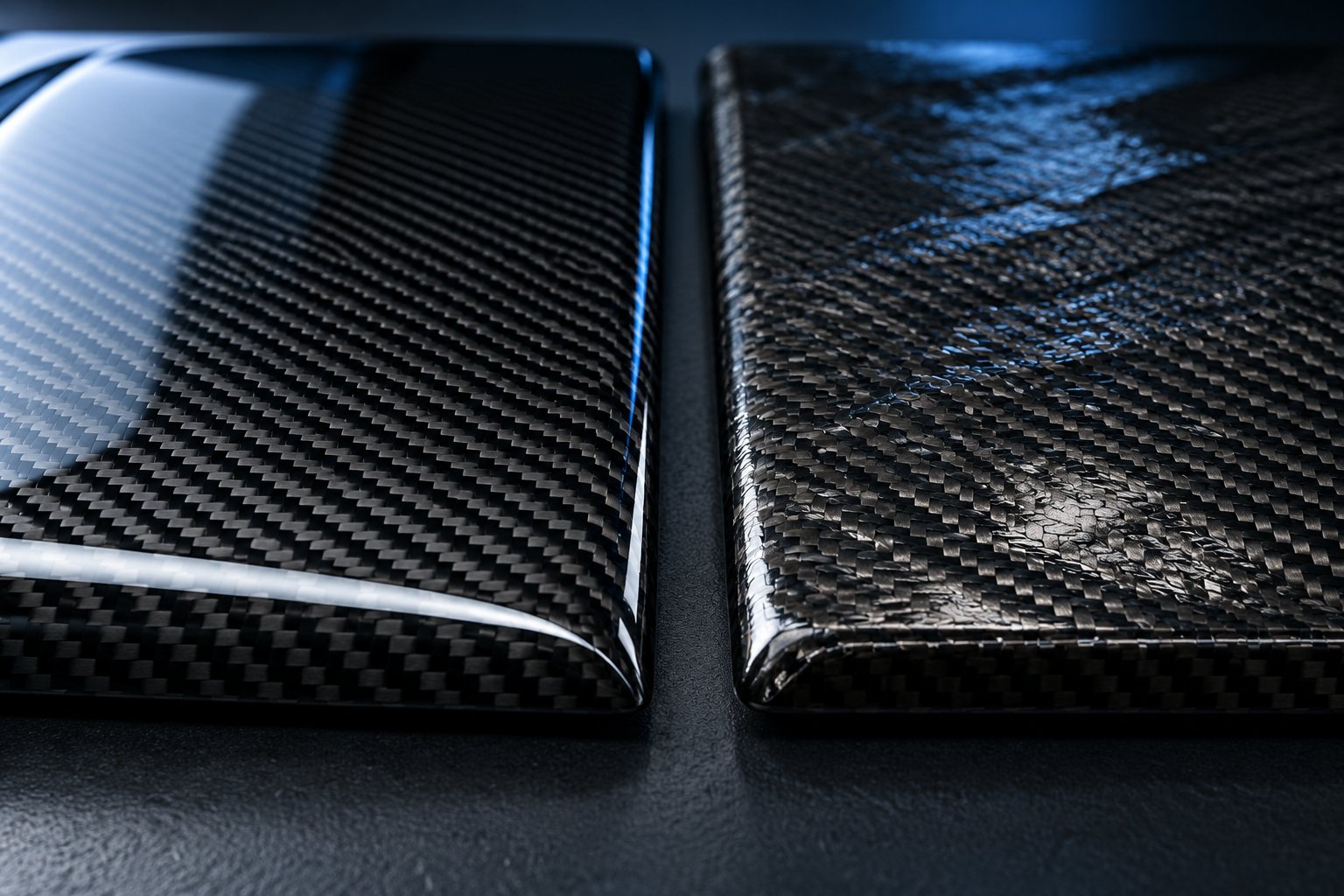
The Carbon Fiber Debate Every Enthusiast Gets Wrong
You are shopping for a carbon fiber spoiler, mirror cap, or hood — and two listings pop up. One says "wet carbon fiber." The other says "dry carbon fiber" and costs twice as much. Both look nearly identical in the product photos. So what actually separates them, and is the premium worth it?
If you have ever asked that question, you are not alone. The terms "dry carbon" and "wet carbon" get tossed around constantly in the aftermarket world, often with zero explanation of what they really mean. Sellers slap these labels on product pages like badges of honor, and buyers end up either overpaying for a process they do not need or settling for a part that will not hold up where it counts.
Here is the short version. Wet carbon fiber refers to a hand-laid composite where dry woven fabric is placed into a mold and saturated with liquid resin — typically epoxy or polyester — then cured at room temperature or low heat. Dry carbon fiber, on the other hand, starts as pre-impregnated sheets (called pre-preg) that already contain a precisely measured amount of resin. These sheets are vacuum-bagged and cured inside an autoclave under high temperature and pressure, producing a lighter, stronger laminate.
Why the Wet vs Dry Debate Matters More Than You Think
The difference between dry carbon vs wet carbon is not just a technicality — it ripples into weight, strength, surface finish, cost, durability, and even how easy a part is to repair years down the road. Misunderstanding these distinctions leads to real-world consequences: spending $800 on a dry carbon fiber trim piece that delivers zero performance benefit over a $300 wet alternative, or choosing a cheap wet layup part for a track car where structural integrity genuinely matters.
Who This Guide Is For
Whether you are a Tesla owner evaluating a set of carbon accessories, a weekend racer chasing tenths of a second, or a hobbyist laying up your first mold in the garage, this guide covers every angle. We ranked the six most important differences between these two composites based on real-world impact — not marketing jargon — so you can match the right material to your actual goals and budget.
Most buyers overpay for dry carbon or undervalue wet carbon because they lack context on what each manufacturing process actually delivers. Understanding six key differences changes that entirely.
Each section ahead breaks down one critical distinction, scored against practical buyer scenarios rather than abstract lab specs. No myths, no fluff — just the information you need to spend smarter on your next carbon fiber upgrade.
How We Ranked These Differences
Not every carbon fiber buyer cares about the same things. A track driver shaving grams off a hood has completely different priorities than a Tesla owner upgrading interior trim for a cleaner look. Treating dry vs wet carbon fiber as a one-size-fits-all comparison misses the point entirely — and it is exactly why so many guides leave readers more confused than when they started.
Instead of declaring one type universally "better," we evaluated each of the six differences through the lens of four distinct buyer profiles. Every ranking in this guide reflects real-world impact for real people, not abstract technical superiority that only matters inside a materials science lab.
Four Buyer Profiles That Shape Our Rankings
Think about which of these sounds most like you. Your profile determines which differences matter most — and which ones you can safely deprioritize when comparing dry carbon fiber vs wet carbon fiber options.
- Track Enthusiast — Prioritizes measurable weight savings and structural performance on aero components, hoods, and body panels where every gram compounds into lap time gains.
- Show Car Builder — Focused on surface finish, weave consistency, and visual depth; wants parts that look flawless under show lighting and close inspection.
- Daily Driver — Balancing cost, durability, and appearance for street-use accessories like mirror caps, spoilers, and interior trim where extreme performance specs are unnecessary.
- Industrial or Aerospace Buyer — Needs verified structural integrity, repeatable manufacturing tolerances, and documented material properties for safety-critical or load-bearing applications.
You might overlap between two profiles, and that is perfectly normal. A weekend racer who also wants the car looking sharp at Cars and Coffee falls somewhere between the first two. The key is knowing which priorities drive your purchasing decision so you can weigh each difference accordingly.
What We Evaluated and Why
Each of the six differences ahead is scored against these profiles using criteria rooted in established composite engineering principles — things like autoclave pressures, resin systems, fiber-to-resin ratios, and cure cycle parameters — rather than the vague marketing language you will find on most product pages. When a manufacturer claims their dry carbon fiber vs wet alternative is "stronger" or "lighter," those words mean nothing without context. We provide that context.
Here are the six evaluation criteria we applied consistently across every section:
- Weight Reduction — How much lighter is the finished part, and does that difference actually matter for the intended use?
- Visual Finish — Weave clarity, surface uniformity, edge quality, and overall cosmetic appeal under real lighting conditions.
- Structural Performance — Tensile strength, stiffness, and reliability under mechanical stress or repeated thermal cycling.
- Cost Efficiency — Not just sticker price, but value relative to what each process delivers for a specific application.
- Long-Term Durability — UV resistance, resistance to yellowing, and how well the part holds up over years of ownership.
- Manufacturing Accessibility — How widely available each process is, and whether production scale affects quality consistency.
These six criteria map directly to the six ranked differences you will find in the sections ahead. The goal is simple: by the time you finish reading, you will know exactly which type of carbon fiber earns your money based on how you actually plan to use it — not based on which product listing had the most impressive-sounding description.

#1 Manufacturing Process Is Where Everything Diverges
Every difference you will read about in the sections ahead — weight, strength, finish, cost, durability — traces back to one fork in the road: how the part is actually made. The manufacturing process is not just a technical footnote. It is the single decision that determines what a carbon fiber part can and cannot do. Understanding wet vs dry carbon fiber starts here, and if you get this part right, every other distinction clicks into place.
Think of it like cooking. Two chefs can use the same cut of steak, but one grills it over an open flame while the other uses a precision sous vide setup. Same raw material, radically different outcomes in texture, consistency, and flavor. Carbon fiber composites work the same way — the fiber itself is identical, but the method of combining it with resin creates two fundamentally different products.
Wet Layup Step by Step
Wet carbon fiber gets its name from the hands-on, resin-heavy process used to create it. Here is what actually happens when a manufacturer produces a wet layup part:
- Mold preparation — A rigid mold (typically fiberglass or machined aluminum) is cleaned and coated with a release agent so the finished part does not bond permanently to the mold surface.
- Dry fabric placement — Sheets of dry woven carbon fiber fabric are cut to shape and carefully laid into the mold by hand. The technician positions each ply to follow the contours, overlapping layers as needed for structural requirements.
- Resin application — Liquid resin, usually a two-part epoxy or polyester system, is mixed and applied directly onto the fabric. This is done by brush, roller, or squeegee. The technician works the resin into the weave, saturating each layer thoroughly. Some higher-end shops use vacuum infusion instead, which pulls resin through the fabric under negative pressure for more even distribution.
- Consolidation — Additional plies are stacked and wetted until the desired laminate thickness is reached. In basic setups, a roller is used to press out trapped air. Vacuum bagging can also be applied at this stage to improve compaction.
- Curing — The saturated layup cures at room temperature over several hours, or in a low-temperature oven (typically below 100°C) to accelerate the process. No autoclave is involved.
- Demolding and finishing — Once cured, the part is removed from the mold, trimmed, and finished with clear coat or paint as needed.
The critical variable in wet layup is the technician. Resin distribution depends entirely on human skill and judgment. Too much resin creates heavy, resin-rich areas. Too little leaves dry spots that become structural weak points. Even experienced hands produce some variation between parts, which is why wet carbon consistency can range dramatically depending on the shop producing it.
Vacuum infusion narrows that gap significantly by letting physics — rather than a brush — control resin flow. But even with infusion, the process cannot match the precision of pre-impregnated materials because the resin-to-fiber ratio is never fixed before layup begins.
Dry Pre-Preg and Autoclave Curing Explained
Dry carbon fiber follows a completely different philosophy: control every variable before the part ever enters the mold. The term "dry" is actually a bit misleading — the carbon sheets used in this process already contain resin. They are called pre-preg (short for pre-impregnated), and the resin is infused into the fabric at the factory under tightly controlled conditions, giving each sheet a precise, uniform fiber-to-resin ratio.
Here is how the process unfolds:
- Material storage — Pre-preg sheets arrive from the supplier with a limited shelf life. Because the resin is already catalyzed, the material must be stored in industrial freezers (typically around -18°C) to prevent premature curing. Once removed, the clock starts ticking — most pre-preg systems have a limited out-time before they become unusable.
- Cutting and layup — Sheets are cut to precise patterns, often using CNC cutting machines for repeatability. Technicians lay the pre-preg plies into precision-machined molds, following engineered ply schedules that dictate fiber orientation, overlap zones, and stacking sequence.
- Vacuum bagging — The entire mold assembly is sealed inside a vacuum bag. Breather fabrics and release films are layered strategically to allow air and excess resin to escape during the cure cycle.
- Autoclave curing — This is where dry carbon separates itself from everything else. The bagged mold enters an autoclave — essentially a pressurized oven — where it is subjected to elevated temperature and high pressure simultaneously. Industrial autoclaves commonly operate at pressures of 6 to 8 bar (roughly 87 to 116 psi), with cure temperatures typically ranging from 120°C to 180°C depending on the resin system. This combination compresses the laminate, forces out virtually all trapped air, and consolidates the fiber and resin into an extremely dense, void-free composite.
- Controlled cool-down and demolding — The autoclave follows a programmed cool-down ramp to prevent thermal shock. The finished part is then demolded, trimmed, and inspected.
The difference in compaction pressure alone is staggering. A wet layup part cured under vacuum sees roughly 1 bar of pressure. An autoclave-cured dry carbon part experiences 6 to 8 times that force. The result is a laminate with virtually zero air voids — a quality benchmark that manufacturers who lack autoclave equipment simply cannot replicate, even when using pre-preg material in an oven-only setup. Those trapped micro-voids are not just cosmetic flaws; they become stress concentration points that reduce both strength and fatigue life under load.
This level of process control is why dry carbon commands a premium. Autoclaves themselves can cost upward of €500,000, pre-preg material is more expensive than dry fabric and bulk resin, and the freezer storage, limited shelf life, and longer cure cycles all add overhead that gets passed along to the buyer.
Environmental Considerations Most Articles Ignore
Manufacturing method matters beyond just part performance — it also carries real environmental consequences that rarely get discussed in buyer-focused guides.
Wet layup generates its share of waste. Excess mixed resin that does not make it into the part must be disposed of as hazardous waste. Epoxy and polyester resins release volatile organic compounds (VOCs) during the open-air application and curing process, posing both workplace health risks and atmospheric emissions. Cleanup solvents like acetone add to the chemical footprint. In small shops without proper ventilation and waste handling, the environmental impact per part can be surprisingly high.
Dry carbon manufacturing is cleaner at the point of production — the pre-preg material is sealed and generates far fewer airborne VOCs during layup. But the process carries its own environmental costs. Pre-preg offcuts (the material trimmed away during cutting) contain catalyzed resin and cannot be reused or easily recycled. Freezer storage demands constant energy. And the autoclave itself is energy-intensive: a life cycle assessment published in Polymers found that energy consumption during carbon fiber manufacturing accounts for roughly 59% of its total climate change impact, with the overall carbon footprint ranging from 13.0 to 34.1 kg CO2 equivalent per kilogram of fiber depending on location, energy source, and plant efficiency. Thermal processing stages — stabilization at 200 to 300°C and carbonization at temperatures reaching 1500 to 1800°C — are the primary energy drivers.
Neither process is environmentally innocent. Wet layup produces more localized chemical waste; autoclave curing demands more energy at scale. For buyers who factor sustainability into purchasing decisions, the honest answer is that both methods have room to improve — and the manufacturing location and energy source matter just as much as the process itself.
| Process Factor | Wet Layup | Dry Pre-Preg / Autoclave |
|---|---|---|
| Resin application method | Manual brush, roller, or vacuum infusion | Factory pre-impregnated into fabric |
| Cure pressure | ~1 bar (vacuum only) | 6–8 bar (autoclave) |
| Cure temperature | Room temp to ~100°C | 120°C–180°C (typical) |
| Resin-to-fiber control | Variable; operator-dependent | Precisely engineered at factory |
| Air void content | Higher; skill-dependent | Near zero |
| Primary waste concern | Excess resin, VOCs, solvents | Pre-preg offcuts, energy consumption |
| Equipment investment | Low (basic molds, vacuum pump) | High (autoclave, freezers, CNC cutting) |
This manufacturing divergence is the root cause of every performance and quality difference buyers encounter. The fiber-to-resin ratio that the autoclave locks in — versus the variable ratio that wet layup produces — directly determines how much a part weighs, how strong it is, and how it looks under close inspection. Those measurable outcomes are exactly where the next distinction picks up.
#2 Weight and Structural Strength Are Not Equal
That fiber-to-resin ratio the autoclave locks in is not just a manufacturing metric — it is the single biggest factor controlling how much a finished part weighs and how much load it can handle. When buyers compare wet carbon vs dry carbon on a spec sheet, weight and strength are usually the first numbers they look for. And for good reason: these two properties determine whether a carbon fiber upgrade is a genuine performance gain or just a cosmetic swap.
But here is where the conversation gets oversimplified. Too many buyers assume dry automatically means "strong" and wet automatically means "heavy." The reality is more nuanced, and understanding what is dry carbon fiber actually delivering — versus what it is delivering for your specific use case — saves both money and disappointment.
Fiber-to-Resin Ratio and Why It Defines Performance
Imagine two sponges. One is mostly sponge material with a thin coating of water. The other is half water, half sponge. Which one is lighter and more structurally rigid? The answer is obvious — and the same logic applies to carbon fiber composites.
Carbon fibers themselves provide virtually all the strength and stiffness in a composite part. Resin is the glue that holds those fibers in position, transferring loads between them and protecting them from environmental damage. But resin is heavy relative to its structural contribution. The more resin a part carries beyond what is needed to bind the fibers, the heavier it gets without a proportional increase in strength.
Dry carbon fiber, cured under autoclave pressure, typically achieves fiber volume fractions in the range of 60 to 70%. Wet layup composites generally land between 50 and 60%, depending on technician skill and whether vacuum assistance was used. That gap may sound modest as a percentage, but the practical outcome is significant: dry carbon parts can be 20 to 40% lighter than equivalent wet carbon components of the same size and geometry.
The strength side of the equation follows the same logic. Higher fiber content per unit volume means more load-bearing material in every square centimeter. This translates to better tensile strength per gram, higher stiffness, and improved fatigue resistance under repeated stress cycles. For a carbon fiber strength comparison, the advantage is not that dry carbon uses some exotic super-fiber — it uses the same carbon filaments. It simply packs more of them into less space with less dead weight from excess resin.
When Weight Savings Actually Matter and When They Do Not
Here is the part most marketing copy conveniently skips over: dry carbon fiber weight savings only matter when the application demands it.
For the track enthusiast, every gram counts — and the gains compound. Replace a stock fiberglass hood with a dry carbon alternative and you might shed 5 to 8 kg. Swap the fenders, trunk lid, and aero components, and those savings start stacking into double-digit kilograms across the entire vehicle. Less unsprung and rotating mass means quicker acceleration, sharper turn-in, and shorter braking distances. In competitive environments where tenths of a second separate podium finishes, that difference is measurable and meaningful.
For the daily driver eyeing a set of carbon mirror caps or a decorative interior trim kit? The math tells a very different story. A wet carbon mirror cap might weigh 15 to 30 grams more than its dry counterpart. On a 1,800 kg sedan, that difference is statistically invisible — you would gain more by skipping your morning coffee before the drive. Paying a 100% premium for dry carbon fiber on non-structural trim pieces delivers zero tangible performance benefit in street applications.
This is also where a persistent myth needs to die: wet carbon is not structurally weak. A properly manufactured wet layup part — especially one produced with vacuum infusion and quality epoxy resin — comfortably exceeds the mechanical demands of street driving, daily commuting, and even spirited weekend canyon runs. The forces acting on a mirror cap, spoiler lip, or dashboard trim piece are a fraction of what either composite type can handle. Wet carbon only falls short when you push into the extreme end of the performance spectrum, where the absolute lightest, stiffest laminate is the engineering requirement rather than a nice-to-have.
| Performance Metric | Dry Carbon Fiber | Wet Carbon Fiber |
|---|---|---|
| Fiber-to-Resin Ratio (by volume) | Superior (60–70% fiber) | Good (50–60% fiber) |
| Weight (relative) | Superior — 20 to 40% lighter than wet equivalent | Adequate — heavier due to higher resin content |
| Tensile Strength per Gram | Superior — more fiber per unit volume | Good — more than sufficient for street use |
| Stiffness | Superior | Good |
| Fatigue Resistance | Superior — fewer voids, tighter laminate | Good — dependent on layup quality |
| Real-World Relevance (street trim) | Marginal benefit | Fully adequate |
| Real-World Relevance (track/aero) | Significant, measurable gains | Acceptable for amateur-level track use |
The bottom line is straightforward. If your build demands absolute weight minimization on structural and aerodynamic components — think race car hoods, wings, and diffusers — dry carbon justifies itself through compounding performance gains. If you are upgrading cosmetic or lightly loaded parts on a street vehicle, a quality wet carbon piece delivers the look and more-than-adequate strength at a fraction of the cost. Knowing which scenario you actually fall into is what separates a smart purchase from an expensive one.
Weight and strength tell you what a part can do. But they do not tell you what a part looks like up close — and that distinction carries its own set of surprises, especially once you understand how weave patterns interact with each manufacturing method.
#3 Surface Finish and Weave Patterns Tell the Real Story
Pick up two carbon fiber spoilers that look identical in photos, hold them side by side in natural light, and the differences jump out immediately. One has a deep, glassy surface where every strand of the weave is crisp and evenly spaced. The other looks decent from a distance but reveals micro-bubbles, slight waviness, or areas where resin has pooled and blurred the weave underneath. That visual gap is not random — it is a direct consequence of how each part was manufactured, and it is one of the easiest ways to judge what you are actually getting for your money.
Surface finish and weave clarity represent the third most impactful difference in the carbon fiber surface finish comparison between dry and wet processes. And unlike weight or tensile strength, this is something every buyer can evaluate with their own eyes — no lab equipment required.
How Weave Patterns Interact With Each Manufacturing Method
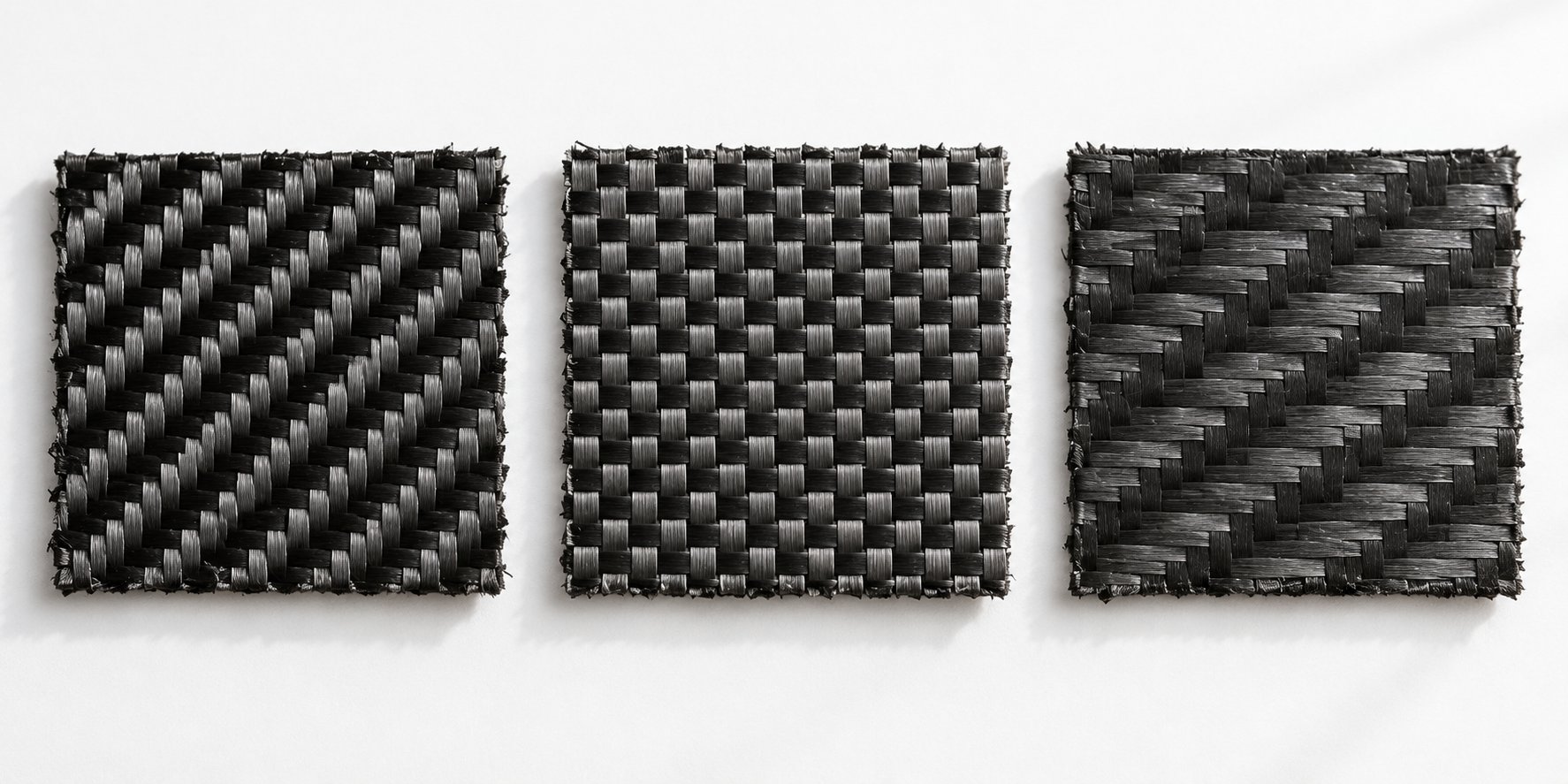
Before you can assess finish quality, you need to understand what you are looking at. Carbon fiber fabric comes in distinct weave patterns, and each one behaves differently depending on whether it goes through a wet layup or a dry pre-preg process. The three carbon fiber weave pattern types you will encounter most often are twill, plain, and satin — and your choice of weave influences both the look and the performance of the finished part.
2x2 Twill Weave is the pattern most people picture when they think of carbon fiber. It creates a distinctive diagonal ribbed texture where each tow passes over two and under two perpendicular tows. This is by far the most popular weave for automotive accessories because it strikes a balance between visual appeal and moderate drapeability — meaning it can conform to gently curved surfaces without excessive wrinkling. In dry pre-preg layup, twill weave produces an exceptionally clean, uniform diagonal pattern because the factory-controlled resin content keeps every tow saturated evenly. In wet layup, twill can still look excellent, but the hand-applied resin tends to settle unevenly in the valleys between tows, sometimes creating subtle glossy spots or slight distortion in the pattern's regularity.
Plain Weave follows a simple over-one, under-one interlacing pattern that creates a tight checkerboard grid. It offers the highest stability of the three common patterns — fibers lock against each other firmly, resisting shifting and distortion during layup. That stability makes plain weave a solid choice for flat or mildly contoured parts. The tradeoff is lower drapeability; it resists conforming to compound curves, so manufacturers working with complex geometries tend to avoid it. Visually, plain weave looks more utilitarian and less "exotic" than twill, which is why it shows up less often on cosmetic automotive parts despite its structural advantages.
Satin Weave (typically 4-harness or 8-harness) floats the weft yarn over multiple warp yarns before interlacing, producing a smoother, almost silky surface. Satin weave drapes beautifully over tight compound curves — think deeply sculpted aero components or parts with aggressive contours — making it the preferred choice when geometry demands flexibility. The visual result is a subtler, less pronounced pattern compared to twill. Satin weave is less common in the aftermarket world but appears regularly in aerospace and high-end motorsport applications.
Here is the key insight most guides miss: the weave pattern alone does not determine dry carbon fiber finish quality. The interaction between weave pattern and manufacturing method is what defines the final appearance. A 2x2 twill fabric processed through autoclave curing will look noticeably crisper than the same fabric processed through a mediocre wet layup — because precise resin distribution prevents the pooling, bubbling, and saturation inconsistencies that muddy the weave's visual clarity. Conversely, a skilled wet layup technician using vacuum infusion can produce a twill part that rivals dry carbon cosmetically, especially after professional clear coating and polishing.
How to Spot Wet vs Dry Carbon on Real Parts
So how do you tell dry carbon from wet carbon when the product is already in your hands? Forget the marketing labels for a moment. Physical inspection reveals more than any product listing ever will, and you do not need any special tools to do it. Here is a practical checklist:
- Back-side texture — Flip the part over and examine the interior surface. Dry carbon backs are typically smooth and uniform, with a consistent texture across the entire panel. Wet layup backs often show a rougher finish — you may see fabric imprint, uneven resin texture, or areas where excess resin pooled and hardened into ridges. This is one of the most reliable visual tells because manufacturers rarely bother finishing the back side cosmetically.
- Edge quality — Look closely at cut edges and trim lines. Dry carbon edges tend to be clean, precise, and uniform in thickness. Wet carbon edges may reveal resin buildup, slight thickness variation, or a less refined cut profile where excess resin made the laminate thicker than intended in some spots.
- Weave consistency — Hold the part at an angle under direct light and scan across the surface. On a well-made dry carbon part, the weave pattern appears tight and consistent from corner to corner — no areas where tows look pinched, spread apart, or obscured by resin. On lower-quality wet layup parts, you may spot sections where the weave appears slightly distorted, blurred, or where resin-rich zones create a "wet" glossy spot that differs from the surrounding surface.
- Surface uniformity — Run your fingertips across the clear-coated surface. Premium parts feel perfectly flat with no subtle bumps, depressions, or orange-peel texture. Micro-bubbles trapped during wet layup sometimes create barely perceptible bumps beneath the clear coat that you can feel even if you cannot see them at a glance.
None of these tells are absolute — a top-tier wet layup shop can produce parts that pass every one of these checks. The differences become most obvious when you compare budget-tier wet carbon against mid-range or better dry carbon. That is where the gap in process control becomes visually unmistakable.
It is also worth noting that resin quality itself plays a role independent of process. A wet layup using premium automotive-grade epoxy will produce a clearer, more durable finish than one using budget polyester resin — even if the layup technique is identical. Similarly, the clear coat applied over the cured laminate has an outsized effect on perceived quality. A mediocre clear coat will yellow, orange-peel, or cloud over time regardless of whether the carbon underneath is wet or dry.
What Premium Finish Quality Looks Like in Practice
Reading about weave clarity and surface uniformity is useful, but seeing it on an actual product cements the concept. When evaluating aftermarket carbon fiber accessories — especially for vehicles like the Tesla Model 3, Model Y, or Model S where interior and exterior trim pieces sit at eye level and catch direct light daily — finish quality becomes the difference between an upgrade that elevates the cabin and one that looks like an afterthought.
Premium finish quality means the weave pattern is visible and consistent across every surface of the part, with no resin-rich dead spots obscuring the carbon underneath. Edges are trimmed cleanly, corners follow the contours of the original vehicle panel precisely, and the clear coat is deep enough to protect against UV degradation without being so thick that it hides the texture of the weave. The part should look like it belongs on the vehicle — not like something bolted on top of it.
For Tesla owners specifically, CUTIM's carbon fiber accessories offer a useful real-world benchmark for what this standard looks like in practice. Their collection of interior and exterior carbon fiber upgrades for Tesla vehicles demonstrates the kind of consistent weave visibility, tight edge finishing, and surface depth that separates thoughtfully manufactured parts from generic alternatives. When you are shopping and comparing options side by side, having a reference point for premium finish quality makes it far easier to identify which sellers are delivering genuine craftsmanship and which are relying on flattering photography to mask inconsistencies.
The visual difference between good and great carbon fiber is something you notice every time you walk up to the car or glance at the dashboard. And unlike weight savings that only matter on a track, finish quality matters every single day — which is exactly why this distinction ranks so high on our list regardless of buyer persona.
Still, even the most visually stunning part has to make financial sense. And the gap between what dry and wet carbon cost — versus what each actually delivers for different use cases — is where many buyers make their most expensive miscalculation.
#4 Cost and Value Are Not the Same Thing
A dry carbon fiber hood for a sports car might run $3,000 to $5,000. A comparable wet carbon version of the same hood? Often $1,000 to $2,000. That kind of price gap makes buyers assume the expensive option must be dramatically superior in every way. But the dry carbon fiber cost vs wet carbon equation is not that simple — and treating price as a proxy for quality leads to some of the most expensive mistakes in the aftermarket world.
Cost tells you what a manufacturer spent to produce the part. Value tells you what you actually get for your specific use case. Understanding why is dry carbon fiber expensive — and whether that expense translates into benefits you will actually use — is what separates a smart upgrade from an overpriced one.
Why Dry Carbon Costs More and Whether the Premium Is Justified
The price difference is not marketing inflation. It reflects a genuinely more expensive manufacturing chain at every stage. Consider what a dry carbon producer pays before a single part ships:
- Pre-preg material — Factory-impregnated carbon fiber sheets cost significantly more than dry woven fabric and bulk liquid resin purchased separately. The controlled resin application and quality certification built into pre-preg drive the raw material price up substantially.
- Freezer storage — Pre-preg has a limited shelf life and must be stored in industrial freezers at approximately -18°C. That means dedicated cold storage infrastructure running continuously, adding overhead whether parts are being produced or not.
- Autoclave equipment — A production-grade autoclave capable of sustaining 6 to 8 bar at temperatures up to 180°C represents a capital investment that can exceed half a million dollars. The energy cost of each cure cycle adds further per-part expense.
- Precision tooling — Dry carbon molds need to withstand autoclave conditions, so they are typically machined from metal or high-temperature composite rather than basic fiberglass. These molds cost more to produce and maintain.
- Longer production cycles — Between freezer retrieval, meticulous ply layup, vacuum bagging, multi-hour autoclave cure cycles, and controlled cool-down ramps, dry carbon parts take considerably longer to manufacture than wet layup equivalents.
All of those costs compound. Industry estimates suggest dry carbon parts typically carry a 40 to 60% price premium over wet carbon — and for complex or low-volume components, the gap can be even wider.
Wet layup, by contrast, requires far less infrastructure. A quality mold, vacuum pump, carbon fabric, and epoxy resin are the core investments. No freezers, no autoclave, no six-figure equipment purchases. The process also scales more flexibly — a small shop can produce wet carbon parts with modest tooling, while dry carbon production demands purpose-built facilities. That accessibility is directly reflected in the wet carbon fiber price comparison: lower barriers to entry mean more manufacturers competing, which keeps prices down for the end buyer.
The Value Sweet Spot Most Buyers Miss
Here is where the carbon fiber parts cost difference gets interesting. Price and value diverge sharply depending on what you are actually buying the part for.
For the show car builder focused on cosmetic impact, a well-made wet carbon part often delivers better overall value. When the goal is a stunning weave pattern visible under show lighting — and the component bears no structural load beyond sitting on a fender or wrapping a mirror — paying double for autoclave-cured laminate buys weight savings that are literally undetectable on a car that never sees a track. The money saved on wet carbon can go toward professional installation, paint protection film, or additional pieces that broaden the visual transformation.
For the daily driver upgrading a Tesla or similar vehicle with carbon trim, the calculus is similar. A spoiler lip, dashboard overlay, or side mirror cap does not need aerospace fiber-to-resin ratios. It needs to look sharp, fit properly, and resist UV degradation over years of sun exposure. Quality wet carbon achieves all three — and the leftover budget from choosing wet over dry might cover an entire additional set of accessories.
For the track enthusiast, the math flips. On structural and aerodynamic components where grams compound into measurable lap time gains — hoods, wings, diffusers, and splitters — dry carbon earns its premium. The lighter, stiffer laminate delivers real performance returns, and cutting corners on these parts can mean the difference between a component that survives a race weekend and one that flexes, fatigues, or fails under load.
One myth needs to be retired permanently: higher price does not automatically equal better quality. A well-made wet carbon part from a reputable manufacturer — using premium epoxy, vacuum infusion, and proper clear coating — will outperform a poorly made dry carbon piece produced in a facility cutting corners on cure cycles or using degraded pre-preg material past its shelf life. Process matters, but execution within that process matters just as much.
Resale value adds another layer to this conversation. In the enthusiast market, genuine dry carbon commands higher resale prices — particularly on performance vehicles where buyers know to ask about construction methods. But this premium only materializes among informed buyers. For mainstream resale, most used-car shoppers cannot distinguish dry from wet, which means the resale bump is concentrated in niche communities rather than the broader market.
| Factor | Dry Carbon Fiber | Wet Carbon Fiber |
|---|---|---|
| Typical price premium | 40–60% higher (or more for complex parts) | Baseline — lower material and equipment costs |
| Best value for track/aero use | Strong — weight and stiffness gains justify cost | Acceptable for amateur-level track use |
| Best value for show/cosmetic use | Diminishing returns — visual difference is subtle | Excellent — premium look at a fraction of the price |
| Best value for daily driver trim | Low — weight savings are imperceptible on street parts | Strong — delivers the look and durability needed |
| Manufacturing scalability | Limited by autoclave capacity and material shelf life | Highly scalable with modest tooling |
| Resale value impact | Higher among informed enthusiast buyers | Neutral — most buyers cannot distinguish |
The real takeaway is that the smartest carbon fiber purchase is not always the most expensive one. It is the one where cost aligns with what you actually demand from the part. Overspending on dry carbon for cosmetic trim is just as wasteful as underspending on wet carbon for a load-bearing aero component. Match the process to the purpose, and you land in the value sweet spot every time.
Of course, the purchase decision does not end when the part arrives. How each type of carbon fiber holds up over years of sun exposure, temperature swings, and the occasional parking lot mishap introduces an entirely different set of trade-offs that most buyers never think about until it is too late.
#5 Durability and Repairability After Years of Real Use
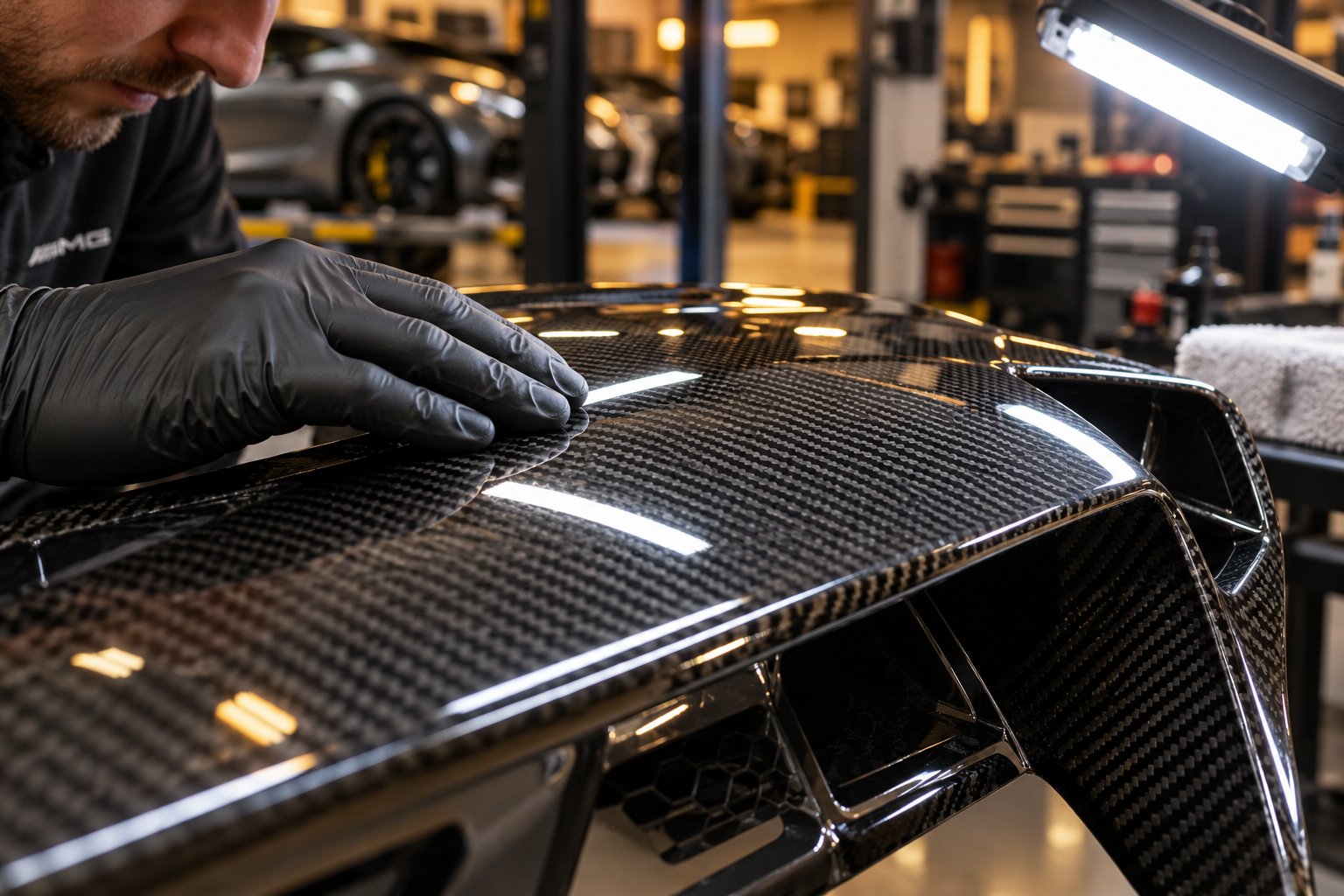
A carbon fiber spoiler looks stunning the day you bolt it on. But what does it look like after three summers of UV exposure, two winters of road salt spray, and that one careless door ding in a grocery store parking lot? Carbon fiber durability wet vs dry is one of the least discussed — and most consequential — differences buyers face, because it determines whether your upgrade still looks premium in year five or quietly degrades into something you wish you had protected better from the start.
Most buying guides end the conversation at weight, strength, and cost. Real ownership, though, introduces variables that no spec sheet covers: ultraviolet radiation, thermal cycling, stone chips, chemical exposure, and the inevitable question of whether a damaged part can be repaired or needs to be replaced entirely. The answers differ more than you might expect depending on which process created your part.
UV Degradation and Yellowing Over Time
Here is something that surprises a lot of first-time carbon fiber owners: the carbon fibers themselves are essentially immune to UV damage. Those black filaments will not fade, weaken, or degrade from sunlight exposure alone. The problem is everything around them — specifically the resin matrix and the clear coat that protect and bind the composite together.
Ultraviolet radiation attacks polymer chains in both epoxy and polyester resins, breaking molecular bonds over time. The visible result? Yellowing, cloudiness, chalking, and eventually surface cracking that exposes the bare weave beneath. Once the resin layer starts degrading, moisture can wick into the laminate along fiber pathways, accelerating delamination from the inside out.
Both wet and dry carbon fiber parts are vulnerable to this process. However, the rate and severity of UV degradation vary based on two factors that align closely with manufacturing method:
Resin system quality. Autoclave-cured dry carbon almost always uses aerospace-grade epoxy systems engineered for environmental resistance. These resins are formulated with UV stabilizers and exhibit superior long-term chemical stability. Wet layup parts, on the other hand, span a much wider quality range. Premium shops use automotive-grade epoxies that perform comparably. Budget manufacturers sometimes use polyester or vinylester resins that yellow noticeably faster — sometimes within a single season of direct sun exposure. If a wet carbon part you are considering seems unusually cheap, the resin system is often where corners were cut.
Resin volume and exposure area. Wet layup parts carry more resin relative to fiber content. That thicker resin layer means there is simply more polymer material exposed to UV attack. In a high-quality wet layup with proper clear coating, this barely matters in practice. But on a part with a thin or poorly applied clear coat, the extra resin surface area accelerates visible yellowing and finish deterioration. Dry carbon's thinner resin layer — a byproduct of that higher fiber-to-resin ratio — gives UV less material to degrade, which can translate to slightly better long-term appearance retention under equivalent conditions.
The single most important variable, though, is neither wet nor dry — it is the clear coat. A high-quality UV-protective clear coat acts as the primary shield for every carbon fiber part regardless of construction method. Skip it or cheap out on it, and even the finest autoclave-cured dry carbon will yellow and deteriorate. Invest in proper UV protection, and even a budget wet layup part can maintain its appearance for years. Think of the clear coat as sunscreen for your carbon — the underlying skin tone matters less than whether you actually applied protection.
Repair Reality for Chips, Cracks, and Structural Damage
Imagine a small rock kicked up on the highway catches the leading edge of your carbon fiber splitter. Or a parking bollard leaves a hairline crack across the corner of a side skirt. What happens next depends heavily on whether you are dealing with dry carbon fiber repair vs wet carbon — and the answer is not always what you would expect.
Cosmetic chips and minor surface damage. This is where wet carbon actually holds a quiet advantage. That thicker resin layer acts as a buffer zone. A stone chip that only penetrates the clear coat and outer resin — without reaching the carbon fiber fabric underneath — can often be repaired with careful sanding, resin fill, and re-clear-coating. The surplus resin gives a technician room to blend new material into old without exposing or disturbing the weave.
Dry carbon's tighter laminate leaves less margin. Because the resin layer is thinner and the fibers sit closer to the surface, even a moderate chip can expose the actual carbon weave. Repairing that invisibly requires more skill and precision — there is less "room" to feather new resin into the existing surface without creating a visible patch or altering the weave appearance. The repair is absolutely possible, but the cosmetic result is harder to make seamless.
Cracks and delamination. A visible crack in any carbon fiber part — wet or dry — demands closer inspection than most owners realize. As composite repair specialists note, a white line or hairline crack may look superficial while hiding separated layers or broken fibers underneath. Surface appearance alone does not reliably indicate the depth of the damage. What looks like a clear-coat scratch could be resin fracture, delamination between plies, or even broken reinforcement fibers beneath an otherwise intact surface.
For structural damage, both types require professional composite repair. The process typically involves removing damaged material, tapering the laminate, adding reinforcement with matched fiber orientation, and curing under controlled conditions. Simply filling a crack with epoxy or bonding a decorative patch over the surface does not restore the original load path. This applies equally to wet and dry parts — there are no DIY shortcuts for genuine structural repair on load-bearing components like hoods, splitters, or wing mounts.
Thermal cycling. One long-term durability factor that rarely gets mentioned is how each type handles repeated temperature swings. Autoclave-cured dry carbon was consolidated under high heat and pressure, so the resin matrix has already been "stress-tested" at temperatures well above what a vehicle encounters on the road. This gives dry carbon superior dimensional stability through hot summers and freezing winters — the part is less likely to develop micro-cracks from thermal expansion and contraction cycles over the years.
Wet layup parts cured at room temperature or in low-heat ovens have a lower glass transition temperature — the threshold at which the resin begins to soften and lose rigidity. For parts mounted near engine bays, exhaust systems, or in direct sun on dark-colored vehicles, this can matter. A room-temperature-cured wet carbon part in a high-heat environment may slowly develop stress marks or minor warping that an autoclave-cured equivalent would shrug off without issue.
Practical Ownership Tips for Both Types
Regardless of whether you invested in dry or wet carbon, the daily care routine is virtually identical — and skipping it is the fastest way to turn a premium upgrade into a faded, damaged eyesore. Here is how to maintain carbon fiber parts for long-term performance and appearance:
- UV-protective clear coat is non-negotiable — If your part did not come with a factory-applied UV clear coat, have one applied professionally before installation. Reapply or inspect every two to three years depending on climate and sun exposure.
- Wash gently and frequently — Use pH-neutral automotive soap and soft microfiber mitts. Avoid automatic car washes with abrasive brushes that can micro-scratch clear coat and eventually expose the laminate beneath.
- Avoid harsh chemicals — Brake dust cleaners, wheel acid, tar removers, and strong degreasers can attack both clear coat and resin. If these products must be used near carbon parts, mask or protect the composite surfaces first.
- Apply ceramic coating or paint protection film — A ceramic coating adds a sacrificial UV-resistant layer that also makes cleaning easier. For high-exposure parts like front splitters or hood scoops, paint protection film (PPF) provides a physical barrier against stone chips and abrasion.
- Inspect mounting points regularly — Check fasteners, adhesive bonds, and mounting brackets for signs of stress, loosening, or cracking. White halos around bolt holes are an early warning of concentrated resin stress that should be addressed before it worsens.
- Store vehicles out of direct sun when possible — Garaged vehicles preserve carbon fiber finish dramatically longer than daily outdoor parking. If a garage is not an option, a quality car cover with soft lining protects against both UV and physical contact damage.
- Do not ignore new rattles or vibration — Movement between a carbon part and its mounting surface can enlarge small defects into cracked laminates over time. A rattle that was not there last month deserves investigation, not dismissal.
The ownership reality is that well-maintained wet carbon and well-maintained dry carbon both age gracefully. Neglected carbon fiber — regardless of how it was manufactured or how much it cost — deteriorates. The manufacturing process gives dry carbon a slight edge in thermal resilience and UV resistance potential, but that edge evaporates the moment an owner skips proper clear coating or leaves the car baking uncovered in Arizona sun for three years straight. Process sets the ceiling; maintenance determines where you actually land.
These five differences cover the core comparisons most buyers need. But there is a sixth category of carbon fiber that keeps popping up in product listings and forum debates — one that does not fit neatly into the wet or dry conversation at all, and generates more confusion than either of them.
#6 Forged Carbon Fiber and the Third Option Nobody Explains
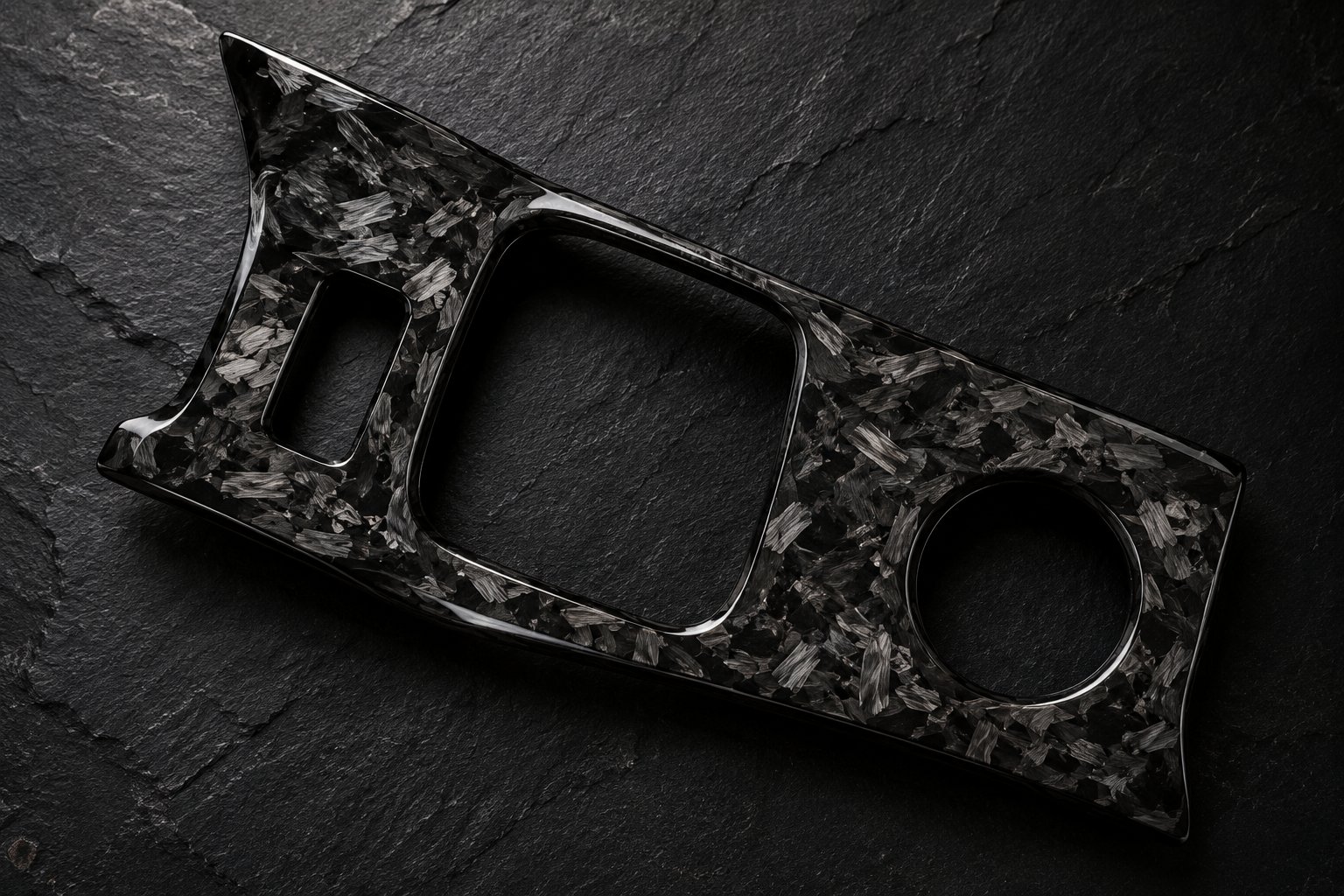
You are scrolling through aftermarket carbon fiber parts, and a listing catches your eye. It does not have the familiar diagonal twill weave or the tight checkerboard of a plain weave. Instead, the surface looks like dark marble — random swirls and chips of carbon frozen mid-flow, creating a pattern that is impossible to predict and impossible to replicate exactly from one part to the next. The listing says "forged carbon fiber," and you are immediately wondering: is this wet? Is it dry? Is it better or worse than either one?
The honest answer is that forged carbon fiber is none of the above. It is its own manufacturing category entirely, and lumping it into the wet vs dry carbon fiber debate creates more confusion than it resolves. Understanding what is forged carbon fiber — and what it is genuinely good at — gives you a third option that might be exactly right for certain upgrades, or completely wrong for others.
What Forged Carbon Fiber Actually Is
Traditional carbon fiber composites — whether wet layup or dry pre-preg — rely on continuous woven fabric. Long, unbroken strands of carbon fiber are interlaced into sheets, and those sheets are layered into molds with resin to create the final part. The weave pattern you see on the surface exists because those continuous fibers run in deliberate, engineered directions.
Forged carbon throws out the weave entirely. Instead of continuous fabric, the process starts with chopped carbon fiber strands — short segments typically 10 to 50 mm in length — mixed thoroughly with resin (usually epoxy) to create a bulk molding compound. That compound is placed into a pre-heated metal mold and compressed under high temperature and high pressure in a single step. The chopped fibers flow randomly as the mold closes, filling the cavity and curing into a solid composite with that distinctive marbled, swirl-like surface.
Each part comes out looking unique because the random fiber distribution is never identical from one pressing to the next. Imagine pouring a handful of short black threads into wet glue, pressing it flat, and letting it harden. The result would be a chaotic, organic pattern — visually striking and completely unrepeatable. That is essentially what forged carbon delivers, just with engineering-grade materials and precision tooling.
The technology was jointly developed by Lamborghini and Callaway Golf in the mid-2000s. Lamborghini wanted to reduce composite part costs while increasing production speed, and the partnership produced a material that could be molded in cycles as short as three minutes — a dramatic improvement over the hours-long cure times required for traditional layup. The Sesto Elemento concept car became the first high-profile showcase, and forged carbon gradually spread across the Lamborghini lineup before appearing on aftermarket parts for everything from BMWs to Teslas.
Forged Carbon Fiber Pros and Cons
Forged carbon occupies a genuinely unique position among composite materials. Its strengths and limitations are distinct from both wet and dry processes, which is exactly why it deserves its own evaluation rather than being squeezed into an existing category.
Pros
- Complex 3D geometry — Because the chopped fiber compound flows like a thick paste under compression, it fills intricate mold cavities that continuous-fiber sheets cannot drape into without wrinkling or bridging. Ribs, grooves, undercuts, and tight radii that would challenge traditional layup are routine for forged carbon.
- Isotropic strength — Traditional woven carbon fiber is strongest along the fiber direction and weaker perpendicular to it. Forged carbon's randomly oriented short fibers create uniform strength in all directions, which eliminates delamination concerns under multi-directional stress.
- Minimal material waste — Pre-preg layup generates offcuts every time a sheet is trimmed to shape. Forged carbon compound fills the mold with very little excess, reducing scrap significantly.
- Faster production — Compression molding cycles measured in minutes versus cure cycles measured in hours mean higher throughput and lower per-part labor costs at scale.
- One-of-a-kind aesthetic — Every single part has a unique pattern. For buyers who want something visually distinctive that stands apart from the ubiquitous 2x2 twill weave, forged carbon delivers an immediate visual statement.
Cons
- Lower tensile strength than continuous-fiber composites — Chopped fibers cannot carry load as efficiently as long, unbroken strands oriented along the stress path. For structural and aerodynamic components where maximum stiffness-to-weight ratio matters, traditional dry carbon remains superior.
- Heavier than dry carbon — While still lighter than aluminum or steel, forged carbon parts tend to be slightly heavier than equivalent dry carbon components because the chopped fiber compound does not achieve the same fiber volume fraction as autoclave-cured pre-preg.
- Polarizing appearance — The marbled swirl pattern is a love-it-or-hate-it proposition. Some enthusiasts see it as premium and exotic; others view it as chaotic or unfinished-looking compared to the orderly weave of traditional carbon. There is no middle ground on the aesthetic.
- Limited aftermarket availability in some categories — While growing, the selection of forged carbon parts is still narrower than traditional woven carbon for many vehicle platforms. Structural components like hoods and splitters are rarely offered in forged carbon because the material is better suited to trim, accents, and non-load-bearing pieces.
A common misconception is that forged carbon fiber is simply a cheaper substitute for "real" carbon fiber. That framing misses the point. The compression molding process can actually be more expensive than basic wet layup due to the metal tooling required for high-pressure molding. Forged carbon is not a budget shortcut — it is an alternative engineering approach optimized for different strengths: complex shapes, production efficiency, isotropic properties, and a visual identity that no woven pattern can replicate.
Forged vs Dry vs Wet in Direct Comparison
Seeing all three types side by side clarifies where each one fits — and where it does not. The following table summarizes how forged carbon fiber vs dry carbon and forged carbon fiber vs wet carbon fiber stack up across the criteria that matter most to buyers:
| Criteria | Dry Carbon Fiber | Wet Carbon Fiber | Forged Carbon Fiber |
|---|---|---|---|
| Manufacturing method | Pre-preg sheets, autoclave-cured under high heat and pressure | Hand-laid woven fabric, liquid resin applied manually or via vacuum infusion | Chopped fiber strands mixed with resin, compression-molded |
| Appearance | Uniform woven pattern (twill, plain, or satin) | Woven pattern, may show slight inconsistencies | Random marbled or swirl pattern, unique per part |
| Structural strength | Highest — continuous fibers in engineered orientations | Moderate to good — depends on layup quality | Good — isotropic but lower peak tensile strength |
| Weight | Lightest of the three | Heavier due to higher resin content | Between dry and wet; slightly heavier than dry |
| Cost | Highest — autoclave and pre-preg overhead | Lowest — accessible materials and tooling | Moderate — metal tooling offset by fast cycles |
| Best use case | Structural aero, track components, weight-critical builds | Cosmetic trim, street accessories, budget builds | Interior accents, complex-shaped trim, statement styling |
For the daily driver or show car builder evaluating forged carbon, the decision usually comes down to aesthetics. If the marbled look resonates with your build's visual direction, forged carbon delivers something no twill weave can — a surface that genuinely looks different from every other carbon fiber car in the parking lot. For the track enthusiast, forged carbon is best reserved for non-structural accents; the performance-critical parts still belong to traditional continuous-fiber dry carbon.
With all three carbon fiber types on the table — dry, wet, and forged — the complete picture finally comes into focus. Pulling every difference together into a single side-by-side reference makes the decision process far more practical than bouncing between individual comparisons.
Dry vs Wet vs Forged Carbon Fiber Comparison at a Glance
Six differences, three carbon fiber types, and four buyer profiles — that is a lot of information to hold in your head while comparing product listings. This section distills everything from the preceding analysis into a single scannable reference you can bookmark, screenshot, or pull up on your phone while shopping. No new arguments here, just a clean consolidation of what each type delivers across every criterion that matters.
Master Comparison Table Across All Six Differences
The following carbon fiber types comparison chart covers every evaluation criterion from this guide. Use it as a quick-reference decision tool when you already know your priorities and just need to confirm which type aligns best.
| Criteria | Dry Carbon Fiber | Wet Carbon Fiber | Forged Carbon Fiber |
|---|---|---|---|
| Manufacturing process | Pre-preg sheets, vacuum-bagged, autoclave-cured at 120-180°C and 6-8 bar pressure | Hand-laid dry fabric saturated with liquid resin, cured at room temp or low-heat oven | Chopped fiber strands mixed with resin, compression-molded under heat and pressure |
| Fiber-to-resin ratio | Superior (60-70% fiber by volume) | Good (50-60% fiber by volume) | Moderate (varies with compound formulation) |
| Weight | Lightest — 20-40% lighter than wet equivalent | Heavier — excess resin adds mass | Mid-range — slightly heavier than dry |
| Structural strength | Highest — continuous fibers in engineered orientations, near-zero voids | Good — more than sufficient for street use; quality-dependent | Good — isotropic strength but lower peak tensile performance |
| Surface finish | Excellent — consistent resin distribution prevents pooling and bubbling | Variable — ranges from excellent (skilled shop) to inconsistent (budget production) | Unique — random marbled pattern; no traditional weave visible |
| Weave consistency | Uniform from corner to corner | Dependent on technician skill; may show distortion or resin-rich zones | Not applicable — no woven pattern exists |
| Cost | Highest — 40-60%+ premium over wet | Lowest — accessible materials and tooling | Moderate — metal tooling costs offset by fast cycle times |
| Durability (thermal cycling) | Superior — cured at high temps, handles temperature extremes consistently | Good — lower glass transition temp may cause issues near heat sources | Good — compression-molded at elevated temperatures |
| Repairability (cosmetic) | Harder — thin resin layer leaves less room for invisible blending | Easier — thicker resin layer provides a buffer for chip and scratch repair | Moderate — random pattern can mask small repairs more naturally |
| UV resistance | Slightly better — thinner resin layer means less polymer exposed to UV attack | Dependent on resin quality — budget resins yellow faster | Comparable to dry — depends on resin system and clear coat |
| Best-fit buyer persona | Track enthusiast, aerospace/industrial buyer | Daily driver, show car builder on a budget | Show car builder seeking unique aesthetics, daily driver wanting a statement look |
The Bottom Line for Each Buyer Type
Reading a comparison chart is one thing. Translating it into a purchasing decision is another. Here is the narrative summary broken down by what each type actually wins on — and which buyer profile benefits most.
Dry carbon wins on weight, strength, and consistency. Every measurable performance metric favors autoclave-cured pre-preg composites. The near-zero void content, higher fiber volume fraction, and engineered ply schedules produce parts that are lighter, stiffer, and more predictable under load. If your build prioritizes function over budget, dry carbon is the technical benchmark.
Wet carbon wins on value, repairability, and accessibility. Lower production costs translate directly into lower prices without sacrificing the durability or appearance needed for street-driven vehicles. The thicker resin layer that adds weight also makes cosmetic repairs more forgiving, and the widespread availability of wet layup manufacturers gives buyers more options at every price point. For the majority of non-structural aftermarket upgrades, wet carbon delivers the best return on investment.
Forged carbon wins on complex shapes and unique aesthetics. When the design calls for tight radii, deep contours, or a visual identity that breaks from the standard twill-weave look, forged carbon occupies territory that neither wet nor dry can match. Its isotropic strength profile and fast production cycles make it a practical choice for accent pieces and interior trim where form matters more than gram-shaving.
No single type is universally superior. The right choice depends entirely on your priorities, your budget, and how you plan to use the part. Here is the simplest decision framework based on the four buyer personas this guide was built around:
- Track enthusiast — Dry carbon for structural and aerodynamic components (hoods, wings, diffusers, splitters) where weight reduction compounds into measurable performance gains.
- Show car builder — Depends on budget. Dry carbon if the build demands the absolute best finish consistency; high-quality wet carbon if the visual result is comparable and funds can be redirected to additional pieces or professional installation.
- Daily driver — Wet carbon or forged carbon for trim, mirror caps, spoilers, and interior accents. The performance gap is imperceptible on street parts, and the savings are real.
- Industrial or aerospace buyer — Dry carbon, full stop. Documented fiber-to-resin ratios, repeatable autoclave cure cycles, and verified structural properties are non-negotiable for load-bearing and safety-critical applications.
Bookmark this section. The next time you are staring at two product listings — one labeled dry, the other wet, and maybe a third in forged — you will already know which one earns your money based on what you actually need it to do. That clarity is the difference between a purchase you are proud of and one you second-guess every time you look at the receipt.
Which Carbon Fiber Type Should I Buy?
Comparison charts and technical breakdowns are useful — but at some point, you need to close the browser tabs and make a decision. Everything in this guide leads to one practical question: which carbon fiber type should I buy for my specific build, my priorities, and my budget?
The answer is different for every buyer profile. A track driver and a Tesla commuter can read the same six differences and walk away with completely opposite — and equally correct — purchasing decisions. That is exactly how it should work. The goal was never to crown one type as universally "best." It was to give you enough context to match the material to the mission. Here is how that plays out in practice.
Best Pick for Track and Performance Builds
If shaving lap times is the objective, dry carbon fiber earns every dollar of its premium on the components that actually affect performance. Hoods, front splitters, rear wings, diffusers, and fender panels are where dry carbon's 20 to 40% weight advantage over wet equivalents compounds into measurable gains. Less mass means quicker directional changes, shorter braking distances, and improved power-to-weight ratios that show up on a timing sheet — not just on a spec page.
The structural advantage matters here too. Aero components at speed endure significant aerodynamic loads, thermal cycling from engine heat and brake radiation, and vibration stress over extended track sessions. Autoclave-cured laminates with near-zero void content handle those conditions with far more predictability than room-temperature-cured alternatives. When a front splitter is generating real downforce at 200 km/h, you want the part that was engineered to stay rigid and dimensionally stable — not one that flexes or fatigues because excess resin created hidden weak points.
That said, not every part on a track car needs to be dry carbon. Interior trim, mirror caps, and non-structural accents can be wet carbon or forged carbon without any penalty to lap performance. Allocate your dry carbon budget where physics rewards it most: the large, structural, and aerodynamically loaded components.
Best Pick for Show Cars and Aesthetic Builds
Show car builds live and die on visual impact. The question is not which process produces a technically superior laminate — it is which process delivers the finish quality your build demands at a price that leaves room for the rest of the project.
Dry carbon's consistent weave clarity and tight edge definition look stunning under show lighting, and for a no-compromise build where every panel must be flawless under magnifying-glass scrutiny, the premium is defensible. But high-quality wet carbon produced by a skilled shop — using vacuum infusion, premium epoxy, and professional clear coating — can deliver a cosmetic result that is visually indistinguishable from dry carbon to all but the most trained eyes. The money saved by choosing wet carbon on cosmetic-only parts can fund additional pieces, professional installation, paint protection film, or ceramic coating that elevates the overall presentation even further.
Forged carbon also enters the conversation for show builds with a distinctive visual direction. Its one-of-a-kind marbled pattern creates an immediate talking point that standard twill weave simply cannot match. If your build's aesthetic leans toward the exotic and unconventional, forged accents mixed with traditional weave components can create a layered, intentional look.
Best Pick for Tesla Owners and Daily Drivers
This is where the carbon fiber upgrade guide for car owners gets the most practical — and where the dry or wet carbon fiber for daily driver debate resolves itself most clearly.
On a street-driven vehicle, the components you are most likely upgrading — mirror caps, spoiler lips, dashboard trim, center console overlays, door handle covers, and similar accessories — bear no meaningful structural load. The performance gap between dry and wet carbon on these parts is functionally zero in daily driving. What does matter every single day is finish quality, fitment precision, UV durability, and whether the manufacturer actually stands behind what they sell.
For Tesla owners specifically, the best carbon fiber for Tesla accessories comes down to sourcing from manufacturers who prioritize consistent weave appearance, clean edge trimming, proper UV-protective clear coating, and model-specific fitment for the Model 3, Model Y, or Model S. These details determine whether your upgrade looks factory-integrated or obviously aftermarket — and they matter far more than whether the part was cured in an autoclave or at room temperature.
CUTIM's carbon fiber accessories for Tesla illustrate this principle well. Their collection spans both interior and exterior upgrades engineered specifically for Tesla platforms, with the kind of authentic weave visibility, lightweight construction, and premium surface finish that make the knowledge from this guide directly actionable. When you can inspect consistent edge quality, uniform weave patterns, and proper clear coating on real parts designed for your exact vehicle, the abstract differences between manufacturing methods become tangible purchasing criteria you can evaluate with your own eyes and hands.
Whether you ultimately choose wet, dry, or forged for your daily driver, prioritize the manufacturer's reputation and finish quality over the manufacturing label alone. A well-executed wet carbon part from a trusted brand will outperform and outlast a poorly made dry carbon piece every time.
- Track enthusiast — Invest in dry carbon for structural aero components (hoods, wings, splitters, diffusers); use wet or forged for non-structural accents to optimize your total budget.
- Show car builder — Choose dry carbon for centerpiece panels where finish perfection justifies the premium; select high-quality wet carbon for supporting pieces where the visual difference is negligible.
- Daily driver and Tesla owner — Prioritize reputable manufacturers with consistent finish quality, proper UV protection, and model-specific fitment over the wet vs dry label; CUTIM's Tesla carbon fiber collection is a strong starting point for real-world evaluation.
- Industrial or aerospace buyer — Dry carbon with documented material properties, verified cure cycles, and repeatable manufacturing tolerances is the only option for safety-critical applications.
The best carbon fiber upgrade is not the most expensive one — it is the one where the manufacturing process, finish quality, and price align with how you actually plan to use the part. Understanding these six differences puts you ahead of 90% of buyers still making decisions based on marketing labels alone.
Frequently Asked Questions About Wet vs Dry Carbon Fiber
1. Is dry carbon fiber always better than wet carbon fiber?
Not necessarily. Dry carbon fiber delivers superior weight savings and structural strength, making it ideal for track and aerospace applications. However, for cosmetic upgrades like mirror caps, spoiler lips, and interior trim on street vehicles, high-quality wet carbon fiber provides more than enough durability and an equally impressive appearance at a significantly lower price. The best choice depends on whether you prioritize performance, aesthetics, or value for your specific use case.
2. How can I tell if a carbon fiber part is wet or dry?
You can physically inspect several areas without any special tools. Flip the part over and check the back side — dry carbon backs are smooth and uniform, while wet layup backs often show rough resin texture or fabric imprint. Examine the edges: dry carbon edges are clean-cut and consistent in thickness, whereas wet carbon edges may show resin buildup. Also check weave consistency under direct light — dry carbon maintains a tight, even pattern from corner to corner, while lower-quality wet layup may reveal resin-rich spots or slight weave distortion.
3. What is forged carbon fiber and how does it compare to wet and dry?
Forged carbon fiber uses chopped carbon fiber strands mixed with resin and compression-molded under high heat and pressure, producing a unique marbled or swirl pattern instead of a traditional weave. It is neither wet nor dry in the conventional sense — it is its own category. Forged carbon excels at filling complex 3D mold shapes with minimal waste and offers isotropic (uniform multi-directional) strength, though it has lower peak tensile strength than continuous-fiber dry carbon. It is best suited for accent pieces, interior trim, and builds where a distinctive visual identity matters most.
4. Why is dry carbon fiber so much more expensive than wet carbon fiber?
The cost difference reflects a more expensive manufacturing chain at every stage. Dry carbon requires pre-impregnated sheets that cost more than raw fabric and bulk resin, industrial freezer storage to prevent premature curing, autoclaves that can exceed half a million dollars in capital investment, precision metal molds that withstand high heat and pressure, and longer production cycles. Industry estimates place the premium at 40 to 60 percent or more over equivalent wet carbon parts, though the gap widens for complex or low-volume components.
5. What carbon fiber type is best for Tesla aftermarket accessories?
For Tesla owners upgrading non-structural parts like mirror caps, dashboard trim, center console overlays, and spoiler lips, the manufacturing method matters less than finish quality, UV protection, and precise fitment for your specific model. Both wet and forged carbon deliver fully adequate performance for daily driving. Prioritize manufacturers like CUTIM (cutimauto.com) who specialize in Tesla-specific carbon fiber accessories with consistent weave patterns, clean edge finishing, and proper UV-protective clear coating — these details determine whether your upgrade looks factory-integrated or obviously aftermarket.