
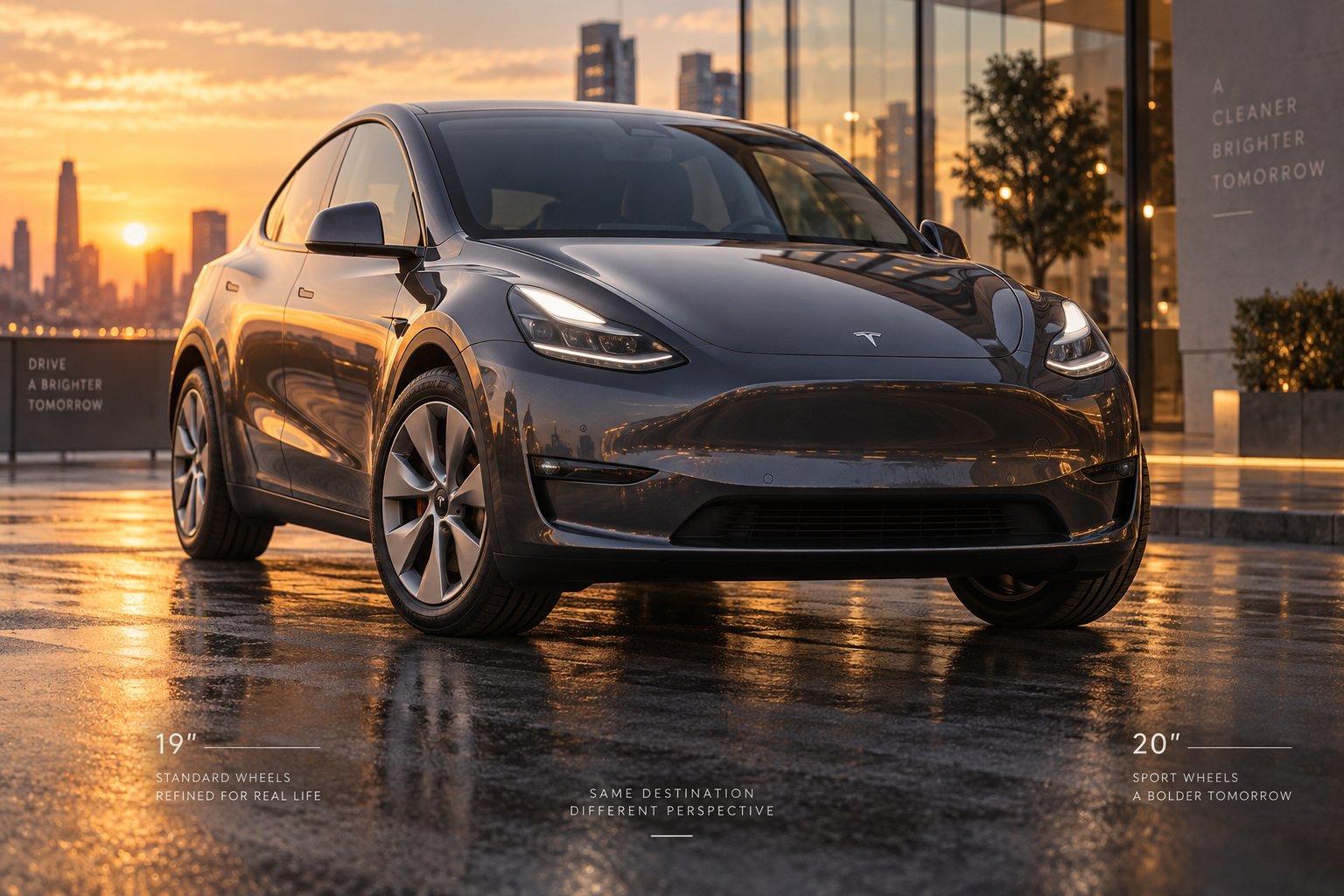
The Model Y Wheel Size Dilemma Every Buyer Faces
You're on the Tesla configurator, your Model Y build is nearly perfect, and then you hit the wheel selection screen. Two options stare back at you: 19-inch or 20-inch wheels. The price difference seems modest. The visual difference looks obvious. So you pick the ones that look cooler and move on, right?
Not so fast. Choosing between Tesla Model Y 19 vs 20 inch wheels is one of those decisions that ripples through your entire ownership experience. It shapes how far you can drive on a single charge, how your cabin feels on rough pavement, what you'll pay for replacement tires years down the road, and even how regenerative braking responds under your foot. This isn't just a cosmetic checkbox — it's a driving-life decision.
Why This Decision Matters More Than You Think
Whether you're configuring a pre-Juniper Model Y or the refreshed Tesla Model Y Juniper, the core tradeoff between 19 and 20 inch wheel sizes remains fundamentally the same. Larger wheels deliver a sportier stance and sharper handling. Smaller wheels protect your range, your wallet, and your comfort over time. The tension is real, and most buyers underestimate it.
The essential tradeoff: 19-inch wheels favor comfort, efficiency, and long-term savings, while 20-inch wheels reward you with sharper handling and a more aggressive look — but at a measurable cost in range and durability.
What This Ranked Guide Covers
This guide ranks the most important decision factors — from range impact and ride quality to ownership costs, tire selection, and aesthetics — so you can match the right wheel size to your actual driving habits. Imagine treating this less like a spec sheet and more like a personalized recommendation engine. Daily commuter? Road tripper? Performance junkie? You'll find your answer here.
The differences start with hard numbers, and that means a close look at the specifications behind each option.
The Definitive 19 vs 20 Inch Specs Comparison Table
Hard numbers cut through opinions faster than anything else. Before you weigh the pros and cons of tesla 20 inch wheels vs 19, you need the raw specifications side by side — organized by trim and generation. The table below consolidates every detail you'd otherwise spend hours hunting across forum threads and spec sheets.
Complete Specs at a Glance
Tesla has offered different wheel names across model years. Pre-Juniper builds (2020-2024) paired 19-inch Gemini wheels and 20-inch Induction wheels with the same core tire sizing. The refreshed 2026 Tesla Model Y 20 inch wheels and their 19-inch counterparts carry updated design names — sometimes called "Storm" covers on the 19s — but share nearly identical fitment dimensions. Both generations use a 5x114.3 lug pattern with M14x1.5 lug bolts, a detail frequently confirmed across model y lug size Reddit discussions.
| Specification | 19-Inch Wheels | 20-Inch Wheels |
|---|---|---|
| Pre-Juniper Wheel Name | Gemini | Induction |
| Juniper Wheel Name | 19" w/ Storm Covers | 20" Sport |
| Tire Size | 255/45R19 | 255/40R20 |
| Sidewall Height | ~115 mm (45-series) | ~102 mm (40-series) |
| Approx. Wheel Weight | ~25 lbs (11.3 kg) | ~28 lbs (12.7 kg) |
| Lug Pattern | 5x114.3, M14x1.5 | 5x114.3, M14x1.5 |
| Available on Trims | RWD, Long Range AWD | Long Range AWD, Performance / Launch Edition |
| Estimated Range Impact | Baseline (best efficiency) | ~3-5% range reduction vs. 19" |
Note: Exact EPA-rated range figures vary by model year, trim, and software version. Always consult Tesla's configurator for the most current range estimates specific to your build.
How to Read This Comparison
A few things jump out immediately. The tesla model y 19 inch wheels use a 45-series tire, giving you roughly 13 mm more sidewall cushion than the 40-series rubber on the 20s. That difference sounds small on paper — but it translates directly into how the car absorbs potholes, how much road noise reaches your ears, and how vulnerable your rims are to curb damage.
Weight matters too. Each 20-inch wheel carries approximately three extra pounds of rotating mass compared to its 19-inch counterpart. Multiply that across four corners, and you're asking the motors to spin an additional 12 pounds on every acceleration and braking cycle. For an EV where every watt-hour counts, that's not trivial.
The Juniper refresh improved the Model Y's overall drag coefficient from 0.23 to 0.22, which helps offset some efficiency losses from larger wheels. Still, the proportional penalty of stepping up to 20-inch wheels remains consistent across both generations.
These specifications set the stage, but raw numbers only tell part of the story. The real question is how that 3-5% range gap plays out during your daily commute, your weekend road trip, and across thousands of real-world miles.

Range and Efficiency Impact Ranked First
For most EV owners, the Tesla Model Y range is the single metric that shapes daily confidence behind the wheel. Every mile of estimated range lost to a wheel choice is a mile you feel on cold mornings, highway stretches, and those moments when the battery icon dips lower than you'd like. That's why range and efficiency earn the top spot in this ranked comparison.
How Wheel Size Affects EPA-Rated Range
The physics behind the penalty are straightforward. Larger 20-inch wheels carry more rotational mass — roughly 12 extra pounds across all four corners. Your motors have to work harder to accelerate that added weight and then recapture energy when slowing down. On top of that, wider wheel barrels and shorter sidewalls slightly increase aerodynamic drag at highway speeds, where air resistance is already the dominant force fighting your efficiency.
There's a subtler factor too. The thinner 40-series sidewall on 20-inch tires is stiffer, which means it deforms less during each rotation. While that stiffness improves handling precision, it also reduces the hysteresis-based energy efficiency that a taller, more flexible 45-series sidewall provides. In plain terms, a softer sidewall rolls a bit more efficiently because less energy is wasted as heat in the contact patch.
Tesla's own configurator reflects this difference. When you toggle between wheel sizes on any trim, the estimated range drops by a measurable margin on 20-inch setups — typically in the range of 3-5% compared to the 19-inch baseline.
Real-World Range Reports from Owners
EPA ratings capture a controlled scenario, but your commute isn't a lab. Owner data logged through tools like TeslaFi and Tessie paints a consistent picture: drivers on 20-inch wheels report slightly higher energy consumption per mile, especially at sustained highway speeds above 65 mph. The gap narrows in city driving where lower speeds and frequent regenerative braking reduce the aerodynamic penalty, but it never disappears entirely.
Road trippers notice this most. When you're planning a multi-stop journey using a tesla route planner, even a 3% efficiency loss can add an extra charging stop on a 500-mile day. For daily commuters covering 60 miles or more round trip, the cumulative energy difference shows up as one or two fewer "comfortable" days between charges each month.
Trim-by-Trim Range Expectations
Each Model Y variant responds to the wheel-size penalty a bit differently, because each starts from a different efficiency baseline.
- Tesla Model Y RWD (Standard Rear-Wheel Drive): This trim ships exclusively with 19-inch wheels, and for good reason. The tesla model y standard rear-wheel drive variant has the smallest battery pack in the lineup, making every percentage point of efficiency critical. Owners benefit from the lightest wheel option and the longest per-charge range in the Model Y family.
- Dual Motor Tesla (Long Range AWD): The Long Range trim offers both 19- and 20-inch wheels at configuration. Choosing 20s trims an estimated 3-5% from the rated range. For owners who prioritize maximizing their dual motor Tesla's highway legs, the 19-inch setup preserves the efficiency advantage that likely motivated choosing the Long Range trim in the first place.
- Performance / Launch Edition: This variant ships standard with 20-inch wheels (or 21-inch on certain Juniper builds), and its tuning prioritizes handling dynamics over peak efficiency. The range reduction is baked into the trim's identity. Owners selecting this variant have typically already accepted a range tradeoff in exchange for faster acceleration and sharper cornering.
A useful rule of thumb: if you regularly drive routes where range anxiety is a factor — long commutes, frequent road trips, cold-climate winters — the 19-inch setup protects your buffer. If most of your driving stays well within a single charge cycle, the efficiency gap on 20s becomes less consequential in daily practice.
Range tells you how far you can go, but it doesn't tell you how the journey feels. The comfort difference between these two wheel sizes is surprisingly significant — and it goes beyond just bumps in the road.
Ride Comfort, Road Noise, and Regen Braking Feel
Picture yourself driving home after a long day. The road surface shifts from fresh asphalt to a patchy stretch of crumbling pavement — the kind littered with frost heaves and shallow potholes. On 19-inch wheels, that transition feels like a muffled drumroll. On 20s, it sounds and feels more like someone tapping a hammer against the floorboard. The difference is subtle at a test drive pace, but over thousands of daily miles, it defines your relationship with the car.
Ride comfort ranks as the second-most impactful factor when choosing between these two wheel sizes, right behind range. And for a vehicle as quiet as the Model Y — where there's no engine rumble to mask road imperfections — every vibration and thump reaches your ears with surprising clarity.
Sidewall Height and What It Means for Your Spine
The mechanical explanation is simple. A 19-inch wheel wears a 255/45R19 tire, giving it a sidewall height of roughly 115 mm. The 20-inch option uses a 255/40R20, which drops that cushion to about 102 mm. That's 13 mm less rubber standing between your rim and the road surface.
Think of the sidewall as a built-in air spring. When you roll over a crack, a raised manhole cover, or a pothole edge, the tire sidewall flexes inward to absorb the impact before it reaches the wheel, the suspension, and ultimately your cabin. A taller 45-series sidewall has more material to flex, more air volume inside to compress, and a greater ability to smooth out sharp jolts. The shorter 40-series sidewall on 20-inch wheels is stiffer by design. It deforms less, which is great for cornering precision but brutal on rough pavement.
When you consider how much does a Tesla weigh — the Model Y tips the scales at roughly 4,400 to 4,600 pounds depending on the configuration — that mass amplifies every impact. A heavy EV slamming into a pothole on stiff, low-profile tires transfers significantly more force into the wheel and suspension assembly than the same hit absorbed through a taller sidewall.
Owner forums are full of reports confirming this. Drivers in northern states and cities with aging infrastructure consistently describe the 19-inch setup as noticeably more forgiving on broken pavement. Several owners who switched from 20s to 19s specifically for pothole season report that the car feels like it gained a comfort upgrade without touching the suspension.
Road Noise Differences Explained
In a gas-powered car, engine noise drowns out a surprising amount of tire roar. The Model Y doesn't have that luxury. Its interior permanent magnet motors are nearly silent at cruising speeds, which means road noise becomes the dominant sound inside the cabin. Your tire choice directly controls how loud that soundtrack gets.
Three factors determine cabin noise from the tires: sidewall height, tire width, and tread pattern. Since both the 19- and 20-inch options on the Model Y share the same 255 mm tire width, the primary noise variables come down to sidewall compliance and the specific tire compound fitted.
A taller sidewall absorbs more vibration before it reaches the wheel hub, which means fewer high-frequency road textures transmit into the cabin as audible noise. The 40-series tires on 20-inch wheels, being stiffer, let more of that surface texture pass through. You'll notice this most on concrete highways with transverse grooves, expansion joints, and coarse chip-seal surfaces — the kinds of roads that produce a persistent hum or drone.
Tread pattern matters too. Many 20-inch setups come fitted with performance-oriented summer tires that use larger tread blocks and stiffer compounds, which can generate more noise at highway speeds than the all-season rubber typically paired with 19-inch wheels. Choosing a quieter tire model can partially close this gap, but it can't fully compensate for the physics of a shorter sidewall.
Regenerative Braking Feel on Different Wheel Sizes
Here's an angle almost no other comparison covers: how wheel size changes the feel of regenerative braking. In the Model Y, lifting off the accelerator activates regen, which decelerates the car by converting kinetic energy back into battery charge. The deceleration force routes through the drivetrain, into the wheels, through the tires, and into the contact patch on the road.
Tire compliance — how much the sidewall flexes under load — influences how that deceleration feels to you as the driver. A taller, more flexible 45-series sidewall on 19-inch wheels introduces a tiny buffer of give between the motor's braking torque and the road surface. The result is a slightly smoother, more progressive onset of regen deceleration. It feels less abrupt, almost cushioned.
On 20-inch wheels with their stiffer 40-series sidewalls, the connection between motor braking and road contact is more direct. Regen engagement feels sharper and more immediate. Performance-oriented drivers often prefer this — it gives a more connected, responsive sensation. But for daily commuting in stop-and-go traffic, that added sharpness can make one-pedal driving feel slightly jerky, especially on slippery or uneven surfaces where brief tire compliance changes can cause micro-variations in deceleration feel.
Neither behavior is a flaw. It's a tuning difference created by the tire, not the software. But it's worth experiencing both if you have the opportunity, because you'll live with that regen feel every single day.
Comfort Pros and Cons at a Glance
Pros of 19-Inch Wheels for Comfort
- Taller 45-series sidewall absorbs potholes, frost heaves, and rough pavement more effectively
- Lower cabin noise on highway surfaces, especially concrete and chip-seal roads
- Smoother, more progressive regenerative braking feel for relaxed one-pedal driving
- Significantly reduced risk of rim cracking or bending from pothole impacts — rim replacement at Tesla service centers can run $750 to over $900 per wheel
- Better suited for regions with harsh winters and deteriorating road surfaces
Pros of 20-Inch Wheels for Comfort
- Sharper steering response and more direct road feel, which some drivers experience as confidence-inspiring
- More immediate regenerative braking feedback, preferred by performance-oriented drivers
- Reduced sidewall flex during aggressive cornering, which translates to less body roll sensation
- Sportier ride character that some owners genuinely enjoy, especially on smooth, well-maintained roads
Cons Worth Noting
- 20-inch setups transmit more vibration on imperfect surfaces, increasing fatigue on long drives
- The thinner sidewall on 20s leaves rims far more vulnerable to pothole strikes — a single bad hit can crack an alloy wheel beyond repair, potentially triggering a tesla tire installation error warning or requiring tesla roadside assist if a blowout occurs
- 19-inch wheels sacrifice some cornering sharpness and steering precision at the limit
The comfort verdict leans clearly toward the 19-inch setup for most owners — especially those who prioritize daily livability over weekend canyon carving. But comfort is only half the ownership equation. The other half lives in your wallet, and the long-term cost differences between these two wheel sizes are more dramatic than most buyers expect.
Long-Term Cost of Ownership by Wheel Size
A wheel choice that looks like a one-time decision at the configurator quietly reshapes your ownership budget for years. Tires wear out. Rims meet curbs. And the price tag attached to each of those events differs significantly depending on whether you're rolling on 19- or 20-inch wheels. This is the structured cost breakdown that most comparison guides skip entirely.
Tire Replacement Frequency and Cost Per Set
EVs chew through rubber faster than comparable gas cars — roughly 20% faster on average, thanks to instant torque delivery and the sheer weight of the battery pack. On a Model Y, that accelerated wear hits differently depending on your wheel size.
The 19-inch Gemini setup uses 255/45R19 tires, which tend to be all-season compounds engineered for longevity and low rolling resistance. These tires typically last in the ballpark of 30,000 to 40,000 miles with diligent tesla tire rotation every 6,250 miles. The 20-inch Induction or Sport wheels wear 255/40R20 tires — often fitted with softer, performance-oriented compounds and sometimes acoustic foam liners (marked T0 or T1). That combination delivers a quieter, grippier ride but wears noticeably faster, with many owners reporting replacement intervals closer to 25,000 to 30,000 miles under normal driving habits.
Performance and Launch Edition variants push the equation further. Their aggressive tread compounds and higher power output can burn through a set in as few as 15,000 miles — meaning heavy-footed owners sometimes spend more on rubber per year than on electricity.
Here's where it gets expensive: the tires themselves cost more in the larger size. A full set of four installed on a 19-inch Model Y runs approximately $1,200 to $1,600, while the same quality tier in 20-inch fitments typically lands between $1,500 and $2,000. Performance-spec tires in 20- or 21-inch sizes can push past $2,500 per set at a Tesla Service Center.
| Cost Factor | 19-Inch Setup | 20-Inch Setup |
|---|---|---|
| Typical Tire Lifespan | 30,000 - 40,000 miles | 25,000 - 30,000 miles |
| Set of 4 Tires, Installed | $1,200 - $1,600 | $1,500 - $2,000+ |
| Rotation Cost (per visit) | $40 - $120 | $40 - $120 |
| Wheel Alignment | $150 - $275 | $150 - $275 |
| Professional Curb Rash Repair (per wheel) | ~$100 - $150 | ~$150 - $250 |
| Wheel Replacement (per wheel, if cracked) | $350 - $600 | $500 - $900+ |
Prices reflect approximate 2026 US figures from independent tire shops and Tesla Service Centers. Costs vary by region, tire brand, and retailer. Shops like Costco and Discount Tire tend to fall at the lower end of these ranges.
Over a typical five-year ownership period, the cumulative cost difference is significant. An owner on 19-inch wheels who replaces tires twice will spend roughly $2,400 to $3,200 on rubber. The same owner on 20s — replacing tires more frequently at a higher per-set price — could easily spend $4,500 to $6,000 or more. That's a potential gap of $2,000 to $3,000 before you even factor in wheel repairs.
Wheel Repair and Curb Rash Realities
Imagine parallel parking on a busy street. You misjudge the curb by half an inch. On a 19-inch wheel with its taller sidewall, the tire lip often absorbs that contact — the rubber takes the scrape, not the alloy. On a 20-inch wheel with its thinner 40-series sidewall, that same half inch of misjudgment sends the rim edge directly into concrete. The result is curb rash — and sometimes something worse.
Professional curb rash repair averages around $150 per wheel for standard cosmetic damage on Tesla's 20-inch wheels, with prices climbing toward $250 or more for matte or satin finishes like Sonic Carbon. Tesla's unique wheel finishes require specific paint codes and techniques that general body shops often lack, pushing owners toward specialized mobile repair services. DIY touch-up kits exist in the $40 to $50 range, but they rarely produce invisible results — especially on the machine-finished "diamond cut" surfaces found on some alloy designs.
Deep impacts pose a costlier threat. A pothole strike that would merely dent a 19-inch rim wrapped in a cushioning 45-series tire can crack or bend a 20-inch alloy beyond repair. Replacement wheels from Tesla can run $500 to over $900 per wheel depending on the design, and availability isn't always immediate. Some owners report waiting weeks for back-ordered rims.
The Juniper Model Y's design doesn't help. Its "stretched" tire fitments leave the rim edge exposed for a sleeker aerodynamic profile — which looks fantastic until concrete gets involved.
Insurance and Warranty Considerations
Here's a question many buyers don't think to ask until it's too late: does the tesla warranty cover wheel damage? The short answer is no. Tesla's standard tesla warranty and tesla extended warranty options treat curb rash and pothole-related wheel damage as wear-and-tear items, meaning you're paying out of pocket.
However, Tesla does offer a tesla wheel and tire protection plan as an add-on at or after purchase. This plan covers repair or replacement for wheels and tires damaged by road hazards — potholes, nails, debris, and curb impacts — typically with a per-incident deductible. For owners choosing 20-inch wheels, this plan becomes a much stronger value proposition given the higher frequency and cost of potential damage. On 19-inch setups, the risk is lower, so the plan is more of a safety net than a necessity.
Third-party wheel and tire protection packages from providers like Allstate or Endurance offer similar coverage and are worth comparing if Tesla's plan isn't available in your region or doesn't fit your budget. Either way, factoring in the cost of protection coverage adds another line item to the ownership equation — one that disproportionately affects 20-inch wheel owners.
Cost-Saving Tips by Wheel Size
If You Choose 19-Inch Wheels
- Stick to the recommended tesla tire rotation interval of every 6,250 miles — it's the single most effective way to extend tire life and ensure you replace all four as a set rather than two at a time
- Choose a durable all-season tire like the Michelin CrossClimate 2, which consistently delivers strong tread life on EVs
- Skip the tesla wheel and tire protection plan if your driving environment is relatively forgiving — the lower curb-rash risk on 19s makes the plan less critical
- Buy tires from independent retailers like Costco or Discount Tire, where pricing is typically $200 to $400 less per set than at Tesla Service Centers
- Get a wheel alignment ($150-$275) every time you install a new set of tires — misalignment on a 4,500-pound EV can feather a brand-new set within a few thousand miles
If You Choose 20-Inch Wheels
- Seriously consider the tesla wheel and tire protection plan — the math tips in your favor given the higher per-incident repair costs on larger wheels
- Invest in rim protectors ($60-$120 for a set of four), which act as a sacrificial barrier between your alloy and the curb
- Rotate tires religiously at the 6,250-mile mark to maximize tread life on the faster-wearing 20-inch compounds
- Budget for tire replacement roughly every 25,000 miles rather than assuming the 30,000+ lifespan typical of 19-inch setups
- Avoid parking tight to curbs whenever possible — the thinner sidewall provides almost no buffer between the rim edge and concrete
- Monitor tread depth regularly with a simple depth gauge; catching uneven wear early can save you from premature full-set replacement
The financial picture is clear: 19-inch wheels are the more economical choice across virtually every cost metric. But money isn't the only currency owners spend on their cars. Choosing the right tires for your specific climate and driving style can close some of those cost gaps — and even reshape the comfort equation explored earlier.
Tire Recommendations by Use Case and Climate
A wheel is only as good as the rubber wrapped around it. You could choose the ideal wheel size for your driving life and still end up disappointed if the tire compound, tread pattern, or seasonal rating doesn't match your environment. The right tire selection can soften the ride harshness of 20-inch wheels, extend the tread life of 19-inch setups, or transform cold-weather traction on either size. Here's how to match the best tires for Tesla Model Y to your specific priorities and climate.
Best All-Season Tires for 19-Inch Wheels
The 255/45R19 fitment on 19-inch wheels opens up the widest selection of quality EV tires on the market. These tires benefit from a taller sidewall that naturally absorbs road imperfections, so you can prioritize either maximum comfort or balanced performance without sacrificing too much in the other direction.
Comfort-Focused All-Season Picks
- Michelin CrossClimate 2: The community favorite for a reason. Tesla owners consistently praise its balanced wet and dry grip, strong tread life, and quiet highway manners. It carries the three-peak mountain snowflake (3PMSF) symbol, making it a capable light-winter option for mild climates. Verify the Michelin tire warranty terms when purchasing — Michelin typically backs this model with a mileage guarantee that adds a layer of cost protection for high-mileage commuters.
- Continental CrossContact RX: Designed with EV weight and torque characteristics in mind, this tire delivers a plush ride with low rolling resistance. It's an excellent choice for owners who want to preserve the range advantage of 19-inch wheels while keeping cabin noise to a minimum.
- Hankook iON evo AS: Built specifically as an EV tire, it handles the Model Y's weight well and offers competitive tread life at a lower price point than the Michelin or Continental options.
Performance-Oriented All-Season Picks
- Michelin Pilot Sport All Season 4: If you chose 19-inch wheels for the efficiency but still want spirited handling, this is the tire that bridges both worlds. Grip levels approach those of a dedicated summer tire, with enough cold-weather capability for three-season driving.
- Vredestein Quatrac Pro: A lesser-known option gaining traction in Tesla forums for its sharp steering response and surprisingly quiet ride. Worth considering if you want sportier dynamics without stepping up to 20-inch wheels.
Best Performance and Summer Tires for 20-Inch Wheels
The 255/40R20 size is where performance-oriented rubber really shines. If you opted for 20-inch wheels, you likely value handling precision and driving engagement — and the right tire amplifies those strengths dramatically.
Performance Summer Picks
- Michelin Pilot Sport 4S: Widely regarded as one of the best performance tires available in this size, period. It delivers extraordinary dry grip, responsive turn-in, and predictable wet-weather behavior. Many Tesla Performance and Launch Edition owners swear by it. Keep in mind that summer compounds are not rated for temperatures below about 7 °C (45 °F) — the rubber stiffens and grip drops sharply in cold conditions.
- Michelin Pilot Sport EV: An EV-specific evolution of the Pilot Sport line, engineered to manage the Model Y's weight while reducing rolling resistance compared to the standard 4S. Acoustic foam inside the tire carcass helps offset the noise penalty that 20-inch setups typically carry. If cabin noise on your current 20s bothers you, this tire can meaningfully close the gap.
- Pirelli P Zero (PZ4) Elect: Pirelli's EV-tuned offering focuses on lower rolling resistance and reduced noise while maintaining the sharp handling that P Zero tires are known for. Some Model Y variants ship with this tire from the factory.
All-Season Options for 20-Inch Wheels
- Michelin CrossClimate 2 (255/40R20): Available in the 20-inch fitment for owners who want year-round versatility. You'll sacrifice a small amount of dry-weather grip versus a dedicated summer tire, but gain three-season capability and a longer tread life that helps offset the faster wear typical of 20-inch setups.
- Continental ExtremeContact DWS 06 Plus: An ultra-high-performance all-season that delivers confident handling in dry and wet conditions while retaining enough cold-weather grip for occasional frost. A solid middle ground for owners in temperate climates who don't want to swap tires seasonally.
Winter and Climate-Based Recommendations
Climate is the deciding factor that many buyers overlook until their first winter behind the wheel. Your geography should shape not just the tire you buy, but potentially which wheel size you choose in the first place.
For pothole-heavy northern climates — think the upper Midwest, New England, the Great Lakes region, or anywhere with freeze-thaw cycles that destroy road surfaces — the 19-inch setup is the clear recommendation. That extra 13 mm of sidewall acts as built-in pothole insurance during the months when road conditions are at their worst. It also allows you to fit a wider selection of dedicated winter tires, since 255/45R19 is one of the most common sizes in the EV tire market.
Owners who experience sustained cold — daytime highs regularly below about 7 °C (45 °F) — should invest in a dedicated winter set regardless of wheel size. As TSLNA's winter tire guide notes, the rubber compound in all-season tires hardens in the cold, losing grip on dry, wet, and icy surfaces alike. Winter tires use a softer compound that stays pliable, plus siping patterns designed to bite into snow and ice.
Top-rated winter tires for the Model Y include:
- Michelin X-Ice Snow (or X-Ice Snow SUV): The best all-round winter tire for range-conscious EV owners — low rolling resistance, quiet, and strong ice braking performance. Its long tread life also makes it one of the most cost-effective winter options.
- Nokian Hakkapeliitta R5 SUV: Purpose-built for EVs, with an emphasis on energy efficiency in extreme cold. An excellent choice for Canadian owners or anyone in regions with consistent sub-zero temperatures.
- Bridgestone Blizzak WS90: The deep-snow and ice benchmark. If your winters feature heavy snowfall and unplowed side streets, the Blizzak's aggressive tread pattern outperforms most competitors in packed-snow traction.
For owners on 20-inch wheels who need winter capability, most Tesla community members recommend buying a separate set of 19-inch winter wheels and tires rather than fitting winter rubber on the 20-inch rims. This "winter downsizing" strategy gives you a taller sidewall for pothole protection, cheaper and more widely available winter tire options, and often better deep-snow performance — all while keeping your 20-inch wheels safely stored for warmer months.
In contrast, owners living in warm, dry climates — the Sun Belt, coastal California, the desert Southwest — can confidently choose 20-inch wheels paired with summer performance tires. Smooth, well-maintained roads rarely punish low-profile sidewalls, and the handling advantages of 20s shine on warm, grippy pavement. The seasonal tire swap equation simply doesn't apply.
One final tip worth remembering: the Michelin tire warranty and similar mileage guarantees from Continental and Bridgestone can substantially reduce your long-term tire cost — but only if you register the tires after purchase and follow the manufacturer's rotation requirements. Many owners skip registration and forfeit hundreds of dollars in potential warranty credit when tires wear prematurely. Regardless of which wheel size or tire model you choose, five minutes of paperwork at installation can pay for itself.
Smart tire selection reshapes the ownership experience on either wheel size. But even with the perfect rubber, a few persistent myths about the 19-versus-20 debate continue to steer buyers toward choices they later regret.
Common Myths vs Reality About Wheel Size on EVs
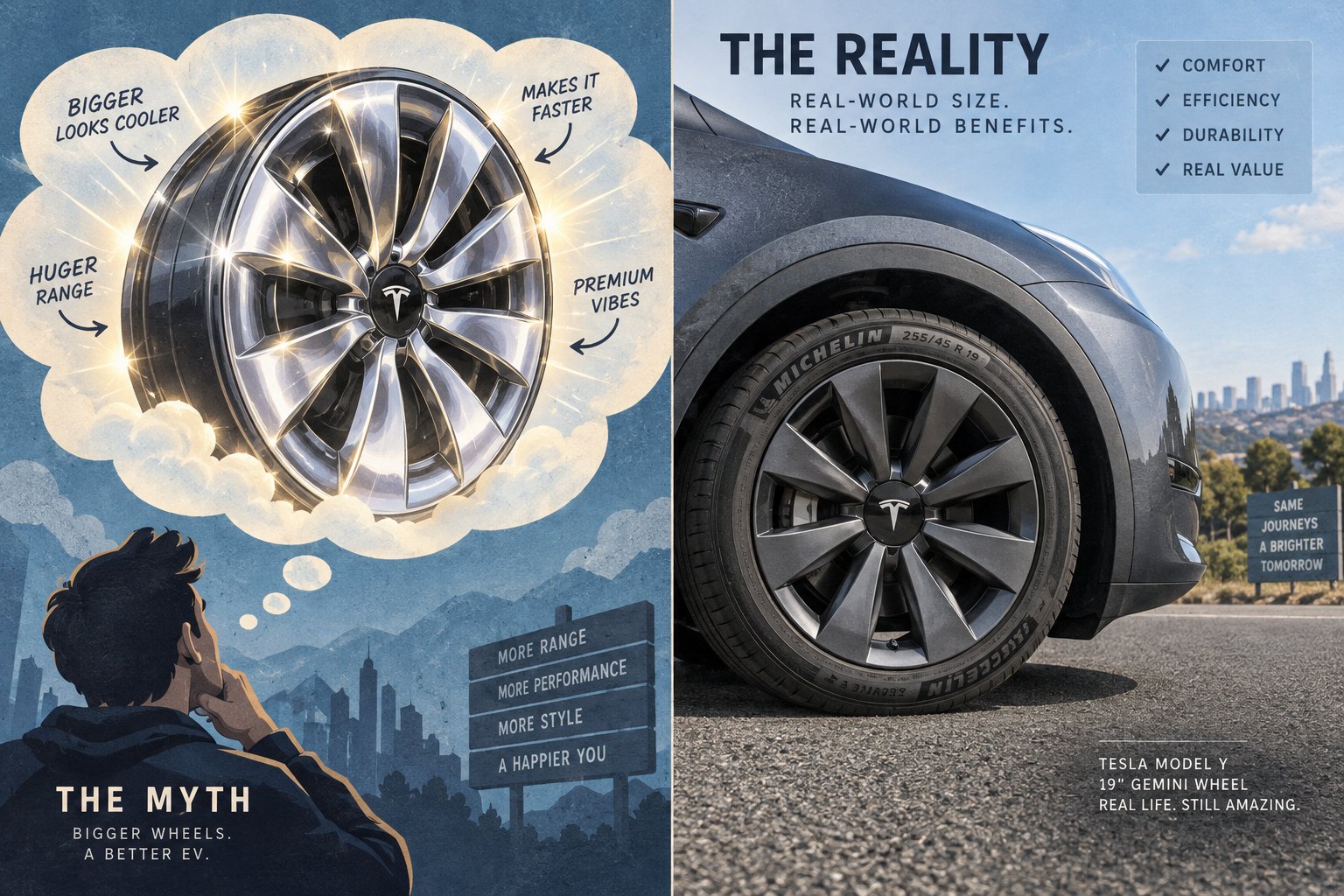
Forums, parking lot conversations, and even some Tesla sales advisors repeat the same handful of assumptions about 19 vs 20 inch wheels Tesla buyers face at configuration. Some of these claims hold a grain of truth. Others are flat-out wrong. Letting a myth drive a multi-year ownership decision is an expensive mistake — so let's set the record straight.
Myth — Bigger Wheels Always Look Better in Person
Scroll through any new Tesla delivery thread and you'll find the same confident declaration: "20s just look better." In photos taken at flattering angles with studio lighting, sure. But proportions, body color, and wheel finish all interact in ways that surprise owners once the car is parked in their actual driveway. Dark-colored Model Ys — especially in Midnight Cherry or Ultra White on a 2024 Tesla Model Y — can look remarkably sharp on well-dressed 19-inch wheels. Several owners in community polls report preferring the cleaner, more proportional look of 19s once aftermarket covers or exposed Gemini spokes replaced the stock plastic caps. Aesthetics are genuinely subjective, and the assumption that bigger automatically equals better doesn't survive real-world scrutiny.
Myth — The Range Penalty Makes 20s Impractical
On the opposite end, some buyers dismiss 20-inch wheels entirely because they've read about the efficiency gap and assumed it makes them unusable. That's overcorrecting. The typical 3-5% range reduction translates to roughly 8 to 15 miles on a full charge, depending on your trim. For an owner who drives 30 miles a day and charges at home overnight, that difference is essentially invisible. Range panic around 20s is valid for long-distance road trippers and extreme-cold commuters — but for the average suburban driver of a new Tesla, the penalty is manageable and rarely changes real-world charging behavior.
Myth — 19-Inch Wheels Cannot Look Premium
This one persists because the stock Gemini covers on pre-Juniper builds divided opinion sharply. Many owners found them utilitarian. But stripping the covers to reveal the alloy spokes underneath — or swapping to quality aftermarket hub caps — transforms the wheel's visual presence entirely. Premium wheel covers designed specifically for the Model Y now offer finishes, spoke patterns, and edge detailing that rival the look of forged aftermarket alloys at a fraction of the cost.
| Myth | Reality | Verdict |
|---|---|---|
| Bigger wheels always look better in person | Proportions, color, and wheel cover design all affect appearance — many owners prefer dressed-up 19s over stock 20s once they see both on their car | False — aesthetics depend on the full package, not just diameter |
| The range penalty makes 20s impractical | A 3-5% reduction amounts to roughly 8-15 miles per charge, which rarely affects daily driving habits for typical commuters | Mostly false — the penalty matters for road trips and cold climates, not everyday use |
| 19-inch wheels look budget or cheap | Quality aftermarket wheel covers and hub caps deliver a premium aesthetic while preserving the efficiency and comfort advantages of the smaller wheel | False — the right covers close the visual gap entirely |
The third myth is worth lingering on, because it points to a practical solution that many buyers overlook. If the only reason you're leaning toward 20-inch wheels is the way they look — while privately wishing for the range, comfort, and cost benefits of 19s — there's a middle path that gives you both.
Aesthetics, Customization, and the Wheel Cover Advantage
Let's be honest — looks matter. You're spending tens of thousands of dollars on a vehicle you'll see in your driveway every morning, catch in reflections at parking garages, and walk toward across crowded lots. Dismissing aesthetics as superficial misses the point. The way your Model Y looks directly affects how much you enjoy owning it. The real question isn't whether appearance matters — it's whether you have to sacrifice range, comfort, and long-term savings to get the look you want.
The answer, increasingly, is no.
Stock Aesthetics — 19-Inch Gemini vs 20-Inch Induction
Out of the box, Tesla's wheel designs tell two very different visual stories. The 20-inch Induction wheels (or the Juniper's 20-inch Sport design) deliver a bold, turbine-inspired pattern with deep-cut spoke pockets and dark satin finishes. They fill the wheel arches aggressively and give the Model Y a planted, performance-forward stance. For many buyers, this is the look that sealed the deal during their first test drive.
The 19 tesla rims tell a quieter story. Pre-Juniper Gemini wheels ship with flat, aero-optimized plastic covers that prioritize airflow efficiency over visual drama. They're functional, and they work — but "functional" isn't the word most owners use when describing what drew them to a tesla model y premium purchase. The Juniper's updated 19-inch Storm covers improved the aesthetic considerably with a more sculpted design, though they still read as understated compared to the sportier 20-inch option.
This visual gap between stock configurations is real. But it's also temporary — because 19-inch wheels offer something 20s fundamentally cannot: a blank canvas for transformation.
How Wheel Covers Bridge the Aesthetic Gap
The aftermarket wheel cover market for Tesla has matured dramatically. What started as flimsy plastic clip-ons has evolved into precision-engineered covers with turbine patterns, multi-spoke layouts, matte and gloss finishes, and integrated rim-edge protection. The best options snap directly onto the 19-inch wheel assembly and deliver a visual transformation that rivals — and sometimes surpasses — what you'd get from factory 20-inch alloys.
This is where 19-inch owners hold a genuine advantage. Because the stock Gemini or Storm wheels use a removable cover system, swapping to a premium aftermarket design takes minutes, requires no tools beyond what's in your frunk, and doesn't void any warranty. You keep the taller sidewall, the better range, the lower tire costs, and the smoother ride — while presenting a wheel face that looks nothing like the factory default.
Brands like CUTIM have carved out a niche by designing Tesla wheel covers and hub caps that specifically address the aesthetic gap between 19- and 20-inch setups. Their covers refresh the vehicle's appearance with aggressive spoke patterns and integrated edge coverage that helps shield the rim lip from minor curb contact — a practical bonus on top of the visual upgrade. Companies like TsportLine offer a different approach with full forged aftermarket wheels, but at price points that often exceed the cost difference between 19- and 20-inch factory configurations entirely.
The practical upside is clear: a quality set of wheel covers costs a fraction of the upcharge for 20-inch wheels at the configurator, and delivers zero ongoing efficiency or comfort penalty. You're essentially buying a cosmetic upgrade without buying into the higher tire costs, shorter tread life, and increased curb-rash risk that come bundled with larger wheels.
Upgrading Your Look Without Sacrificing Efficiency
Think of it as decoupling aesthetics from engineering. With 20-inch wheels, the look and the mechanical tradeoffs are inseparable — you accept the range hit, the stiffer ride, and the costlier tires as the price of admission for that visual presence. With 19-inch wheels and aftermarket covers, those variables become independent. You tune the appearance separately from the driving experience.
Here's how the two paths compare when you break them down side by side:
Pros of Upgrading 19-Inch Wheels with Premium Covers
- Retains the full range and efficiency advantage of the 19-inch setup — no energy penalty
- Keeps the taller 45-series sidewall for better comfort, pothole resilience, and rim protection
- Dramatically lower cost than the 20-inch wheel upgrade — most quality covers run $150 to $400 per set
- Easy to swap or remove — change your look seasonally or revert to stock in minutes
- Some covers, like those from CUTIM, add functional edge coverage that reduces curb rash risk beyond what the stock covers provide
- Maintains access to the widest and cheapest tire selection in the 255/45R19 size
Pros of Choosing 20-Inch Wheels Outright
- Factory-integrated design with a seamless OEM finish — no covers to manage
- Sharper handling response and reduced sidewall flex during spirited driving
- Sportier stance and proportions that some owners strongly prefer, especially on lighter body colors
- No compatibility questions — the wheel and tire package is engineered as a matched system from Tesla
Tradeoffs Worth Weighing
- Wheel covers, however well-designed, are still snap-on accessories — occasional rattles or fit adjustments can occur, though premium options largely eliminate this issue
- 20-inch wheels carry the cumulative cost burden outlined earlier: shorter tire life, pricier replacements, and greater curb-damage vulnerability
- Aftermarket covers offer flexibility, but finding a design that perfectly matches your taste requires browsing — not every pattern appeals to every owner
For owners who value both aesthetics and practicality, the wheel cover path represents one of the smartest compromises in the entire Model Y customization playbook. It's not the only option — full aftermarket wheel swaps, powder coating, and vinyl wraps all exist — but it's the only one that preserves every mechanical benefit of the 19-inch setup while meaningfully closing the visual gap.
Appearance preferences are personal, and there's no wrong answer. But the best decision isn't just about which wheel looks sharpest in isolation — it's about which setup fits your complete driving profile. And that's exactly where the final piece of this puzzle comes together.
Final Verdict and Owner Profile Recommendations
Every factor explored in this guide — range, ride comfort, long-term costs, tire selection, myth-busting, and aesthetics — ultimately circles back to one question: which wheel size fits your life? Not the life of a YouTuber reviewing cars on smooth California pavement. Not the build your coworker configured. Yours.
The data points are clear by now. The 19-inch setup wins on efficiency, comfort, durability, and total cost of ownership. The 20-inch setup wins on handling precision and visual presence. Neither choice is objectively wrong — but one is almost certainly a better match for how you actually drive, where you actually live, and what you actually value when you're three years into ownership instead of three minutes into a configurator session.
Match Your Driving Profile to Your Ideal Wheel Size
Rather than offering a single blanket recommendation, here's a profile-based matching system. Find the description that sounds most like your daily reality, and the recommendation follows naturally.
- The Daily Commuter (30-80 miles round trip): Choose 19-inch wheels. Your priority is maximizing range confidence and minimizing tire costs over tens of thousands of commuting miles. The smoother ride on imperfect suburban and city roads reduces fatigue on your daily grind. Every percentage point of efficiency you preserve means fewer midweek charging sessions and more flexibility in your routine. If you're planning routes with a tesla trip planner or monitoring consumption through third-party apps, you'll appreciate the consistently lower energy draw the smaller wheels deliver.
- The Road Tripper (frequent drives over 200 miles): Choose 19-inch wheels. Long-distance efficiency directly determines how many charging stops you make and how tight your timing gets. Even a 3-5% range gap compounds across a 500-mile driving day — it can mean the difference between two comfortable stops and three rushed ones. The taller sidewall also absorbs the varied road surfaces you'll encounter across state lines, and it gives you better protection against unexpected potholes on unfamiliar highways. When you're plugging destinations into a free road trip planner the night before a family trip, that extra buffer of range provides genuine peace of mind.
- The Performance Enthusiast (spirited driving, canyon roads, track days): Choose 20-inch wheels. You bought the 2026 Tesla Model Y Performance — or you're eyeing one — because driving engagement matters to you. The stiffer 40-series sidewall reduces lateral flex during hard cornering, the direct steering response sharpens your inputs, and the aggressive spoke design matches the intent behind the car. You've already accepted the range and cost tradeoffs as the price of a more dynamic driving experience. Pair the 20s with a quality performance tire like the Michelin Pilot Sport 4S, and the handling transforms into something genuinely exciting for a crossover SUV.
- The Style-Conscious Pragmatist (wants the look without the penalty): Choose 19-inch wheels with premium aftermarket wheel covers. This is the best-of-both-worlds profile, and it's more popular than most people realize. You keep every efficiency, comfort, and cost advantage of the 19-inch setup while transforming the visual presence with covers that rival the aesthetics of factory 20-inch alloys. Options like CUTIM's Tesla wheel covers deliver aggressive spoke designs and integrated edge coverage, closing the visual gap for a fraction of the cost of upsizing — and without adding a single watt-hour to your energy consumption.
- The Harsh-Climate Owner (northern states, pothole-heavy cities, freeze-thaw regions): Choose 19-inch wheels. This isn't even close. Pothole-riddled roads in the Midwest, New England, and the Great Lakes region punish low-profile tires mercilessly. A cracked 20-inch rim from a single springtime pothole can cost $500 to $900 to replace — more than you saved by skipping the larger wheel option. The taller 45-series sidewall acts as a physical shield for your alloy, and it provides a broader selection of dedicated winter tires when temperatures drop. If you live somewhere that salt trucks and frost heaves are part of the landscape, the 19-inch setup isn't just the smarter choice. It's the obvious one.
- The 2026 Tesla Model Y L or Long Wheelbase Buyer (six-seat family configuration): Choose 19-inch wheels for most family-oriented use cases. The Model Y L's longer body and added passenger capacity make ride comfort and tire resilience even more important than on the standard Model Y. With the EPA range difference between 19- and 20-inch wheels on the Model Y L shrinking to just four miles, the range argument for 19s is less dramatic — but the comfort and durability arguments remain compelling, especially when you're carrying passengers across all three rows.
The Bottom Line for Every Type of Model Y Owner
If the profiles above still leave you on the fence, ask yourself one honest question: What will matter more to me in year three — how the car looks parked, or how it feels driven? Most owners who've lived with both wheel sizes report that the daily comfort and cost advantages of 19-inch wheels quietly outweigh the showroom excitement of 20s. The visual thrill of larger wheels fades into background noise after a few months. The smoother ride, the cheaper tires, and the extra range never stop mattering.
That doesn't mean 20-inch wheels are a mistake. For the right driver — someone who genuinely values handling dynamics, lives on smooth roads, and isn't bothered by higher maintenance costs — the larger setup is a legitimate choice that brings real driving satisfaction. The key is making that decision with eyes open, not based on a five-minute configurator session fueled by showroom lighting.
Choose the wheel size that matches your daily reality, not your showroom excitement. The best wheel is the one you'll still be happy with 30,000 miles from now — not the one that looked best on a screen.
Frequently Asked Questions About Tesla Model Y 19 vs 20 Inch Wheels
1. How much range do you lose with 20-inch wheels on a Tesla Model Y?
Owners typically see a 3-5% range reduction when choosing 20-inch wheels over the 19-inch option. In practical terms, that translates to roughly 8 to 15 fewer miles per full charge depending on the trim. The penalty stems from increased rotational mass (about 12 extra pounds across four wheels), slightly higher aerodynamic drag, and the stiffer 40-series sidewall rolling less efficiently than the more compliant 45-series rubber on 19s. Daily commuters covering under 50 miles may barely notice, but road trippers and cold-climate drivers feel it most when planning charging stops.
2. Are 20-inch wheels on a Tesla Model Y more expensive to maintain long term?
Yes, meaningfully so. Over a five-year ownership period, 20-inch setups can cost $2,000 to $3,000 more than 19-inch configurations in tire and wheel expenses alone. The 255/40R20 tires wear faster (roughly 25,000-30,000 miles versus 30,000-40,000 for 19s), cost more per set ($1,500-$2,000+ vs. $1,200-$1,600), and leave rims far more exposed to curb damage. A single cracked 20-inch alloy can run $500 to $900+ to replace at a Tesla Service Center, while curb rash repairs average $150-$250 per wheel for the larger size.
3. Can you make 19-inch Tesla Model Y wheels look like 20s?
Absolutely. The aftermarket wheel cover market for Tesla has evolved well beyond basic plastic caps. Premium covers from brands like CUTIM (cutimauto.com) offer turbine patterns, multi-spoke layouts, matte and gloss finishes, and integrated rim-edge protection that rival or even surpass the visual impact of factory 20-inch Induction wheels. A quality set typically costs $150 to $400 and snaps onto 19-inch Gemini or Storm wheels in minutes with no tools required. You retain every efficiency, comfort, and cost benefit of the smaller wheel while achieving a sportier, more aggressive aesthetic.
4. Which Tesla Model Y wheel size is better for winter and pothole-heavy roads?
The 19-inch setup is the clear winner for harsh climates. Its taller 45-series sidewall provides roughly 13 mm more rubber cushion between the rim and road hazards, acting as built-in pothole insurance during freeze-thaw seasons. The 19-inch size also opens up a wider and more affordable selection of dedicated winter tires, such as the Michelin X-Ice Snow and Nokian Hakkapeliitta R5 SUV. Many 20-inch wheel owners in northern states end up buying a separate set of 19-inch winter wheels anyway, which adds cost and storage logistics that 19-inch owners avoid entirely.
5. Does wheel size affect regenerative braking feel on the Tesla Model Y?
It does, though subtly. The taller, more flexible 45-series sidewall on 19-inch wheels introduces a small cushion between the motor's braking torque and the road surface, resulting in smoother and more progressive regen deceleration. The stiffer 40-series sidewall on 20-inch wheels transmits braking force more directly, making regen engagement feel sharper and more immediate. Performance-oriented drivers often prefer the direct feedback of 20s, while commuters using one-pedal driving in stop-and-go traffic may find the gentler onset on 19s more comfortable over extended daily use.