
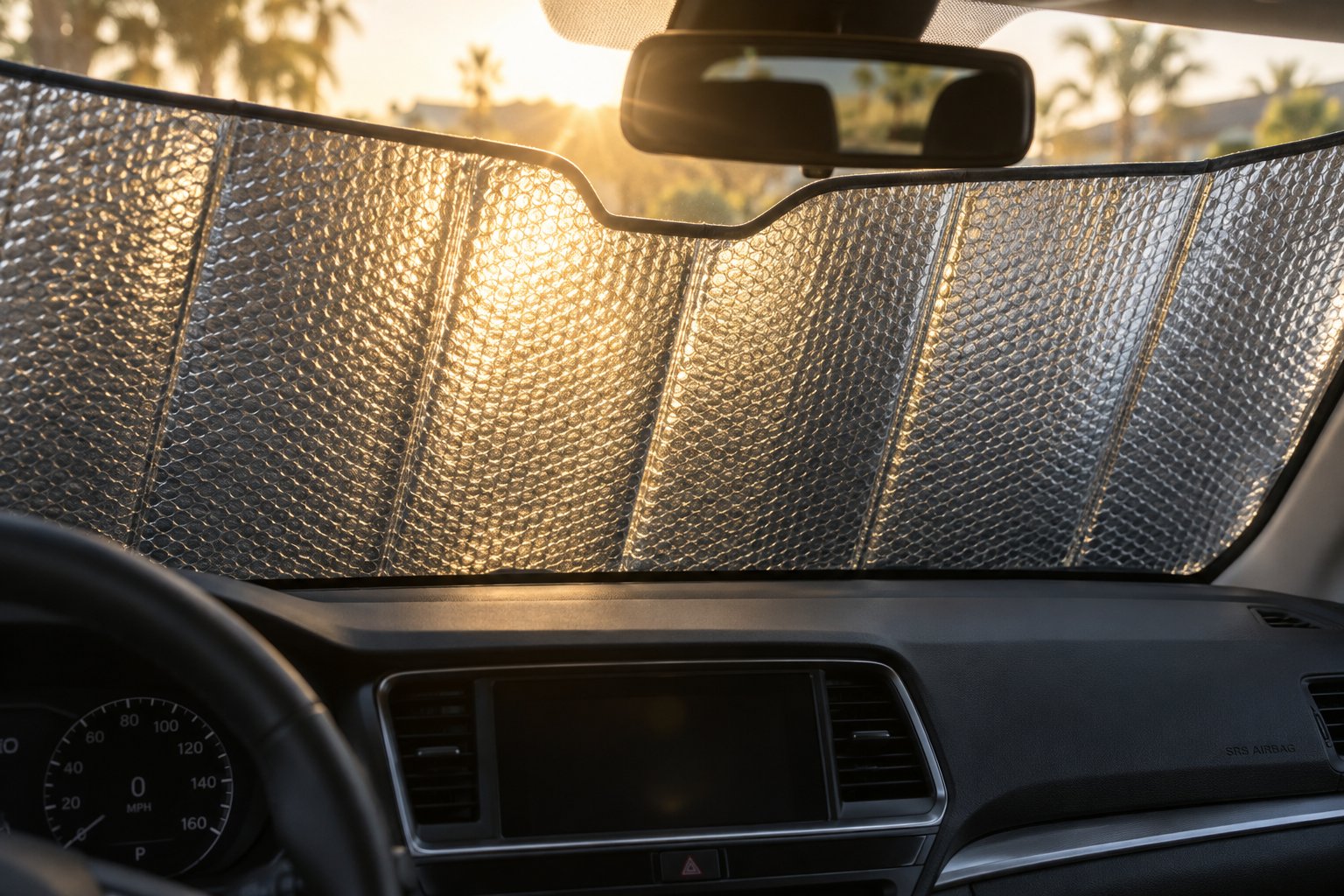
Which Side of a Sunshade Faces Out
No buried leads here. If you landed on this page wondering which side of sunshade faces out, the answer is simple and non-negotiable for the vast majority of car sunshades:
The reflective (silver or metallic) side of a sunshade faces OUT — toward the windshield glass and the sun. The darker fabric or foam side faces IN — toward your cabin and dashboard.
That is the correct orientation every single time you deploy a standard two-sided windshield shade. Reflective side out, dark side in. Commit it to memory, and your dashboard will thank you.
The Short Answer — Silver Side Faces Out
When you unfold your sunshade, you will notice two distinct surfaces. One side is shiny, silvery, or coated with a metallic finish. The other side is typically a darker color — black, gray, or covered in fabric or foam. The shiny, reflective side always goes against the glass, facing outward toward the sun. Its job is to act like a mirror, bouncing solar energy back through the windshield before it can heat up your interior.
This is the standard rule whether you are asking about a car sun shade — which side faces out — for the first time or just double-checking before a summer road trip. The reflective coating is engineered specifically to deflect sunlight, so placing it inward defeats the entire purpose of the product.
Why This Matters More Than You Think
Getting the orientation right is not just a minor detail. A properly positioned sunshade can reduce interior temperatures by up to 40°F compared to an unshaded vehicle. That kind of temperature drop means your steering wheel is not scalding, your leather seats are not branding the backs of your legs, and your air conditioning does not have to work overtime the moment you start the engine.
The stakes go beyond comfort, though. Prolonged heat and UV exposure crack dashboards, fade upholstery, and warp interior trim. Every time you place the wrong side out, you are letting more of that destructive energy reach the surfaces you are trying to protect. UV protection effectiveness shifts dramatically based on what side of a sunshade faces out — the reflective layer blocks and bounces radiation, while the dark layer absorbs and re-emits it as heat right into your cabin.
So how does this reflection actually work at a material level, and what exactly happens when you accidentally reverse the sides? The physics behind each surface tell a surprisingly clear story.
The Science Behind Reflective vs. Absorptive Sides
Knowing that the sunshade black or silver side out question has a definitive answer is one thing. Understanding why the silver side wins is what keeps you from second-guessing yourself on a 100-degree afternoon.
How Reflective Surfaces Bounce Solar Radiation Away
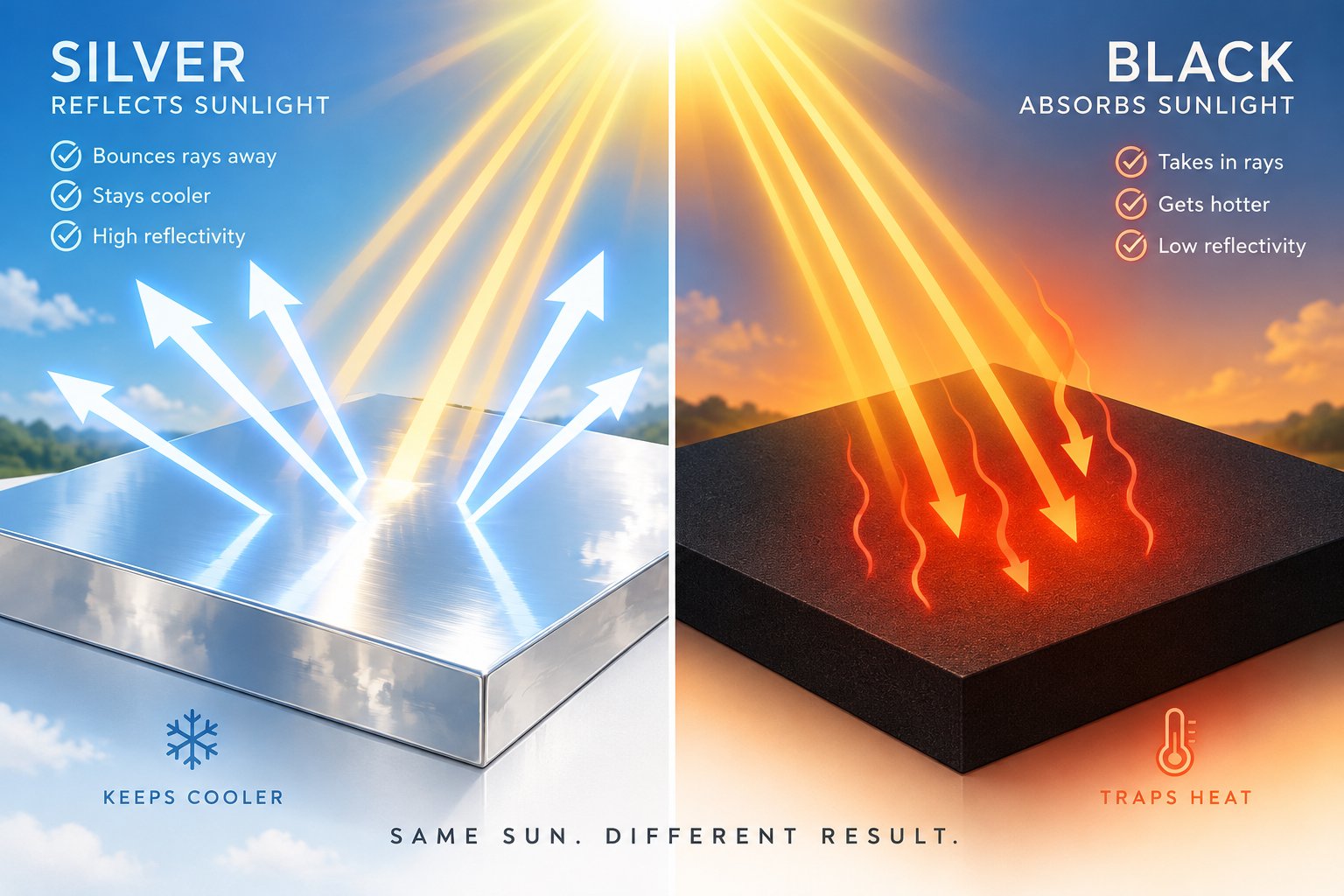
Imagine standing in front of a mirror with a flashlight. The beam hits the glass and bounces straight back at you. That is essentially what the metallic coating on your sunshade does to sunlight — only instead of visible light alone, it deflects a broad spectrum of solar radiation, including the infrared wavelengths responsible for most of the heat you feel.
The silver or aluminum-coated side of a car sunshade acts as a low-cost solar mirror. When sunlight passes through your windshield and strikes that reflective layer, a significant portion of the energy is sent right back out through the glass before it ever reaches your dashboard or seats. Laboratory measurements of household aluminum foil reflectivity show that aluminum surfaces can reflect around 86% of visible light and up to 97% of near-infrared radiant heat. The metallic coatings on quality sunshades operate on the same principle — they are engineered to mirror solar energy away from your cabin.
So, do windshield reflectors work? Absolutely. Their effectiveness is rooted in straightforward physics: a reflective surface returns solar energy to its source rather than letting it convert into trapped heat inside your vehicle.
What the Dark Side Actually Does
The flip side of the equation — literally — is the darker fabric or foam layer. This surface behaves in the opposite way. Instead of bouncing light away, it soaks it up. Dark materials absorb solar radiation and convert that energy into thermal radiation, which then radiates inward toward your steering wheel, dashboard, and seats.
Think of it like choosing between a black shirt and a white shirt on a blazing summer day. The white shirt reflects sunlight and keeps you cooler. The black shirt absorbs it and turns you into a walking radiator. Your sunshade works the same way. If you are still debating car shade silver side in or out, picture your shade wearing a black shirt pointed at the sun — it heats up and pushes that warmth straight into the cabin.
A reflective surface sends solar energy back through the glass. An absorptive surface converts that same energy into heat and radiates it inward — turning your sunshade from a shield into a space heater.
This is exactly why the car sun shade silver side in or out question matters so much. When the dark side faces the sun, the shade itself becomes a heat source sitting inches from your dashboard. Does the reflective side of a sunshade go out? Every time — because reflection prevents heat gain, while absorption guarantees it.
Of course, understanding the science only tells half the story. The real question most drivers never consider is what specific damage occurs when they install the shade backward — and how quickly that damage adds up.
What Happens If You Install the Sunshade Wrong
Flipping your sunshade the wrong way might seem like a harmless mistake — after all, something is still blocking the windshield, right? In reality, incorrect orientation does not just reduce the shade's effectiveness. It actively works against you, creating a cascade of problems that range from uncomfortable to genuinely dangerous.
Increased Cabin Temperature and Reduced Cooling Efficiency
When the dark, absorptive side faces the sun, your sunshade transforms from a heat reflector into a heat collector. The fabric or foam layer soaks up solar radiation, heats up rapidly, and then re-emits that thermal energy directly into the cabin. Instead of bouncing sunlight back through the glass, the shade radiates warmth inward — like placing a warm blanket against your windshield on a hot day.
The numbers make this painfully clear. Properly oriented sunshades can reduce interior temperatures by up to 40°F compared to an unshaded vehicle. That dramatic cooling benefit depends on reflection doing the heavy lifting. Reverse the shade so the wrong side faces the sun, and you sacrifice a significant chunk of that temperature reduction. Your car still sits cooler than it would with no shade at all, but the difference between "noticeably cooler" and "still an oven" often comes down to what side of the car shade faces out.
The downstream effect hits your wallet, too. A hotter cabin means your air conditioning has to run harder and longer to bring temperatures down after you start the engine. That extra load increases fuel consumption in gas-powered vehicles and drains range in electric ones — a recurring cost that adds up over an entire summer.
Accelerated Dashboard and Interior Degradation
Your dashboard takes the brunt of everything that passes through the windshield. UV radiation and excessive heat are the two biggest threats to its longevity, and a backward sunshade lets both reach the dash in higher concentrations than a correctly oriented one.
Over time, UV exposure weakens vinyl, plastic, and composite dashboard materials at a molecular level. The result is fading, warping, and eventually cracking — damage that is irreversible without expensive reconditioning or full replacement. Leather and vinyl seats suffer the same fate, losing color and developing brittle surfaces that split along stress lines. Heat accelerates this process by causing repeated expansion and contraction cycles that fatigue the material faster than UV alone.
Knowing what side goes out on a sun shade and acting on it consistently is one of the simplest ways to slow this degradation. A correctly oriented reflective surface blocks a significant portion of UV and infrared radiation before it ever contacts your interior surfaces. A reversed shade, by contrast, absorbs that energy and re-radiates it at close range — essentially cooking your dashboard from inches away.
Impact on Electronics and Child Safety
Modern vehicles rely heavily on heat-sensitive electronics. Touchscreen infotainment displays, backup camera screens, and dashboard-mounted sensors are all vulnerable to excessive heat exposure. Prolonged high temperatures can cause screen discoloration, reduced responsiveness, and in extreme cases, permanent damage to internal components. When you are deciding what side of sunshade faces out, you are also deciding how much thermal stress these electronics endure every time you park.
The safety implications are just as real — and often overlooked. Metal seat-belt buckles and steering wheels absorb heat quickly in a sun-baked cabin. A steering wheel left in direct, concentrated heat can reach temperatures well above 150°F, hot enough to cause contact burns. For families with young children, overheated buckles and car seat hardware pose a genuine risk every time a child is strapped in after the car has been parked in the sun.
These are not hypothetical scenarios. They happen every summer in parking lots across the country, and many of them are preventable with one small adjustment: making sure the car sun shade — what side faces out — is answered correctly before you walk away from your vehicle.
All of these consequences assume a standard two-sided sunshade, though. What about shades that look silver on both sides, or novelty shades with printed designs? The orientation rules shift slightly depending on the type of shade you own.
Orientation Guide for Every Sunshade Type
The "silver side out" rule covers the most common sunshade design, but not every shade you encounter in the wild has an obvious silver-and-black split. Some look metallic on both sides. Others feature a giant cartoon character or branded logo. A few are designed specifically for rear or side windows, where the windshield logic might not seem like it applies. Each of these variations trips people up — and each one has a clear answer once you know what to look for.
Standard Two-Sided Windshield Shades
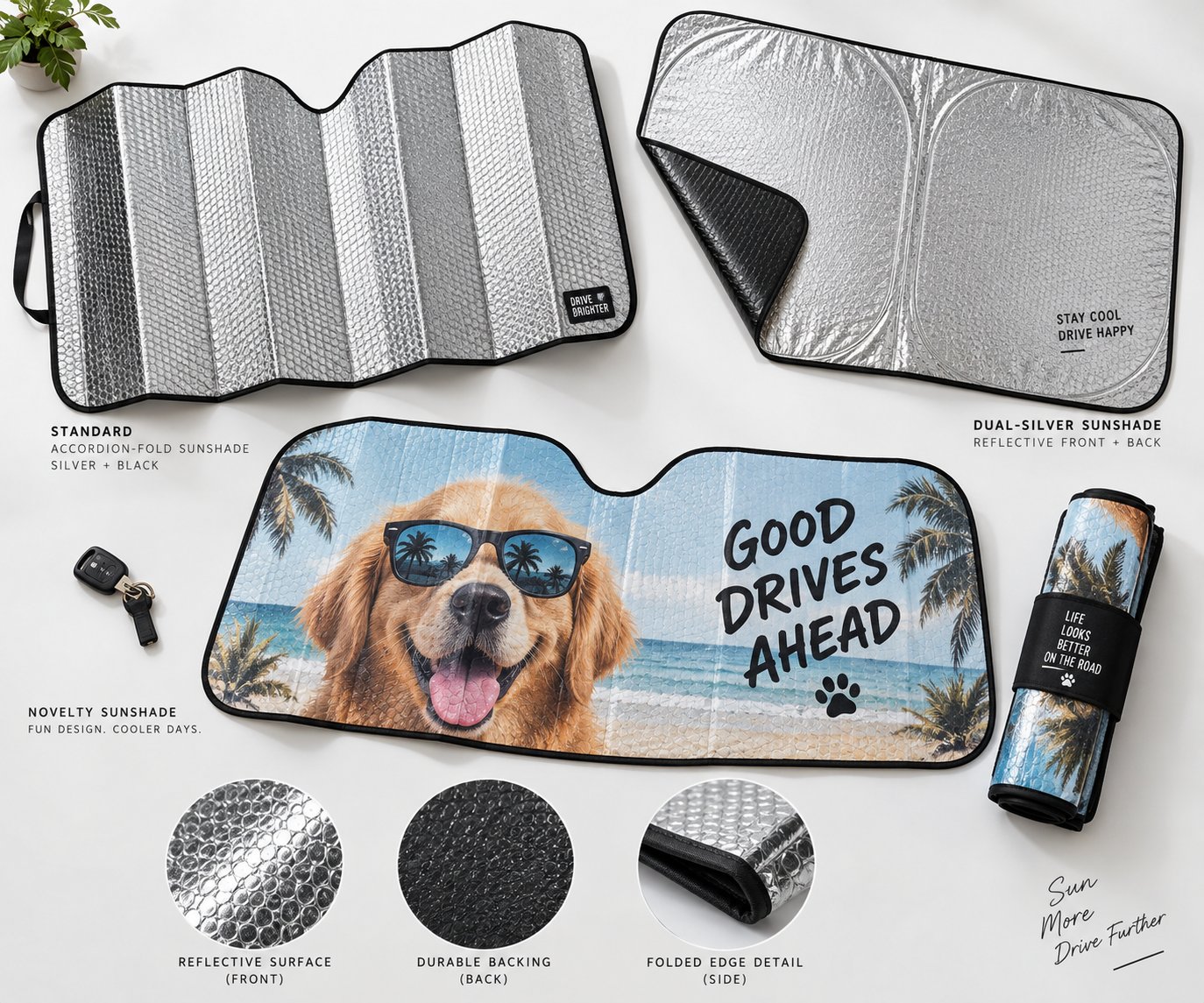
This is the style most drivers own: one shiny, silver, or aluminum-coated side paired with a darker fabric, foam, or black-colored opposite side. The orientation could not be simpler. The reflective side faces out toward the windshield glass, and the dark side faces in toward the cabin.
You will find this design in accordion-fold, pop-up circular, and roll-up formats alike. Regardless of the folding mechanism, the rule stays identical. If you can tell which side is shinier, that side goes against the glass. The dark interior-facing layer often has a softer texture — felt, polyester, or foam — which also serves the practical purpose of protecting your dashboard from scratches when the shade rests against it. As Popular Mechanics notes, some premium shades even include a felt-covered interior side specifically to prevent scuffing smooth plastic dashboard surfaces.
Dual-Reflective and All-Silver Shades
Here is where the question of which side of the windshield sunshade faces out gets genuinely confusing. You unfold the shade, flip it back and forth, and both sides look equally silver. No obvious dark side, no clear visual cue. What now?
Look more closely. In most dual-reflective designs, one side has a slightly smoother, shinier, or more mirror-like metallic finish, while the other has a subtly duller or more textured surface. The smoother, higher-gloss side is the one engineered for maximum reflectivity — point that side out toward the sun.
If you genuinely cannot tell the two sides apart after a careful comparison, you are actually in luck. A shade that is truly identical on both sides reflects equally well from either direction. Orientation becomes irrelevant because both surfaces perform the same reflective function. Real-world testing confirms this — if your shade has shiny foil on both sides, it simply will not matter which side points outward. Deploy it whichever way is convenient and move on with your day.
Printed, Branded, or Novelty Shades
Novelty sunshades — the ones with cartoon eyes, sports team logos, or custom artwork — follow a slightly different logic. The printed or image side is designed to face outward, visible to anyone walking past your parked car. That is the entire point of a novelty design: it is meant to be seen.
Behind that printed surface, though, is where the real work happens. The reverse side typically features a reflective or insulated backing — a metallic coating, foil layer, or heat-resistant material — that faces inward toward the cabin. This backing does the actual job of blocking heat and UV radiation.
So for printed or branded shades, the orientation flips compared to a standard shade: the decorative image goes against the glass (facing out), and the functional insulated layer faces your dashboard. If the novelty shade lacks any reflective or insulated backing and is simply printed fabric on both sides, its heat-blocking performance will be limited regardless of orientation. In that case, it is serving more as a UV screen and privacy cover than a true heat reflector.
Rear Windshield and Side Window Shades
Many drivers install a windshield shade religiously but never think about the rear or side windows. If you do use shades on these additional glass surfaces, the same reflective-side-out principle applies — no exceptions.
Rear window shades work identically to windshield shades: the silver or coated side faces the glass, and the fabric side faces the cargo area or back seat. The physics of solar reflection do not change just because the glass is at a different angle. Side window shades — whether they use suction cups, static cling, or clip-on frames — follow the same rule. If the shade has a reflective or coated dense side and a mesh or fabric side, the coated side faces outward toward the sun.
One practical note for side window shades: many mesh-style side shades are a single-layer design with no distinct reflective coating. These work primarily by filtering and diffusing light rather than reflecting it. For single-layer mesh shades, orientation is less critical because both sides have the same material properties. They still reduce glare and provide UV filtering, but they rely on absorption and shade rather than reflection.
Quick-Reference Orientation Table
Use the table below as a fast lookup the next time you are standing in a parking lot wondering which side of window shade faces out:
| Sunshade Type | Which Side Faces Out | Key Notes |
|---|---|---|
| Standard Two-Sided (Silver + Dark) | Silver/reflective side out | Most common type; dark fabric side protects dashboard from scratches |
| Dual-Reflective (Silver on Both Sides) | Shinier/smoother side out; if identical, either side works | Check for subtle differences in gloss or texture between sides |
| Printed/Novelty/Branded | Printed image side out (toward observers) | Reflective or insulated backing faces inward toward cabin |
| Rear Windshield Shade | Reflective/foil side out toward glass | Same principle as windshield shades; fabric side faces cargo area |
| Side Window Shade (Coated) | Coated/reflective side out | Applies to suction cup, static cling, and clip-on styles with a reflective layer |
| Side Window Shade (Single-Layer Mesh) | Either side — orientation does not matter | Works by filtering light, not reflecting it; lower heat reduction than reflective types |
With the correct side identified for your specific shade type, the remaining variable is how well you actually install it. A perfectly oriented sunshade still underperforms if it is crooked, undersized, or slipping off the windshield — and the installation details matter more than most drivers realize.
How to Install a Windshield Sun Shade Correctly
Knowing the correct side to face outward is only half the battle. A sunshade oriented perfectly but sitting crooked, bunched up, or leaving two inches of exposed glass along the bottom edge is not doing its full job. The correct way to put windshield cover on involves both proper orientation and proper placement — and the second part is where most drivers cut corners without realizing it.
Step-by-Step Windshield Sunshade Installation
Whether you have used a sunshade for years or just pulled one out of the packaging for the first time, following a consistent routine ensures full coverage every time. Here is how to put sun shade in car the right way:
- Unfold the shade and identify the reflective side. Before you do anything else, lay the shade flat or hold it open in front of you. Find the shiny, silver, or metallic-coated surface. That is the side going against the glass. If you own a dual-reflective shade, look for the smoother or glossier face — or simply pick either side if both are identical.
- Hold the shade with the reflective side facing you. This step sounds almost too simple, but it prevents the most common installation error. When you are standing inside the car looking at the windshield, you want the reflective side pointed at you — because it is about to be pressed against the glass, facing outward toward the sun.
- Place the shade against the inside of the windshield. Start by positioning the top edge of the shade snugly against the upper border of the windshield where the glass meets the headliner. The reflective surface should rest flat against the glass with as little air gap as possible.
- Adjust to cover the maximum windshield area, including corners. Slide the shade left and right until it is centered. Pay special attention to the lower corners near the dashboard — these are the spots that most often get left exposed and allow direct sunlight to hit the dash and steering column.
- Tuck edges behind the sun visors or use suction cups to secure. Flip your sun visors down and press them against the face of the shade. This pins the upper portion in place and prevents the shade from sliding down. If your shade came with suction cups, attach them to the glass through the designated grommets for extra hold.
- Check for gaps around the edges. Step back and scan the perimeter. Look for any strip of exposed glass — along the bottom where the shade meets the dashboard, along the sides near the A-pillars, and along the top edge. Even a narrow gap lets a surprising amount of heat pour through.
That is the complete process for how to use a windshield sun shade from start to finish. The whole routine takes under thirty seconds once it becomes habit, and those thirty seconds determine whether your interior stays protected or slowly roasts in the gaps you left behind.
Securing the Shade to Prevent Gaps and Slippage
Even a correctly oriented sunshade loses a significant portion of its cooling power if it does not stay in position. A shade that slips down five minutes after you walk away leaves the top third of the windshield completely exposed — right where the sun angle delivers the most intense radiation during midday parking.
Gaps are the enemy. An undersized shade that leaves two or three inches of exposed glass along the bottom edge creates a greenhouse channel: sunlight enters through that uncovered strip, gets trapped as heat beneath the shade, and bakes the very dashboard surface you thought was protected. This is why proper fit matters almost as much as proper orientation. A shade that is too small for your windshield will always underperform, no matter which side faces out.
Several securing methods can minimize slippage and gap issues:
- Sun visors as clamps — The simplest and most universal method. Folding the visors down over the top edge of the shade pins it firmly against the glass and prevents it from collapsing forward onto the dashboard.
- Suction cups — Many shades include suction cups that attach to the glass through built-in eyelets. These work well on clean windshields but lose grip on dusty or textured glass, so wipe the contact area before attaching.
- Mounting clips — Some premium sunshade systems use dedicated clips that distribute tension evenly across the shade's frame, preventing sagging and ensuring full windshield coverage without relying on visors alone.
- Ear flaps — You may have noticed fabric extensions on either side of certain sunshades and wondered, what are ears on windshield cover? These "ears" are flaps designed to tuck behind or wrap around your sun visors, anchoring the shade in place laterally. They stop the edges from curling inward and keep the shade stretched across the full width of the windshield. If your shade has them, use them — they exist specifically to solve the slippage problem.
A quick test before you lock the car: give the shade a gentle push from the center. If it shifts more than an inch or collapses forward, the securing method is not adequate. Readjust, tuck the ears behind the visors if your shade has them, and confirm the edges sit flush against the glass perimeter.
Proper installation technique, paired with the right orientation, extracts every degree of cooling your sunshade is capable of delivering. Yet even drivers who nail the technique sometimes fall for persistent myths about how sunshades work — and those misconceptions can quietly undo everything they got right during setup.
Common Mistakes and Misconceptions About Sunshade Placement
Sunshades are deceptively simple products — two sides, one windshield, no moving parts. Yet a surprising number of drivers confidently install them the wrong way based on logic that sounds reasonable but falls apart under scrutiny. Some of these myths have been circulating for decades, passed along in parking lots and online forums without anyone stopping to check the physics. Let's dismantle them one by one.
Myth — It Does Not Matter Which Side Faces Out
This is the most widespread misconception, and it is flatly wrong. The argument usually goes something like this: "A shade is a shade — it blocks the sun either way, so orientation is irrelevant." On the surface, that logic seems plausible. Any physical barrier between the sun and your dashboard will provide some benefit, right?
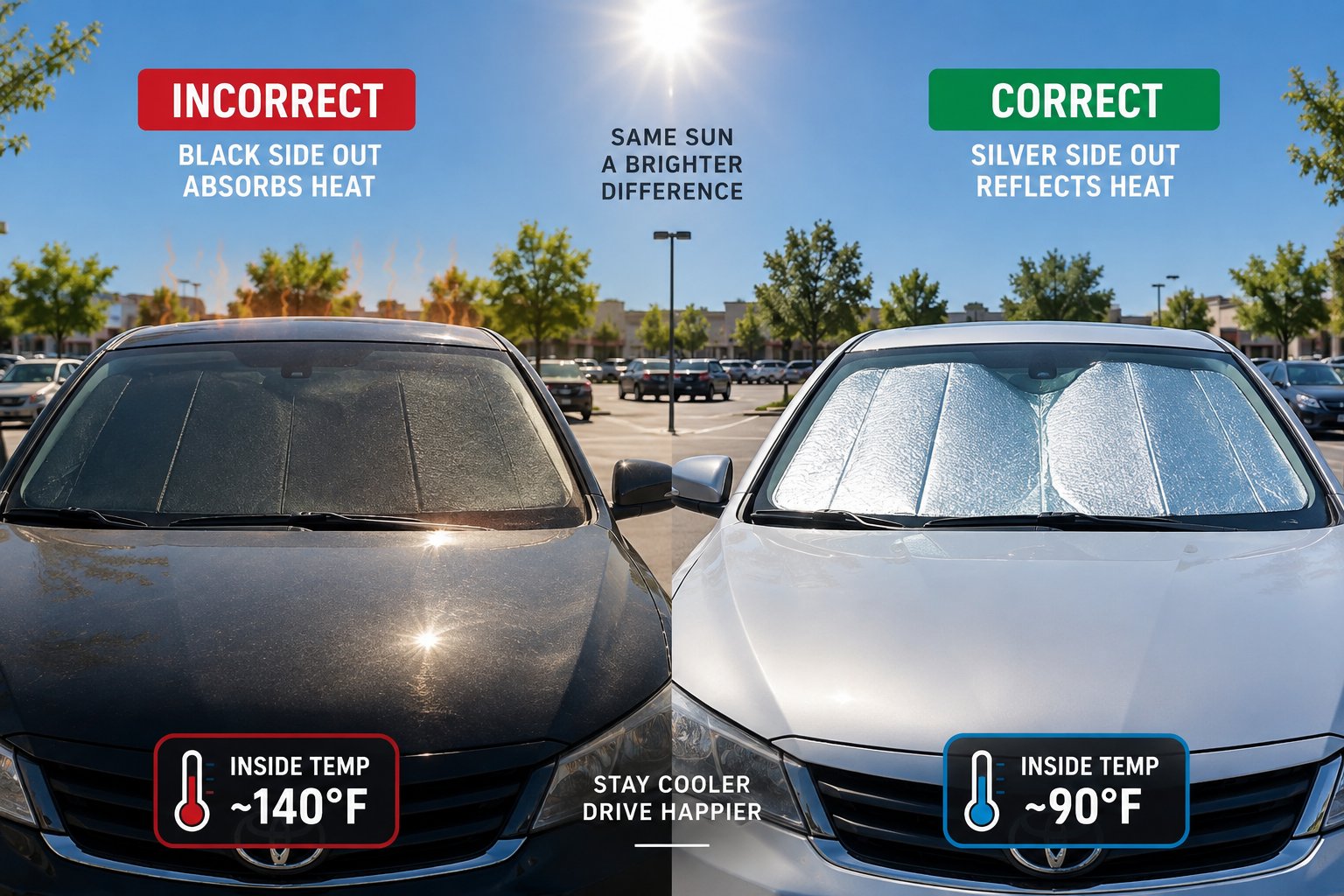
Technically, yes — even a reversed shade blocks a portion of direct light. But "some benefit" and "full benefit" are dramatically different outcomes. Orientation determines whether solar energy is reflected back through the glass or absorbed by the shade itself and radiated inward as heat. A sun shade for car which side faces out is not a trivial question when the difference between correct and incorrect placement can mean 15 to 25 degrees of additional cabin heat that did not need to be there.
Real-world temperature testing consistently shows that a reflective surface facing outward keeps interiors markedly cooler than an unshaded vehicle — with reductions of 20 to 30 degrees or more after an hour in direct sun. Flip the shade so the dark side faces out, and you are voluntarily surrendering a meaningful portion of that cooling. The shade still technically "works," but it works like wearing oven mitts with the insulation on the outside — you are using the right tool in the wrong way.
Myth — The Black Side Absorbs Heat So It Keeps the Car Cooler
This one sounds clever until you trace the logic to its conclusion. The reasoning goes: the black side absorbs heat, which means the heat stays in the shade instead of passing through to the cabin. Problem solved, right?
Not even close. Absorption does not mean the energy vanishes. It means the shade's dark surface converts solar radiation into thermal energy — and that thermal energy has to go somewhere. Since the shade is sitting inches from your dashboard inside a sealed cabin, a significant portion of that absorbed heat radiates inward. The shade itself becomes a heat source, warming the very space you are trying to keep cool.
Think of the black shirt versus white shirt comparison. Under a UV index of 9, black fabric can reach surface temperatures exceeding 140°F after just 15 minutes of direct sun exposure — roughly 40 degrees hotter than an identical white garment under identical conditions. Your sunshade behaves the same way. Point the dark side at the sun, and it heats up fast, then pushes that warmth toward your steering wheel and dashboard. The car sun shade black or silver out debate has a clear winner, and it is silver — every time.
Interestingly, some manufacturers do suggest using the black side outward — but only in winter. As Popular Mechanics notes, flipping the shade so the dark side faces out and the foil side faces inward can absorb and trap solar warmth to keep the cabin slightly warmer during cold months. That is a legitimate seasonal use case. In summer heat, though, you want the opposite: maximum reflection, minimum absorption.
Mistake — Using a Shade That Does Not Cover the Full Windshield
Even drivers who get the orientation perfectly right often undermine their own efforts with a shade that is too small for their windshield. A universal one-size-fits-all shade wedged into a full-size truck's windshield might leave four or five inches of exposed glass along the bottom edge and both sides. That uncovered strip becomes a direct channel for sunlight, and the heat it generates gets trapped behind the shade with nowhere to go.
Picture it this way: you would not expect a window curtain that covers 70% of the opening to block all the light. The remaining 30% floods in unobstructed, and the room stays bright. Your windshield works the same way. Every square inch of uncovered glass allows solar energy to enter the cabin unchecked, heating the dashboard, steering wheel, and front seats despite the shade doing its job everywhere else.
Proper coverage means the shade reaches as close to the edges of the glass as possible — top to bottom, left to right — with minimal gaps at the corners and along the A-pillars. If your current shade leaves visible strips of glass exposed, it is undersized for your vehicle, and no amount of correct orientation will compensate for the heat pouring through those openings.
Mistake — Placing the Shade Outside the Windshield
Here is a question that comes up more often than you might expect: do car sun shades go inside or outside the windshield? The answer for the vast majority of sunshade products is firmly inside. A standard car windshield cover inside the cabin sits between the glass and the dashboard, secured by sun visors, suction cups, or friction. It is designed for interior use — the materials, construction, and attachment methods all assume it will be deployed from the driver's seat.
Placing a standard interior shade on the outside of the windshield exposes it to wind, rain, and road grime. Most interior shades are not built to withstand flapping in a breeze or getting soaked in a sudden downpour. The suction cups will not grip from the outside, the visor-tuck method obviously will not work, and you risk the shade blowing off the car entirely and becoming a road hazard.
External windshield covers do exist as a separate product category. These are typically heavier, weather-resistant covers with straps, magnets, or door-clamp systems that anchor them to the vehicle's exterior. They are excellent for blocking sun and snow alike, but they are purpose-built for outside use and priced accordingly. If you want exterior coverage, buy an external cover. Do not jury-rig an interior shade on the outside and hope for the best.
Quick Summary — Mistakes to Avoid
Before you head to the parking lot, run through this checklist to make sure you are not sabotaging your own shade:
- Do not assume orientation is irrelevant. Which way does sunshade go matters — reflective side out, dark side in. Always.
- Do not place the black side outward in summer. Absorption creates heat inside the cabin, the opposite of what you want during hot months.
- Do not settle for an undersized shade. Exposed glass around the edges lets heat flood in and negates the benefit of a correctly oriented shade.
- Do not place an interior shade on the outside of the windshield. Standard shades are designed for interior use; external covers are a separate product built for outdoor conditions.
- Do not forget to check for gaps after installation. A shade that slips down or curls at the edges creates the same problem as an undersized shade — uncovered glass and wasted effort.
Avoiding these errors puts you ahead of the majority of sunshade users who unknowingly leave performance on the table. The remaining piece of the puzzle is the shade itself — because even flawless orientation and installation cannot overcome a poorly made or badly fitting product.
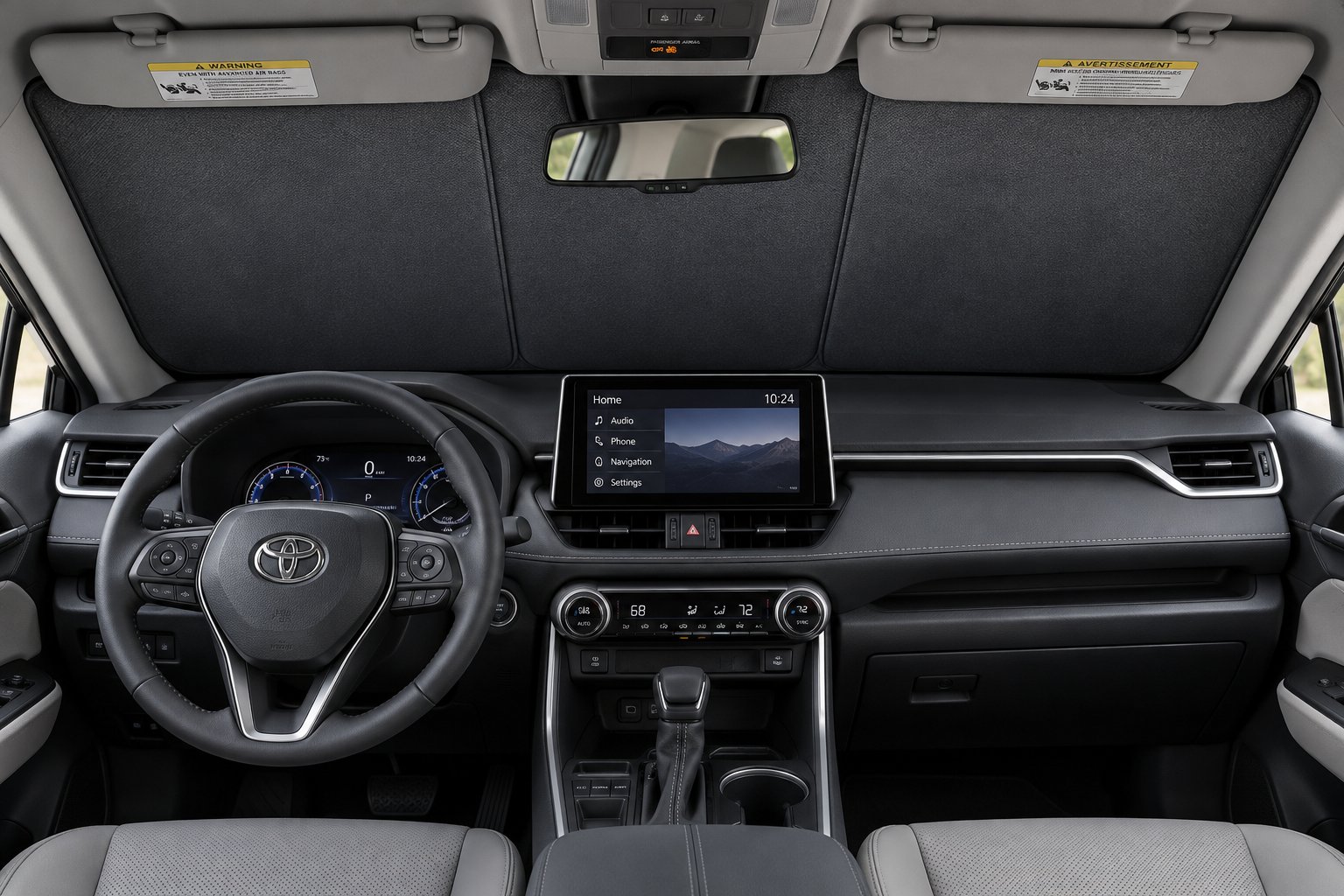
Choosing the Right Sunshade for Maximum Heat Protection
A sunshade with the correct side facing out and flawless installation technique still has a ceiling on its performance — and that ceiling is determined by the shade itself. Material quality, reflective coating grade, and most critically, how well the shade fits your specific windshield all dictate whether you get the full 40-degree temperature reduction or settle for a fraction of it. Choosing the right shade is the final variable that separates "good enough" from genuinely effective heat protection.
Why Proper Fit Is Essential for Sunshade Performance
Imagine you have answered the car sun shade cover which side faces out question correctly, nailed the installation, and walked away confident. But your shade is a generic universal model wedged into a windshield it was never designed for. The result? Three-inch gaps along the bottom. Exposed corners near the A-pillars. Sunlight streaming in around every edge the shade cannot reach.
A vehicle-specific sunshade eliminates this problem entirely. These shades are cut to match the exact dimensions and curvature of a particular windshield, which means edge-to-edge coverage with no guesswork. The reflective surface sits flush against the glass from corner to corner, leaving no channels for solar energy to sneak through.
This matters even more for vehicles with expansive glass. Tesla owners, for example, deal with massive glass roofs that extend well beyond a traditional windshield footprint. A universal silver car sunshade designed for a standard sedan simply cannot cover the surface area of a Model Y's roof panel. That is why purpose-built solutions like CUTIM's Tesla Sunshades exist — they offer glass roof, windshield, and rear window shades engineered specifically for Tesla dimensions, ensuring complete coverage where generic shades fall short. The same logic applies to anyone shopping for a sun shield for SUV models with oversized windshields: vehicle-specific fit outperforms universal sizing every time.
What to Look for in a Quality Sunshade
Not all sunshades are created equal. Beyond proper fit, several features separate a shade that genuinely protects your interior from one that just looks like it does. Here is what to prioritize:
- High-reflectivity coating — Look for aluminum or metalized film rated for maximum solar reflection. The higher the reflectivity, the more heat gets bounced back through the glass.
- Vehicle-specific fit — Custom-cut shades matched to your windshield's exact shape and curvature provide full coverage without gaps or overhang.
- Multi-layer construction — Quality shades use multiple layers: a reflective outer surface, an insulating foam or air-pocket core, and a soft interior layer that protects the dashboard from scratches.
- UV-blocking rating — A high UV-blocking percentage protects dashboard materials and interior surfaces from the radiation that causes fading, cracking, and warping.
- Ease of installation and storage — A shade you find annoying to deploy is a shade you will stop using by mid-July. Look for designs that fold compactly, unfold quickly, and secure without a fight.
Wondering what size sun shade do I need? The answer depends entirely on your vehicle. Measure your windshield's width across the top and bottom edges and the height from the dashboard base to the headliner. Compare those measurements to the shade's listed dimensions before purchasing. Better yet, skip the measuring tape and choose a shade designed for your exact make and model.
The table below breaks down the major sunshade categories so you can see how they compare across the factors that matter most:
| Sunshade Category | Fit Accuracy | Heat Reduction | Ease of Use | Best Use Case |
|---|---|---|---|---|
| Custom-Fit Vehicle-Specific | Excellent — cut to exact windshield dimensions | Highest — full coverage eliminates gaps | High — designed to match your car's interior geometry | Daily drivers who want maximum protection without compromise |
| Universal / One-Size-Fits-All | Poor to moderate — approximate sizing only | Moderate — gaps reduce overall effectiveness | Moderate — may require folding or trimming to fit | Budget option or temporary use across multiple vehicles |
| External Car Sun Shade / Full-Coverage Covers | Good to excellent — wraps around exterior | High — blocks sun before it reaches glass | Low to moderate — takes longer to install and remove | Extended outdoor parking, extreme heat climates, snow protection |
Custom-fit shades consistently deliver the best balance of protection and convenience. An external car sun shade provides excellent heat blocking as well, but the extra setup time and weather exposure make it better suited for long-term parking rather than quick errands. Universal shades work in a pinch, but their inherent fit limitations mean you are always leaving some performance on the table — no matter which side faces out.
For drivers with glass-heavy vehicles like Teslas or panoramic-roof SUVs, the gap penalty from a universal shade is even steeper. A sun shield for SUV models with oversized windshields needs to match that larger surface area precisely, or exposed glass around the edges turns the shade into a partial solution at best. Investing in a shade purpose-built for your vehicle is the single most impactful upgrade you can make after learning the correct orientation.
With the right shade selected and the correct side facing out, the only thing left is to lock in these principles so they become second nature every time you park.
Putting It All Together for a Cooler Car Interior
Seven sections of science, installation technique, myth-busting, and buying advice all point back to one beautifully simple principle: the reflective side faces out, every time. If you have ever stood in a parking lot wondering which way does the sun shade go in the car, the answer has never changed — and it never will, because the physics behind it are non-negotiable.
Quick Recap — The Rules of Sunshade Orientation
Before you close this tab, burn these rules into memory. They cover every scenario you will encounter, from a basic accordion shade to a full vehicle sunshade system:
- Reflective or silver side always faces out — toward the windshield glass and the sun. This is the single most important rule and the direct answer to the sun shade which side faces out question.
- Dark, fabric, or foam side always faces in — toward the cabin and dashboard. This layer absorbs residual heat and protects interior surfaces from scratches.
- The same principle applies to rear and side window shades — any shade with a reflective coating follows the identical orientation rule regardless of which piece of glass it covers.
- Dual-reflective shades with identical sides can go either way — if both surfaces are truly the same, orientation is irrelevant because both reflect equally.
- Proper fit and full coverage amplify effectiveness — a correctly oriented shade that leaves gaps around the edges surrenders a significant portion of its cooling benefit through exposed glass.
- Interior shades stay inside the vehicle — standard sunshades are designed for deployment from the cabin, not for draping over the exterior of the windshield.
Silver side out, dark side in, full coverage corner to corner — that is the entire formula for getting maximum performance from any car sunshade.
Keeping Your Car Cooler Starts With Getting the Basics Right
Correct orientation is the rare car hack that costs absolutely nothing to implement. You already own the shade. You already park in the sun. The only variable is whether you take three seconds to confirm the windshield sun shade — which side out — before walking away. That single habit protects your dashboard from UV cracking, keeps your steering wheel touchable, reduces the strain on your air conditioning, and can shave up to 40 degrees off your cabin temperature on the hottest days of the year.
Pair that habit with the right equipment, and the results compound. A vehicle-specific shade that matches your windshield's exact dimensions eliminates the coverage gaps that undermine even perfectly oriented universal shades. For Tesla owners managing expansive glass roofs, purpose-built options like CUTIM's Tesla Sunshades cover the glass roof, windshield, and rear window with precision-cut panels — the kind of complete coverage that generic shades simply cannot deliver on glass-heavy vehicles.
Which side of sunshade goes out is not a complicated question, and it never was. The answer is the reflective side — always. The deeper value is in understanding why it matters, avoiding the mistakes that quietly undo your effort, and choosing a shade that lets the correct orientation do its full job. Get those three things right, and you will never slide into a scorching cabin again.
Frequently Asked Questions About Sunshade Orientation
1. Does it really matter which side of a car sunshade faces out?
Yes, orientation makes a measurable difference. The reflective silver side is engineered to bounce solar radiation back through the windshield glass before it converts into cabin heat. When the dark absorptive side faces outward instead, the shade itself heats up and re-emits thermal energy inward, acting more like a space heater than a shield. Correct placement with the silver side out can contribute to interior temperature reductions of up to 40 degrees Fahrenheit compared to using no shade at all, while reversed placement sacrifices a significant portion of that cooling benefit.
2. What if my sunshade looks silver on both sides?
Dual-reflective sunshades are common, and they can be confusing at first glance. Look closely for subtle differences between the two surfaces — one side is usually slightly smoother, glossier, or more mirror-like than the other. That shinier side should face outward toward the glass. If you truly cannot distinguish any difference after careful inspection, you are in luck: a shade with identical reflective surfaces on both sides performs equally well in either orientation, so you can deploy it whichever way is convenient.
3. Should a car sunshade go on the inside or outside of the windshield?
Standard car sunshades are designed exclusively for interior use. They sit between the windshield glass and the dashboard, held in place by sun visors, suction cups, or friction. Placing an interior shade on the outside exposes it to wind, rain, and debris — and most interior shades lack the materials or attachment hardware to stay secure on the exterior. External windshield covers are a separate product category built with weather-resistant fabrics, straps, or magnetic systems specifically for outdoor mounting.
4. Do car sun shades actually work to reduce heat?
Absolutely. When the reflective side faces out, the metallic coating mirrors a large percentage of incoming solar radiation — including the infrared wavelengths responsible for most heat buildup — back through the glass. Real-world testing shows properly oriented sunshades can lower interior temperatures by 20 to 40 degrees compared to an unshaded vehicle after an hour in direct sun. The key to maximum effectiveness is pairing correct orientation with full windshield coverage, which is why vehicle-specific shades like CUTIM's Tesla Sunshades often outperform generic universal models.
5. How do I choose the right size sunshade for my car?
Measure your windshield's width across both the top and bottom edges, then measure the height from the dashboard base to the headliner. Compare those dimensions against the shade's listed size before buying. However, the most reliable approach is choosing a sunshade designed for your exact make and model. Custom-fit options are cut to match your windshield's precise shape and curvature, eliminating the gaps and exposed glass that reduce a universal shade's effectiveness — regardless of how perfectly you orient it.