
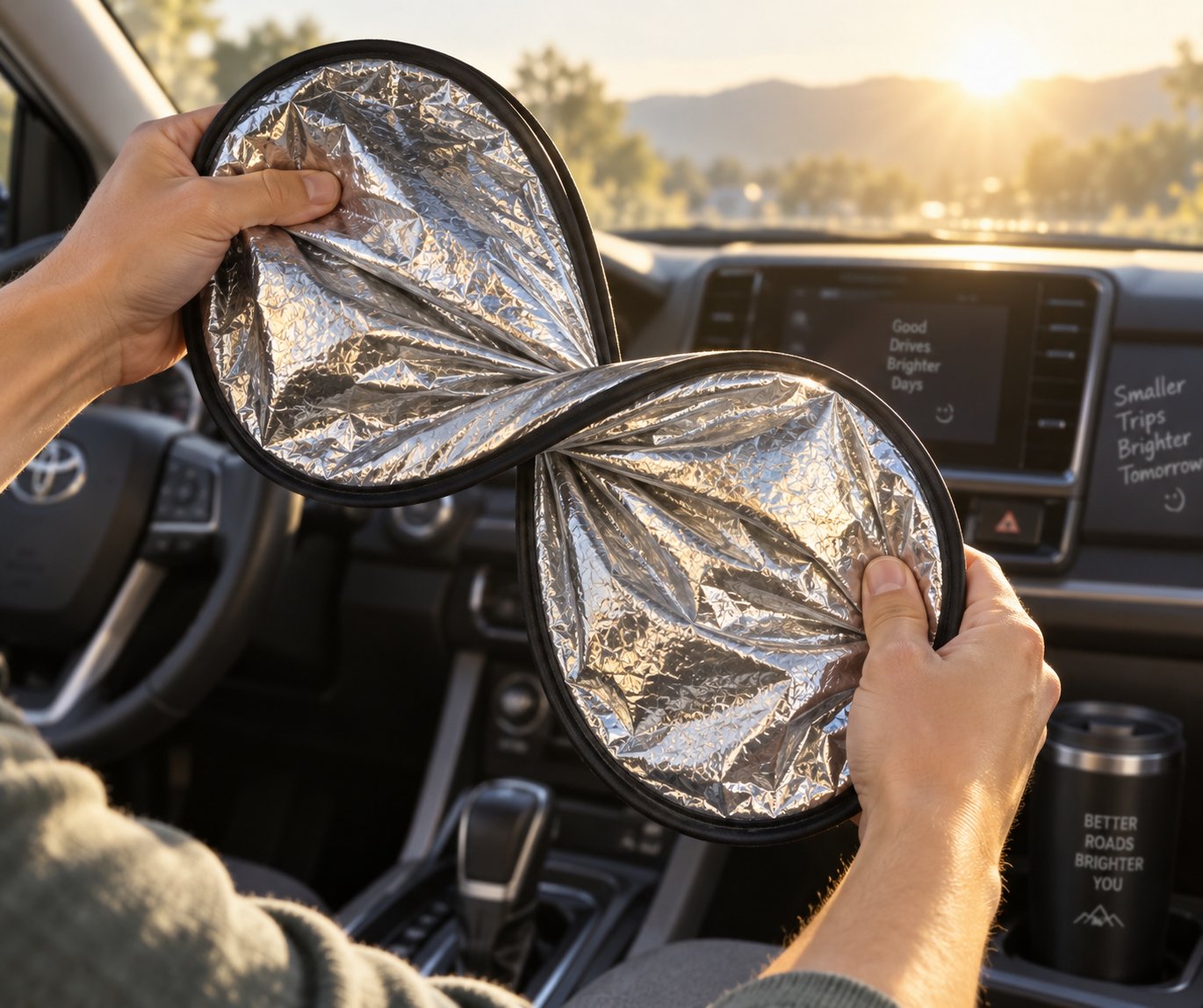
Your Quick-Reference Sunshade Folding Cheat Sheet
You just pulled your foldable sun shade off the windshield, and now it's fighting you in a parking lot like an angry spring-loaded octopus. Sound familiar? You're not alone. Car sun shade folding is one of those deceptively simple tasks that leaves millions of drivers sweating — sometimes literally — every summer. Bookmark this page, because the cheat sheet below gives you the answer in seconds.
30-Second Folding Cheat Sheet for Every Sunshade Type
| Sunshade Type | Folding Method | Key Tip |
|---|---|---|
| Pop-Up / Twist | Bring sides together into a "taco," then twist hands in opposite directions to create figure-eight loops that stack into circles. | The shade will resist — keep twisting. The wire wants to loop once you commit. |
| Accordion | Compress panels along the pre-set creases like closing a paper fan. | Start from one side and work across; don't try to squeeze the whole thing at once. |
| Roller / Retractable | Roll the shade back onto its bar, guiding the fabric evenly. | Keep tension even so the material doesn't bunch or crease on the roller. |
| Custom-Fit Rigid Panel | No folding needed — store flat. | Slide behind a seat or lay flat in the trunk to prevent warping. |
Why Most People Struggle With Sunshade Folding
If you've ever wondered how to fold a sun shade without it exploding back open, the culprit is almost always the spring-steel wire sewn into the perimeter. That wire stores rotational energy, and it desperately wants to return to its full, open circle. Forcing it flat — the instinct most people follow — fights the wire's natural mechanics and usually ends with the shade springing out of your hands.
The secret? You need to twist, not flatten. Once you understand that a folding sunshade collapses through rotation rather than compression, the whole process clicks. The steps ahead break down exactly how to fold sunshade types of every size, from compact side-window screens to oversized SUV shields. You'll also learn proper installation, orientation, troubleshooting for bent frames, and storage tips that keep your shade folding smoothly for years.
This guide covers every window position and every shade style — not just the standard windshield pop-up. Whether you're wrestling folding sun shades for car windows you've owned for years or unboxing a brand-new one, the right technique makes all the difference. And it starts with knowing exactly which type you're holding.
Step 1 – Identify Your Sunshade Type Before Folding
Grabbing a sunshade and immediately trying to fold it is like jumping into a recipe halfway through — you'll probably end up with a mess. Each shade type is built around a different structural principle, and the folding technique that works perfectly on one will completely fail on another. A quick visual inspection tells you everything you need to know.
Pop-Up Twist Shades vs. Accordion Panels vs. Roller Shades
Four broad categories cover nearly every collapsible car sun shade on the market. Here's how to tell them apart at a glance:
- Pop-up / twist shades: Pick up the shade and flex the edge. If it bends freely and springs right back into a round or oval shape, you're holding a pop-up twist shade. These have a continuous loop of flexible spring-steel wire sewn into a fabric perimeter. The wire gives the shade its signature "pop" when you open it — and that same springiness is what makes folding feel like a wrestling match. Collapsible auto sun shades like these are, by far, the most common style sold today.
- Accordion shades: Look for visible, pre-set creases running vertically across rigid or semi-rigid panels. When you hold one up, it looks like a large paper fan. Accordion auto sun shades compress along those factory fold lines and don't require any twisting at all. Hands-on testing by Car and Driver rated an accordion-style shade as the best overall pick, noting that it "couldn't be simpler" — though it still must be folded properly to fit back in its storage bag.
- Roller / retractable shades: If your shade winds onto a bar or rod, you have a retractable windshield shade. Some mount semi-permanently with adhesive hooks across the top of your windshield; others are standalone units you place and roll by hand. There's no twisting or creasing involved — you simply guide the fabric back onto the roller evenly.
- Custom-fit rigid panels: These are the outliers. Made from stiff foam, cardboard, or molded material, they're cut to match a specific vehicle's windshield shape. You won't fold them at all — they store flat behind a seat or in the trunk.
Still unsure? Here's a fast test: grab the shade by opposite edges and try to bend it into a taco. If it bows smoothly and the edge feels like a springy wire, it's a pop-up. If it resists bending and shows straight crease lines instead, it's an accordion. If it doesn't bend at all, it's a rigid panel.
How Construction Affects the Folding Method
Understanding why each technique works saves you from following the wrong instructions entirely. The difference comes down to how the shade stores energy.
A windshield sun shade foldable enough to fit into a small pouch relies on that spring-steel wire loop. The wire is a continuous ring of tempered metal that naturally wants to stay in one large circle. When you twist it, you're converting that single circle into two or three smaller, concentric loops — the wire's stored rotational energy actually helps you once you initiate the twist in the right direction. Fight the rotation, and the shade fights back. Work with it, and the loops practically fall into place.
Accordion panels, on the other hand, store zero rotational energy. Their creases act like hinges, and gravity does most of the work. You compress them the same way every time, and there's no trick to it beyond keeping the panels aligned.
Roller shades rely on a spring-loaded or manual spool. The fabric has no internal frame — it's the bar mechanism that does the heavy lifting. And rigid panels? They don't fold at all, which is both their biggest limitation and their simplest feature.
Pop-up twist shades dominate the market because they're lightweight, inexpensive, and compact when folded correctly. They're also the single most confusing type to collapse — which is exactly why the next section breaks the twist-and-fold technique into five deliberate moves anyone can follow.
Step 2 – Fold a Pop-Up Twist Sunshade Like a Pro
Here's the moment of truth. You've identified your shade as a pop-up twist type, you know the spring-steel wire stores rotational energy, and you understand that twisting — not flattening — is the key. So let's put hands on the shade and walk through exactly how to fold a car sunshade using the twist-and-fold technique that works on every pop up car sun shade on the market, from budget models to premium custom-fit options.
The Basic Twist-and-Fold Technique in 5 Moves
Clear a little space, take a breath, and follow these steps in order. The first two times will feel awkward. By the third attempt, your hands will remember the motion automatically.
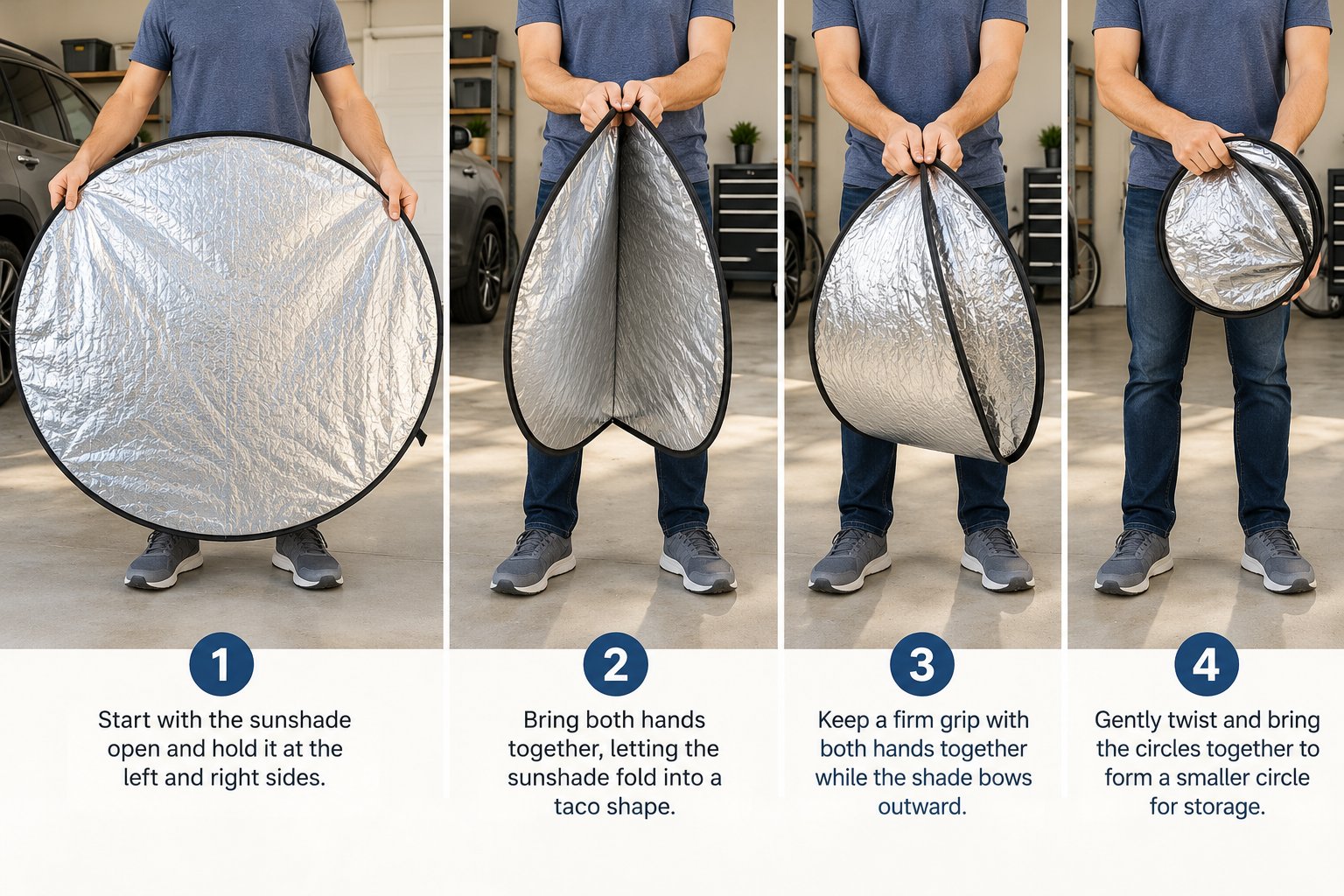
- Hold the shade vertically in front of you, gripping the sides at 3 o'clock and 9 o'clock. Stand up and let the shade hang like a steering wheel in front of your chest. Spread your fingers across the fabric-bound edge — not the wire itself. Pinching the wire at a single point creates a kink that stays even after you unfold. You want your palms pressing against the bound perimeter so the wire can move freely beneath the fabric.
- Bring your hands together so the shade bows outward into a taco shape. Imagine you're closing a book. As your hands move toward each other, the shade's center will push away from you, forming a deep U-shape or "taco." This step compresses the shade's width and sets up the rotational force you'll use next. Don't rush — the taco shape is your launching pad.
- Twist one hand forward and the other backward. This is the only counterintuitive part of the entire process. Your left hand rotates the wire edge away from your body while your right hand simultaneously rotates toward you — or vice versa. The direction doesn't matter as long as your hands rotate in opposite directions. The shade will buckle into a figure-eight shape on its own. You're not muscling it into position; the spring-steel wire wants to form that figure-eight once you initiate opposing rotation.
- Tuck the emerging loops together so they stack into concentric circles. As the figure-eight forms, the two lobes will naturally want to overlap. Guide them on top of each other so they nest like concentric rings. Most standard-size shades collapse into two or three stacked loops roughly one-third the diameter of the fully open shade.
- Secure with the elastic band or slide into the storage pouch immediately. Hold the stacked loops firmly with one hand and slip the disc into its storage bag or snap the elastic strap around it with the other. This step matters more than you'd think — the spring-steel wire is still loaded with tension, and without the pouch or band keeping those loops nested, the shade will spring back open within seconds.
Total time once you've practiced twice? Roughly eight to ten seconds. That number isn't an exaggeration — it's simply how fast the twist-fold mechanic works once your muscle memory catches up to the physics.
Adjustments for Stiff or Brand-New Shades
Bought a brand-new pop up auto sun shade and the twist technique feels impossibly stiff? You're not doing anything wrong. Fresh-out-of-the-box shades resist folding because the spring-steel wire hasn't been "broken in" yet. The wire's temper is at full strength, and the fabric binding is still tight around it, adding friction to every rotation.
A few targeted adjustments make all the difference:
- Pre-flex the wire before attempting the twist. Run both hands slowly around the entire perimeter, gently bending the wire back and forth at small intervals. You're not trying to weaken it — just loosening the wire's resistance to rotation within the binding. Thirty seconds of flexing can dramatically reduce the effort needed for your first fold.
- Brace the bottom edge against your hip for leverage. If the shade is too stiff to twist with arms alone, press the bottom of the shade against your hip bone and use your body as an anchor point. This gives your twisting hand a stable base to push against, effectively doubling your mechanical advantage.
- Try the opposite twist direction. Some car sun shade pop up models have a wire frame that favors one rotational direction over the other. If the shade is fighting you hard, release it fully, reset to the taco position, and reverse which hand goes forward and which goes backward. One direction will feel noticeably easier.
If the shade fights back, you're twisting in the right direction — keep going, the wire will give.
That counterintuitive truth trips up almost everyone on their first try. The resistance you feel is stored spring energy building up right before the wire buckles into the figure-eight. Stopping at that moment of peak resistance — which feels like something is about to break — means you're abandoning the fold one second before it would have worked. Commit to the twist, and the wire snaps into its folded shape with a satisfying pop.
One more thing worth knowing: if you've just pulled the shade off a sun-baked dashboard, give it 60 seconds to cool down before folding. The reflective layer reaches peak softness when hot, and folding it immediately can create micro-creases in the coating that become permanent within hours. A brief cooldown in the shade protects the surface and makes learning how to fold auto twist sunshade models far more forgiving on the material itself.
The twist sun shade technique handles the vast majority of shades drivers encounter. But pop-up shades aren't the only type sitting in back seats and trunks across the country — accordion and rigid panel shades require an entirely different approach, one that's actually much simpler once you know the ground rules.
Step 3 – Fold Accordion and Panel Windshield Shades
If the twist-and-fold technique for pop-up shades felt like learning a magic trick, folding an accordion sun shade will feel like a well-deserved break. There's no spring-steel wire, no rotational energy, and no figure-eight gymnastics. The creases are already built into the shade — your only job is to follow them.
Folding an Accordion Windshield Shade Step by Step
An accordion windshield shade uses pre-set vertical creases that alternate direction, exactly like a paper fan. Those factory fold lines never disappear, which means the shade "remembers" how to collapse every single time. Here's how to work with that design instead of against it:
- Remove the shade from the windshield and hold it vertically. Peel the shade away from the glass, letting it hang in front of you. Holding it vertically lets gravity pull the panels downward evenly, which prevents any section from bunching up before you start compressing.
- Starting from one side, compress the panels together along the existing fold lines — like closing a paper fan. Place one hand on the far-left (or far-right) panel and begin pushing it toward the center. Each crease will naturally hinge inward or outward based on its factory direction. You'll feel a satisfying accordion rhythm as each panel clicks against the next. Don't grab the middle and try to squeeze everything at once — that crumples the panels and makes the shade bulge unevenly.
- Once fully compressed, the shade should form a narrow rectangle. If any panel is sticking out at an odd angle, pull it back slightly and re-fold it along its crease. A properly compressed car accordion sunshade ends up roughly the width of a single panel — typically four to six inches wide.
- Secure with the included strap or rubber band. Most accordion car sun shade models ship with an elastic band or a Velcro strap. Wrap it around the compressed rectangle immediately so the panels don't fan back open in your hands. If your shade didn't come with a strap, a simple rubber band or hair tie works perfectly.
The entire process takes about five seconds — no exaggeration. Because the creases do all the structural work, there's virtually no learning curve. Even a windshield accordion sunshade you've never touched before will telegraph its fold pattern the moment you pick it up. You'll notice the creases alternate like a zigzag, and your hands just follow the path that's already there.
One small detail worth noting: over time, some accordion sunshade for car windshield models develop "lazy" creases near the center panels, especially if they've been stored flat or pressed under heavy cargo. If a couple of panels refuse to fold cleanly, run your thumb firmly along the crease line to re-establish the hinge. A quick re-crease brings the fold back to factory sharpness.
Handling Rigid Static Panel Shades
Not every shade folds at all — and that's by design. Custom-fit panel shades made from rigid foam, dense cardboard, or molded insulation are cut to match a specific vehicle's windshield dimensions exactly. They don't compress, twist, or roll. You simply lift them off the glass and store them flat.
Where should they go? The best spot is behind the driver or passenger seat, slid vertically between the seatback and the rear cushion. If your vehicle has enough trunk space, laying the panel flat on the trunk floor works too. The key is keeping it flat — leaning it at an angle or wedging it into a tight gap can warp the foam core over time, and a warped panel won't sit flush against the windshield when you reinstall it.
Rigid panels and accordion shades serve the same purpose but suit different priorities. Here's how they compare:
| Feature | Accordion Windshield Sun Shade | Rigid Custom-Fit Panel |
|---|---|---|
| Foldability | Compresses to a narrow rectangle | Does not fold — stores flat |
| Fit | Universal sizes; some edge gaps | Vehicle-specific; near-perfect coverage |
| UV Coverage | Good, but gaps reduce effectiveness | Excellent edge-to-edge protection |
| Price | Budget-friendly ($10–$20) | Higher ($30–$90+) |
| Storage Footprint | Compact; fits in a door pocket | Large; requires dedicated flat space |
If convenience and portability matter most, an accordion shade wins every time. If you want maximum UV blocking and a seamless fit — especially on vehicles with unusually shaped windshields — a rigid custom-fit panel is the better investment. Products like the Covercraft UVS100, for example, use a triple-layer rigid construction that reflects heat outward while insulating the cabin, and they fold accordion-style into a compact shape despite their sturdy build.
Accordion and rigid panel shades are straightforward to manage, but they represent only part of the challenge drivers face. Larger vehicles introduce a different kind of difficulty — not a different shade type, but a dramatically different scale that demands modified hand positions and a bit more physical strategy.
Step 4 – Handle Oversized SUV and Truck Sunshades
Everything you just learned about folding accordion and pop-up shades still applies here — with one critical caveat. Scale changes everything. A foldable windshield sunshade designed for a full-size SUV or pickup truck isn't just a bigger version of a sedan shade. It's a fundamentally more demanding piece of equipment to wrestle into a pouch, and the standard mid-air twist technique can leave you genuinely struggling if you don't adjust your approach.
Why Large-Vehicle Sunshades Are Harder to Fold
Imagine stretching a rubber band to twice its normal length. It snaps back harder, right? The same principle governs oversized sunshades. SUV and truck windshields can be 30 to 50 percent wider than a typical sedan's, which means the spring-steel wire loop running through the shade's perimeter is significantly longer. That extra length translates directly into more stored tension, a stiffer resistance to twisting, and a much stronger "snap-back" force when you lose control mid-fold.
A standard sedan windshield shade might span 55 to 60 inches across. A foldable car windshield sun shade built for a Chevy Suburban, Ford Expedition, or Ram 1500 can easily stretch beyond 70 inches — sometimes approaching 75. That additional 15 to 20 inches of wire doesn't just add a proportional amount of difficulty. Because spring-steel tension increases exponentially with length, a shade that's 25 percent wider can feel nearly twice as stiff when you try to initiate the twist. Your arm span may not even reach both edges comfortably, and holding the shade in the air while twisting becomes an exercise in controlled chaos.
There's a physical reality here that smaller-shade instructions never mention: if you can't span the shade comfortably with both arms, you lose the leverage needed to initiate opposing rotation. Your hands end up too close together, the twist doesn't propagate evenly through the wire, and the shade buckles unpredictably instead of forming a clean figure-eight. That's why the standard "hold it up and twist" method needs a deliberate modification for anything designed to cover a large-vehicle windshield.
Modified Twist Technique for Oversized Shades
The core mechanic — opposing rotation creating a figure-eight — remains identical. What changes is your body positioning and the surface you use. Here's the adjusted method for car windshield sun shade folding on larger vehicles:
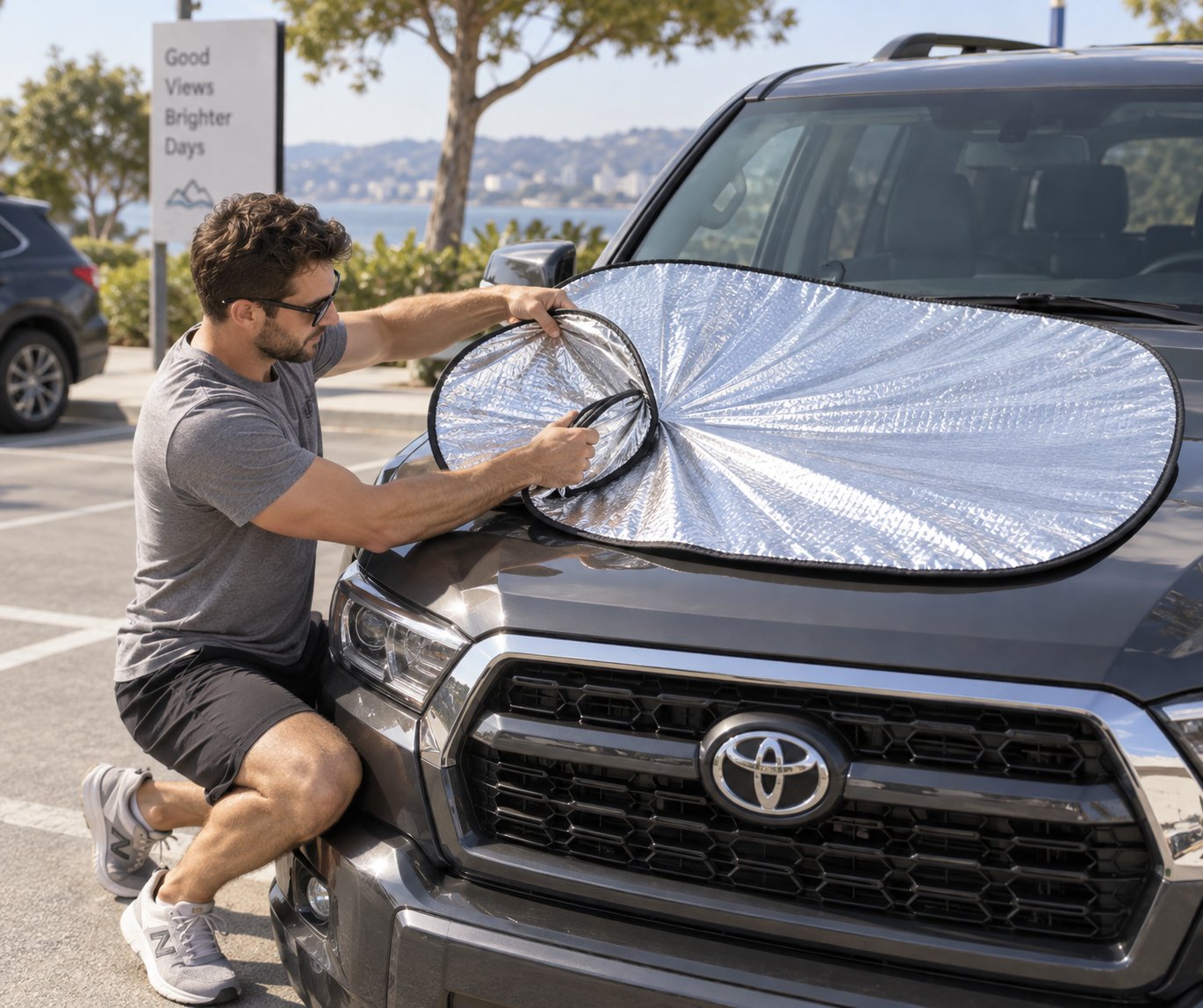
- Lay the shade on a flat surface like the hood of your vehicle or a garage floor instead of holding it in the air. A flat surface gives you something the mid-air technique can't: friction. The shade can't spring away from you when it's pressed against a stable base. Your car's hood works well in a parking lot, and a garage floor or large table is even better at home. Avoid rough asphalt — it can scuff the reflective coating.
- Place one hand at the top center and the other at the bottom center — not at the sides. This is the key departure from the standard technique. On a sedan shade, gripping at 3 o'clock and 9 o'clock works because your arms can span the width. On an oversized shade, switching to 12 o'clock and 6 o'clock lets you apply force along the shorter vertical axis, where the wire is more compliant and your reach is more than adequate.
- Push the top hand forward and pull the bottom hand toward you to initiate the twist. With the shade flat on a surface, this motion feels more like rolling dough than wrestling a spring. The surface provides friction that stabilizes the lower half while your top hand drives the rotation. You'll feel the wire begin to buckle into the figure-eight shape within two to three seconds.
- Use your knee or hip to hold one loop in place while you tuck the second loop on top. Here's where body mechanics save the day. As the figure-eight forms, press one loop firmly against the surface with your knee, hip, or forearm. This frees both hands to guide the second loop on top of the first. Without this anchoring step, the tension in the wire often springs the first loop open the instant you reach for the second.
- Secure immediately with both hands before the tension releases. Grab the stacked loops with one hand and snap the elastic strap or slide the shade into its pouch with the other. Speed matters — oversized shades store substantially more energy than their sedan counterparts, and even a one-second delay can let the loops separate and spring open. If your shade came with a storage pouch, hold the pouch open on the surface and slide the folded shade directly into it rather than lifting it first.
If your shade is larger than your arm span, never try to fold it mid-air — use a flat surface for control.
That single adjustment — moving from air to surface — eliminates roughly 80 percent of the frustration drivers experience with folding windshield sun shade models built for trucks and SUVs. The flat surface acts as a third hand, providing the stability your body can't offer when the shade's dimensions exceed your comfortable reach.
A couple of extra tips specific to large-vehicle shades are worth keeping in your back pocket. First, if you drive a vehicle with a steeply raked windshield — common on modern SUVs — the foldable windshield shade may have an asymmetric shape, with one edge noticeably longer than the other. When you lay it flat, orient the longer edge away from you so you're pushing the heavier side during the twist. This distributes the wire tension more evenly and produces a cleaner fold. Second, windshield sun shade folding on oversized models often produces three nested loops instead of two. That's completely normal — the extra wire length needs somewhere to go, and a third loop keeps each ring smaller and more manageable.
Large-vehicle shades demand a bit more strategy, but the payoff is the same satisfying collapse into a compact disc that slides neatly behind a seat. The real surprise for most drivers? The technique scales in the opposite direction just as well — smaller side-window and rear-window shades use the exact same twist principle but shrink the motion down to a quick, one-handed flick.
Step 5 – How to Fold Up Car Window Shades for Side and Rear Glass
Most folding guides stop at the windshield and call it a day. But if you've ever bought a set of foldable car window shades — the kind that suction-cup onto rear doors or clip into the backseat — you know those smaller panels need folding too. The good news? The same twist mechanic you've already practiced applies here, just scaled down to a size your hands can manage far more easily.
Folding Pop-Up Side Window Shades
A pop up car shade designed for a side window uses the exact same spring-steel wire perimeter as its windshield cousin. The difference is purely dimensional — most side shades measure 17 to 21 inches across, roughly a third the span of a full windshield shade. That smaller circumference means less stored wire tension, a lighter frame, and a twist you can execute with a single hand once you get the feel for it.
Here are a few tips for folding car window shades on the side glass quickly and cleanly:
- Grip the shade at 12 o'clock and 6 o'clock — top and bottom — rather than at the sides. On a small circle, a vertical grip gives you better rotational leverage because your wrist naturally twists along that axis.
- Twist inward with a quick, confident flick. Hesitating mid-twist is what lets the shade spring back. Because the wire loop is short, one decisive inward rotation collapses it into a single compact circle — no figure-eight, no multiple loops, just one neat disc about six inches across.
- Palm the folded disc immediately. Side shades are small enough to fly out of your grip if you loosen your hold for even a second. Cup the folded circle in one hand and slip it into its pouch or stack it with the matching shade from the opposite window.
The entire motion takes about two seconds. Once you've figured out how to fold window shades for car side glass, you'll wonder why you ever struggled — the compact size makes these the most forgiving foldable window shades to practice on before tackling a full windshield shade.
Rear Window Shade Folding and Removal
Rear windows sit in a middle ground between side glass and windshields, and so do the shades that cover them. Two distinct subtypes show up in most vehicles:
- Suction-cup static shades: These flat, semi-rigid screens attach to the glass with small suction cups and have no wire frame at all. Folding isn't part of the equation — just peel them off, stack them flat, and slide them into a door pocket or seat-back organizer. They're essentially a foldable car shade cover in name only, since they store flat without any collapsing.
- Pop-up rear shades: These work identically to windshield pop-up shades. The twist-and-fold technique from Step 2 applies without modification. Rear shades are typically wider than side shades but narrower than windshield models, so the stiffness level falls somewhere in between — manageable mid-air for most people, though laying the shade on a seat makes the twist even easier.
Worth mentioning: some vehicles come with built-in retractable rear sunshades that roll into the rear deck at the push of a button or a manual pull. Models from Audi, Lexus, BMW, and several others include these as factory options. If your rear shade retracts into a housing below the rear window, there's nothing to fold — it simply rolls home on its own mechanism.
Side and rear shades round out the full set of windows in your vehicle, but knowing how to fold them is only half the equation. The way you install your shade — which side faces the glass, how snugly you position it, and whether you tuck or bend the edges — directly affects how smoothly it comes off and how cooperatively it folds afterward.
Step 6 – Set Up Your Sunshade Correctly Before Folding
Here's something most people never connect: the way you install your sunshade directly determines how easily it comes off — and how cooperatively it folds. Jam it in crooked, bend the edges to force a fit, or slap it up with the wrong side facing the glass, and you're setting yourself up for a frustrating removal that warps the frame before the folding even begins. A clean installation creates a clean removal, and a clean removal creates a smooth fold. It's a chain reaction that starts the moment you place the shade against the windshield.
Which Side of the Sunshade Faces Out
This might be the single most common question drivers ask about sunshades — and getting it wrong doesn't just reduce performance, it can cut your shade's heat-blocking ability in half. So which side of sunshade faces out? The answer is simple: the reflective, shiny, metallic side always faces outward toward the sun.
That reflective surface is engineered to bounce solar radiation away from your vehicle before it passes through the glass and heats the cabin. The matte, colored, or printed side faces inward toward you — it's cosmetic, not functional. If you've ever wondered which side of the sun shade faces out and accidentally installed it backward, you probably noticed your car was still uncomfortably hot. That's because the matte side absorbs heat instead of reflecting it, essentially turning your shade into a blanket draped over the dashboard.
Reflective side out, decorative side in — this maximizes heat rejection by bouncing UV rays before they enter the cabin.
On most shades, the distinction is obvious at a glance. One side gleams like aluminum foil, and the other is black, patterned, or branded. A few premium shades use dual-reflective surfaces — silver on both sides — in which case either orientation works equally well. But for the vast majority of car sun shade which side faces out questions, the rule holds: shiny toward the sun, matte toward the interior.
How to Install a Sunshade Properly for Easy Removal and Folding
Knowing how to use car sun shade products properly isn't just about heat protection — it's about preserving the wire frame so folding stays easy for years. A shade that's been crammed, bent, or wedged into place picks up stress points in the wire that make the twist-and-fold technique harder every single time. Here's the correct way to put sun visor in car position for a clean fit:
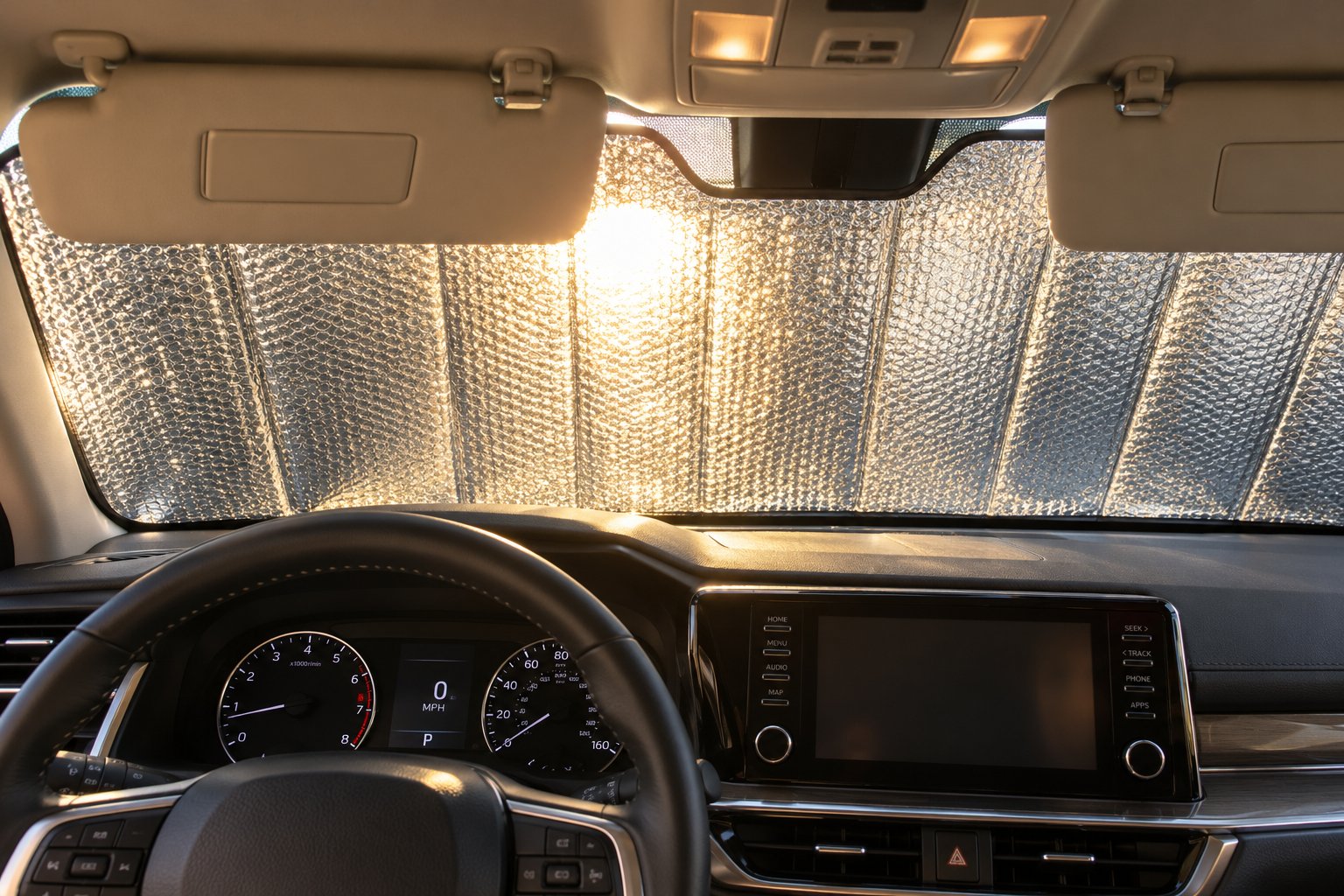
- Position the shade against the inside of the windshield with the reflective side facing the glass. Hold the shade up with both hands and press it flush against the interior surface of the windshield. The car windshield sun shade which side faces out question is already answered — shiny side toward the glass, which means toward the sun. Let the shade's natural shape conform to the curvature of the windshield rather than forcing it flat.
- Tuck the top edge behind the sun visors to hold it in place. Flip both sun visors down, then slide the shade's top edge behind them. The visors act as clamps, pinning the shade against the glass without any suction cups or clips. This is how to use a windshield sun shade on most vehicles — the visors provide all the support you need.
- For custom-fit shades, align the shape to the windshield perimeter for full coverage. Custom-fit models are cut to match your exact windshield dimensions, so they shouldn't need tucking, bending, or trimming. Simply press the shade into position and let its contoured edges sit naturally against the glass. The closer the fit, the fewer gaps for heat to sneak through — and the less stress you place on the frame during installation and removal.
That third point is where vehicle-specific shades offer a real advantage over universal options. Generic shades often require aggressive tucking or bending to cover the full windshield, and that repeated deformation gradually weakens the wire frame. Custom-fit shades eliminate the problem entirely because the frame already matches the glass curvature.
Tesla owners feel this difference more than most. Tesla's panoramic glass roofs and expansive windshields are significantly larger and more uniquely shaped than conventional vehicles, which means universal shades rarely provide adequate coverage. Gaps along the edges let heat pour in, and forcing an ill-fitting shade to stay put warps both the wire and the reflective coating. CUTIM's Tesla sunshade collection addresses this directly with shades purpose-built for specific Tesla models — covering the glass roof, windshield, and rear window with frames shaped to match Tesla's distinctive glass geometry. The result is a shade that drops into place without tucking or bending, comes off cleanly, and folds predictably because the wire frame hasn't been stressed by a poor fit.
Whether you drive a Tesla or a ten-year-old sedan, the principle is the same: a shade that fits properly installs in seconds, removes without resistance, and folds more easily because its frame stays in factory condition. But what happens when the frame doesn't stay in factory condition? Bent wires, kinked perimeters, and shades that refuse to twist — those problems are more fixable than you might think.
Step 7 – Fix Bent Frames and Troubleshoot Folding Problems
A shade that once folded smoothly but now fights you at every step isn't broken — it's kinked. Repeated incorrect folding, rough storage, or one bad wrestling match in a parking lot can bend the spring-steel wire at a single point, creating a flat spot that disrupts the entire twist mechanic. The good news? Most kinks are reversible if you catch them before the wire permanently deforms. And nearly every frustrating folding failure traces back to one of a handful of predictable mistakes you can stop making right now.
How to Fix a Kinked or Bent Wire Frame
Ever tried to fold a car shade and felt the wire "catch" at one spot instead of flowing into the figure-eight? That catch is almost certainly a kink — a localized flat spot where the wire lost its natural curve. It happens most often when someone forces the shade into a flat fold instead of twisting it, or when the shade gets wedged under heavy cargo in a trunk for weeks. The wire bends sharply at one point rather than curving evenly, and that single disruption throws off the entire rotational fold.
Here's how to diagnose and repair it:
- Locate the kink by running your hands slowly along the wire perimeter. Unfold the shade completely and lay it flat on the floor or a table. Starting at any point, slide your fingers along the fabric-bound edge, feeling for the wire beneath. A healthy wire feels like a smooth, continuous curve. A kink feels like a subtle angle — a spot where the wire changes direction abruptly instead of arcing gently. Mark that spot mentally or with a small piece of tape so you don't lose it.
- Gently flex the wire back and forth at the kink point to restore its curve. Hold the shade on either side of the kink, about four to six inches apart, and rock the wire slowly in alternating directions. You're coaxing the metal back into its original arc — not forcing it straight. Think of it like working a crease out of a garden hose. Small, patient movements over 30 to 60 seconds gradually restore the curve. Do not grab the kink and yank it in one direction. That creates a new kink in the opposite orientation, and you'll end up chasing flat spots around the entire perimeter.
- Reshape the shade into a full circle on a flat surface to verify the wire is round again. After working the kink, open the shade fully and let it rest on a flat surface. Step back and look at the overall shape. A properly restored wire will hold an even oval or circle with no visible corners, dips, or flat edges. If you spot another irregularity, repeat the flexing process at that point.
- Attempt the twist fold to test the repair. Run through the standard twist-and-fold technique. A successfully repaired wire will buckle into the figure-eight smoothly, without catching or resisting at the old kink location. If the shade still fights you at that same spot, the wire may be permanently deformed — tempered spring steel can only be re-bent so many times before it loses its elasticity at the stress point. At that stage, the shade will still work as a sunshade, but folding it neatly becomes a losing battle, and replacement is the practical next step.
One detail worth noting: if you're wondering how to fold sun shade models that have multiple kinks — say, from being stored crumpled in a footwell for an entire summer — the repair process is the same, just repeated at each trouble spot. Work from the most severe kink to the least, and re-test the fold after each correction. Sometimes fixing one kink resolves a second one automatically, because the restored curve allows the wire to distribute tension evenly again.
Common Folding Mistakes and How to Avoid Them
Most folding frustrations aren't caused by defective shades. They're caused by a small number of repeated mistakes that compound over time. Learning how to fold windshield covers and pop-up shades correctly is partly technique — and partly unlearning habits that feel logical but actively damage the frame. Here are the four most common errors, what they do to your shade, and how to fix each one:
| Mistake | What Happens | Fix |
|---|---|---|
| Twisting in the wrong direction | The shade fights back aggressively, resisting the fold at every point. You feel like you need twice the strength, and the wire bows unpredictably instead of forming a clean figure-eight. | Reverse your twist. Release the shade fully, reset to the taco position, and switch which hand rotates forward and which rotates backward. One direction will click almost immediately. |
| Forcing a flat fold instead of twisting | The wire kinks at the points where you press it flat, creating permanent flat spots that resist future folds. Over several flat-fold attempts, the wire accumulates enough kinks to make the shade nearly impossible to collapse properly. | Always twist — never flatten. The spring-steel wire is designed to rotate into loops, not compress into a rectangle. If you catch yourself pressing the shade flat, stop and switch to the opposing-rotation technique. |
| Storing under heavy objects | Sustained pressure deforms the wire over time, gradually reshaping it from a circle into an irregular oval or flattened ellipse. The shade still opens, but it no longer folds symmetrically because the wire tension is uneven. | Store the shade upright behind a seat, in its included pouch, or in a door pocket. Never stack luggage, groceries, or toolboxes on top of a folded shade in the trunk. |
| Pulling the shade through a too-small gap | Dragging the shade between the seat and center console — or yanking it through a narrow opening — tears the binding stitches along the edge. Once those stitches fail, the wire can poke through the fabric, scratching your windshield and making the shade uncomfortable to handle. | Remove the shade fully from its installed position before attempting to fold. Give yourself clear space — don't try to fold it while it's still half-tucked behind a visor or wedged against the dashboard. |
That last mistake — pulling through tight gaps — causes more long-term damage than most drivers realize. The binding stitches that wrap the fabric around the wire are the shade's most vulnerable structural element. Once the stitching tears at even one point, the wire begins to migrate through the opening. You'll feel a sharp metal edge where there used to be smooth fabric, and that exposed wire will scratch any surface it contacts, including the inside of your windshield. A quick check of your shade's edge stitching every few months catches small tears before they become irreparable.
If you're still struggling with how to fold windshield sun shade models after correcting these mistakes, consider one more possibility: the shade might simply be the wrong size for your windshield. An oversized shade that's been bent and crammed to fit a smaller windshield picks up frame distortion with every installation. A shade that's too small, on the other hand, gets stretched and pulled to cover gaps, stressing the wire in directions it wasn't engineered to handle. Either mismatch accelerates wear on the frame and makes folding progressively harder over time.
Knowing how to fold car shades properly — and how to fix them when something goes wrong — keeps your current shade functional far longer than most people expect. But every shade has a lifespan, and there are clear signals that tell you when repair stops being worthwhile and replacement becomes the smarter move.
Step 8 – Store, Maintain, and Choose a Foldable Car Sun Shade Built to Last
A shade that folds perfectly today can become a nightmare six months from now — not because your technique changed, but because poor storage slowly destroyed the wire frame while you weren't looking. The way you stow your sunshade between uses, the warning signs you watch for, and the shade you choose in the first place all determine how long that satisfying twist-and-fold motion keeps working.
Where and How to Store Your Sunshade in the Vehicle
You've nailed the fold. The shade is sitting in a neat disc in your hands. Where does it go? The storage spot you pick matters more than most drivers realize — heat, pressure, and positioning all affect the wire frame's longevity. Here are the best options ranked by accessibility:
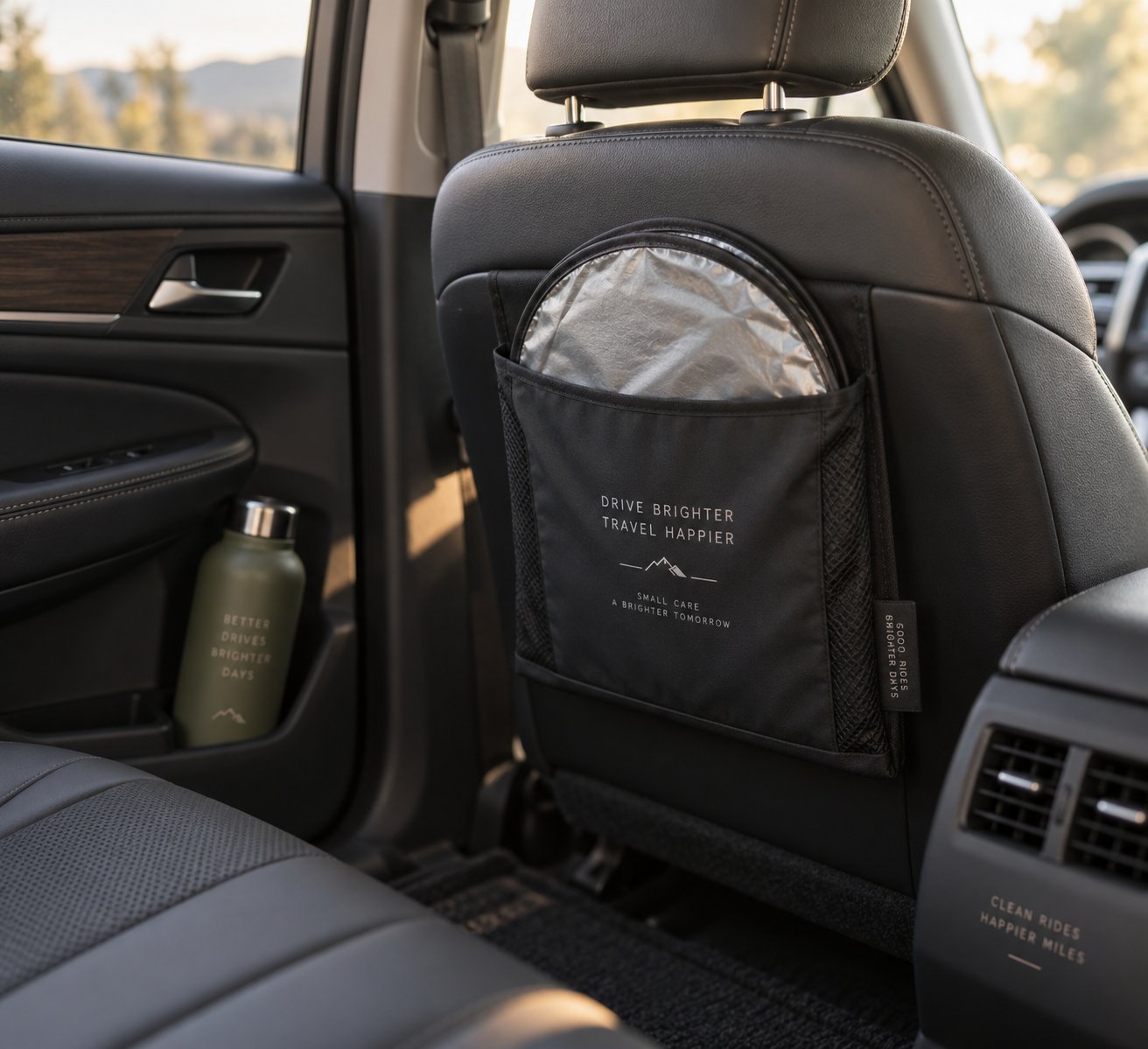
- Behind the driver or passenger seat: Slide the folded shade vertically between the seatback and the rear seat cushion. This is the most accessible spot — you can reach back, grab it, and deploy it in seconds. The shade stays flat, upright, and protected from pressure.
- In the included storage pouch in the trunk: If your foldable sunshade for car windows came with a pouch or bag, use it. The pouch prevents the reflective coating from scuffing against rough trunk surfaces, and it keeps the elastic strap from snagging on other cargo. Lay the pouch flat on the trunk floor rather than wedging it against a sidewall.
- In the door pocket for smaller side shades: Folding sun shade cars models designed for side windows are compact enough to drop into a standard door pocket. Stack left and right shades together so they don't rattle around individually.
Two storage habits will quietly ruin your shade over time. First, avoid leaving a folded shade sitting in direct sunlight — on a rear shelf, for example — when it's not actively covering a window. Prolonged heat exposure weakens the spring-steel wire's temper, gradually reducing the tension that makes the twist fold work. Second, don't leave a shade tightly folded for months in a scorching trunk without ever opening it. Extended compression in high heat can cause the wire to "set" in its folded shape, creating permanent deformation that prevents the shade from popping open to its full size. Even during off-season months, unfold your shade once every few weeks and let it spring open fully to reset the wire's memory.
Maintenance beyond storage is refreshingly minimal. A dirty shade reflects less sunlight and looks grungy, but cleaning it takes about 30 seconds — wipe the reflective surface with a damp cloth or paper towel, let it air dry, and you're done. No special cleaners, no scrubbing. That's it.
Signs Your Sunshade Needs Replacing
Every car sunshade foldable or rigid has a functional lifespan. Sometimes the fade is gradual, and you don't notice until folding becomes an unreasonable chore. Other times, a single event — a trunk full of heavy groceries, a dog scratching across the surface — delivers the finishing blow. Here's your replacement checklist:
- The wire no longer holds a circular shape when unfolded. If your shade opens into a lopsided oval, a lumpy blob, or a shape with visible flat spots that won't flex back to round, the wire has permanently deformed. A misshapen wire won't twist cleanly into the figure-eight, and no amount of re-bending will fully restore it.
- The reflective coating is peeling, cracked, or flaking off. That metallic layer is your shade's primary defense against solar radiation. Once it degrades, the shade absorbs heat instead of reflecting it. Testing by Popular Mechanics demonstrated that a properly reflective shade can keep a car's interior up to 30 degrees cooler after an hour in direct sun — a benefit that disappears when the reflective surface fails.
- The binding stitches along the edge are torn. Exposed wire poking through frayed stitching will scratch your windshield glass, your dashboard, and your hands. Once the stitching fails at one point, it tends to unravel progressively along the perimeter.
- The shade no longer fits the windshield after deformation. A warped frame creates gaps between the shade and the glass, letting heat flood through the edges and reducing overall effectiveness. If your collapsible windshield sun shade has shrunk or distorted enough that it leaves an inch or more of exposed glass on any side, the fit has been compromised beyond recovery.
Hitting even one of these marks means your shade has moved from "functional tool" to "frustrating clutter." Replacing it is cheaper and faster than fighting a damaged frame every time you park.
Choosing a Sunshade That Folds Easily and Lasts
Not all shades are created equal, and the one you buy determines how many headache-free folds you'll get over its lifetime. The single biggest factor? Fit. A customized car sun shade designed for your specific vehicle model maintains its shape longer and folds more predictably than a universal one-size option, because the wire frame matches your windshield's exact curvature. There's no tucking, no bending, and no stress points accumulating with every installation — which means the wire stays round, the fold stays clean, and the shade lasts years instead of months.
For Tesla owners, the fit question is especially critical. Tesla's panoramic glass roofs and uniquely contoured windshields are larger and more irregularly shaped than conventional vehicles, making most universal shades a poor match. CUTIM's Tesla sunshade collection offers glass roof, windshield, and rear window shades purpose-built for specific Tesla models — engineered for UV protection and heat control with frames designed for easy folding and long-term durability. It's a practical example of how vehicle-specific design solves both the coverage problem and the folding problem in one purchase.
When shopping for your next foldable anti UV windshield sunshade — whether for a Tesla or any other vehicle — evaluate these criteria before committing:
- Custom-fit for your vehicle model (e.g., CUTIM for Tesla) — ensures precise coverage, no forced bending, and a wire frame that folds the same way every time.
- Quality reflective coating — look for multi-layer metallic film rather than single-layer foil, which peels and cracks faster under UV exposure.
- Reinforced wire frame — thicker, well-tempered spring steel resists kinking and maintains its circular shape through hundreds of fold cycles.
- Included storage pouch — a dedicated pouch protects the reflective surface, prevents the shade from getting crushed under cargo, and gives you a target to slide the folded disc into immediately after the twist.
A foldable car sun shade that checks all four boxes will fold predictably on the first try and the five-hundredth. Invest in the right shade upfront, store it properly between uses, and the twist-and-fold technique you've learned in this guide will feel effortless every time you step out of the car — no more parking-lot wrestling matches, no more YouTube rabbit holes, and no more shoving a mangled shade behind the seat in defeat. Just a clean twist, a satisfying pop, and a shade that slides into its pouch like it was never any trouble at all.
Frequently Asked Questions About Folding Car Sunshades
1. Why does my car sunshade keep popping back open when I try to fold it?
The spring-steel wire sewn into the perimeter stores rotational energy and naturally wants to stay in a full open circle. Most people instinctively try to flatten the shade, which fights the wire's mechanics. The correct approach is to twist — bring the sides together into a taco shape, then rotate your hands in opposite directions so the shade buckles into a figure-eight that stacks into compact loops. Once you commit to the twist past the point of peak resistance, the wire snaps into its folded position on its own.
2. Which side of a car sunshade should face the windshield?
The reflective, shiny metallic side should always face outward toward the sun — meaning it presses against the interior surface of the windshield glass. This reflective layer bounces solar radiation away from your vehicle before it heats the cabin. The matte, colored, or printed side faces inward toward the dashboard. Installing it backward significantly reduces heat rejection because the matte surface absorbs warmth instead of reflecting it.
3. How do I fold a large SUV or truck sunshade that's wider than my arm span?
Oversized shades require a modified technique. Lay the shade on a flat surface such as your vehicle's hood or a garage floor instead of holding it mid-air. Place one hand at the top center and the other at the bottom center, then push the top hand forward while pulling the bottom hand toward you. Use your knee or hip to anchor one loop while tucking the second on top. The flat surface acts as a third hand, providing stability that your arms alone cannot offer on shades wider than roughly 70 inches.
4. Can I fix a sunshade with a bent or kinked wire frame?
Yes, most kinks are repairable if caught early. Run your fingers along the wire perimeter to locate the flat spot, then gently flex the wire back and forth at that point for 30 to 60 seconds to restore its natural curve. Avoid yanking the wire in one direction, as that creates a new kink. After working the bend out, open the shade fully on a flat surface to verify it holds an even circular shape. If the kink persists after repeated attempts, the wire may be permanently deformed and replacement becomes the practical option.
5. How should I store my car sunshade to keep it in good condition?
Slide the folded shade vertically behind the driver or passenger seat for easy access, or keep it in its included storage pouch in the trunk. Avoid storing it under heavy objects, which deform the wire frame over time, and don't leave it tightly folded in a hot trunk for months without unfolding it occasionally. Extended heat and compression can cause the wire to permanently set in its folded shape. For Tesla owners needing precise-fit shades that hold their shape longer, CUTIM's Tesla sunshade collection offers model-specific options designed for easy folding and durable storage.