
What Tesla Owners Really Want to Know About Glass Roof Heat
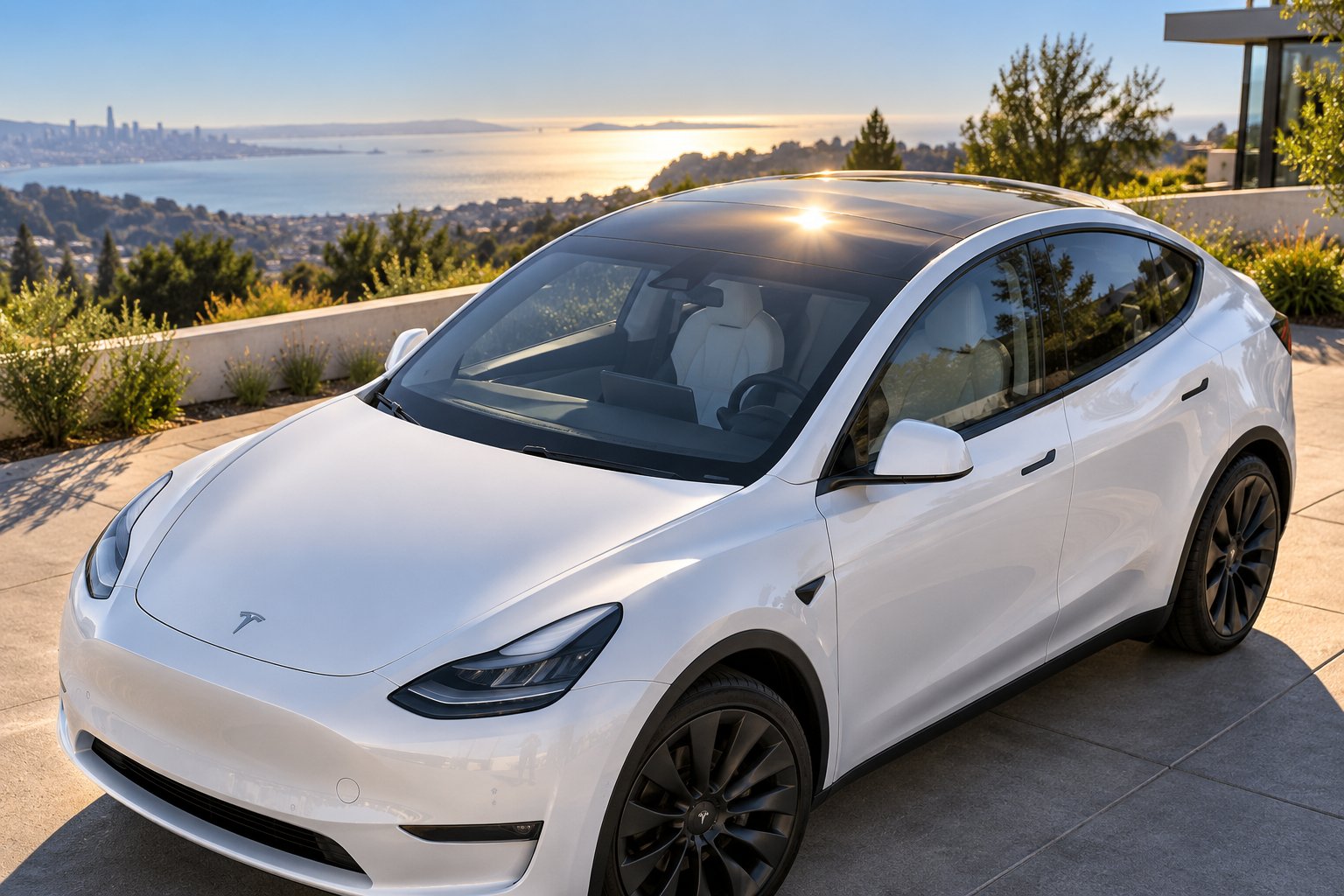
Imagine sliding into a Tesla on a July afternoon. The sweeping all-glass roof floods the cabin with natural light, and the interior feels undeniably futuristic. Then the sun climbs directly overhead, and a warm tingle spreads across the top of your head. Suddenly one question dominates your thinking: does Tesla's glass roof get hot enough to be a real problem?
You are not alone in asking. This single concern shows up in nearly every Tesla forum, test-drive recap, and buyer FAQ. Yet most answers online treat it as a simple yes-or-no issue when it is actually two separate questions tangled together.
The Two Questions Every Tesla Buyer Really Wants Answered
The first question is physical: does the glass panel itself become hot to the touch, and does infrared energy pass through it onto your skin? The second is thermodynamic: does that expansive glass surface raise the overall cabin temperature significantly compared to a traditional stamped-metal roof? These are different phenomena with different causes and, importantly, different fixes.
Feeling radiant warmth on your skin is not the same as your cabin being measurably hotter.
This article tackles both questions with a science-first approach. You will find a breakdown of Tesla's multi-layer glass coating technology, real-world heat behavior across every current model, an honest look at how climate zones shift the equation, and a ranked comparison of every cooling solution available to owners. No sales pitch — just data, physics, and practical advice.
Why This Matters Before You Buy or Trade In
Whether you are configuring a new Tesla, evaluating a trade-in offer, or simply trying to survive August in Arizona, the glass roof heat question shapes real decisions. A hot test drive on a sunny afternoon can single-handedly kill a purchase, and lingering discomfort can erode long-term satisfaction. Understanding what is actually happening — and what you can do about it — puts you back in control of the decision.
The answer starts with the glass itself and what Tesla engineered it to do with the three types of solar energy hitting your roof every second you are parked or driving in sunlight.
How Tesla's Glass Roof Technology Blocks Heat and UV
Sunlight is not one thing. When it hits your Tesla's glass roof, three distinct types of energy arrive simultaneously, each interacting with the glass in a different way. Understanding this trio is the key to answering whether the roof truly lets too much heat through — or whether your perception is playing tricks on you.
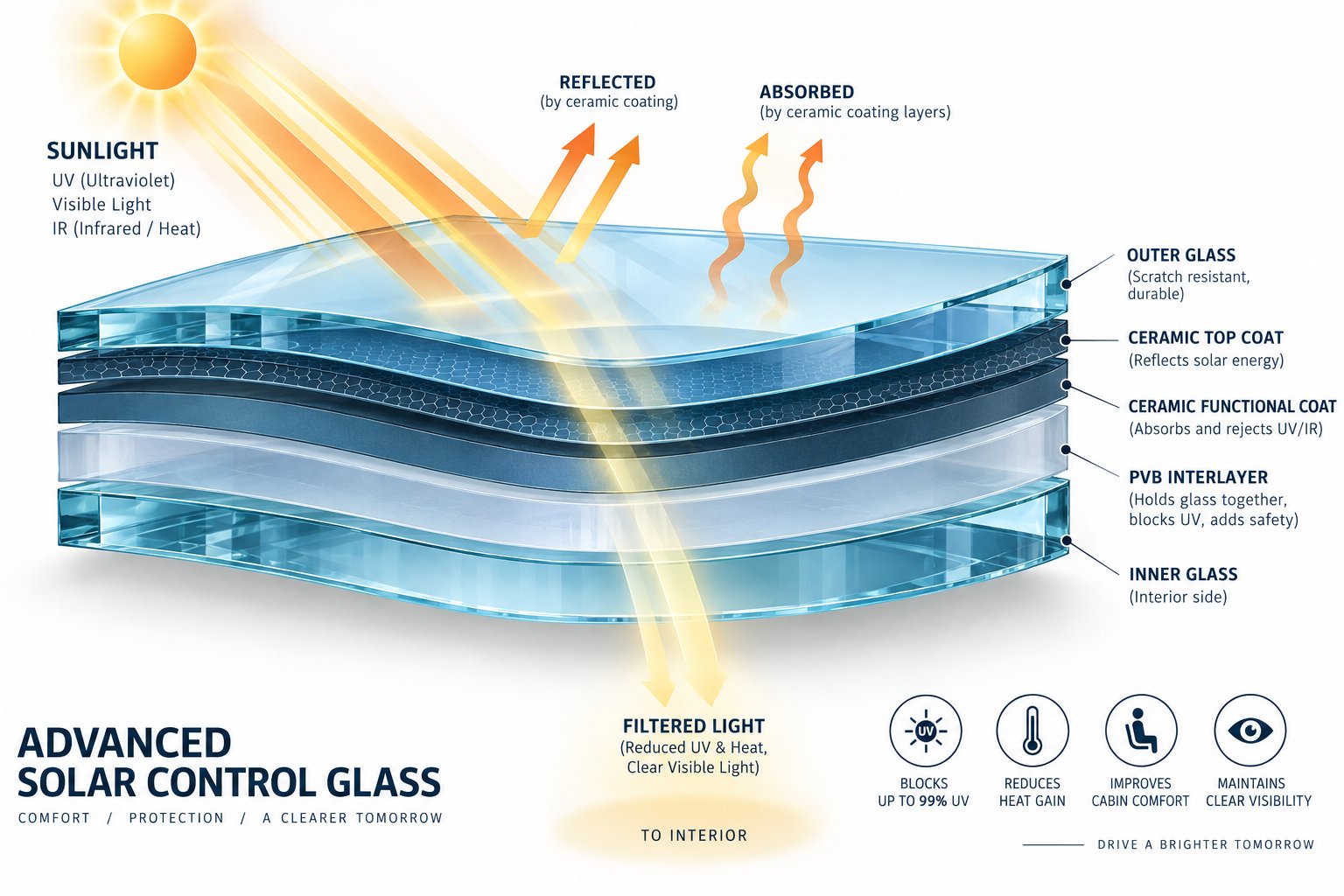
The solar spectrum relevant to your driving comfort breaks down into ultraviolet (UV) radiation, infrared (IR) radiation, and visible light. UV is the invisible energy responsible for sunburns and interior fading. IR is the invisible energy you experience as warmth on your skin. Visible light is everything your eyes can see — the brightness that makes a glass roof feel so open and airy. Tesla's engineering challenge is straightforward in concept but demanding in execution: block as much UV and IR as possible while letting visible light pour through.
UV, Infrared, and Visible Light — What Each Means for Heat
Most online discussions about Tesla's glass mention a single UV-blocking number and move on. That shortcut leaves you without the context you need to evaluate the roof's real thermal performance. Here is how each type of solar energy affects you and how Tesla's glass handles it:
| Solar Energy Type | What It Is | What It Does to You | How Tesla's Glass Handles It |
|---|---|---|---|
| Ultraviolet (UV) | Short-wavelength radiation invisible to the eye, roughly 3% of total solar energy | Causes sunburn, skin aging, and fading of leather and plastics | Tesla's roof glass absorbs 99% of UV radiation, virtually eliminating skin and interior damage |
| Infrared (IR) | Long-wavelength radiation invisible to the eye, roughly 53% of total solar energy | Creates the sensation of warmth on skin, heats cabin surfaces and air | Multi-layer ceramic and metallic oxide coatings reflect and absorb a significant portion of IR, though some still passes through |
| Visible Light | The portion of sunlight you can see, roughly 44% of total solar energy | Provides brightness and contributes a smaller share of thermal gain | Allowed through at controlled levels to maintain the open, panoramic feel of the glass roof |
Notice the imbalance. UV is the headline stat — 99% blocked sounds impressive, and it is — but UV carries only a small fraction of the sun's total energy. IR is the real heat driver, accounting for over half of solar energy. Tesla's coatings tackle IR aggressively, yet the sheer physics of a large glass panel means some infrared energy inevitably reaches your skin. That is why understanding all three types matters far more than quoting a single UV percentage.
How Tesla's Coating Differs From a Standard Sunroof
Imagine a conventional panoramic sunroof on an electric Cadillac or a luxury sedan. Typically, these use a single layer of tinted glass or a basic dyed film to darken the panel and reduce glare. That approach blocks some visible light — making the cabin dimmer — but does surprisingly little to reject infrared heat. When you open the fabric shade on a traditional sunroof, you often feel an immediate blast of warmth because the glass itself was never engineered for serious heat rejection.
Tesla takes a fundamentally different approach. Rather than relying on darkness to imply protection, Tesla's glass uses a multi-layer construction where ceramic and metallic oxide coatings are sandwiched between glass layers. A glass specialist at Tesla's Design Center in Hawthorne, California, has explained this system: a 2% tint film is combined with other films that reflect solar radiation, all bonded together using a PVB (Polyvinyl Butyral) interlayer that also adds structural toughness and acoustic dampening.
The result is a glass panel that appears lightly tinted from outside but still feels bright and open from inside. It rejects the majority of UV, blocks a meaningful share of IR, reduces road and wind noise through laminated double-glass construction, and withstands enormous structural loads — Tesla claims their glass roof can handle four times the weight of the vehicle. This is a purpose-built system, not an afterthought bolted onto a traditional roof opening.
Does the Factory Coating Degrade Over Time?
A common worry among prospective owners is durability. If you have ever seen aftermarket window tint bubbling, peeling, or turning purple after a few summers, the concern makes perfect sense. Will Tesla's heat-rejection coating suffer the same fate?
The engineering principle here offers reassurance. Aftermarket tint is a polymer film adhesively bonded to the interior surface of existing glass. Over years of UV exposure and thermal cycling, that adhesive can break down, causing the familiar bubbling and discoloration. Tesla's coatings, by contrast, are integrated into the glass during manufacturing. The ceramic and metallic oxide layers are part of the laminated glass stack itself — baked in, not stuck on. There is no adhesive interface exposed to the cabin environment that can degrade in the same way.
This means the heat-rejection performance you get on delivery day should remain stable throughout the vehicle's life. Long-term owner data across early Model 3 vehicles — many of which have been on the road for several years — has not surfaced widespread reports of coating failure or measurable performance loss. That said, this remains an area where the full multi-decade picture is still forming, and owners in extreme climates should monitor for any changes over time.
The coating's durability is encouraging, but engineering specs only tell half the story. The real question most owners wrestle with is more personal: why does my head still feel warm if the glass is blocking so much energy? The answer lies in the subtle but important difference between radiant heat reaching your skin and the air temperature surrounding you.
Radiant Heat vs Cabin Air Temperature and Why It Matters
Here is a scenario that confuses thousands of Tesla owners every summer. You climb into your Model Y, glance at the climate display, and it reads a perfectly comfortable 72 °F. The air blowing from the vents feels cool. Yet the top of your head and your forearms feel distinctly warm — almost like sitting near a campfire on one side of your body while cool air blows on the other. Is the glass roof failing? Is the air conditioning broken? Neither. You are experiencing two completely different forms of heat transfer at the same time, and your body is reporting both sensations simultaneously.
This distinction — between radiant heat striking your skin and convective air temperature filling the cabin — is the single most misunderstood aspect of living with a Tesla glass roof. Getting it right changes how you evaluate the roof, how you troubleshoot discomfort, and which solutions actually work.
Why the Roof Feels Hot Even When Your AC Says It Is Cool
Think about standing outside on a crisp autumn afternoon. The air temperature is 65 °F, comfortable enough for a light jacket. Step into direct sunlight and your skin feels noticeably warmer — maybe 10 or 15 degrees warmer on exposed surfaces. Step back into the shade and the warmth vanishes instantly, even though the air temperature around you has not changed by a single degree. What changed was the infrared radiation reaching your skin, not the air.
This exact phenomenon happens inside your Tesla. The multi-layer glass roof blocks a significant portion of incoming infrared energy, but not every last photon. The remaining IR passes through the glass and travels in a straight line until it strikes a surface — your scalp, your arms on the armrest, the dashboard, or the seat leather. Those surfaces absorb the energy and warm up. Your skin's thermal receptors detect this warming and send your brain a clear signal: something hot is nearby.
Meanwhile, the HVAC system is doing its job perfectly. It measures and controls the temperature of the air circulating through the cabin. Cool air flows across your body, and the cabin thermometer confirms the setpoint is holding. There is no contradiction here. The air really is cool. Your skin really does feel warm. Both are true because they represent two independent heat transfer mechanisms operating at the same time.
You will notice this radiant warmth most on clear days between roughly 10 a.m. and 3 p.m., when the sun is high enough to send rays nearly straight down through the roof. Overcast skies, low sun angles, and even light cloud cover dramatically reduce the effect — not because the air temperature drops, but because diffused sunlight carries far less directional IR energy.
What Temperature Measurements Actually Show
If radiant heat explains the sensation, what does the thermometer actually say? Automotive thermal studies consistently show that vehicles with large glass roof panels do soak up more heat when parked in direct sun compared to identical vehicles with solid metal roofs. The peak cabin soak temperature — the highest interior reading after sitting sealed in full sun — is typically higher in a glass-roof vehicle. However, the gap is smaller than most people expect.
Real-world owner experiments and thermal testing suggest the difference often falls in the range of 5 to 10 °F higher peak soak temperature for a glass-roof car versus a comparable solid-roof car under the same conditions. That is a measurable difference, but it is not the 30- or 40-degree oven effect that online commentary sometimes implies. Tesla's factory coatings are doing significant heavy lifting to keep that gap narrow despite the enormous glass surface area.
Once the HVAC system activates — either through Cabin Overheat Protection while parked or through preconditioning before you enter — the air temperature gap closes quickly. The climate system is engineered to handle the additional solar load. Within minutes of running, cabin air temperature in a glass-roof Tesla and a metal-roof competitor can converge to nearly identical readings. The radiant sensation, however, persists as long as direct sunlight is striking the glass, because no amount of cold air eliminates infrared photons already in transit through the panel.
Radiant discomfort and actual cabin temperature rise are different problems requiring different solutions.
This distinction is not academic — it directly shapes which cooling strategy will help you. If your complaint is that the cabin takes too long to cool down after parking in the sun, preconditioning and Cabin Overheat Protection solve it. If your complaint is that warm sunshine on your head bothers you even after the cabin is cool, you need a physical barrier between your skin and the glass — something that blocks the remaining infrared before it reaches you. Confusing the two problems leads owners to spend money on solutions that address the wrong issue.
That said, the intensity of both problems varies wildly depending on where you live and drive. A Tesla parked in the Arizona desert faces a fundamentally different thermal challenge than one sitting in a Seattle driveway — and understanding those regional differences is essential before deciding whether any mitigation is necessary at all.
Glass Roof Heat Performance Across Every Tesla Model
Regional climate is only one variable in the equation. The specific Tesla you drive — or the one sitting in your online shopping cart — plays an equally important role. Each model in the lineup uses a different glass panel configuration, roof geometry, and cabin volume ratio, all of which influence how much radiant heat reaches your skin and how effectively the HVAC compensates. Yet most discussions about whether the glass roof gets hot treat the entire lineup as if every Tesla is identical. They are not, and the differences matter more than you might expect.
Model 3 and Model Y Glass Roof Heat Characteristics
The Model 3 and Model Y generate the overwhelming majority of glass roof heat complaints online, and the reason is partly mathematical: they are Tesla's highest-volume sellers by a wide margin. More cars on the road means more owners posting about warm heads on Reddit. But the design itself also contributes.
Both vehicles feature a single, uninterrupted glass panel that stretches from just behind the windshield header all the way to the rear of the cabin. There is no metal crossbar breaking the panel, no retractable shade, and no body-colored section to interrupt the solar exposure. If you are sitting in either front seat with the sun directly overhead, IR energy has a clear, unobstructed path through the glass to your scalp and shoulders.
The key difference between the two comes down to cabin geometry. The Model Y sits taller, with a higher roofline and greater overall interior volume. That extra vertical space means hot air rising off sun-warmed surfaces has more room to stratify before reaching occupants. In a practical sense, some Model Y owners report the radiant sensation feels slightly less intense compared to the Model 3, where the glass sits closer to the heads of taller drivers. The lower seating position in the Model 3 actually places you nearer to the roof panel, reducing the air gap that provides a small buffer against radiant warmth.
If you are considering a tesla model y 2026 or a current Model 3, expect a virtually identical glass coating — both use the same generation of multi-layer ceramic and metallic oxide treatment. The thermal experience difference between them comes down to your height, your seat position, and the cabin's vertical proportions rather than any meaningful difference in the glass itself.
Model S and Model X Roof Configurations
The Model S tells a more complicated story because it has offered multiple roof options over its production life. Earlier versions gave buyers a choice between an all-glass panoramic roof and a solid metal roof, while more recent refreshed models moved to a standard glass roof design similar in philosophy to the Model 3 and Model Y. If you are shopping for a used Model S or evaluating a tesla trade in, knowing which roof configuration is on the car matters significantly. A pre-refresh Model S with a metal roof will have a fundamentally different cabin heat profile than a newer one with full glass.
The Model X introduces an entirely unique variable. Its signature panoramic windshield extends upward and rearward over the front seats, creating what Tesla calls the largest windshield in production. This is not just a roof panel — it is the windshield itself curving overhead. For front-seat occupants, this means solar exposure comes from a different angle compared to other models. When the sun is lower on the horizon in the morning or late afternoon, the Model X's extended windshield can funnel IR energy toward the driver and passenger from a direction that a standard flat roof panel would not. Conversely, when the sun is directly overhead, the windshield extension's steep angle actually deflects more energy than a flat panel would.
Rear-seat passengers in the Model X sit beneath a more conventional glass roof section, and their experience aligns more closely with what Model Y owners report. The heat story in the Model X is really a front-seat story driven by that distinctive windshield architecture.
Cybertruck and Its Distinct Glass Approach
The Cybertruck departs from every other Tesla in materials and philosophy. Its stainless steel exoskeleton and armor glass represent a fundamentally different engineering mindset. The Cybertruck features a large rear glass panel and a separate glass roof section, but the overall design incorporates more opaque structural steel above occupants than the Model 3 or Model Y. The armor glass itself uses a different lamination strategy designed for impact resistance first and solar management second.
Early owner feedback suggests the Cybertruck's cabin heat experience is distinct — the combination of a large, thermally conductive stainless steel body and the glass panels creates a different thermal profile. The metal portions of the roof can conduct exterior heat inward in hot climates, while the glass sections behave similarly to other Teslas in terms of radiant IR transmission. Owners in desert environments have noted that the entire vehicle — glass and steel alike — runs warm after extended sun exposure.
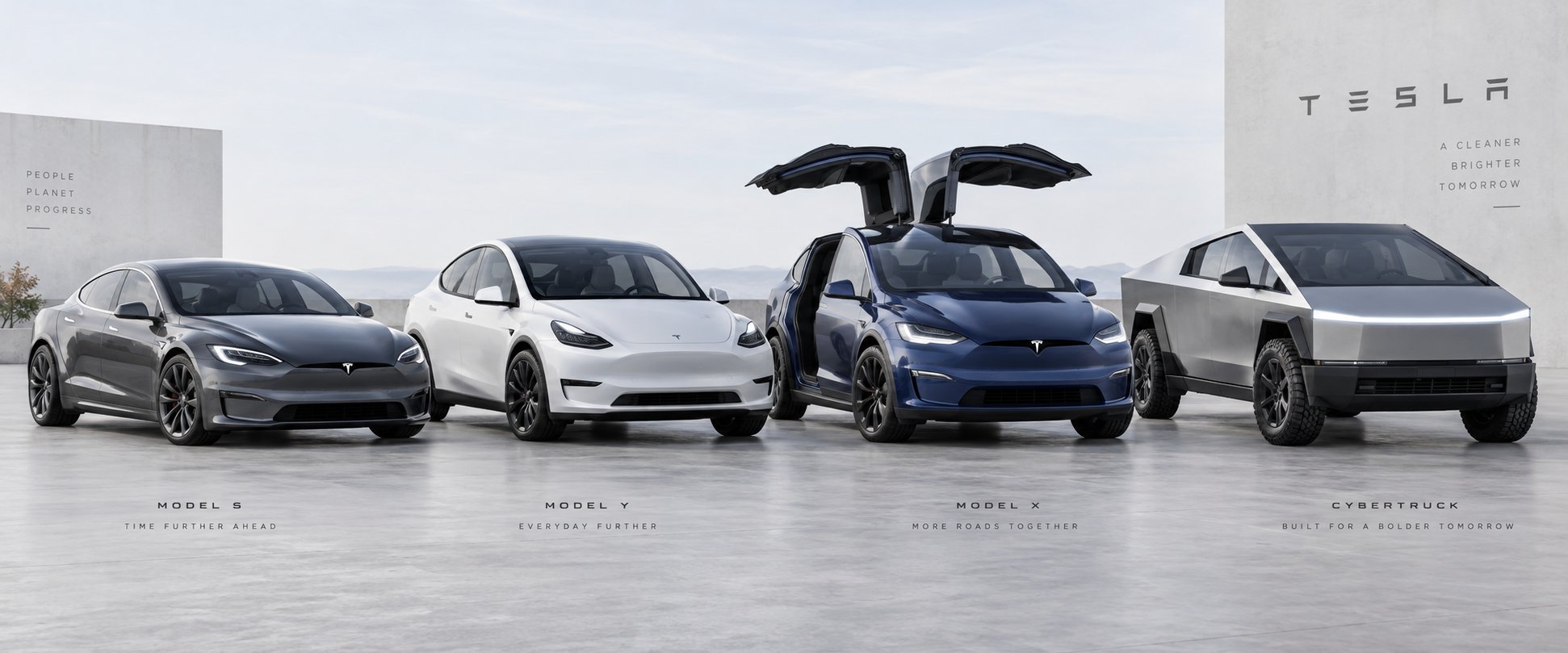
Here is how all five models compare at a glance:
| Model | Glass Roof Area | Roof Geometry | Owner-Reported Heat Perception |
|---|---|---|---|
| Model 3 | Large — single uninterrupted panel | Low, close to occupant heads | Moderate to high; most commonly reported due to proximity and sales volume |
| Model Y | Large — single uninterrupted panel | Taller cabin, more air gap above heads | Moderate; similar glass but slightly better perceived comfort from extra headroom |
| Model S (refresh) | Large — full glass roof standard | Low-slung sports sedan profile | Moderate; comparable to Model 3 but lower sales volume generates fewer reports |
| Model X | Very large — panoramic windshield extends overhead | Tall SUV with curved windshield sweeping rearward | Variable; front seats exposed to low-angle sun through extended windshield, rear seats more typical |
| Cybertruck | Medium — glass panels combined with extensive steel roof sections | Angular, flat planes with stainless steel exoskeleton | Mixed; steel conducts ambient heat, glass transmits radiant heat — a dual challenge in extreme climates |
A few patterns stand out from this breakdown. The vehicles with the largest uninterrupted glass and the shortest distance between the roof and your head — the Model 3 being the prime example — tend to generate the strongest radiant heat complaints. Models with more vertical cabin space or partial metal roofing offer a modest natural buffer. And the Cybertruck reminds us that metal roofs are not automatically cooler in every scenario; conductive heat through steel is its own challenge.
These model-specific differences also mean that a cooling strategy perfect for one Tesla may be overkill or insufficient for another. Before reaching for any solution, though, it helps to understand a factor that arguably outweighs model choice entirely: the climate where you park and drive every day.
How Your Climate Zone Changes the Glass Roof Heat Experience
A Model Y parked in a Phoenix parking lot at 2 p.m. in August and an identical Model Y parked in a Seattle driveway on the same date are living two completely different thermal lives. The glass is the same. The coating is the same. The HVAC hardware is the same. Yet one owner is searching for every possible heat solution while the other barely thinks about the roof at all. Geography does not just tweak the answer to whether the glass roof gets hot — it fundamentally rewrites it.
This is a gap that most discussions overlook entirely. Forum advice tends to treat every Tesla owner as if they share the same sun, the same humidity, and the same parking situation. In reality, your zip code may matter more than your model choice when it comes to daily glass roof comfort.
Dry Desert Heat vs Humid Subtropical Climates
Imagine parking your Tesla in Phoenix, Las Vegas, or Tucson on a summer afternoon. Ambient air temperatures routinely push past 110 °F, and the direct solar radiation in these arid environments is among the most intense on the planet. Clear skies mean virtually no cloud diffusion — the full force of infrared energy hits your glass roof at steep, direct angles for hours on end. The glass coating still blocks a significant share of that IR, but the sheer volume of incoming energy overwhelms the margin. More total thermal energy passes through the roof, cabin surfaces heat faster, and the HVAC system has to work considerably harder to claw temperatures back down.
For owners in these climates, the peak cabin soak temperature after even 20 to 30 minutes of direct sun parking can climb aggressively. Research cited by the American College of Emergency Physicians notes that a vehicle interior can rise 20 °F in just 10 minutes — and that baseline figure applies to any car. Layer a full glass roof on top of triple-digit ambient heat, and you can see why desert Tesla owners are the loudest voices in the glass roof debate. Their experience is real, measurable, and intense enough that aftermarket mitigation shifts from optional to nearly essential.
Humid subtropical climates — think Houston, Miami, New Orleans, or coastal Florida — present a different but equally challenging equation. Peak solar intensity may actually be slightly lower than the desert thanks to afternoon cloud buildup and atmospheric moisture scattering some radiation. However, humidity compounds the discomfort in a way that dry heat does not. When the air itself carries heavy moisture, your body's primary cooling mechanism — evaporative sweating — becomes far less efficient. The radiant warmth passing through the glass roof feels more oppressive because your skin cannot shed the heat as easily. Even after the HVAC brings the cabin air temperature down, the combination of residual radiant load and humid air creates a muggy, sticky sensation that dry-climate owners rarely experience.
There is also a secondary cost consideration for owners in both extreme climate types. Running Cabin Overheat Protection and preconditioning frequently draws energy from the battery. If you are already managing range carefully — especially relevant for owners who have researched tesla battery replacement cost or track their efficiency closely — the additional HVAC load in extreme climates is a real factor in daily energy budgeting. It is not enough to change your buying decision, but it is worth understanding before your first brutal summer.
Temperate and Coastal Climates
Shift the map to San Francisco, the Pacific Northwest, the upper Midwest, the UK, or Northern Europe, and the glass roof conversation changes tone entirely. Owners in these regions frequently describe the roof as one of their favorite features with essentially zero thermal downside. Why? The math is straightforward: moderate ambient temperatures, frequent cloud cover, and lower peak solar angles mean the total IR energy hitting the roof on a given day is a fraction of what Phoenix or Houston delivers.
On the handful of warm days that do occur — a 90 °F heat wave in Portland or an unusually sunny July afternoon in London — owners might notice the familiar radiant warmth on their scalp. But these episodes are brief and infrequent enough that most temperate-climate owners never bother with aftermarket shades or tint. Tesla's factory coating and standard climate controls handle the load without breaking a sweat, figuratively speaking.
For these owners, the glass roof is overwhelmingly a net positive. The natural light brightens the cabin on gray days, the open sightline creates a sense of spaciousness that enhances every drive, and the thermal penalty is negligible for 90% or more of the year. If you are test-driving a Tesla in Seattle and worrying about the glass roof based on a Phoenix forum post, you are solving a problem you likely will not have.
Practical Implications for Buyers in Different Regions
Your climate zone effectively sorts you into one of three action categories. Rather than guessing where you fall, use this as a quick self-assessment:
- Extreme heat climates (desert, humid subtropical): Plan for aftermarket mitigation from day one. A fitted roof sunshade and consistent preconditioning should be considered standard equipment, not optional accessories. Ceramic tint on side windows is worth evaluating for comprehensive heat control. Budget for slightly higher energy consumption from frequent HVAC use.
- Moderate climates (mid-Atlantic, Midwest, inland California, southern Europe): Tesla's factory glass coating and built-in cooling features — Cabin Overheat Protection and app-based preconditioning — are usually sufficient for comfortable daily driving. A roof sunshade is a nice-to-have for occasional hot days or long parking sessions, but many owners in these zones never purchase one.
- Cool or coastal climates (Pacific Northwest, Northern Europe, upper New England): The glass roof is overwhelmingly a benefit. The thermal penalty is minimal and occurs so rarely that most owners consider it a non-issue. Spend your accessory budget elsewhere — the roof is doing exactly what it was designed to do.
This climate-based framework also explains why online opinions about the glass roof seem so contradictory. A five-star review from a Vancouver owner and a frustrated complaint from a Dallas commuter are both honest — they are just living under very different suns. Matching the advice to your actual geography is the single most important filter you can apply before deciding whether any thermal mitigation is worth your time and money.
Of course, geography sets the baseline challenge, but Tesla did not leave owners to fight the sun alone. The vehicle itself includes several software-driven cooling features specifically designed to counteract glass roof heat gain — and using them effectively can close the comfort gap even in the most demanding climates.
Tesla's Built-In Cooling Features That Fight Glass Roof Heat
Tesla engineers did not design a massive glass roof and then hope for the best. The vehicle's software-driven thermal management system was built with that roof's solar load baked into every calculation. The problem is that most owners either do not know these features exist or do not use them consistently enough to experience the difference. When you connect each built-in tool directly to the glass roof heat challenge, a clear defense strategy emerges — and it does not cost you a single extra dollar.
Cabin Overheat Protection and How It Counteracts Glass Roof Heat
Picture your Tesla sitting in a sun-drenched parking lot while you spend two hours inside a restaurant. Without intervention, solar energy streaming through that glass roof steadily bakes the cabin. Surfaces absorb IR, re-radiate warmth into the enclosed air, and temperatures spiral upward. This is where Cabin Overheat Protection steps in as your first automated line of defense.
When enabled, this feature monitors interior temperature and automatically activates the air conditioning or fans when the cabin exceeds 105 °F (40 °C). You can also select a custom temperature threshold if your vehicle supports it. The system cycles on and off as needed, preventing the interior from reaching the extreme peak soak temperatures that give the glass roof its worst reputation. For a glass-roof vehicle specifically, this matters more than it would for a solid metal roof — because the glass transmits more solar energy, the cabin climbs faster without active cooling to push back.
There is a tradeoff worth understanding. Running Cabin Overheat Protection draws energy from the high-voltage battery. Tesla's own guidance recommends leaving the vehicle plugged in whenever this feature is active, so the charging system — rather than stored battery energy — powers the climate hardware. If you routinely park unplugged in extreme heat for extended periods, you will see a modest range reduction. For most owners, especially those near a NEMA 14-50 outlet at home or at work, this energy cost is trivial compared to the comfort benefit. But if you are already managing range tightly, it is a variable to keep on your radar.
Smart Preconditioning Through the Tesla App
Cabin Overheat Protection prevents the worst-case scenario while you are away. Smart preconditioning eliminates it entirely before you return. This is the feature that separates glass-roof owners who complain from those who shrug and say the heat is a non-issue.
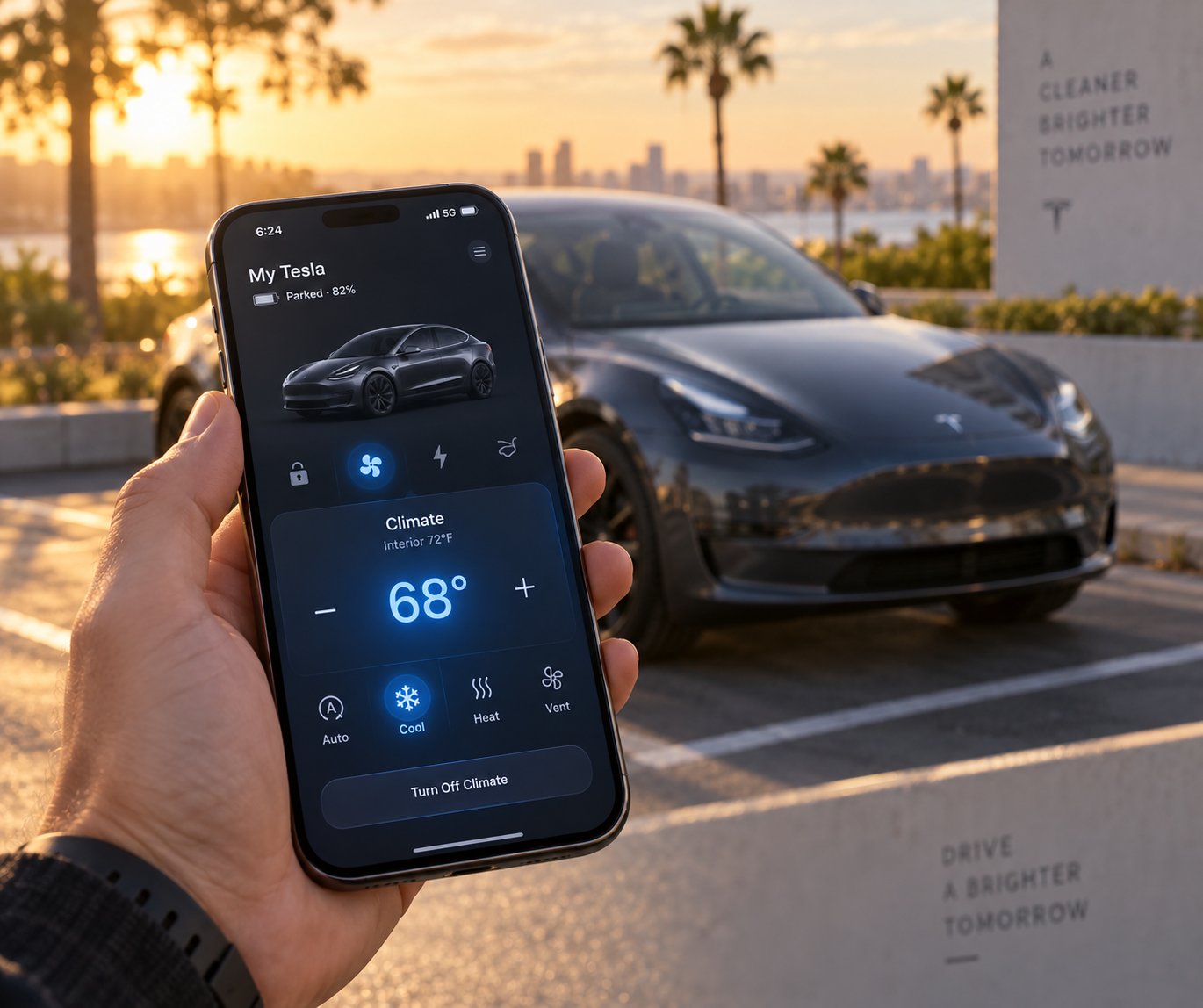
Through the Tesla mobile app, you can remotely activate climate controls and start cooling the cabin while you are still finishing your coffee indoors, wrapping up a meeting, or walking across a parking lot. Navigate to the Climate section in the app, set your preferred temperature, and the HVAC goes to work immediately. Tesla recommends activating climate settings at least 30 to 45 minutes before departure for optimal results, though even 10 to 15 minutes of pre-cooling makes a dramatic difference on a hot day.
You can also schedule departure times directly from the vehicle's Charging or Climate Control screens. Set a recurring 8:00 a.m. departure for your daily commute, and the car will calculate when it needs to start cooling to have the cabin at your target temperature right when you open the door. The glass roof's accumulated heat? Already purged. The steering wheel and seats that soaked up IR all morning? Already cooled by conditioned air circulating through the cabin. You sit down to a comfortable interior instead of a wall of heat — and the glass roof never gets the chance to form its bad first impression.
This is why preconditioning is especially powerful for glass-roof vehicles. The initial blast of hot air when you open the door of a sun-soaked car is the moment that cements the "glass roof is too hot" narrative in an owner's mind. Preconditioning erases that moment completely. The roof is still transmitting some radiant IR while you drive, but by the time you are behind the wheel, the HVAC is already running and the cabin air is controlled. Your experience shifts from reactive — enduring the heat and waiting for relief — to proactive, never encountering the worst of it in the first place.
Climate Controls and Airflow Design
Beyond the headline features, Tesla's HVAC system itself is calibrated for the glass roof's reality. The auto-climate algorithm does not treat a glass-roof Tesla like a conventional car with a metal lid. It accounts for the additional solar load when calculating fan speed, compressor output, and air distribution. On a sunny day, you will notice the system ramps up more aggressively than you might expect even when the set temperature has not changed — that is the software anticipating IR-driven heat gain and compensating in real time.
Airflow direction also plays a role. Tesla's vent design pushes conditioned air across the upper cabin space where radiant warmth accumulates. This does not eliminate the IR photons striking your skin, but it does ensure the air layer between you and the glass stays as cool as possible, reducing the overall thermal discomfort. Combined with the seated position's distance from the glass — especially in the taller Model Y — this airflow pattern provides a meaningful buffer that most owners take for granted until they compare it against a vehicle without the same engineering consideration.
Most owners who report the glass roof is not a problem are using preconditioning consistently.
That single habit — tapping the app five minutes before you walk to your car — accounts for more glass roof satisfaction than any aftermarket accessory. Tesla's built-in software tools are the first, free, and most effective line of defense. They handle the cabin air temperature side of the equation remarkably well, which is why data consistently shows the glass roof does not overheat the cabin as much as perception suggests.
The radiant heat side, though, is a different story. No amount of cold air stops infrared energy from passing through glass and warming your skin directly. For that challenge — and for buyers cross-shopping against other brands — the question becomes how Tesla's glass stacks up against the panoramic sunroofs found on competitors, and whether a physical barrier is ultimately the smarter play.
Tesla Glass Roof vs Competitor Panoramic Sunroofs
If you are cross-shopping a Tesla against a BMW iX, a Mercedes EQS, a Hyundai Ioniq 5, or a Kia EV6, you have probably noticed something: panoramic glass roofs are everywhere now. Nearly every premium EV and a growing number of mainstream vehicles offer some version of a large glass panel overhead. So the real question is not just whether Tesla's glass roof gets hot — it is whether it handles heat better or worse than the panoramic sunroof on the other car you are considering. This competitive context is surprisingly absent from most discussions, and it changes the calculus more than you might expect.
Tesla's Full Glass Roof vs Traditional Panoramic Sunroofs
The structural differences between Tesla's approach and a traditional panoramic sunroof start with a fundamental design philosophy split. Most competitors — think BMW, Mercedes, Audi, Hyundai, and Kia — use a two-panel panoramic sunroof separated by a metal crossbar running laterally across the roofline. This crossbar serves double duty: it provides structural rigidity and houses the tracks for a retractable fabric or mesh shade that slides between the glass and the cabin. When the sun beats down, you pull the shade closed. Problem solved — at least mechanically.
Tesla eliminated both the crossbar and the shade entirely. The result is a single, uninterrupted glass panel that stretches from the windshield header to the rear of the cabin with nothing breaking the visual line. No mechanical shade tracks. No motor to fail or rattle after 50,000 miles. No fabric panels that can sag, stain, or block your rearview mirror sightline when partially retracted. The tradeoff is clean and deliberate: Tesla traded a physical shade — the simplest possible heat barrier — for a cleaner aesthetic, fewer moving parts, and total reliance on the glass coating itself to manage solar energy.
This is where opinions split sharply. Owners who came from a BMW X5 or a Mercedes GLC with a retractable shade sometimes miss the on-demand ability to simply block the sun overhead. Even if the shade was just fabric — offering minimal IR rejection on its own — the psychological comfort of closing it was real. You felt cooler because you could see a barrier between you and the sky. Tesla owners do not have that option from the factory, which means the coating has to do all the work, all the time, with no backup.
On the flip side, anyone who has dealt with a panoramic sunroof shade motor failure, a rattling track, or a shade that jams halfway open knows the appeal of Tesla's no-moving-parts simplicity. Fewer components mean fewer failure points — a meaningful consideration over years of ownership, especially outside warranty periods.
Heat Rejection Coatings Compared
Here is where Tesla's engineering advantage becomes clearest. Most competitor panoramic sunroofs use relatively basic tinted glass. The tinting darkens the panel and reduces some visible light transmission, but it does surprisingly little to reject infrared radiation — the wavelength responsible for the warm-on-your-skin sensation. These competitors lean on the retractable shade as the primary heat management tool. When the shade is open and the sun is blazing, their glass alone often transmits more IR energy into the cabin than Tesla's coated panel does under the same conditions.
Tesla's multi-layer ceramic and metallic oxide coating is factory-integrated into the glass during manufacturing, creating an always-on heat rejection system that does not depend on any occupant action. You never need to remember to close a shade, and the coating works identically whether you are in the car or it is sitting empty in a parking lot. This passive, zero-maintenance approach means Tesla's glass roof is rejecting significant UV and IR energy even during long parking sessions — something a competitor's shade only does if the driver remembered to close it before walking away.
Some newer competitors are catching up. Certain model-year configurations of the BMW iX and Mercedes EQE SUV have introduced electrochromic glass that can darken on demand, offering variable light and heat control without a mechanical shade. These systems are impressive but add cost, electrical complexity, and another potential failure mode. They also tend to appear only on higher trim levels, while Tesla includes its coated glass roof as standard equipment across the lineup.
The following table puts the two approaches side by side so you can evaluate the tradeoffs at a glance:
| Feature | Tesla Glass Roof | Typical Competitor Panoramic Sunroof |
|---|---|---|
| Factory UV Blocking | High (blocks approximately 99% of UV) | Medium to High (varies by manufacturer; most block significant UV but specs are less consistently published) |
| Factory IR Blocking | High (multi-layer ceramic and metallic oxide coatings actively reject IR) | Low to Medium (basic tinted glass; primary IR management relies on retractable shade) |
| Physical Shade Included | None — coating is the sole heat management layer from the factory | Yes — retractable fabric or mesh shade standard on most models |
| Glass Area | Very Large — single uninterrupted panel with no crossbar | Large — typically two panels divided by a structural metal crossbar |
| Overall Heat Management Approach | Passive always-on coating plus software-driven HVAC compensation; no moving parts | Combination of basic glass tinting and user-operated mechanical shade; some newer models add electrochromic glass |
A few insights jump out from this comparison. When a competitor's shade is closed, that vehicle will almost certainly feel cooler overhead than a Tesla, because even a thin fabric layer adds a physical barrier that Tesla does not offer. But when the shade is open — which is the entire reason most buyers chose a panoramic sunroof in the first place — Tesla's coated glass often outperforms the competitor's tinted-but-uncoated panel in raw IR rejection. The irony is real: the car without the shade may actually transmit less heat through its glass than the car whose shade is retracted.
For cross-shoppers weighing a model Y or any other Tesla against competitors, this reframes the conversation. The question is not simply "does the glass roof get hot compared to a metal roof" — it is "does Tesla's always-on coating manage heat as well as or better than a competitor's shade-dependent system?" For many driving scenarios, especially when you want the open, light-flooded experience that drew you to a glass roof in the first place, the answer tilts in Tesla's favor.
That said, no factory solution — Tesla's coating or a competitor's shade — is perfect in every climate and every use case. Owners in extreme heat environments consistently find that adding an aftermarket physical barrier on top of whatever the factory provides delivers the most comfortable result. The real decision becomes which aftermarket strategy gives you the best return on your money and effort, and how each option stacks up in terms of cost, effectiveness, and daily convenience.
Every Cooling Solution Ranked by Effectiveness and Value
Knowing that the glass roof transmits radiant heat and that competitors face similar challenges is useful context — but it does not cool your head on a 100 °F afternoon. What you need is a clear, prioritized action plan: which solutions actually work, how much do they cost, and when does each one make sense? Most online advice throws every option at you in no particular order. Here, each strategy is ranked so you can start with the highest-value move and layer on additional protection only if your climate and comfort threshold demand it.
Preconditioning and Software Solutions
Before spending a dollar on accessories, exhaust what your Tesla already gives you for free. As covered earlier, smart preconditioning through the Tesla app and Cabin Overheat Protection are your first-line defenses against the glass roof's thermal load. Activate climate controls 10 to 15 minutes before you walk to your car, and the initial blast of oven-hot air — the moment that fuels most glass roof complaints — simply never happens.
This approach costs nothing beyond a small draw on the battery. If you are plugged in at home or at a destination charger, the energy impact is negligible. Even unplugged, the consumption is modest enough that you would not notice it unless you were already managing a low battery situation on a long drive. For road-trippers who plan routes using the tesla trip planner, factoring in a few extra minutes of preconditioning at each stop barely registers against the overall energy budget. Software solutions will not eliminate radiant warmth on your skin while driving, but they solve the cabin air temperature problem completely — and that is half the battle.
Aftermarket Sunshades for the Glass Roof
If preconditioning handles the air temperature side, sunshades handle the radiant heat side. A dedicated glass roof sunshade sits between you and the glass panel, physically intercepting the infrared energy before it reaches your scalp and shoulders. This is the most direct, targeted fix for the specific complaint that drives most owners to search whether the glass roof gets hot in the first place.
Fitment matters enormously. A generic sunshade draped loosely across the roof leaves gaps at the edges, sags in the middle, and can rattle at highway speed. Quality sunshades are cut precisely to your Tesla's roof dimensions and attach via clips or magnetic strips that hold the panel taut and flush against the glass. The mesh material blocks a substantial portion of direct sunlight while still preserving some of the open, airy feel that makes the glass roof appealing. Most owners report that a well-fitted shade reduces the radiant heat sensation dramatically — transforming a noticeable warm spot on the head into a barely perceptible background warmth.
CUTIM's Tesla sunshade collection is a purpose-built option worth considering here. Their lineup offers model-specific fitment for the glass roof, windshield, and rear window, which means you can start with just the roof panel and add windshield or rear coverage later based on your climate and needs. Having separate shade options for each glass surface lets you customize your heat protection — a Phoenix owner might want all three, while someone in Charlotte may only need the roof shade for the hottest months. This modular approach keeps the initial cost low while leaving room to scale up if your first summer reveals more radiant heat than you expected.
Whether you choose CUTIM or another brand, prioritize shades explicitly designed for your exact model and production year. Tesla has made subtle dimensional changes across model years — what fits a 2022 Model 3 may not align perfectly with a Highland refresh. Confirming compatibility before purchasing saves the hassle of returns and ensures the shade performs as intended.
Ceramic Tint and Professional Window Film
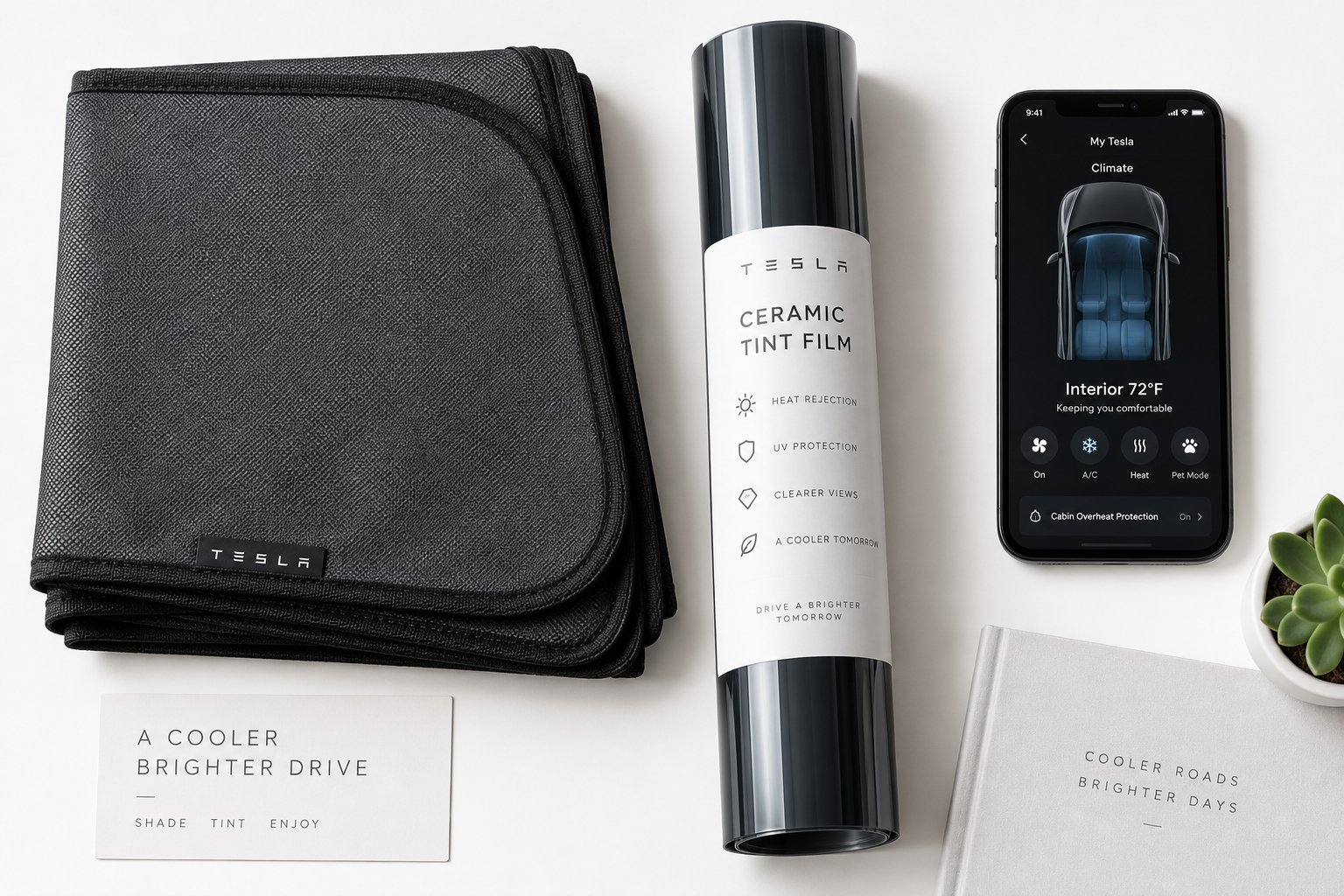
For owners who want a permanent, invisible solution, aftermarket ceramic window film applied directly to the glass roof is the next step up. High-quality nano-ceramic films can reject a significant additional percentage of infrared energy on top of what Tesla's factory coating already blocks, further reducing both radiant warmth and peak cabin soak temperatures. Once installed, there is nothing to deploy, retract, or store — the protection is continuous and maintenance-free.
The tradeoffs are cost and complexity. Professional ceramic tint installation on a Tesla glass roof typically runs between $200 and $600 depending on the film brand and your region, and the work requires a skilled installer to avoid bubbles, haze, or edge lifting on the large curved panel. DIY application is possible but risky — one poorly placed crease on a Model S Plaid or any other model's panoramic panel means starting over with a new film sheet. Unlike sunshades, ceramic tint also cannot be removed seasonally if you want the full glass experience during cooler months.
An important nuance: ceramic tint and sunshades are not mutually exclusive. Many owners in extreme heat climates layer both — the tint provides a permanent baseline of additional IR rejection, while a removable sunshade adds on-demand radiant blocking during the worst months. Think of tint as raising the floor of your heat protection and sunshades as giving you a ceiling you can deploy when conditions demand it.
Here is how all three strategies compare side by side:
| Solution | Relative Cost | Effectiveness for Radiant Heat | Effectiveness for Cabin Temperature | Ease of Use |
|---|---|---|---|---|
| Custom-Fit Roof Sunshade | Low ($45 – $110) | High — physically blocks IR before it reaches skin | Medium — reduces solar load but does not actively cool air | High — installs in minutes, removable or retractable |
| Preconditioning and Cabin Overheat Protection | Free (built into every Tesla) | Low — does not block radiant IR through the glass | High — actively cools cabin air to your set temperature | High — tap the app or set a schedule |
| Ceramic Window Tint (roof panel) | Medium to High ($200 – $600 installed) | Medium to High — rejects additional IR beyond factory coating | Medium — lowers peak soak temperature measurably | High after installation — zero daily effort required |
| Windshield and Rear Window Sunshades | Low ($30 – $70 each) | Medium — protects dash, steering wheel, and rear surfaces from direct sun | Medium — reduces overall solar entry points when parked | Medium — must be placed and removed each time you park |
| Ceramic Tint on Side Windows | Medium ($150 – $400 installed) | Medium — reduces side-angle IR reaching passengers | Low to Medium — side windows contribute less total solar load than the roof | High after installation — permanent and invisible |
A clear pattern emerges from this ranking. Preconditioning solves the cabin air problem for free, making it the mandatory first step for every owner regardless of climate. A custom-fit sunshade delivers the best cost-to-comfort ratio for radiant heat — the specific complaint that preconditioning cannot address. Ceramic tint adds a permanent layer of protection for owners who want set-and-forget performance or who live in climates where the sun never relents. And combining multiple strategies — a sunshade layered over tinted glass, backed by consistent preconditioning — gives you the most comprehensive defense available.
With this toolkit mapped out, the final question is the simplest: what should you actually do, and in what order? The answer depends on where you live, how sensitive you are to overhead warmth, and how much you are willing to invest — a decision framework that brings the entire glass roof conversation to a clear, actionable close.
The Bottom Line and What to Do Next
You came here with a straightforward question: does Tesla's glass roof get hot? After walking through the physics, the model-by-model differences, the climate variables, and every mitigation option on the market, the honest answer is more useful than a simple yes or no — because it respects the complexity your actual driving life demands.
The Honest Answer to Whether Tesla's Glass Roof Gets Hot
Yes, the glass roof transmits some infrared radiation that you can feel as warmth on your skin and scalp. That radiant sensation is real, and dismissing it as imaginary does no one any favors. On a clear summer afternoon with the sun directly overhead, your head will feel warmer under a Tesla's glass panel than it would under a stamped-metal roof. Full stop.
But no, the glass roof does not turn your cabin into an oven the way internet anxiety suggests. Tesla's multi-layer ceramic and metallic oxide coatings block the vast majority of UV and a significant share of infrared energy before it ever enters the cabin. Peak soak temperatures run modestly higher than a comparable solid-roof vehicle — typically in the range of 5 to 10 °F — but once the HVAC activates, that gap closes within minutes. The data consistently tells a calmer story than the forum posts.
Your personal experience with the roof depends on three variables: the climate zone where you park and drive every day, how consistently you use Tesla's built-in preconditioning and Cabin Overheat Protection, and whether you add a physical barrier to intercept the remaining radiant heat. A Phoenix commuter who never preconditions will have a genuinely uncomfortable experience. A Seattle driver using the app routinely may forget the roof is glass at all. Same car, same coating, vastly different realities.
A Simple Decision Framework for Tesla Owners
Rather than leaving you with abstract conclusions, here is a prioritized action plan you can follow regardless of which Tesla you own or where you live. Start at step one — it costs nothing — and move down the list only as far as your comfort and climate require.
- Use preconditioning via the Tesla app every time before entering a parked car in the sun. This single habit eliminates the initial blast of trapped heat that forms the glass roof's worst first impression. Set a departure schedule for your daily commute so it happens automatically. If you are leasing through a deal you found on a site like leasehacker or buying outright, this feature works identically — it is built into every Tesla at no extra cost.
- If you live in a hot climate or are sensitive to radiant heat, invest in a custom-fit glass roof sunshade. This is the most cost-effective physical solution for the specific problem preconditioning cannot solve: infrared warmth reaching your skin through the glass. Consider adding windshield and rear window shades for comprehensive coverage, especially if your car parks in open lots regularly. CUTIM's Tesla sunshade collection offers model-specific options for the glass roof, windshield, and rear window, letting you start with just the roof panel and expand coverage later based on your needs. Whether you are driving a Model 3, Model Y, or any other Tesla, confirming exact fitment for your production year ensures the shade sits flush and performs as intended.
- For maximum protection, add ceramic tint to side windows to complement the factory roof coating. This rounds out your thermal defense by reducing IR entry from every angle — not just overhead. Pair it with your existing roof sunshade and preconditioning routine, and you have a layered system that handles even the most brutal desert or subtropical summers. If you have ever experienced a tesla tire installation error message and felt the frustration of an unexpected service visit, you will appreciate that ceramic tint, once professionally installed, requires zero maintenance and zero troubleshooting for the life of the vehicle.
This framework scales naturally to your situation. Cool-climate owners may never move past step one. Moderate-climate drivers typically find steps one and two more than sufficient. And owners baking under intense sun — the kind of heat where you could do your arizona mills shopping in the morning and return to a scorching parking lot by noon — benefit from all three layers working together.
The glass roof is not the liability the internet sometimes makes it out to be. Tesla's factory coating does heavy lifting that most competitors' panoramic sunroofs cannot match without a mechanical shade. The built-in software tools handle cabin air temperature brilliantly. And a modest investment in a fitted sunshade closes the one remaining gap — radiant warmth on your skin — with minimal cost and effort.
Tesla's glass roof is not the heat problem the internet fears — but a quality sunshade turns a good experience into a great one.
Tesla Glass Roof Heat: Frequently Asked Questions
1. Does the Tesla glass roof make the cabin hotter than a metal roof?
Tesla's glass roof does raise peak cabin soak temperature by roughly 5 to 10 degrees Fahrenheit compared to a solid metal roof when parked in direct sun. However, multi-layer ceramic and metallic oxide coatings block approximately 99% of UV and a large share of infrared radiation, keeping that gap far smaller than most buyers expect. Once the HVAC system activates through preconditioning or Cabin Overheat Protection, interior air temperature converges with metal-roof vehicles within minutes. The warmth owners feel on their skin is radiant infrared energy, which is a separate phenomenon from overall cabin air temperature.
2. Can you get sunburned through a Tesla glass roof?
Getting sunburned through a Tesla glass roof is extremely unlikely. Tesla's factory glass absorbs roughly 99% of ultraviolet radiation, which is the wavelength responsible for sunburn and skin damage. This level of UV protection rivals or exceeds what you would get from high-SPF sunscreen. While some infrared warmth does pass through and you may feel heat on your skin, that thermal sensation is not the same as UV exposure. Interior surfaces like leather and plastics also benefit from this UV blocking, experiencing significantly less fading and degradation over time.
3. What is the best way to keep a Tesla with a glass roof cool in summer?
The most effective approach layers multiple strategies. Start with Tesla's free built-in tools: use the mobile app to precondition the cabin 10 to 15 minutes before you enter, and keep Cabin Overheat Protection enabled while parked. For radiant heat on your skin, install a custom-fit glass roof sunshade such as those from CUTIM's Tesla sunshade collection (https://www.cutimauto.com/collections/tesla-sunshades), which offers model-specific options for the roof, windshield, and rear window. In extreme climates, adding professional ceramic tint to side windows provides a permanent additional layer of infrared rejection that complements the factory roof coating.
4. Does Tesla's glass roof coating wear out or peel over time?
Tesla's heat-rejection coating is engineered to last the life of the vehicle. Unlike aftermarket window tint, which is a polymer film adhesively bonded to glass and can bubble or peel after years of UV exposure, Tesla's ceramic and metallic oxide layers are integrated into the laminated glass stack during manufacturing. There is no adhesive interface exposed to the cabin environment that could degrade. Early Model 3 vehicles with several years of road use have not shown widespread reports of coating failure, though full multi-decade data is still accumulating as these vehicles age.
5. Is Tesla's glass roof better or worse than a panoramic sunroof on a BMW or Mercedes?
It depends on whether the competitor's retractable shade is open or closed. When a BMW or Mercedes panoramic sunroof shade is closed, that cabin will feel cooler overhead because the fabric physically blocks sunlight. But when the shade is open, Tesla's multi-layer ceramic coating typically rejects more infrared heat than a competitor's basic tinted glass, which relies primarily on that shade for thermal management. Tesla's advantage is that its heat rejection works passively and permanently with no moving parts, while competitors trade simplicity for the on-demand control of a mechanical shade.