
Finding the Perfect Sleep Setup Inside Your Tesla Model Y
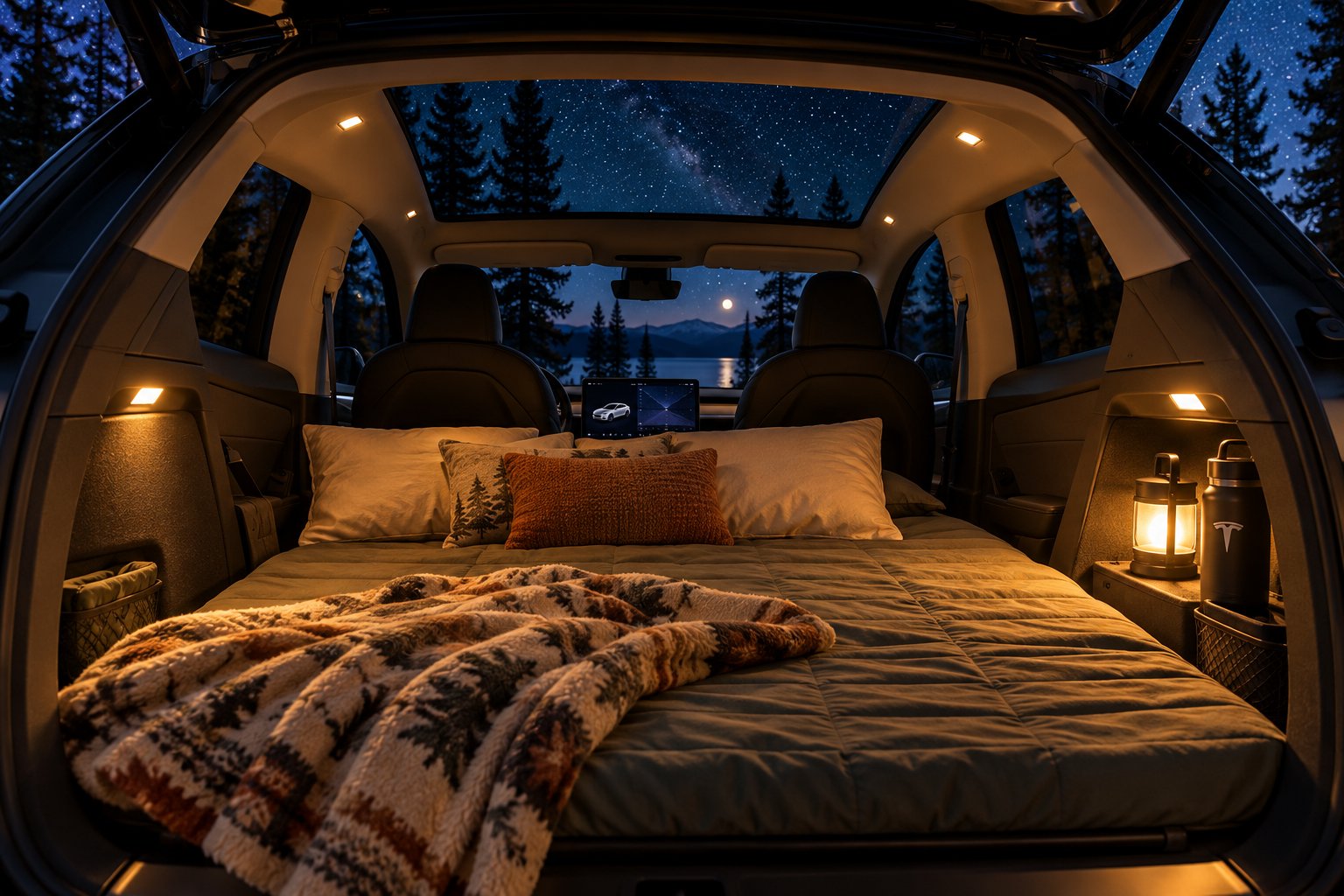
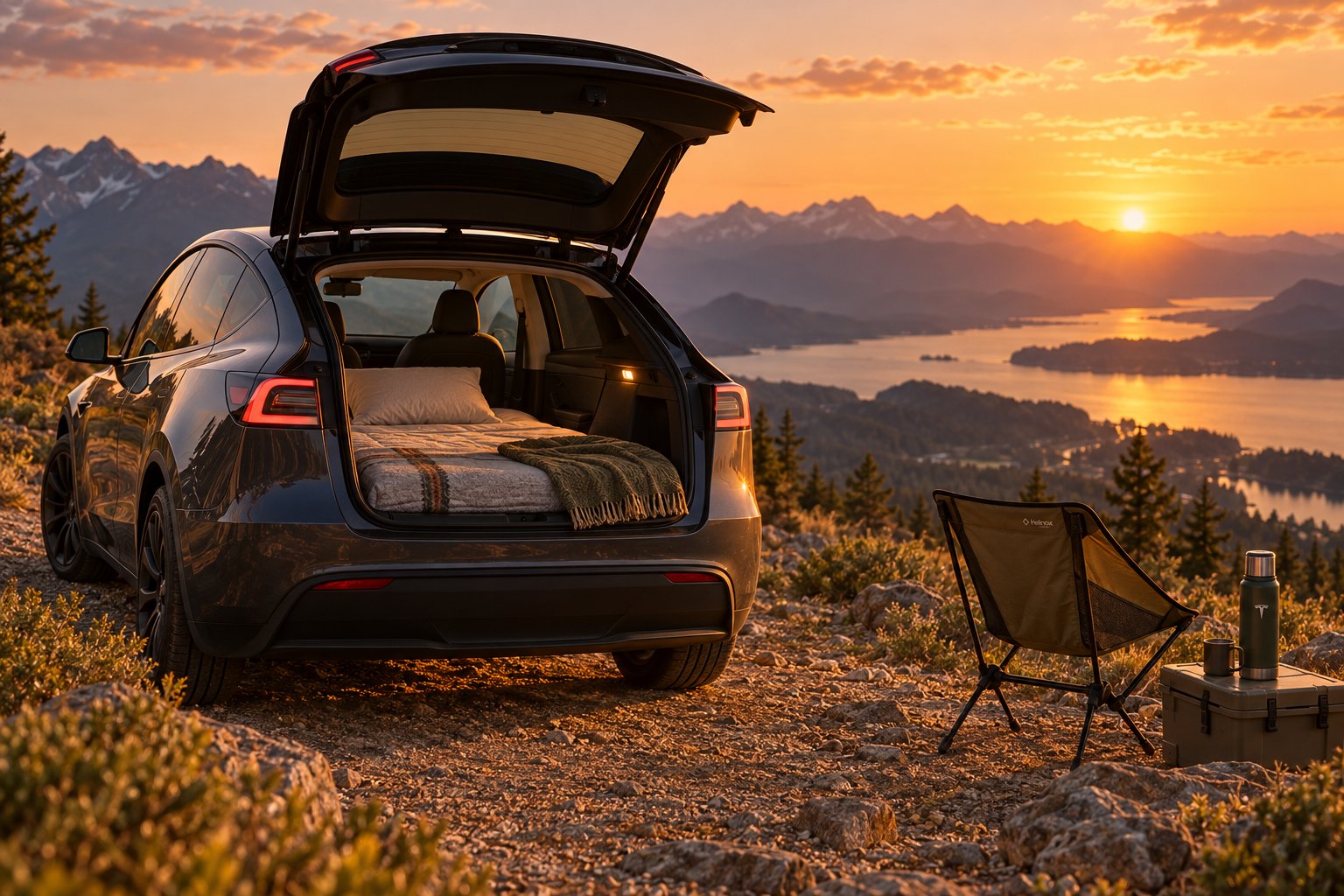
Imagine this: you've driven four hundred miles through the mountains, the sun dipped below the ridgeline an hour ago, and Camp Mode is humming quietly inside your Tesla Model Y. The temperature is perfect. The stars are out. Everything about this moment is ideal — except the crumpled sleeping bag draped over a foam pad that keeps sliding into the gap between your folded rear seats and the trunk floor. Sound familiar?
Why Your Tesla Model Y Mattress Choice Matters More Than You Think
The Model Y has earned its reputation as one of the best electric vehicles for car camping. Flat-folding rear seats, a spacious cargo area, and Camp Mode's built-in climate control make overnight stays surprisingly viable. But here's the catch most people discover the hard way: the cargo area is not a flat rectangle. Wheel well intrusions eat into the width, the trunk floor slopes slightly, and an awkward gap forms right where the seat backs fold down. A standard queen air mattress? It bunches, sags, and leaves you sleeping on pressure points instead of a stable surface.
Your mattress choice is the single biggest factor separating a restful night from a miserable one — and Model Y camping only works as well as the surface you're lying on.
What This Roundup Covers and How to Use It
This guide reviews six mattresses spanning every budget tier — under $100, $100 to $250, and $250 and above — and every major type, including inflatable, self-inflating (like the popular Snuuzu camping mattress for the Tesla Model Y), and full foam options. Each product is evaluated across five criteria: fit precision, comfort, setup speed, packed size, and honest drawbacks. No single brand is paying for placement here. Whether you're shopping for a Tesla Model Y air mattress on a tight budget or a premium foam solution for extended road trips, you'll find a clear, side-by-side breakdown designed to match you with the right option for how you actually use your vehicle.
The real question isn't whether Model Y camping works — it's whether you've got the right foundation underneath you. And that starts with understanding exactly what the cargo space demands from a mattress.
How We Evaluated Every Tesla Model Y Mattress
Before diving into individual product reviews, you need to understand the space you're actually working with. Most Tesla Model Y mattress listings show glossy photos of someone sleeping peacefully in the back — but they rarely show you the oddly shaped cargo area that makes or breaks the experience. Let's fix that.
Tesla Model Y Cargo Dimensions and the Flat-Sleep Problem
When you fold the rear seats flat, the Model Y opens up roughly 71.4 cubic feet of total cargo volume behind the front row, according to Car and Driver's spec sheet. That sounds enormous — and it is, for hauling luggage. Sleeping is a different story because cubic feet don't tell you anything about the shape of the surface underneath you.
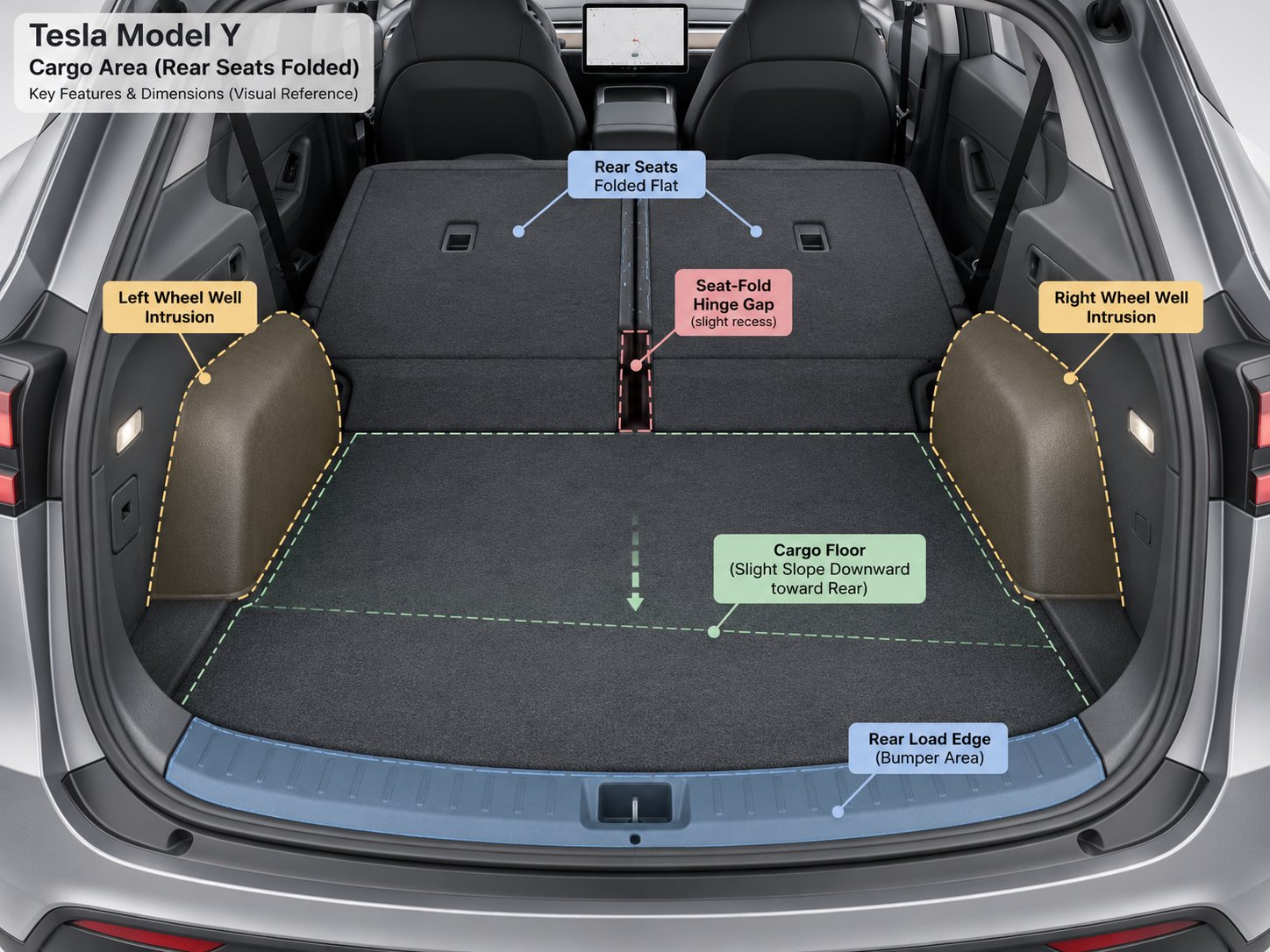
Here's what the sleeping footprint actually looks like. With both rear seats folded, the usable length from the back of the reclined front seats to the trunk lip measures approximately 72 to 76 inches, depending on how far forward you push the driver and passenger seats. The width between the wheel wells — the narrowest point — drops to roughly 40 to 42 inches. That's tighter than a standard twin mattress. Available headroom above the cargo floor sits around 28 to 30 inches before you hit the rear hatch glass, which means thick mattresses can make the space feel cramped fast.
Those numbers look workable on paper. The problem is that this sleeping area is not a clean rectangle, and three specific fitment challenges trip up nearly every Tesla model Y mattress on the market.
Challenge 1 — The seat-fold gap. When the rear seat backs fold down, they don't meet the trunk floor at a perfectly flush angle. There's a noticeable gap and a slight ledge right at the hinge point. If your mattress doesn't bridge or fill this transition, you'll feel a hard ridge pressing into your lower back or hips all night.
Challenge 2 — Wheel well intrusions. The rear wheel arches jut into the cargo area on both sides, stealing several inches of width at shoulder and hip level. A mattress cut for a simple rectangle will bunch against these intrusions, creating uneven support and wasted material. As BASENOR's cargo measurement guide notes, wheel-arch and side-panel shapes can significantly reduce the usable width compared to the raw cargo volume numbers.
Challenge 3 — The trunk floor slope. The cargo floor isn't perfectly level. There's a subtle downward slope from the folded rear seats toward the trunk lip. On a firm surface, you might not notice. On a soft tesla air mattress, your body slowly migrates toward the tailgate as the night goes on. Any mattress worth buying needs to either compensate for this gradient or be firm enough to prevent you from sliding.
Pre-Refresh vs Highland Model Y — What Changed for Sleepers
This is the question that causes the most anxiety for buyers: "Will this mattress fit my specific Model Y?" The answer depends on which generation you own.
The pre-refresh Model Y (2020-2024) established the cargo dimensions that most aftermarket mattresses were originally designed around. When the Juniper refresh arrived in early 2025, Tesla redesigned over 40% of the vehicle's components. That sounds alarming if you're mattress shopping — but here's the reassuring detail. The main trunk floor dimensions stayed essentially the same. According to compatibility testing, the cargo floor footprint didn't undergo significant changes between the pre-refresh and Juniper models.
Where things did shift is in the trunk side pockets and trim panels. The Juniper's left-side pocket is deeper to accommodate a new 12V access panel, and some interior trim contours differ slightly. For mattresses that rely on tight edge-to-edge fitment against the side walls, these small changes can matter. A foam mattress cut precisely for 2022 side trim might press differently against 2025 Juniper trim.
The practical takeaway? Most Tesla Model Y mattresses designed for the 2020-2024 cargo floor will physically fit inside a Juniper, but edge fitment may vary by a centimeter or two. Always verify that the manufacturer explicitly lists your model year — especially if you're buying a premium foam option with precision-cut edges. When a product page only references "2020-2024," treat Juniper compatibility as unconfirmed until you see it stated directly.
Our Five Evaluation Criteria Explained
Every mattress in this roundup is measured against the same five criteria, weighted for what actually matters when you're sleeping inside a vehicle:
- Fit precision to Model Y cargo shape — Does the mattress account for wheel wells, the seat-fold gap, and the trunk slope? A mattress that technically fits but leaves dead zones or pressure ridges loses points here.
- Comfort and support quality — How does it feel after six-plus hours? We consider firmness, pressure distribution, and whether the surface stays stable or bottoms out overnight.
- Setup and teardown time — Can you go from packed to sleeping in under five minutes? This matters most for road-trippers who set up camp after a long driving day.
- Packed size and storage footprint — A mattress you can't easily store in the trunk alongside the rest of your gear becomes a logistical headache. We note whether each option fits in the sub-trunk well or requires dedicated cargo space.
- Value relative to price tier — A $60 inflatable isn't competing with a $300 foam mattress on comfort. We judge each product against others in its budget category.
Beyond these five core criteria, two additional factors deserve attention before you pick a type.
Seasonal insulation and condensation. Foam mattresses naturally provide better insulation from the cold cargo floor — think of it as a higher R-value barrier between your body and the metal beneath. A tesla air mattress, by contrast, holds a large volume of air that drops to ambient temperature overnight. In cold-weather Camp Mode use, that means you'll feel the chill rising through an inflatable far more than through dense foam. On the flip side, foam surfaces can trap body heat and moisture against the cargo floor, increasing condensation risk during humid conditions. Self-inflating mattresses, like the popular Snuuzu Model Y mattress, split the difference — their foam core adds insulation while the air chamber keeps weight manageable.
Thickness and headroom trade-offs. Every inch of mattress thickness costs you an inch of headroom. With only 28 to 30 inches of clearance above the cargo floor, a 4-inch mattress leaves enough space to sit up and shift positions comfortably. A 7- or 8-inch mattress delivers a more bed-like feel but makes the interior feel noticeably tighter — you'll be rolling in and out instead of sitting up. Neither choice is wrong, but your sleeping style and tolerance for tight spaces should guide the decision.
With these dimensions, fitment challenges, and evaluation criteria mapped out, the next step is seeing how specific products handle them in practice — starting with options designed from the ground up for the Model Y's unique cargo shape.
CUTIM Tesla Mattress
One of the most practical ways to narrow your search for a tesla mattress is to find a brand that offers multiple types under one roof — foam and inflatable — so you can compare dimensions and packing requirements without bouncing between a dozen websites. That's exactly the approach behind CUTIM's Tesla Mattresses & Camping collection, which brings together folding foam mattresses, memory foam beds, and inflatable air mattresses all designed around Tesla cargo dimensions. For Model Y owners, this means you can check vehicle fitment across different mattress styles in a single place before committing.
CUTIM Tesla Mattress — Fit and Comfort Breakdown
CUTIM's lineup addresses the Model Y cargo area from multiple angles. Their foam options — including a folding chenille foam mattress and a dedicated Model Y Juniper memory foam bed — are shaped to sit within the cargo footprint once the rear seats are folded flat. The inflatable options, such as the custom-fit car air mattress for Model 3 and Model Y, use contoured air chambers designed to work around the wheel well intrusions and seat-fold transition rather than fighting against them.
Comfort varies by which type you choose. The memory foam models provide denser support with a surface that conforms to your body weight, making them a solid pick for side sleepers who need pressure relief at the hips and shoulders. The inflatable models feel lighter and bouncier — closer to a traditional tesla bed experience on a camping trip — and they let you fine-tune firmness by adjusting how much air you pump in. CUTIM also offers an Ice Feel Cooling Mattress specifically for the Juniper Model Y, which uses a cool-touch fabric layer. That's a thoughtful detail for summer camping when Camp Mode is keeping the cabin cool but your body heat still builds up against a foam surface.
For fitment, Juniper-specific listings are clearly separated from pre-refresh options in the collection. This distinction matters — as we covered earlier, the side trim differences between generations can affect edge-to-edge precision with foam mattresses. CUTIM's approach of listing Juniper products independently gives buyers confidence they're ordering for the right vehicle.
Setup Process and Packed Size
Setup depends entirely on the type you select. The folding foam mattresses unfold in three sections directly onto the cargo floor — no pump required, no waiting for inflation. You're looking at roughly two to three minutes from opening the carrying bag to having a ready sleeping surface. The trade-off is packed size: foam doesn't compress the way air does, so these options occupy more storage space when not in use.
The inflatable models pack down significantly smaller and typically include a pump or are compatible with portable air pumps that plug into the Model Y's USB-C ports. Inflation takes a few extra minutes compared to unfolding foam, but the payoff is a mattress that can tuck into the sub-trunk or frunk when deflated, leaving your main cargo area clear for coolers, luggage, and other tesla camping accessories.
Who Should Buy This and Who Should Skip It
Pros
- Multiple mattress types (foam, memory foam, inflatable) available in one collection, making it easy to compare options side by side
- Juniper-specific listings eliminate guesswork about generation compatibility
- Inflatable options pack small enough for sub-trunk or frunk storage
- Specialty options like the Ice Feel Cooling Mattress address seasonal comfort needs
- Covers both Model 3 and Model Y fitments across the lineup
Cons
- Foam options are bulkier when packed, reducing available cargo space during the day
- Inflatable models carry the inherent puncture risk of any air-based mattress
- Not all models include a pump — check individual product listings before ordering
- Product descriptions could provide more detailed thickness and weight specifications for easier comparison
Who this is for: Model Y owners who want the flexibility to compare foam versus inflatable options within one brand, especially those who value being able to check Juniper-specific fitment details upfront. Road-trippers and overnight campers who prefer browsing a curated collection rather than piecing together specs from scattered listings will find this approach practical.
Who this is NOT for: Buyers who already know they want a single premium foam mattress and are willing to pay top dollar for the thickest, most bed-like option available. If maximum plushness is your only priority and storage space is irrelevant, you may want to look at dedicated premium foam brands instead.
The CUTIM collection works best as a starting point — it lets you weigh trade-offs between foam comfort and inflatable portability in one place. You can browse the full Tesla Mattresses & Camping collection to compare dimensions and packing requirements for your specific Model Y generation before deciding which mattress type suits your camping style.
Of course, CUTIM isn't the only brand engineering a dedicated tesla bed for the Model Y's cargo area. Premium foam mattresses from competitors like Havnby take a very different design philosophy — one that prioritizes solving the seat-fold gap with a single, thick wedge of foam rather than offering multiple product types.
Havnby FlatCore Foam Mattress
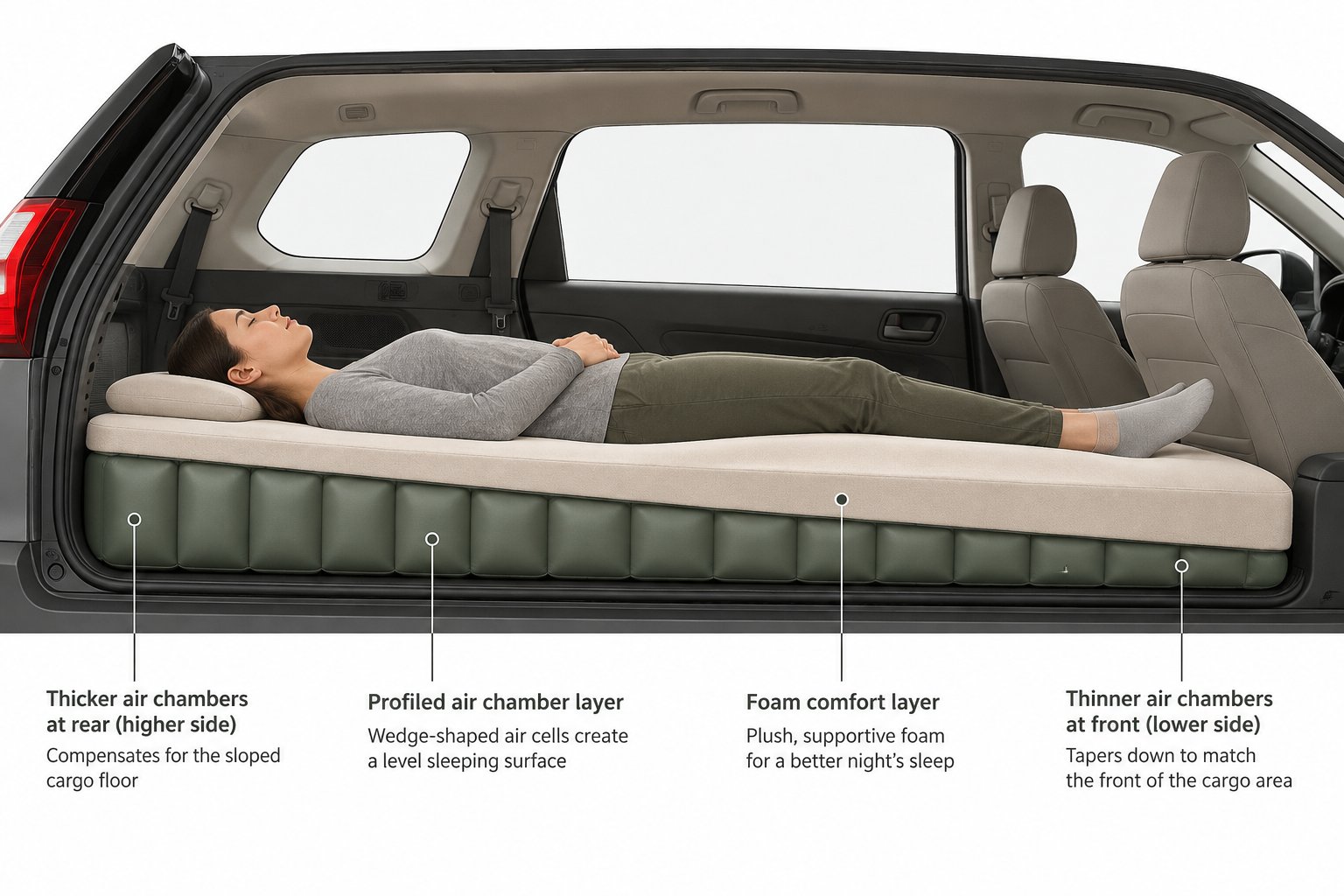
Remember that two-in-the-morning discovery we mentioned earlier — the one where you realize the Model Y's folded seats slope toward the windshield with a hard ridge across the middle? Havnby built an entire product around fixing exactly that problem. The FlatCore takes a different approach than collections offering multiple mattress types: it's a single, purpose-engineered air-foam hybrid designed to cancel the Model Y's inclined cargo floor and deliver a genuinely level sleeping surface.
Havnby FlatCore — Wedge Design and Foam Core Explained
Calling the FlatCore a simple foam mattress undersells what's actually happening inside it. It's an air-foam hybrid: a profiled air chamber handles the leveling work — thicker where the cargo floor drops, thinner where it rises — while a foam comfort layer sits on top so the surface feels stable rather than bouncy. Think of it as an engineered wedge that compensates for every degree of slope in the Model Y's folded-seat area. The result, according to AWD Camper's detailed review, is a truly flat bed where a tilted surface used to be.
Fitment precision is another strong point. Havnby sells distinct versions for the 2020-2024 Model Y and the 2025-2026 Juniper rather than declaring one shape close enough for both. At $549, that kind of generation-specific engineering is worth respecting — you're paying for a model y mattress that actually matches your vehicle's build year, not a one-size-hopes-to-fit-all compromise. The seat-fold gap, which is the single most common complaint with generic air mattresses in Teslas, gets addressed directly by the profiled air chamber geometry. No separate gap filler needed.
Setup Speed and Storage Trade-Offs
Here's where the FlatCore earns serious convenience points for tesla model y camping. The pump is built right into the mattress and runs off the car's 12V socket — no hunting for batteries, no separate pump to lose in your gear bag. Havnby quotes 80 seconds to full inflation and roughly 90 seconds to deflate and pack everything back into the included storage bag. That's fast enough to set up after a long driving day without it feeling like a chore.
The hybrid air-foam construction also gives the FlatCore a real advantage over pure foam competitors when it comes to packed size. Unlike dense, full-foam mattresses that demand a dedicated shelf or permanent trunk space, the FlatCore deflates and compresses into a carry bag that's far more manageable between trips. It's not as compact as a simple model y air mattress, but the gap is narrower than you'd expect for something this thick and supportive.
Who Should Buy This and Who Should Skip It
Owner feedback paints a clear picture. The core promise — a level, stable sleeping surface — delivers consistently. "Perfect and worth the price" and "stayed inflated overnight with no issues" are representative of the experience most buyers report. But two practical gripes come up repeatedly and deserve your attention before you order.
First, the cover fabric is slippery. Some sleepers find themselves slowly sliding on it overnight, especially with silk or satin sleeping bag liners. A fitted cotton sheet solves this, but it's an extra step Havnby could address. Second, the rear-mounted pump housing sits exactly where you climb in through the hatch. It's not a dealbreaker, but you'll notice it every time you get in and out.
Pros
- Profiled air-foam hybrid genuinely levels the Model Y's sloped cargo floor — the core problem most mattresses ignore
- Built-in 12V pump inflates in 80 seconds with no external accessories required
- Generation-specific versions for 2020-2024 and 2025-2026 Juniper ensure precise fitment
- Packs into a carry bag — significantly more portable than full-foam alternatives
- Foam comfort layer prevents the bouncy, unstable feel of pure air mattresses
Cons
- $549 price tag puts it firmly in the premium tier — a real investment for occasional campers
- Slippery cover fabric can cause sliding; a fitted sheet is a near-essential add-on
- Pump housing at the rear edge sits right where you enter through the hatch
- Still bulkier packed than a basic inflatable, even though it's far more compact than pure foam options
Who this is for: Serious road-trippers, work shift nappers, and anyone who has already tried sleeping on the Model Y's sloped cargo floor and knows that the tilt is their main comfort problem. If you prioritize a level sleeping surface and fast setup over everything else, the FlatCore earns its price.
Who this is NOT for: Minimalist travelers who need every cubic inch of trunk space for gear, or occasional campers who can't justify $549 for a few nights per year. If you're looking for the most compact packed size possible, a dedicated inflatable will serve you better — and if maximum plushness matters more than flatness, thicker layered foam options exist at similar price points.
The FlatCore solves the slope problem decisively, and that singular focus is both its greatest strength and its limitation. Not every Model Y camper's primary pain point is the incline, though. Some prioritize the balance between comfort and packability — a middle ground where self-inflating mattresses like the Snuuzu stake their claim.
Snuuzu Camping Mattress
Between the compactness of a pure inflatable and the plushness of a full foam slab sits a category that often gets overlooked: the self-inflating hybrid. The Snuuzu camping mattress for the Tesla Model Y has carved out significant popularity in exactly this space, and for good reason. It approaches the Model Y's awkward cargo floor with a layered construction philosophy — air for leveling, foam for comfort, premium textiles for the sleep surface — rather than relying on a single material to do everything.
Snuuzu Model Y — Self-Inflating Convenience Reviewed
What separates Snuuzu from a basic tesla mattress model y is its multi-layer architecture. At the base sits a shaped adjustable air layer that compensates for the Model Y's folded-seat transition, the ditch where the seats hinge, and the gap that plagues every car camper's lower back. Above that structural air chamber, a breathable 3D Airmesh layer and Snuuzu's proprietary Zero Gravity foam distribute body pressure across the sleeping surface. The top contact layer uses an organic Tencel cover — a fabric known for moisture-wicking and softness — while a protective shell on the underside faces the vehicle's cargo floor to guard against grit and abrasion.
This arrangement is deliberate. The foam sits outside the air chamber rather than inside it, so you're sleeping directly on foam and textile instead of on a plastic bladder. The air layer handles leveling and adjustable firmness while the foam handles the actual body feel. It's a meaningful distinction from simple inflatables, where every pressure point interacts directly with an air pocket that can shift or bottom out.
Fit precision for the Model Y cargo area is a core part of the Snuuzu Model Y design. The shaped base layer is profiled to sit within the wheel well intrusions and bridge the seat-fold gap — the two fitment challenges that trip up generic mattresses most often. One long-term owner review documented 17 nights across a full year of travel in a 2022 Model Y, including multi-day trips through varied terrain and weather. That kind of repeated real-world use reveals whether fitment holds up after many setup-and-teardown cycles, not just during the first unboxing.
Comfort and Portability Balance
The self-inflating mechanism is where the Snuuzu hits its sweet spot between convenience categories. Unlike a manual pump inflatable that requires several minutes of active pumping (or hunting for a charged electric pump), and unlike a full foam mattress that simply unfolds at whatever thickness it was built, the Snuuzu uses a built-in rechargeable pump powered via USB-C. You connect it, the air chamber fills to your preferred firmness, and the foam layers above are already in position — no separate inflation step for the comfort surface.
How does that compare to the alternatives in practice? A pure inflatable can be ready in under two minutes but offers no foam comfort layer. A full foam mattress is instant — unroll and sleep — but you're stuck with one firmness setting and a bulky packed size. The Snuuzu lands in between: slightly more setup involvement than tossing down a foam pad, but you gain adjustable firmness and a significantly smaller storage footprint than any full-foam competitor.
Speaking of storage, the packed dimensions tell an honest story about where this tesla matress fits in the portability spectrum. When rolled into its integrated storage bag, the Snuuzu Model Y mattress measures approximately 29.1 by 12.6 inches and weighs around 23.4 pounds. That's not light — you'll notice the weight carrying it from your apartment to the car. But it's substantially more manageable than a full-foam mattress that might occupy half your trunk permanently. The integrated bag design, where the storage sack stays attached to the mattress itself, eliminates the classic problem of losing a separate stuff sack between trips. After repeated use, owners report that the packing routine becomes familiar enough that it stops feeling like a task.
One detail worth highlighting for anyone considering cold-weather model y camping: the foam-over-air construction provides meaningful insulation. The foam layers between your body and the air chamber prevent the direct cold transfer that makes sleeping on a pure air mattress miserable in low temperatures. It's not a substitute for proper bedding and a good sleeping bag, but it's a noticeable advantage over inflatables that leave nothing but a thin plastic wall between you and cold air.
The removable Tencel cover also earns points for long-term practicality. After real travel — campsite dust, spilled coffee, the general grime of living out of a car — you can pull the cover off and machine wash it according to the care label. A protective shell on the underside keeps the inflatable portion shielded from rough cargo floor surfaces. These aren't glamorous features, but they're the kind of details that determine whether a for tesla model y self-inflating camping mattress still feels clean and functional on trip number fifteen.
Who Should Buy This and Who Should Skip It
Pros
- Multi-layer construction (air base, 3D Airmesh, Zero Gravity foam, Tencel cover) provides both adjustable support and genuine foam comfort
- Shaped air layer specifically profiles to the Model Y's seat-fold gap and cargo contours
- Built-in rechargeable USB-C pump eliminates the need for external inflation accessories
- Removable, washable cover extends usable lifespan across many trips
- Integrated storage bag can't be misplaced — stays attached to the mattress
- Foam-over-air design offers better cold-weather insulation than pure inflatables
Cons
- At approximately 23.4 pounds, it's heavier than most inflatable alternatives
- Packed size of 29.1 x 12.6 inches requires dedicated cargo space — won't disappear into a sub-trunk well
- The built-in pump is a potential failure point; one documented long-term review noted a pump issue requiring a manual workaround and support contact
- Premium pricing places it above budget inflatables and into the mid-to-high tier
- Not as plush or bed-like as the thickest full-foam options like a 7.5-inch dedicated foam mattress
Who this is for: Campers who want the best balance of comfort and portability — people who plan regular overnight trips and need a mattress that's genuinely comfortable without permanently occupying the trunk. If you've tried a basic tesla model 3 mattress or generic inflatable and found it too thin, too cold, or too unstable, the Snuuzu's layered approach addresses all three complaints without going full foam.
Who this is NOT for: Buyers chasing the absolute most compact packed size should look at dedicated inflatables instead. And if maximum plushness is your non-negotiable priority — you want the feeling of sleeping on a real bed, not just a very good car mattress — thicker premium foam options will get you closer to that goal, at the cost of significantly more bulk and weight. The Snuuzu is a deliberate compromise, and it's a good one, but it is still a compromise.
The Snuuzu represents what happens when a brand optimizes for the middle of the comfort-portability spectrum. Other manufacturers have aimed at the opposite end entirely — investing in thick, premium foam slabs that prioritize the most mattress-like sleep possible, storage space be damned. Two of the most established names in that premium foam category are TESMAT and Lost Horizon.
TESMAT Horizon and Lost Horizon
If you've ever slept on a dense memory foam mattress at home and thought, "Why can't my Model Y feel like this?" — these two brands heard you. TESMAT and Lost Horizon both occupy the premium end of the tesla y camping mattress market, and both share a fundamental design conviction: the best sleeping surface is a thick slab of quality foam, shaped precisely for Tesla's cargo geometry, with zero reliance on air chambers. It's the least portable approach and the most expensive one. It's also the closest you'll get to an actual bed inside a car.
Pairing these two in a single section makes sense because they're solving the same problem from similar angles — yet the details of how each brand executes its foam solution reveal meaningful differences for buyers choosing between them.
TESMAT Horizon — Premium Foam with Privacy Screen Integration
TESMAT has been a familiar name in the Tesla camping accessories space for several years, and the Horizon represents its most refined product. The mattress consists of segmented memory foam sections that zip together to form a continuous sleeping surface across the Model Y's folded cargo area. Because each segment is cut independently, the foam can be shaped to account for the seat-fold hinge point and the wheel well intrusions — the two fitment hurdles that flat, rectangular mattresses can't handle.
What sets TESMAT apart from most competitors is its ecosystem approach. The Horizon isn't sold as a standalone mattress — it's positioned alongside dedicated privacy screens, window shades, and accessory bundles designed for a complete overnight camping setup. For buyers who want a turnkey experience rather than piecing together gear from five different brands, that bundled strategy has real appeal. The privacy screens in particular solve a practical problem that every Model Y camper faces: the expansive glass roof and large rear window make the cabin feel exposed at campsites and rest stops after dark.
The foam itself uses relatively thin memory foam compared to some competitors. TENTSLA's expert review notes that while TESMAT excels in packing down small enough to fit inside the frunk — a genuine rarity for foam mattresses — the thinner profile means strict side-sleepers may feel their hips pressing against the hard folded seats beneath. Back sleepers and lighter individuals tend to fare better. The segmented zip-together design also means there are seams running across the sleeping surface, and some owners report feeling these seam ridges during the night, especially after the foam compresses over time.
Setup is straightforward: unzip the carrying case, lay the segments across the cargo floor, zip them together, and you're done. No pump, no inflation wait, no batteries. Teardown follows the same steps in reverse. TESMAT quotes the entire process at a few minutes, and real-world use confirms that — it's about as simple as foam gets.
Pros
- Segmented design packs into a carrying case compact enough for the frunk — exceptional for a foam mattress
- Ecosystem of matching privacy screens and window shades creates a complete camping kit
- No pump or inflation needed — unzip, lay flat, and sleep
- Memory foam provides consistent support without air pressure fluctuations overnight
- Established brand with a track record in the Tesla camping accessories market
Cons
- Thinner foam profile may bottom out for side-sleepers and heavier individuals
- Zip-together seams can be felt through sheets, especially as foam ages and compresses
- Premium pricing ($200+) for a mattress that prioritizes packability over maximum cushioning
- Memory foam stiffens noticeably in cold temperatures, making it harder to roll up and less comfortable in winter tesla y camping without significant cabin heating
Lost Horizon — Another Dedicated Tesla Foam Solution
Where TESMAT optimizes for packability within the foam category, Lost Horizon takes the opposite stance: maximum comfort, consequences be damned. The Lost Horizon Model Y mattress uses thick, high-density memory foam that absorbs the seat incline and cargo floor irregularities through sheer material depth. Lie down on it, and you'll understand immediately why this brand has earned dedicated search interest — terms like "lost horizon tesla mattress" and "lost horizon model y mattress" reflect a buyer base that specifically seeks out this product by name.
The comfort story is genuinely compelling. Among all the foam options available for the Model Y, the Lost Horizon feels closest to a traditional home mattress. The thick memory foam cradles pressure points at the hips, shoulders, and lower back in a way that thinner segmented foams simply can't replicate. For extended camping — multiple consecutive nights on the road — that depth of cushioning accumulates into a meaningful difference in how rested you feel each morning.
Fitment is handled through custom shaping for the Model Y's cargo contours, including accommodation for the wheel arches. The foam's density also works in its favor for bridging the seat-fold gap: rather than requiring a separate wedge or filler piece, the thick foam spans the transition point and distributes your weight across it without creating a noticeable ridge. You still feel the slight transition if you press your hand into it deliberately, but under body weight, it effectively disappears.
The trade-off is significant and unavoidable: bulk. Rolling this mattress back up after sleeping on it — especially in cold weather, when memory foam becomes stubbornly rigid — requires real physical effort. And once packed, it consumes a massive footprint in the cargo area. Unlike TESMAT's frunk-friendly segments, the Lost Horizon essentially demands a permanent chunk of your trunk space. As one expert review put it, the "massive drawback is its sheer bulk" — a frank assessment that matches owner experiences consistently. If you need the cargo area for luggage, coolers, or gear during the day, that's a logistical problem with no clean solution.
Pros
- Thickest, most bed-like sleep surface available — closest to a home mattress experience inside a Model Y
- High-density memory foam absorbs the seat-fold gap and cargo slope without separate filler accessories
- Excellent pressure point relief for side-sleepers, heavier individuals, and multi-night trips
- No air chambers mean zero risk of punctures or slow leaks overnight
- Dedicated following with strong brand-specific search demand, indicating consistent owner satisfaction
Cons
- Largest packed size of any mattress in this roundup — consumes significant cargo space even when compressed
- Rolling and repacking in cold weather is physically demanding due to stiff, cold-hardened foam
- Cannot fit in the sub-trunk or frunk; requires dedicated trunk real estate during travel days
- Premium price point ($200+) with the highest ongoing space cost of any option reviewed
- Weight makes it cumbersome to carry from storage to vehicle and back
Are Premium Foam Mattresses Worth the Investment
Here's the honest calculus. Premium foam mattresses like the TESMAT Horizon and Lost Horizon deliver the most mattress-like sleep you can get inside a vehicle. Full stop. No inflatable or self-inflating option matches the feeling of sinking into dense memory foam after a long day of driving. If comfort is the metric that matters most to you — and you camp frequently enough to justify the cost — either of these options earns its price over dozens of nights.
But comfort doesn't exist in isolation. Every Model Y owner also has to answer a logistics question: what happens to this mattress during the 90% of the time I'm not sleeping on it? TESMAT answers that question better than most foam competitors by engineering segments small enough for frunk storage, though you pay for that packability with thinner cushioning. Lost Horizon answers it honestly: this mattress lives in your trunk, period.
Who these are for: Frequent campers, digital nomads, Tesla rental fleet operators on platforms like Turo, and anyone who treats their Model Y as a regular sleeping space rather than an occasional emergency backup. If you camp ten or more nights per year and prioritize waking up feeling genuinely rested, premium foam is the right investment. The TESMAT Horizon suits owners who need the cargo area back during the day. The Lost Horizon suits those who've accepted the trunk space trade-off in exchange for the best possible sleep surface — a true blue model y camping companion for the comfort-obsessed.
Who these are NOT for: Occasional road-trippers who sleep in the car once or twice a year, minimalist packers who need full access to cargo space, or budget-conscious buyers exploring the tesla model x mattress market alongside the Model Y and looking for a versatile option that moves between vehicles. At the $200+ price point, premium foam only makes financial sense if you'll use it enough to amortize the cost — and if you're willing to live with the storage reality that comes with thick, dense material.
Premium foam represents one end of the price-and-comfort spectrum. At the opposite end sits a question that nearly every first-time Model Y camper asks before anything else: can I just grab a cheap air mattress and make it work?
Budget Air Mattress Options Under $100
The answer is: sort of. Almost every Model Y owner's first instinct is to grab something cheap and see if car camping even sticks before investing hundreds of dollars. That's completely reasonable. The problem isn't the impulse — it's the assumption that any air mattress will work inside a vehicle with a cargo area shaped like nothing you'd find in a bedroom.
Can a Generic Air Mattress Work in a Tesla Model Y
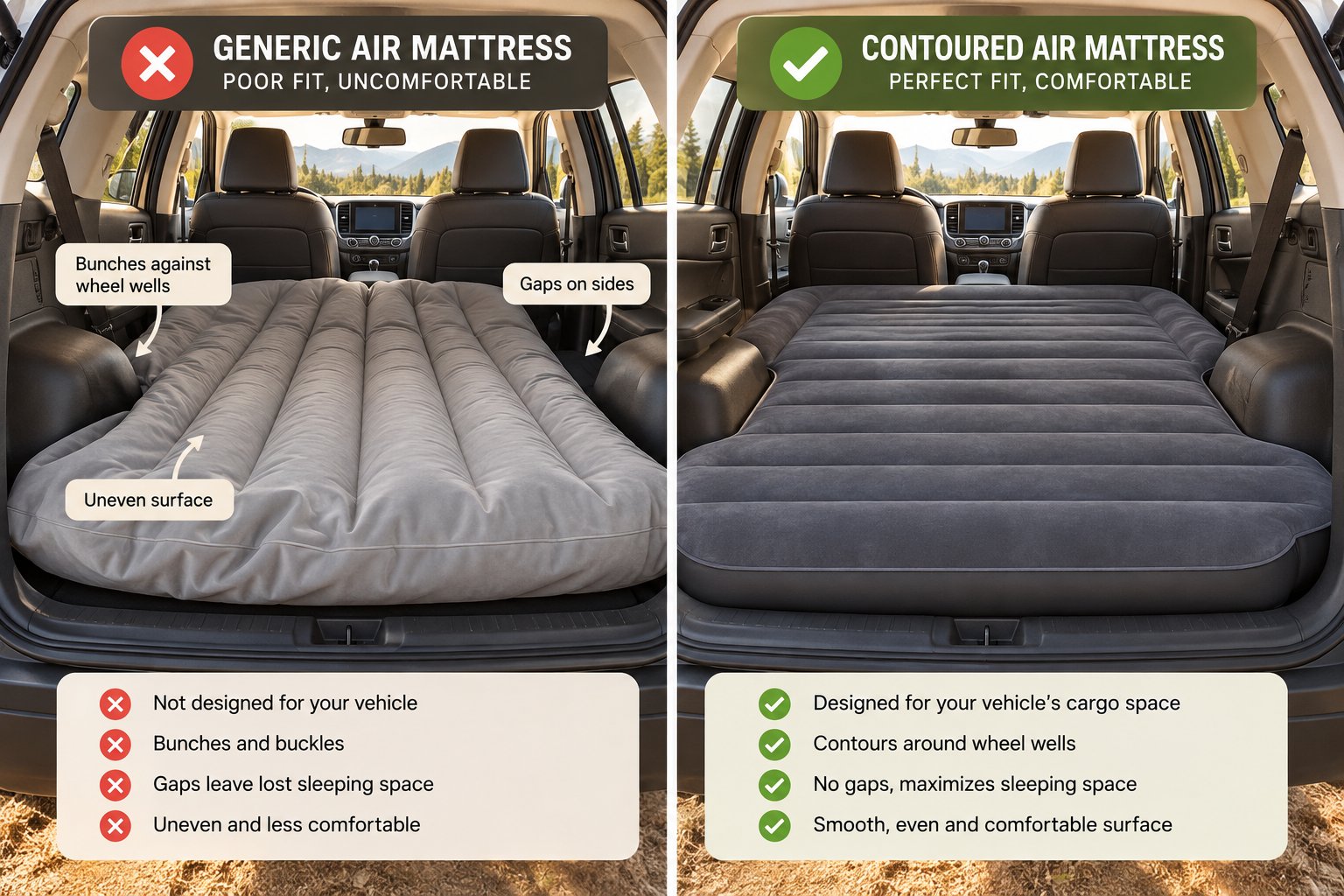
Picture a standard queen air mattress — the kind you'd inflate for a guest on the living room floor. It measures roughly 60 inches wide and 80 inches long. The Model Y's cargo area between the wheel wells? About 40 to 42 inches wide. You can probably see where this is going.
A queen-size inflatable physically cannot lay flat inside the Model Y. The wheel wells force the mattress edges upward, creating walls of bunched material on either side of your body. The excess length buckles against the front seat backs or crumples at the trunk lip. And the seat-fold gap we've discussed throughout this guide? A generic air mattress simply drapes over it, creating a valley that sinks under your weight. You end up sleeping in a taco-shaped trough rather than on a flat surface.
Even a twin-size air mattress, which is closer to the right width, runs into the slope and gap issues. The dimensions might technically fit between the wheel arches, but a rectangular footprint can't account for the curved intrusions or the angled transition at the seat hinge. You'll feel every irregularity underneath you, and without any contoured shaping, the mattress slides toward the tailgate on the sloped cargo floor.
So no — a generic air mattress from the closet is not a reliable tesla model y bed solution. It's a one-night experiment that usually convinces people to buy something purpose-built.
What Budget-Friendly Tesla Air Mattresses Get Right and Wrong
The good news is that a growing number of sub-$100 inflatables on Amazon and other retailers are now marketed specifically as a tesla air mattress model y. These budget options typically include a few Tesla-specific design features that generic mattresses lack: narrower overall width to sit between the wheel wells, contoured side cutouts to accommodate the wheel arches, and sometimes an inflatable bridge or wedge insert meant to fill the seat-fold gap.
When these features are executed well, a budget inflatable can provide a passable sleeping surface for occasional use. The dimensions at least respect the cargo area's actual shape rather than pretending it's a flat rectangle. Some include a basic electric pump that runs off USB or plugs into the car's 12V socket, cutting setup time to a few minutes.
Here's what they get wrong. "Tesla compatible" on a product listing doesn't guarantee precise fitment. As HEST's foam vs. inflatable comparison points out, air mattresses as a category share inherent limitations: they lose pressure as nighttime temperatures drop, they provide minimal insulation from a cold cargo floor, and punctures from zippers, keys, or rough cargo surfaces are always a risk. Budget models amplify these downsides because they use thinner PVC or vinyl materials with less robust seam construction. A $60 inflatable won't hold air as reliably as a $150 one — that's not snobbery, it's material science.
Fitment quality also varies wildly within this price tier. Two products can both claim "designed for Tesla Model Y" while fitting completely differently inside the same vehicle. One might have wheel well cutouts that match the actual arch radius. Another might use approximate shapes that leave inch-wide gaps along the edges. Without standardized sizing certifications, you're relying on product photos, reviews, and sometimes guesswork. Reading verified buyer reviews — especially ones with photos showing the mattress installed inside the cargo area — is the single best way to judge real fitment before ordering.
Comfort is the other honest trade-off. Budget inflatables are thin, typically 3 to 5 inches when inflated. That's enough cushioning for one or two nights, but over extended trips, the limited thickness means heavier sleepers may bottom out against the hard cargo floor underneath. CNET's air mattress testing consistently finds that cheaper models lack the internal coil structures or reinforced chambers that keep premium air beds from sagging — and that holds doubly true inside a vehicle where the surface beneath isn't a flat bedroom floor.
Cold weather makes the gap between budget and premium even wider. Air inside a cheap inflatable drops to ambient temperature quickly, turning your sleeping surface into a cold reservoir. Foam and self-inflating options insulate far better because the foam itself acts as a thermal barrier. If you're running Camp Mode in temperatures below 50 degrees Fahrenheit, a budget air mattress without supplemental insulation — a thick blanket underneath, at minimum — will leave you shivering by 3 AM.
Who Should Buy Budget and Who Should Spend More
Budget inflatables fill a legitimate role. Not every Model Y owner is a frequent camper, and spending $300 or more on a mattress you'll use three nights a year doesn't make financial sense for everyone. The key is matching your expectations to what this price tier can realistically deliver.
Pros
- Lowest entry cost — most options fall between $40 and $90, making them accessible for first-time car campers testing the waters
- Compact packed size when deflated; most roll into a bag small enough for the sub-trunk well or frunk
- Easy to replace if damaged — a punctured $50 mattress is an inconvenience, not a financial loss
- Some Tesla-specific models include contoured cutouts and gap-filling inserts that address basic fitment needs
- Lightweight and simple to carry, store, and lend to friends trying their own Model Y camping setup
Cons
- Thinner materials and fewer internal chambers lead to faster air loss and less consistent support overnight
- Minimal insulation — cold air inside the mattress pulls heat from your body, especially in cooler weather
- "Tesla compatible" claims vary enormously in actual fitment precision; buyer reviews with photos are essential
- Comfort degrades noticeably after the first few hours; heavier sleepers risk bottoming out against the cargo floor
- Higher puncture risk from thinner PVC construction, cargo area debris, or sharp edges on folding seat hardware
- No custom shaping for Model Y-specific challenges like the seat-fold hinge ridge or trunk floor slope
Who should buy budget: First-time car campers who want to test whether Model Y camping works for them before committing real money. Weekend road-trippers who sleep in the car once or twice a season and prioritize saving cargo space and dollars over sleep quality. Anyone who treats the mattress as disposable gear — something to grab for spontaneous overnight stops rather than planned multi-day trips.
Who should spend more: If you already know you enjoy camping in your Model Y and plan to do it regularly, the comfort and durability gap between a $60 inflatable and a $150-plus foam or self-inflating option is dramatic. Side sleepers, anyone over 180 pounds, cold-weather campers, and multi-night road-trippers will feel the limitations of a budget tesla air mattress model y within hours. The money saved upfront gets spent in lost sleep quality — and after a few uncomfortable nights, most people upgrade anyway.
Budget inflatables are a perfectly valid starting point. Just understand what you're buying: a test run, not a long-term solution. The real value of a $50 air mattress might be proving to yourself that car camping is something you want to do seriously — which is exactly when the comparison table in the next section becomes useful for finding the right upgrade.
Every Tesla Model Y Mattress Compared Side by Side
Seven chapters of fitment details, foam densities, and packed dimensions are a lot to hold in your head at once. If you've read through each review and still feel torn between two or three options, this section exists to make the decision visual. Below you'll find every mattress from this roundup mapped across the criteria that actually matter — type, price, setup speed, packed size, comfort, fitment quality, and ideal use case — so you can scan one table and land on the right match for your specific Model Y camping style.
Side-by-Side Feature Comparison Table
This table captures the essential trade-offs across all six options. Use it as a quick-reference tool: find your budget column first, then check whether the comfort level and packed size work for how you travel.
| Mattress | Type | Price Tier | Setup Time | Packed Size | Comfort Level | Model Y Fitment | Best Use Case |
|---|---|---|---|---|---|---|---|
| CUTIM (Foam / Inflatable) | Foam or Inflatable (multiple options) | Budget to Mid ($50–$180) | 2–5 min (varies by type) | Small (inflatable) to Medium (foam) | Good — adjustable firmness on inflatables; solid foam support | Good — Juniper-specific listings available; wheel well and gap accommodation | Versatile pick for owners comparing foam vs. inflatable before committing |
| Havnby FlatCore | Air-Foam Hybrid | Premium ($549) | ~80 sec (built-in 12V pump) | Medium (carry bag) | Very Good — foam comfort layer over profiled air chamber; truly flat surface | Excellent — generation-specific versions; engineered wedge solves seat-fold slope | Road-trippers and shift nappers who need fast setup and a level sleeping surface |
| Snuuzu | Self-Inflating Hybrid | Mid to Premium ($200–$350) | 3–5 min (built-in USB-C pump) | Medium (~29 x 13 in, ~23 lbs) | Very Good — Zero Gravity foam over adjustable air base; Tencel cover | Very Good — shaped base profiles to wheel wells and seat-fold gap | Regular campers wanting the best comfort-to-portability balance |
| TESMAT Horizon | Segmented Memory Foam | Premium ($200+) | 2–3 min (no pump needed) | Small for foam (fits in frunk) | Good — thinner foam; back-sleeper friendly; seams may be felt | Good — segmented sections shaped for cargo contours | Frequent campers who need foam comfort AND full cargo access during the day |
| Lost Horizon | Thick Memory Foam | Premium ($200+) | 2–3 min (no pump needed) | Large (requires dedicated trunk space) | Excellent — thickest foam; closest to a home mattress feel | Very Good — dense foam bridges seat-fold gap through sheer material depth | Extended multi-night camping where sleep quality is the top priority |
| Budget Air Mattress | Inflatable (PVC/Vinyl) | Budget ($40–$90) | 3–5 min (pump usually included) | Very Small (fits in sub-trunk) | Fair — thin chambers; may sag or bottom out overnight | Variable — "Tesla compatible" claims range from precise to approximate | First-time car campers testing the waters; spontaneous one-night stops |
A few patterns jump out immediately. Packed size and comfort pull in opposite directions across almost every row — the more comfortable the mattress, the more space it demands between trips. The one exception is the Havnby FlatCore, which manages to compress into a carry bag despite offering a very good comfort rating, though it commands the highest price in the roundup to achieve that combination. Budget inflatables win decisively on portability and cost but lose on every comfort and fitment metric. That's the fundamental trade-off spectrum you're navigating as you pick the best mattress for your Model Y.
Best Mattress by Use Case
Numbers in a table are useful, but most buyers make their final decision based on how they actually plan to use the mattress. Here's where each option shines brightest when matched to a specific camping scenario:
- Best for weekend road trips: Havnby FlatCore. The 80-second inflation, built-in pump, and truly flat sleeping surface make it ideal for drivers who roll into a campsite or rest stop after hours of driving and want to be horizontal within two minutes. It packs back down fast enough that you're not losing morning time to teardown either.
- Best for extended camping (3+ nights): Lost Horizon. When you're sleeping in the Model Y for multiple consecutive nights, cumulative comfort becomes the deciding factor. The thick memory foam provides home-mattress-level support that prevents the progressive soreness thinner options cause over several days. Accept the trunk space trade-off and your mornings will thank you.
- Best for work shift napping: TESMAT Horizon. Shift nappers need a mattress that deploys fast and stores completely out of the way during work hours. TESMAT's segmented foam fits inside the frunk — giving you back the entire cargo area when you're not sleeping. No pump, no inflation delay, no airbed in car that you have to deflate before loading tools or equipment.
- Best on a budget: Budget Tesla-specific air mattress (sub-$100). If you're exploring whether Model Y camping suits you at all, a $50 to $80 inflatable with contoured cutouts lets you test the experience without financial commitment. Just set realistic expectations: you're buying a trial run, not a permanent sleep system.
- Best overall value: Snuuzu. It doesn't win any single category outright — it's not the cheapest, not the most compact, not the plushest. But it loses the fewest points across all five evaluation criteria. The self-inflating hybrid design with adjustable firmness, foam comfort, washable cover, and reasonable packed size delivers the broadest set of strengths for the widest range of camping styles. For most Model Y owners who camp regularly but aren't specialists in any one niche, this is where the money goes furthest.
You might notice that CUTIM doesn't appear as a single "best" pick above. That's intentional — and actually a strength. Because CUTIM offers both foam and inflatable options in one collection, its value depends entirely on which product type you choose. Their inflatable options compete with the budget tier on portability. Their foam and memory foam models compete with mid-range options on comfort. The collection functions best as a comparison resource, especially for owners who haven't yet decided between foam and air and want to evaluate both against the same vehicle fitment specs in one place.
Tesla Model Y Sleep Setup Checklist
A mattress is the foundation, but a genuinely comfortable overnight setup involves a handful of other elements working together. Use this checklist to make sure nothing gets forgotten before you park for the night. Camp Mode handles the climate control independently — your mattress choice doesn't affect heating, cooling, or battery management — so focus these preparations on physical comfort and privacy.
- Mattress selection and fit check: Confirm your mattress is rated for your Model Y generation (2020–2024 pre-refresh or 2025+ Juniper). Do a test setup at home before your first trip to verify fitment and practice the inflation or unfolding process. If using an airbed with memory foam topper or layered system, confirm total thickness leaves enough headroom to sit up comfortably.
- Bedding and pillows: Bring a fitted sheet sized to your mattress — it prevents sliding on slippery mattress covers and adds a cleaner sleep surface. Compact camping pillows or standard pillows from home both work; stuff sacks filled with spare clothing serve in a pinch. A lightweight sleeping bag or packable blanket handles temperature drops that Camp Mode's climate system supplements from above.
- Window covers for privacy: The Model Y's large glass roof and expansive rear window feel amazing during the day and completely exposed at night. Dedicated privacy shades or sunshades for the rear, side, and front windshield block light from campsite neighbors and parking lot lamps. Magnetic or suction-cup styles are easiest to install and remove repeatedly.
- Camp Mode activation: Engage Camp Mode through the climate controls on the Tesla touchscreen before settling in. This keeps the HVAC running, maintains interior lighting options, and powers the USB-C and 12V ports for charging phones, running fans, or inflating your mattress. Camp Mode typically draws 5% to 15% of battery overnight depending on external temperature — arrive with enough charge to handle both the night and your morning departure.
- Essential accessories: A small headlamp or USB-powered lantern avoids relying on the car's interior lights, which can be harsh. Tape a small piece of opaque tape over the trunk light if it activates every time you open the hatch for a bathroom break. Keep shoes, water, and a phone charger within arm's reach — the sub-trunk well or footwells behind the front seats work perfectly as bedside storage. And if you're using an inflatable or self-inflating mattress, pack a repair patch kit just in case.
That checklist covers the practical side. But knowing what to bring and knowing what to actually buy are two different decisions — especially when budget tiers, generation compatibility, and personal sleep preferences all pull in different directions. The final section narrows everything down to three clear picks and the mistakes to avoid before you hit "add to cart."
Which Tesla Model Y Mattress Should You Actually Buy
You've seen the dimensions, the fitment challenges, the pros-and-cons lists, and the full comparison table. At this point, the question isn't which mattress exists — it's which one belongs in your specific Model Y, given your budget, your camping frequency, and the way you actually sleep. Here's the short version.
Each mattress in this roundup solves the Model Y cargo area problem differently. CUTIM gives you the flexibility to compare foam and inflatable options under one roof. The Havnby FlatCore engineers a truly level surface using a profiled air-foam wedge. The Snuuzu balances comfort and portability through its self-inflating multi-layer design. TESMAT Horizon segments memory foam into frunk-friendly sections for shift nappers who need the trunk back during the day. Lost Horizon goes all-in on thick memory foam for the most bed-like sleep possible. And budget inflatables let first-timers test whether Model Y camping is for them without a major financial commitment.
Our Top Picks by Budget Tier
- Budget Pick (Under $100) — Tesla-Specific Inflatable Air Mattress. If you're trying car camping for the first time or only plan a few overnights per year, a sub-$100 inflatable with contoured cutouts for the Model Y's wheel wells is the smartest entry point. It packs into the sub-trunk, costs less than a night at a hotel, and tells you whether you enjoy sleeping in your car before you spend real money. Just manage your expectations — comfort and insulation will be limited, and fitment quality varies by brand.
- Best Value Pick ($200–$350) — Snuuzu Self-Inflating Mattress. For most Model Y owners who camp regularly and want a single mattress that handles the widest range of conditions, the Snuuzu delivers the strongest all-around package. Its foam-over-air construction provides genuine comfort, adjustable firmness, cold-weather insulation, and a washable Tencel cover — all in a packed size that won't permanently occupy your trunk. It doesn't dominate any single metric, but it loses the fewest points across all five evaluation criteria. That consistency is what makes it the best value in this roundup.
- Premium Pick ($500+) — Havnby FlatCore. When fast setup and a perfectly level sleeping surface matter more than anything else, the FlatCore earns its $549 price tag. The built-in 12V pump, 80-second inflation, and generation-specific engineering (separate versions for pre-refresh and Juniper) make it the most refined option for serious road-trippers and frequent campers who refuse to compromise on flatness. The premium cost is justified if you're sleeping in your Model Y ten or more nights per year.
One important note on these tiers: the TESMAT Horizon and Lost Horizon both sit in the $200+ premium foam category and serve specific niches brilliantly. TESMAT is the pick if you need foam comfort and full cargo access during the day — its frunk-storable segments are unmatched for space recovery. Lost Horizon is the pick if multi-night comfort is your only priority and you've accepted the trunk space trade-off. Neither is a general recommendation, but for the right buyer, each is the obvious choice.
Common Mistakes to Avoid When Buying
Before you add anything to your cart, run through these pitfalls that trip up Model Y mattress buyers repeatedly:
- Assuming any queen mattress fits. A standard queen is roughly 60 inches wide. The Model Y's cargo area between the wheel wells measures 40 to 42 inches. A queen-size air mattress will bunch, buckle, and create a taco-shaped sleeping trough — not a flat surface. Always buy a mattress dimensioned specifically for the Model Y.
- Ignoring the seat-fold gap. When the rear seats fold down, they create a ledge and a slight gap at the hinge point. If your mattress doesn't bridge or fill this transition, you'll feel a hard ridge pressing into your lower back all night. Look for products with wedge inserts, profiled air chambers, or thick enough foam to span the gap under body weight.
- Not accounting for headroom loss with thicker mattresses. The Model Y offers roughly 28 to 30 inches of clearance above the cargo floor. A 4-inch mattress still lets you sit up and shift positions. A 7-inch mattress feels like sleeping in a coffin. Match thickness to your comfort needs, but test headroom tolerance before committing to the thickest option available.
- Skipping the generation compatibility check. This is the mistake that causes the most returns. A mattress designed for the 2020–2024 pre-refresh Model Y will usually fit inside a 2025+ Juniper physically, but side trim differences can affect edge fitment on precision-cut foam models. Always confirm that the manufacturer explicitly lists your model year. If a product page only references "2020–2024" and you own a Juniper, treat compatibility as unconfirmed until you see it stated directly — or contact the seller.
- Buying based on "Tesla compatible" labels alone. That phrase isn't standardized. Two mattresses can both claim Model Y compatibility while fitting completely differently inside the same vehicle. Verified buyer reviews with installation photos are your most reliable fitment check before ordering.
The best mattress for your Tesla Model Y is the one that fits your specific generation, matches how often you actually camp, and solves the cargo area's three unique challenges — the seat-fold gap, wheel well intrusions, and trunk floor slope. Everything else is personal preference.
Your Next Step to Better Sleep on the Road
If you're still weighing foam against inflatable — or you haven't decided whether packability matters more than plushness — the fastest way to narrow your options is to compare multiple mattress types against your specific Model Y's fitment requirements in one place. CUTIM's Tesla Mattresses & Camping collection lets you do exactly that: browse foam, memory foam, and inflatable options side by side, check dimensions and packing specs, and filter by generation (including Juniper-specific models) without jumping between a dozen different brand websites.
Whether you start there or go directly to one of the dedicated picks above, the most important thing is matching the mattress to your actual use case — not someone else's. A weekend road-tripper and a full-time digital nomad have completely different needs, and the Model Y is flexible enough to serve both. Your mattress just has to keep up.
Camp Mode already solved the climate problem. The right mattress solves everything else.
Frequently Asked Questions About Tesla Model Y Mattresses
1. Will a regular queen air mattress fit in a Tesla Model Y?
No. A standard queen mattress measures about 60 inches wide, but the Model Y cargo area between the wheel wells is only 40 to 42 inches. Forcing a queen-size inflatable inside causes the edges to bunch against the wheel arches, creating a taco-shaped trough instead of a flat surface. The excess length also buckles against the front seats or trunk lip. For a usable sleeping surface, you need a mattress specifically dimensioned for the Model Y's cargo shape, with cutouts for wheel wells and a solution for the seat-fold gap.
2. Does a mattress designed for the 2020-2024 Model Y fit the 2025 Juniper refresh?
In most cases, the mattress will physically fit because Tesla kept the main trunk floor dimensions essentially the same between the pre-refresh and Juniper models. However, the Juniper introduced changes to side trim panels and a deeper left-side pocket for the 12V access panel. These small differences can affect edge-to-edge fitment on precision-cut foam mattresses by a centimeter or two. Always confirm that the manufacturer explicitly lists your model year, especially for premium foam options. Brands like CUTIM and Havnby offer generation-specific listings to eliminate this guesswork.
3. What type of mattress is best for cold-weather Tesla Model Y camping?
Foam and self-inflating hybrid mattresses outperform pure inflatables in cold conditions. Air inside a standard inflatable drops to ambient temperature overnight, turning the mattress into a cold reservoir beneath your body. Foam acts as an insulating barrier between you and the cargo floor, similar to having a higher R-value pad. Self-inflating options like the Snuuzu combine a foam comfort layer with an air base, offering meaningful insulation while keeping packed size manageable. If you must use a budget inflatable in cold weather, place a thick blanket underneath it as a thermal buffer.
4. How much headroom do you lose with a thick mattress in the Model Y?
The Model Y offers roughly 28 to 30 inches of clearance above the cargo floor to the rear hatch glass. Every inch of mattress thickness subtracts directly from that number. A 4-inch mattress leaves enough space to sit up and shift sleeping positions comfortably. A 7- to 8-inch mattress delivers a more bed-like feel but makes the interior noticeably tighter, requiring you to roll in and out rather than sit upright. Consider your sleeping style and tolerance for confined spaces before choosing the thickest option available.
5. How much battery does Camp Mode use overnight while sleeping in a Tesla Model Y?
Camp Mode typically draws between 5% and 15% of battery charge overnight, depending on the outside temperature and your climate settings. Extreme cold or heat increases energy consumption because the HVAC system works harder to maintain interior comfort. Your mattress choice does not affect Camp Mode's battery draw, climate settings, or screen behavior — it operates independently through the vehicle's climate controls. Plan to arrive at your overnight spot with enough charge to cover both the night and your morning departure.