
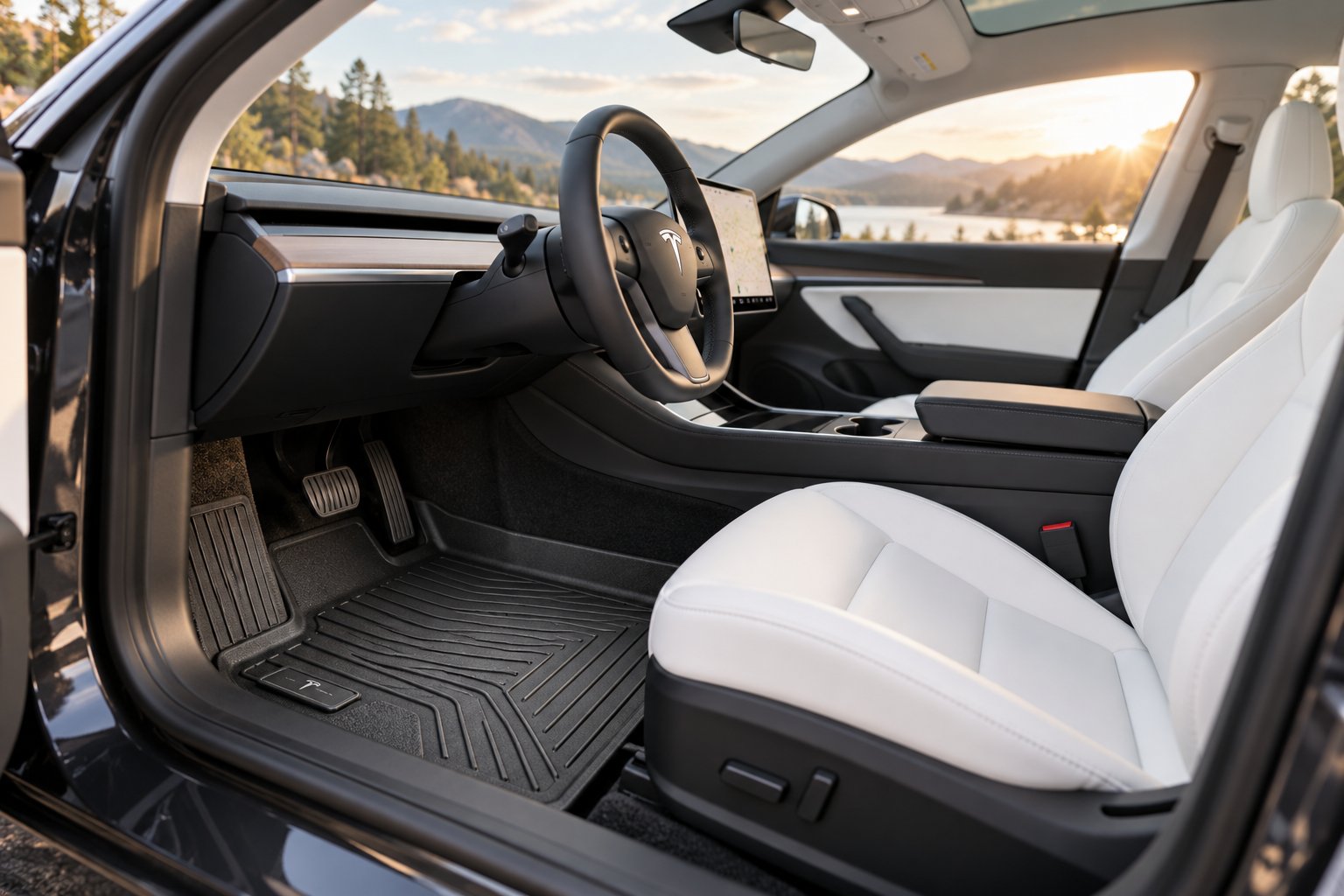
Why Your Tesla Model 3 Deserves Better Floor Mats
You just took delivery of your Model 3, and within a week the light-colored factory carpet already shows coffee drip marks and shoe grit. Sound familiar? It is the single most common frustration new owners share in Tesla forums, and it starts with a misconception most buyers carry right through the checkout process: the assumption that Tesla ships the car with proper all-weather protection already in place.
It does not. Every new Model 3 arrives with basic textile carpet mats. They look clean on delivery day, but they are the weakest link in the interior. They absorb moisture, trap odors, stain easily, and offer zero spill containment. Tesla's own all-weather interior liners are a separate paid accessory, not standard equipment. That means from the moment you drive off the lot, your original carpet is exposed to everything your shoes carry in.
This guide is not a product catalog. It is a brand-neutral, criteria-based buying framework designed to help you evaluate any tesla floor mats model 3 option on the market, whether that is from Tesla's own shop or from a dozen aftermarket competitors. The goal is simple: give you the knowledge to pick the right mat for your generation, climate, and budget without relying on someone else's affiliate link to make that decision for you.
Do Tesla Model 3s Come With Floor Mats
Yes, but barely. Tesla includes a set of thin textile carpet mats that sit loosely on the floor. They are not all weather floor liners, they have no raised edges, and they offer no waterproof barrier between spills and the permanent carpet underneath. The all-weather mats Tesla sells separately typically run in the range of $115 to $150 for a front-and-rear set, covering footwells only. Trunk, frunk, and sub-trunk liners are additional purchases on top of that.
This pricing structure is why aftermarket brands have become the default choice in the Tesla community. Many third-party manufacturers bundle front mats, rear mats, and cargo liners together for a similar or lower total price than Tesla charges for footwell coverage alone. The result? Most experienced owners skip the OEM accessory page entirely and go straight to aftermarket options that deliver more coverage per dollar.
Why Aftermarket Floor Mats Outperform OEM Options
The advantages are not subtle. Quality aftermarket all weather car mats built specifically for the Model 3 routinely offer higher sidewall edges for spill containment, full coverage that extends under the front seats and around the center console, and a wider selection of materials ranging from TPE to layered XPE foam. Brands like 3W produce 3w tesla floor mats with model-specific laser-scanned fitment, while others compete on weathertech all weather floor mats-level precision at lower price points.
Aftermarket sets also tend to include retention features, either anti-slip textured backing or clips that engage the factory anchor points, addressing the flat-carpet sliding problem that plagues generic mats in Tesla cabins. And because the aftermarket is competitive, you will find options across every budget tier rather than a single take-it-or-leave-it OEM listing.
The right floor mat does more than catch dirt. It keeps the original carpet pristine underneath, directly protecting your Model 3's resale value. A $150 mat set can save you hundreds at trade-in by preventing permanent stains, moisture damage, and wear marks that buyers notice immediately.
Even owners who initially purchase weathertec floor mats or Tesla's own liners often upgrade later once they realize the coverage gaps. The OEM mats protect the footwell and nothing else. A well-designed aftermarket set protects the entire cabin floor, from the dead pedal to the rear seat footrests, treating interior protection as a system rather than an accessory checkbox.
Of course, knowing that aftermarket mats are worth considering is only the first step. The real challenge is figuring out which features actually matter and which ones are just marketing noise. That distinction starts with understanding the specific criteria that separate a great Model 3 floor mat from a mediocre one.
What Actually Matters When Choosing Tesla Floor Mats
Every product listing you will find online leads with material type and price. Those details matter, but they skip the step that actually determines whether you end up satisfied or filing a return: knowing what to evaluate before you ever look at a brand name. Think of this section as your personal scoring card. Apply these six criteria to any floor mats tesla retailers offer, and you will filter out the underperformers before spending a dollar.
Most buying guides rank products. This one ranks the criteria themselves, because a mat that scores well on all six points will outperform a famous-brand mat that only nails two or three of them.
Fitment Precision and Coverage Area
The Model 3 has a unique footwell geometry. The driver-side floor angles sharply near the dead pedal, the rear floor slopes toward the center tunnel, and the area beneath the front seats creates a recessed zone that universal mats simply cannot reach. Laser-measured, model-specific tesla floor mats account for every one of those contours. Universal-fit alternatives, no matter how large or flexible, leave gaps at the edges where liquid pools and debris collects against the permanent carpet.
Fitment is not just an aesthetic preference. It is a safety issue. A mat that does not lock into the footwell precisely can migrate forward during hard braking. If the driver-side mat edge slides under the brake pedal, it physically restricts pedal travel. WeatherTech's own safety documentation flags pedal interference as the primary risk of poorly secured mats, and Tesla owner forums are filled with reports of generic mats bunching under the accelerator during spirited driving. This is why every reputable brand, from floor mats WeatherTech produces to smaller specialists like 3W, engineers their Model 3 sets around the exact footwell dimensions rather than adapting a near-fit template.
Coverage area goes beyond the footwell itself. Look for mats that extend to the dead pedal zone on the driver side, wrap around the center console gap where crumbs and liquid sneak through, and reach far enough under the front seats to catch anything that slides backward. Two-piece rear sets often leave the center tunnel completely exposed. A one-piece rear mat eliminates that vulnerability entirely.
Raised Edges, Retention Systems, and Cleaning
Imagine dumping a full water bottle in your footwell. A flat mat channels that liquid straight to the carpet edges. A mat with raised perimeter lips and molded drainage channels contains the spill in a reservoir, keeping it off the carpet until you can remove and rinse the mat. Lip height, measured in inches, directly determines how much liquid a mat can hold before overflow. For owners in snow-belt regions or anyone who regularly carries wet gear, a minimum lip height of roughly one inch is the threshold where real containment begins.
Retention is the second half of this equation. Tesla's Model 3 carpet is flat and smooth, which means mats without anti-slip backing or retention clip compatibility tend to creep forward over time. The car does have factory floor hooks on the driver side, and the best aftermarket options engage those hooks directly. If a mat relies solely on its own weight or a thin rubber backing, it will shift, especially during winter when boots carry moisture that lubricates the surface underneath. Brands offering 3w floor mats tesla owners trust, for example, use anti-slip nails on the underside specifically to address this flat-carpet problem.
Cleaning should take minutes, not an afternoon. TPE and TPO materials rinse clean with water and mild soap. No scrubbing, no staining, no drying cycle. Mats with deep channel patterns shed water faster than flat-surface designs, and mats that pop out of the footwell without fighting retention clips make the entire process easier. If you dread the cleanup step, you will skip it, and skipped cleanings lead to trapped moisture and odor buildup underneath the mat itself.
The sixth criterion, odor off-gassing, deserves its own mention. Cheaper PVC-based mats often arrive with a strong chemical smell that can persist for weeks inside a sealed cabin. High-quality TPE and TPO materials produce minimal to no odor out of the box. If a new mat still smells harsh after 48 hours of airing out, that is a material quality signal worth paying attention to, especially in an EV where there is no engine noise to distract you from cabin smells during your commute.
Here is the complete framework in one table. Print it, bookmark it, or keep it open on your phone the next time you are comparing car floor mats WeatherTech floor mats sets or any other brand:
| Criterion | Why It Matters | What to Look For |
|---|---|---|
| Fitment Precision and Model-Year Compatibility | Prevents pedal interference, eliminates edge gaps, and ensures the mat does not shift during driving | Laser-measured or 3D-scanned mats listed for your exact Model 3 production year and generation |
| Edge-to-Edge Coverage | Protects dead pedal zone, under-seat areas, and center console gaps that universal mats miss entirely | One-piece rear mats covering the center tunnel; driver mats extending to the dead pedal |
| Raised Lip Height | Determines spill and slush containment capacity before liquid overflows onto carpet | Minimum one-inch perimeter lip with molded drainage channels for liquid routing |
| Retention System and Anti-Slide Performance | Tesla's flat, smooth carpet allows unsecured mats to creep forward toward pedals | OEM floor hook engagement, anti-slip nails or textured backing, or compatible retention clips |
| Ease of Removal, Cleaning, and Reinstallation | Difficult cleaning means deferred maintenance and trapped moisture under the mat | Hose-washable TPE or TPO material, quick-release from retention hooks, fast air-dry surface |
| Odor Off-Gassing | Cheap materials release chemical fumes that linger in the sealed EV cabin for weeks | TPE or TPO construction with minimal break-in smell; no strong odor after 48 hours of airing |
Use this table as a pass-fail checklist. Any mat that scores poorly on fitment or retention is a safety concern regardless of price or brand reputation. Any mat that fails on coverage or lip height will leave your carpet exposed in exactly the spots that matter most. And any mat made from witamats tesla owners mention or any lesser-known brand can still earn a recommendation if it checks every box above.
These criteria tell you what to measure. The next question is what your mat is actually made of, because the material sitting between your shoes and the carpet determines how every one of these criteria performs over the life of the product.
TPE vs XPE vs TPO Floor Mat Materials Explained
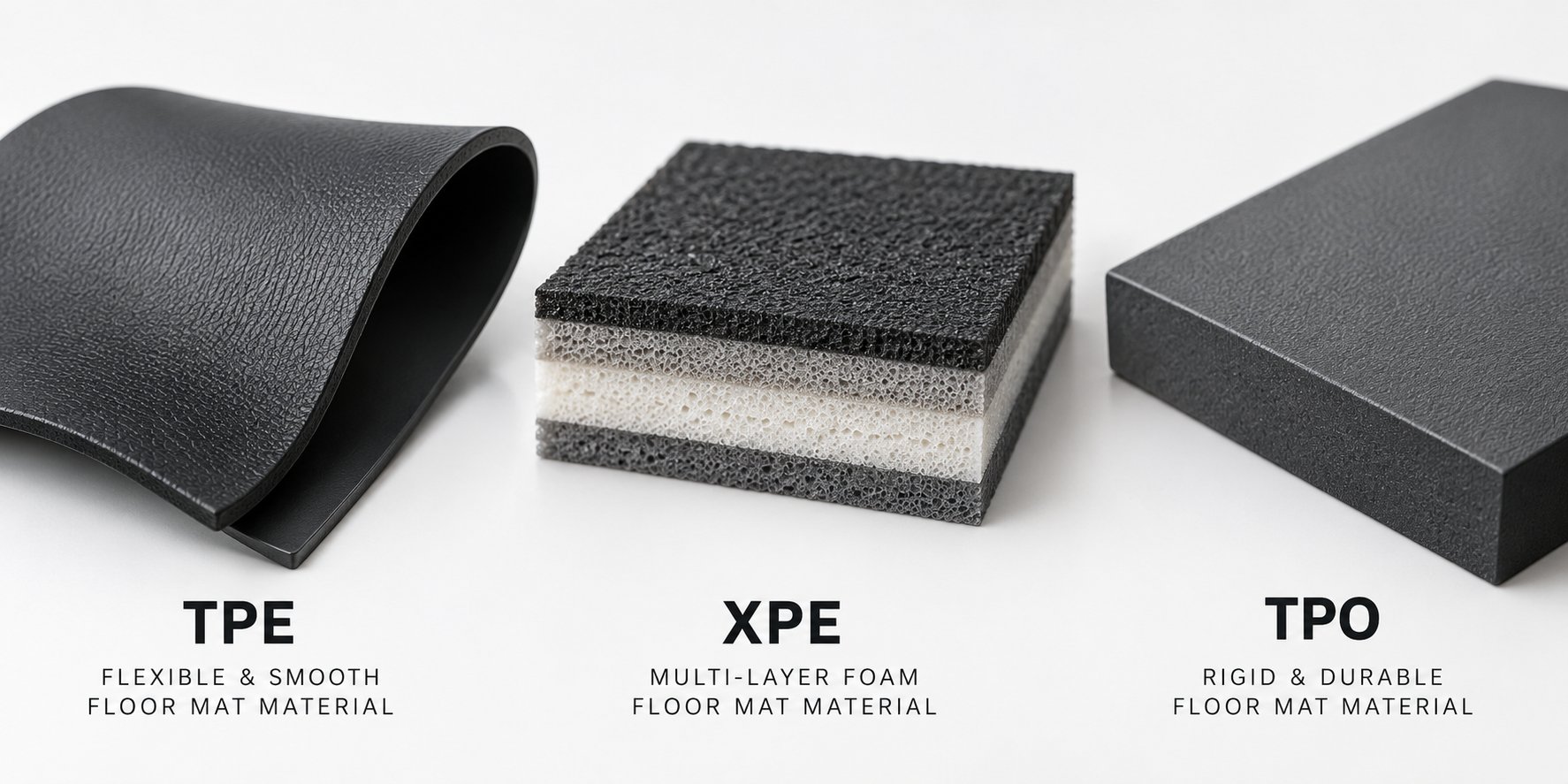
Every product listing for tesla model 3 floor mats throws around material abbreviations like they are self-explanatory. TPE, XPE, TPO — the acronyms blur together fast, and most buyers end up choosing based on price or brand recognition instead. That is a mistake, because the material under your feet controls every performance dimension that matters: how the mat handles a Minnesota winter, whether it smells like a chemistry lab on a hot day, and how it looks after three years of daily use.
Decoding these three materials takes less time than you think, and it gives you a permanent filter for evaluating any tesla model 3 mats on the market — from premium options to budget sets.
TPE Floor Mats and Why They Dominate the Market
TPE, or thermoplastic elastomer, is a hybrid polymer that combines the flexibility of rubber with the lightweight strength of plastic. It has become the dominant material in premium aftermarket floor mats for good reason. TPE is low-odor, recyclable, and maintains its flexibility across a wide temperature range, from scorching summer cabins that can exceed 140°F to subzero winter mornings where cheaper materials crack and stiffen.
For Tesla owners specifically, TPE solves the off-gassing problem that plagues budget alternatives. Because the Model 3 cabin is sealed tighter than most combustion vehicles and lacks engine noise to mask smells, any chemical odor from a new mat becomes immediately obvious. TPE mats produce minimal to no smell out of the box, a characteristic that matters far more in an EV than in a traditional car.
Durability is another strong suit. TPE resists cracking, warping, and UV degradation over years of exposure. It holds its molded shape — including those critical raised edges — without the gradual softening that erodes containment performance in foam-based alternatives. Multiple well-known brands have adopted TPE as their standard material, including manufacturers behind tesmanian floor mats and several other Tesla-focused accessory lines. Even weather tech floor matts competitors in the aftermarket space increasingly highlight TPE construction as a selling point.
The tradeoff? TPE mats tend to sit at mid-range to premium price points. They are not the cheapest option on the shelf, but their longevity and performance consistency make them the material most owners settle on after trying alternatives.
XPE and TPO Alternatives Worth Considering
XPE — cross-linked polyethylene foam — takes a fundamentally different approach. Instead of a single molded layer, XPE mats use a multi-layer construction: a water-resistant top surface, a foam cushioning core, and an anti-skid bottom layer. The result is a mat that feels noticeably softer underfoot and provides sound-dampening properties that reduce cabin road noise — a feature some owners appreciate on long highway drives.
XPE's closed-cell structure makes it naturally moisture-resistant and lightweight. However, that foam core introduces a vulnerability TPE does not share. Over time, especially in high-traffic zones like the driver footwell, XPE foam can compress and lose its original shape. The edges may curl or warp after repeated exposure to extreme heat, which is a concern for owners in warmer climates who park outdoors regularly. XPE mats are generally more affordable than TPE alternatives, making them a solid mid-range option for owners who value comfort and are willing to accept a shorter performance lifespan in exchange for a lower upfront cost.
TPO, or thermoplastic olefin, sits at the opposite end of the spectrum from XPE. It is a rigid, heavy-duty material with excellent chemical resistance and a no-nonsense utilitarian feel. Think of TPO as the industrial workhorse: it handles abuse well, cleans easily, and costs less than both TPE and premium XPE layered sets. The downsides are real, though. TPO mats are heavier, stiffer in cold weather, and more prone to producing noticeable odor during the break-in period. They also tend to lack the precise 3D-molded contours that TPE and XPE mats achieve, which can affect fitment on the Model 3's complex floor geometry.
For owners shopping across vehicle lines — say, comparing tesla model y suv floor mats alongside Model 3 options — understanding these material differences prevents buying the wrong type for your specific needs. A TPO mat that performs fine in a truck might feel out of place in a Model 3's refined cabin.
Material choice often matters more than brand name when evaluating long-term satisfaction. A lesser-known brand using high-quality TPE will outperform a recognizable name stamped on a basic TPO shell over three years of daily use.
Here is the side-by-side comparison to reference when you are narrowing down your shortlist:
| Property | TPE (Thermoplastic Elastomer) | XPE (Cross-Linked Polyethylene) | TPO (Thermoplastic Olefin) |
|---|---|---|---|
| Flexibility in Cold Weather | Excellent — stays pliable below freezing | Good — foam core may stiffen slightly | Fair — noticeably rigid in low temperatures |
| Odor Level | Minimal to none | Low — adhesive layers may produce mild smell | Moderate — break-in off-gassing is common |
| Weight | Light to moderate | Lightest of the three | Heaviest |
| Durability | High — resists cracking, warping, and UV damage | Moderate — foam compresses over time in high-use areas | High — excellent chemical and abrasion resistance |
| Typical Price Range | Mid-range to premium | Budget to mid-range | Budget |
Keep this table in mind as a quick-reference filter. If you prioritize all-season versatility and minimal maintenance, TPE is the default answer. If cabin comfort and noise reduction rank higher on your list, XPE layered mats deserve a serious look. And if your primary concern is basic carpet protection at the lowest cost, TPO handles the fundamentals without pretending to be something it is not.
Material knowledge eliminates guesswork, but it cannot protect you from the single most common purchasing error in the Tesla floor mat market: buying a mat designed for the wrong generation of Model 3. The difference between pre-Highland and Highland interior dimensions is significant enough to make even the best TPE mat useless if it was molded for the wrong cabin.
Tesla Model 3 Highland Fitment and Generation Guide
Imagine ordering a perfectly reviewed set of TPE tesla mats, waiting a week for delivery, pressing them into the footwell — and watching the edges gap by half an inch around the center console. That is exactly what happens when you install a pre-Highland mat in a Highland cabin, or vice versa. The two generations share a name and a silhouette, but below the beltline, the interior dimensions diverge enough to make cross-generation mats a guaranteed misfit.
This fitment mismatch is the single most common reason for floor mat returns in the Tesla aftermarket. Getting your generation right before you shop eliminates the problem entirely.
Pre-Highland vs Highland Interior Differences That Affect Mat Fit
The Model 3 Highland, which began production in late 2023 as a 2024 model, is far more than a cosmetic refresh. MotorTrend's comparison testing confirmed that nearly every interior surface changed between generations. The center console received a complete redesign with a new shape and profile, altering the gap dimensions where the console meets the floor carpet. The dashboard layout shifted as well — the wood trim was removed entirely, replaced by new mixed-material surfaces and a wraparound ambient lighting strip that changes the lower dash-to-floor transition point.
The rear cabin is equally different. Tesla raised the rear seat cushion height on the Highland to improve the passenger seating position, and the backrest firmness was revised. A new rear-facing touchscreen now sits between the front seatbacks. These changes alter the rear footwell geometry, particularly where the floor meets the center tunnel and where rear tesla car mats need to terminate at the seat base. Mats molded around the older, lower seat position leave exposed carpet along the new contact points.
Even the front footwells shifted subtly. The Highland's stalkless steering column and revised lower dash cowling changed the clearance around the driver's dead pedal zone. A pre-Highland mat designed to wrap up to the old column housing will either overlap awkwardly or leave an unprotected strip along the revised contour. For owners who prioritize full-coverage car all weather floor mats, these millimeter-level differences are the line between a flush fit and a frustrating return.
The bottom line: a mat that fits a 2019-2023 Model 3 perfectly will not fit a Highland correctly, and forcing it creates the exact sliding hazards and coverage gaps that quality aftermarket mats are designed to eliminate.
How to Verify Your Model 3 Generation Before Buying
Before you add anything to your cart, confirm which generation you own. This takes about five minutes and saves you the hassle — and shipping cost — of a return. Here is the verification process:
- Check your VIN for the production date. Your VIN is located on the driver-side dashboard (visible through the windshield) and in the Tesla mobile app under vehicle details. A production date before late 2023 means you have a pre-Highland Model 3. Production from late 2023 onward indicates the Highland variant.
- Open the Tesla app and review your vehicle information. The app displays your model year and configuration. Highland models are listed as 2024 or later and may show the updated trim designation. This is the fastest digital confirmation available.
- Look for visual identification cues inside the cabin. The Highland features a distinctive wraparound ambient lighting strip across the dashboard, a stalkless steering wheel with haptic buttons instead of traditional turn signal stalks, and a rear-facing screen mounted between the front seats. If your Model 3 has column stalks and no ambient light bar, it is a pre-Highland generation.
- Check the dash screen position. The Highland's center touchscreen has a slimmer bezel and sits in a slightly updated mount. While this difference is subtle, comparing your screen to photos of both generations will confirm which version you have.
- Confirm your trim level. Some mat manufacturers offer trim-specific variations within each generation. Knowing whether you have a Standard Range, Long Range, or Performance variant ensures you select the exact SKU that matches your interior configuration.
This five-step process applies whether you are shopping for Model 3 mats, tesla model y floor mats, or even a model s rear trunk mat — generation and trim verification is universally the step that prevents the most returns across Tesla's entire lineup.
Once you have locked in your generation, the real comparison begins. Knowing your exact Model 3 variant lets you filter every brand and product listing with confidence, which is exactly what a side-by-side brand evaluation requires to be genuinely useful.
Top Floor Mat Brands for Tesla Model 3 Compared
With your generation confirmed and your criteria checklist in hand, you are finally ready for the part most buying guides skip entirely: an honest, side-by-side brand evaluation that does not just list products but actually measures them against the six performance criteria that matter. Most competitor pages rank floor mats by affiliate commission or popularity. This comparison ranks them by how well they solve the specific problems Model 3 owners face — fitment gaps, sliding on flat carpet, spill containment, and generation compatibility.
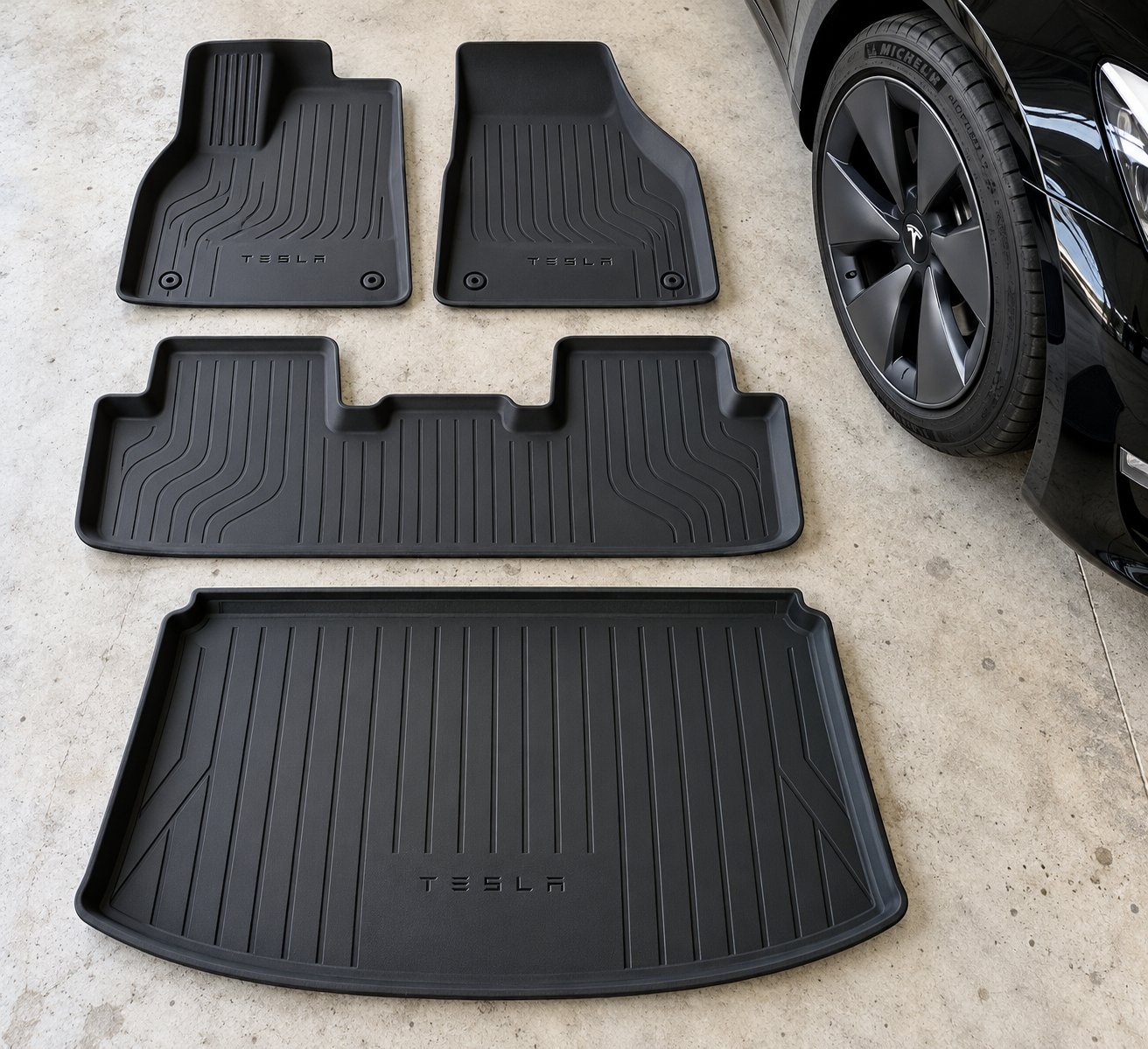
Five brands consistently surface when Tesla owners discuss the best tesla model 3 floor mats: CUTIM, WeatherTech, 3D MAXpider, Tesmanian, and 3W. Each brings a different strength to the table. Some excel at raw protection, others at value, and a few have carved out reputations within Tesla-specific communities that mainstream automotive brands simply have not matched. Here is how they compare across the criteria that actually determine daily satisfaction.
Top Tesla Model 3 Floor Mat Brands Compared
| Brand | Material Type | Coverage Area | Lip Height | Highland Compatibility | Value Tier | Key Differentiator |
|---|---|---|---|---|---|---|
| CUTIM | TPE and layered XPE options | Full cabin including under-seat zones and center console gap | Moderate to tall | Yes — generation-specific sets for both pre-Highland and Highland | Mid-range | Dual material lineup with generation-specific fitment across both Model 3 variants |
| WeatherTech | Tri-extruded TPO | Footwell-focused with tall perimeter walls | Tallest in class | Yes — updated FloorLiner SKUs available | Premium | American-made, laser-measured reputation; industry benchmark for weathertech all weather mats protection |
| 3D MAXpider | Patented thermoplastic rubber (Kagu/Elitect lines) | Full footwell with carbon-fiber texture surface | Moderate | Yes — Elitect line covers Highland dimensions | Premium | Upscale interior aesthetic with structured feel; cult following in Tesla forums |
| Tesmanian | TPE | Front, rear, and optional trunk bundles | Moderate | Yes — Highland-specific sets launched | Budget to mid-range | Tesla-community favorite; strong value bundles at entry-level pricing |
| 3W | XPE layered construction | Front and rear with optional cargo add-ons | Low to moderate | Yes — updated fitment for Highland production runs | Budget | Lowest price point for model-specific mats; all-weather xpe floor mats for tesla model 3 & highland at accessible pricing |
A few patterns stand out immediately. WeatherTech commands the highest price and delivers the tallest containment walls, making it the clear pick for owners in extreme climates who need industrial-level spill capacity. Its tri-extruded TPO material is rigid and heavy, though — a tradeoff that matters in the Model 3's refined cabin where softer materials feel more at home. The 3D MAXpider Kagu and Elitect lines compete at a similar price point but prioritize interior aesthetics, offering a carbon-fiber surface pattern that blends seamlessly with the Model 3's minimalist design language.
On the value end, Tesmanian has built its reputation as the default Reddit recommendation for budget-conscious owners. The TPE material is genuine and the bundles are generous, though multiple owner reports note slightly looser fitment and thinner material compared to mid-range competitors. 3W targets the same budget tier with XPE layered mats that feel softer underfoot but carry the compression concerns inherent to foam-core construction over time.
CUTIM occupies interesting middle ground. Their Tesla Floor Mats & Cargo Liners collection offers both TPE and layered mat options — a dual-material lineup that lets you choose based on the material comparison framework from earlier in this guide rather than being locked into a single construction type. Their generation-specific fitment for both pre-Highland and Highland Model 3 variants addresses the exact compatibility trap covered in the previous section, and the mid-range pricing positions them as a strong contender for owners who want TPE-level performance without premium-tier cost. For owners who also protect a Model Y, many of these brands — including CUTIM — offer model y all-weather interior liners built on the same material platforms, making it easy to standardize across a multi-Tesla household.
Which Brand Fits Your Priorities
Rather than declaring one winner for all owners, match your top priority to the brand that excels in that specific dimension. Your climate, budget, and aesthetic preferences make this a personal decision, not a universal one:
- Maximum spill and slush containment: WeatherTech FloorLiner — tallest sidewalls and most rigid containment structure available for all season car mats protection in harsh climates
- Premium interior aesthetic: 3D MAXpider Kagu or Elitect — carbon-fiber texture surface that matches the Model 3's cabin design language
- Best material flexibility at mid-range pricing: CUTIM — choose between TPE and layered XPE depending on whether you prioritize durability or underfoot comfort, with Highland-specific fitment included
- Lowest price for Tesla-specific fitment: 3W — budget XPE layered mats that still offer model-year-specific contouring
- Strongest Tesla community track record on a budget: Tesmanian — years of owner reviews and bundle pricing that covers front, rear, and trunk in a single purchase
- Highland-specific fitment with full cabin coverage: CUTIM or 3D MAXpider Elitect — both offer generation-verified sets designed around the Highland's revised floor geometry
Notice that no single brand dominates every category. WeatherTech wins on containment but loses on cabin refinement. 3D MAXpider wins on aesthetics but commands a premium. Tesmanian wins on community trust and price but may sacrifice precision. This is exactly why the criteria framework matters more than any brand ranking — it lets you weight the factors that matter to your specific situation and filter accordingly.
The real question most owners still have at this stage is not which brand to buy but how much to spend. Tesla all weather interior liners span a wide price range, and understanding what you gain or sacrifice at each tier prevents both overspending and underprotecting. That budget-to-premium breakdown is where the decision gets practical.
Budget, Mid-Range, and Premium Price Tiers Explained
You know the materials. You know the brands. But how much should you actually spend? This is where most owners stall out — bouncing between product pages, comparing numbers that are hard to contextualize without a clear framework for what each price tier actually delivers. A budget mat and a premium mat can look nearly identical in product photos, yet the real-world difference in fitment, durability, and daily usability is significant enough to determine whether you are satisfied for years or shopping again within twelve months.
Rather than chasing specific dollar figures that shift with sales and inventory, think about tesla all weather floor mats in three distinct tiers defined by what you get and what you give up.
Budget Floor Mats and What You Sacrifice
Entry-level mats typically use TPO or basic rubber compounds. They protect the carpet — that much is true — but the compromises show up fast. Fitment is the first casualty. Budget sets are often designed from approximate measurements rather than laser-scanned vehicle data, which means edge gaps around the center console, incomplete dead pedal coverage, and rear mats that leave the center tunnel partially exposed. You will notice the difference the first time you vacuum around the mat edges and find dirt trapped in exactly the spots the mat was supposed to cover.
Sidewall edges on budget mats run noticeably lower, reducing spill containment to a minimal splash guard rather than a genuine reservoir. Retention systems are usually absent or limited to basic friction backing that loses grip within a few weeks on Tesla's flat carpet. And off-gassing? Budget TPO and rubber mats are the primary offenders. That chemical smell you notice when you first sit in the car on a warm afternoon is the material releasing volatile compounds into the sealed cabin — an issue that can linger for weeks.
Budget mats still have a role. They make sense for lease vehicles where you need basic carpet protection without a major investment, or as a stopgap until you decide on a longer-term option. Just understand that lower cost means shorter lifespan, less precise fit, and a higher chance of the mat shifting toward the pedals over time.
Mid-Range Mats That Balance Value and Quality
This is the sweet spot where most Tesla owners land — and stay. Mid-range sets use genuine TPE or layered XPE construction, offer model-specific fitment scanned from the actual Model 3 floor geometry, and include adequately raised lip heights for real spill containment. The odor issue essentially disappears at this tier, and the materials hold their shape across temperature extremes without cracking or warping.
You will also find better retention engineering here. Mid-range mats commonly feature anti-slip nails, textured backing, or direct engagement with the factory floor hooks on the driver side. That combination keeps the mat locked in place through daily driving, hard braking, and seasonal shoe changes — solving the sliding problem that budget mats never quite address.
Coverage expands meaningfully as well. A good mid-range set extends to the dead pedal, wraps around the center console edges, and uses a one-piece rear mat that eliminates the center tunnel gap. Some mid-range brands even bundle front, rear, and basic cargo coverage into a single purchase, giving you near-complete cabin protection without stepping into premium pricing. If your weather tech floor mat comparison research keeps pointing you toward options that seem just slightly above entry level, the mid-range tier is likely where you belong. Most owners report the highest long-term satisfaction here because the quality-to-cost ratio is genuinely difficult to beat.
Premium Floor Mats and When They Are Worth It
Premium sets push every criterion to its maximum. Edge-to-edge coverage includes under-seat zones, the full dead pedal wrap, and extended rear mats that protect areas cheaper sets ignore entirely. Lip heights reach the tallest available measurements, turning each footwell into a sealed basin that can handle a full water bottle spill without overflow. Surface textures are refined — carbon-fiber patterns, diamond-cut channels, or low-profile ridge designs that look intentional rather than industrial.
At this tier, you often gain extras beyond the mats themselves. Premium bundles may include matched cargo liners, frunk protection, rear seatback covers, and even center console mats — all manufactured from the same material in the same color for a cohesive interior look. Brand warranty programs are more robust here too, with satisfaction guarantees and defect coverage that budget and mid-range options rarely match.
Premium makes sense for owners who plan to keep their Model 3 long-term, drive in harsh climates with heavy snow or rain, or simply want the highest level of cabin protection available. If you frequently haul gear, travel with kids or pets, or park outdoors year-round in extreme conditions, the investment pays for itself in carpet preservation and reduced cleaning effort. Owners exploring tesla all weather mats at the premium level are essentially buying a comprehensive interior protection system rather than a set of floor covers.
Here is the tier breakdown in one reference table:
| Tier | Typical Material | Fitment Precision | Lip Height | Odor Risk | Best For |
|---|---|---|---|---|---|
| Budget | TPO or basic rubber | Approximate — generic or near-fit templates | Low — minimal splash protection | Moderate to high — chemical off-gassing common during break-in | Lease vehicles, temporary protection, or owners in mild climates with minimal spill risk |
| Mid-Range | TPE or layered XPE | Model-specific — laser-scanned or 3D-molded to Model 3 geometry | Moderate — adequate containment for daily spills and light weather | Minimal to none — quality materials eliminate break-in odor | Daily drivers who want reliable all-season protection without overspending |
| Premium | High-grade TPE, multi-layer TPR, or tri-extruded composites | Exact — generation-specific fitment with full dead pedal and under-seat coverage | Tall — sealed basin design for maximum liquid containment | None — odor-free out of the box | Long-term owners, harsh-climate drivers, and those seeking full cabin protection bundles with cargo liners |
A quick self-check: if you are leasing or live somewhere with mild, dry weather, budget mats handle the basics. If you own your Model 3 and deal with any combination of rain, snow, kids, pets, or coffee, the mid-range tier eliminates every meaningful compromise. And if you want maximum protection with zero gaps in coverage — or you are pairing mats with a full cargo liner set — premium delivers that without reservation.
The price tier you choose sets the ceiling for protection and longevity. But even the right tier cannot save you from the purchasing mistakes that trip up thousands of Tesla owners every year — errors that have nothing to do with budget and everything to do with overlooking details that seem minor until they ruin the fit or create a safety hazard.
Common Floor Mat Mistakes Tesla Owners Make
Spending money on a quality tier and selecting the right material still leaves room for errors that no product spec sheet warns you about. These are the mistakes that show up weeks or months after installation — the slow slide toward the brake pedal you do not notice until a panic stop, the coffee stain that appears in a gap you assumed was covered, or the return shipping label you print after realizing your Highland cabin swallowed a pre-Highland mat like a mismatched puzzle piece.
Owner forums and return data from aftermarket retailers reveal the same handful of pitfalls repeated thousands of times. Every one of them is preventable if you know what to watch for before you click "add to cart."
Buying Universal-Fit Mats Instead of Tesla-Specific
This is the most dangerous mistake on the list, and it happens more often than you would expect. A universal-fit tesla mat from a big-box retailer or a generic Amazon listing might look like a reasonable shortcut — it is cheaper, it ships fast, and the product photo shows it sitting in what appears to be a Model 3 footwell. The reality is different the moment you press it into place.
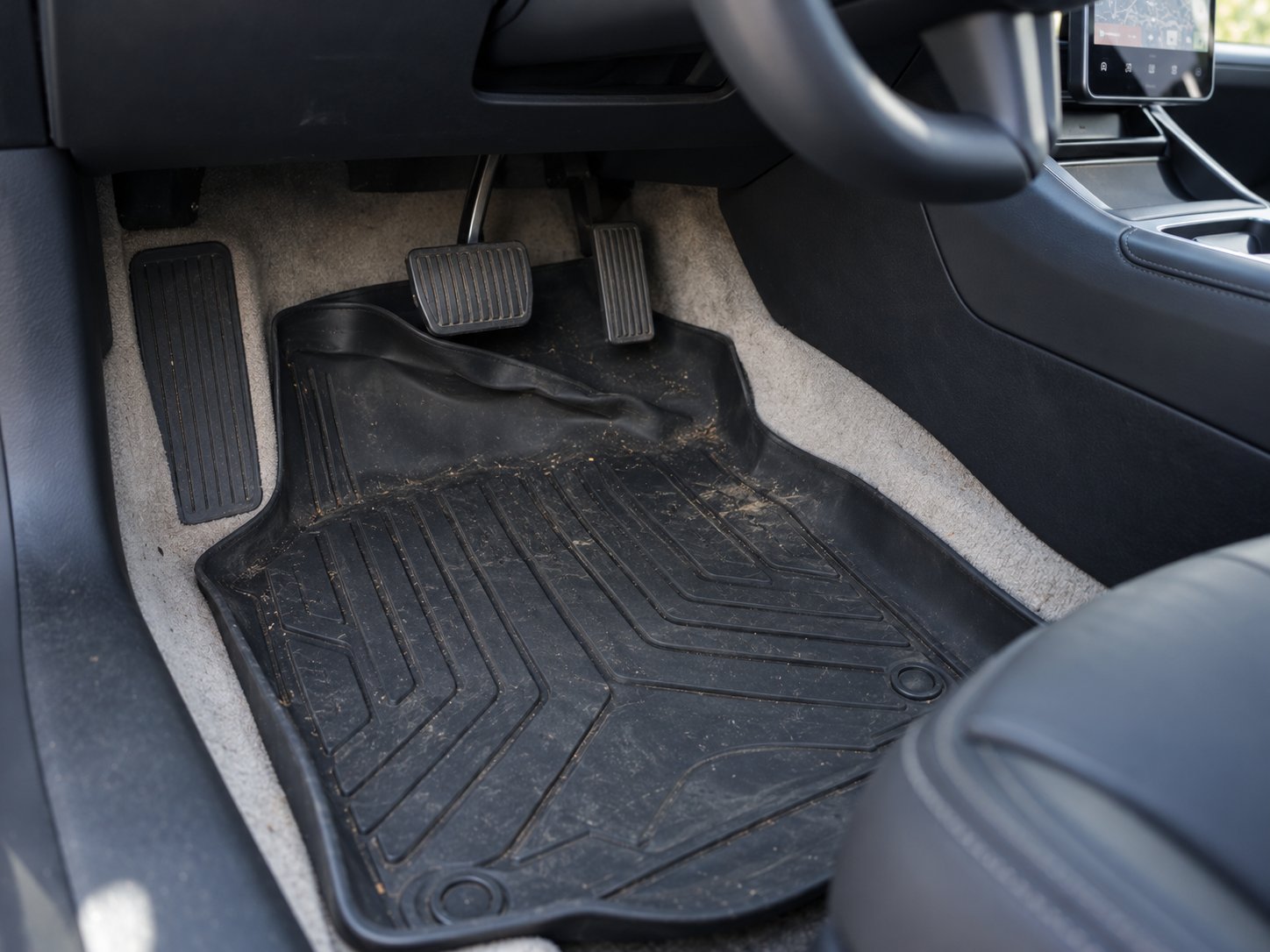
The Model 3's footwell geometry is unique. The driver side angles sharply at the dead pedal, the center console gap sits at a specific width that generic mats cannot account for, and the rear floor has a pronounced tunnel crown that universal trays simply drape across rather than contour around. A universal mat leaves exposed carpet at every one of those transition points. Worse, the driver-side mat can bunch forward during braking because it was never shaped to lock against the Model 3's specific floor contours. When a mat edge slides under the brake pedal, it physically restricts pedal travel — a genuine safety hazard that no amount of savings justifies.
Even listings that claim to "fit Model 3 and Model Y" are suspect. These two vehicles share platform architecture but diverge significantly at the floor level, with the Model 3's narrower footwells and sharper tunnel crown making cross-compatible mats a poor fit in both vehicles. If the product page does not specify your exact model, year range, and generation, treat it as a universal mat regardless of what the title says.
Ignoring Model Year Compatibility and Retention Systems
Even within the Model 3 line, interior changes across production runs mean a mat designed for one year range may not fit another. This is not hypothetical. The Highland refresh altered the center console shape, rear seat position, and footwell contours enough that mats fitting one Model 3 generation will not fit another. Ordering all weather floor mats for tesla model 3 without confirming your exact production year is how owners end up with mats that gap at the console, ride up at the seat base, or leave the dead pedal completely exposed.
Retention is the second silent failure. Tesla's Model 3 carpet is flat and smooth — there are no aggressive textures or deep pile fibers to grip a mat from underneath. Budget mats that rely solely on their own weight or a thin rubber backing will creep forward over weeks of daily use. You might not notice the gradual migration until the mat edge contacts the accelerator or brake pedal during a sudden stop. The driver-side floor does have factory anchor hooks, but plenty of aftermarket mats ship without compatible clips or retention features, leaving you with a mat that technically fits the footwell shape but refuses to stay put in it.
Then there is the rear center console gap — the strip of exposed carpet between the rear mat edges that cheaper two-piece sets leave completely unprotected. Every crumb, every drop of spilled water, and every grain of road salt that your rear passengers track in settles directly onto the permanent carpet in that gap. A one-piece rear mat eliminates the problem, but many budget and even some mid-range weather tech custom floor mats sets still ship as two-piece rears to cut manufacturing costs.
Seasonal mismatch rounds out the list. Owners in snow-belt and rainy regions who install low-lip mats designed for mild climates discover the hard way that a half-inch sidewall cannot contain winter slush. And owners in dry, warm climates who buy heavy-duty weathertech tesla-level containment mats sometimes find the rigid, utilitarian feel at odds with the Model 3's refined interior — paying a premium for protection they rarely need while sacrificing the softer, more comfortable feel of a carpet or hybrid mat that would suit their actual conditions perfectly.
Here are the five most common mistakes ranked by severity, from highest risk to lowest. Use this as a quick-scan checklist before any purchase:
- Using universal-fit mats that can slide under the brake or accelerator pedal — This is a direct safety hazard. No price savings or shipping convenience justifies compromised pedal travel. Always verify the mat is model-specific and generation-specific before buying.
- Ignoring model year and generation compatibility — A pre-Highland mat in a Highland cabin, or vice versa, creates fitment gaps, exposed carpet zones, and sliding risk. Confirm your VIN production date and match it to the manufacturer's fitment chart.
- Choosing mats without retention systems for Tesla's flat carpet — Mats lacking anti-slip nails, textured backing, or factory anchor hook engagement will migrate forward over time. Check retention specs before assuming a well-shaped mat will stay in place on its own.
- Buying two-piece rear sets that leave the center tunnel exposed — That gap is a magnet for debris, moisture, and staining. A one-piece rear mat costs slightly more but eliminates the single largest coverage hole in most budget floor mat sets.
- Overlooking climate-specific needs when selecting lip height and material — Tall sidewalls and rigid TPO are overkill in mild, dry regions. Low-lip mats and soft XPE foam are inadequate in snow-belt or heavy-rain climates. Match the mat's containment capacity and material type to your actual weather exposure, not just its star rating.
Avoiding these five errors does not require spending more money. It requires spending five minutes on verification before you spend anything at all. The right mat at the right price tier, confirmed for your exact generation and climate, will protect your cabin for years without a single return label printed.
Floor mats handle the footwells, but your Model 3's interior extends well beyond the area under your shoes. The trunk, frunk, rear seatback, and cargo well are equally exposed to damage — and the owners who protect only the floor often discover that lesson at trade-in time, when a stained trunk liner costs them more than a full cabin protection set would have.
Complete Cabin Protection Beyond Just Floor Mats
Your footwells are covered. The front and rear mats are locked in, contoured to your exact generation, and ready for whatever your shoes drag in. But step back and look at the full picture: floor mats protect roughly 20% of the surfaces inside your Model 3 that actually take abuse. The trunk carpet absorbs grocery leaks. The frunk lining catches cooler condensation. The rear seatbacks get kicked, scuffed, and pressed against every time you fold them down for bulky cargo. These are the surfaces that show wear at trade-in — and they are the ones most owners forget to protect until the damage is already done.
A complete interior protection strategy treats the cabin as a system, not a series of isolated accessories. That shift in thinking is what separates owners who maintain pristine interiors for years from those who discover permanent trunk stains the week they list the car for sale.
Trunk and Frunk Liners That Complete the Setup
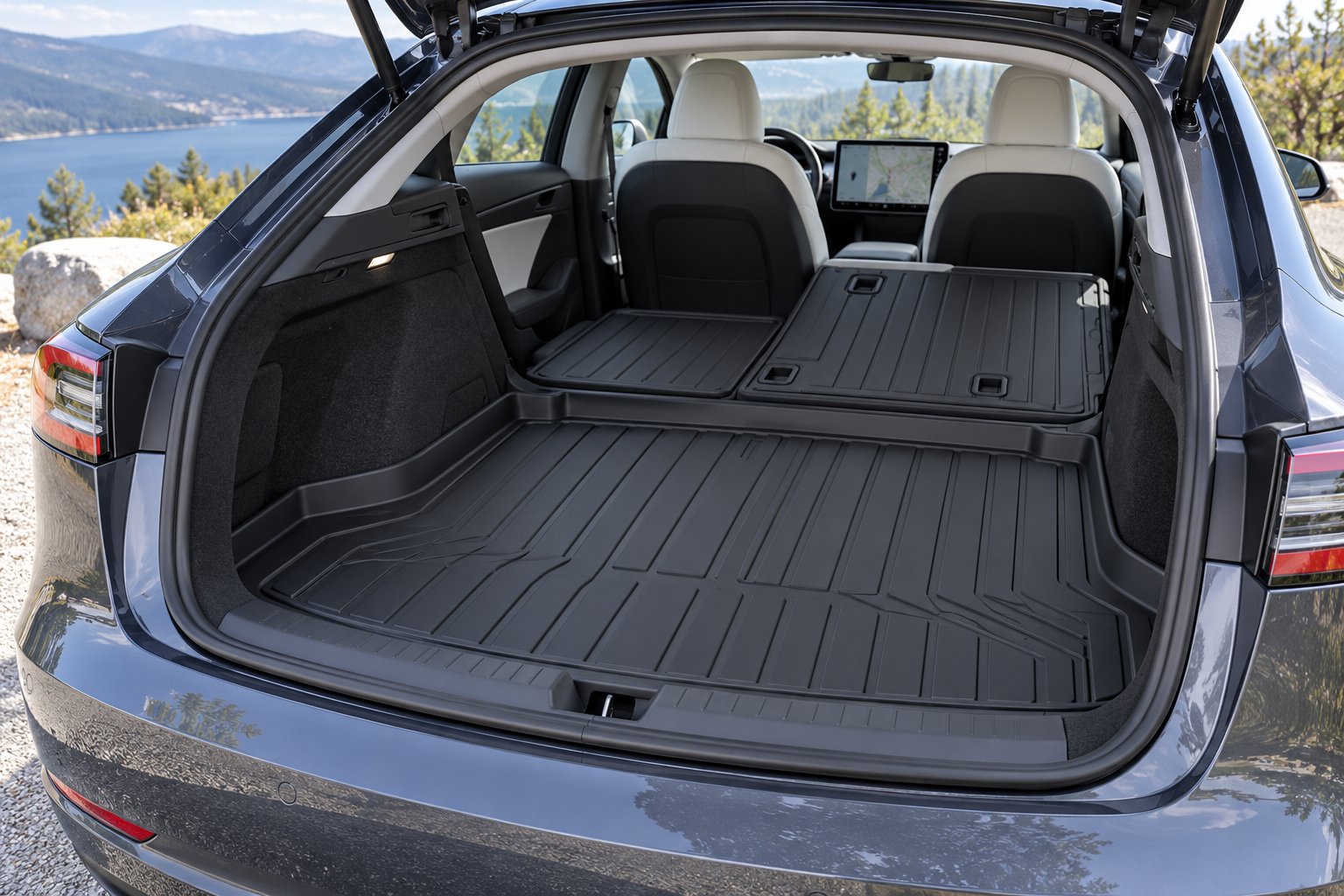
The Model 3's rear trunk well is deeper than it looks. That recessed cargo area sits below the trunk lip, creating a basin where spills, dirt, and moisture settle out of sight. A single leaking grocery bag or a rain-soaked backpack can soak into the factory carpet lining and leave a stain you will not notice until the next time you load the trunk in daylight. The frunk presents a similar risk on a smaller scale — its shallow, carpeted cavity is designed for light storage, but it has zero waterproof protection from the factory.
Matching your trunk and frunk liners to your floor mat brand delivers two practical benefits. First, material consistency. A TPE trunk liner from the same manufacturer as your TPE tesla model 3 all weather floor mats will share the same durability profile, cleaning behavior, and temperature tolerance — no guesswork about whether the cargo liner will warp while the floor mats hold up fine. Second, color and texture matching. Mismatched liners from different brands create a patchwork look that undermines the Model 3's clean interior aesthetic. When the floor mats, trunk liner, and frunk mat share the same surface texture and color tone, the cabin looks intentionally finished rather than cobbled together from separate purchases.
This matching principle applies whether you are shopping weathertech tesla model 3 cargo sets, browsing all weather interior liners tesla owners recommend, or comparing mid-range alternatives. Consistency across the entire coverage footprint matters more than any single piece performing at a premium level while the rest lag behind.
Rear Seatback and Cargo Well Protection
Here is the coverage zone almost everyone overlooks: the rear seatback surface. Every time you fold the Model 3's 60/40 split rear seats down to haul something long — furniture pieces, bikes, camping gear — the back surface of those seats becomes the new cargo floor. Without a protective liner, zippers, buckles, and hard edges press directly into the seat material, leaving scuff marks and compression lines that do not bounce back. A full-cabin protection approach includes rear seatback liners specifically shaped to cover this surface when the seats are folded, adding a layer that absorbs the contact damage your cargo dishes out.
The cargo well — the sub-trunk storage compartment beneath the main trunk floor — is another blind spot. Owners who store charging cables, emergency kits, or tools in this area rarely think to line it until a bottle cap punctures the thin factory carpet or road salt residue builds up over a winter season.
When you map out every vulnerable surface, a complete cabin protection package includes seven distinct coverage zones:
- Front floor mats — driver and passenger footwells with dead pedal coverage
- Rear floor mats — one-piece design covering the center tunnel gap
- Center console mat — protecting the carpet strip between the console base and floor mats
- Trunk liner — full coverage of the rear cargo well and trunk floor
- Frunk liner — waterproof protection for the front trunk cavity
- Rear seatback liner — shielding the fold-down seat surfaces during cargo hauling
- Cargo well mat — covering the sub-trunk storage compartment beneath the main trunk floor
Buying these pieces individually from different brands is possible but inefficient. You end up with mismatched materials, inconsistent fitment tolerances, and color variations that look uncoordinated. Brands that offer bundled full-cabin sets solve this by engineering every piece as part of a single system. CUTIM's Tesla Floor Mats & Cargo Liners collection, for example, provides coordinated cabin-to-cargo coverage in matching TPE and layered options — owners replacing worn mats after seasonal cleanup or upgrading for the first time can compare full-set bundles for consistent fitment across all Model 3 coverage zones, including generation-specific options for both pre-Highland and Highland variants. Similar bundled approaches exist from weathertech tesla model 3 packages and other brands that recognize owners want a unified protection system, not a scavenger hunt across five different product pages.
Whether you build your protection setup piece by piece or buy a matched bundle, the key insight remains the same: floor mats are the starting point, not the finish line. The owners who protect every high-wear surface from day one never face the unpleasant math of calculating how much a stained trunk or scuffed seatback costs them at resale — because the damage simply never happens.
All of this information — materials, brands, tiers, fitment, and coverage zones — gives you the raw knowledge to make a confident decision. Distilling it into a practical, step-by-step purchasing path is the final piece that turns research into action.
How to Choose the Right Floor Mats for Your Model 3
You have the criteria framework, the material knowledge, the generation fitment guide, the brand comparison, and the price tier breakdown. That is a lot of information — and it can feel overwhelming when you just want to protect your cabin and move on with your life. So here is the entire decision distilled into three steps. Follow them in order, and you will land on the right mat for your specific situation without second-guessing yourself or processing a return two weeks later.
Step One — Verify Your Model 3 Generation
This is the non-negotiable starting point. Before you open a single product page — whether you are browsing floor mats Weather Tech offers, scanning Tesla-community favorites, or comparing mid-range TPE options — confirm whether you own a pre-Highland or Highland Model 3. Pull up your VIN in the Tesla app, check the production date, and look for the visual cues covered in the fitment section: ambient lighting strip, stalkless steering wheel, and rear-facing screen. Getting this step right eliminates the most common reason for returns across every brand and every price tier. Skip it, and nothing else in this guide can save you from a mat that gaps, slides, or sits awkwardly against a console it was never designed for.
Step Two — Match Your Climate and Priorities to a Material
Your daily environment determines which material actually performs for you — not what looks best in a product photo. Here is the quick filter:
- TPE for all-weather versatility — handles freezing winters, scorching summers, road salt, rain, and daily spills without cracking, warping, or off-gassing. This is the default for owners who want one material that works everywhere.
- XPE layered mats for comfort-forward owners — softer underfoot with sound-dampening properties. Best for mild-to-moderate climates where extreme containment is less critical than cabin feel and reduced road noise.
- Budget TPO for basic protection — handles the fundamentals at the lowest cost. Appropriate for lease vehicles, dry climates, or temporary use while you decide on a longer-term option.
If you live in a snow-belt state or a region with heavy rain, TPE with tall sidewalls is the answer without hesitation. If you park in a garage in Phoenix and your biggest threat is crumbs, XPE or even a quality TPO set handles the job comfortably. Match the material to your actual conditions, not to someone else's five-star review written from a completely different climate.
Step Three — Choose Your Coverage Level and Buy
Decide whether you need footwell-only protection or a full cabin package. Front-and-rear mat sets handle the high-traffic zones and suit owners who want immediate protection at a manageable cost. A complete cabin package — adding trunk liner, frunk liner, rear seatback cover, and cargo well mat — makes sense for owners who plan to keep the car long-term, haul cargo regularly, or want seamless resale-value preservation across every interior surface.
Use the six-criteria checklist from the evaluation framework as your personal scoring card when comparing any shortlisted product. Fitment precision, coverage area, lip height, retention system, cleaning ease, and odor profile — if a mat checks all six boxes for your generation and climate, you have found your answer regardless of which brand name is on the label.
The best floor mat for any Tesla Model 3 owner is the one that matches their specific generation, climate, and coverage needs — not necessarily the most expensive or most popular brand. A lesser-known option that nails fitment, material quality, and containment for your exact situation will outperform a famous name that misses on even one of those dimensions.
This guide was built to be brand-neutral and criteria-driven for a reason. The floor mats Weather Tech manufactures solve different problems than a budget XPE set from a Tesla-community startup — and both can be the right choice depending on who is buying and where they drive. Your job is not to find the universally "best" mat. Your job is to find the one that fits your Model 3, your weather, and your coverage priorities without compromise. The framework is yours. Use it every time you shop, and you will never pick wrong.
Frequently Asked Questions About Tesla Model 3 Floor Mats
1. Does the Tesla Model 3 come with all-weather floor mats?
No. Every new Tesla Model 3 ships with basic textile carpet mats that offer no waterproof barrier or spill containment. Tesla's all-weather interior liners are a separate paid accessory, typically priced between $115 and $150 for a front-and-rear set covering footwells only. Trunk, frunk, and sub-trunk liners cost extra on top of that. This is why aftermarket brands like CUTIM, WeatherTech, and 3D MAXpider have become the go-to choice among Tesla owners — many bundle front mats, rear mats, and cargo liners together for comparable or lower pricing than Tesla charges for footwell coverage alone.
2. What is the difference between TPE, XPE, and TPO floor mat materials?
TPE (thermoplastic elastomer) is the most popular premium option — it stays flexible in extreme cold, produces virtually no odor, and resists cracking or warping over years of use. XPE (cross-linked polyethylene foam) uses a multi-layer construction that feels softer underfoot and dampens road noise, but the foam core can compress over time in high-traffic areas. TPO (thermoplastic olefin) is a rigid, budget-friendly material with strong chemical resistance, though it tends to be heavier, stiffer in cold weather, and more prone to off-gassing during break-in. For most Model 3 owners, TPE offers the best balance of durability, comfort, and all-weather performance.
3. Will pre-Highland Tesla Model 3 floor mats fit the Highland refresh?
No, and this mismatch is the most common reason for floor mat returns. The Highland refresh (late 2023 onward) features a redesigned center console, revised rear seat height, updated footwell contours, and a stalkless steering column — all of which change the floor geometry enough that pre-Highland mats leave gaps, sit unevenly, or slide. Always verify your generation by checking your VIN production date in the Tesla app and looking for visual cues like the ambient lighting strip and rear-facing screen before purchasing. Brands such as CUTIM offer generation-specific sets for both variants through their Tesla Floor Mats & Cargo Liners collection at cutimauto.com.
4. Are universal-fit floor mats safe to use in a Tesla Model 3?
Universal-fit mats are strongly discouraged for the Model 3 due to a genuine safety risk. The car's unique footwell geometry means generic mats leave gaps around the pedals, dead pedal area, and center console. More critically, a universal mat that is not contoured to lock into the footwell can migrate forward during braking and slide under the brake pedal, physically restricting pedal travel. Always choose model-specific, generation-verified mats with anti-slip backing or retention clip compatibility to keep them securely in place on Tesla's flat, smooth carpet.
5. What coverage zones should a complete Tesla Model 3 cabin protection setup include?
A thorough interior protection package covers seven distinct zones: front floor mats with dead pedal coverage, a one-piece rear floor mat that spans the center tunnel, a center console mat for the carpet strip at the console base, a trunk liner for the rear cargo well, a frunk liner for the front trunk cavity, a rear seatback liner to protect fold-down seat surfaces during cargo hauling, and a cargo well mat for the sub-trunk storage compartment. Purchasing these pieces from a single brand — such as a coordinated full-cabin bundle — ensures consistent material quality, color matching, and fitment tolerances across every surface.