
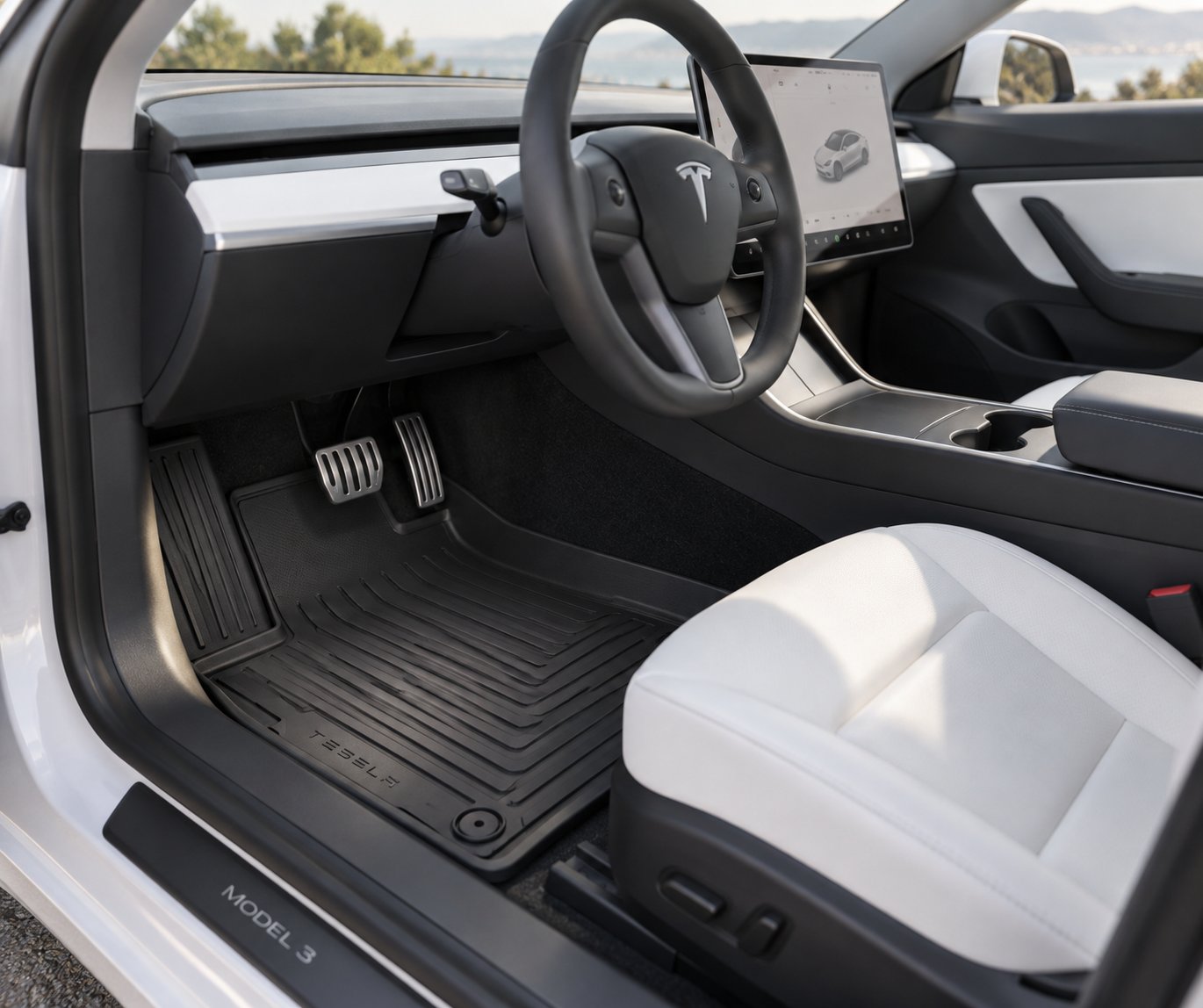
The Quick Answer to Tesla's Floor Mat Policy
You just placed your Tesla order — or maybe you're still deciding — and a surprisingly common question pops up: does Tesla come with floor mats? It sounds like a small detail, but it catches a lot of new owners off guard at delivery.
Yes, Tesla vehicles ship with basic textile (carpet) floor mats as standard. However, they do not include all-weather or rubber-style mats. This applies across the entire lineup — Model 3, Model Y, Model S, Model X, and Cybertruck — though the exact type and quality of the included mats has varied across production years.
That one-line answer only scratches the surface, though. What you actually receive at delivery, how useful those mats really are, and whether you should budget for an upgrade are all details that deserve a closer look.
What Tesla Includes in the Box
When your Tesla rolls off the transport truck, you'll find a set of thin carpet mats covering the front and rear footwells. These textile mats are functional — they prevent your shoes from touching bare carpet directly, and they give the cabin a finished look. Think of them as a baseline layer of interior protection rather than a heavy-duty shield.
The carpet material is similar to what you'd find in many new vehicles: a soft, woven textile that sits flat against the floor. It catches light dust, dry dirt, and minor debris reasonably well. Where it falls short is anything involving moisture. A spilled water bottle, muddy hiking boots, or slushy winter roads can quickly overwhelm these mats. Liquids tend to soak straight through the fibers and into the original carpet beneath, which is exactly the kind of damage most owners hope to avoid.
Why Most Owners Upgrade Immediately
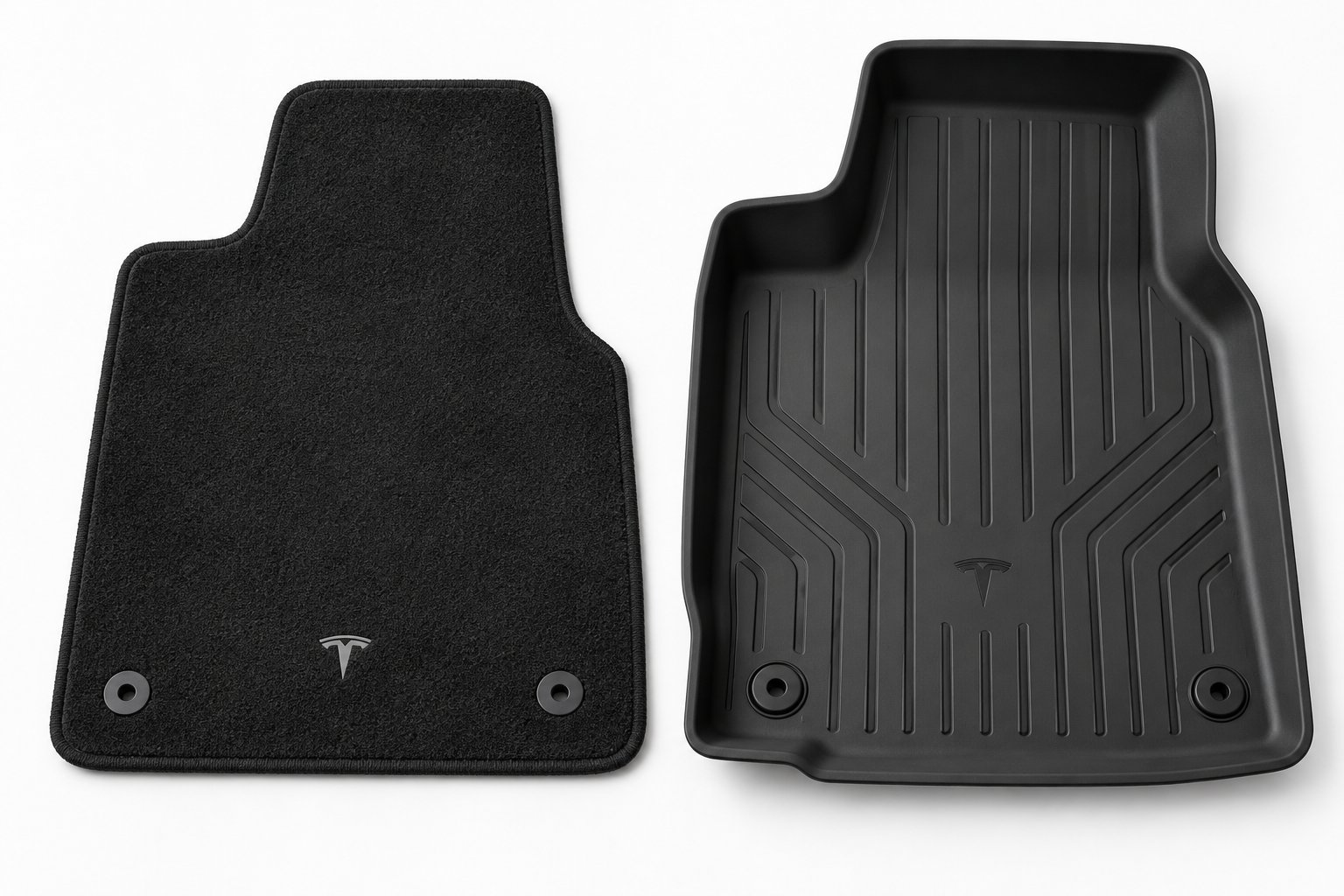
Here's the reality: a large number of Tesla owners replace their factory carpet mats within the first few weeks of ownership. The reason is straightforward. Carpet mats simply don't offer the spill containment or heavy-use durability that daily driving demands — especially in climates with rain, snow, or even sandy terrain. All-weather alternatives, typically made from thermoplastic elastomer (TPE) or rubber, feature raised edges that trap liquids and deep grooves that channel dirt away from the cabin floor. They're also far easier to clean — usually a quick rinse with a hose is all it takes.
Whether you drive a Model 3, Model Y, or Cybertruck, the upgrade conversation is essentially the same. Tesla sells its own OEM all-weather option (officially called "All-Weather Interior Liners"), and a growing market of aftermarket brands offers competitive alternatives at various price points. Picking the right one depends on your specific model year, driving habits, and local climate.
Understanding exactly what each Tesla model includes at delivery — and how those inclusions have shifted over the years — is the critical first step before spending a dollar on replacements.
What Each Tesla Model Includes at Delivery
Every Tesla in the current lineup arrives with some form of floor covering — but what you get varies more than you might expect. The differences aren't dramatic at first glance, yet they matter when you're shopping for replacements or trying to figure out what fits your specific vehicle. Here's what each model actually ships with and what Tesla offers as an upgrade.
Model 3 and Model Y Standard Floor Coverings
The Model 3 and Model Y are Tesla's highest-volume sellers, and they both arrive with a set of textile carpet mats covering the front driver and passenger footwells plus a rear mat. These tesla floor mats model 3 and Model Y owners receive are lightweight, thin, and designed primarily for appearance rather than serious protection. They clip or anchor into place using simple retention points on the floor.
For daily commuters in dry climates, these carpet mats do the bare minimum. But imagine stepping into your Model Y after a rainy school pickup or a muddy trailhead parking lot — that thin textile layer soaks through almost instantly. The same story plays out in the Model 3, where the shallow carpet material offers zero containment for spills or standing moisture. This is precisely why all weather floor mats for tesla model 3 rank among the most popular accessories new owners buy.
Model S, Model X, and Cybertruck Inclusions
Tesla's premium sedans and SUVs follow a similar pattern. The Model S and Model X ship with textile floor mats that are slightly more refined in feel — matching the higher-end interior trim — but still fundamentally carpet-based. They share the same vulnerability to liquids, staining, and wear over time.
The Cybertruck takes a somewhat different approach. Given its truck-oriented positioning and utilitarian interior design, some early deliveries included more durable floor coverings suited to the vehicle's rugged character. Still, the Cybertruck's standard mats aren't true all-weather liners, and most owners in off-road or work-truck scenarios find themselves upgrading quickly for better mud and debris protection.
Tesla's OEM Upgrade Options by Model
Tesla's official shop sells model-specific All-Weather Interior Liners for every vehicle in the lineup. These OEM upgrades are custom-molded to each model's floor contours and offer raised edges, anti-slip surfaces, and full liquid containment. Pricing varies by model, and Tesla occasionally adjusts its shop prices, but here's a general overview:
| Tesla Model | Standard Floor Covering at Delivery | Tesla's Official All-Weather Upgrade | Approximate OEM Upgrade Price |
|---|---|---|---|
| Model 3 | Textile carpet mats (front and rear) | All-Weather Interior Liners (front and rear) | $200 – $250 |
| Model Y | Textile carpet mats (front and rear) | All-Weather Interior Liners (front and rear) | $225 – $275 |
| Model S | Textile carpet mats (front and rear) | All-Weather Interior Liners (front and rear) | $250 – $300 |
| Model X | Textile carpet mats (front and rear) | All-Weather Interior Liners (front and rear) | $275 – $300 |
| Cybertruck | Durable floor covering (front and rear) | All-Weather Interior Liners (front and rear) | $250 – $300 |
Keep in mind that these prices reflect the liner sets alone — cargo liners and trunk mats are sold separately, which adds to the total cost if you want full cabin coverage. Third-party brands like Tesmanian, WeatherTech, and others often compete at similar or lower price points, sometimes bundling cargo liners into the package. Whether you go OEM or aftermarket, the key is matching the product to your exact model year, because even small design changes between production runs can affect fit.
That fit question gets even more interesting when you look at the naming conventions Tesla uses — and the confusion those names create for owners searching online.
Floor Mats vs All-Weather Interior Liners Explained
Try searching for "tesla car mats" or "tesla floormats" on Tesla's own website, and you might come up empty. That's not a glitch — it's a naming choice that trips up thousands of owners every year. Tesla doesn't call its upgraded floor protection "floor mats" at all. Instead, the official product name is All-Weather Interior Liners. Understanding this distinction saves you real time and frustration when you're ready to buy.
Why Tesla Calls Them Interior Liners
The terminology isn't just branding for the sake of branding. Tesla draws a deliberate line between the basic textile carpet mats that ship with every vehicle and the molded protective products sold as upgrades. Traditional floor mats — the kind most people picture — sit loosely on top of the cabin floor and catch surface-level dirt. Interior liners, by contrast, are engineered as a semi-permanent protective shell. They feature vertical walls that help protect the interior carpet and allow for easy cleanup, functioning more like a tray than a flat mat.
This matters more than it sounds. When you search "model 3 floor mats" on the Tesla Shop, you'll find the basic carpet set priced around $95. But the all-weather product — the one most owners actually want — only appears under its official "Interior Liners" label. If you don't know to look for that term, you might assume Tesla doesn't sell a premium option at all, or worse, you might accidentally order the wrong product.
The same confusion carries over to aftermarket shopping. Third-party brands almost universally use the phrase "floor mats" in their product titles because that's what buyers type into search engines. So you'll see hundreds of listings for "Tesla Model 3 all-weather floor mats" from aftermarket sellers, while Tesla's own version sits under a completely different name. Knowing this quirk lets you compare apples to apples — OEM liners against aftermarket mats — without getting lost in conflicting terminology.
OEM Material Specifications and Safety Certifications
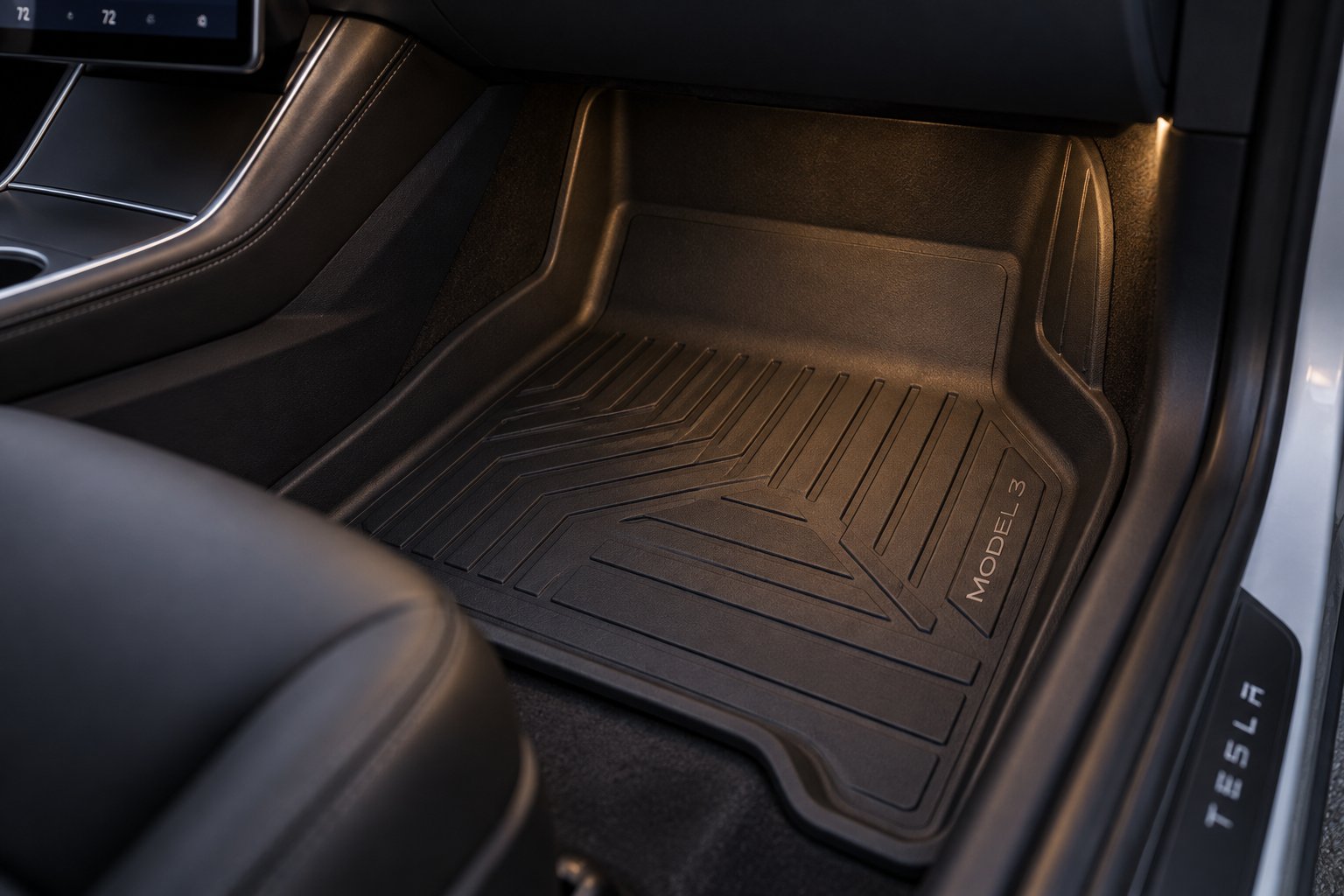
Beyond the naming, Tesla's All-Weather Interior Liners stand out on a material level. They're constructed from injection molded thermoplastic elastomer, commonly abbreviated as TPE. Imagine a material that combines the flexibility of rubber with the structural rigidity of hard plastic — that's essentially what TPE delivers. It holds its shape under heavy foot traffic, resists cracking in freezing temperatures, and won't soften or warp in summer heat.
Each liner is custom molded using digital measurements specific to the model and production year, which means they snap into the exact contours of your vehicle's footwells. Integrated cleats on the underside lock them in place, preventing the kind of sliding and bunching that plagues generic mats. The Model Y set, for example, includes a driver-side liner, a passenger-side liner, and a one-piece second-row liner — all tailored to vehicles produced in 2025 and later.
Tesla also highlights an impressive list of safety and environmental certifications for these liners. Here's what the official product documentation confirms:
- 100% recyclable — the TPE material can be fully reclaimed at end of life
- Cadmium-free — no toxic heavy metals in the construction
- Lead-free — safe from lead contamination concerns
- Latex-free — important for owners or passengers with latex allergies
- PVC-free — avoids the chemical softeners (phthalates) commonly found in cheaper vinyl mats
These certifications aren't just marketing checkboxes. PVC-based mats, for instance, can release volatile organic compounds (VOCs) inside a sealed cabin — especially problematic in a Tesla, where the car often sits closed with recirculated air while preconditioning. A TPE liner sidesteps that issue entirely.
The combination of precision fit, durable construction, and clean material composition makes Tesla's OEM liners a strong choice. But they haven't always been available in this form, and what Tesla includes — or offers as an upgrade — has shifted meaningfully across different production years and model refreshes.
How Tesla's Floor Mat Offerings Have Evolved
Tesla's approach to floor coverings hasn't stayed static. What shipped with a 2018 Model 3 isn't the same as what rolls off the line today — and the differences go well beyond material quality. Production changes, interior redesigns, and shifting accessory strategies have all reshaped what owners receive at delivery and what they need when shopping for replacements. If you're hunting for floor mats for Tesla vehicles without checking production year first, you're setting yourself up for a frustrating return.
How Tesla's Floor Mat Policy Has Changed Over Time
When the Model 3 first entered mass production in 2017, Tesla included a set of basic textile carpet mats — thin, functional, and clearly designed as a cost-effective inclusion for a vehicle targeting mainstream buyers. The Model S, which had been in production since 2012, followed a similar pattern, though its mats reflected a slightly more premium feel consistent with its higher price point. In both cases, all-weather options were either unavailable from Tesla's shop or quietly listed without much promotion.
Over the following years, Tesla gradually built out its official accessories catalog. OEM All-Weather Interior Liners appeared in the Tesla Shop, first for the Model 3 and Model S, then expanding to cover the Model Y after its 2020 launch. The Cybertruck, which began deliveries in late 2023, arrived with its own set of floor coverings tailored to the vehicle's utilitarian cabin design.
Here are the key generational shifts worth understanding:
- 2017–2020 Model 3: Early production runs shipped with basic carpet mats. Tesla's aftermarket accessory ecosystem was still developing, and OEM all-weather options were limited or periodically out of stock.
- 2020–2023 Model 3 and Model Y: Tesla refined its carpet mat quality slightly and expanded OEM liner availability. Third-party brands like WeatherTech and 3D MAXpider began offering custom-fit alternatives, giving owners more choices.
- 2021+ Model S and Model X (Refresh): The Plaid and Long Range refresh models introduced updated interior layouts, including a yoke steering option and redesigned center console. These changes affected floor contours, meaning mats designed for pre-refresh Model S and Model X vehicles no longer fit correctly.
- 2024+ Model 3 Highland: A major interior redesign reshaped the footwells, center console geometry, and rear floor transition — making pre-Highland mats incompatible with the refreshed car.
- 2023+ Cybertruck: As a completely new platform, the Cybertruck required purpose-built floor coverings from day one, with no cross-compatibility to any other Tesla model.
Each of these transitions created a wave of confusion among owners who assumed a "Model 3 floor mat" would work across all Model 3 production years. That assumption breaks down fast when the car underneath the mat has changed shape.
Model 3 Highland and Fit Compatibility Concerns
The 2024 Model 3 Highland refresh is the most consequential example of why production year matters. Most media coverage focused on the exterior redesign — flush headlights, new taillights, removed turn signal stalks. What received far less attention was that Tesla retooled significant portions of the interior floor and footwells, creating a genuine compatibility problem for anyone trying to reuse older accessories.
The changes are subtle but measurable. The Highland's center console is lower and longer, which shifts where the driver's mat meets the console edge. The front passenger footwell is roughly 4–6mm shallower at the heel pad. The rear floor transition across the driveshaft tunnel is reshaped entirely. At key reference points, the footwell dimensions differ by 3–9mm compared to the 2017–2023 Model 3 — small enough to seem trivial, but well outside the tolerance a precision-molded mat can absorb.
What does that mean in practice? A pre-Highland mat installed in a Highland car will either float above the floor surface, bunch up at the toe kick, or leave exposed gaps along the inner console edge. That last one is particularly problematic — it's exactly where mud, salt, and spilled coffee end up. Early Highland adopters on Tesla forums reported visible gaps on the driver's side where moisture could reach the factory carpet underneath, defeating the entire purpose of upgrading in the first place.
The reverse is also true. Highland-specific mats won't fit a pre-2024 Model 3 correctly. The two generations are not cross-compatible in either direction. Any product listing that advertises "fits 2017–2025 Tesla Model 3" is either shipping a single mold that compromises fit on both generations or quietly sending the wrong version and hoping you won't notice.
If you're shopping for all weather floor mats for Model 3 Highland specifically, look for listings that explicitly state "2024–2026" or "Highland" in the product title. Mats built from 3D laser scans of an actual Highland vehicle will outperform anything derived from older CAD files. And always double-check whether the seller offers separate SKUs for pre-Highland and Highland — that distinction alone tells you whether the manufacturer took fitment seriously.
This generational split doesn't only affect the Model 3. Any Tesla model that receives an interior refresh — whether it's the Model S Plaid update or a future Model Y redesign — will likely create the same compatibility gap. The safest approach is simple: verify your exact model year and production variant before purchasing any floor mat product. A two-minute VIN check can save you weeks of return shipping hassle.
Fit compatibility becomes an even bigger question mark when you're not buying new from Tesla at all — and instead picking up a pre-owned vehicle where the original mats may have vanished entirely.
Buying a Used or CPO Tesla Without Floor Mats
Imagine you've just picked up a pre-owned Model 3, driven it home, and opened the door only to find bare carpet staring back at you. No textile mats. No liners. Nothing. If you're wondering whether something went wrong — it didn't. Missing floor mats on a used Tesla are the norm, not the exception, and understanding why saves you from unnecessary frustration.
Why Used Teslas Often Arrive Without Floor Mats
When someone asks "does Tesla come with floor mats," the answer usually assumes a brand-new vehicle rolling off the delivery truck. Used and Certified Pre-Owned (CPO) Tesla purchases play by entirely different rules. Floor mats are considered personal accessories — not permanent vehicle components. The previous owner may have kept them, thrown them away after years of wear, or swapped them out for aftermarket alternatives they took with them when they sold the car.
Tesla's CPO process focuses on inspecting and reconditioning the vehicle's mechanical, electrical, and safety systems. The company checks paint, tires, brakes, and battery health. Interior accessories like car mats for a Tesla, cargo liners, and phone mounts simply aren't part of that checklist. A CPO vehicle can pass every inspection criterion and still arrive at your delivery appointment with completely bare floors.
Private sales carry the same risk — arguably more. There's no standardized inspection at all, so you're relying entirely on the seller's honesty and your own due diligence. Many buyers skip the floor mat question entirely because it feels trivial compared to battery degradation or Autopilot hardware versions. Then delivery day arrives, and they're caught off guard by an expense they didn't budget for.
The fix is simple: ask before you buy. Whether you're purchasing through Tesla's CPO program or negotiating with a private seller, add floor mats to your pre-purchase checklist right alongside tire tread depth and charging cable inclusion. A quick text or email asking "Are the original floor mats included?" takes ten seconds and eliminates the surprise.
Steps to Replace Missing Mats on a Pre-Owned Tesla
Your used Tesla arrived without mats — what now? This happens to thousands of buyers every year, and you've got several clear paths forward. Here's a step-by-step approach to getting your floors covered properly:
- Identify your exact model year and variant. This is non-negotiable. As the previous chapter explained, a mat designed for a 2020 Model 3 won't fit a 2024 Highland Model 3. Check your VIN through the Tesla app or on the door jamb sticker to confirm your production year and trim level. If you're driving a Model 3 from 2018–2024, products like the Tesla Model 3 2018–2024 premium MAXpro floor mats are specifically designed for that generation's footwell geometry.
- Decide between OEM and aftermarket. Tesla's official All-Weather Interior Liners are available through the Tesla Shop and offer guaranteed fit for your model. Aftermarket brands like WeatherTech, 3D MAXpider, and others compete at similar or lower price points, often bundling cargo liners into the package. Both routes work — the right choice depends on your budget and coverage preferences.
- Check Tesla's parts department for OEM carpet mats. If you simply want to restore the original textile mats your car shipped with, Tesla's service centers and parts departments can order replacement carpet mat sets. These are typically less expensive than all-weather liners, though they offer the same limited protection as the originals.
- Consider upgrading directly to all-weather protection. Since you're starting from scratch anyway, this is an ideal moment to skip the carpet mats entirely and go straight to all-weather coverage. You'll spend roughly the same amount you would on OEM carpet replacements, but you'll get dramatically better spill containment, mud resistance, and long-term durability — especially valuable for Tesla 3 floor mats that need to handle daily commuting wear.
- Verify return policies before ordering. Fitment issues are the number one reason floor mat purchases get returned. Confirm that whichever brand you choose offers hassle-free returns in case the mats don't sit flush in your specific vehicle. This is especially important for pre-Highland versus Highland Model 3 purchases, where even a single model year difference changes everything.
One last thing worth emphasizing: arriving at pickup and finding no mats is not a dealer oversight, a vehicle defect, or grounds for a complaint. It's simply how the used car market works — for Teslas and every other brand. Treat floor mats as a planned accessory purchase, budget $100–$300 depending on the level of protection you want, and you'll have your cabin fully covered within days of taking delivery.
Of course, your replacement options might look slightly different depending on where in the world you purchased your Tesla — and that geographic factor influences more than just product availability.
Regional Differences in Tesla Floor Mat Inclusion
Tesla builds cars on four continents — and what's inside the box at delivery isn't always identical across all of them. Your geographic location shapes not just the price you pay for a Tesla, but potentially the floor coverings you receive, the upgrade options available in your local Tesla Shop, and how urgently you actually need to replace those factory carpet mats. It's a variable that most buyers never consider until they're comparing notes with an owner in a different country and realize their experiences don't match.
U.S. vs European vs Chinese Market Differences
Tesla operates major manufacturing facilities in Fremont (California), Austin (Texas), Shanghai (China), and Berlin-Brandenburg (Germany). Each Gigafactory serves specific regional markets, and the vehicles they produce can differ in small but meaningful ways — interior trim materials, software features, and yes, what's included at delivery. A Model 3 built in Shanghai for the Chinese domestic market may ship with slightly different standard accessories than an identical Model 3 rolling off the Fremont line for U.S. buyers.
Why does this happen? Regulatory requirements, local supplier agreements, and regional consumer expectations all play a role. European markets, for example, often have stricter material and safety standards that can influence which accessories Tesla bundles at no extra cost versus which ones get listed as paid add-ons. The Chinese market, where Tesla competes aggressively on value with domestic EV brands like BYD and NIO, has occasionally seen adjusted accessory bundles designed to sharpen the vehicle's perceived value proposition at the point of sale.
The practical takeaway is straightforward: don't assume that a Tesla Model 3 floor mat set listed on the U.S. Tesla Shop will appear — or be priced identically — on the European or Chinese Tesla Shop. Each regional storefront carries its own product catalog. Availability of Tesla Model 3 all weather interior liners can vary by market, and pricing reflects local currency, import duties, and regional manufacturing costs. Before ordering any OEM upgrade, navigate directly to your country-specific Tesla Shop page rather than relying on screenshots or links shared by owners in other regions.
Another subtlety worth noting: Tesla vehicles built at Gigafactory Berlin for European delivery and those built in Shanghai for export to Europe aren't necessarily equipped with identical standard accessories. Two buyers in the same German city could receive slightly different floor coverings depending on which factory produced their car. Checking your build sheet or delivery documentation confirms exactly what was included — and what wasn't.
How Climate Should Influence Your Floor Mat Choice
Geography doesn't just affect what Tesla ships with your car. It fundamentally changes how much protection you need from your floor coverings in the first place. A Tesla Model 3 mat that works perfectly in Phoenix won't survive a single Minnesota winter without leaving the original carpet underneath soaked and stained.
Consider how different climates interact with the basic carpet mats Tesla includes:
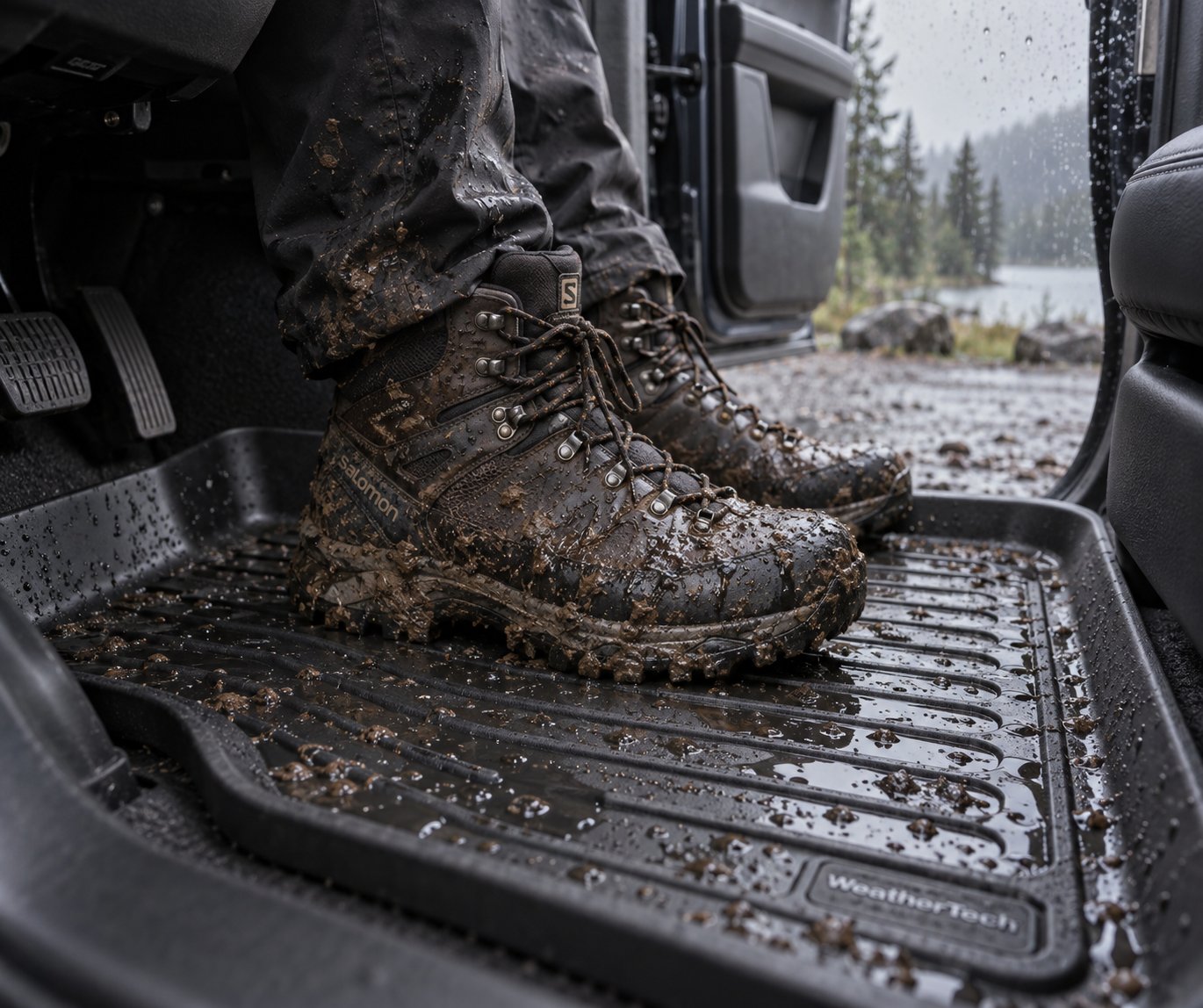
- Snowy and icy regions (Scandinavia, Canada, northern U.S.) — Road salt, slush, and melting snow are the biggest enemies of carpet mats. Moisture pools in footwells, saturates the textile fibers, and can eventually promote mildew or corrosion underneath. All-weather mats with raised edges and waterproof surfaces aren't optional here — they're essential.
- Rainy and humid climates (Pacific Northwest, UK, Southeast Asia) — Frequent rain means consistently wet shoes. Carpet mats absorb that moisture day after day, becoming waterlogged and potentially developing mildew if they never fully dry between trips. All-weather alternatives drain and dry far faster.
- Hot and arid climates (Arizona, Middle East, parts of Australia) — Dry heat is gentler on carpet mats. You won't deal with moisture issues, but fine sand and dust can grind into carpet fibers and become nearly impossible to vacuum out. All-weather mats shake clean in seconds.
- Temperate and mild climates (coastal California, southern Europe) — This is the one scenario where factory carpet mats can hold up reasonably well over time. Minimal rain, no snow, and moderate temperatures keep the textile fibers intact longer. Even here, though, a single beach trip or coffee spill makes a strong case for upgrading.
Some owners in seasonal climates take a hybrid approach — keeping the factory carpet mats for dry summer months and swapping in all-weather liners for fall and winter. It's a practical strategy, though it does mean purchasing two sets. Others skip the rotation entirely and install all-weather mats year-round, accepting the slightly firmer feel underfoot in exchange for never worrying about what their shoes track in.
Wherever you live, the decision boils down to one honest question: how often do your shoes carry moisture, dirt, or debris into the car? If the answer is "regularly," the factory carpet mats won't hold up — regardless of which Gigafactory built your Tesla. And once you've decided to upgrade, the real question becomes which aftermarket brand delivers the best combination of fit, materials, and value for your specific model.
Popular Third-Party Tesla Floor Mats Compared
The aftermarket Tesla accessory space has exploded over the past few years, and floor mats sit at the center of it. Dozens of brands now offer custom-fit options for every Tesla model — but they're far from interchangeable. Material composition, edge height, anti-slip design, and coverage area vary dramatically from one manufacturer to the next. Most review articles mention a brand or two in passing without ever putting them side by side. That makes it nearly impossible to compare your options in one place — until now.
Whether you're shopping for Tesla Model 3 floor mats 2025 or planning ahead for 2026 Tesla Model 3 floor mats, the brands below represent the most widely purchased aftermarket choices. Each has genuine strengths and trade-offs worth understanding before you spend your money.
Key Differentiators Across Aftermarket Brands
Not all "custom-fit" mats are created equal, and the differences show up the moment you lay them in your footwells. Here are the factors that actually separate one brand from another:
- Material type — TPE (thermoplastic elastomer), TPO (thermoplastic olefin), rubber, or carpet. Each behaves differently under temperature extremes, offers different grip and flexibility, and ages at different rates.
- Edge height — Raised walls around the perimeter trap liquids and debris. Some brands feature edges under half an inch, while others run 1.5 inches or higher — a meaningful difference when you're dealing with snowmelt or a tipped travel mug.
- Anti-slip backing — Mats that shift underfoot aren't just annoying — they're a safety concern if they slide under the brake pedal. The best options use textured nibs, integrated cleats, or hook-and-loop systems that lock into Tesla's factory anchor points.
- Coverage area — Some brands cover only the front and rear footwells. Others offer matching cargo liners, frunk mats, and even door sill protectors as part of a complete cabin protection system.
- Fit precision — The gold standard is 3D laser scanning of the actual vehicle interior. Brands that rely on older CAD files or generic templates produce mats that leave gaps along console edges and door sills — exactly where dirt accumulates fastest.
With those criteria in mind, here's how five of the most popular aftermarket brands stack up against each other.
Side-by-Side Brand Comparison Table
| Brand | Material Type | Coverage Area | Custom Fit Precision | Notable Features |
|---|---|---|---|---|
| CUTIM | TPE (thermoplastic elastomer) | Front, rear, and matching cargo liners available for all Tesla models | Model-specific 3D design tailored to each Tesla's floor layout | All-weather protection against dirt, spills, and slipping; complete mat-plus-cargo-liner packages for full cabin coverage |
| WeatherTech | TPO (thermoplastic olefin) — proprietary FloorLiner compound | Front, rear, and cargo liners sold separately | Laser-measured to factory floor contours; strong reputation for precision | Made in USA; well-established brand with decades of automotive accessory experience; rigid feel underfoot |
| 3D MAXpider | TPE with carbon fiber texture top layer | Front, rear, and cargo liners available | Multi-layer construction using 3D scanning; snug fit on most models | Three-layer KAGU design; soft carpet-like surface with waterproof base; odorless construction |
| Tesmanian | TPE | Front, rear, cargo liners, and frunk mats | Custom-molded per model and production year; Highland-specific versions available | Tesla-focused brand; competitive pricing; frequently updated molds for new production runs |
| Tesloid | TPE | Front, rear, cargo liners, and full interior sets | 3D laser scanned for each model generation; separate Highland SKUs | Canadian-based; bundle packages for complete cabin and cargo protection; popular in colder climate communities |
A few things jump out from this comparison. Every brand on this list uses some form of thermoplastic material rather than traditional rubber, which tells you something about where the industry has moved. TPE and TPO dominate because they're lighter, more flexible in cold weather, and easier to manufacture into complex 3D shapes than vulcanized rubber. They also tend to resist the chemical "new mat smell" that cheaper rubber alternatives are notorious for.
You'll also notice that coverage area varies meaningfully. Some brands — like CUTIM and Tesloid — offer bundled packages that include both cabin mats and cargo liners, which simplifies the buying process and often saves money compared to purchasing components individually. Others, like WeatherTech, sell each piece separately, giving you more control but requiring multiple transactions if you want full coverage.
Material Types and What They Mean for Protection
Choosing a mat for your Tesla ultimately comes down to what the mat is made of, because material dictates every performance characteristic you'll experience day to day. Here's a quick breakdown of the three material families you'll encounter:
TPE (Thermoplastic Elastomer) — This is the most common material across Tesla-specific aftermarket mats, and it's what Tesla uses in its own OEM liners. TPE is flexible enough to conform to footwell contours without cracking, even in sub-zero temperatures. It's waterproof, stain-resistant, and easy to rinse clean. Most TPE mats are also free from PVC, latex, and heavy metals — a meaningful advantage inside an EV cabin where air recirculates frequently. Brands like CUTIM, Tesmanian, Tesloid, and 3D MAXpider all build their mats from TPE or TPE-based composites.
TPO (Thermoplastic Olefin) — WeatherTech's proprietary FloorLiner material falls into this category. TPO is slightly more rigid than TPE, which gives it excellent structural memory — the mat holds its molded shape firmly and resists deformation under heavy use. The trade-off is a stiffer feel underfoot and slightly less flexibility when removing or reinstalling the mat. In extremely cold climates, some owners report that TPO mats feel noticeably harder than their TPE counterparts, though they still outperform rubber in sub-freezing flexibility.
Rubber — Traditional rubber mats are becoming less common in the Tesla aftermarket, but you'll still find budget options using vulcanized or synthetic rubber. They offer decent waterproofing and durability at a lower price point, but they tend to be heavier, may emit a strong odor for weeks after installation, and don't match the precise 3D contours of TPE or TPO alternatives. For owners who want a temporary solution or an ultra-budget option, rubber works. For long-term daily use, the thermoplastic options win on nearly every metric.
One nuance worth highlighting: 3D MAXpider's KAGU line uses a unique multi-layer approach. The bottom layer is waterproof TPE, the middle layer provides structural support, and the top layer features a carpet-like texture that mimics the feel of the factory mats while still offering all-weather protection underneath. It's a genuinely clever compromise for owners who want waterproof performance without the bare-plastic aesthetic of a standard liner. The downside? That carpet top layer can trap fine dirt and pet hair more readily than a smooth TPE surface, requiring more frequent vacuuming.
No single material is perfect for every owner. If you prioritize easy cleaning and maximum spill containment, a smooth-surface TPE mat from brands like CUTIM or Tesmanian will serve you best. If you want a more premium underfoot feel with hidden waterproofing, 3D MAXpider's layered design is worth the premium. And if structural rigidity and American manufacturing matter to you, WeatherTech's TPO formula has earned its decades-long reputation for a reason.
With the right brand and material identified, the final piece of the puzzle is matching your choice to your specific ownership situation — because a new Model Y buyer, a used Model 3 owner, and someone adding winter protection to a Cybertruck all need slightly different things.
How to Choose the Right Floor Mats for Your Tesla
You've seen what Tesla ships at delivery, why the factory carpet mats fall short, how OEM and aftermarket options compare, and which production-year details can make or break your purchase. That's a lot of ground to cover. The question left is the most personal one: which option actually makes sense for your situation? Not every Tesla owner is starting from the same place, and the ideal floor mat setup depends on a handful of practical factors that only you can weigh.
Rather than offering a single blanket recommendation, let's break the decision down by the three most common buyer profiles — because a brand-new owner, a used Tesla buyer, and a current owner adding seasonal protection are each solving a different problem.
Matching the Right Mat to Your Situation
Profile 1: New Tesla owners deciding whether to upgrade from factory carpet mats.
You just took delivery. The carpet mats are sitting in your footwells, and they look fine — for now. The temptation is to wait and see how they hold up before spending more money. Here's the honest truth: every week you drive on those textile mats is a week your original cabin carpet absorbs whatever the mats can't catch. If you live anywhere with rain, snow, or dusty roads, that window between "they look fine" and "there's a permanent stain underneath" is shorter than you'd expect. Upgrading early protects your floor from day one and preserves resale value over the long run.
For new owners, the simplest path is choosing a model-specific all-weather set that matches your exact production year. Tesla's OEM All-Weather Interior Liners guarantee fit straight from the source. Aftermarket brands — especially those offering bundled cabin-plus-cargo packages — often deliver comparable or broader coverage at a competitive price point. If you're eyeing 2025 Tesla Model 3 floor mats or shopping for a Tesla Model 3 2026 floor mats set, confirm that the product explicitly lists your model year, particularly if you're driving a Highland refresh or a Juniper Model Y.
Profile 2: Used Tesla owners replacing missing mats entirely.
Your pre-owned Tesla arrived with bare floors. No carpet mats, no liners, nothing. As frustrating as that feels, it's actually an opportunity. You're not replacing something that sort of works — you're starting fresh, which means you can skip the carpet stage entirely and go straight to all-weather protection. There's no reason to spend $95 on replacement textile mats only to realize three months later that you need all-weather liners anyway.
The critical step for used buyers is precise model-year verification. A tesla car mat designed for a 2021 Model Y won't fit a 2025 Juniper Model Y, and a pre-Highland Model 3 mat won't sit flush in a 2024+ Highland. Check your VIN, confirm your production variant, and match those details to the product listing before clicking "add to cart." If you inherited a 2018–2023 Model 3, aftermarket options are abundant and well-reviewed. If you're driving a Highland or Juniper, make sure the seller offers generation-specific SKUs.
Profile 3: Current owners adding seasonal or all-weather protection.
Maybe you've been driving on the factory carpet mats for a year or two and they're starting to show their age. Or maybe winter is approaching and you want protection against road salt and slush without permanently replacing the carpet set you're happy with during summer. Seasonal swapping is a legitimate strategy — keep the textile mats for dry months and install all-weather liners from fall through spring. The key consideration here is storage. TPE liners are flexible enough to stack flat in a garage or closet, and they rinse clean before you store them, so they won't carry last season's grime into your storage area.
For year-round upgraders who don't want the hassle of seasonal rotation, a single set of all-weather mats eliminates the decision entirely. You'll sacrifice a bit of the soft, carpet-like feel underfoot, but you'll gain complete peace of mind against whatever your shoes track in — regardless of the season.
No matter which profile fits you, the decision process follows the same framework. Here are the criteria to evaluate in order:
- Model year and variant compatibility — This is the single most important factor. A mat that doesn't fit your specific vehicle is worse than no mat at all, because it can shift, leave gaps, or even interfere with pedal operation. Always verify pre-Highland vs. Highland (Model 3), pre-Juniper vs. Juniper (Model Y), and pre-refresh vs. refresh (Model S/X) before purchasing.
- Material preference — TPE offers the best balance of flexibility, waterproofing, and cold-weather performance. TPO delivers superior rigidity and shape retention. Carpet-topped hybrids blend comfort with hidden waterproofing. Your local climate and personal feel preference should drive this choice.
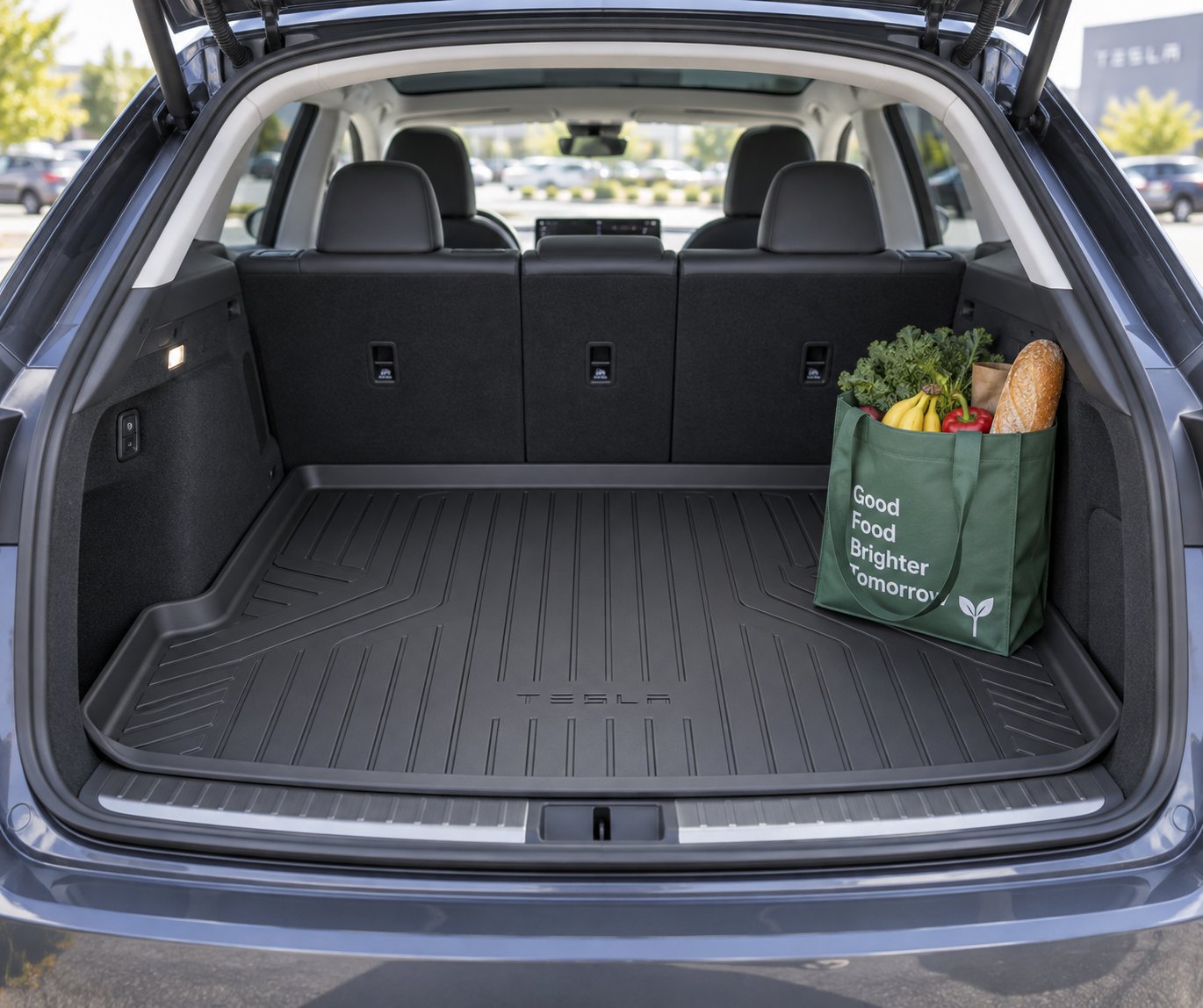
- Coverage needs — Cabin-only sets protect the footwells. Full packages add cargo liners, frunk mats, and sometimes door sill guards. If you regularly haul groceries, gear, or pets, the trunk and frunk take as much abuse as the cabin floor — possibly more.
- Budget — OEM Tesla Model 3 all-weather interior liners run roughly $200–$250 for the cabin set alone. Aftermarket alternatives range from $90 to $180, with bundled cabin-plus-cargo packages typically landing between $150 and $300. Factor in what you're actually protecting — a pristine interior adds measurable value at trade-in or resale.
- Climate — Snowy and rainy regions demand raised-edge, waterproof mats as a baseline. Hot, arid climates can get away with lighter protection but still benefit from mats that shake free of sand and dust. Temperate climates offer the most flexibility in material and style choices.
Your Next Steps as a Tesla Owner
Here's the complete journey this article has walked through: Tesla ships basic carpet mats with every new vehicle, but those mats offer minimal real-world protection. Upgrading to all-weather coverage is the single highest-return interior investment you can make. Tesla's OEM liners are a solid choice with guaranteed fit, while aftermarket brands compete on price, coverage breadth, and material innovation. Your specific model year and production variant determine which products actually fit — and getting that wrong means return shipping headaches and exposed carpet in the meantime.
If you've decided to upgrade — whether you're protecting a brand-new delivery, outfitting a used purchase, or swapping in seasonal liners — the next step is finding a set designed specifically for your vehicle. CUTIM's Tesla Floor Mats & Cargo Liners offer model-specific, custom-fit designs for every current Tesla, with all-weather TPE construction and matching cargo liner packages that cover the entire cabin in a single order. It's a practical starting point for owners who want complete protection without piecing together individual components from multiple sellers.
Whatever brand you choose, the principle stays the same: verify your model year, pick the material that suits your climate, and don't wait until the factory carpet underneath is already stained. A $150 mat set protecting a $40,000+ vehicle isn't an accessory — it's common sense.
Frequently Asked Questions About Tesla Floor Mats
1. Does Tesla include floor mats with a new car?
Every new Tesla — Model 3, Model Y, Model S, Model X, and Cybertruck — ships with a set of basic textile carpet mats covering the front and rear footwells. These mats handle light dust and dry dirt but lack waterproof protection. Tesla does not include all-weather or rubber-style mats as standard equipment, so most owners purchase upgraded all-weather liners separately through the Tesla Shop or from aftermarket brands like CUTIM, WeatherTech, or 3D MAXpider.
2. What is the difference between Tesla floor mats and All-Weather Interior Liners?
Tesla uses the term 'All-Weather Interior Liners' for its upgraded molded floor protection, which is distinct from the basic carpet 'floor mats' included at delivery. The liners are constructed from thermoplastic elastomer (TPE), feature raised edges for liquid containment, and are custom-molded to each model's footwell contours. They are also certified cadmium-free, lead-free, latex-free, and PVC-free. Searching for 'floor mats' on Tesla's website may only show the basic carpet set, so use 'Interior Liners' to find the premium option.
3. Do used or CPO Teslas come with floor mats?
Floor mats are not guaranteed with a used or Certified Pre-Owned Tesla. Previous owners often keep, discard, or replace the original mats before selling. Tesla's CPO inspection focuses on mechanical, electrical, and safety systems — not interior accessories. Before finalizing a used Tesla purchase, ask the seller directly whether floor mats are included. If your vehicle arrives without them, you can order OEM replacements from Tesla or go straight to all-weather mats from aftermarket brands such as CUTIM, which offers custom-fit options for every Tesla model.
4. Will floor mats from an older Model 3 fit the 2024 Highland refresh?
No. The 2024 Model 3 Highland refresh significantly changed the interior floor and footwell dimensions, with key reference points differing by 3-9mm compared to the 2017-2023 Model 3. Pre-Highland mats will leave gaps, float above the floor, or bunch up at the toe kick in a Highland vehicle. The two generations are not cross-compatible in either direction, so always confirm that the product listing specifies '2024-2026' or 'Highland' before purchasing.
5. What material is best for Tesla all-weather floor mats?
TPE (thermoplastic elastomer) is the most popular material for Tesla all-weather mats, used by Tesla's own OEM liners and brands like CUTIM, Tesmanian, and Tesloid. TPE is waterproof, flexible in freezing temperatures, odor-free, and free from PVC and latex. TPO (thermoplastic olefin), used by WeatherTech, offers greater rigidity and shape retention but feels stiffer underfoot. Traditional rubber is a budget option but tends to be heavier and may emit strong odors. For most Tesla owners, TPE provides the best balance of protection, flexibility, and cabin-safe material composition.