
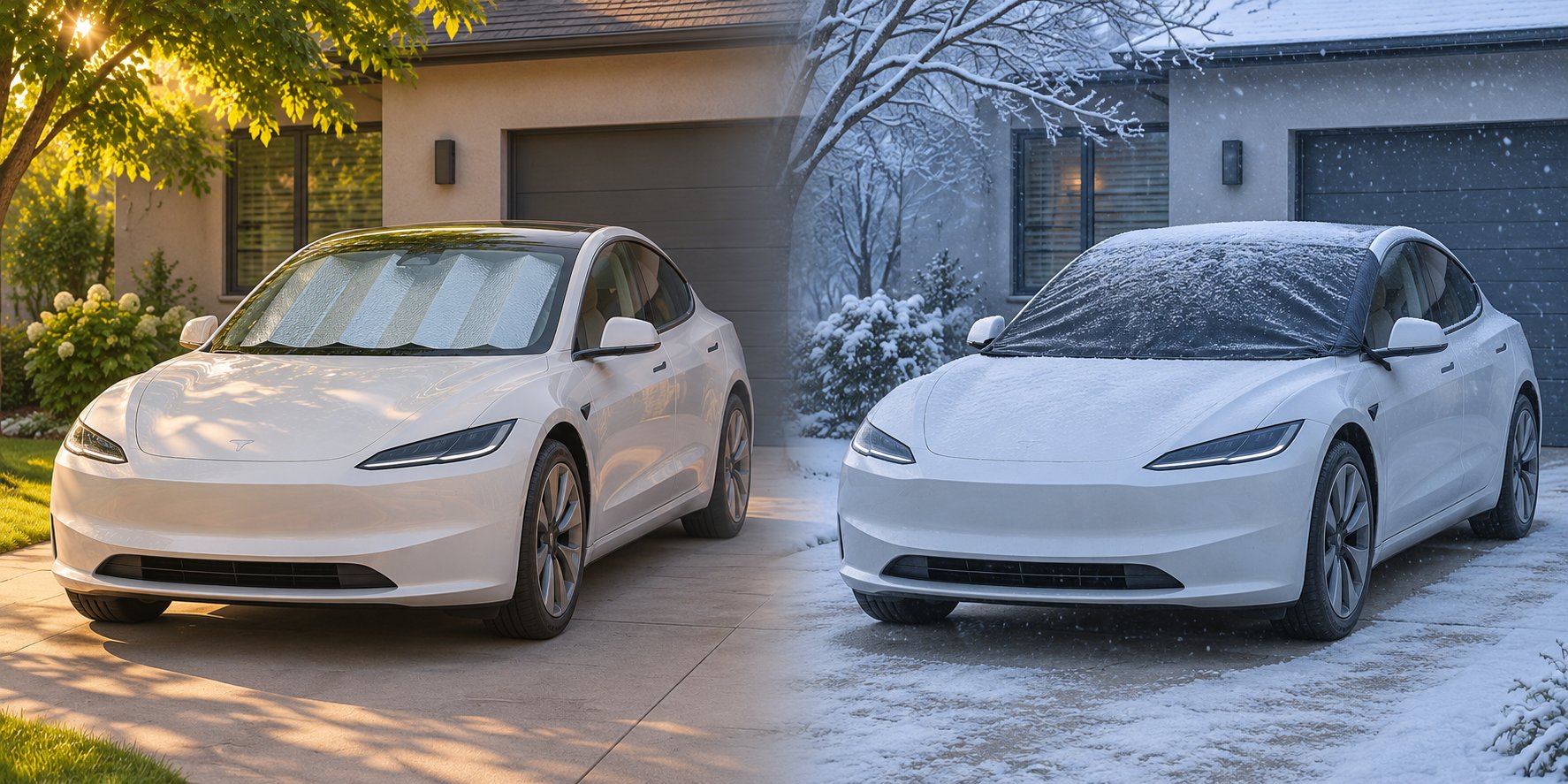
What a Tesla Windshield Cover Actually Means
A Tesla windshield cover is one of two products: an interior windshield sunshade that sits inside the glass and blocks summer heat and glare while the car is parked, or an exterior windshield cover that sits on the outside of the glass and keeps snow, ice and frost off. All five pages now ranking for this search cover only interior shades, so this guide explains both.
Say you search for a cover in July and again in January. You need a different product each time, and sellers use the same name for both. If you know which problem you're solving, you're less likely to buy the wrong one.
Interior Windshield Sun Shades for Heat and Glare
A Tesla windshield shade goes inside the car, pressed flat against the inside of the windshield. With most foldable styles, you push the shade against the glass and flip the sun visors down over the top edge to hold it, as this sun shade installation guide describes. Other designs, such as umbrella-style shades with a spring-loaded frame, stay in place because of their own shape.
However it's held, the shade covers your view of the road. It's only for when the car is parked, and you have to take it out before you drive.
Exterior Windshield Covers for Snow, Ice and Frost
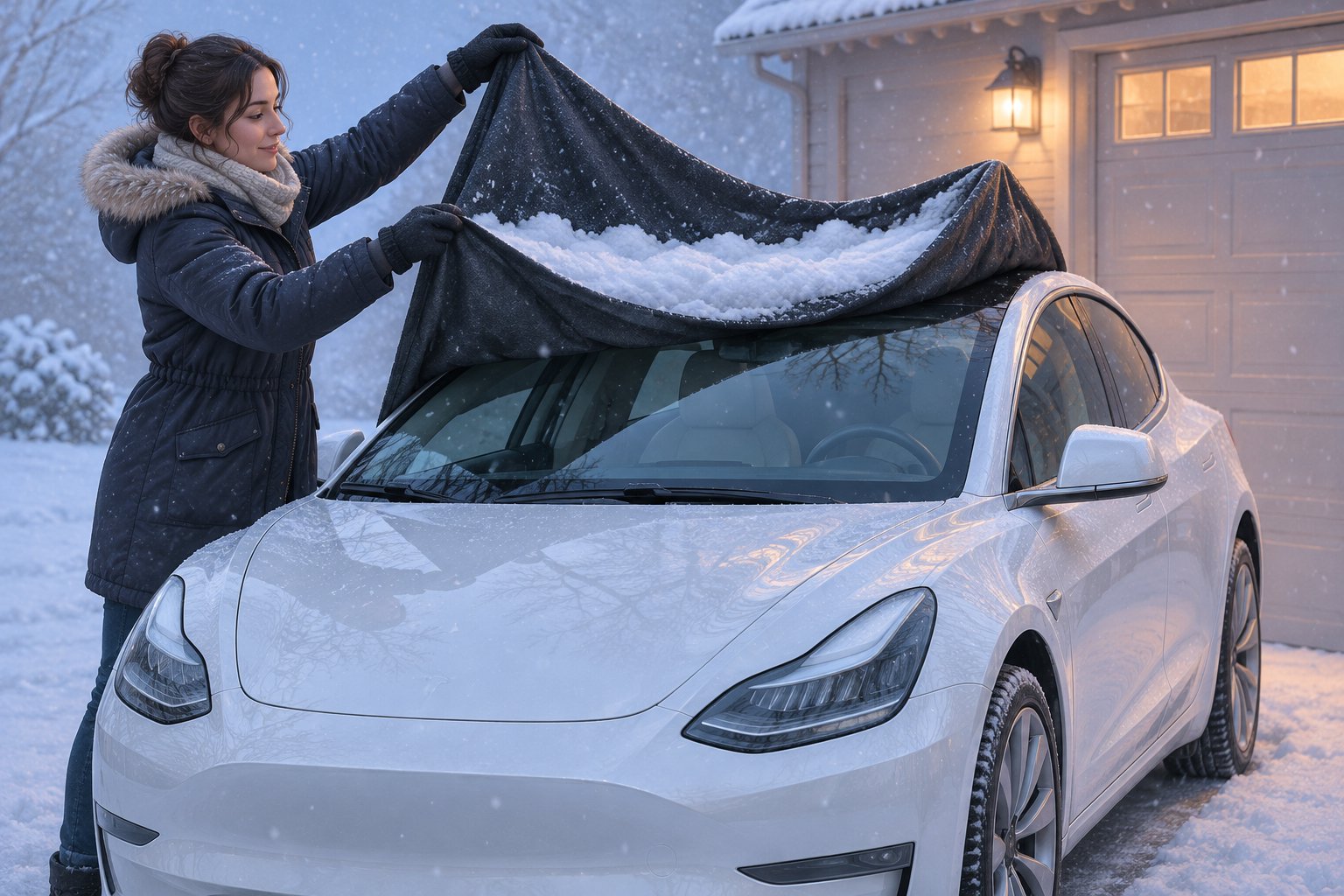
An exterior cover goes over the outside of the windshield before bad weather arrives. Snow and frost land on the fabric instead of the glass. In the morning you pull the cover off and drive away, with no scraping.
In Car and Driver's tests, most covers had flaps that you tuck inside the car and hold by closing the doors. Others hooked onto the side mirrors, and some added elastic bands with hooks or magnets. The testers found that more anchor points held up better in wind. They also pointed out that a windshield cover protects only the windshield. You'll still need a brush for the roof, side windows and rear glass.
Which Type You Actually Need
Pick by the problem you have. Heat and glare call for an interior shade. Frost and snow call for an exterior cover.
| Type | Where It Sits | Season | Main Job | Remove Before Driving |
|---|---|---|---|---|
| Interior windshield sun shade | Inside the car, against the windshield | Summer | Blocks sun and glare while parked | Yes |
| Exterior windshield cover | Outside the car, over the windshield | Winter | Keeps snow, ice and frost off the glass | Yes |
The naming gets more confusing when you search for a Tesla sunshade. Many of the results, including listings on Tesla's own shop, are made for the glass roof, not the windshield.
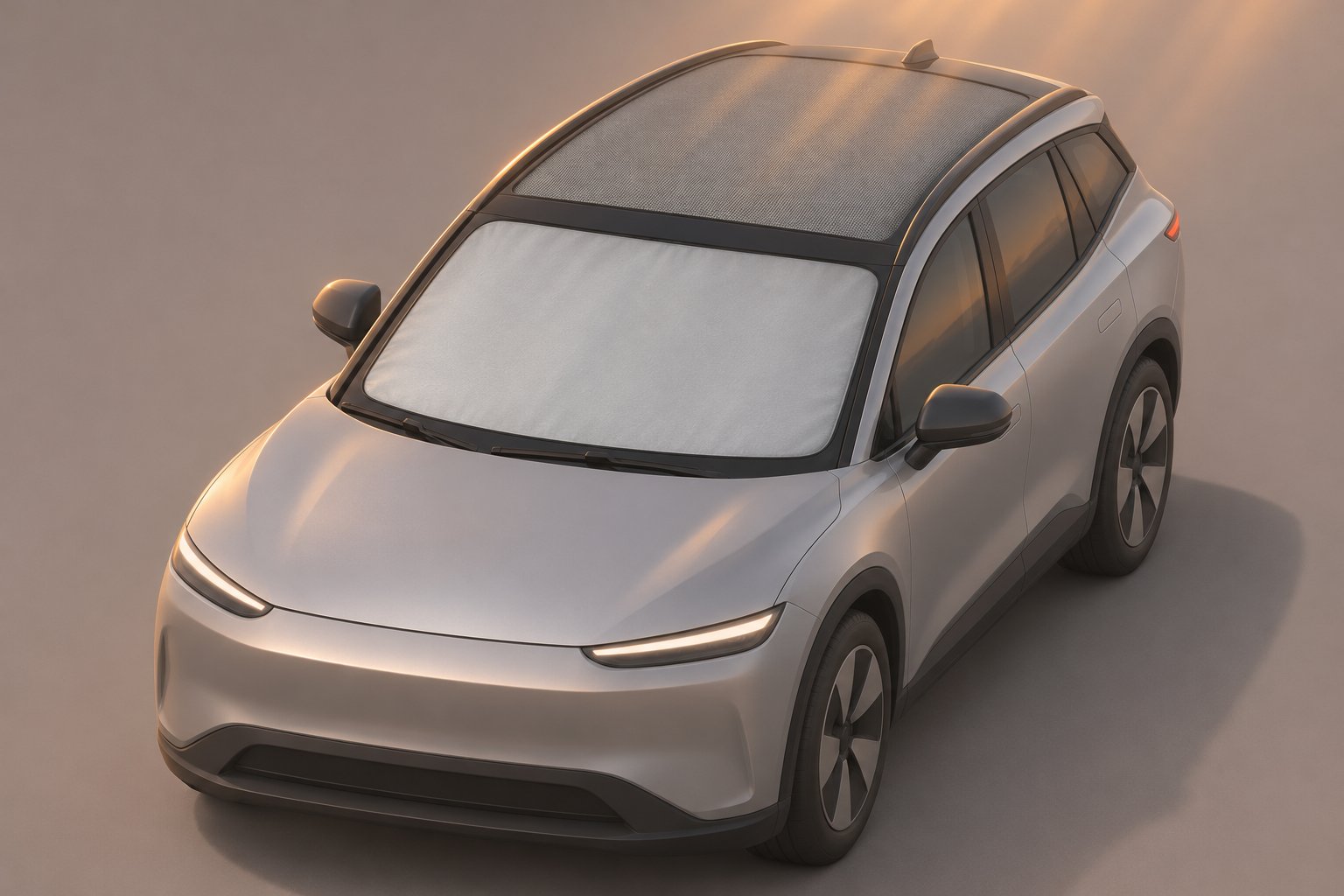
Windshield Shades Versus Tesla Glass Roof Shades
Have you ever searched for a Tesla sunshade and gone straight to Tesla's own store? It seems like the safe choice. If you want to cover the windshield, though, it's often the wrong page.
Why Tesla's Own Sunshade Pages Cover the Roof
The sunshade pages from Tesla's official shop that rank for this search sell glass roof and rear liftgate shades. None of them is a windshield product. Summaries of those listings describe mesh fabric stretched over a collapsible rigid frame that folds down for storage. Tesla updates its accessory pages from time to time, so read the current product copy before you rely on that description.
If you want to keep sun off the dashboard and steering wheel, a Tesla roof shade won't do it. You need a separate windshield shade.
Tesla's Retractable Roof Sunshade for Model Y
Many owners also search for a Tesla Model Y retractable sunshade. Tesla's current accessory listings are the place to confirm what this product is, which Model Y versions it fits and how it opens and closes. Those details can change between product releases. Read the fitment notes closely. Tesla's Model Y roof shade listing has excluded the Model Y L, so a Model Y badge on your car doesn't guarantee a fit.
You'll also see people searching for a Tesla sunroof shade or a moonroof shade. Some earlier Model S cars came with a sunroof that opens. The Model S owner's manual for those cars explains how to vent, open and close it from the touchscreen, the right scroll wheel or the mobile app. Owners and sellers now often say 'sunroof' for any Tesla glass roof, whether or not it opens. Check the owner's manual for your car to see which kind you have.
When Owners Want Both
The windshield and the glass roof are separate panes of glass. A windshield shade does nothing for the roof, and a roof shade does nothing for the windshield. Imagine parking facing west on a summer afternoon. Low sun comes straight through the windshield while the roof takes the light from above. If both bother you, plan on buying two products.
| Shade Type | Location | Purpose | Remove Before Driving? |
|---|---|---|---|
| Windshield shade | Inside, against the windshield | Blocks sun and glare on the dash and front seats while parked | Yes |
| Glass roof shade | Inside, under the glass roof | Cuts sunlight and glare coming through the roof | Usually not, since it doesn't block the road view. Check the listing. |
| Rear liftgate shade | Inside, against the rear liftgate glass | Cuts sunlight on the rear seats and cargo area | Check the listing and local rules, because it covers the rear glass |
| Side window shade | Inside, on the side windows | Shades passengers and cuts side glare | Front side windows: yes. Rear side windows: depends on the design and local rules. |
Choosing the right pane of glass is the first decision. Shades made for the same glass can still be built very differently, and the build affects how much light each one blocks and how easily it folds away.
Tesla Sunshade Materials and Build Types Explained
Have you ever pulled a shade out of the trunk and found it wouldn't fold back the way it came? Two shades made for the same glass can work very differently. The build decides how a shade blocks light, how well it fits and where it goes while you drive.
Reflective Windshield Shades
A reflective shade has a shiny face that points out through the windshield. It's meant to bounce sunlight back out through the glass before the light reaches the dash and seats. T Sportline, for example, lists a reflector-style windshield shade that comes with a tote, so check the current listing for details. Many reflective shades fold along set lines into panels and then go into a bag, a door pocket or the space under a seat.
Mesh Fabric on a Collapsible Frame
Tesla uses this build for its roof shades. Mesh fabric stretched over a rigid frame cuts sunlight and glare coming through the glass. When you don't need the shade, the frame folds down so it takes up less room. If you're shopping for a Tesla Model 3 glass roof sunshade, you'll see this build on Tesla's own listings. Read the current product copy for your model.
Custom-Fit Sunscreens
Covercraft makes its UVS100 sunscreen for a specific vehicle's year, make and model. It has a rigid body that holds its place and folds for storage. A closer fit leaves fewer gaps along the edges for light to get through. Even so, Covercraft notes that some windshields may have slight gaps around the rearview mirror or the sides. Those gaps let the shade fit without damage to its foam core. Look closely at the mirror area on any shade you consider.
Multi-Layer and Exterior Cover Materials
Some shades stack layers so each one does a different job. The UVS100, for instance, combines a foam core with a triple laminate and a soft felt backing. In a build like this, the outer layer faces the sun, the core gives the shade its stiffness, and the backing gives the cabin side a softer surface. More layers usually mean more bulk when the shade is folded.
Exterior snow covers have to handle water. Car and Driver's testers sorted these covers into two groups. Single-layer polyester repels water more easily, and one hard shake can dry it enough to stow in the car. It won't protect the glass from heavy precipitation like hail, though. Stitch-layered quilts insulate and protect better, but they get wet and heavy and need to dry out regularly. If a listing doesn't say how its fabric holds up in freezing weather, look for reviews from owners in snowy areas.
| Build Type | Intended Job | How It Stores | Trade-offs to Weigh |
|---|---|---|---|
| Reflective windshield shade | Bounce sunlight back out through the windshield | Folds along set lines into a tote or bag | Takes cabin space when stowed. Folding it the wrong way can wear the creases. |
| Mesh on a collapsible frame | Cut sunlight and glare, mainly through the glass roof | Frame folds down | Made for the roof, not the windshield |
| Custom-fit sunscreen | Cover one vehicle's windshield with fewer gaps | Folds. Covercraft offers an optional storage bag. | Fits only the vehicle it's made for. May leave small gaps at the mirror and sides. |
| Multi-layer interior shade | Give separate jobs to the outer face, core and backing | Folds, usually thicker | Bulkier to store |
| Exterior polyester cover | Keep snow and frost off the outside of the glass | Shake off water, then fold into a bag | Less protection from hail and heavy precipitation |
| Exterior quilted cover | Keep snow off and add insulation | Needs to dry before storing | Gets wet and heavy |
On most cars, a small gap by the rearview mirror is a minor flaw. On a Tesla, the forward cameras sit in that same spot, so how a cover fits there matters more.
Tesla Features That Change How a Windshield Cover Works
Most guides to Tesla window covers are written as if the only thing behind the windshield were a mirror. A Tesla also has cameras there. It can record while parked, run its climate system from your phone and move its wipers when you tell it to. Each of these features changes how a cover fits or behaves. Features vary by model, software version and region, so check the owner's manual for your car before you rely on any of them.
The Camera Cluster Behind the Mirror
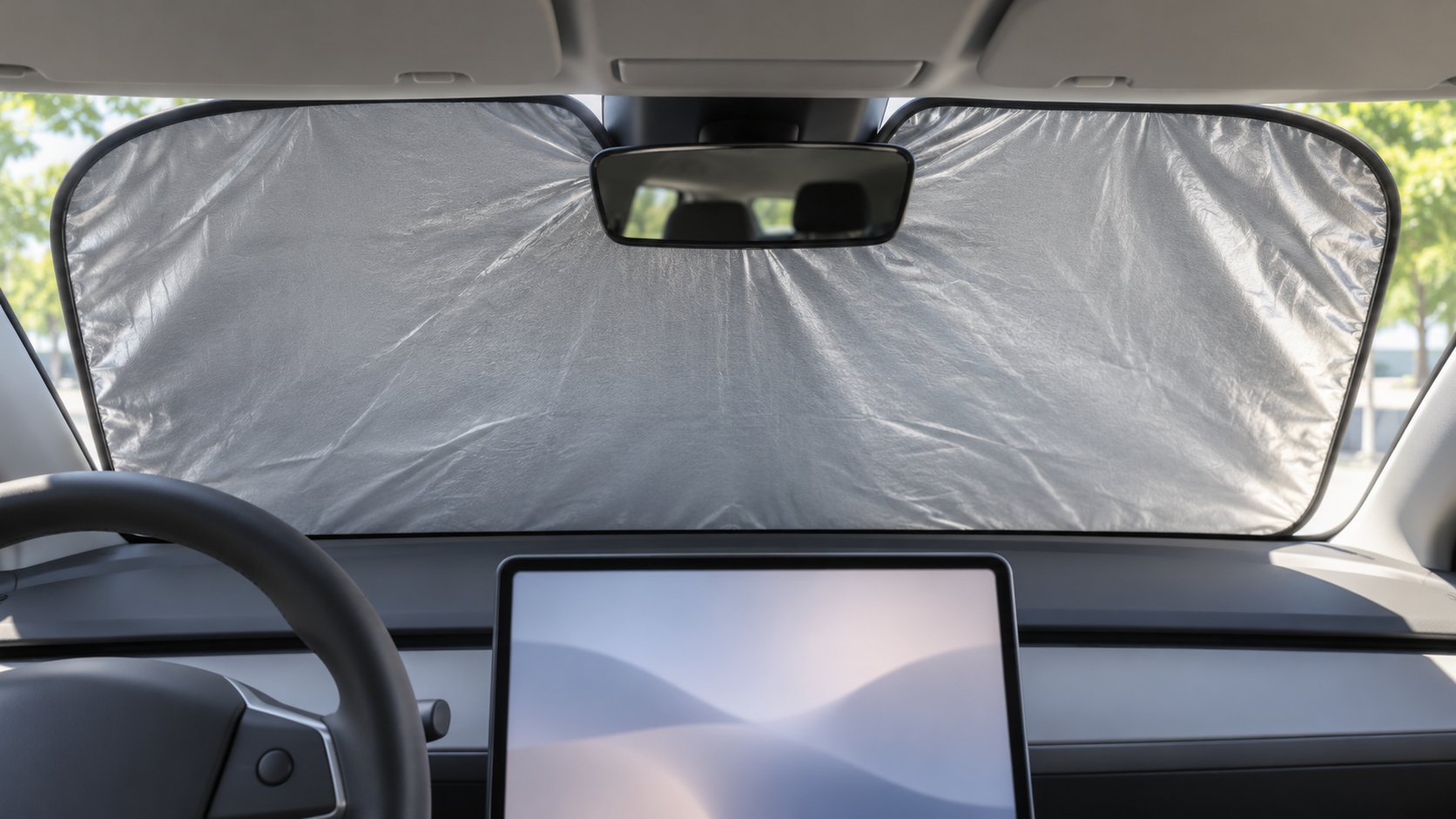
Tesla's forward cameras sit in a housing behind the windshield, near the rearview mirror. The Model Y owner's manual warns that even worn wipers can reduce visibility for these front windshield cameras. A Tesla front windshield sunshade has to fit around that housing without pressing on it or leaving a wide gap. Whether you're fitting a Tesla windshield sunshade on a Model 3 or a Model Y, check the listing photos for a cutout, notch or shaped edge at the mirror. If the photos only show the shade from outside the car, ask the seller how it sits around the cameras.
Sentry Mode and Dashcam While Parked
With Sentry Mode on, the car's cameras stay powered and ready to record whenever the car is locked and in Park. Tesla's Sentry Mode instructions note that footage saves to a USB drive and that Dashcam must be on for Sentry Mode to work. An interior shade sits between the forward cameras and the street, so the front footage will probably show the back of the shade. If Camera-Based Detection is on, Sentry also uses the external cameras to spot events, so it may miss more activity in front of the car. To find out for sure, put the shade in, save a Dashcam clip and watch it.
Cabin Overheat Protection, Preconditioning and Defrost
Cabin Overheat Protection runs the climate system while the car is parked to keep the cabin from getting too hot. Settings such as Keep Climate On also keep the climate system running in Park. A shade works alongside these features and doesn't replace them. The shade keeps direct sun off the dash and seats, and the climate system controls the air temperature.
In winter, an exterior cover keeps frost and snow off the glass overnight. Preconditioning from the Tesla app warms the cabin before you leave, and defrost clears whatever the cover missed. If you're using an interior shade in cold weather, take it out before you drive.
Wiper Service Mode for Exterior Covers
Wiper Service Mode moves the wipers into a service position. The Model Y manual has you shift into Park and turn off the wipers before you turn the mode on. The exact menu path can differ by model and software version, so look it up in your manual. With the wipers in the service position, it's easier to tuck the edge of an exterior cover under them. The manual warns that wiper arms don't lock when lifted, so don't lift them past their intended position. Turn the mode off afterward so the wipers go back to their normal position.
- Forward cameras: The shade has to fit around the camera housing. Check the listing for a mirror cutout.
- Sentry Mode and Dashcam: An interior shade will likely block the front view. Test it by saving a clip.
- Cabin Overheat Protection and Keep Climate On: The shade blocks sun, and the climate system still cools the air.
- Preconditioning and defrost: These work alongside an exterior cover. An interior shade comes out before you drive.
- Wiper Service Mode: This makes the wipers easier to reach when you fit an exterior cover. Lift the arms gently.
The camera housing and the shape of the glass around it may not be the same on every Tesla. That's why a cover's fit has to be checked against your exact model and generation.
Tesla Windshield Cover Fitment by Model and Generation
Have you ever bought a part for your Tesla and found out it was made for the version before yours? This happens a lot with shades and covers. Most pages that rank for this search cover only one or two models, and many don't say which generation they mean. The checks below go model by model, so you can confirm fit from the listing itself. The badge on your car isn't enough to go on.
Model 3 Before and After the Highland Refresh
The refreshed Model 3, known as Highland, may need a different shade than the earlier Model 3. One Tesla accessory fitment guide found that many accessories for the refreshed interior are now sold as a set with the refreshed Model Y, not with the earlier Model 3. The same guide points to older screen protector listings that say they don't suit the refreshed Model 3. A Model 3 sunshade that fit an earlier car might not fit yours. Check that the listing names your generation, either as Highland or with a clear note about which versions it covers.
Model Y Before and After the Juniper Refresh
The Model Y needs the same check. One accessory maker has written about why legacy Model Y sunshades can fail on the refreshed Model Y, known as Juniper. When you shop for a Tesla Model Y Juniper sunshade, look for a listing that names Juniper or the refreshed Model Y. A listing that only says 'Model Y' doesn't tell you which one. Some windshield shades are sold for both Model 3 and Model Y across more than one generation. The fitment guide mentioned above trusts those combined listings only when the page names each model and version it covers.
Model Y L, Model S, Model X and Cybertruck
None of the pages that rank for this search cover these vehicles. Tesla's own Model Y roof shade listing excludes the Model Y L, which shows that sharing a model name doesn't guarantee a fit. If you're shopping for a Tesla Model S sunshade, a Tesla Model X sunshade or a cover for a Cybertruck, look for a listing that names your vehicle. A general 'fits Tesla' claim doesn't count. Model S and Model X have both been updated over the years, so ask the seller which versions the shade was made for.
| Model | Generations to Tell Apart | What to Confirm in the Listing |
|---|---|---|
| Model 3 | Earlier Model 3 and the refreshed Highland | Your generation is named, and photos show the mirror and camera area |
| Model Y | Earlier Model Y and the refreshed Juniper | Your generation is named. Combined Model 3/Y listings name each version. |
| Model Y L | A separate variant from the standard Model Y | Model Y L is named, not just Model Y |
| Model S | Earlier and updated versions | Model S is named, along with the versions it covers |
| Model X | Earlier and updated versions | Model X is named, along with the versions it covers |
| Cybertruck | Ask the seller about any version differences | Cybertruck is named, and the listing says whether it's for interior or exterior use |
Not sure which generation you have? Don't rely on memory or on how the car looks. Your purchase agreement, registration and window sticker list the exact model and trim. The Tesla app and the car's touchscreen show your vehicle details, including the VIN. If a listing is unclear, send the seller your VIN and ask them to confirm the fit in writing.
Knowing your generation tells you what to look for. You still have to judge whether a listing's wording backs up its fit claim, and some fitment phrases are more trustworthy than others.
How to Read a Tesla Sunshade Listing Before You Buy
Have you ever scrolled through a page of Tesla Model Y sunshades where every listing promised a perfect fit? Before you pay, the listing is your only evidence. Reading it closely can save you a return. Some fitment wording gives you details you can check, and some gives you none.
Fitment Phrases You Can Trust
A trustworthy listing names the exact model, the generation and any exclusions. A line such as 'for the refreshed Model Y (Juniper), not for Model Y L' gives you something to compare against your car. Phrases like 'fits Tesla' or 'fits all Model Y' don't. A broad range can mean the shade was cut for one version and is being sold for several. If a sunshade for Tesla Model Y doesn't say which Model Y it fits, treat the fit as unconfirmed until the seller answers in writing.
What Combined Model 3 and Model Y Listings Mean
Combined listings are common. T Sportline sells one windshield shade labeled for both Model 3 and Model Y, and a Tesla Model 3/Y side window sunshade is often sold the same way. A combined label can be accurate, but the page should back it up. Look for a separate note on each model, a compatibility statement from the seller and any generation exclusions. Read the current product copy, because sellers revise these notes when new versions come out. If one set of photos covers two cars, ask the seller which car is shown.
Reading Luminous Transmittance Figures
Some listings give a luminous transmittance figure. It describes how much visible light passes through a material, weighted toward the colors the human eye sees as brightest. The scale runs from 0%, where no light passes through, to 100%, where all of it does, so a lower figure means less light gets through. A lens maker's guide to luminous transmittance explains that 'density' is roughly 100 minus this figure, so 75% transmittance works out to about 25% density. The guide also notes that density has no standard definition. Two sellers who both say their shade 'blocks' a percentage of light may not be measuring it the same way.
The figure also covers only visible light. It doesn't measure heat. Use it to compare glare and brightness, and don't read it as a promise of a cooler cabin.
A Six-Point Listing Checklist
- Exact model named: The listing says Model 3, Model Y, Model Y L, Model S, Model X or Cybertruck, not just 'Tesla.'
- Generation named: It names Highland, Juniper or the earlier version, or clearly states which versions it covers.
- Interior or exterior use stated: A summer shade and a snow cover are different products.
- Mirror and camera area shown in photos: Look for a cutout or shaped edge around the camera housing.
- Seller compatibility notes and exclusions read: Check the fine print and the customer questions for versions the seller rules out.
- Storage method described: The listing says how the shade folds and whether a bag or tote comes with it.
A listing can pass all six checks and still leave you choosing between sellers. Tesla's shop, custom-fit brands, direct sellers and marketplaces each handle fit their own way, and that changes how much a listing can promise.
Comparing Tesla Sunshade Buying Channels and Shade Options
Imagine you find two shades with nearly the same photos. One is on a brand's own site and the other is on a marketplace. The product may look the same, but the place you buy it changes how fit is described and who answers your questions. Some channels don't sell a windshield product at all. The table below compares the main options. Sellers revise their pages, so read each current listing before you order.
| Option | Channel | What It Covers | How Fit Is Handled | Storage | What to Check |
|---|---|---|---|---|---|
| CUTIM dual-layer windshield sunshade | Direct brand | Windshield on Model 3 and Model Y. Interior use while parked. | Separate selections for each vehicle generation | Foldable | Pick the selection that matches your generation. Remove before driving. |
| Tesla glass roof and rear liftgate shades | Tesla's official shop | Glass roof and rear liftgate, not the windshield | Listed by model, with exclusions such as the Model Y L on the Model Y roof shade | Mesh on a collapsible frame that folds down | The listing names your model and generation |
| Covercraft UVS100 custom sunscreen | Custom-fit brand | Windshield | Made for a specific year, make and model | Folds. Optional storage bag. | Possible small gaps at the mirror and sides |
| T Sportline reflector windshield shade | Tesla accessory retailer | Windshield | One shade labeled for both Model 3 and Model Y | Comes with a tote | Notes for each model and any generation exclusions |
| Amazon marketplace listings | Marketplace | Varies: windshield, roof, side window and exterior snow covers | Varies by seller | Varies by seller | Generation named, mirror-area photos, seller answers |
Direct Brand Windshield Shades
When you buy from a direct brand, the maker's own product page is the listing, so you can check fit claims against the company that made the shade. CUTIM's dual-layer windshield sunshade for Model 3 and Model Y has separate selections for each vehicle generation. That lines up with the fitment checks earlier in this guide: confirm your generation from your documents or the Tesla app, then choose the matching selection. The shade folds, so you can store it in the car between uses.
Official, Custom-Fit and Marketplace Options
Tesla's shop is the place to look for a Tesla glass roof sunshade. You'll still need a separate windshield shade. Covercraft makes its sunscreens for specific vehicles, so confirm that your Tesla model and generation are on the list. T Sportline's combined Model 3 and Model Y label calls for the combined-listing checks from the previous section. Marketplaces have the widest range. Search Amazon for a Tesla sunshade for Model 3 and you'll see windshield shades, roof shades, side window sets and snow covers on the same page. Fit and quality vary by seller, so run each listing through the six-point checklist.
Pros and Cons of an Interior Windshield Shade
A Tesla Model 3 windshield sunshade and a Model Y sunshade have the same strengths and the same limits. That's true of every interior shade, CUTIM's included.
Pros
- Keeps direct sun and glare off the dash, steering wheel and front seats while the car is parked.
- Works alongside Cabin Overheat Protection and doesn't replace it.
- Folding designs stow inside the car.
- Generation-specific selections make fit easier to confirm before you buy.
Cons
- Works inside the car only, and you must take it out before you drive.
- Doesn't protect against snow or ice. Winter needs a separate exterior cover.
- Sits in front of the forward cameras while it's in place, so front Sentry Mode and Dashcam footage will likely be blocked.
- Takes up cabin space when it's stowed.
Whichever channel you choose, the shade will come in and out of the car many times each season. How you clean, dry and fold it affects whether it still sits flat next summer. Exterior covers need even more care after a night of snow.
Cleaning, Drying and Storing Your Tesla Window Cover
When you pull a cover off on a cold morning, do you shake it out or throw it in the trunk and drive off? That habit affects whether the cover protects your glass or scratches it. None of the pages ranking for this search cover care, so this section gives simple routines for exterior covers and interior shades.
Keep Grit Off an Exterior Cover
The fabric itself rarely causes the damage. A car cover removal guide explains that most scratches come from grit trapped between the cover and the surface. If you drag the cover sideways, that grit rubs across glass and paint like sandpaper.
- Brush loose snow, leaves and dirt off the top before you unhook anything.
- Undo the door flaps, mirror loops or straps first so you don't have to tug the cover sideways.
- Lift the cover straight up and off. Don't slide it across the glass or the hood.
- Carry it a few steps away from the car before you shake it out, so the debris doesn't land back on the car.
Removing a Cover After Snow or Ice
A cover that has frozen to the glass needs time to come loose. The same guide warns that yanking a frozen cover off paint can pull clear coat away with it, and pulling hard can tear the fabric too.
- Let the cover loosen before you pull. Wait for a partial thaw, or run defrost or preconditioning for a few minutes so the glass warms up.
- Fold the edges in toward the center so the snow stays inside the cover.
- Keep ice scrapers away from the fabric. Use them on bare glass only.
- If your cover came with removal instructions, follow those first.
Dry Before You Store
A wet cover stays wet once it's folded into a bag. A cover left damp and balled up grows mildew quickly. One sunshade folding guide warns that folding a shade while it's damp traps moisture and can cause mildew within days.
- Shake off water and snow outside the car.
- Hang the cover or lay it flat indoors until both sides are dry.
- Store it in a breathable bag. Don't leave it crumpled on the garage floor.
Folding a Reflective Shade So It Keeps Its Shape
A Tesla sun shade with a wire frame can kink, and its reflective layer can crease for good if you fold it the wrong way. The folding guide traces most of this damage to forcing the fold or storing the shade under something heavy.
- Let a hot shade cool for a minute first. The reflective layer is softest when it's hot, so folding it then can leave creases.
- Follow the fold pattern the shade was made for, whether it twists into loops or folds into panels along set lines.
- Hold the fabric edge, not the wire. If the frame resists, stop and start again.
- Put the shade back in the pouch or tote it came with, such as the tote T Sportline lists with its reflector shade. Check the current listing to confirm it's still included.
- Store the shade flat and out of the footwell, with nothing heavy on top.
Your care routine depends on which cover you own. If you park in hot summer sun and also wake up to frost in January, you may end up caring for two products. Your climate decides which ones you need.
Matching the Right Tesla Window Shades to Your Climate and Car
Where do you park, and what bothers you most when you come back to the car? A cabin that bakes in a sunny lot needs a different fix than a windshield buried in frost. Start with the problem you have. Then match it to the right pane of glass and the right season.
Choosing by Season and Problem
- Summer heat and glare on the windshield: Use an interior windshield shade. It goes in when you park and comes out before you drive.
- Frost, ice and snow on the windshield: Use an exterior windshield cover. Most covers tuck their end flaps inside the closed doors, and some add straps for windy spots.
- Heat and glare through the roof: Use a glass roof shade. If you're shopping for a Tesla Model Y roof sunshade, pick the version made for your generation. Some roof shades are sold in separate versions for the earlier Model Y and Juniper, and Tesla's own listing excludes the Model Y L.
- Hot summers and snowy winters: Plan on two products. An interior shade can't keep snow off the outside of the glass, and an exterior snow cover is made for winter weather.
An Interior Option for Model 3 and Model Y
Whichever brand you look at, a Tesla sunshade for Model Y or Model 3 should name your generation and show the mirror area in its photos. For summer windshield coverage while you're parked, CUTIM's dual-layer windshield sunshade for Model 3 and Model Y is one option, with separate selections for each vehicle generation and a design that folds for storage between uses. Like any interior shade, it must come out before you drive, and it doesn't replace an exterior snow or ice cover.
After the shade arrives, test it with your car. Save a Dashcam clip with the shade in place and watch it, so you know what Sentry Mode can still see while you're away.
Before you buy, confirm your model and generation, decide whether you need interior or exterior use, and check how the cover works with your car's forward cameras, Sentry Mode and climate features.
Tesla Windshield Cover FAQs
1. Is a Tesla windshield cover the same as a windshield sunshade?
Not always. Sellers use the name for two different products. An interior windshield sunshade fits against the inside of the glass and keeps sun and glare off the dash, steering wheel and front seats while the car is parked. An exterior windshield cover goes over the outside of the glass, so snow, ice and frost land on the fabric and not on the windshield. Both come off before you drive, but each one handles a different season. If you get hot summers and snowy winters, you will probably need one of each, because neither product can do the other's job.
2. Does Tesla sell a windshield sunshade on its official shop?
The sunshade listings on Tesla's official shop that show up for this search are made for the glass roof and the rear liftgate, not the windshield. They use mesh fabric on a frame that folds down. A roof shade won't keep sun off the dashboard. For windshield coverage you need a separate product, which you can get from a custom-fit brand, an accessory retailer, a marketplace seller or a direct brand. Tesla changes its accessory lineup over time, so check the current product pages before you decide.
3. Will a sunshade block Sentry Mode or Dashcam footage?
It will most likely block the front view. Tesla's forward cameras sit behind the windshield near the rearview mirror, so an interior shade ends up between those cameras and the street. Front recordings may show only the back of the shade, and camera-based detection may catch less activity in front of the car. A windshield shade doesn't cover the side or rear cameras. To test it, install the shade, save a Dashcam clip and play it back. That shows you what the car can still see while you're away.
4. Will a Model 3 or Model Y sunshade fit the Highland or Juniper refresh?
Don't assume it will. The refreshed Model 3 (Highland) and the refreshed Model Y (Juniper) may need different shades than the earlier cars. A shared model name doesn't guarantee fit either, since Tesla's own Model Y roof shade excludes the Model Y L. Confirm your generation from your purchase agreement, registration, window sticker or the vehicle details in the Tesla app. Then choose a listing that names that generation. CUTIM's dual-layer windshield sunshade for Model 3 and Model Y, for example, has a separate selection for each vehicle generation and folds for storage between uses. Like any interior shade, it must come out before you drive, and it doesn't replace an exterior snow or ice cover.
5. How do I put an exterior snow cover on a Tesla without damaging the wipers or glass?
Start with clean glass so no grit gets trapped under the fabric. Wiper Service Mode moves the wipers into a service position, which makes it easier to tuck the edge of the cover under them. Your owner's manual gives the exact menu steps for your model and software version. It also warns that lifted wiper arms don't lock, so handle them gently. Secure the cover with its door flaps, mirror loops or straps. More anchor points generally hold better in wind. In the morning, let a frozen cover loosen before you pull it, fold the edges inward to keep the snow inside, and lift the cover straight off without dragging it. Let it dry fully before you store it, and turn Wiper Service Mode off when you're done.