
How Far a Tesla Actually Goes on a Full Charge
Are you planning a weekend getaway or a long daily commute in a new EV? The first thing you'll want to know is how far a Tesla will go on a full charge. Tesla range covers a fairly wide spread, and the figure that applies to you depends on which model and trim you drive.
The Short Answer to Tesla Range
A new Tesla can travel about 294 to 410 miles on a full charge, based on EPA estimates for the 2026 U.S. lineup. The Model Y Standard All-Wheel Drive is at the low end with 294 miles. The Model S All-Wheel Drive leads with 410 miles, according to 2026 spec data compiled by CarBuzz. Most other trims of the Model 3, Model Y, Model X, and Cybertruck are rated between about 305 and 370 miles. Tesla has announced that Model S and Model X production is ending, so new examples of the longest-range sedan may be hard to find. Used Teslas from earlier years can carry different ratings.
Why the Range Question Is More Complicated Than It Seems
So how many miles does a Tesla last in everyday driving? The EPA number is a starting point, and it doesn't guarantee what you'll get. In the EPA's range test, each vehicle runs on a lab dynamometer until the battery is empty. The agency then typically multiplies the result by 0.7 to account for air conditioning, cold temperatures, and faster, more aggressive driving. That correction gets the estimate closer to real life, but it can't reflect your own commute, climate, or highway speed.
This explains why owners give such different answers when someone asks how long does the Tesla charge last. Most of the difference comes from these factors:
- Temperature: Cold weather reduces the energy the battery can deliver, and heating the cabin draws more power.
- Speed: Highway cruising uses more energy per mile than city driving.
- Tire pressure: Underinflated tires increase rolling resistance.
- Battery age: Tesla battery life determines how much capacity is left after years of charging.
Commuters, road-trippers, and first-time EV buyers all need more than one headline number to plan around. Even within a single model, the trim you choose can change the rating by 50 miles or more. That is why the next step is comparing every trim side by side.
Tesla Range by Model and Trim Compared
Are you comparing two Teslas that look almost the same? Their range figures can still be dozens of miles apart. Trim level, the number of motors, and even wheel size all affect how far a Tesla goes on one charge. The model name alone won't tell you the number.
Full Tesla Lineup Range and Battery Specs
If you search how far can Tesla go on full charge, you'll get a pile of different numbers, and the table below shows where they come from. The Model Y figures are Tesla's own estimates, compiled by Edmunds. The Model 3 figures come from Notebookcheck. Tesla doesn't publish battery size or efficiency for every trim. A dash means the figure isn't confirmed in our sources, so check the EPA window sticker or fueleconomy.gov before you buy. Fueleconomy.gov lists efficiency in kWh/100 mi, and 25 kWh/100 mi works out to 250 Wh/mi.
| Model/Trim | Battery Pack Size (kWh) | EPA-Rated or Tesla-Estimated Range (miles) | Estimated Real-World Range (miles) | Energy Efficiency (Wh/mi) |
|---|---|---|---|---|
| Model Y (base RWD), 18-inch wheels | - | 321 | - | - |
| Model Y Standard (RWD), 19-inch wheels | - | 303 | - | - |
| Model Y Premium RWD (formerly Long Range RWD), 19-inch | - | 357 | - | - |
| Model Y Premium RWD, 20-inch | - | 344 | - | - |
| Model Y Premium AWD (formerly Long Range AWD), 19-inch | 79* | 327 | - | - |
| Model Y Premium AWD, 20-inch | 79* | 303 | - | - |
| Model Y Performance, 21-inch | - | 306 | - | - |
| Model 3 Performance (latest update) | - | 316 (EPA, up from 309) | - | - |
| Model 3 Long Range RWD (2024 launch) | - | 363 (advertised) | 408 in one independent drive | - |
*Battery size reported for a 2025 Model Y Premium AWD tested by Enhance Auto. Verify all figures at the time of purchase, because Tesla updates specs during the model year.
RWD vs. AWD Range Differences
Look at the Model Y Premium on 19-inch wheels. The rear-wheel-drive version is rated at 357 miles and the all-wheel-drive version at 327. The body and trim level are the same, yet the gap is 30 miles.
The difference is mechanical. The AWD car adds a second motor at the front, which means more weight and more drivetrain parts to turn. In ordinary driving the rear motor still does most of the work, but the car carries the front motor everywhere it goes. Enhance Auto estimates that a RWD Model Y can deliver up to about 5% more range than an equivalent AWD version in real use. The exact gap depends on wheels, weather, and driving style.
So which drivetrain makes sense for you?
- Choose RWD if you mostly drive on maintained roads in a mild climate. It costs less and goes farther on each charge. Edmunds recommends the Premium RWD as the best mix of features and range for the price.
- Choose AWD if you regularly drive in snow or ice or on steep hills. The front motor can send torque to the front wheels when the rear tires start to slip.
Tires matter as much as motors. Enhance Auto notes that good winter tires on a RWD car can be more useful in snow than the wrong tires on an AWD model.
How Tesla Range Has Evolved Across Refreshes
A Tesla model name doesn't lock in a fixed spec. In a recent North American update, the Model 3 Performance's EPA range rose from 309 to 316 miles, and Tesla announced no mechanical change. The entry-level Model Y was renamed partway through the year and went from 303 to 321 miles, mainly because it switched to smaller 18-inch wheels. Tesla also renamed its Long Range trims to Premium, so a used listing and a new one can describe similar cars under different names.
If you're shopping used against new, check the production date, the trim name the car was sold under, and the wheel size. Notebookcheck advises buyers with pending orders to check their build sheet, because delivery timing can decide which hardware they receive. Ask how many miles a Tesla will last on one charge, and the accurate answer starts with which version and when it was built.
Every number in the table also comes from standardized testing or Tesla's own estimates. A 70-mph winter commute puts the car through very different conditions.
EPA-Rated Range vs. Real-World Driving Range
Have you ever watched your Tesla's range estimate drop faster than the odometer climbs? That's normal. Ask what is the range on a full charge, and the window sticker gives one answer while your trip meter gives another. The sticker number comes from a lab. Your drive happens on real roads with wind, hills, and traffic.
How EPA Range Testing Works
In the EPA range test, a fully charged car runs on a dynamometer through repeated city or highway cycles until the battery is empty. The lab is climate-controlled, with no headwind or rain. The EPA then reduces the lab distances, usually with the 0.7 factor, and blends them into one figure weighted 55% city and 45% highway.
If most of your miles are steady 70 mph cruising, your driving doesn't match that mix, so the sticker will often look optimistic. To compare efficiency, look at the label's energy consumption figure in kWh/100 mi, where lower is better. The EPA includes charging losses in that figure, so it reflects the energy you actually pay for at the outlet. Range alone can mislead, because a bigger battery can post a big number even in a less efficient car.
What Independent Range Tests Reveal
Independent testers check the lab results on public roads. For its EV Range Test, Edmunds charges each car to 100%, sets the tires to factory pressure, and runs the climate control at 72 degrees. Its drivers follow a loop that is 60% city and 40% highway in Southern California, staying within 5 mph of posted limits. With that gentle, city-heavy style, Edmunds' results often beat EPA estimates, though not always. Gentle driving like this is how the Model 3 Long Range RWD in the previous section covered 408 miles on a 363-mile rating.
Tests at sustained highway speed, like those run by InsideEVs and YouTuber Bjorn Nyland, often come in below the EPA rating. Edmunds itself notes that EVs get less efficient as speed rises. So how far can a Tesla go on a full charge when you're the one driving? Edmunds says neither its figure nor the EPA's is right for everyone, because weather, driving style, passengers, and cargo all change the result.
Treat real-world range as a planning floor: build your trips around the lower figure from your own driving and count any extra miles as a cushion.
Tesla's Energy App as a Real-Time Range Tool
The most reliable answer to how long does a fully charged Tesla last on your own routes comes from the car itself. Tesla's range tips point owners to the Energy app on the touchscreen. The app tracks consumption as you drive and projects remaining range from your recent driving instead of the rated figure. Its consumption view splits energy use into categories:
- Driving: energy used to move the car, which depends on speed and acceleration.
- Climate: heating or cooling the cabin.
- Elevation: energy spent climbing hills, minus what regenerative braking recovers on the way down.
- Battery conditioning: warming the battery pack in cold weather or before charging.
Imagine your range drops on a January commute you drive every day. One look at the app shows whether the extra energy went to cabin heat or battery warming, or whether you simply drove faster. Each category responds to different conditions, and some of those conditions cost far more range than others.
What Affects How Far Your Tesla Can Travel
Why does the same car show plenty of range in May and much less in January? The battery is the same size in both months. The difference is how much energy each mile costs. A handful of variables decide how far the Tesla goes on one charge, and you can control several of them.
Speed, Climate, and Driving Style
Speed has the biggest effect on the highway. Air resistance grows with the square of speed, so going from 65 to 80 mph adds about 50% more aerodynamic drag to every mile. Highway driving also gives regenerative braking little to do, because you rarely slow down. Recurrent estimates that EVs get about 15-25% better mileage in the city than on the highway, which is the reverse of a gas car.
Climate control is the next big draw on the battery. A gas car heats its cabin with waste heat from the engine. A Tesla has no spare engine heat, so cabin heat, seat heaters, and the defroster all run on battery power. Air conditioning uses battery power too, although Consumer Reports got its longest range on sunny summer days in the mid-80s, with the A/C running.
Driving style matters as well. Hard acceleration uses more power. Hard braking pushes more of the stopping work onto the friction brakes, which turn that energy into heat instead of sending it back to the battery.
Terrain, Cargo, and Passenger Load
Climbing a hill means lifting the car's full weight, and that takes a lot of energy. Regenerative braking recovers some of it on the way down, but some is lost in the conversion. As a result, a hilly route that starts and ends at the same elevation still uses more energy than a flat one. Passengers and cargo add weight that the motors have to accelerate and carry uphill, so each extra load cuts range a little. Consumer Reports lists hills, cargo, passengers, speed, traffic, and climate settings among the factors that change EV range.
How OTA Software Updates Can Change Your Range
Tesla can change your car's range without touching the hardware. In its 2020.40.7 software update, Tesla raised the range of existing Model Y vehicles by making the motors and the climate control system more efficient, as Electrek reported. One Model Y Long Range owner saw his range rise to 320-325 miles, which matched the new 325-mile rating that replaced 316 miles. In 2019, Tesla added 15 miles of range to some Model 3 vehicles the same way.
Software updates can move the number in either direction. Battery management and the range calculation both run in software, so an update can also lower the figure on your screen. If your displayed range jumps or drops right after an update, read the release notes before you conclude that the battery itself has changed.
Seasonal Range Variation
Cold weather reduces range in two ways. The first is chemistry. Low temperatures slow the reactions inside lithium-ion cells and raise their internal resistance, so the battery can deliver less of its stored energy and deliver it more slowly. The second is that the car spends energy heating the cabin and keeping the battery warm. Consumer Reports' testing shows how large the effect can be:
- Around 40 degrees F: range starts to drop.
- About 16 degrees F at 70 mph: roughly 25% less range than in the same driving in the mid-60s.
- Short winter trips with frequent stops: up to 50% less range, because the cabin has to be reheated after every stop.
In Tesla miles per kWh, the gap looks like this. Recurrent lists the Model 3 at 25 kWh/100 mi based on EPA data, which works out to about 4 miles per kWh. On a 100-mile highway loop on single-digit days, the trip meter in Consumer Reports' Model 3 Long Range AWD showed 2.7 miles per kWh. When the car was preconditioned while still plugged in, efficiency rose to 2.9 miles per kWh, and the car projected 10 more miles of remaining range.
National averages only go so far. The range for a Tesla in your own winter depends on your local temperatures and routes. Check the Energy app to see how much of each cold trip goes to climate and battery conditioning. Range lost to winter comes back when the weather warms up. Range lost as the battery ages does not come back.
How Many Miles Does a Tesla Get as It Ages?
Imagine you're looking at a used Tesla with 80,000 miles on the odometer. Will it still match the range on its original sticker? Probably not quite. Every lithium-ion battery loses some capacity with age. Owner data shows that Tesla packs lose less, and more slowly, than many buyers expect.
What Happens to a Tesla Battery Over Time
Battery capacity fades in two main ways. Calendar aging happens as time passes, even while the car sits parked, and it speeds up when the battery stays at a high charge level in hot weather. Cycle aging comes from the wear of charging and discharging. Tesla Battery Check notes that a full 0-100% cycle stresses the cells more than a shallow 30-80% one.
Tesla's thermal management system keeps the cells within a safe temperature range. The charge limit slider steers owners away from the extremes with a "Daily" band and a separate "Trip" setting for 100%. Tesla also backs the pack with its Battery and Drive Unit Limited Warranty, which guarantees at least 70% capacity retention over the warranty period:
| Model/Trim | Coverage (whichever comes first) |
|---|---|
| Model S, Model X, Cybertruck | 8 years or 150,000 miles |
| Model 3 RWD, Model Y RWD, Model Y AWD | 8 years or 100,000 miles |
| Model 3 Premium RWD/AWD, Model 3 Performance, Model Y Premium RWD/AWD, Model Y Performance, Model Y L Premium Launch Series | 8 years or 120,000 miles |
Coverage can differ for older cars, depending on when they were bought, so check the warranty that came with your vehicle. For a Model Y Premium RWD rated at 357 miles, the 70% floor works out to about 250 miles. Most packs stay well above that.
Real Owner Data on Range Loss at Key Milestones
Autoblog reviewed data from thousands of high-mileage owners and third-party trackers such as Geotab and Recurrent, and the results follow a clear pattern:
- First 20,000 miles: an initial capacity loss of about 3-5% as the battery settles in.
- After that: degradation slows down considerably.
- At 200,000 miles: most high-mileage Teslas keep about 85-88% of their original capacity.
Most of that early drop comes from growth of the SEI layer, a thin film that forms on the anode during the car's first year or two. As a result, Tesla Long Range mileage holds up well. A car rated at 357 miles would land at roughly 340-346 miles after the early dip and about 303-314 miles at 200,000 miles. So how many miles does a Tesla get after 200,000 miles? For this example car, the rated figure is still above 300 miles, although your real-world range will be lower, as earlier sections explained.
Most measurable range loss happens in roughly the first 20,000 miles, and the battery then settles into a much slower decline.
Daily Habits That Preserve Battery Health
Most commutes use a small share of the pack, so how long a Tesla battery lasts in a day rarely matters. The charge level the car sits at, and for how long, matters more. Owners who search "why is my Tesla set to 80 charge" are usually looking at the Daily band on the charge limit slider. On Long Range and Performance cars with NCA or NMC cells, that band tops out around 80-90%.
- Keep a moderate daily limit: On NCA/NMC cars, charge to about 80% or lower. Save 100% for road trips, and charge to it shortly before you leave.
- Follow Tesla's LFP guidance: The Standard Range Model 3 from 2021 onward and the Standard Range Model Y from 2022 onward use LFP cells. Tesla recommends charging these to 100% at least once a week so the battery percentage stays accurate. Check which chemistry your car has before you pick a daily limit.
- Charge at home when you can: Frequent DC fast charging produces heat, and over the years that heat stresses the cells. Supercharging all the way to 100% adds high-charge stress on top of the heat. Slower Level 2 charging at home to a moderate limit is gentler on the pack.
- Avoid parking at the extremes: Leaving the car at 100% or below 10% for long periods strains the cells, and letting it sit near 0% does the most damage. For storage of several weeks, aim for about 50-60%.
- Keep the car cool in summer: Park in the shade or a garage during heat waves. Cold weather cuts range only temporarily and causes very little lasting degradation, while heat causes permanent wear.
Charging slowly at home is easier on the battery, and it is usually the cheapest way to charge. Your home electricity rate is the starting point for working out what each full charge costs.
The Real Cost Per Mile of Driving a Tesla
When you plug in at night, what does a full battery actually cost? It depends on two numbers. The first is your Tesla battery capacity, measured in kilowatt-hours (kWh). The second is the price your utility charges for each kWh.
Calculating Your Cost Per Full Charge
The formula is simple:
Battery capacity (kWh) x electricity rate ($/kWh) = cost per full charge
Your rate is printed on your utility bill. For a national baseline, the U.S. Energy Information Administration reports an average residential price of 18.16 cents per kWh for August 2026. Prices vary widely by state. Across all customer types, North Dakota averaged 8.91 cents per kWh and California averaged 29.02 cents, the highest in the contiguous U.S. The table below applies those rates to the Model Y Premium AWD from the earlier spec table.
| Model | Usable Battery Capacity (kWh) | Example Electricity Rate | Estimated Cost Per Full Charge |
|---|---|---|---|
| Model Y Premium AWD | 79* | 8.91 cents/kWh (North Dakota) | About $7.04 |
| Model Y Premium AWD | 79* | 18.16 cents/kWh (U.S. residential average) | About $14.35 |
| Model Y Premium AWD | 79* | 29.02 cents/kWh (California) | About $22.93 |
| Your Tesla | Your pack size | Rate on your bill | Capacity x rate |
*This is the reported battery size for a tested 2025 car, and Tesla doesn't confirm usable capacity for every trim. Some energy is lost as heat during charging, so your meter will record slightly more than the pack holds. You also rarely charge from 0% to 100%, so a typical nightly top-up costs much less than these figures.
Cost Per Mile Compared to Gasoline
To find your cost per mile, divide the cost of a full charge by the range you actually get. At the national average rate, $14.35 spread over the full 327-mile rating comes to about 4.4 cents per mile. If winter highway driving cuts your real range to 250 miles, the same charge works out to about 5.7 cents per mile. A full charge lasts fewer miles in winter, so each mile costs more.
For a gasoline car, divide the price per gallon by the car's MPG. Portsmouth Ford gives an example of a 25 MPG car with gas at $3.50 a gallon, which works out to 14 cents per mile. The same source puts a typical EV that uses 0.3 kWh per mile at 3 to 6 cents per mile. Use your local pump price and your car's real MPG to get your own comparison.
Does mileage matter on a Tesla when it comes to running costs? Efficiency matters more. A trim that uses fewer kWh per 100 miles costs less on every trip. Many utilities also offer time-of-use plans with lower overnight rates, and charging on one of those plans gives you the largest savings.
Home Charging vs. Supercharger Economics
Home charging makes up about 80% of EV charging, according to the same Portsmouth Ford analysis. Public fast charging averages $0.30 to $0.50 per kWh. At 0.3 kWh per mile, that comes to 9 to 15 cents per mile, which is about the same as the gas example. Supercharger prices vary by station and time of day, and Tesla shows the rate on the touchscreen and in the app before you plug in.
Road trips cost more for a second reason. A Tesla's top speed doesn't affect your bill, but sustained highway cruising uses more energy per mile than commuting around town. Some of that energy goes to rolling resistance, which you can partly control through your tires.
Tire Pressure and Maintenance Tips That Protect Your Tesla Mileage
When did you last check your tire pressure? If the answer is "when the warning light came on," you may be losing range on every drive. So how far does a Tesla go on a single charge when its tires are soft? It goes less far than it should. Tires are one of the few range factors you fully control, and keeping them in shape costs almost nothing.
Why Tire Pressure Matters More in an EV
An underinflated tire flexes more each time it rolls. That extra flexing raises rolling resistance, so the motors pull more energy from the battery for every mile. Michelin notes that every PSI below the recommended pressure adds rolling resistance and cuts range.
The effect is larger in a Tesla than in a gas car. A gasoline engine loses a lot of energy as heat and friction, so tire losses make up a small share of the total. An electric drivetrain loses very little, which leaves rolling resistance as a much bigger share of the energy the car uses. Ask how far can a Tesla go on one charge, and part of the answer depends on the air in your tires.
Inflate to the PSI on the driver's door jamb sticker, not the maximum printed on the tire sidewall. Don't wait for the tire pressure warning either. Michelin points out that the tire pressure monitoring system (TPMS) only alerts you after pressure has dropped significantly, which is well past the point where range starts to suffer.
Building a Simple Tire-Care Checklist
- Check pressure monthly and before long trips. Measure when the tires are cold, before you drive. Pressure falls in cold weather and rises after driving, so a reading taken after a drive can trick you into letting out air you need.
- Inspect tread depth and wear patterns. Uneven wear can point to an alignment problem. Worn tires roll slightly more easily, and Michelin cites studies showing about 6% better range than new tires, but safety comes first. Replace tires when they're worn, and expect a small, temporary dip in range after new ones go on.
- Rotate on schedule. Tesla recommends rotating every 6,250 miles, or sooner if two tires differ in tread depth by 2/32 inch or more. Even wear keeps rolling resistance consistent across all four tires.
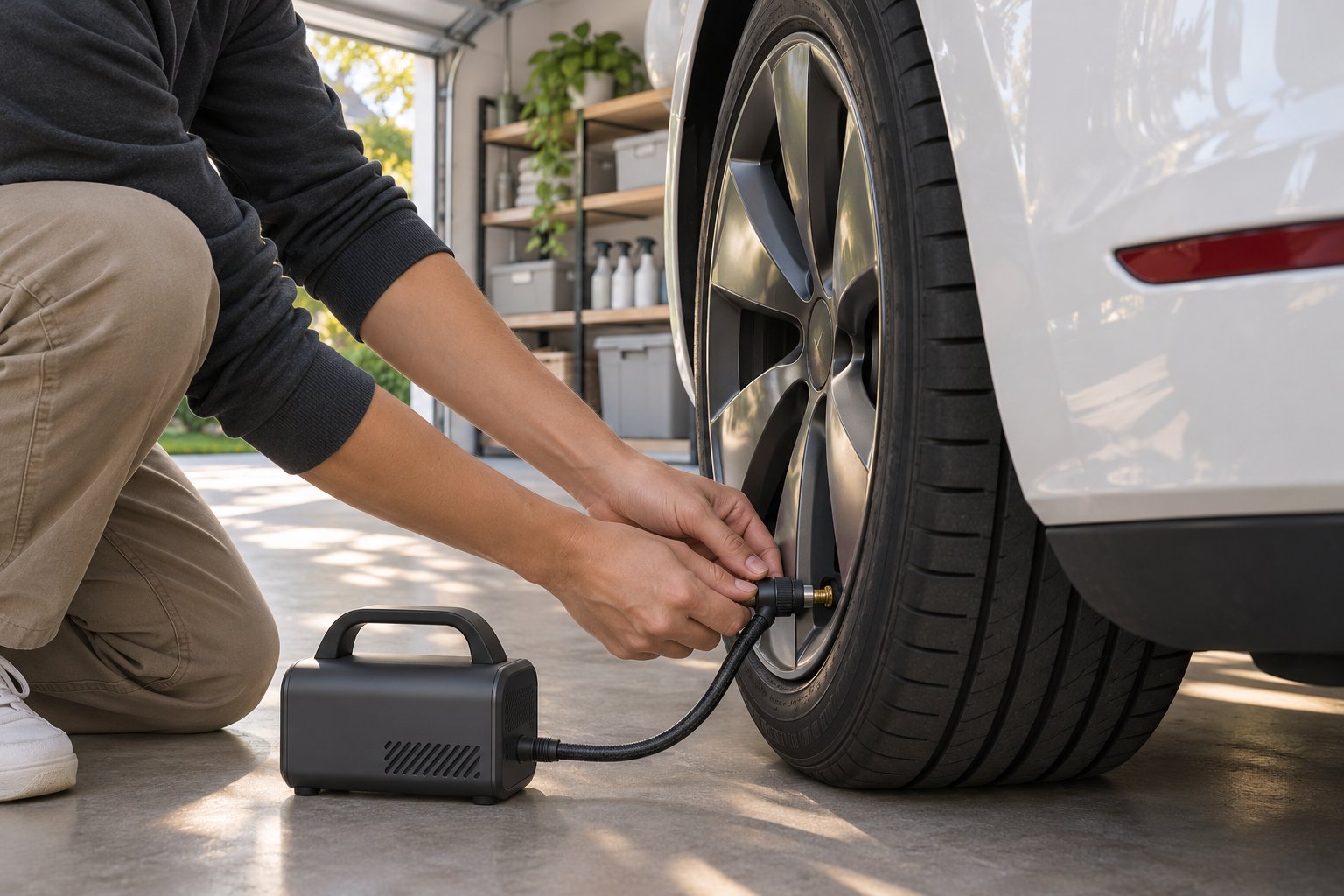
- Keep a portable inflator in the car. With a compact inflator, you can top up at home or at a rest stop instead of hunting for a gas station air pump that works. Commuters and road-trippers can browse options such as CUTIM's portable tire inflators. An inflator handles routine pressure top-ups. It is not a substitute for a spare tire or a proper puncture repair.
After any tire or wheel service, Tesla recommends resetting the tire and wheel configuration on the touchscreen under Controls > Service > Wheel & Tire.
Other Low-Effort Maintenance That Protects Range
- Cabin air filter: Tesla's schedule calls for a new filter every 2 years on Model 3 and Model Y, and every 3 years on Model S and Model X built after 2020. A clogged filter restricts airflow, so the climate system has to run harder. The touchscreen shows when the filter is due under Controls > Service > Maintenance.
- Wheel alignment: Tesla suggests an alignment if your tires wear unevenly, if the car pulls to one side while the steering wheel is held straight, or after a new set of tires is installed.
- Unneeded cargo: Michelin explains that the more weight a tire carries, the more energy it loses as it rolls. Take sports gear and stray boxes out of the trunk when you don't need them.
None of these steps adds much Tesla mile range by itself. Together, they help the car get closer to its rated range on a full battery. On a road trip, though, you'll rarely use the whole battery between stops, and that changes how far each leg can go.
Road Trip Planning
Picture a 600-mile drive to see family. Your Tesla is rated for well over 300 miles, so two legs should be enough. In practice you'll probably stop three or four times, and that is usually the faster plan. On a road trip, the number that matters is how far you get between Supercharger stops. That distance is shorter than the full-charge range.
Usable Range Per Supercharger Stop
You'll rarely leave a Supercharger at 100% or pull in completely empty. Most drivers charge from about 10% to 80%, because charging slows sharply after that. Tesla's Supercharging guide notes that reaching 100% typically takes significantly longer than reaching 80%. At busy sites, the car may also lower your charge limit to 80% automatically.
That leaves about 70% of the battery for each leg. To estimate your own Tesla range miles per stop, multiply your real-world range by 0.7:
- Real-world highway range of 300 miles: 300 x 0.7 = about 210 miles per leg.
- Winter highway range of 250 miles: 250 x 0.7 = about 175 miles per leg.
The first leg works differently. If you leave home at 100% and arrive at the first Supercharger with about 10%, you can use roughly 90% of the car's real-world range on that leg.
How Charge Curve Tapering Affects Trip Time
V3 Superchargers deliver up to 250 kW. In North America, V4 sites also top out at 250 kW for the Model S, 3, X, and Y, while the Cybertruck can take up to 325 kW at V4. A car only draws that peak power when its battery is fairly empty. Charging data for a 2025 Model Y Long Range from EVKX shows how quickly the power drops:
| State of Charge | Charging Power |
|---|---|
| 9% | 245 kW |
| 30% | 159 kW |
| 50% | 103 kW |
| 80% | 45 kW |
| 100% | 13 kW |
Charging this car from 10% to 80% takes about 32 minutes. Going from 80% to 100% takes another 31 minutes. Measured in 70-mph driving, a 10-80% session adds an average of 5.7 miles of range per minute. If you keep charging to 100%, the average falls to 3.7 miles per minute. EVKX puts this car's fastest charging window at 5% to 45%. That is why two short stops often get you there sooner than one long stop.
Charge just enough to reach the next Supercharger comfortably, then get back on the road.
Using Tesla's Built-In Trip Planner
Turn on Trip Planner under Settings > Navigation > Trip Planner. When you enter a destination, it adds Supercharger stops based on your current charge, and the car recommends how much charge you need at each stop to reach the next one. While you navigate to a Supercharger, the car also warms the battery so it can charge faster when you arrive. The owner's manual recommends navigating to the charger for at least 30-45 minutes before you arrive so the battery has time to warm up. This matters most in cold weather.
Let the planner choose your stops, and keep the Energy app open during the drive. If a headwind, rain, or higher speed pushes consumption above the plan, you'll notice early enough to slow down or add a stop. Stopping near 80% also means the pack spends less time at a high charge level. That helps Tesla Model 3 battery life and the life of every other Tesla pack.
So how far will a Tesla go on a full charge? The rated figure is useful for comparing models and estimating your first leg. For the rest of the trip, the mileage range of a Tesla comes down to the roughly 70% of the battery you use between stops and how long you charge at each one.
Frequently Asked Questions About Tesla Range
1. Which Tesla model has the longest range on a full charge?
CarBuzz compiled 2026 U.S. spec data showing the Model S All-Wheel Drive at the top of the lineup with an EPA estimate of 410 miles. The Model Y Standard All-Wheel Drive sits at the bottom with 294 miles. Most Model 3, Model Y, Model X, and Cybertruck trims fall between about 305 and 370 miles. Tesla is ending Model S and Model X production, so new examples may be hard to find. Among Model Y trims, the Premium RWD on 19-inch wheels has the highest rating at 357 miles. The same car on 20-inch wheels drops to 344 miles, so wheel size matters as much as trim. Before you buy, check the exact trim, wheel size, and build date on the EPA window sticker or fueleconomy.gov.
2. Why does my Tesla get less range than the EPA estimate?
The EPA figure comes from a climate-controlled lab test on a dynamometer. The result is reduced, usually by a 0.7 factor, and weighted 55% city and 45% highway. Real roads add conditions the lab leaves out, such as steady 70 mph cruising, headwinds, rain, hills, and cold. Air resistance rises with the square of speed, so each extra mph on the highway costs more energy per mile. Winter reduces range in two ways: cold cells deliver their energy less efficiently, and the car uses power to heat the cabin and the battery. Consumer Reports measured roughly 25% less range at about 16 degrees F at highway speed, and up to 50% less on short winter trips with frequent stops. Underinflated tires and extra cargo also reduce range. To see where your energy goes, open the Energy app. It splits consumption into driving, climate, elevation, and battery conditioning.
3. How much range does a Tesla lose as the battery ages?
Autoblog reviewed owner data and third-party trackers such as Geotab and Recurrent. They show a typical early drop of about 3-5% in the first 20,000 miles, after which capacity fades much more slowly. Many Teslas still hold about 85-88% of their original capacity at 200,000 miles. For a car rated at 357 miles, that still leaves more than 300 rated miles. Tesla's Battery and Drive Unit Limited Warranty guarantees at least 70% capacity retention for 8 years, with a mileage limit of 100,000, 120,000, or 150,000 miles depending on model and trim. To slow wear on NCA/NMC packs, set a daily limit around 80%, avoid parking near 0% or 100% for long periods, store the car at about 50-60% for long breaks, and keep it out of extreme heat. Standard Range cars with LFP cells follow different advice: Tesla recommends charging them to 100% at least once a week.
4. How far can a Tesla drive between Supercharger stops on a road trip?
Plan to use about 70% of the battery per leg, because most drivers arrive at a Supercharger near 10% and leave around 80%. For a quick estimate, multiply your real-world highway range by 0.7. A car that manages 300 highway miles covers about 210 miles per leg, or about 175 miles if winter cuts its range to 250. The first leg can be longer if you leave home at 100%. Stopping at 80% saves time because charging power falls steeply as the battery fills. In EVKX data for a 2025 Model Y Long Range, charging from 80% to 100% took about as long as the whole 10-80% session. Let Tesla's Trip Planner choose your stops, and navigate to each Supercharger so the car can warm the battery before you plug in.
5. How much does it cost to fully charge a Tesla at home?
Multiply your battery size in kWh by the per-kWh rate on your utility bill. Take a Model Y Premium AWD with a reported 79 kWh pack. A full charge costs about $14.35 at the August 2026 U.S. residential average of 18.16 cents per kWh. Using EIA averages across all customer types, it costs about $7 in North Dakota and about $23 in California. At the national average, spreading that charge over 327 rated miles gives about 4.4 cents per mile. A 25 MPG gas car with fuel at $3.50 per gallon costs about 14 cents per mile. Your meter will read slightly more than the pack holds because of charging losses, and most nightly top-ups cost much less than a full charge. Off-peak time-of-use rates lower the cost further. Public fast charging at $0.30 to $0.50 per kWh can bring the cost per mile close to gasoline.