
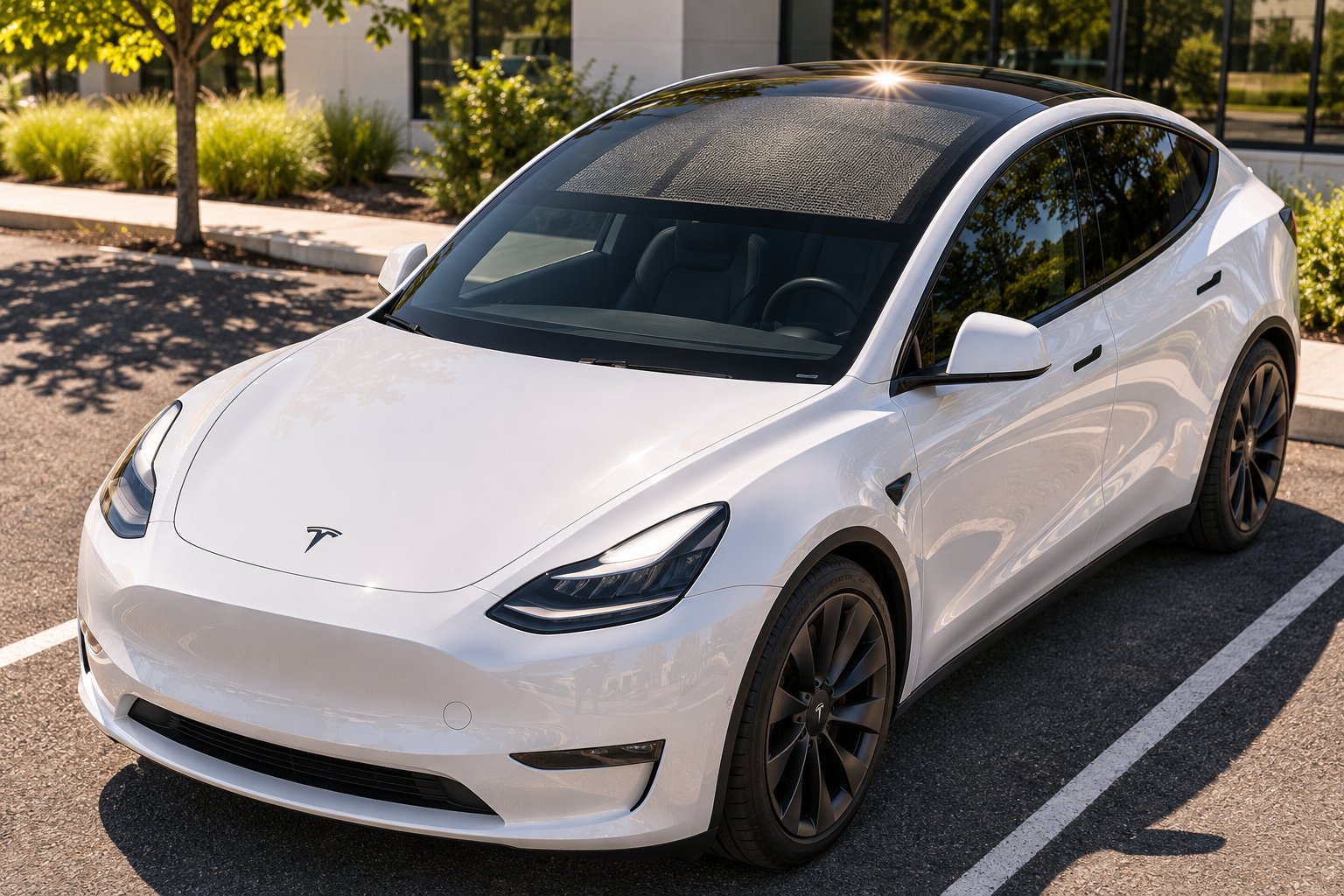
Why Tesla's Glass Roof Leaves Room for an Add-On Shade
Picture this: you slide into a Tesla on a bright afternoon, and the cabin feels wide open. Light pours in from every angle, the roofline disappears into glass, and the interior looks like something out of a concept car. Then the sun parks itself directly overhead, and a warm tingle creeps across your scalp. The airy, open feeling suddenly comes with a catch. So why does Tesla ship every single model with a panoramic glass roof and no built-in opaque shade to block the sun?
Does Tesla have a sunroof in the traditional sense? Not exactly — every current Tesla uses a fixed glass roof rather than a retractable moonroof panel. That distinction matters more than most buyers realize, and it explains why the tesla sunroof shade category exists in the first place.
Tesla's All-Glass Roof Design Philosophy
Tesla chose a single, seamless pane of laminated glass over the conventional moonroof-with-sliding-panel approach for three deliberate reasons. First, structural rigidity. A fixed glass panel bonded directly into the roof frame adds stiffness to the entire body structure — there are no cutouts for tracks, no motor housings weakening the roofline. Second, weight savings. Eliminating the mechanical slide assembly, guide rails, and electric motor shaves pounds from the highest point of the vehicle, which benefits both handling and efficiency. Third, aesthetics. That uninterrupted expanse of glass, stretching from just behind the windshield header to the rear of the cabin with no crossbar in sight, creates an interior spaciousness that makes even the compact Model 3 feel larger than its footprint suggests.
The result is unmistakable. When Tesla launches an official retractable sunshade for Model Y vehicles in select markets, it arrives as an accessory layered over the glass — not as a replacement for it. The glass itself stays fixed, and the minimalist design philosophy remains intact.
Where Factory Glass Protection Ends
Here is where the story gets nuanced. Tesla's glass is not ordinary automotive glass. It features a multi-layer construction where ceramic and metallic oxide coatings are sandwiched between glass layers during manufacturing. According to thermal analysis of the roof system, this factory coating absorbs roughly 99% of ultraviolet radiation and reflects a meaningful share of infrared energy before it enters the cabin. Your skin and your leather seats get strong UV protection straight from the factory.
The gap, though, is significant. UV accounts for only about 3% of total solar energy. Infrared — the wavelength you feel as warmth on your head and shoulders — makes up over half. Tesla's coatings tackle infrared aggressively, yet the sheer surface area of a panoramic glass panel means some of that radiant energy inevitably passes through. Visible light, which contributes its own share of thermal gain, is intentionally allowed through at controlled levels to preserve the open, panoramic experience. In other words, the factory glass is a UV champion and an infrared compromise.
Factory glass coatings reduce UV exposure but do not eliminate cabin heat buildup or visible glare — an add-on shade addresses the gap.
This is exactly why a roof shade is a separate physical accessory, not a modification to the glass itself. A tesla sunshade clips, snaps, or rolls beneath the glass panel to intercept the radiant energy the coatings let through. It is not window-tint film, it does not alter the glass's factory UV rating, and it does not change the structural properties of the roof. Think of it as a second line of defense — one you control — layered over the engineering Tesla already built in. Whether you are searching for a sunshade for Tesla Model Y or exploring options like the Eclipse Model Y Juniper 2025+ glass roof sunshade, every product in this category works on the same principle: blocking the solar energy the factory glass was never designed to stop entirely.
That leaves a practical question wide open: what kinds of shades actually exist, and how do they differ in mechanism, coverage, and performance?
Every Type of Tesla Sunroof Shade Mechanism Explained
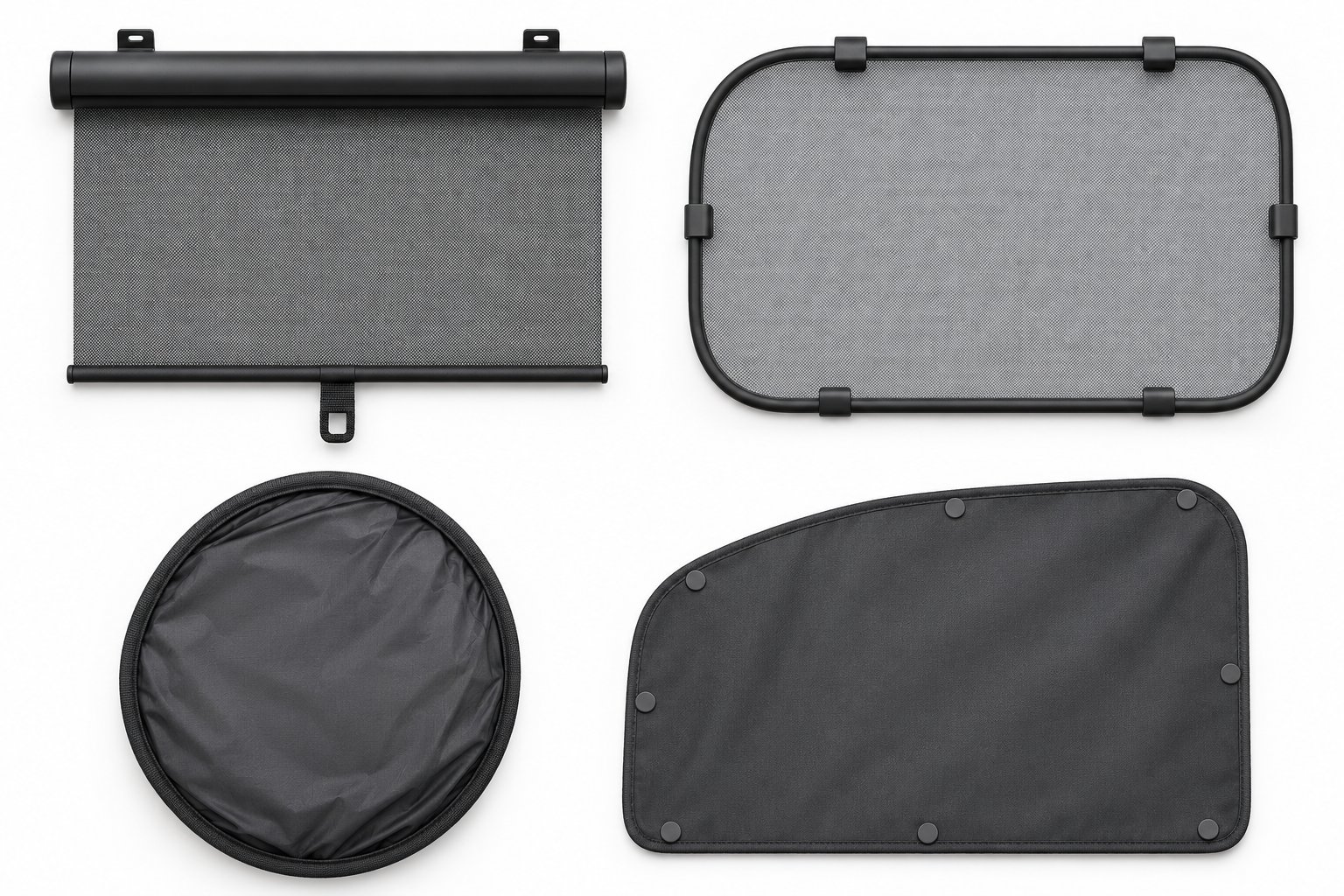
The aftermarket is flooded with options, and every product page uses slightly different language — "snap-on," "retractable," "magnetic," "foldable." Before you compare prices or read reviews, you need a clear mental map of how each mechanism actually works. Here is the full taxonomy, broken down by how the shade attaches, moves, and covers the glass.
Retractable Roller-Blind Shades
Imagine a window blind scaled down and turned sideways across your roof. A retractable roller-blind shade uses a reel-type mechanism — motorized or manual spring-loaded — that rolls fabric across the underside of the glass from one edge. You pull a handle or press a button, the fabric extends, and the shade locks into position. Release it, and the fabric retracts into a slim housing that sits nearly flush with the headliner.
Tesla's own official retractable sunshade for the Model Y, launched through the Tesla China Shop, uses exactly this approach. It features a permanent, low-noise reel-type roller-blind constructed from the same headliner fabric found in the vehicle, giving it a factory-integrated look. The listing notes the shade has undergone comprehensive airbag point-explosion testing, a safety detail most aftermarket alternatives cannot claim.
Pros
Sleek appearance with no removal needed, partial-open positions for adjustable light, and a permanently mounted design that stays with the car.
Cons
Higher cost — Tesla's version is priced at roughly $220 USD in China — along with a more involved initial installation and the potential for motor or spring failure over years of daily use.
Folding Mesh-Frame and Snap-On Shades
This is the most common aftermarket category and the one you will encounter most often when shopping for a tesla model y glass roof sunshade or a Model 3 equivalent. These shades use a rigid or semi-rigid frame — typically spring steel or molded plastic — with mesh or opaque fabric stretched across it. The frame clips, snaps, or magnetically attaches to the glass edge or the headliner trim surrounding it.
Sub-variants matter here. Full-coverage two-piece sets span the entire panoramic roof from front to rear, delivering maximum heat blocking. Partial-coverage panels target just the front or rear section — useful if only one seating row gets uncomfortable. Ultralight foldable versions collapse into a compact disc or rectangle for trunk storage, trading some fitment precision for portability. Products like the HaloBlk roof glass sunshade for Tesla Model 3 represent the fixed-frame end of this spectrum, while pop-up folding shades sit at the portable end.
Fixed-frame mesh shades can block roughly 85 to 90 percent of incoming light, making them one of the most effective options per dollar spent. The tradeoff is bulk — when removed, they do not fold flat, so you need trunk or garage space to stow them.
Magnetic and Suction-Cup Mounted Options
Side windows and rear glass call for a different attachment strategy. Magnetic shades embed small magnets along the fabric edge that cling to the metal door frame, making placement and removal nearly instantaneous — no clips, no tools, no fuss. Suction-cup shades work similarly but use rubber cups pressed against the glass surface, a method common for temporary use during road trips or when kids need shade in the back seat.
A niche but useful sub-type worth mentioning: triangular quarter-window shades. These small, custom-cut panels cover the fixed glass triangles near the A-pillar or C-pillar, closing off light leaks that larger shades miss. They are inexpensive and easy to overlook, but owners who add them often notice a meaningful reduction in peripheral glare.
Quick-Reference Summary of Every Tesla Sun Shade Type
- Retractable Roller-Blind: Permanently mounted reel mechanism that rolls fabric open or closed across the roof glass — the most integrated tesla roof shade option available.
- Fixed-Frame Mesh (Snap-On): Rigid or semi-rigid frame with stretched mesh that clips into headliner trim for maximum coverage and heat rejection.
- Foldable Pop-Up: Spring-loaded collapsible panels that open quickly and store flat — ideal for occasional or seasonal use.
- Magnetic Edge-Mount: Fabric panels with embedded magnets for tool-free attachment to metal door frames, best suited for side windows.
- Suction-Cup Mount: Temporary shades pressed onto glass with rubber suction cups — portable and universal but less secure at highway speed.
- Triangular Quarter-Window: Small custom-cut panels covering fixed glass triangles near the A-pillar or C-pillar to eliminate peripheral light leaks.
Each mechanism solves the same underlying problem — intercepting solar energy before it reaches you — but the right choice depends on which glass panels you need to cover, how often you want to install and remove the shade, and how much you are willing to spend. Those questions lead directly to a critical distinction: Tesla's own official shade products versus the broader aftermarket landscape.
Official Tesla Sunshades vs the Aftermarket Landscape
Two products carry the Tesla badge, and they could not be more different from each other. Confusing them is easy — both are called "sunshades" in Tesla's own marketing — but they differ in mechanism, price, installation effort, and where you can actually buy them. Sorting out which is which saves you from ordering the wrong thing and helps you understand why aftermarket options still dominate the model y sunshade market.
Tesla's OEM Clip-On Roof Sunshade
Visit shop.tesla.com in the United States, Canada, or most European markets, and you will find a static, frame-based mesh sunshade listed under the accessories tab. This is Tesla's original offering — a rigid-frame panel with woven mesh stretched across it that clips directly onto the headliner trim surrounding the tesla sunroof glass. Installation takes a few minutes, no tools required. You align the frame, press the clips into place, and the shade sits flush beneath the glass.
The OEM clip-on is available for the Model 3 and Model Y in most global markets and functions identically to the aftermarket snap-on shades described in the previous section. It blocks a portion of visible light and radiant heat, it stays put once installed, and it needs to be physically unclipped and stowed when you want the open-roof experience back. Think of it as Tesla's baseline solution — functional, widely available, and familiar in design.
The Official Retractable Sunshade and What It Signals
The second product is a different animal entirely. Tesla listed a premium retractable roller-blind sunshade for the Model Y on the Tesla China Shop, priced at 1,499 RMB (roughly $220 USD). Instead of a removable frame, this shade uses a permanently mounted reel mechanism that rolls headliner-matched fabric across the glass. A metallic-textured grab handle lets you extend or retract the shade to any position — full coverage, partial, or fully open — without ever removing it from the vehicle.
What sets this product apart from aftermarket roller blinds is the level of integration. Drive Tesla Canada reports that the shade sits flush and blends into the cabin thanks to matching color and fabric. Tesla also states the product has undergone comprehensive airbag point-explosion testing, ensuring the frame does not interfere with side-curtain airbag deployment during a collision — a safety certification most third-party alternatives lack.
Availability, however, is the catch. The retractable shade launched exclusively in China, with no confirmed rollout timeline for North America, Europe, or other regions. Reported compatibility details also vary between sources — one outlet indicates support for all 2020+ Model Ys, while another notes it fits only Juniper models produced after February 2025. If you are considering this product, verifying fitment for your specific build date is essential. The fact that Tesla developed a factory-quality retractable shade at all signals strong demand, and a broader market release seems likely — but for owners outside China, the wait continues.
Where Aftermarket Shades Fill the Gap
This regional limitation is exactly why aftermarket shades still own the market. Need a tesla sunroof shade for a pre-refresh Model 3? Aftermarket has it. Looking for triangular window shades for Tesla Model Y/3 Model 3 to close off those small fixed-glass panels near the pillars? Aftermarket covers that too. Want a full-vehicle camping shade set that blocks every window for privacy during Camp Mode? You will not find that in Tesla's official shop.
The aftermarket advantage comes down to four factors: broader model coverage spanning every Tesla generation, a wider variety of mechanisms from budget mesh to premium motorized blinds, price range flexibility from entry-level to high-end, and immediate availability regardless of your region. For owners who care about features like Tesla Model Y V2L power output during camping trips, aftermarket shade sets designed for overnight use pair naturally with that kind of setup.
| Category | Mechanism | Model Coverage | Approx. Price Tier | Availability |
|---|---|---|---|---|
| Official OEM Clip-On | Rigid mesh frame, manual clip attachment | Model 3, Model Y (select generations) | Mid | Global via shop.tesla.com |
| Official Retractable | Roller-blind reel, manual pull handle | Model Y (Juniper confirmed; pre-Juniper compatibility varies by source) | Mid-to-Premium | China only (as of mid-2026) |
| Aftermarket | Snap-on mesh, foldable pop-up, magnetic, suction-cup, motorized roller, triangular quarter-window | All Tesla models and generations | Budget to Premium | Global, multiple retailers |
The comparison makes one thing clear: Tesla's official products serve a narrow slice of the market well, but the aftermarket fills every gap they leave behind. The real challenge for most owners is not choosing between official and third-party — it is figuring out which shade actually fits their specific Tesla, especially when a mid-cycle refresh changes the roof dimensions entirely.
Model-by-Model Shade Compatibility and Fitment Guide
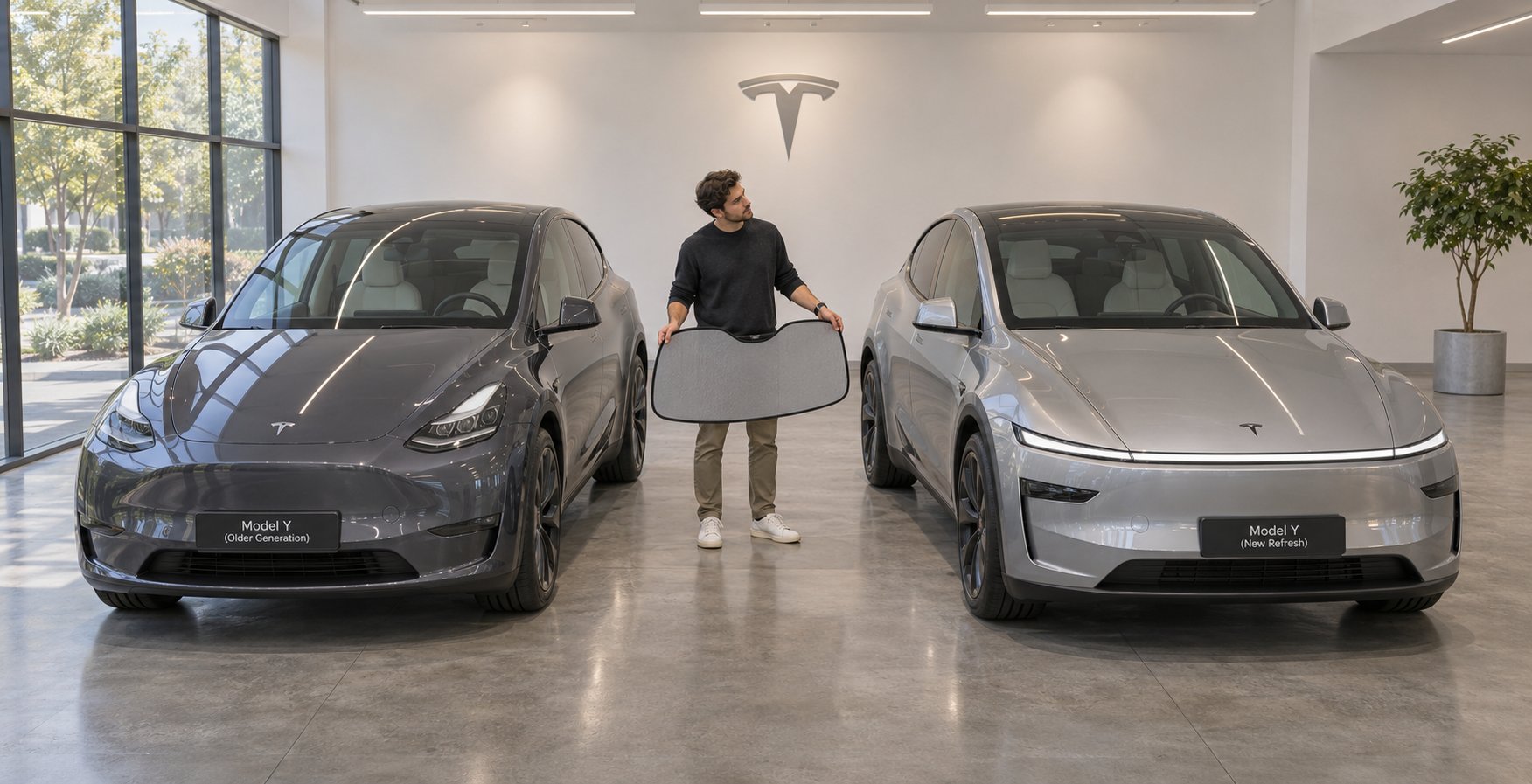
Here is the single biggest purchasing mistake Tesla owners make with sunshades: they search by model name alone. "Tesla Model Y sunshade" goes into the search bar, a product shows up, the price looks right, and they click buy. Two days later, the shade arrives and the edges sag, bright strips glow around the perimeter, or the clips do not line up with the headliner trim. The problem is not the shade — it is the generation mismatch hiding behind the same model name.
People often ask, "does Tesla have a sunroof?" The answer is a fixed panoramic glass roof on every current model — but that glass panel is not identical across production years. Tesla's mid-cycle refreshes change roof curvature, interior trim geometry, and clip mounting points enough to split each model into distinct fitment families. Buying the wrong generation shade is like ordering a phone case for last year's model — close in size, wrong in every detail that matters.
Model Y Pre-Juniper vs Juniper Fitment Differences
The Model Y Juniper refresh, which began deliveries in early 2025, redesigned over 40% of the vehicle's components. While the glass roof dimensions look similar at a glance, the curvature changed enough that classic sunshades sag in the middle when placed on a Juniper roof. Fitment testing from aftermarket brands confirms this split — a 2020-2024 Model Y roof shade will not seat correctly on a 2025-2026 Juniper, and the reverse is equally true.
The differences go beyond the glass itself. The Juniper's interior trim flows differently around the roof edges, and the headliner clip attachment points shifted position. If you are shopping for tesla model y sunshades, the first question is not "which brand?" — it is "which generation do I own?" Check your vehicle's production year on the driver's door jamb sticker or in the Tesla app under vehicle details before adding anything to your cart.
Model 3 Standard vs Highland Compatibility
The same generation split applies to the Model 3 family. Tesla's Highland refresh, which rolled out starting in late 2023 for some markets and 2024 broadly, brought a redesigned interior with new trim geometry, a stalkless steering column, and revised roof glass dimensions. A tesla model 3 sunshade built for the 2017-2023 Legacy Model 3 uses different edge profiles than one built for the 2024-2026 Highland.
Generation-specific fitment data reinforces this: Highland roof shades and Legacy roof shades are not interchangeable, even though windshield shades can sometimes span both generations when the product explicitly lists the full year range. If you own a Highland, look for shades that specifically name "Highland" or "2024-2026 Model 3" in the product title. Generic listings that say only "fits Tesla Model 3" without a year range are a red flag.
Model S, Model X, and Specialty Fitment
Model S and Model X owners face a thinner aftermarket. The refreshed Model S (2021+) has a panoramic glass roof, but its dimensions differ significantly from the Model 3/Y platform. Shade options exist — primarily windshield sunshades and some roof panels — but the selection is narrower and skews toward foldable or snap-on designs rather than retractable roller blinds.
Model X adds another layer of complexity. Its falcon-wing rear doors and unique rear-glass configuration make side-window and rear shading more specialized. Most universal magnetic shades will not conform to the X's unconventional door geometry, so confirmed-fit products are essential. For owners exploring options like a tesla electric sunshade with motorized retraction, Model S and X availability remains limited compared to the Model 3/Y ecosystem.
Given how easily fitment confusion leads to returns and frustration, browsing by your exact model and generation is the safest approach. CUTIM's Tesla sunshades collection organizes roof, windshield, side-window, and rear-window options by specific Tesla model and generation — a layout that helps you filter out incompatible products before they ever reach your doorstep, whether you drive a Legacy Model Y, a Juniper, a Highland Model 3, or a refreshed Model S.
| Tesla Model | Generation / Refresh | Roof Glass Configuration | Shade Types Commonly Available |
|---|---|---|---|
| Model Y | Standard (2020-2024) | Fixed panoramic glass, original curvature and trim geometry | Snap-on mesh, foldable pop-up, OEM clip-on, some retractable aftermarket options |
| Model Y | Juniper (2025-2026) | Fixed panoramic glass, revised curvature and headliner clip points | Juniper-specific snap-on mesh, foldable pop-up, OEM retractable (China), growing aftermarket retractable selection |
| Model 3 | Legacy (2017-2023) | Fixed panoramic glass, original interior trim profile | Snap-on mesh, foldable pop-up, OEM clip-on, magnetic side-window options |
| Model 3 | Highland (2024-2026) | Fixed panoramic glass, revised trim and roof edge geometry | Highland-specific snap-on mesh, retractable aftermarket options, OEM clip-on (updated fitment) |
| Model S | Refresh (2021-2026) | Fixed panoramic glass, unique dimensions separate from Model 3/Y platform | Windshield sunshades, limited roof panel snap-on options, foldable pop-up |
| Model X | Refresh (2021-2026) | Panoramic windshield, falcon-wing door glass, unique rear configuration | Windshield sunshades, specialty side-window shades, very limited roof options |
| Cybertruck | 2024-2026 | Large single-panel fixed glass roof | Dedicated snap-on roof panels, foldable windshield shades |
The pattern is clear: model name alone tells you almost nothing about fitment. Generation, production year, and refresh status determine whether a shade will sit flush or leave frustrating gaps. With the right match confirmed, the next question becomes practical — how much of a difference does that shade actually make once it is in place?
How a Sunroof Shade Changes Cabin Temperature and Comfort
You have confirmed the right fitment for your Tesla. You know which generation you own, and you have narrowed down the shade type. But a fair question lingers: is a tesla sunroof shade actually worth the effort, or is it just a feel-good accessory? The answer lives in basic physics — and it is more dramatic than most owners expect.
How Radiant Heat Enters Through a Glass Roof
Imagine your Tesla parked in a sunny lot for an hour. Sunlight — a broad spectrum spanning ultraviolet, visible, and infrared wavelengths — strikes the panoramic glass. The factory coatings filter out most UV and reject a portion of infrared, but visible light and near-infrared energy still pass through. That energy does not just float around the cabin. It lands on the dashboard, seats, headrests, and every dark surface inside the car.
Here is where it gets interesting. When visible light hits your black leather seats, the material absorbs it and converts that energy into heat. The warmed surfaces then re-radiate energy, but at a much longer wavelength — deep in the infrared spectrum, around 10 microns. And glass, which happily transmitted the shorter-wavelength visible light on its way in, blocks this long-wave infrared on its way out. The energy enters easily but cannot escape. Surfaces get hotter, air temperature climbs, and your cabin becomes a slow-cooker.
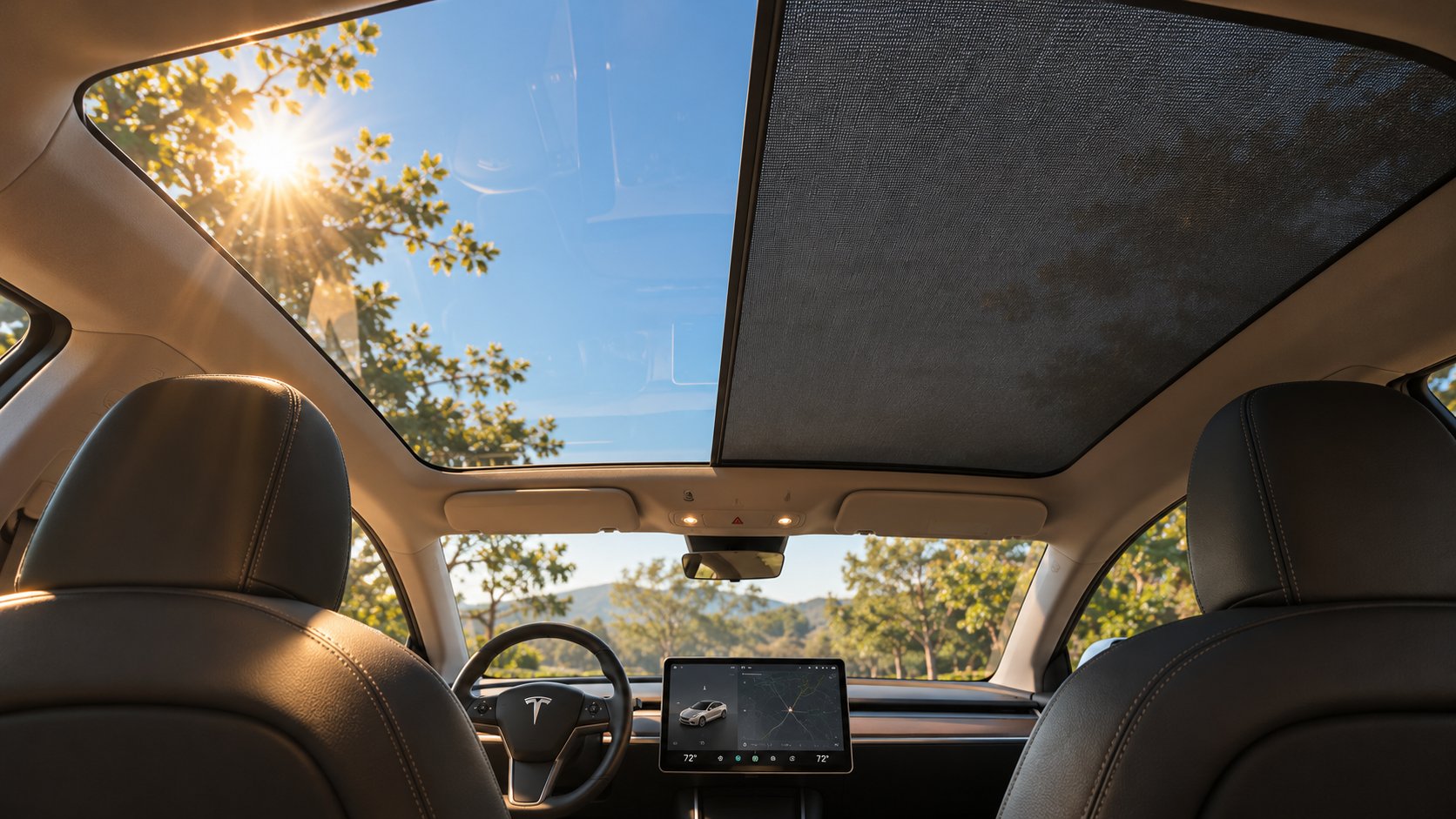
This is the same greenhouse mechanism that heats an actual greenhouse — and it is amplified by the sheer surface area of a panoramic glass roof. A tesla glass roof sunshade interrupts the cycle at the earliest possible point. By sitting between the glass and the cabin interior, the shade intercepts incoming visible light and near-infrared before those wavelengths ever reach your seats and trim. Less energy absorbed means fewer heated surfaces, which means less trapped infrared bouncing around inside. The cabin still warms up — no shade eliminates heat entirely — but the rate and peak temperature drop noticeably.
Impact on AC Load and Range
Every Tesla owner has watched the energy consumption screen climb on a hot day. The HVAC system pulls power directly from the battery pack, and the harder it works to maintain your set temperature, the more range you sacrifice. Reducing the heat load inside the cabin gives the climate system a head start — it spends less energy pulling temperatures down and more time maintaining them at a comfortable level.
Think of it this way: without a model y roof shade, the air conditioning fights a constant stream of radiant energy pouring through the glass overhead. With a shade in place, that stream is significantly weakened before it reaches the cabin air. The compressor cycles less aggressively, fan speeds stay lower, and the net battery draw for climate control shrinks. On a long summer highway drive, this difference can translate into a few extra miles of range — marginal on any single trip, but compounding over a full season of daily driving.
The benefit extends to parked vehicles, too. Tesla's Cabin Overheat Protection feature activates automatically after you leave the car, running the HVAC fan or full air conditioning to prevent interior temperatures from exceeding your chosen threshold — 90, 95, or 100 degrees Fahrenheit. On scorching days, this feature can cycle repeatedly over 12 hours, drawing meaningful energy from the battery. A shade sitting beneath the glass slows the rate at which the cabin temperature climbs toward that threshold, reducing how often Cabin Overheat Protection needs to kick in and conserving battery you would rather spend on driving. Owners who park outdoors in hot climates and rely on this feature will notice the difference in their state of charge at the end of the day.
Rear-Passenger and Child Comfort
Front-seat occupants rarely feel the glass roof's full intensity. The header overhang, the windshield sun visor, and the natural angle of the front seats create some buffer. Rear-seat passengers get no such relief. The back half of the panoramic roof sits directly overhead, fully exposing anyone sitting beneath it to unfiltered downward sun. Children in rear-facing car seats, passengers in the middle seat, and even pets in the back are essentially sitting under a skylight with no blinds.
This is why tesla model y window shades designed for the rear roof panel are among the most popular single-panel purchases. A rear-specific shade blocks the section of glass where sun exposure is most direct and where passengers are least able to shift away from it. Parents who install a rear roof shade often describe it as one of the most immediately noticeable comfort upgrades they have made — the back seat goes from uncomfortably warm to genuinely pleasant, even on peak-sun afternoons.
For families who use Camp Mode or sleep in their Tesla during road trips, the comfort calculus extends beyond daytime heat. A shaded rear roof panel reduces the need for aggressive air conditioning overnight, keeping the cabin cool and quiet while drawing less from the battery. It also blocks early-morning light that would otherwise pour straight down onto sleeping passengers — a small detail that makes a real difference when your car doubles as a hotel room.
The thermal logic is simple: less solar energy in means less heat buildup, less AC strain, and more comfort for everyone inside — especially those sitting under the widest, most exposed stretch of glass. What remains less obvious is how easy or difficult these shades are to actually install, and whether the process changes depending on the type you choose.
Step-by-Step Installation for Every Tesla Shade Type
You have picked the right shade for your model and generation. The box is sitting on your passenger seat. And now you are staring at it wondering whether this is a five-minute job or a Saturday afternoon project. The answer depends entirely on the mechanism — clip-on shades, retractable roller blinds, and magnetic side-window covers each follow a different process. Here is what to expect for each, so nothing catches you off guard.
Installing Clip-On and Snap-Frame Roof Shades
This is the most common installation you will encounter, and the good news is that it requires zero tools. Whether you bought a two-piece full-coverage set or a single rear-panel shade, the process follows the same basic pattern.
Start by holding the shade panel up to the tesla glass roof and orienting it correctly. Most manufacturers mark the front edge or include an asymmetric shape that only aligns one way. Once oriented, position the frame so its edges line up with the perimeter of the glass where the headliner trim meets the roof panel. You will notice small clips, tabs, or snap hooks along the frame's edge — these are designed to tuck into the narrow gap between the headliner fabric and the glass surround.
Press each clip into place one side at a time, working from the front edge toward the rear (or vice versa, depending on the product's instructions). You should hear or feel a soft click as each point engages. Once all clips are seated, run your fingers along the entire perimeter and confirm the shade sits flush against the glass without sagging in the center. A well-fitted shade should look nearly invisible from inside — just a smooth, slightly darker surface overhead.
One detail worth noting: clip quality varies dramatically across products. Budget shades sometimes use thin plastic tabs that flex under pressure and disengage when the car hits a bump. Premium options tend to use reinforced nylon or spring-loaded clips that grip firmly and resist vibration. If your shade rattles at highway speed, the clips are the likely culprit — not the frame itself. For a tesla sunshade model y or Model 3 equivalent, secure attachment matters more than most buyers realize, especially on rough roads or at sustained high speeds where wind buffeting creates subtle pressure changes inside the cabin.
Setting Up Retractable Roller-Blind Shades
Retractable shades demand a bit more patience upfront. Unlike snap-on panels that pop in and out freely, a roller-blind system involves a one-time mounting step that anchors the reel housing and guide rails to your headliner. The payoff is daily convenience — once mounted, you simply pull the fabric to extend it and release to retract, with no removal or storage hassle.
The typical installation goes like this. You start by positioning the reel housing along one edge of the roof glass — usually the rear edge, though some designs mount at the front. Guide rails or tracks attach along the left and right sides of the glass perimeter, secured by adhesive brackets, screw-in mounts, or clips that hook into existing headliner trim gaps. A few products, including some aftermarket versions inspired by the tesla moonroof shade concept, use a combination of adhesive and mechanical fasteners for extra stability.
You may need basic tools for this step — typically a trim removal tool to gently pry headliner edges, and possibly a Phillips-head screwdriver if the bracket system uses screws. The entire process takes 15 to 30 minutes for most products. Once the rails are secure, you slide the fabric panel into the tracks, test the extension and retraction a few times to confirm smooth operation, and you are done.
A tesla model s sunshade in the retractable category follows a similar logic, though the roof dimensions and headliner trim differ enough from the Model 3/Y platform that mounting points will not align between vehicles. Always confirm that the guide-rail length and reel housing width match your specific model before committing any adhesive to the headliner — repositioning a bonded bracket is far messier than getting it right the first time.
Side-Window and Rear-Window Shade Placement
Magnetic and suction-cup shades are the simplest to install — so simple that "install" is almost too strong a word. Magnetic shades rely on small magnets sewn into the fabric perimeter that cling to the metal door frame surrounding each window. You hold the shade up to the window, let the magnets find the frame, and adjust the position until the fabric covers the glass evenly. The whole process takes about ten seconds per window.
One caveat: magnetic attachment depends on a ferrous metal frame behind the door panel trim. Most Tesla door frames provide enough metal contact along the top and sides for a secure hold, but the bottom edge — where the window drops into the door — offers less magnetic surface. Some shades compensate with a small tuck-in flap that wedges between the window glass and the rubber seal. Others simply leave the bottom loosely draped. Neither approach is perfect, and you may find that magnetic shades work better on some window positions than others on the same vehicle.
Suction-cup shades attach directly to the glass itself. Press the cup firmly, push the release tab, and the shade holds. These are ideal for temporary use — road trips, parked nap sessions, or shading a child's window on a sunny drive — but they can lose suction over time, especially in heat, as the rubber softens and the seal weakens. For a tesla model s sunshade covering the rear window, suction cups offer portability that magnetic mounts cannot, since the rear glass lacks a surrounding metal frame for magnets to grip.
Universal Installation Best Practices
Regardless of shade type, a handful of simple steps prevent the most common installation headaches:
- Clean the glass first. Dust, fingerprints, and residue reduce suction-cup grip and can cause clips to slide during positioning. A quick wipe with a microfiber cloth and glass cleaner takes 30 seconds and improves the fit noticeably.
- Test-fit before fully committing clips or adhesive. Hold the shade in position, check all edges for alignment, and confirm orientation before you start pressing clips into place. Repositioning a half-clipped shade is awkward and risks bending the frame.
- Check for obstruction of rearview visibility. A roof shade should not droop low enough to enter your rearview mirror's line of sight. Sit in the driver's seat after installation and verify that your view through the rear window and mirror remains unobstructed.
- Verify the shade does not interfere with Tesla's interior cameras or rain sensor. The cabin-facing camera above the rearview mirror and the rain sensor embedded near the top of the windshield both need a clear optical path. Most roof shades sit behind these components, but oversized or incorrectly positioned shades can partially block them — causing Autopilot alerts or rain-sensing malfunctions.
- Listen for rattles before your first drive. Tap the shade gently and wiggle the frame. If anything vibrates or feels loose, reseat the clips or tighten the mounting hardware. A rattle that seems minor in the driveway becomes maddening on the highway.
Installation across every shade type shares one reassuring trait: none of it is permanent in a way that alters your vehicle. Clips unclip, magnets pull away, suction cups release, and even retractable guide rails can be removed if you change your mind. The real question that follows installation is not whether you can put it in — it is how long the shade itself will hold up under repeated use and constant sun exposure.
Durability and Long-Term Care for Tesla Sunshades
Here is the irony no product listing mentions: the very thing your shade protects you from is also the thing slowly destroying the shade itself. Ultraviolet radiation does not just heat your cabin — it breaks down the organic polymers in nylon mesh, polyester fabric, and even the plastic clips holding everything together. A tesla sunroof shade is not a buy-it-and-forget-it accessory. Understanding what degrades, how fast, and what you can do about it sets realistic expectations and helps you get the most life out of your investment.
Fabric and Mesh Degradation Over Time
Every mesh or fabric shade you install beneath your Tesla's glass roof is made from synthetic polymers — typically nylon or polyester. These materials are chains of smaller molecules (called monomers) held together by chemical bonds. UV radiation breaks those bonds at the molecular level, causing the material to weaken, stiffen, and eventually crumble. Research conducted by SlingFin on lightweight synthetic fabrics showed that after just one month of continuous outdoor UV exposure, most test fabrics lost between 5% and 47% of their original tensile strength. After 100 days, nearly all unprotected fabrics dropped below 70% strength.
Your sunshade does not sit on an exposed rooftop around the clock — it lives beneath glass that already filters most UV — so the degradation timeline is much longer than those test conditions suggest. Still, the process is cumulative and irreversible. Over months and years of daily use, you will notice the signs: mesh that once felt supple becomes stiff and brittle, colors fade from dark charcoal toward a washed-out gray, and elastic edges or fabric borders lose their tension and begin to sag.
Coating matters as much as the base fabric. SlingFin's testing found that silicone-coated fabrics significantly outperformed polyurethane or polyether-coated equivalents in UV resistance, and the addition of titanium dioxide to coatings dramatically slowed degradation. Most aftermarket Tesla shades do not specify their coating chemistry, but higher-quality products tend to use UV-stabilized mesh with reinforced stitching that resists brittleness far longer than bargain alternatives. A 3W foldable car sunshade for Tesla Model Y Juniper 2025-2026 built with premium UV-stabilized materials will outlast a no-name import using untreated polyester — even if both look identical when new.
The bottom line: no shade lasts forever. Mesh degrades, fabric fades, and the protection it offers diminishes gradually. The question is not whether your shade will wear out, but how many seasons of solid performance you get before replacement becomes necessary.
Clip and Frame Longevity
Fabric is only half the durability story. The mechanical components — clips, snap tabs, spring-steel frames, and mounting brackets — face their own wear patterns, and they fail differently than fabric does.
Plastic clips endure a double assault. Repeated install-remove cycles stress the connection points each time you press them in or pry them out. Add temperature extremes — the kind a parked Tesla's headliner reaches on a 100-degree afternoon — and the plastic becomes more brittle with each thermal cycle. A clip that snapped crisply into place in month one may crack or lose its grip by month eighteen. This is especially relevant for owners who remove their shades seasonally or swap between a front and rear panel depending on passenger load.
Spring-steel frames in foldable pop-up shades face a subtler enemy: memory loss. The coiled steel wire that lets a foldable shade collapse into a compact disc can gradually lose its spring tension if stored in a compressed or twisted position for extended periods. Over time, the frame no longer pops open into a flat, taut panel — instead, it opens unevenly or refuses to sit flush against the glass. A tesla model y retractable sunshade with a permanent roller mechanism avoids this issue entirely, since the reel housing holds the fabric under consistent tension rather than relying on a foldable frame. But for owners who prefer removable pop-up or foldable designs, proper storage habits are the difference between a shade that performs well for years and one that warps after a single summer.
The same principle applies to tesla model 3/y side window sunshade products that use magnetic edge strips. The magnets themselves are durable, but the fabric pocket holding each magnet can fray if the shade is repeatedly pulled away from the door frame at sharp angles rather than peeled off gently.
Care Tips to Maximize Shade Lifespan
A few simple habits go a long way. Cleaning guidance from Snap Shades reinforces that gentle hand washing with mild soap and water, followed by complete air drying in the shade before storage, is the safest approach for any mesh or fabric automotive sunshade. Avoid machine washing, harsh detergents, and pressure washers — all of which can weaken the mesh and distort the frame.
- Avoid folding when fabric is hot. Mesh straight off a sun-baked roof is at its most pliable and also most vulnerable. Let the shade cool for a few minutes before collapsing or folding it — hot folds can create permanent creases in the mesh.
- Clean with mild soap and water. A soft microfiber cloth, lukewarm water, and a drop of gentle dish soap remove dust and grime without degrading the fabric. Rinse thoroughly and let the shade air dry completely before reinstalling or storing.
- Inspect clips and attachment points seasonally. Give each clip a gentle tug and check for hairline cracks, especially at the hinge point. Replacing a single cracked clip is cheap — discovering it failed at highway speed is not.
- Store out of direct sun when not installed. Even window-filtered sunlight contains enough UV to degrade unprotected fabric over time. Keep removed shades in a closet, trunk organizer, or the storage pouch included with many products. Foldable shades should be stored flat or in their carry case rather than left compressed in a glove box.
- Do not soak or leave damp before storage. Moisture trapped against fabric in an enclosed space promotes mildew and can weaken adhesive-backed components. Always ensure the shade is fully dry before tucking it away.
Treating your sunshade as a consumable with a multi-year lifespan — rather than a permanent installation — keeps expectations honest. The shade that blocks heat and glare beautifully in year one will still do its job in year three if you store it properly and clean it occasionally. By year five, you will likely notice enough fading or stiffness to start shopping for a replacement. That timeline is normal, and knowing it in advance lets you plan rather than react.
Durability sets the outer boundary of your shade's usefulness, but choosing the right shade in the first place determines how well it serves you within that window. The real decision is not just which product holds up longest — it is which product matches your climate, your priorities, and the way you actually use your Tesla day to day.

A Decision Framework for Choosing the Right Tesla Sunroof Shade
You now understand the shade types, know which generation your Tesla belongs to, have a feel for installation effort, and can set realistic expectations for how long each product lasts. And yet — you are still staring at a dozen options on your screen, unsure which one actually belongs in your car. That hesitation is completely normal. The right tesla sunroof shade is not the one with the best reviews or the lowest price. It is the one that matches your life — your climate, your passengers, your parking situation, and how you use your Tesla on the days when the sun is least forgiving.
Here is a structured way to work through the decision without second-guessing yourself.
Climate and Seasonal Considerations
Where you live changes everything about what you need. An owner in Phoenix dealing with 110-degree afternoons from May through September has a fundamentally different shade requirement than someone in Seattle who sees aggressive sun for maybe eight weeks a year. The shade that is perfect for one driver would be overkill — or woefully insufficient — for the other.
If you live in a hot climate (think Arizona, Texas, Florida, inland California, Nevada, or similar), your priority is maximum heat rejection across the entire roof panel. A full-coverage snap-on mesh shade or a retractable roller blind that stays permanently installed gives you consistent protection without requiring daily setup. In these regions, a tesla sunshade model 3 or Model Y roof panel shade is less of a luxury and more of a functional necessity — the kind of thing that keeps your HVAC from fighting a losing battle every afternoon.
Tesla's Cabin Overheat Protection illustrates this point clearly. In extreme-heat regions, this feature can cycle repeatedly over the course of a parked afternoon, drawing meaningful energy from the battery just to keep interior temperatures below your chosen threshold. A shade supplements Cabin Overheat Protection by slowing the rate at which the cabin heats up in the first place — reducing activation frequency and conserving the charge you would rather spend on driving. Owners in desert climates who park outdoors daily will feel this difference in their state of charge at the end of every workday.
Mild-climate owners face a lighter decision. If overhead glare during the occasional sunny commute is your main irritation rather than oppressive heat, a light mesh shade or even a partial-coverage front-only panel may be all you need. And if your sun exposure is genuinely seasonal — intense for a few summer months, negligible the rest of the year — an easy-remove snap-on or foldable pop-up shade makes more sense than a permanent retractable installation. You install it in June, pull it out in September, and stow it in the garage until next year.
Coverage Area and Privacy Priorities
The second axis of your decision is not just "do I need a shade" but "which glass panels need shading?" Most people default to the roof — and for good reason, since overhead sun is the most common complaint. But the roof is only one of several glass surfaces contributing to heat and light intrusion.
Consider your typical pain points:
- Roof-only: Best for owners whose primary issue is overhead heat and glare during daily driving. A single two-piece roof panel set — or a tesla model 3 roof shade for Model 3 owners — addresses the biggest thermal entry point and keeps things simple.
- Roof plus rear window: Ideal for families with rear-seat passengers who feel the combined effect of roof glass and the large rear window. Shading both panels creates a noticeably cooler, calmer environment in the back half of the cabin.
- Full-vehicle coverage including side windows: The choice for owners who use Camp Mode, sleep in their Tesla on road trips, or simply want maximum privacy and light blocking. An eight-piece set covering every glass panel transforms the cabin into a dark, private space — useful for overnight camping, midday nap breaks, or changing clothes at a trailhead.
Privacy is the factor people underestimate most. If you have ever tried to sleep in your Tesla with Camp Mode running and no window coverage, you know the problem: streetlights, parking lot floods, and early-morning sun pour through every unshaded surface. Full-coverage shading is not about heat at that point — it is about creating a usable sleeping environment. Owners who regularly camp or do work-from-car sessions find that a complete shade set changes the vehicle from "a car you can nap in" to "a genuinely comfortable mobile room."
Budget and Permanence Tradeoffs
The final decision axis comes down to how much you want to spend and how integrated you want the solution to feel. These two factors tend to move together, but not always — and understanding the tradeoffs helps you avoid both overspending and under-buying.
At the entry level, foldable mesh shades offer the lowest cost and easiest removal. A decent two-piece roof set runs in the budget tier, installs in minutes, and stows in the trunk when you want the open-sky experience back. The tradeoff is aesthetics: a pop-up shade sitting beneath a sleek glass roof looks functional rather than factory-finished. For a new owner testing whether a shade actually improves comfort before committing to a premium option, this is the smart starting point. Tesla North America Guide echoes this approach — start cheap and reversible, then upgrade if the benefit justifies the cost.
Mid-range snap-on mesh-frame shades improve fitment precision and clip quality. They sit more flush, rattle less, and generally use UV-stabilized materials that hold up longer. This is the sweet spot for most daily drivers who want a reliable, set-it-and-forget-it solution without the complexity of a motorized system.
At the premium end, retractable roller-blind shades — whether aftermarket motorized kits or Tesla's own official retractable option — deliver the most integrated look and the most convenient daily operation. Pull to extend, release to retract, and never remove anything from the car. The cost is higher, the installation is more involved, and repair options are more limited if the mechanism fails years down the road. But for owners who prioritize a factory-quality feel and plan to keep the vehicle long-term, a retractable system eliminates the daily friction of installing and removing a separate panel.
Match your shade to your hottest use case — the scenario where you need it most should drive the type, coverage, and mounting permanence you choose.
That principle cuts through the noise. If your worst day is a July afternoon parked at the office with kids in the back seat, you need a full-coverage, high-heat-rejection roof shade that stays installed all summer. If your worst day is a weekend road trip where you want privacy for an overnight camp, you need a multi-panel set that covers every window. And if your worst day is a mild glare on a spring commute, a simple foldable mesh panel you toss in the frunk handles it. Let the scenario dictate the product — not the other way around.
With your climate assessed, coverage mapped, and budget framed, one step remains: turning this framework into action and finding shade products confirmed to fit your exact Tesla model and generation.
Putting It All Together and Taking the Next Step
You have walked through the science, the shade types, the fitment traps, and the decision framework. Everything comes back to four variables: your exact Tesla model and generation, the mechanism type that fits your daily routine, the glass panels causing you the most discomfort, and the climate you actually live in. Get those four right, and the shade you choose will earn its place in the car. Get even one wrong — especially fitment — and you are dealing with returns, gaps, and rattles that make the whole exercise feel pointless.
So where do you actually start?
Start With Your Biggest Comfort Gap
Resist the urge to buy a full coverage set on day one unless you already know you need it. Instead, identify the single glass panel that bothers you most and solve that problem first.
If overhead heat and glare during daily driving are your main complaint, a roof panel shade is your first purchase — whether that is a snap-on mesh set for the model y sunroof glass or a retractable roller blind you plan to leave installed year-round. Most owners land here because the panoramic roof is the largest and most exposed surface.
If windshield sun exposure during your morning or evening commute creates the worst discomfort, prioritize a windshield sun shade. This is especially relevant for owners who park outdoors at work and return to a steering wheel too hot to touch. A windshield shade paired with Cabin Overheat Protection keeps the dash and front cabin dramatically cooler.
If rear-passenger comfort is the pain point — kids complaining, pets panting, or a back seat no one wants to sit in on sunny days — a rear roof panel shade or a set of tesla window shades covering the rear side glass makes the most immediate difference. And if Camp Mode privacy or overnight road-trip sleeping is your priority, a full-vehicle set including side and rear windows transforms the cabin into a dark, private space worth sleeping in.
Where to Find Model-Matched Shade Options
The fitment lesson from earlier in this guide bears repeating: always verify your vehicle's generation before ordering. A tesla model y 2020-2025 sun shade will not fit a Juniper built after March 2025, and a Legacy Model 3 shade will not align with a Highland interior. The same caution applies to less common models — a tesla x sunshade designed for the refreshed 2021+ Model X will not work on earlier production years with different roof and door geometry.
Rather than cross-referencing product titles and hoping the year range is accurate, start with a retailer that organizes shades by model and generation from the outset. CUTIM's Tesla sunshades collection groups roof shades, windshield shades, side-window shades, and rear-window options by specific Tesla model and production generation — so you can filter directly to your vehicle and see only confirmed-fit products. This layout is especially useful if you are building a multi-panel setup over time, starting with a roof shade this month and adding side-window coverage next season, without worrying about compatibility mismatches between pieces.
Remember: these are physical shade accessories that sit over or alongside the glass. They are not window-tint film, they do not modify your factory glass, and they do not change the UV-protection rating Tesla engineered into the roof. They simply fill the gap the factory glass leaves open — blocking the visible light, radiant heat, and glare that coatings alone were never designed to eliminate.
Here is your action checklist to move from research to purchase with confidence:
- Identify your Tesla model and generation. Check the build date on your door jamb sticker or in the Tesla app — this single detail determines every fitment decision that follows.
- Decide which glass panels to shade first. Start with the surface causing the most discomfort and expand later if needed.
- Choose a mechanism type that matches your usage pattern. Seasonal users benefit from easy-remove snap-on or foldable shades; year-round users may prefer a permanent retractable installation.
- Verify fitment before ordering. Confirm the product listing names your exact generation — "Model Y Juniper," "Model 3 Highland," or the specific year range — rather than a vague "fits Tesla Model Y."
Your glass roof is not going anywhere. It is a core part of what makes a Tesla feel like a Tesla — the light, the openness, the minimalist sweep of the cabin. A well-chosen shade does not take that away. It gives you control over it, letting you decide when the sky pours in and when the sun stays out.
Tesla Sunroof Shade FAQs
1. Does Tesla have a built-in sunroof shade?
Tesla does not include a built-in opaque sunroof shade on any current model. Every Tesla ships with a fixed panoramic glass roof that uses factory UV-filtering and infrared-rejection coatings, but no physical shade is standard. Tesla does sell an OEM clip-on mesh sunshade through shop.tesla.com for the Model 3 and Model Y, and a retractable roller-blind sunshade was launched exclusively through the Tesla China Shop for the Model Y. However, both are separate accessories purchased in addition to the vehicle.
2. Will a Tesla Model Y sunshade fit the new Juniper refresh?
No. The Model Y Juniper refresh, which began deliveries in early 2025, changed the roof glass curvature, headliner trim geometry, and clip attachment points enough that shades designed for the 2020-2024 Model Y will not fit correctly on a Juniper — and vice versa. Always verify whether a product listing specifies 'Juniper' or '2025+' before ordering. Retailers like CUTIM organize their Tesla sunshades collection by model and generation, which helps avoid purchasing an incompatible shade.
3. How much heat does a tesla sunroof shade actually block?
The exact temperature reduction depends on shade material, coverage area, and ambient conditions. Fixed-frame mesh shades can block roughly 85 to 90 percent of incoming visible light, significantly reducing radiant heat that reaches interior surfaces. By intercepting solar energy before it warms seats and trim, a roof shade lowers the greenhouse effect inside the cabin, reduces HVAC workload, and can decrease how often Tesla's Cabin Overheat Protection activates while parked — all of which conserve battery energy.
4. What is the difference between a retractable and a snap-on Tesla sunshade?
A retractable sunshade uses a permanently mounted roller-blind mechanism with fabric that extends and retracts along guide rails, offering partial-open positions and a factory-integrated look. A snap-on sunshade is a rigid or semi-rigid mesh frame that clips onto the headliner trim and must be physically removed for an open-roof experience. Retractable options cost more and require a longer initial installation, while snap-on shades are cheaper, tool-free, and easier to remove for seasonal use.
5. How long does a Tesla sunroof shade last before it needs replacing?
Most quality mesh or fabric sunshades deliver solid performance for two to four years of regular use, though longevity depends on material quality, UV exposure levels, and care habits. UV radiation gradually breaks down synthetic polymers, causing mesh to stiffen, colors to fade, and elastic edges to lose tension. Storing shades out of direct sunlight when removed, cleaning with mild soap and water, and avoiding folding while the fabric is hot all extend the useful lifespan significantly.