
Understanding Your Tesla Model Y Dual Filtration System
You pop open a parts catalog, search for a tesla model y cabin air filter, and suddenly you're staring at two completely different products at two very different price points. One looks like a standard rectangular panel. The other is a massive unit that barely fits in a shipping box. Which one does your car actually need? The answer might be both — and that's exactly where the confusion starts.
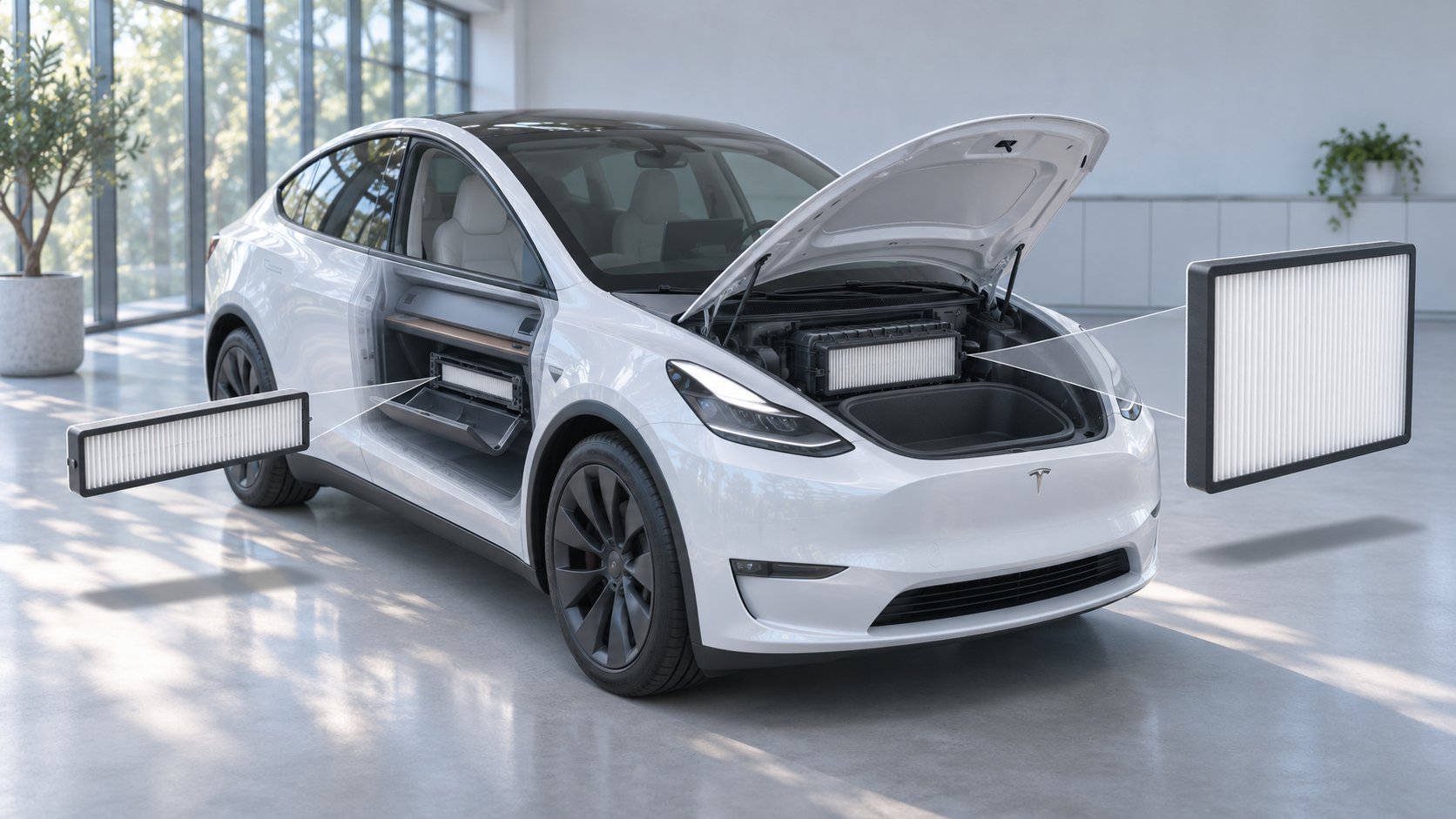
Most Tesla Model Y owners don't realize their vehicle can have two entirely separate air filtration systems working simultaneously. These aren't redundant backups or optional extras that do the same job. They sit in different locations, connect to different airflow paths, and protect you from different threats. Buying the wrong replacement — or skipping one entirely — means you're leaving a gap in your cabin's air quality defense.
Why Your Model Y Might Have Two Filter Systems
The first system is the pair of cabin air filters tucked behind your glovebox. These filters handle the air that's already circulating inside your car. Every time your HVAC system recirculates cabin air — pulling it through the vents, conditioning it, and pushing it back out — those glovebox filters catch dust, pet dander, allergens, and odors that accumulate from passengers, food, and everyday use. They're always active, regardless of which climate mode you're running.
The second system is the much larger HEPA filter mounted in the frunk. This one has a completely different job: it scrubs incoming outside air before it ever reaches the cabin. When your Model Y pulls in fresh air from the exterior — especially during Bioweapon Defense Mode — the frunk-mounted HEPA filter strips out smoke particles, pollen, industrial fallout, and ultrafine contaminants as small as 0.3 microns.
The cabin air filters sit behind the glovebox and filter recirculated interior air. The HEPA filter sits in the frunk and filters incoming outside air. They serve two completely different airflow paths — and one doesn't replace the other.
Here's the critical detail many owners miss: not every Model Y comes equipped with that frunk-mounted HEPA filter. Tesla made Bioweapon Defense Mode available on the Model Y starting in 2020, but availability has varied across trims and model years. If your climate control screen doesn't display a biohazard icon, your vehicle likely wasn't built with the HEPA system. That means your tesla y cabin air filter pair behind the glovebox is doing all the heavy lifting — and choosing the right replacement becomes even more important.
What This Guide Covers and Who It Helps
Whether your Model Y has a single filtration layer or the full dual-filter setup, picking the right replacement filter can feel overwhelming. Standard particulate filters, HEPA-rated upgrades, activated carbon options — the aftermarket is packed with choices, and the labels don't always tell the full story.
This guide breaks down the tesla model y cabin air filter vs hepa filter distinction in plain language, then ranks the best filter options across both categories. You'll find detailed reviews of OEM and aftermarket picks, a side-by-side comparison table, and clear recommendations based on your specific Model Y configuration. The goal is simple: help you spend your money on the filter that actually makes a measurable difference in the air you breathe every time you drive.
Choosing the right filter starts with understanding what each one is designed to capture — and that comes down to filtration standards, filter media, and real-world performance criteria.
How We Evaluated and Ranked These Filters
Not every tesla model y air filter is built to solve the same problem. Some catch pollen and dust but let smoke odors sail right through. Others tackle chemical fumes but ignore the fine particulate matter that actually triggers allergy symptoms. Picking a winner requires a consistent set of criteria — so before diving into individual reviews, here's exactly what we measured each filter against and why it matters for your daily driving experience.
Key Evaluation Criteria for Tesla Air Filters
Every filter in this guide was assessed across seven dimensions that directly affect what you'll notice behind the wheel:
- Filtration efficiency — What particle sizes does the filter actually capture? A filter rated for particles down to 0.3 microns protects against far more than one that only stops pollen-sized debris above 10 microns.
- Filter media composition — Is it a basic particulate mesh, HEPA-grade material, activated carbon, or a combination of layers? The media type determines which pollutants get trapped and which pass straight through.
- Compatibility with the Model Y HVAC system — Proper fitment isn't optional. A filter that's slightly too thick or too narrow can allow unfiltered air to bypass the media entirely, defeating its purpose.
- Ease of installation — Glovebox-mounted model y air filters take a few minutes and zero tools. Frunk-mounted HEPA units require partial liner removal and more patience. Both are DIY-friendly, but the effort gap is real.
- Replacement interval — Tesla's owner's manual recommends cabin air filter replacement every 2 years and HEPA filter replacement every 3 years. Driving in dusty or heavily polluted conditions can shorten those intervals significantly.
- Odor elimination capability — Particle filters alone won't fix that musty HVAC smell. Only filters with a meaningful activated carbon layer can adsorb the gas-phase molecules responsible for persistent odors.
- Approximate cost — Prices range from budget aftermarket options under $20 to OEM HEPA replacements that can run well over $100. Higher cost doesn't always mean better protection for your specific situation.
Filtration Standards Explained in Plain Language
You'll see terms like "HEPA H13" and "activated carbon" splashed across product listings, often with little explanation of what they actually mean. Here's the plain-English breakdown.
HEPA H13 refers to a specific filtration grade defined by international standards. A true H13 HEPA filter captures 99.97% of airborne particles at 0.3 microns — the particle size that's hardest to trap because it's too small to be caught by simple impact and too large to be captured by diffusion alone. If a filter meets this threshold, it handles everything from pollen and mold spores down to fine wildfire smoke particulate (PM2.5) and even many bacteria.
Activated carbon works through an entirely different mechanism. Instead of trapping particles mechanically, the porous carbon material adsorbs gas molecules — volatile organic compounds (VOCs), smoke odors, and chemical fumes — by bonding them to its massive internal surface area. Imagine millions of microscopic pockets acting like sponges for gas-phase pollutants that a particle filter simply can't touch. The thickness and weight of the carbon layer directly determines how long this odor control lasts before the material saturates.
Why does this distinction matter for your daily drive? Consider these real-world scenarios:
- Wildfire smoke season — You need HEPA-grade media for the hazardous PM2.5 particles, plus activated carbon for the lingering smoke smell.
- Heavy pollen season — Even a standard particulate filter catches pollen grains, but a HEPA-rated option also captures the much smaller allergenic fragments that trigger symptoms indoors.
- Urban commuting in traffic — Exhaust fumes are gas-phase pollutants. Only activated carbon addresses them. A particle-only filter won't reduce the chemical smell from bumper-to-bumper highway traffic.
The takeaway is straightforward: particle filters and gas-phase filters solve fundamentally different problems. The best tesla model y air filters combine both technologies — and the reviews ahead will show you exactly which options deliver that dual protection and which ones leave gaps.
CUTIM HEPA and Activated Carbon Filter for Tesla Model 3 and Y
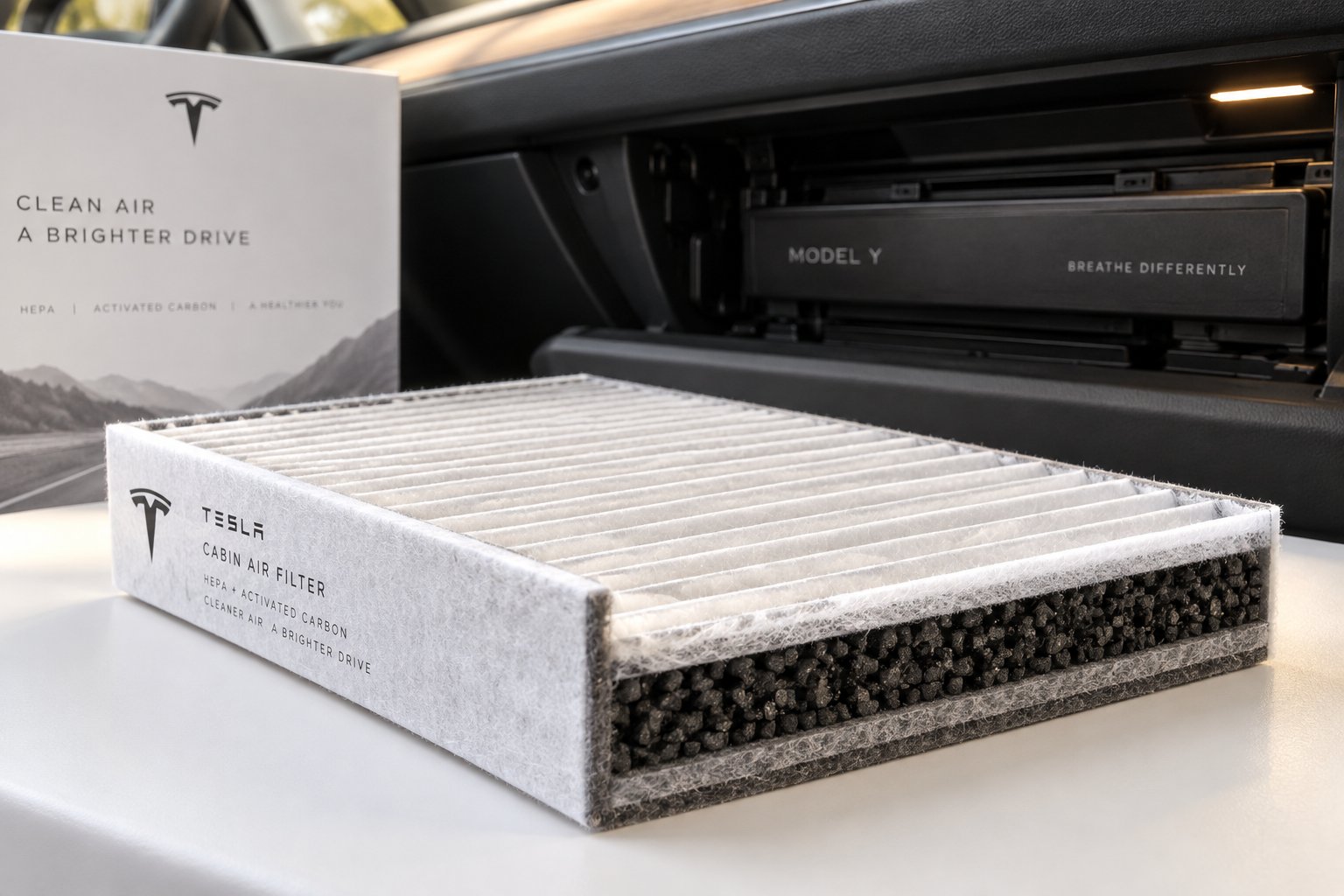
A filter that traps fine particles and eliminates gas-phase odors from a single glovebox slot — that's the exact dual-protection approach most OEM cabin filters lack. The CUTIM High-Efficiency HEPA & Activated Carbon Air Filter is designed to close that gap for Tesla Model 3 and Y owners who want meaningfully cleaner cabin air without touching the frunk or modifying any factory hardware.
CUTIM HEPA and Activated Carbon Filter Overview
Most standard cabin air filters rely on a single layer of particulate media — effective for dust and pollen, but essentially invisible to exhaust fumes, VOCs, and that persistent musty smell many Tesla owners report from their HVAC system. The CUTIM filter takes a fundamentally different approach by stacking two filtration technologies into one unit.
The first layer uses HEPA-style media engineered to capture ultrafine particulate matter, including PM2.5 particles from wildfire smoke and diesel exhaust soot that basic filters let pass through. The second layer integrates activated carbon designed to adsorb gaseous pollutants — the chemical odors, volatile organic compounds, and traffic fumes that no amount of particulate filtration can address. Together, these layers create what amounts to a tesla model y hepa carbon filter kit in a drop-in glovebox replacement form factor.
What makes this particularly practical is the installation process. You're not retrofitting new hardware or rerouting ductwork. The CUTIM filter slides into the same cabin air filter housing behind the glovebox, replacing the factory filters with zero modifications. If you've ever swapped a standard model 3/y air filter, you already know the steps — pop the glovebox, release the filter cover, slide the old filters out, and insert the new ones. The entire job takes roughly five minutes.
Who Benefits Most From This Upgrade
Imagine you own a Model Y that didn't come equipped with the frunk-mounted HEPA filter. Your glovebox filters are the only line of defense your cabin air has — and the factory-installed ones are basic particulate filters with no carbon layer. Every time your HVAC recirculates interior air, odors, chemical off-gassing, and fine particles just keep cycling through the cabin unchecked.
This is where a hepa air filter for tesla model y like the CUTIM option delivers the most dramatic improvement. By upgrading your glovebox slot to a combined HEPA and activated carbon filter, you're essentially adding the closest possible equivalent to HEPA-grade protection without needing the frunk-mounted system at all. It's the single highest-impact change a non-HEPA Model Y owner can make for cabin air quality.
That said, even owners with a factory HEPA system benefit from this upgrade. The frunk filter only processes incoming outside air. Your recirculated cabin air — the air that's already inside the vehicle picking up pet dander, food smells, and passenger allergens — still flows exclusively through the glovebox filters. Upgrading those filters to hepa cabin air filters for tesla model 3 and y means both airflow paths get comprehensive filtration, not just one.
Drivers who commute through heavy urban traffic, live in wildfire-prone regions, or simply notice a stale or musty odor when the AC kicks on will feel the difference most immediately. The activated carbon layer specifically targets the gas-phase molecules responsible for those persistent HVAC smells that particle-only filters can't touch.
Pros and Cons
Pros
- Dual-action filtration — Combines HEPA-style particulate capture with an activated carbon layer in a single unit, addressing both fine particles and gaseous pollutants simultaneously.
- Designed specifically for Model 3/Y — Purpose-built dimensions ensure proper fitment in the glovebox filter housing without air bypass or modification.
- Tackles HVAC odors directly — The activated carbon component adsorbs the VOCs and mustiness that standard particulate filters ignore entirely.
- Simple drop-in installation — No tools, no frunk disassembly, no dealer visit required. Five minutes and you're done.
- Best single upgrade for non-HEPA Model Y vehicles — Gives owners without the factory frunk filter the closest available HEPA-grade cabin protection in the easiest-to-access filter slot.
Cons
- Aftermarket product — As with any non-OEM filter, it's worth confirming the latest fitment details for your specific production year before ordering.
- May require more frequent replacement in harsh environments — The activated carbon layer can saturate faster in heavily polluted urban areas or during extended wildfire smoke exposure, potentially shortening the effective lifespan compared to a basic particulate-only filter.
For Tesla owners who want the most filtration performance possible from their glovebox filter slot, the CUTIM HEPA & Activated Carbon filter earns the top spot in this guide. It's the rare aftermarket option that genuinely fills a functional gap the OEM filters leave wide open — combining two filtration technologies where the factory gives you only one.
Of course, many Model Y owners stick with what Tesla provides out of the box. The OEM cabin air filters offer guaranteed compatibility and the peace of mind that comes with a factory part — but what exactly are you getting (and what are you giving up) with that choice?
Tesla OEM Cabin Air Filters for Model Y
The factory cabin air filter tesla model y owners receive from the assembly line is a straightforward particulate filter — nothing more, nothing less. It's built with standard filter media designed to block pollen, road dust, industrial fallout, and other larger airborne particles from entering the cabin through the HVAC vents. For everyday driving in relatively clean environments, it does a competent job. But if you're expecting it to scrub out exhaust fumes, wildfire smoke odors, or that musty AC smell many owners report after a few months, you'll be disappointed. The OEM tesla model y cabin filter simply wasn't engineered for those tasks.
What the Tesla OEM Cabin Air Filter Actually Does
Tesla's factory filters use a cotton-based particulate media that acts as a physical barrier against debris. Think of it as a fine mesh screen: particles above a certain size get caught in the fibers, while smaller contaminants and gas-phase molecules pass straight through unimpeded. There's no HEPA-rated layer to capture ultrafine PM2.5 particles, and there's no activated carbon to adsorb volatile organic compounds or persistent odors.
That's a meaningful limitation for a lot of real-world scenarios. Sitting in bumper-to-bumper traffic behind a diesel truck? The exhaust fumes flow right through the OEM media. Driving through a region affected by wildfire haze? The dangerous fine particles that make smoke harmful to breathe are largely below the capture threshold of a standard particulate filter. The OEM model y cabin filter keeps the obvious stuff out — visible dust, pollen grains, leaf fragments — but it leaves the invisible threats largely unaddressed.
On the positive side, fit and compatibility are never a question. These filters are built to the exact specifications of the Model Y's HVAC housing. You won't deal with air gaps, bypass leaks, or awkward fitment issues. They slide in and out cleanly, every time.
For the model y cabin air filter replacement process itself, Tesla's official DIY guide walks you through accessing the filters from the passenger-side footwell area. On vehicles manufactured prior to February 2025, you'll remove a side panel from the center console, disconnect two electrical connectors in the footwell cover, release the filter cover (secured by either a 6 mm screw or squeeze tabs depending on production date), and swap the upper and lower filter units. Newer vehicles from approximately February 2025 onward simplify the process slightly with updated panel clips and tab-only cover retention. Either way, the entire tesla model y cabin filter replacement takes most owners under 30 minutes with no special tools required.
Replacement filters are available through the Tesla Shop and Tesla service centers. Pricing tends to run at a premium compared to equivalent aftermarket options — a common trade-off with OEM parts across the auto industry. If you're approaching a 2023 tesla model y cabin air filter replacement and comparing options, the OEM set typically costs more per unit than aftermarket alternatives offering equal or superior filtration media.
As for timing, Tesla recommends replacing cabin air filters every 2 years. In practice, that interval can shrink dramatically depending on your environment. Owners who commute through dusty construction zones, live in high-pollen regions, or regularly drive in heavy urban pollution often notice reduced airflow or stale cabin odors well before the two-year mark. A good rule of thumb: if your HVAC starts producing a "dirty sock" smell or your allergies flare up inside the car, it's time — regardless of the calendar.
OEM Filter Pros and Cons
Pros
- Guaranteed OEM fit — Manufactured to Tesla's exact specifications, so fitment in the HVAC housing is always precise with zero air bypass.
- Readily available through Tesla service centers — No hunting for third-party sellers or verifying compatibility charts. Order directly from Tesla or pick them up at your next service appointment.
- No compatibility concerns — Works with every Model Y production year without needing to cross-reference part numbers or worry about dimensional variations.
Cons
- No activated carbon for odor control — The standard media captures particles but does nothing to adsorb gases, VOCs, exhaust fumes, or that persistent musty HVAC smell.
- Not HEPA-rated for ultrafine particles — Fine particulate matter like PM2.5 from wildfire smoke or diesel exhaust passes through the OEM media largely unfiltered.
- Premium-priced relative to aftermarket alternatives — You're paying more per filter set than comparable (or superior) aftermarket options that often include activated carbon or HEPA-grade media at a lower cost.
The OEM cabin air filter is a safe, predictable choice — but "safe" and "optimal" aren't the same thing. For owners who want reliable particulate filtration and don't mind paying the Tesla premium for guaranteed compatibility, it gets the job done at a basic level. For everyone else, the limitations in odor control and fine-particle capture leave room for meaningful upgrades.
The story shifts considerably when you move from the glovebox to the frunk. Tesla's factory HEPA filter operates on an entirely different scale — larger, more capable, and significantly more expensive to replace.
Tesla OEM HEPA Filter With Bioweapon Defense Mode
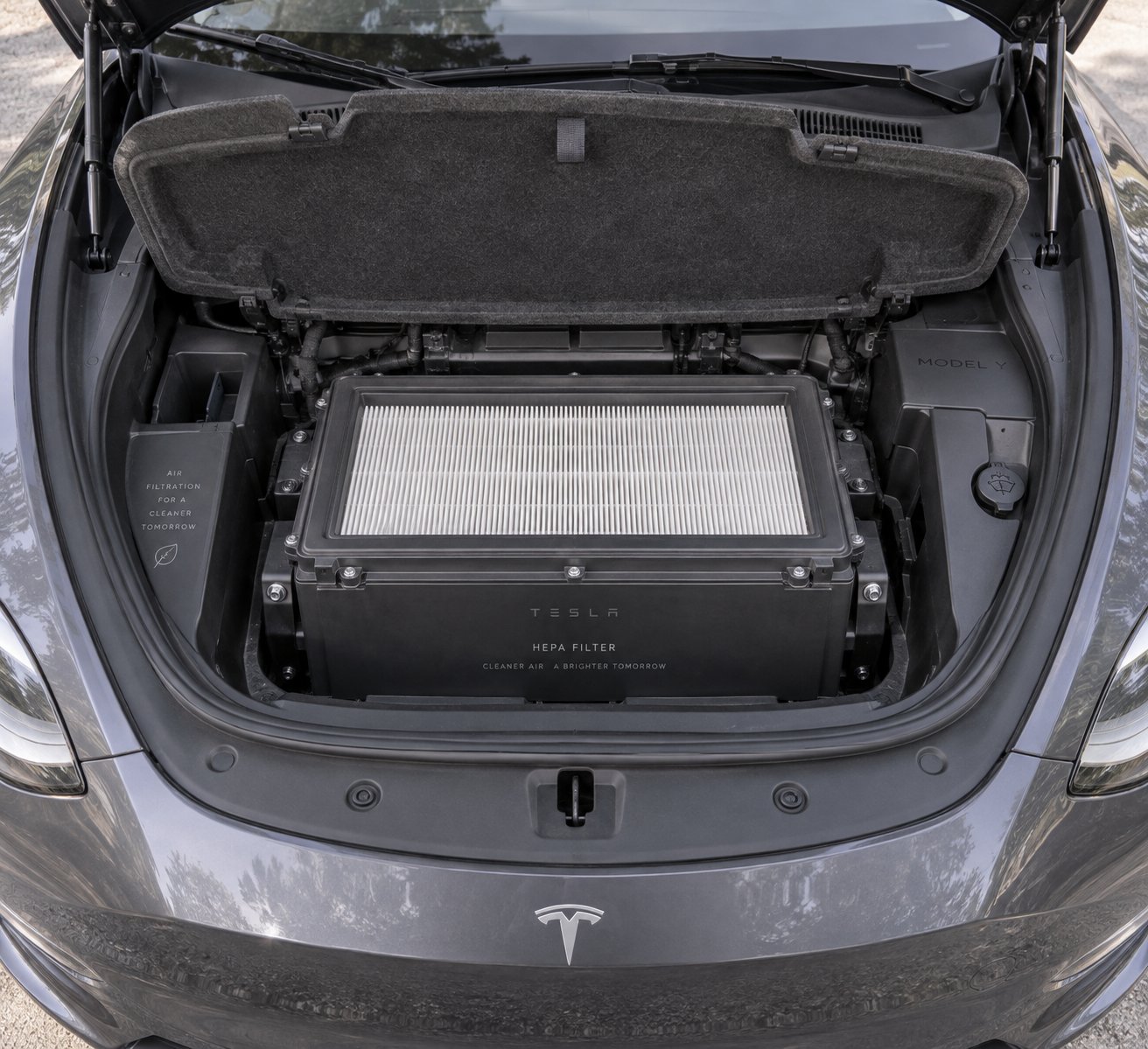
If the glovebox cabin air filters are the everyday workhorses of your Model Y's air quality system, the frunk-mounted HEPA filter is the heavy artillery. This unit is physically massive compared to those slim glovebox panels — and it needs to be. Its job isn't to clean the air that's already inside your cabin. Instead, the model y hepa filter intercepts every cubic foot of outside air before it crosses the threshold into your vehicle's interior, stripping out ultrafine particles, allergens, bacteria, and even some viruses along the way.
That distinction matters more than most owners realize. You could have the best aftermarket cabin air filters money can buy behind your glovebox, and they still won't touch the quality of the fresh air flowing in from outside. The tesla hepa filter handles that entire pathway independently — and it does so at a filtration grade that captures 99.97% of particles as small as 0.3 micrometers. That's true HEPA H13 performance, not "HEPA-style" or "HEPA-like" marketing language. It's the same standard used in hospital-grade air purification systems.
How the Frunk-Mounted HEPA Filter Differs From Cabin Filters
Picture two completely separate plumbing systems in a house — one handling the water that recirculates through the radiators, and another filtering the fresh water coming in from the street. That's essentially how the Model Y's dual filtration architecture works. The glovebox cabin air filters clean recirculated interior air. The frunk-mounted HEPA filter scrubs incoming outside air. They never overlap, never compete, and never substitute for each other.
The physical differences are just as stark. Where the cabin air filters are relatively thin rectangular panels that slide easily in and out of a compact housing, the tesla model y hepa filter is a substantially larger unit nested within the frunk area. Tesla's Bioweapon Defense Mode leverages this filter to create a positive pressure environment inside the cabin — essentially pushing filtered air outward through any gaps so that unfiltered outside air physically cannot seep in. It's the same principle used in hospital cleanrooms and pharmaceutical manufacturing facilities, applied to a consumer vehicle.
When Bioweapon Defense Mode activates, external air gets pulled through both the HEPA media and an additional activated carbon filter layer before entering the cabin. The HEPA layer handles particulate matter — smoke, pollen, mold spores, fine dust. The carbon layer adsorbs gaseous pollutants like VOCs and chemical fumes. Together, they provide the most comprehensive outside-air protection available in any production vehicle.
Can You Retrofit a HEPA Filter to a Non-HEPA Model Y
Here's a question that comes up constantly in Tesla forums: "My Model Y didn't come with the HEPA filter. Can I add one?" The answer is more nuanced than a simple yes or no.
When the Model Y first launched in early 2020, it did not include a HEPA filter. Tesla began incorporating HEPA filters into the Model Y production line in June 2021. That means any Model Y built before that date shipped without the frunk-mounted system — and many owners of those earlier vehicles have been eager to upgrade ever since.
The good news: Tesla eventually responded. The company launched an official retrofit service for 2020 and 2021 Model Y vehicles in the United States and Canada, priced at $330 USD. Owners can schedule this service directly through the Tesla mobile app. The retrofit installs the HEPA filter hardware and enables Bioweapon Defense Mode in the vehicle's software — a legitimate factory-supported upgrade, not a hack or third-party modification.
There are practical limitations worth noting, though. The retrofit program has been specifically targeted at early Fremont-built Model Y vehicles. Availability can vary by region, and Tesla controls the scheduling through its own service infrastructure. You can't simply buy the filter online and install it yourself — the software activation component requires Tesla's involvement. If you're checking whether your specific vehicle qualifies, the Tesla app's service section is the most reliable place to verify eligibility.
For owners of mid-2021 and later Model Y vehicles, the HEPA system should already be factory-installed. A quick way to check: look for the biohazard icon on your climate control screen. If it's there, you have the hardware. If not, you're working with the glovebox cabin filters alone.
OEM HEPA Filter Pros and Cons
Replacing the model y hepa filter is a more involved process than swapping the glovebox cabin air filters. You'll need to open the frunk and partially remove the frunk liner to access the filter housing — a job that requires more patience, a bit more mechanical confidence, and typically 30 to 45 minutes of hands-on work. It's still a DIY-friendly task for most owners, but it's a meaningful step up in complexity from the five-minute glovebox swap.
The tesla hepa filter replacement cost is also substantially higher than cabin air filter replacements. Where aftermarket glovebox filters can run under $20 and OEM cabin filters sit in the mid-range, HEPA replacement filters carry a premium price tag that reflects the larger filter size, higher-grade media, and the additional activated carbon layer. Budgeting for the model y hepa filter replacement every three years — Tesla's recommended interval — means planning for a noticeably bigger line item than the cabin filters demand on their two-year cycle.
Pros
- Highest level of outside-air filtration available — True HEPA H13 media captures 99.97% of particles at 0.3 microns, covering wildfire smoke, pollen, mold spores, bacteria, and ultrafine industrial particulate.
- Enables Bioweapon Defense Mode — Creates positive cabin pressure that actively prevents unfiltered air from entering through gaps, cracks, or door seals. No other production vehicle offers this level of cabin isolation.
- Includes activated carbon filtration for incoming air — The system doesn't just trap particles from outside air; it also adsorbs gaseous pollutants and chemical fumes before they reach passengers.
- Factory-supported with official Tesla retrofit option — Even early Model Y owners without the original hardware can get the system installed through Tesla service at a known price point.
Cons
- Significantly higher replacement cost — The tesla hepa filter replacement cost runs well above cabin air filter pricing, making it the most expensive single filter maintenance item on the Model Y.
- Not available on all Model Y trims and model years — Pre-June 2021 vehicles require the retrofit service, and availability may vary by region and production configuration.
- More complex replacement process — Partial frunk liner removal adds time and effort compared to the simple glovebox access for cabin air filters. Some owners prefer having Tesla service handle it rather than tackling it themselves.
- Only filters outside air intake — Despite its impressive capabilities, the HEPA filter does nothing for recirculated cabin air. Odors, pet dander, and allergens already inside the vehicle bypass this system entirely.
The OEM HEPA filter represents the gold standard for incoming air protection in the Model Y lineup. But its premium cost, limited availability across model years, and exclusive focus on outside air mean it's only one half of a complete air quality strategy. The recirculated air flowing through your glovebox filters still needs its own solution — which is exactly why the aftermarket has stepped in with brand-name alternatives that aim to match OEM quality at a friendlier price point.
MANN Aftermarket Cabin Air Filter for Model Y
Brand-name aftermarket filters occupy an interesting middle ground in the tesla model y filter replacement market. They promise OEM-level quality without the OEM price tag — and few names carry more weight in automotive filtration than MANN. If you've ever replaced a cabin or oil filter on a European vehicle, chances are you've already encountered their products. MANN-FILTER, produced by the German manufacturer MANN+HUMMEL, has been building filtration systems for automakers worldwide for decades, supplying original equipment to brands like BMW, Mercedes-Benz, and Volkswagen.
That pedigree is exactly why so many Tesla owners search specifically for a mann filter tesla model y option when it's time for a model y air filter replacement. There's a built-in trust factor that generic no-name brands simply can't replicate overnight.
MANN Filter as an Aftermarket Alternative
MANN's cabin air filter offerings for the Model Y generally deliver particulate filtration on par with Tesla's own factory filters — trapping dust, pollen, and airborne debris using quality filter media. Some MANN variants also incorporate an activated carbon layer (often marketed under the MANN FreciousPlus line), which adds gas-phase adsorption for exhaust fumes and odors that standard particulate-only filters miss.
One important nuance: if you're shopping for a 2023 tesla model y cabin air filter from MANN, verify the exact part number before purchasing. Tesla has updated the Model Y's HVAC housing and filter dimensions across production years, meaning a filter that fits a 2021 vehicle perfectly might not seat correctly in a newer build. MANN typically lists vehicle compatibility by year and production date on its packaging, but double-checking against your VIN or build date eliminates guesswork entirely.
Pricing tends to land below what Tesla charges for OEM replacements, making this a practical choice for owners who want a trusted brand at a lower cost per tesla y air filter replacement cycle. MANN filters are widely stocked through major auto parts retailers and online marketplaces, so sourcing them is rarely an issue.
Pros and Cons of Choosing MANN
Pros
- Established automotive filter brand — Decades of OE manufacturing experience across major automakers lends genuine credibility to filtration performance claims.
- Typically lower cost than OEM — Competitive pricing makes routine replacement more budget-friendly without sacrificing build quality.
- Widely available through auto parts retailers — Stocked by major online and brick-and-mortar sellers, so you're not dependent on Tesla service center inventory or shipping timelines.
- Activated carbon variants available — The FreciousPlus line adds odor and gas adsorption capability that Tesla's standard OEM cabin filter lacks.
Cons
- Part number compatibility requires verification — Filter dimensions can differ between Model Y production years and build configurations. Always confirm fitment for your specific vehicle before ordering.
- Standard variants may lack HEPA-grade media — The base particulate filter matches OEM capture capability but doesn't reach true H13 HEPA efficiency for ultrafine particles.
- Fitment may vary slightly from OEM — Some owners have reported minor dimensional differences that require a bit of extra effort during installation, though functional air bypass is uncommon with correctly matched part numbers.
MANN represents a solid, reliable middle path for the 2023 tesla model y cabin air filter replacement and beyond — better brand assurance than unknown sellers, friendlier pricing than Tesla's own parts catalog. It's a smart pick for owners who prioritize proven manufacturing quality and don't necessarily need the maximum HEPA-plus-carbon filtration that specialty aftermarket options provide.
MANN isn't the only aftermarket player in this space, though. A growing wave of lesser-known brands now markets HEPA-rated and activated carbon cabin filters specifically for the Model Y — often at the lowest price points you'll find anywhere. The question is whether those budget options actually deliver on their filtration promises.
Other Aftermarket HEPA-Rated Cabin Filters Worth Considering
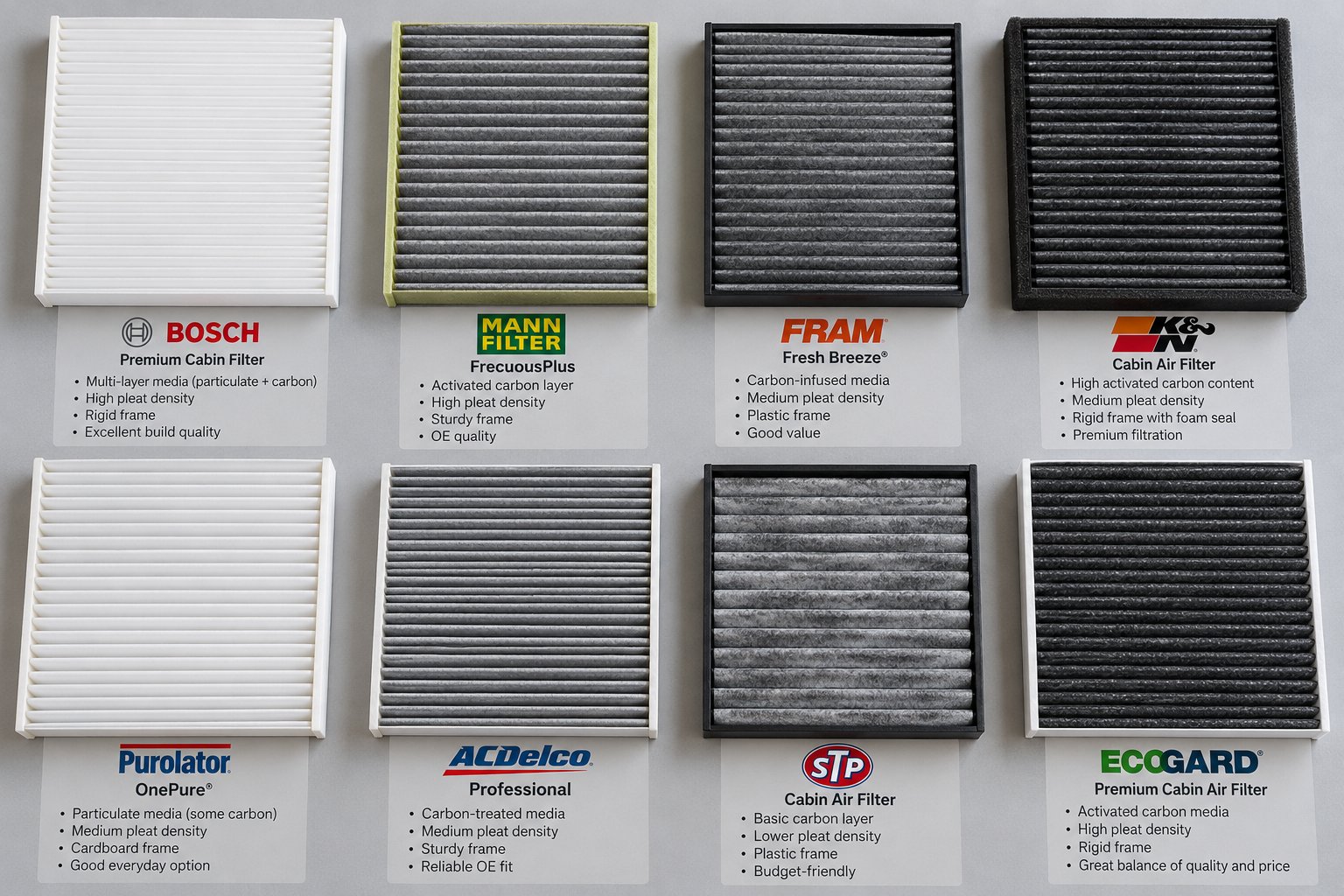
Search "hepa filter for tesla model y" on Amazon and you'll get pages of results from brands you've probably never heard of. Some promise hospital-grade filtration for under $15. Others bundle a double hepa filter x2 set claiming N98 or HEPA-equivalent ratings alongside activated carbon layers — all at a fraction of what Tesla or MANN charges. The sheer volume of options reflects real demand: Tesla owners want better cabin air filtration, and the aftermarket has responded aggressively. The real question isn't whether budget alternatives exist. It's whether any of them actually work as advertised.
The honest answer? Some do, and some absolutely don't. This category spans everything from genuinely well-engineered tesla model y hepa filters built by smaller filtration specialists to hastily assembled products where "HEPA-rated" is more marketing aspiration than verified performance. The gap between the best and worst offerings here is wider than in any other filter category covered in this guide — which means your purchasing decisions need to be sharper, too.
What to Look for in Generic Aftermarket Filters
Before adding any budget hepa filter tesla option to your cart, run through these four checkpoints:
- Verified particle capture ratings — Look for filters that cite specific testing standards, not vague claims like "captures 99% of particles." A credible listing specifies the particle size threshold (0.3 microns for true HEPA) and references a recognized filtration standard. If the product page can't tell you what was tested or how, treat the claim with skepticism.
- Proper fitment dimensions — Even a millimeter of gap between the filter and the HVAC housing allows unfiltered air to bypass the media entirely. Check that the listing confirms compatibility with your specific Model Y production year, and read owner reviews for mentions of loose fit or trimming required.
- Quality activated carbon — not just a coating — Some budget filters advertise "activated carbon filtration" but use only a thin carbon-infused spray on the outer layer. That saturates within weeks and provides almost no meaningful odor control. A genuine carbon layer has visible thickness and weight. If the filter feels suspiciously light for its size, the carbon component is likely cosmetic.
- Tesla owner reviews confirming real-world compatibility — Skip the generic five-star reviews and look specifically for feedback from Model Y owners who mention their build year, installation fit, and whether they noticed a difference in air quality or HVAC odor. A double hepa filter x2 pack with hundreds of verified Tesla-specific reviews carries far more credibility than one with only generic automobile ratings.
These checkpoints won't guarantee perfection, but they filter out the worst offenders before your money leaves the account. Owners shopping for a tesla model y hepa filter kit from lesser-known brands should also consider buying from retailers with straightforward return policies — if the fitment is off or the filtration falls short, you want a clean exit.
Pros and Cons of Budget Aftermarket Options
Pros
- Often the lowest price point available — Budget aftermarket filters can cost half or less what OEM or premium aftermarket options charge, making frequent hepa filter replacement tesla model y cycles far more affordable.
- Many options combine activated carbon with improved particulate filtration — The best budget filters genuinely offer dual-layer protection that Tesla's standard OEM cabin filter lacks.
- Widely available on Amazon and auto parts sites — No waiting for Tesla service appointments or hunting through specialty retailers. Most ship with Prime delivery and arrive within days.
Cons
- Filtration claims may not be independently verified — Without third-party lab testing, "HEPA-rated" on a product listing is a marketing decision, not a performance guarantee.
- Inconsistent quality between brands — Two identically priced filters from different sellers can perform radically differently. One might rival premium aftermarket options; the other might barely outperform a basic particulate filter.
- Fitment issues reported with some budget options — Slightly undersized or oversized filters create bypass gaps that defeat the purpose of upgrading. Several tesla model y hepa filters from generic sellers have drawn complaints about dimensional inaccuracies.
- Activated carbon quality varies widely — The difference between a thick, densely packed carbon layer and a thin carbon-dusted surface translates directly into how long odor control actually lasts. Budget options tend to skimp here first.
Generic aftermarket filters aren't inherently bad — they're inherently inconsistent. The best ones punch well above their price point and give budget-conscious owners a genuine upgrade path. The worst ones deliver filtration theater: impressive-sounding specs on the listing, underwhelming performance in your HVAC system. Knowing what to look for is the difference between a smart buy and wasted money.
With five distinct filter options now on the table — from premium OEM to budget aftermarket — the obvious next step is laying them all side by side. How do they actually compare across the dimensions that matter most for your daily drive?
Side-by-Side Comparison of All Five Filter Options
Five filters, two installation locations, wildly different price tags — and each one fills a different niche in the Tesla Model Y's air quality ecosystem. Seeing them all lined up in a single view cuts through the noise faster than any individual review can. The table below maps every option against the evaluation criteria covered earlier, so you can match each filter's strengths to your specific driving environment and budget.
Complete Feature Comparison Table
| Filter Option | Filter Type | Filtration Media | Installation Location | What It Captures | Airflow Mode | Replacement Interval | Cost Tier |
|---|---|---|---|---|---|---|---|
| CUTIM HEPA & Activated Carbon | Hybrid (HEPA + Carbon) | HEPA-style media + activated carbon layer | Glovebox (cabin) | Fine particles (PM2.5), pollen, dust, VOCs, gases, HVAC odors | Recirculated cabin air | ~1-2 years (shorter in polluted areas) | Mid-range |
| Tesla OEM Cabin Air Filter | Standard cabin | Standard particulate media | Glovebox (cabin) | Dust, pollen, larger airborne particles | Recirculated cabin air | ~2 years | Mid-to-premium |
| Tesla OEM HEPA Filter | HEPA (H13) | True HEPA H13 + activated carbon | Frunk | Ultrafine particles (0.3 microns), smoke, pollen, bacteria, gases, chemical fumes | Fresh outside air intake | ~3 years | Premium |
| MANN Aftermarket Cabin Filter | Standard cabin (carbon variant available) | OEM-equivalent particulate; FreciousPlus adds activated carbon | Glovebox (cabin) | Dust, pollen, larger particles; carbon variant adds odors and gases | Recirculated cabin air | ~2 years | Budget-to-mid-range |
| Generic Aftermarket HEPA-Rated | Hybrid (varies by brand) | HEPA-style or N98 media; some include activated carbon | Glovebox (cabin) | Varies — best options capture fine particles and odors; worst barely exceed OEM | Recirculated cabin air | ~1-2 years (varies widely) | Budget |
A few patterns jump out immediately. The tesla cabin air filter model y options — whether OEM, MANN, CUTIM, or generic — all install in the same glovebox location and handle recirculated cabin air. The frunk-mounted OEM HEPA filter is the only option that touches incoming outside air. These two filtration paths never overlap, which means you're not choosing between them. You're deciding how much protection to put on each path independently.
Cost differences are equally revealing. The tesla air filter replacement cost for a basic OEM cabin filter set runs higher per unit than most aftermarket alternatives offering equal or better media. Meanwhile, the frunk HEPA replacement commands the highest tesla air filter change cost of any single filter on this list — a reflection of its larger size, higher-grade materials, and the Bioweapon Defense Mode functionality it supports. Budget aftermarket options sit at the opposite end, though their inconsistent quality means the lowest sticker price doesn't always translate to the best value.
Real-World Performance by Scenario
Specs on paper only tell half the story. What really matters is how each hepa filter tesla model y option — or combination of options — performs against the air quality threats you actually encounter. Here's how the five filters stack up in the scenarios that affect Tesla owners most:
| Driving Scenario | Best Filter Choice | Why |
|---|---|---|
| Wildfire smoke season | OEM HEPA (frunk) + CUTIM HEPA & Carbon (glovebox) | Wildfire smoke contains both hazardous PM2.5 particles and persistent gas-phase odors. The frunk HEPA captures fine particles from incoming air; the CUTIM filter's carbon layer adsorbs smoke odors from recirculated cabin air. Neither alone covers both threats. |
| Heavy pollen season | Any cabin filter (glovebox) — even OEM handles pollen grains | Pollen particles are large enough that standard particulate filters catch them effectively. Upgrading to HEPA-grade media helps capture smaller allergenic fragments that trigger symptoms even indoors. |
| Urban commuting with traffic fumes | CUTIM HEPA & Carbon (glovebox) or MANN FreciousPlus | Exhaust fumes are gas-phase pollutants. Only activated carbon adsorbs them. A particle-only filter — whether OEM or budget aftermarket — lets these chemical odors pass straight through. |
| Highway driving in clean air | Tesla OEM cabin filter or MANN standard | With minimal pollution exposure, a basic particulate filter handles road dust and general debris without issue. Upgrading to HEPA-grade media offers marginal benefit in these conditions. |
Notice how wildfire smoke and urban commuting — arguably the two most concerning scenarios for health — both demand filtration beyond what the standard OEM tesla model y cabin filters provide. In both cases, activated carbon is the missing ingredient that separates adequate protection from comprehensive protection.
Combining a HEPA-rated cabin air filter in the glovebox with the frunk-mounted HEPA filter (if your Model Y is equipped) provides the most comprehensive air quality protection available — covering both recirculated interior air and incoming outside air across particle and gas-phase pollutants simultaneously.
For owners whose vehicles lack the frunk HEPA system entirely, the glovebox filter upgrade becomes even more critical. It's your only filtration layer, and choosing one with both HEPA-style particle capture and meaningful activated carbon is the single most effective improvement you can make. The comparison data makes a clear case: a hybrid filter in the glovebox slot delivers the best balance of protection, practicality, and cost for the widest range of real-world conditions.
With the performance picture now fully mapped, the final question is the most practical one — which filter should you actually buy, given your specific Model Y configuration and the conditions you drive in every day?
Our Final Verdict and Top Recommendations
Every filter reviewed in this guide solves a real problem — but not every filter solves your problem. Your ideal tesla model y air filter replacement depends entirely on two things: whether your vehicle came equipped with the frunk-mounted HEPA system and how much filtration performance you're willing to invest in. Rather than offering a one-size-fits-all answer, here are specific recommendations tailored to the three most common owner scenarios.
Best Filter Choice by Owner Scenario
Scenario 1: You have a factory HEPA filter and need to replace both systems.
If your Model Y includes Bioweapon Defense Mode and the frunk-mounted HEPA unit, you already have the best outside-air protection available in any production vehicle. Your priority should be matching that level of quality on the recirculated air side. Replace the frunk HEPA filter on Tesla's recommended 3-year interval using the OEM replacement to maintain Bioweapon Defense Mode performance. For the glovebox cabin filters, upgrade from the basic OEM particulate media to a combined HEPA and activated carbon option. This ensures your recirculated air gets the same caliber of dual-layer treatment that your incoming outside air receives — particle capture plus gas-phase adsorption working together on both airflow paths.
Scenario 2: You don't have a factory HEPA filter and want the best possible cabin air quality.
This is where the right filter choice makes the biggest difference. Without the frunk-mounted HEPA system, your glovebox cabin filters are doing 100% of the work. The standard OEM filters installed in that slot are basic particulate panels — they catch pollen and dust but let fine smoke particles, exhaust fumes, and HVAC odors pass straight through. Upgrading to a tesla model y hepa air filter replacement that combines HEPA-style media with a meaningful activated carbon layer is the single highest-impact improvement you can make. You're essentially compensating for the absent frunk HEPA by maximizing what the glovebox slot can deliver. The tesla model y cabin air filter replacement cost for this type of upgrade runs significantly less than the frunk HEPA retrofit ($330 through Tesla service), making it the most cost-effective path to dramatically cleaner cabin air.
Scenario 3: You're on a tight budget and want solid filtration at the lowest cost.
A reputable brand-name aftermarket filter like the MANN FreciousPlus (activated carbon variant) gives you meaningful odor control and reliable particulate filtration at a price point below OEM. If even that feels like a stretch, a well-reviewed generic aftermarket option with verified Tesla owner feedback can work — just apply the quality checkpoints covered earlier: proper fitment, credible particle capture ratings, and a genuinely thick carbon layer rather than a cosmetic coating. Budget filters aren't inherently bad, but you need to vet them more carefully since quality varies dramatically across sellers.
Which Filter Should You Replace First
If both your glovebox cabin filters and your frunk HEPA filter are due for replacement, which one deserves your attention — and your money — first? Start with the cabin air filters. Here's why:
- They're easier and faster to access — A glovebox swap takes five to ten minutes with no tools. The frunk HEPA requires partial liner removal and significantly more time.
- They're less expensive to replace — Even a premium aftermarket cabin filter costs a fraction of what a frunk HEPA replacement runs. You get a meaningful air quality upgrade for a smaller financial commitment.
- They filter all recirculated air — Every breath you take inside the cabin passes through the glovebox filters. The frunk HEPA only processes incoming outside air. If you had to choose one system to optimize first, the one that handles the air you're actively breathing is the obvious priority.
- They address the most common complaints — Musty HVAC odors, stale cabin smell, and allergy flare-ups inside the car are all recirculated-air problems. Upgrading the tesla model y ac filter in the glovebox slot — especially to a version with activated carbon — directly targets these issues. The frunk HEPA, no matter how powerful, won't fix an odor that's already circulating inside.
Think of it this way: replacing the cabin air filters is the quick win. It costs less, takes less effort, and produces an immediately noticeable improvement in the air quality you experience every single drive. The frunk HEPA replacement is important too, but it's the second move — not the first.
Our Top Overall Pick
Across all five options reviewed, here's how we rank the recommendations for owners seeking the best tesla model y air conditioner filter upgrade:
- CUTIM High-Efficiency HEPA & Activated Carbon Air Filter — The top pick for owners who want maximum filtration from the glovebox slot. Combines HEPA-style particulate capture with a dedicated activated carbon layer for gas-phase pollutants and HVAC odors in a single drop-in unit. Particularly valuable for non-HEPA Model Y vehicles where the glovebox filters are the only line of defense, and equally beneficial for HEPA-equipped vehicles where recirculated air still needs comprehensive treatment.
- Tesla OEM HEPA Filter (frunk-mounted) — Essential for maintaining Bioweapon Defense Mode on equipped vehicles. The gold standard for outside-air filtration, but only relevant if your Model Y has the hardware. Replace on Tesla's recommended 3-year cycle.
- MANN FreciousPlus (activated carbon variant) — A strong middle-ground choice for owners who want brand-name reliability with carbon-layer odor control at a lower price than OEM. Verify part number compatibility for your build year.
- Tesla OEM Cabin Air Filter — Guaranteed fit with zero compatibility concerns, but limited to basic particulate filtration with no carbon layer. Best suited for owners who prioritize factory-spec simplicity over maximum air quality performance.
- Generic aftermarket HEPA-rated filters — The most affordable entry point, and some deliver genuinely good performance. Quality is inconsistent across brands, so careful vetting through owner reviews and fitment verification is non-negotiable.
The tesla model y ac filter upgrade that delivers the most dramatic, immediately noticeable improvement for the broadest range of owners — especially those driving without a factory HEPA system — is a combined HEPA and activated carbon cabin air filter in the glovebox slot. It addresses the two biggest gaps the standard OEM filter leaves open: ultrafine particle capture and gas-phase odor elimination.
For most Tesla Model Y owners, upgrading the glovebox cabin air filters to a combined HEPA and activated carbon option like the CUTIM filter is the single most impactful, most accessible, and most cost-effective improvement you can make to your cabin air quality — whether or not your vehicle has a factory frunk-mounted HEPA system.
Clean cabin air isn't a luxury feature. It's the air you and your passengers breathe every mile of every drive. The hepa filter replacement tesla owners often put off is one of the simplest maintenance tasks on the entire vehicle — and choosing the right filter turns a routine swap into a genuine quality-of-life upgrade. Don't buy the wrong one. Match the filter to your vehicle, your environment, and the threats that actually matter for your daily commute.
Frequently Asked Questions About Tesla Model Y Air Filters
1. What is the difference between a Tesla Model Y cabin air filter and a HEPA filter?
The cabin air filter sits behind the glovebox and cleans recirculated air already inside the vehicle, trapping dust, pollen, and allergens. The HEPA filter is a much larger unit mounted in the frunk that scrubs incoming outside air before it enters the cabin, capturing 99.97% of particles down to 0.3 microns. They serve two completely separate airflow paths and one does not replace the other. Not all Model Y trims include the frunk-mounted HEPA filter, so owners without it rely entirely on the glovebox filters for air quality protection.
2. Does every Tesla Model Y come with a HEPA filter?
No. Tesla began incorporating HEPA filters into the Model Y production line in June 2021. Vehicles built before that date were not equipped with the frunk-mounted HEPA system. Tesla later introduced an official retrofit service for eligible 2020 and 2021 Model Y vehicles at $330 USD, available through the Tesla mobile app. You can check whether your vehicle has the HEPA system by looking for the biohazard icon on the climate control screen — if it is not there, your Model Y likely lacks the hardware.
3. How often should I replace the cabin air filter and HEPA filter in a Tesla Model Y?
Tesla recommends replacing cabin air filters every 2 years and the frunk-mounted HEPA filter every 3 years. However, these intervals can shorten significantly if you drive in dusty areas, high-pollen regions, or cities with heavy air pollution. Signs that your cabin air filter needs earlier replacement include reduced HVAC airflow, a musty or stale odor when the AC runs, and increased allergy symptoms inside the car. Upgrading to a combined HEPA and activated carbon cabin filter, such as the CUTIM filter, can address odor issues that basic particulate filters cannot.
4. Can I upgrade my Tesla Model Y cabin air filter to a HEPA filter?
You cannot install a true frunk-mounted HEPA filter yourself since Tesla controls the hardware installation and software activation for Bioweapon Defense Mode. However, you can upgrade your glovebox-mounted cabin air filters to HEPA-rated aftermarket options that combine HEPA-style particle capture with activated carbon layers. Products like the CUTIM High-Efficiency HEPA and Activated Carbon Air Filter drop directly into the existing glovebox filter housing with no modifications, giving you significantly better filtration than the standard OEM particulate filter on recirculated cabin air.
5. Is it worth getting an activated carbon cabin air filter for a Tesla Model Y?
Yes, especially if you deal with HVAC odors, commute in heavy traffic, or live in a wildfire-prone region. Standard OEM cabin filters only capture particles like dust and pollen but cannot adsorb gas-phase pollutants such as exhaust fumes, VOCs, or that musty AC smell many owners report. An activated carbon layer works through a completely different mechanism, bonding gas molecules to its porous surface. Filters that combine HEPA-style media with activated carbon — like the CUTIM filter for Model 3 and Y — address both particle and gas-phase threats simultaneously from a single glovebox filter slot.