
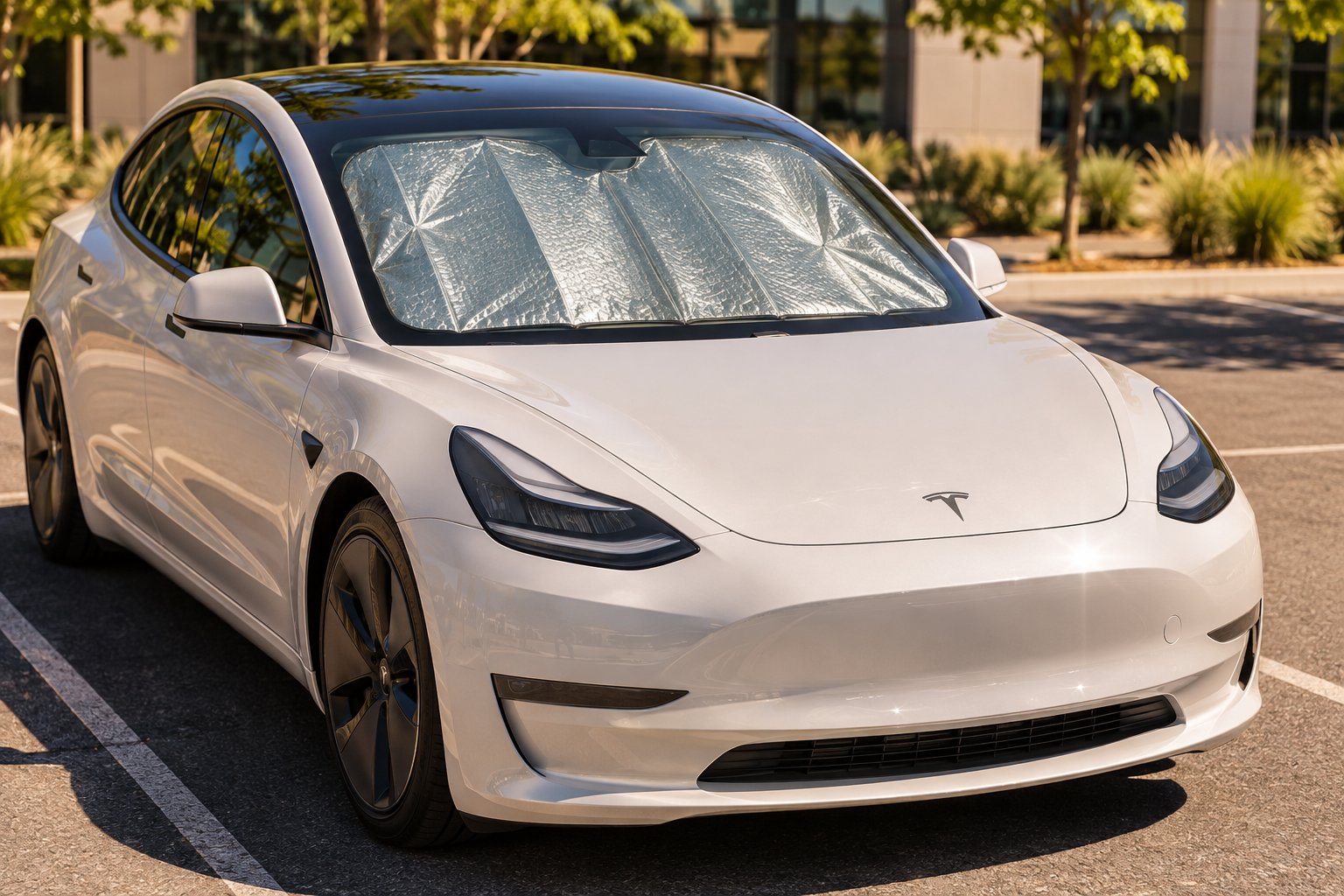
Why the Tesla Model 3 Needs a Windshield Sunshade More Than Most Cars
Imagine walking back to your parked Tesla Model 3 on a summer afternoon. You open the door and a wall of heat hits you. The steering wheel is too hot to grip, the dashboard radiates warmth like an oven, and the center touchscreen has dimmed itself to cope with the temperature. This scenario is far more common in a Model 3 than in most traditional vehicles, and the reason comes down to one defining design choice: glass — and a lot of it.
The All-Glass Cabin Problem
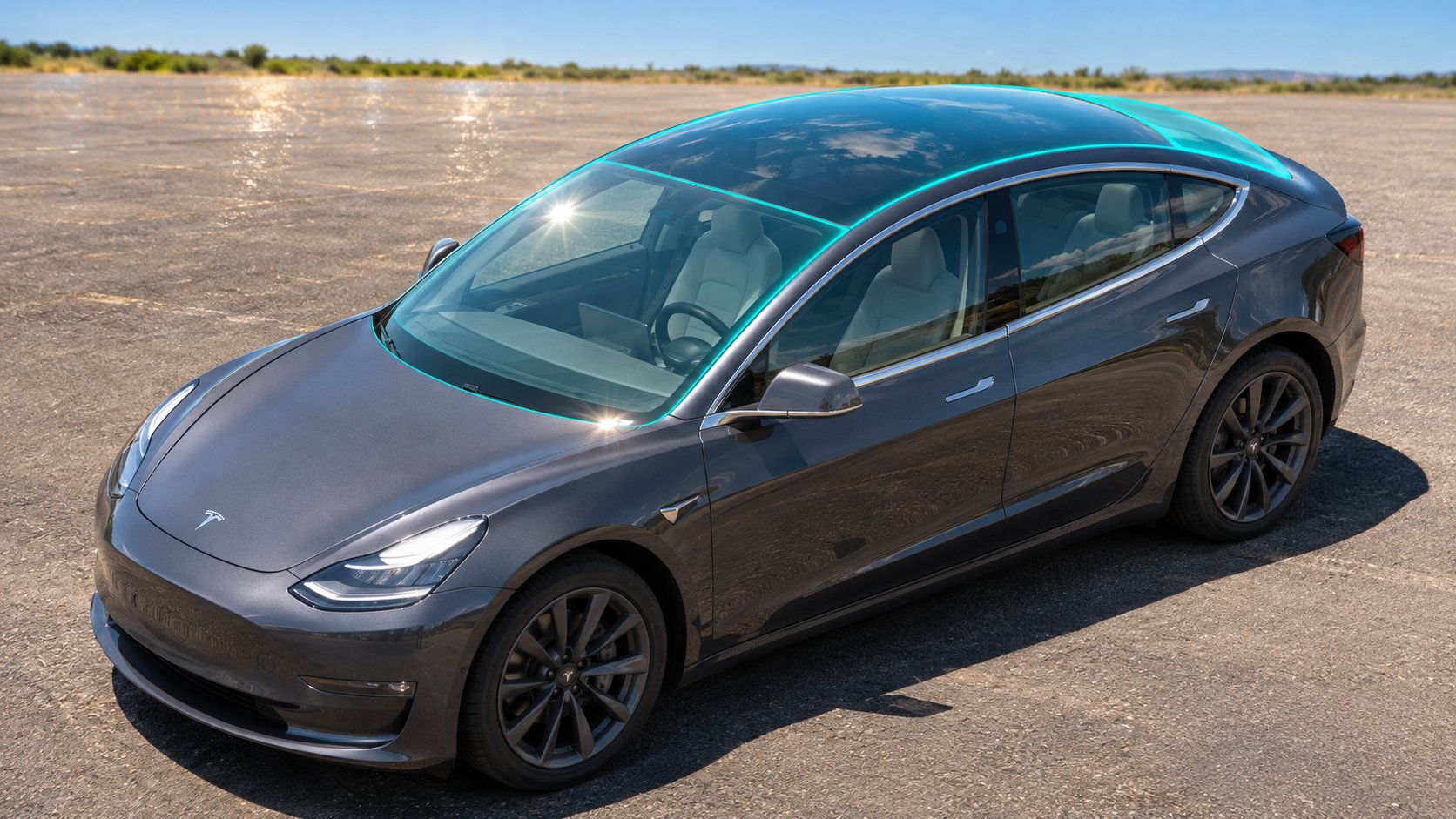
The Model 3 features a sweeping windshield that flows seamlessly into a panoramic glass roof panel, stretching nearly from the hood line to the rear of the cabin. It is a stunning design that floods the interior with natural light and gives passengers an open, airy feel. But all that glass comes with a thermal penalty.
Traditional cars use metal roofs and smaller windshields that naturally reflect and block a large portion of incoming solar energy. The Model 3's expansive glass area does the opposite — it lets in ample sunlight and infrared rays, turning the cabin into something resembling a greenhouse. Visible light passes through the glass, gets absorbed by dark interior surfaces like the dashboard and seats, and is re-emitted as infrared heat that remains trapped inside. The result? Heat concentrates directly on the surfaces you touch most: the steering wheel, the dashboard, and that 15-inch center touchscreen that sits fully exposed behind the windshield with no traditional overhang to shield it.
Over time, this repeated cycle of UV and heat exposure can degrade interior surfaces. Leather and synthetic materials may fade, crack, or become brittle. Even the touchscreen — the nerve center of every Model 3 function — faces accelerated wear from sustained thermal stress. A quality tesla model 3 sunshade addresses this damage before it starts.
How Cabin Temperatures Climb Without Protection
The physics here are straightforward but dramatic. A peer-reviewed thermal study measured what happens inside a parked car exposed to direct sunlight on a 26°C (roughly 79°F) day. Near the windshield, temperatures soared to 70.6°C (about 159°F) within two hours. At driver head height, the air reached 55.4°C (nearly 132°F). When window inserts were used, those same measurements dropped by 36% and 33% respectively — and total heat absorbed by the cabin air was reduced by over 90%. The Model 3's glass-heavy design amplifies this effect even further, because the solar exposure area is significantly larger than the test vehicle's conventional windows.
You might think Tesla's built-in Cabin Overheat Protection solves this. It helps — but only partially. This feature activates the HVAC system or fans after the interior has already climbed past a set threshold (90°F, 95°F, or 100°F). It is reactive, not preventive. And it draws battery power the entire time it runs, automatically shutting off after 12 hours or if the battery drops below 20%. For owners who park outdoors all day, that is a meaningful range penalty.
A tesla sun shade flips this equation entirely. Instead of spending energy to cool an already overheated cabin, it stops the heat from building up in the first place.
A windshield sunshade is a passive, zero-energy solution that prevents heat buildup rather than reacting to it — protecting your interior, your touchscreen, and your battery simultaneously.
This distinction matters more for the Model 3 than for almost any other vehicle on the road. Where a conventional car might benefit from a sunshade as a nice-to-have comfort accessory, the Model 3's all-glass architecture makes it closer to essential equipment. The real question is not whether you need one — it is whether the one you are considering actually fits your car correctly.
Sunshade Types Explained for Tesla Model 3 Owners
Fit is critical, but it is only half the equation. The type of sunshade you choose — its surface material, its folding mechanism, and whether it is built specifically for your car — determines how well it actually performs once it is in place. The market for a tesla sunshade model 3 has grown well beyond the flimsy silver rectangles you might remember from a decade ago. Understanding the differences between each category helps you avoid buying something that looks right in the listing photo but disappoints in real-world use.
Reflective Foil vs. Fabric Sunshades
The most fundamental distinction comes down to how the sunshade handles incoming sunlight: does it bounce it away, or does it absorb and diffuse it?
Reflective sunshades use a metallic or aluminum-coated outer surface to redirect solar energy back through the windshield before it ever reaches the cabin. Think of them like a mirror facing the sun. Road & Track's sunshade testing highlights that non-reflective front windshield shades are significantly less effective — black mesh alone absorbs heat rather than repelling it. A reflective surface paired with foam-core or insulating backing is what delivers real temperature reduction.
Fabric sunshades, by contrast, rely on dense, opaque material to block and diffuse sunlight. They tend to feel softer and are often lighter, but because they absorb rather than reflect, they can radiate some of that captured heat back into the cabin. They still reduce direct solar exposure on the dashboard and touchscreen, but the thermal ceiling is lower compared to a metallic surface.
The sweet spot? Dual-layer designs that pair a reflective exterior with an insulating or padded interior layer. The outer surface handles the solar load while the inner layer creates a thermal buffer — and a soft, non-scratch contact point against the windshield glass. For a vehicle like the Model 3, where the windshield area is large and the touchscreen sits fully exposed, this combination matters more than it would in a car with a smaller glass footprint.
Accordion-Fold vs. Roll-Up vs. Pop-Up Designs
Beyond material, the folding mechanism affects how quickly you can deploy the shade, how easily you can stow it, and how long it holds up over months of daily use. Each design brings distinct trade-offs.
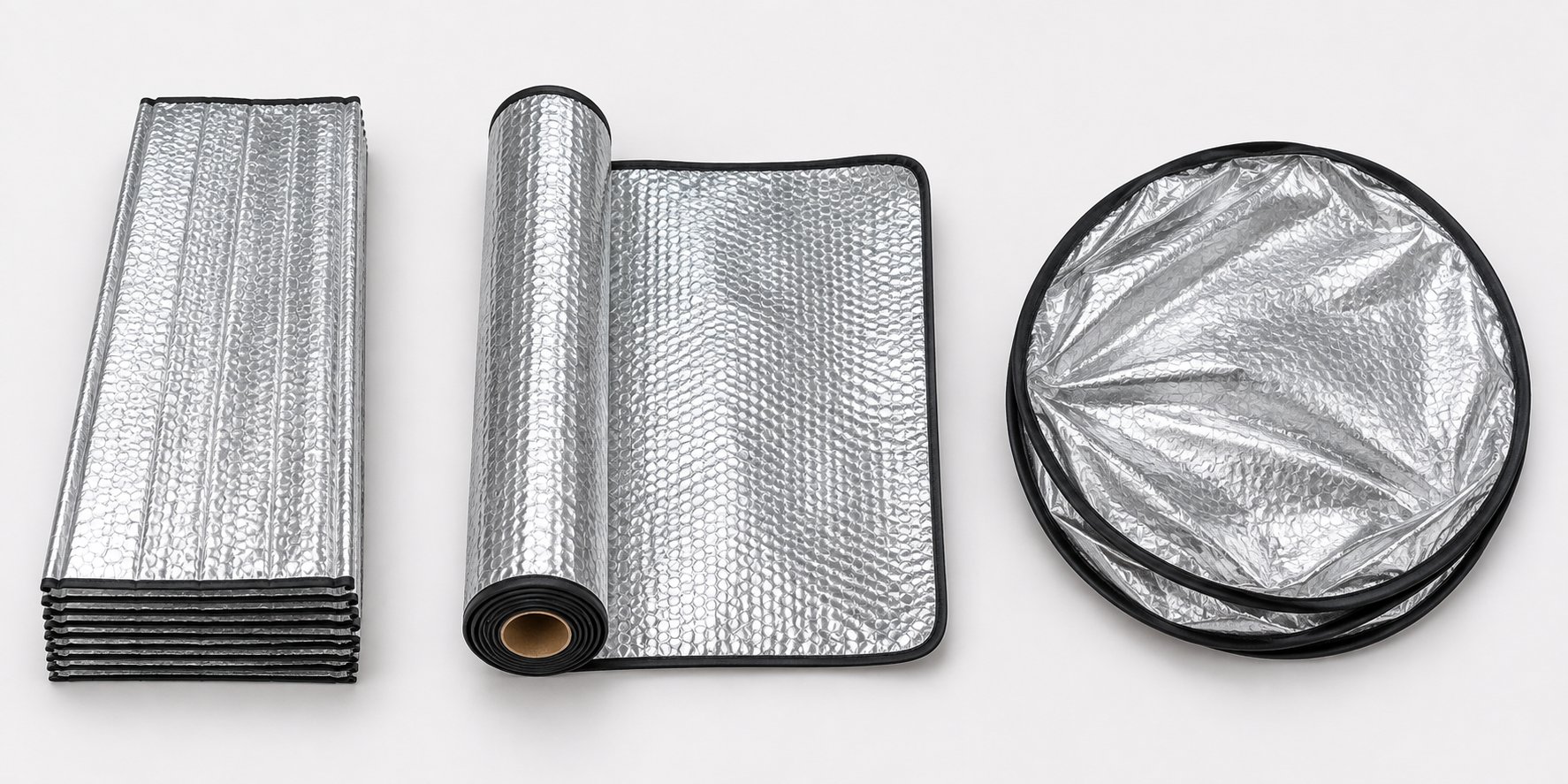
Accordion-fold shades collapse like a fan along pre-set crease lines, then lie flat or fold into a compact stack. They are the most common type and generally the fastest to set up — unfold, place against the windshield, and you are done. Because the creases are built into the structure, they maintain their shape reliably and resist the warping that can happen with other styles over time. Storage is straightforward: they slip behind a seat or into a door pocket with minimal fuss.
Roll-up shades wrap around a central core, much like a window blind. Brands like WeatherTech use this approach for their custom-fit sunshades. The advantage is a clean, compact rolled profile when stored. The downside? They can develop a tendency to hold their rolled shape, requiring a moment of flattening each time you deploy them. In a tight cockpit like the Model 3, that extra step adds a small but noticeable friction to daily use.
Pop-up shades use a spring-wire frame that twists into a compact disc for storage and springs open into a full panel when released. They are impressively compact when collapsed, but the twist-folding motion takes practice to master — and if you get it wrong, you are wrestling a sprung wire ring in your front seat. Long-term, the wire frame can lose tension or warp, especially after hundreds of fold cycles in a hot vehicle.
Custom-Fit vs. Universal-Fit for Model 3
This is where many Model 3 owners make their most expensive mistake. A universal-fit sunshade is designed to work across dozens of vehicle windshields. It covers the general area, but the Model 3's windshield has a specific rake angle, width, and curvature that universal sizing rarely matches precisely. The result is gaps around the perimeter — and those gaps are not just cosmetic. Every inch of exposed glass lets solar energy pour directly onto the dashboard and touchscreen, undermining the shade's purpose.
Custom-fit sunshades are designed to the exact dimensions of the Model 3's windshield. They reach edge to edge, sit flush against the glass, and stay in place without constantly sliding or needing readjustment. As Road & Track notes, universal shades that leave gaps drastically reduce heat and UV protection, especially in vehicles with large or steeply raked windshields — a description that fits the Model 3 perfectly.
If you are shopping for a tesla glass roof sunshade or a tesla sunroof shade as part of a broader protection kit, the same principle applies to every panel: vehicle-specific sizing outperforms generic alternatives. And for owners considering a tesla model 3/y side window sunshade, keep in mind that the same custom-vs-universal trade-off holds true across every glass surface.
The table below summarizes how the three main folding designs compare across the factors that matter most for daily use:
| Criteria | Accordion-Fold | Roll-Up | Pop-Up |
|---|---|---|---|
| Folding Style | Fan-like creases, collapses flat | Wraps around a central core | Spring-wire frame twists into a disc |
| Storage Size | Slim and flat — fits behind seats or in door pockets | Compact cylinder — easy to stow but rigid | Small disc — very compact but round shape can be awkward |
| Ease of Use | Very quick to deploy and fold | Moderate — may need flattening after unrolling | Fast to open, but twist-fold takes practice |
| Coverage Quality | Excellent with custom-fit versions | Excellent with custom-fit versions | Good, but typically universal sizing limits edge coverage |
| Durability | High — defined creases hold shape over many cycles | High — minimal stress points | Moderate — wire frame can lose tension over time |
Choosing the right type is a meaningful first step. But equally important is what the sunshade is actually made of — the layers, coatings, and materials that determine how much heat and UV radiation it truly blocks over months and years of use.
Materials and UV Protection in Tesla Windshield Sunshades
A sunshade can have the perfect fit and the most convenient folding mechanism on the market — but if the materials are cheap or the UV-blocking capability is weak, it is little more than a decorative panel leaning against your windshield. The layers, coatings, and construction quality of a tesla model 3 windshield sunshade determine how much real thermal and UV protection it delivers. Yet this is the one area almost no product listing or review ever explains in meaningful detail.
UV-Blocking Layers and What Ratings Mean
When you see a sunshade advertise "blocks 99% of UV rays," what does that actually mean? Ultraviolet radiation reaches your car in two primary forms: UVA and UVB. UVB rays are the shorter-wavelength type responsible for sunburns, but standard automotive glass already filters most UVB. UVA rays are the real concern for your interior. They have longer wavelengths, pass through glass far more easily, and are the primary driver of the photodegradation that causes dashboards to fade, crack, and become brittle over time. UVA also damages leather and synthetic surfaces by breaking down their chemical bonds at a molecular level.
For Model 3 owners, UVA protection is especially critical. The 15-inch touchscreen sits directly behind the windshield with zero overhang or physical shielding. Sustained UVA exposure does not just affect the surrounding trim — it can degrade screen coatings and contribute to the thermal load that forces the display into protection mode. A sunshade that blocks a high percentage of both UVA and UVB radiation keeps these surfaces intact season after season.
So how do you evaluate UV performance when shopping? Look for specific claims: "blocks 99% of UV radiation" is a strong indicator, but only if the product specifies that this covers the full UV spectrum (both UVA and UVB). Vague language like "UV resistant" or "sun protection" without quantified ratings is a red flag. The best tesla window shades will reference their UV-blocking capability explicitly, often tied to independent testing or material certifications.
Material construction is where the real performance gap emerges. Single-layer sunshades — the kind you might find at a gas station — typically use one thin sheet of reflective or opaque material. They block direct light, but they offer minimal thermal insulation. Heat still transfers through the material and radiates into the cabin. Multi-layer construction solves this by stacking purpose-built layers, each handling a different job:
- Reflective outer layer: A metallic or aluminum-coated surface that bounces solar energy back through the glass before it can enter the cabin. As Car and Driver's sunshade testing emphasizes, a reflective, shiny side pointing outward is essential — installing it backward can result in the shade not working at all.
- Insulating middle layer: A foam-core or air-gap buffer that reduces heat conduction between the outer reflective surface and the cabin-facing side. This layer is what separates a shade that blocks light from one that genuinely reduces temperature.
- Soft inner layer: A non-abrasive fabric or felt lining that sits against the windshield glass or dashboard. This protects the Model 3's glass coatings and dash surfaces from scratches during installation and removal — a detail that matters enormously over hundreds of daily use cycles.
Dual-layer and triple-layer designs that combine these elements deliver measurably better thermal performance than single-layer alternatives. You will notice the difference not just in dashboard temperature, but in how quickly your cabin cools down once you start driving.
Why Material Quality Matters for Longevity
Here is where budget sunshades reveal their true cost. A cheap tesla model 3 roof shade or windshield shade might perform reasonably well for the first few weeks. But repeated folding, unfolding, and exposure to extreme heat inside a parked car puts serious stress on materials. Lower-grade reflective coatings begin to flake and peel. Thin foam layers compress and lose their insulating properties. Rigid crease points crack and split. Within a single summer, you can end up with a shade that looks worn out and performs noticeably worse than when it was new.
Quality materials resist this degradation cycle. A well-constructed sunshade maintains its reflective efficiency and structural integrity across many seasons of daily use. The creases stay defined without cracking, the reflective coating remains bonded to the substrate, and the inner lining continues to protect your glass and dash from surface scratches. Think of it the same way you would approach any Tesla accessory: the upfront cost matters less than how the product holds up over years of ownership.
The inner surface deserves special attention for Model 3 owners. The windshield has factory-applied coatings that help with UV filtering and clarity. A rough or abrasive sunshade interior — common in bargain options — can gradually scratch or wear these coatings through daily friction. A soft, non-scratch lining eliminates this risk entirely, preserving both the glass treatment and the dashboard finish underneath.
When you are evaluating any tesla model 3 sunroof shade or windshield option, these are the material features worth prioritizing:
- Multi-layer thermal construction (reflective + insulating + soft inner layer)
- High UV-blocking capability covering both UVA and UVB, with a quantified rating (99%+ preferred)
- Non-scratch interior lining to protect windshield coatings and dashboard surfaces
- Durable, fold-resistant materials that maintain performance after repeated daily use
Material quality separates a sunshade that works from one that lasts. But even the best-constructed shade becomes worthless if it does not match your specific vehicle — and for the Model 3, "specific" means more than just the model name. Tesla's mid-cycle refresh changed the windshield geometry in ways that catch many buyers off guard.
Fitment Differences Between Model 3 Generations
You have picked the right material, the right folding style, and even the right UV-blocking rating. You add the sunshade to your cart, it arrives, and you unfold it against your windshield — only to discover a two-inch strip of exposed glass along the top edge and a loose sag in the middle. The shade is not defective. It was simply made for the wrong version of your car.
This is one of the most common and least discussed purchasing mistakes among Tesla Model 3 owners. The reason? Tesla did not just tweak a few cosmetic details when it refreshed the Model 3. It reworked the entire front end — and that includes the windshield geometry itself.
Original Model 3 vs. Model 3 Highland Windshield Dimensions
Tesla's mid-cycle overhaul, internally known as Project Highland, delivered far more than a visual facelift. MotorTrend's detailed teardown of the 2024 Model 3 Highland documented changes to nearly every exterior panel, including a brand-new front fascia, reshaped headlights, a lower nose profile, and — critically for sunshade buyers — an updated cowling along the windshield that was adjusted to reduce noise and improve aerodynamics. The roof rail skins and front fenders were also altered, meaning the structural frame surrounding the windshield is not dimensionally identical to the pre-refresh car.
What does this mean in practical terms? The Highland's windshield sits at a subtly different angle, with revised edge contours where the glass meets the A-pillars and cowl. A tesla windshield shade designed to hug the original Model 3's glass perimeter may leave gaps at the top or sides of the Highland's windshield — or it may press too tightly in some areas and buckle in others. Those gaps are not minor inconveniences. As discussed earlier, every inch of uncovered glass is a direct channel for solar energy to reach your dashboard and touchscreen.
The fitment issue runs deeper than just dimensions. The Highland also repositioned the windshield wiper fluid filler and revised the camera housing at the top of the windshield. While interior sunshades sit below the camera zone, these surrounding changes can affect how the shade anchors against the glass and where the visor clips interact with it. A shade that sat perfectly flush on a 2022 Model 3 may not seat correctly on a 2025 Highland, even though both cars share the same name on the trunk lid.
Real-world fitment testing confirms this split. Sunshade manufacturers who take fitment seriously now treat the Legacy Model 3 (2017-2023) and the Highland Model 3 (2024-2026) as separate accessory families. Roof sunshades in particular are generation-locked — a Highland roof shade will not seat correctly in a Legacy car, and vice versa. Windshield shades have a slightly wider tolerance window, but only when the product explicitly lists both generation ranges in its compatibility notes.
The bottom line for buyers: before you click "add to cart" on any tesla windshield cover, confirm whether your Model 3 is a pre-refresh (2017-2023) or Highland (2024 onward). Your VIN, your original purchase date, or a quick check of your car's front-end design — Highland models have the slimmer headlights and no fog lights — will tell you immediately which generation you own.
Model 3 and Model Y Cross-Compatibility
Fitment confusion does not stop at generation boundaries. It extends across model lines, too. Browse any major marketplace for a tesla model 3 sunroof shade or windshield shade and you will encounter listings that claim compatibility with "Model 3/Y" — as if the two vehicles are interchangeable. They are not.
Yes, the Model 3 and Model Y share Tesla's compact platform. They use similar battery architectures, many of the same software features, and related interior design philosophies. But detailed fitment analysis makes the distinction clear: the Model Y is taller, wider, and longer than the Model 3. Their windshields have different rake angles, different widths at the A-pillar junction, and different curvatures across the glass surface. A sunshade cut to the Model Y's windshield dimensions will be oversized for the Model 3, resulting in material bunching at the edges and an inability to sit flat against the glass. The reverse — a Model 3 shade on a Model Y — leaves exposed glass around the perimeter.
Some manufacturers do produce genuinely cross-compatible windshield shades that account for the dimensional overlap between both vehicles. These products work because their designers engineered a size envelope that covers both windshield profiles with acceptable coverage. The key distinction? They explicitly list both models with specific year ranges in their product titles and fitment notes. A listing that says "2017-2026 Model 3 and Model Y Windshield Sunshade" with documented fitment data is very different from a generic "fits Model 3/Y" claim tucked into a bullet point.
Be especially cautious when the refresh generations get involved. The Highland Model 3 and the Juniper Model Y (2025-2026) introduced separate interior and exterior geometry changes. Some refreshed accessories now group Highland with Juniper as a shared fitment family — but that applies to specific interior components like console organizers, not necessarily to windshield shades. The safest approach is always the same: match the product to your exact vehicle, exact generation, and exact production year.
Always verify the exact production year and generation of your Model 3 before ordering a windshield sunshade. A shade built for the wrong generation or the wrong model will leave gaps, sag, or fail to stay in place — defeating the purpose of buying one in the first place.
Getting fitment right eliminates the most frustrating failure point in sunshade ownership. With your exact vehicle generation confirmed, the next step is comparing the specific products that are actually designed for your car — and understanding what sets each option apart beyond the listing photos.
Top Tesla Model 3 Windshield Sunshades Compared
You know which generation you own. You understand the material differences. You have a handle on folding mechanisms. The missing piece? A side-by-side look at the actual products competing for space behind your windshield. Surprisingly, no single resource pulls together the leading tesla windshield sun shade options with enough detail to make an informed decision. Most listings show a photo, a bullet list, and a price — leaving you to guess how each product stacks up against the others.
That changes here. Below is a brand-by-brand breakdown of five popular windshield sunshade options for the Model 3, evaluated across the criteria that matter most for daily ownership.
Brand-by-Brand Breakdown of Leading Options
This comparison focuses on windshield-specific shades designed for the Tesla Model 3. Each product takes a different approach to materials, folding, and fitment — and those differences have real consequences for how well the shade performs and how long it lasts.
| Brand / Product | Sunshade Type | Folding Mechanism | Key Feature | Notable Detail |
|---|---|---|---|---|
| CUTIM Dual-Layer Thermal Sunshade | Dual-layer reflective panel | Accordion-fold (foldable) | Separate generation-specific selections for Model 3 and Model Y | Interior-only use; must be removed before driving |
| WeatherTech Custom-Fit Sunshade | Reflective panel | Roll-up with storage bag | Precision-cut to vehicle-specific windshield dimensions | Known for tight edge-to-edge coverage |
| Tesla OEM Sunshade Bundle | OEM reflective panel | Fold-flat | Factory-designed fitment for the Model 3 windshield | Priced at approximately $115 for the bundle |
| T Sportline Reflector | Reflective panel | Fold-flat with tote bag | Includes a branded tote for convenient storage | Tote bag makes transport and trunk storage cleaner |
| Spigen CryoShade | Multi-coated reflective panel | Accordion-fold | Triple-coated technology for enhanced heat rejection | Confirm exact year and trim compatibility before purchase |
What Sets Each Option Apart
Numbers in a table tell part of the story. The real differences emerge when you look at how each product handles the specific challenges of protecting a Model 3 cabin.
CUTIM's dual-layer thermal sunshade takes a generation-aware approach that directly addresses the fitment problem discussed earlier. Instead of selling a single "fits all Model 3" product, CUTIM offers separate selections for different vehicle generations — and extends the same logic to Model Y. The foldable design collapses flat for storage between the seats or in a door pocket, and the dual-layer construction pairs a reflective outer surface with an insulating interior layer. One important note: this is an interior sunshade designed exclusively for parked use. It is not an exterior ice or snow cover, and it must be removed before driving.
WeatherTech has built its reputation on precise vehicle-specific fitment across hundreds of car models. Their custom-cut approach means the shade is shaped to the Model 3's exact windshield profile, and the roll-up mechanism stores into a tidy cylinder. For owners who prioritize edge-to-edge coverage above all else, WeatherTech's track record in the custom-fit space is well established.
The Tesla OEM sunshade bundle is the factory option — designed by the same team that designed the car. At roughly $115 for the package, it carries a higher price point than most aftermarket alternatives. The appeal is straightforward: guaranteed compatibility with your specific vehicle, no guesswork required. The trade-off is that OEM accessories often lack the multi-layer thermal construction or specialized coatings that dedicated aftermarket brands engineer into their products.
T Sportline targets the premium Tesla accessories market, and their windshield reflector comes with a branded tote bag — a small but practical touch that gives the shade a dedicated home in your trunk or frunk instead of floating loose behind a seat. For owners who value a polished ownership experience and tidy tesla window covers, the included storage solution is a genuine differentiator.
Spigen's entry into the tesla model 3 roof and windshield shade space leverages triple-coated technology aimed at maximizing heat rejection. Their approach layers multiple reflective and insulating coatings to push thermal performance beyond what standard dual-layer designs achieve. The caveat — and it is an important one — is that Spigen's fitment can vary across Model 3 production years. Always confirm your exact year and trim before ordering, especially if you own a Highland refresh vehicle.
Each of these products solves the same core problem from a different angle. CUTIM leads with generation-specific selection and foldable convenience. WeatherTech emphasizes precision fit. Tesla's OEM option removes compatibility uncertainty. T Sportline adds a storage-first polish. Spigen pushes material science with triple-coated layers. The "best" choice depends on which combination of fitment accuracy, thermal performance, daily convenience, and budget aligns with how you actually use your car.
What none of these product listings typically explain, though, is how a windshield sunshade interacts with the Tesla-specific technology features you rely on every day — from Sentry Mode to Cabin Overheat Protection to the touchscreen itself.
How Windshield Sunshades Work with Tesla Tech Features
Here is a concern that stops many Model 3 owners from committing to a tesla model 3 windshield sunshade: will it mess with my car's cameras, Sentry Mode, or dashcam? It is a reasonable worry. The Model 3 relies on an integrated camera and sensor suite more heavily than almost any other vehicle on the road, and the idea of draping a large opaque panel across the windshield naturally raises compatibility questions. The good news is that a properly positioned interior sunshade works alongside Tesla's technology rather than against it — and in several key ways, it actually makes those systems perform better.
Touchscreen and Dashboard Heat Protection
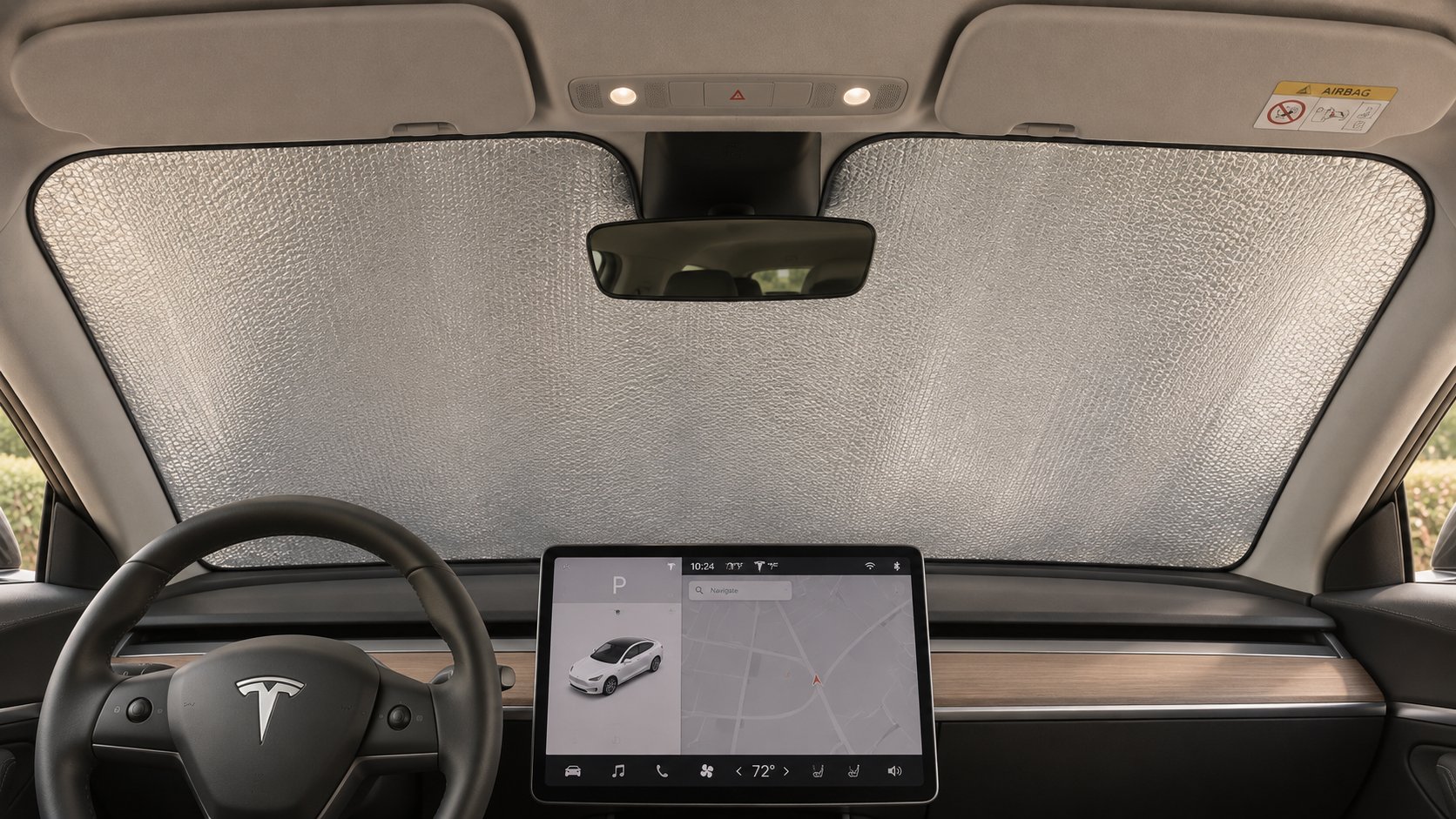
Picture how the Model 3's interior is laid out. The 15-inch center touchscreen — the single interface for navigation, climate, media, vehicle settings, and virtually every control — sits on a horizontal stalk directly behind the windshield. Unlike traditional cars that tuck their instrument clusters behind a deep dashboard cowl or overhead visor, the Model 3's minimalist design leaves this screen fully exposed to incoming sunlight. There is no overhang, no physical hood, and no secondary shade between the glass and the display surface.
On a hot day, that screen absorbs a tremendous amount of direct solar energy. You have probably experienced the result: the display dims noticeably, response times slow, and in extreme cases the system enters a thermal protection mode that temporarily limits brightness or restricts certain functions until the hardware cools down. This is not a defect — it is the touchscreen protecting its own electronics from heat damage. But it means your primary interface becomes partially unusable precisely when you need it most, like when you are about to drive away and want to set navigation or adjust climate settings.
A tesla window shade placed against the windshield intercepts that solar load before it reaches the screen. The reflective surface bounces the energy back out through the glass, and the insulating layer prevents residual heat from conducting inward. The touchscreen stays cooler, avoids thermal throttling, and is fully responsive the moment you remove the shade and get behind the wheel. Over time, this protection also reduces cumulative heat stress on the display's internal components and surface coatings — extending the usable lifespan of the most critical piece of hardware in the car.
The dashboard itself benefits equally. The Model 3's dash surfaces sit in the same direct solar path, absorbing heat that then radiates into the cabin air. By shielding the entire windshield aperture, a sunshade reduces surface temperatures across the full width of the dashboard, keeping the steering wheel, air vents, and center console noticeably cooler than they would be with unprotected glass.
Sentry Mode, Dashcam, and Cabin Overheat Protection Compatibility
This is the question that generates the most hesitation — and the answer is more straightforward than most owners expect.
Tesla's Sentry Mode relies on the vehicle's external cameras and sensors to detect suspicious activity while the car is locked and parked. These cameras are mounted at the top of the windshield, integrated into the rearview mirror housing and the B-pillar assemblies. An interior windshield sunshade sits below this camera zone. It rests against the lower and middle portions of the glass — the area covering the dashboard and touchscreen — while leaving the upper windshield section where the forward-facing cameras are housed completely unobstructed. Sentry Mode continues to monitor, record, and alert exactly as it would without a shade in place.
The same logic applies to dashcam functionality. Tesla's built-in dashcam captures footage through the same forward-facing camera cluster at the top of the windshield. Since the sunshade does not extend into that zone, dashcam recording remains fully operational while the car is parked. Your footage quality, recording triggers, and USB storage behavior are entirely unaffected.
Cabin Overheat Protection is where the relationship between sunshade and technology becomes genuinely complementary rather than just compatible. As the Tesla Owner's Manual explains, this feature activates the A/C or fan when cabin temperature exceeds the set threshold — but it draws battery power the entire time it runs. A tesla model 3 glass roof sunshade or windshield shade reduces the peak temperature the cabin reaches in the first place. The climate system activates less frequently, runs for shorter durations, and consumes less energy. For owners who park outdoors for extended periods, this translates directly into preserved driving range.
Think of it this way: Cabin Overheat Protection is your emergency backstop. A windshield sunshade is your first line of defense. Together, they keep your cabin cooler while using significantly less battery than either approach alone.
Here is a quick compatibility summary for the features Model 3 owners ask about most:
- Sentry Mode: Fully compatible — external cameras sit above the sunshade and remain unobstructed
- Dashcam: Fully compatible — forward-facing camera cluster operates normally with a sunshade in place
- Cabin Overheat Protection: Complementary — the sunshade reduces peak cabin temperatures, so the climate system cycles less often and drains less battery
- Touchscreen: Directly protected — the shade blocks solar load that causes thermal dimming, throttling, and long-term component degradation
No competitor product page breaks down these interactions, yet they are among the most practical reasons to use a windshield sunshade consistently. The technology in your Model 3 does not just tolerate a sunshade — it benefits from one.
With compatibility concerns off the table, the next decision is scope. Does a windshield shade alone give you enough protection, or does your situation call for a full sunshade kit that covers the glass roof and rear window as well?
Windshield Shade Only vs. Full Sunshade Kit for Model 3
Every Model 3 owner eventually faces this fork in the road: do you protect just the windshield, or do you go all-in with a complete sunshade tesla kit that also covers the panoramic glass roof and rear window? The answer is not universal — it depends on how you park, where you live, and what you are trying to protect. Spending too little leaves your cabin exposed. Spending too much on coverage you do not need adds clutter and cost without a meaningful payoff. Here is how to figure out which approach actually fits your life.
When a Windshield Sunshade Alone Is Enough
Think about your typical parking scenario. If your Model 3 spends most of its time in a garage or covered structure and only sees direct sunlight during short errands — grocery runs, restaurant stops, quick office visits — a windshield-only shade handles the job effectively. Why? Because the windshield is the largest single pane of glass facing the sun during standard nose-forward parking. It is also the most steeply raked, meaning overhead and angled sunlight pours through it more efficiently than through any other panel on the car. As Popular Mechanics notes, windshields are angled more steeply than other windows specifically to cut aerodynamic drag — and that steep rake also allows the most sunlight to pass into the interior when the sun is high during the hottest parts of the day.
Covering just the windshield blocks the primary heat entry point, shields the dashboard and touchscreen, and keeps the steering wheel cool enough to grip without flinching. For owners in moderate climates — the Pacific Northwest, the Northeast, coastal California, or anywhere summer highs hover in the low-to-mid 80s — this single shade often provides all the thermal relief you need. The tesla 3 roof glass does let in some additional heat from above, but in mild conditions the cabin temperature stays manageable, especially if you are only parked outside for an hour or two at a time.
There is also a practical convenience factor. A single windshield shade deploys in seconds, folds flat, and stows in a door pocket or behind a seat. There is no setup ritual, no multiple panels to position, and no storage juggling when you need your trunk space for actual cargo. If ease of use is what keeps you consistent — and consistency is what makes a sunshade effective — then a single-shade approach removes every barrier to daily use.
When You Need a Full Glass Roof and Rear Shade Kit
The calculus shifts dramatically when the parking conditions get harsher. Imagine your Model 3 sits in an uncovered office lot for eight or nine hours under direct sun in Phoenix, Houston, or Tampa. The windshield shade handles the front glass, but what about the massive panoramic roof directly overhead? That tesla model 3 moonroof stretches from roughly the front seats all the way past the rear headrests. On a 100-degree-plus day, the sun beats down through it with very little interruption.
Tesla's glass roof does block the vast majority of ultraviolet radiation — testing confirms roughly 99% UV rejection. But as that same analysis emphasizes, the roof is a "UV champion and a heat compromise." It does not fully block near-infrared energy — the portion of sunlight you feel as radiant warmth on your head and shoulders. In extreme heat climates, that radiant load from the tesla model 3 window shade-less roof adds meaningfully to the total cabin temperature, even when the windshield is covered. Rear-seat passengers — especially children or pets — sit directly beneath this glass and feel the effect most acutely.
A full sunshade kit that covers the windshield, the glass roof, and the rear window creates a comprehensive thermal barrier across every major glass surface. The roof shade alone can make a noticeable difference in rear-seat comfort on scorching days, and it reduces the total solar energy entering the cabin from all angles. For owners with leather or vegan leather interiors, this broader coverage also slows the UV-driven fading and surface degradation that accumulates across seat bolsters, rear parcel shelves, and the headliner edges that sit near exposed glass.
Here are the situations where a full kit earns its keep:
- You park outdoors all day in a climate where summer temperatures regularly exceed 90°F
- You have rear-seat passengers — children, elderly family members, or pets — who are sensitive to radiant heat from above
- Your Model 3 has a leather or light-colored interior that is especially vulnerable to UV fading
- You want to minimize how often Cabin Overheat Protection cycles, preserving battery range during long outdoor parking sessions
- You live in a Sun Belt state where the sunshade tesla owners need stays in the car year-round rather than seasonally
The trade-off is added complexity. A full kit means multiple panels to install and remove, more bulk to store somewhere in the cabin, and a higher upfront cost. For owners who garage their car overnight and only face occasional outdoor exposure, that extra coverage may sit unused more often than not.
The table below lays out the practical differences between the two approaches so you can match the right level of protection to your actual ownership situation:
| Criteria | Windshield Only | Full Kit (Windshield + Roof + Rear) |
|---|---|---|
| Heat Reduction | Addresses the majority of direct solar gain through the largest forward-facing glass panel | Covers all major glass surfaces for maximum thermal reduction across the entire cabin |
| Cost | $30 - $80 for a quality custom-fit shade | $80 - $200+ depending on brand and layer count |
| Installation Effort | Seconds — unfold and place against the windshield | Several minutes — position windshield, roof, and rear panels individually |
| Storage Space Needed | Minimal — one flat panel fits in a door pocket or behind a seat | Moderate — multiple panels require trunk, sub-trunk, or behind-seat storage |
| Recommended Climate | Moderate summers, short outdoor parking, garage-primary owners | Extreme heat climates, all-day outdoor parking, Sun Belt and desert regions |
Neither approach is inherently better. A windshield shade alone covers the single biggest heat entry point on the car and works perfectly for the majority of daily-use scenarios. A full kit is insurance against extreme conditions, protecting every glass surface and keeping the cabin significantly cooler during those brutal all-day outdoor stretches. The right answer is the one that matches how — and where — you actually park your Model 3.
Whichever route you choose, the shade itself only works if you actually use it. And that brings up a surprisingly practical question most buyers overlook until after the purchase: how quickly can you fold it, and where does it go when you are driving?
Folding, Storage, and Everyday Convenience Tips for Your Model 3 Sunshade
A sunshade that lives permanently in your trunk because it is too annoying to use is not protecting anything. This is the dirty secret of sunshade ownership: the single biggest factor in real-world heat protection is not material science or UV ratings — it is whether you actually bother to put the shade up every time you park. And that comes down to two unglamorous but critical details: how fast can you fold it, and where does it go once you are behind the wheel?
Folding Mechanisms and Why They Matter for Daily Drivers
If you use your Model 3 as a daily driver — commuting, errands, school pickups, weekend trips — you are deploying and stowing your sunshade potentially twice a day, five to seven days a week. Over a single summer, that is hundreds of fold-unfold cycles. The folding mechanism is not a minor convenience detail. It is the feature that determines whether the shade becomes a habit or a hassle.
Accordion-fold designs remain the most practical option for frequent use. They collapse along pre-set crease lines, fan-style, into a flat stack that takes up minimal space. Deployment is equally fast: grab one edge, unfold, and place against the windshield. The entire process — from parked car to shade in place — takes roughly ten seconds once you have done it a few times. Because the creases are engineered into the material, an accordion-fold shade maintains its shape predictably over hundreds of cycles. You are not fighting the shade to get it back into form. It wants to fold the way you need it to.
Pop-up shades offer impressive compactness when collapsed — they twist into a disc roughly the diameter of a dinner plate. The problem is the twist itself. Getting a spring-wire frame to collapse cleanly requires a specific wrist motion that takes practice, and getting it wrong means you are wrestling a sprung metal ring in your front seat. Car and Driver's hands-on sunshade testing noted that pop-up designs can be "tricky at first" and that mastering the fold is a real learning curve. In a compact cabin like the Model 3, where elbow room is limited, that extra struggle adds friction to every parking stop. Over time, the wire frame can also lose tension, making the shade progressively harder to manage.
Roll-up shades — the style used by brands like WeatherTech — wrap into a compact cylinder. Storage is tidy, and the rolled profile fits neatly in a trunk or behind a seat. The trade-off hits you at deployment: a shade that has been rolled up in a hot car all morning wants to stay curled. You spend an extra moment flattening it against the windshield, and it may try to spring back at the edges until gravity and the sun visors hold it in place. For owners who use a sunshade a few times a week, this is a minor nuisance. For daily drivers, it is one more step standing between you and a protected cabin.
The pattern is clear: the easier the fold, the more consistently you will use the shade. CUTIM's foldable dual-layer sunshade is purpose-built around this principle. Its accordion-fold design collapses flat in seconds, and the dual-layer construction — reflective outer surface plus insulating interior — does not add meaningful bulk to the folded profile. CUTIM also addresses the fitment challenge head-on by offering separate vehicle-generation selections, so you get a shade sized precisely for your Model 3 or Model Y without compromising fold quality or coverage. One essential reminder: this is an interior tesla roof sunshade designed for parked use only. It must be removed before driving — it is not built to serve as an exterior ice or snow cover.
Whatever mechanism you choose, pay attention to the crease quality over time. Cheap shades develop weak points along fold lines within weeks, leading to cracks in the reflective coating and eventual material failure. A well-built model 3 sunshade maintains defined creases that fold and unfold cleanly season after season, without the coating flaking off into your lap every time you collapse it.
Where to Store Your Sunshade in a Model 3
The Model 3's minimalist interior is a masterclass in clean design — but it also means dedicated storage space is limited. There is no deep glovebox shelf, no oversized door bins, and no cavernous center console waiting to swallow a bulky accessory. Finding a home for your sunshade requires a bit of intentional planning, and the best spot depends on the shade's folded footprint and how quickly you need to access it.
Imagine your routine: you park, deploy the shade, lock the car, and walk away. When you return, you want the shade folded and stowed before you even shift into drive. The storage location needs to be reachable from the driver seat, fast to access, and out of the way during driving. Here are the most practical options, ranked from most accessible to least:
- Driver-side door pocket — If your shade folds slim enough, the door pocket is the fastest grab-and-go location in the car. You reach for it without unbuckling or twisting. Accordion-fold shades with a thin profile fit here best; bulkier roll-up or pop-up styles usually will not. Test the fit before committing to this as your permanent spot.
- Behind the rear seat backs — The narrow gap between the rear seatbacks and the trunk partition accommodates a flat-folded shade perfectly. It stays out of sight, does not interfere with rear passengers, and is easy to reach by sliding an arm between the front seats. This is the most popular storage solution among daily tesla sunroof cover and windshield shade users because it balances accessibility with invisibility.
- Under the front passenger seat — Sliding the folded shade under the passenger seat keeps it within arm's reach of the driver while freeing up door pockets for other items. The clearance under Model 3 seats is limited, though, so this works best with thinner accordion-fold designs. Thicker shades or those with rigid storage bags may not slide in cleanly.
- Sub-trunk storage compartment — The Model 3's sub-trunk well beneath the main trunk floor offers plenty of space for a glass roof sunshade for tesla model 3 kit or a windshield shade with a storage bag. The downside is accessibility: you need to open the trunk, lift the floor panel, and dig the shade out every time you want to use it. This is fine for shades you use occasionally — weekends, road trips, airport parking — but it adds too many steps for daily drivers who need the shade deployed at every stop.
A quick practical tip: whichever location you choose, do a test run before it becomes routine. Fold the shade, place it in the spot, sit in the driver seat, and time how long it takes to retrieve and deploy. Then reverse the process — fold, stow, and confirm nothing rattles or shifts while driving. The best storage location is the one that makes using your sunshade feel effortless rather than like an extra chore layered onto every parking stop.
Convenience and fit are the two pillars of consistent sunshade use. But a sunshade — no matter how well-designed — is only one layer in a broader strategy for keeping your Model 3's cabin cool and its interior protected. The most effective approach combines passive shielding with permanent treatments and smart use of Tesla's built-in climate tools.
Complementary Strategies to Keep Your Model 3 Cool
A windshield sunshade handles the heaviest single source of solar heat gain when your Model 3 is parked. But it only works while it is in place — and it only covers one glass surface. The Model 3's cabin is surrounded by glass on nearly every side, and the sun does not stop at the windshield. Owners who want year-round interior protection and genuinely comfortable cabin temperatures need a layered approach that combines passive shielding, permanent treatments, and smart use of Tesla's built-in climate tools. Think of it like sunscreen for your car: one layer is good, but stacking complementary layers is what delivers real, consistent results.
Ceramic Window Tint as a Permanent Layer of Protection
If a windshield sunshade is your best defense while parked, ceramic window tint is its always-on counterpart while driving. High-quality ceramic films — like those using nano-ceramic particle technology — block infrared heat and UV radiation without reducing visible light transmission below legal thresholds. The effect is significant: ceramic tint can deliver up to a 50% reduction in heat entering the cabin and block up to 99% of harmful UV rays, all while maintaining the clear, unaltered appearance of your tesla model 3 glass roof and side windows.
What makes ceramic tint especially valuable for the Model 3 is where it works. You cannot practically keep a sunshade on the side windows or glass roof while driving — but tint is bonded directly to those surfaces and filters solar energy continuously, whether you are cruising at highway speed or sitting in traffic. It reduces glare, slows interior fading, and takes measurable load off your climate system. When the A/C does not have to fight as hard against incoming heat, it runs more efficiently — and in an EV, that efficiency translates directly into preserved driving range.
The key distinction between tint and a sunshade is their coverage window. Tint is always active but provides moderate heat reduction — it filters rather than blocks. A tesla model 3 windshield sunshade provides maximum heat rejection but only when deployed on a parked vehicle. They serve different roles in different scenarios, and together they cover virtually every situation your car will face: parked in a lot, stuck in traffic, on a long highway stretch, or sitting in your driveway on a 95-degree afternoon.
One practical note: ceramic films outperform carbon films in both heat rejection and longevity. Carbon tint is a budget-friendly step up from basic dyed film, but ceramic maintains its performance characteristics over a longer lifespan and delivers noticeably better infrared blocking. For a vehicle with as much glass as the Model 3, the investment in ceramic-grade tint pays for itself in comfort and interior preservation across years of ownership.
Seasonal and Climate-Specific Usage Guidance
Not every Model 3 owner lives in Phoenix. How aggressively you need to deploy tesla model 3 sun shades — and which complementary strategies matter most — depends heavily on your regional climate and how your parking habits shift across seasons.
Extreme heat climates (Southwest desert, Gulf Coast, Deep South): A windshield sunshade should go up every single time you park outdoors, twelve months a year. Summer temperatures routinely push interior cabin temps well past 140°F without protection, and even winter sun in southern latitudes generates enough heat to stress dashboard and touchscreen surfaces. Pair the sunshade with ceramic tint on all glass surfaces and a tesla model 3 roof sunshade for the panoramic glass. This is the region where a full sunshade kit earns its investment back fastest.
Moderate climates (Mid-Atlantic, Pacific Northwest, Midwest): Peak summer months — roughly June through September — are when a windshield shade delivers its biggest payoff. During spring and fall, the sun angle is lower and ambient temperatures are milder, so the shade becomes most useful during midday parking. Ceramic tint remains valuable year-round because it also reduces glare during low-angle winter sun driving. You can reasonably get by with a windshield-only shade in these regions unless you park outdoors all day during summer heat waves.
Cold climates (Northern states, mountain regions, Canada): The primary threat shifts from cabin heat to UV degradation. Even in winter, UV rays penetrate cloud cover and reflect off snow, continuing to assault interior surfaces over time. A parasol tesla model 3 owners use seasonally still has value during those bright, crisp winter days when the sun sits low and streams directly through the windshield at a sharp angle. Ceramic tint pulls double duty here — blocking UV year-round while also reducing glare from snow-reflected sunlight.
Parking orientation is an often-overlooked variable that affects how much heat your windshield absorbs. In the Northern Hemisphere, a car parked nose-south receives the most direct windshield sun exposure throughout the day. If you have a choice of parking direction — at home, at the office, or in an open lot — pointing the nose away from the sun's arc can reduce windshield heat load meaningfully, even without a shade in place. Combine a favorable parking angle with a deployed sunshade, and you have cut your cabin's peak temperature by a substantial margin before any active cooling even kicks in.
The most effective approach to keeping your Model 3's cabin cool is not any single product or feature — it is a strategy that layers passive and active protection so each element covers what the others cannot. Here is the complete heat protection stack worth building:
- Windshield sunshade (parked protection): Blocks the largest single source of direct solar heat gain. Zero energy cost. Effective the moment you deploy it.
- Ceramic window tint (always-on UV and heat filtering): Provides continuous infrared and UV reduction across all tinted glass surfaces — while driving, while parked, and in every season.
- Cabin Overheat Protection (active climate backup): Prevents cabin temperatures from reaching extreme peaks when other defenses are not enough. Works best as a safety net rather than a primary cooling strategy, since it draws battery power and only activates after the cabin is already hot.
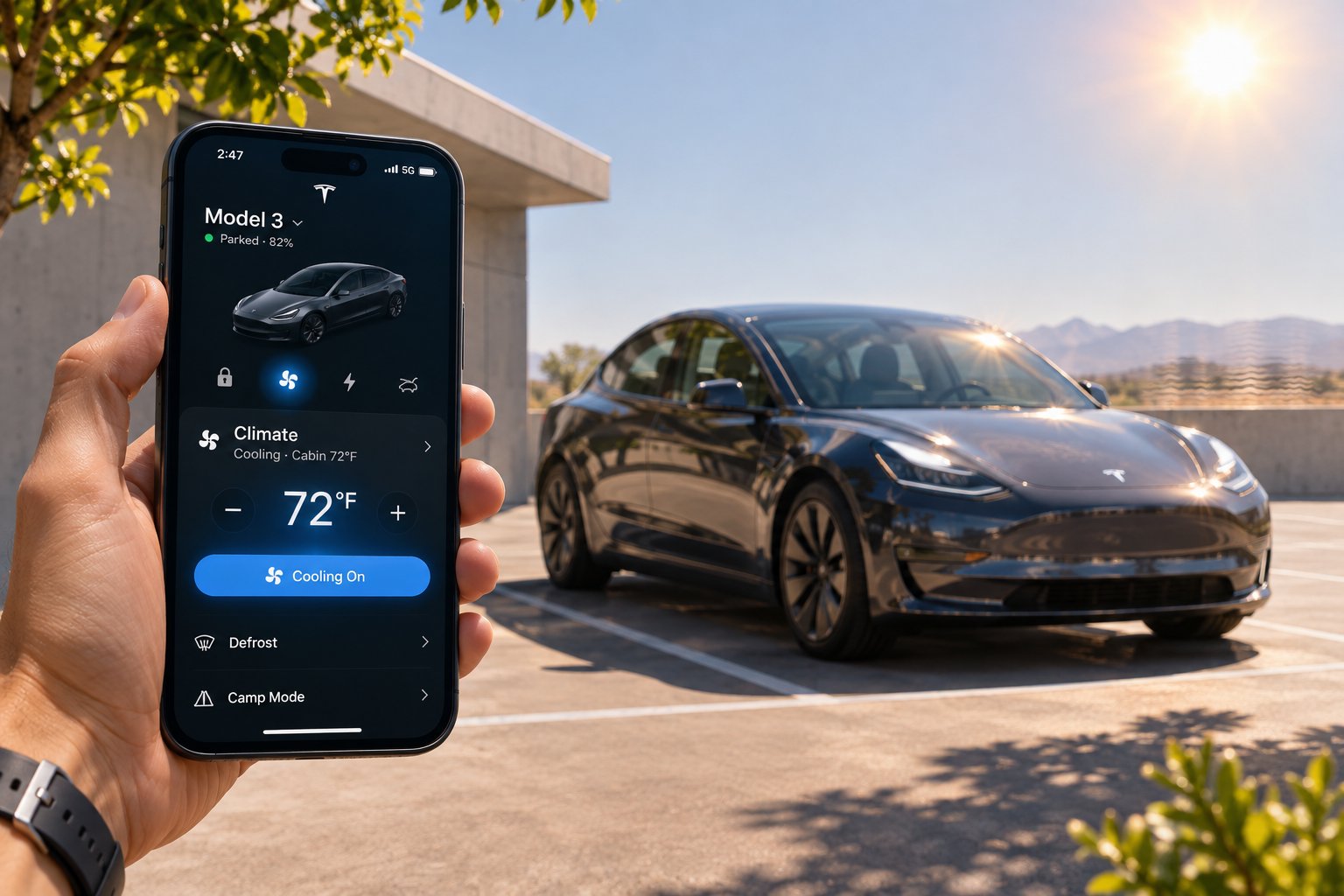
- Pre-conditioning via the Tesla app (cool the cabin before entry): Remotely activate climate control before returning to your car so the interior is comfortable the moment you open the door. Most efficient when your vehicle is plugged in, as the A/C draws from wall power instead of the battery pack.
Each layer in this strategy addresses a different gap. The sunshade prevents heat from entering. Ceramic tint filters what the sunshade cannot cover while you are driving. Cabin Overheat Protection catches temperature spikes when passive measures are not enough. Pre-conditioning clears whatever residual heat remains before you sit down. Stack all four, and you have a Model 3 that stays cooler, preserves its interior longer, and uses less battery fighting the sun — whether you park in a Miami parking garage or a Montana driveway in July.
The right tesla model 3 roof sunshade or windshield shade is the cornerstone of that stack — the one layer that costs nothing to operate, requires no installation appointment, and delivers immediate, measurable results every time you use it. Everything else builds on top of that foundation.
Tesla Model 3 Windshield Sunshade FAQs
1. Does a windshield sunshade interfere with Tesla Sentry Mode or dashcam?
No. Tesla's Sentry Mode and dashcam cameras are mounted at the top of the windshield near the rearview mirror housing. An interior windshield sunshade sits below this camera zone, covering only the lower and middle portions of the glass. Both Sentry Mode and dashcam continue recording normally with a sunshade in place. The sunshade also complements Cabin Overheat Protection by reducing peak cabin temperatures, which means the climate system cycles less often and uses less battery while parked.
2. Will a pre-refresh Model 3 sunshade fit the Model 3 Highland?
In most cases, no. Tesla's Highland refresh changed the front-end design, including the windshield angle, edge contours, and surrounding cowling. A sunshade built for the Legacy Model 3 (2017-2023) may leave gaps or sag on a Highland (2024 onward). Always verify your exact production year and generation before purchasing. Brands like CUTIM address this by offering separate generation-specific selections for their dual-layer thermal sunshade, ensuring precise fitment for each version.
3. Why does the Tesla Model 3 need a sunshade more than other cars?
The Model 3 features an expansive windshield that flows into a panoramic glass roof, creating far more solar exposure than traditional vehicles with smaller windshields and metal roofs. This all-glass design creates a greenhouse effect that concentrates heat on the dashboard, steering wheel, and the 15-inch touchscreen. Cabin temperatures can climb dramatically in parked vehicles, and the Model 3's glass-heavy architecture amplifies this effect. A windshield sunshade passively prevents heat buildup without drawing any battery power.
4. Do I need a full sunshade kit or just a windshield shade for my Model 3?
It depends on your climate and parking habits. A windshield-only shade covers the largest forward-facing glass panel and protects the dashboard and touchscreen effectively for short outdoor parking in moderate climates. If you park outdoors all day in extreme heat regions like the Southwest or Gulf Coast, a full kit covering the windshield, glass roof, and rear window provides comprehensive thermal protection. Full kits are also recommended for owners with rear passengers sensitive to overhead radiant heat from the panoramic roof.
5. What is the best sunshade material for blocking heat in a Tesla Model 3?
Dual-layer or triple-layer construction delivers the best thermal performance. Look for a reflective outer layer (metallic or aluminum-coated) that bounces solar energy away, an insulating middle layer that reduces heat conduction, and a soft inner layer that protects your windshield coatings from scratches. Single-layer shades block direct light but still allow heat to transfer into the cabin. Also prioritize sunshades that block 99% or more of both UVA and UVB radiation, as UVA rays are the primary driver of dashboard fading and touchscreen degradation.