
What Is a Tesla Model 3 Center Console Tray
Picture this: you slide into your Model 3, toss your wallet and keys into the center console, and hear them clatter into the same deep, undivided well as your sunglasses, loose change, and charging cables. Everything tangles together, slides around on every turn, and finding your key card at a drive-through becomes a mini excavation project. A Tesla Model 3 center console tray exists to solve exactly this problem.
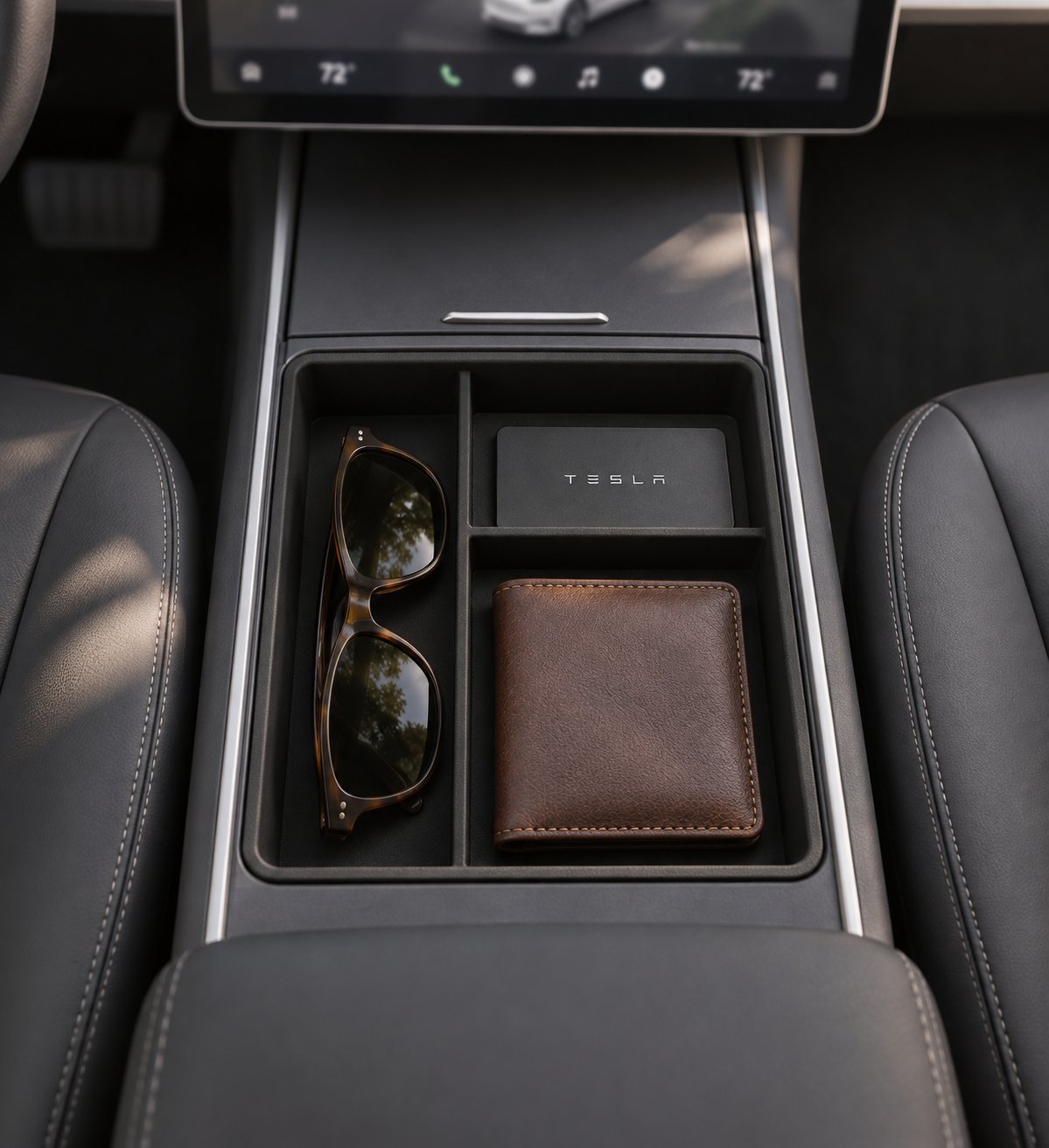
In simple terms, it is a drop-in organizer insert that subdivides the open storage compartment between the front seats into smaller, purpose-built sections for everyday items. Think of it like an ice cube tray for your console — rigid or semi-flexible walls that carve one big cavity into several organized pockets. No drilling, no adhesive, no permanent changes to your vehicle. You simply place it into the existing console well, and it sits there by matching the compartment's contours.
What Exactly Is a Center Console Tray
The product category is refreshingly straightforward. A center console tray is a removable insert, typically made from materials like ABS plastic, silicone, or flocked composites, that drops directly into the Model 3's console well to create divided compartments. You'll notice the terms "tray" and "organizer" used interchangeably across product listings and owner forums — they refer to the same type of accessory. Some designs offer a grid of small compartments for granular sorting, while others use two or three larger sections for flexible storage. Regardless of layout, the core function stays the same: turning a single open bin into organized, accessible space for the small items you reach for every day.
How a Console Tray Differs from the Console Itself
This distinction trips up more shoppers than you might expect. Tesla's built-in center console assembly is a structural vehicle component — it includes the armrest lid, the sliding cover mechanism, the housing that frames the storage area, and the integrated wireless charging pad. These are factory-installed parts bolted and wired into the car. Tesla center console trays, by contrast, are aftermarket accessories that sit inside that existing structure. They do not replace the console, modify its hardware, or alter any built-in functionality. They simply organize the open space within it.
If you have ever searched for a console upgrade and encountered listings for full console replacements, armrest lid swaps, or locking storage safes, those are entirely different product categories. A tray is far simpler and far less invasive.
A console tray is an organizational insert that drops into your existing center console — it is not a structural replacement, a console lid upgrade, or a locking safe.
Understanding what this accessory actually is — and what it is not — matters because the real purchasing pitfalls start with choosing the right one. And the single biggest factor most buyers overlook has nothing to do with brand or price. It has everything to do with which version of the Model 3 they drive.
Why Aftermarket Trays Are the Standard for Model 3
Here is something that surprises a lot of first-time buyers: if you head over to the Tesla Shop expecting to find an official center console tray for your Model 3, you will come up empty. Tesla does not sell one. Not because it is sold out, and not because you are looking in the wrong place. The product simply does not exist in their accessory lineup for this model. Every console tray you find for the Model 3 is a third-party product — and understanding why actually works in your favor.
Tesla's Official Offering Covers Model Y Only
Tesla's own accessory storefront does list a center console organizer, but it is designed exclusively for the redesigned Model Y. The Model Y Premium and Performance Center Console Trays retail for $40 and include three separate bins — two stacking front trays with a sliding mechanism and one armrest insert. They are built specifically for 2025 or later Model Y Premium and Performance vehicles, and they are not compatible with the Model 3.
This is not an oversight on Tesla's part. It reflects the reality of their current product catalog. If you are shopping for a center console tray for a Model 3, whether it is a pre-refresh, a mid-cycle update, or a Highland, you are shopping the aftermarket. Knowing this upfront saves you from wasting time hunting for an OEM option that does not exist, and it reframes how you should evaluate what is available.
Why Third-Party Trays Became the Standard
Tesla designed the Model 3's interior around a minimalist philosophy — clean surfaces, few physical controls, and open storage wells that prioritize volume over compartmentalization. That deep, undivided center console is a deliberate design choice, not a manufacturing shortcut. But it left a very practical gap for drivers who carry multiple small items daily and want them organized rather than rattling around in a shared bin.
Aftermarket accessory makers recognized this gap almost immediately. The result? A competitive ecosystem of purpose-built organizers spanning a wide range of materials, compartment layouts, and price points. You will find rigid ABS trays, soft-touch flocked inserts, silicone-lined organizers, sliding double-layer systems, and minimalist two-compartment designs — all tailored to specific Model 3 console generations. The EV aftermarket industry reached nearly $100 billion in 2024 and continues to grow rapidly, with Tesla owners representing one of the largest accessory-buying segments. That demand fuels innovation and keeps manufacturers competing on quality, fit, and price.
This actually benefits you as a buyer. A single OEM option gives you one material, one layout, and one price — take it or leave it. A healthy aftermarket gives you dozens of choices tuned to different priorities. Want maximum compartments for granular organization? There is a tray for that. Prefer two large flexible sections that accommodate a bulky sunglasses case? That exists too. Need a center console organizer with silicone padding that eliminates rattling? Multiple manufacturers offer exactly that. Competition drives both quality up and prices down, which is the opposite of what happens when a single supplier controls the market.
The fact that every Model 3 console tray is aftermarket is not a red flag — it is the reason buyers get more choices, better innovation, and more competitive pricing than a single OEM option could deliver.
The variety, however, introduces a challenge that catches many buyers off guard. With so many options available, it is tempting to grab the first well-reviewed tray you see and assume it will fit. But the Model 3 has gone through multiple console redesigns across its production life, and a tray built for one generation will not drop cleanly into another. Getting the material and layout right means nothing if the tray does not physically match your console — and that is the mistake most buyers make.
Know Your Model 3 Generation Before You Buy
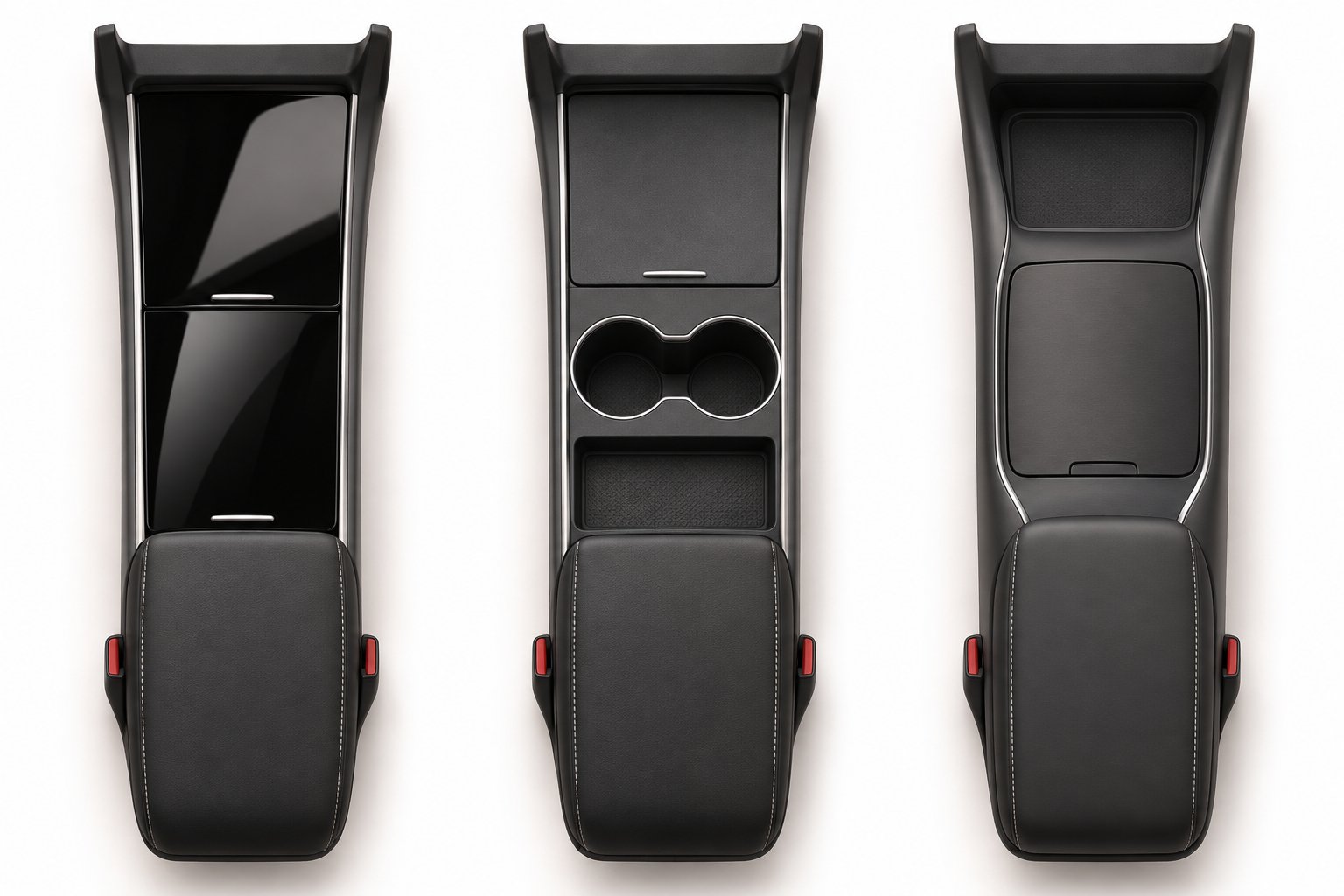
Here is where most buyers get burned. They find a highly rated Tesla Model 3 center console tray, click "Add to Cart," and only discover the problem when the tray arrives and does not fit their console. The reason? Tesla has produced three distinct console designs across the Model 3's production life, and trays built for one generation will not drop into another. The cavity dimensions, storage well shapes, and feature layouts are different enough that even a few millimeters of mismatch turns a clean insert into a rattling, ill-fitting disappointment.
This is the single most common purchasing mistake in the entire Tesla center console accessory space, and it stems from a simple misconception: that "Model 3" means one interior. It does not.
Pre-Refresh Model 3 Console Design
The original Model 3, produced from initial 2017 deliveries through the 2020 model year, featured the first-generation center console. You'll recognize it by the glossy piano black finish on the console surfaces and the open tray area sitting beneath a sliding cover. The phone dock sat at the front of the console area, and the main storage well offered a relatively deep, undivided cavity underneath. This era's console had a specific footprint and sliding mechanism that aftermarket tray makers designed around from the very beginning.
If you drive a 2017 through 2020 Model 3, any tray you purchase needs to be explicitly designed for this original console geometry. Products labeled for "2021+" or "Highland" will not work.
Mid-Cycle Refresh Console Changes
The 2021 mid-life facelift is widely considered the most meaningful single-year improvement of any Model 3. Among many updates — heat pump, double-pane front windows, chrome delete — Tesla redesigned the center console with a matte finish replacing the glossy piano black, a revised sliding cover mechanism, and altered storage well proportions. The overall ergonomics shifted, and the console's contact points and internal dimensions changed enough that trays designed for the original 2017-2020 console do not fit this version.
This refreshed console carried through the 2022 and 2023 model years with minimal further changes to the storage area layout. So if you own a 2021, 2022, or 2023 Model 3, you are shopping for trays designed specifically for this mid-cycle generation. Grabbing a tray labeled for "pre-2021" or "Highland" will leave you with something that either wobbles inside the well or does not seat properly at all.
Highland Refresh and Its Completely New Console
Then came Highland. Tesla's internal codename for the 2024+ Model 3 refresh represents a ground-up interior redesign. Tesla stated that 50% of components are new, and the center console is no exception. The Highland interior introduced a completely revised cabin layout with new door and cupholder designs, a deeper wireless charging pad, repositioned storage areas, and different console trim geometry. The sliding cover, the storage compartment proportions, and the relationship between the console and surrounding interior panels all changed significantly.
This means center console trays built for either previous generation — original or mid-cycle — simply do not fit the Highland console. The contact points are wrong, the well dimensions are different, and attempting to force an older tray into a Highland console risks scratching trim surfaces or creating persistent rattling against misaligned edges. As fitment testing has shown, even a few millimeters of geometric mismatch between a tray and the factory console creates daily noise and poor clearance that makes the accessory more annoying than helpful.
| Generation | Approximate Production Period | Key Console Characteristics | Tray Compatibility Notes |
|---|---|---|---|
| Original (Pre-Refresh) | 2017 - 2020 | Glossy piano black finish, original sliding cover mechanism, first-generation phone dock orientation, deep undivided storage well | Requires trays designed for pre-2021 Model 3 only; not compatible with 2021+ or Highland inserts |
| Mid-Cycle Refresh | 2021 - 2023 | Matte console finish, revised sliding cover, updated storage well proportions, chrome-delete trim throughout interior | Requires trays designed for 2021-2023 Model 3; not compatible with pre-2021 or Highland inserts |
| Highland Refresh | 2024 onward | Completely redesigned interior, new cupholder and storage geometry, deeper wireless charging pad, revised console trim and proportions | Requires Highland-specific trays only; no backward compatibility with any earlier generation |
Always confirm your exact Model 3 generation before purchasing any console tray. A five-star review means nothing if the product was reviewed by someone with a different console than yours.
Identifying your generation is straightforward: check the model year on your registration or the tenth character of your VIN. When browsing center console trays for your Tesla, ignore any listing that simply says "Model 3" without specifying which generation it fits. Reputable manufacturers clearly label their products for the exact production years they support — and that specificity is a sign of quality, not a marketing gimmick.
Generation compatibility narrows your options to only the trays that will physically work in your car. But within that narrowed field, you still face a meaningful choice that affects daily usability: what material the tray is made from and how that material performs inside a moving vehicle.
Materials and Build Quality Breakdown
Material choice is where a Tesla Model 3 center console tray goes from "it fits" to "it actually improves my daily drive." Two trays can match the same console generation perfectly, yet deliver completely different experiences depending on whether they are made from hard plastic, flocked composites, or flexible silicone. One might look sharp but rattle at highway speed. Another might feel premium and stay silent but turn into a dust magnet within a week. Understanding these trade-offs before you buy saves you from a return label and a second purchase.
Every material brings strengths and compromises. The question is not which one is universally "best" — it is which one aligns with what matters most to you.
Hard Plastic and ABS Trays
ABS (Acrylonitrile Butadiene Styrene) is the most common material in the center console tray Tesla market. It is the same rigid thermoplastic used in everything from LEGO bricks to automotive dashboard components. You'll find it across budget and mid-range organizers because it is inexpensive to injection-mold, holds sharp geometric edges, and maintains its shape reliably over time — even through temperature swings inside a parked car on a summer afternoon.
Structural integrity is the big advantage here. An ABS tray keeps its form year after year. Compartment walls stay rigid, dividers do not sag, and the tray does not deform when you drop a heavy keychain into it. For drivers who want a clean, defined layout that feels solid to the touch, hard plastic delivers.
The trade-off? Noise. Hard plastic against hard plastic is not quiet. At highway speeds, vibrations transfer through the road, into the chassis, and into the console housing — and a rigid ABS tray sitting inside that housing can amplify those micro-vibrations into audible rattling. Real-world testing by aftermarket manufacturers has confirmed this pattern: ABS organizers produced measurable rattle on three out of five tested sets during sustained 75 mph driving. The two that passed had felt padding on their contact surfaces — an added fix, not an inherent material property.
This is why you'll see many ABS trays marketed with "felt-lined" or "rubber-padded" contact edges. Those dampening additions matter significantly. An unlined ABS tray in an otherwise whisper-quiet EV cabin can be surprisingly distracting. If you lean toward hard plastic for its durability and crisp aesthetics, check whether the product includes some form of vibration dampening on the surfaces where the tray meets the console walls.
Flocked and Felt-Lined Options
Imagine running your hand across the inside of a jewelry box — that soft, velvety surface is flocking. In the context of Tesla model 3 center console trays, flocking is a thin layer of short fiber strands electrostatically bonded to the tray's surface. The result is a matte, premium-feeling interior that absorbs impact and eliminates the plastic-on-metal clatter you get when keys, coins, or sunglasses land in a bare compartment.
Flocked trays excel at two things simultaneously: noise dampening and item retention. The textured surface creates enough friction that your phone, wallet, or garage door opener stays put through turns and lane changes rather than sliding to the back of the compartment. For drivers who value a quiet, luxury feel — something closer to what you would find in a high-end European sedan's console — flocking delivers that experience at a fraction of the cost.
The downsides are practical rather than aesthetic. Flocked surfaces trap fine dust and lint over time, especially in the corners of small compartments where a cloth cannot easily reach. Spills are a bigger issue. Coffee, hand sanitizer, or any liquid that contacts flocking soaks into the fibers rather than beading on the surface. Cleaning requires more effort — often a damp cloth and patience — compared to simply wiping down a smooth tray. Drivers who frequently eat or drink in the car, or who live in dusty environments, should weigh this maintenance trade-off against the noise benefits.
Silicone and Rubber Inserts
Silicone and TPE (thermoplastic elastomer) rubber represent the newest wave of center console tray Tesla owners are gravitating toward, and for good reason. These flexible materials combine grip, noise reduction, and easy maintenance in a way that rigid options cannot match on their own.
The grip factor alone sets silicone apart. Its naturally high coefficient of friction means items stay where you place them without needing a textured liner. Your phone does not slide. Your key card does not migrate. And because the material is soft and pliable, it absorbs vibrational energy rather than transmitting it — so items landing in a silicone tray produce a muted thud rather than a sharp clack. Aftermarket tests have shown that TPU and silicone-based inserts produce zero measurable cabin rattle during extended highway driving, outperforming both bare ABS and felt-padded ABS in noise testing.
Cleaning is effortless. Silicone is waterproof, non-porous, and resistant to most household cleaners. A spill wipes off in seconds. You can remove the tray, rinse it under a faucet, and reinstall it in under a minute. For families, pet owners, or anyone who treats their console as a catch-all for slightly messy daily life, this washability is a genuine advantage.
The compromise lives in structural rigidity. Softer materials can flex under weight or gradually lose their crisp edge definition over years of use, particularly in extreme heat. Very cheap silicone trays may feel "sloppy" if the material is too pliable, leading to a loose fit that defeats the purpose. Higher-grade formulations — like the TPU used in some premium organizer sets — address this by balancing softness with enough stiffness to hold shape in temperatures up to 90 degrees Celsius. If you go the silicone route, prioritize trays that specify their material grade rather than generic "rubber" descriptions.
| Material Type | Noise Dampening | Grip | Ease of Cleaning | Durability |
|---|---|---|---|---|
| ABS (Hard Plastic) | Fair (without lining); Good (with felt or rubber pads) | Fair | Excellent | Excellent |
| Flocked / Felt-Lined | Excellent | Good | Fair | Good |
| Silicone / TPU Rubber | Excellent | Excellent | Excellent | Good |
No single material wins across every category. ABS leads on long-term shape retention and is the easiest to wipe clean. Flocking offers the quietest, most premium feel for items bouncing around inside the tray. Silicone and TPU strike the broadest balance — quiet, grippy, and washable — but demand attention to material quality to avoid a mushy fit. Your choice depends on which daily friction point bothers you most: noise, mess, or keeping items locked in place.
Material, however, only solves half the usability equation. Even the best-built tray becomes frustrating if its compartment layout does not match the items you actually carry — and that mismatch is more common than most buyers realize.
What Actually Fits Inside a Tesla Model 3 Center Console Tray
You have nailed down your Model 3 generation. You have picked a material that matches your tolerance for noise, dust, or mess. But there is a question that product photos never answer honestly: will the stuff you actually carry every day fit inside the tray you are about to order? A compartment layout that looks organized in a listing image can feel cramped or wasteful in practice, depending entirely on what you drop into it. The only way to avoid that disconnect is to think about your daily items first and the tray design second.
Common Items Drivers Want to Organize
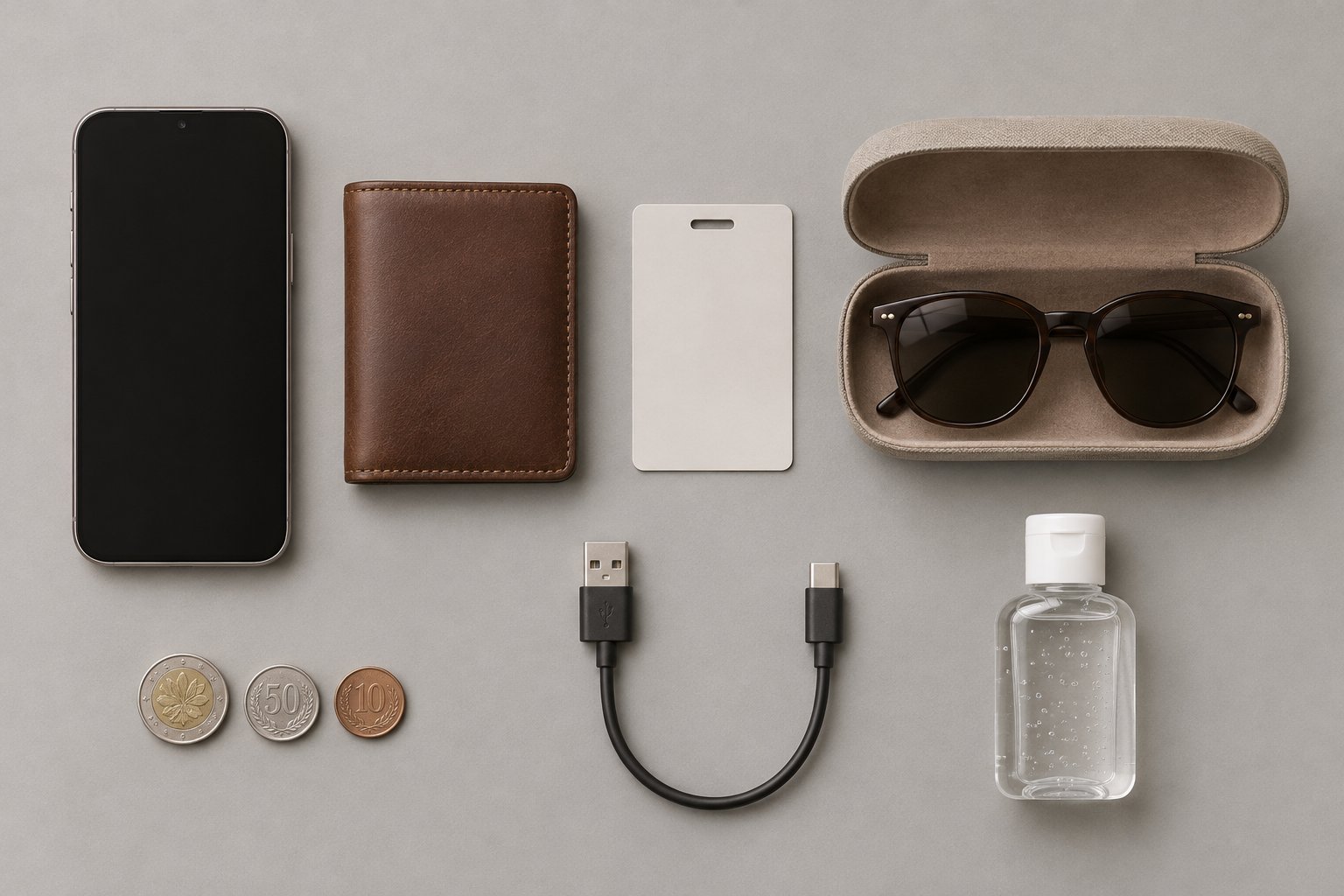
Imagine everything that ends up in your Tesla Model 3 center console over the course of a normal week. For most owners, the list is surprisingly consistent. Here are the items that show up again and again in owner discussions and aftermarket tray reviews:
- Smartphone (as a secondary resting spot beyond the wireless charging pad)
- Wallet or slim cardholder
- Tesla key card and traditional key fob
- Sunglasses or a glasses case
- Coins, toll tokens, or parking garage cards
- USB drives and short charging cables
- Hand sanitizer or a small lotion bottle
- Lip balm, gum, mints, or other pocket-sized personal items
- Garage door remote or building access badge
Not every driver carries all of these. Some keep the console nearly bare; others treat it like a daily pocket dump for everything that leaves their jacket at the end of a commute. The point is that different tray configurations prioritize different combinations of these items. A tray with six narrow slots handles key cards, coins, and lip balm beautifully — but leaves no room for a sunglasses case. A tray with two roomy sections accommodates a bulky wallet and a glasses case side by side — but coins and USB drives rattle around in the leftover space with nowhere specific to land.
This is why grabbing the first well-reviewed organizer you find often leads to disappointment. The five-star reviewer may carry a slim wallet and a single key card. You may carry a thick bifold, a glasses case, and a handful of charging adapters. Same tray, completely different experience.
Compartment Layouts and Trade-Offs
Console tray designs generally fall along a spectrum. On one end, you'll find highly segmented layouts — six, eight, or even ten small compartments, each sized for a specific item type. On the other end, minimalist designs offer just two or three larger open sections with no fine-grained division.
The trade-off is intuitive once you see it clearly. More compartments deliver better organization. Every item gets its own slot, nothing slides into something else, and you can grab what you need without rummaging. The cost is flexibility. A sunglasses case that measures a quarter-inch wider than the designated slot simply will not fit, and larger items like a phone in a thick case may not seat properly in a narrow channel. Owners who frequently swap between different items — rotating sunglasses, stashing a protein bar one day and a small flashlight the next — can find a rigid multi-compartment layout more restrictive than helpful.
Fewer compartments flip the equation. Two or three larger sections keep things versatile. You can toss in a bulky item without worrying about slot dimensions, and the layout adapts naturally to whatever your day demands. The downside is that small items — coins, a USB stick, a toll card — tend to slide into corners or pile up together, partially defeating the purpose of having an organizer at all.
The sweet spot for most Tesla Model 3 owners tends to land somewhere in the middle: a layout with three to five compartments of varying sizes, offering at least one larger section for a phone or sunglasses case and two or three smaller slots for cards, coins, and cables. This hybrid approach keeps the organizational benefit without forcing you to Tetris every item into a tight predetermined slot.
The practical advice? Before you browse any product listings, take thirty seconds to mentally inventory what you actually place in your console on a typical day. Better yet, set those items on your desk and arrange them. You'll quickly see whether you need granular division or generous open space — and that clarity makes choosing a layout dramatically easier.
Depth and Stacking Considerations
Compartment layout is only two-dimensional. Depth adds the third dimension, and it introduces its own set of trade-offs that catch buyers off guard. The Tesla Model 3's center console well is deeper than most drivers expect — deep enough that small items sink below your natural reach line and become hard to see, let alone grab quickly. That depth is the whole reason organizer trays exist. But every tray addresses depth differently.
Shallow trays sit near the top of the console well. Items stay visible, accessible, and easy to grab at a red light or in a parking lot. The trade-off is volume: a shallow tray that occupies the upper portion of the well reduces the total storage capacity below it. Drivers who like stashing a water bottle, a thick phone case, or bulkier items underneath the tray will find that the remaining vertical space shrinks significantly. As owner testing has shown, the real value of a shallow upper tray is creating a fast-access shelf for three to six frequently touched items while the deeper space underneath holds backup or low-frequency accessories.
Deeper trays, or designs that sit lower in the well, preserve more of that original cavity volume. Items may be slightly harder to see at a glance, but you retain the ability to store taller objects without interference. Some designs solve this with a two-layer stacking system — a shallow removable upper tray that lifts out to reveal a deeper lower compartment. These stacking organizers offer the best of both worlds in theory, but they add one extra step every time you need something from the bottom layer.
The right depth depends on your habits. If you grab items from the console multiple times per drive — key card at every parking gate, sunglasses at sunset, phone when you stop for coffee — a shallow, visible tray saves repeated seconds that add up fast. If you use the console more as weekly storage and access it less frequently, a deeper or stacking design preserves volume without much inconvenience.
Before buying a console tray, place your everyday carry items in the console and assess honestly: do you need more division to organize what is in there, or more volume to fit what you want to store?
Getting the layout and depth right ensures the tray works with your habits instead of against them. But even a perfectly sized, perfectly divided organizer can cause daily frustration if it interferes with the built-in features your Tesla Model 3 center console was designed around — and that compatibility question deserves its own closer look.
Will a Tray Block Wireless Charging or USB Access
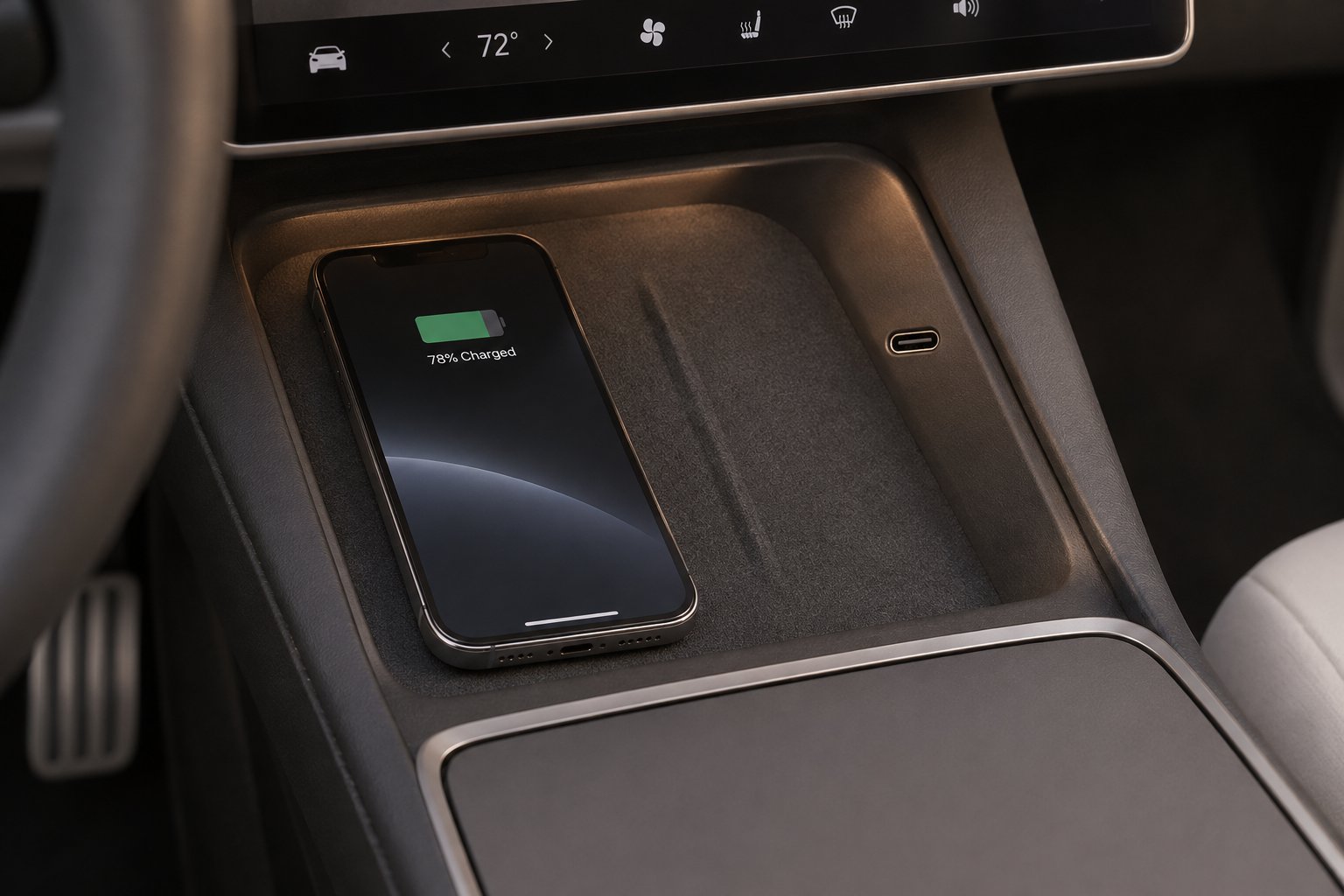
A model 3 center console tray can organize your daily essentials perfectly — right up until it blocks the wireless charger your phone needs or covers the USB port your dashcam depends on. This is a compatibility blind spot that product photos rarely reveal and listing descriptions often gloss over. The Tesla middle console is not just a storage bin. It is an integrated electronics hub with charging pads, data ports, and a power outlet all packed into a compact footprint. Any insert that sits inside it needs to coexist with every one of those features without interference.
Wireless Charging Pad Compatibility
The Model 3's wireless phone chargers are integrated into the front console area, delivering up to 15W of Qi charging power across two side-by-side pads. Your phone must be in direct contact with the charger surface to charge — any gap or obstruction between the phone and the pad can reduce or completely kill the charging connection. Tesla's own manual notes that even a thick phone case can interfere, so imagine what a poorly positioned tray lip or raised plastic edge can do.
Well-designed trays account for this by leaving the entire charging zone completely open, with beveled edges or cutaway sections that stop short of the pad boundaries. Poorly designed ones — particularly generic inserts or trays built for a different console generation — may encroach on the charging area, lifting your phone's resting surface a few millimeters above the charger's effective induction range. That tiny gap is enough to turn a reliable overnight charge into a phone that is still at 40% when you head out in the morning.
The fix is simple: verify that any tray you consider explicitly states compatibility with the wireless charging pad for your specific Model 3 generation. The Highland refresh, for instance, repositioned and deepened the charging pad relative to earlier versions — so a tray that clears the charger on a 2021 console may not clear it on a 2024. Generation-specific design is not optional here.
USB Port and Cable Routing Access
USB ports in the Model 3 serve double duty. They charge your devices and they provide data connections for features like Sentry Mode and Dashcam recordings. The Model 3 includes a USB-C port in the rear compartment of the center console for device charging, plus two additional USB-C ports below the rear cabin vents. A console tray that covers or partially obstructs any of these ports creates a daily irritation that compounds every time you need to plug in.
Quality trays handle this with purpose-cut cable routing channels — small notches or pass-through slots that let a USB cable run from the port up through the tray without pinching or bending at a sharp angle. Some designs route the cable path along the tray's back edge; others carve a discreet channel through the tray floor. Either approach works as long as the cable sits naturally and does not strain the connector.
Generic or ill-fitting trays often lack these routing provisions entirely. The result is a cable that either gets pinched under the tray edge — stressing the connector and potentially damaging the port — or has to drape awkwardly over the tray wall, ruining the clean organized look you bought the tray to achieve. Before purchasing, check product images and reviews for visible cable pass-throughs. If the listing does not show or mention cable management, treat that as a warning sign.
Sliding Lid and Armrest Clearance
Several Model 3 console generations use a sliding cover that doubles as an armrest surface. When it works correctly, the lid glides smoothly along its track to reveal or conceal the storage well beneath. When a tray interferes, the lid catches, stutters, or refuses to close flush — a small annoyance that becomes maddening over weeks of daily use.
The interference typically happens one of two ways. Either the tray sits too high in the console well, with its upper edge protruding above the lid rail and physically blocking the cover's travel path. Or the tray's outer edges are slightly misaligned with the console walls, creating a ridge that catches the lid as it slides. Both issues stem from the same root cause: a tray that was not precision-designed for that specific console generation's dimensions.
Before committing to a purchase, look for reviews from owners who specifically mention testing the sliding lid after installation. A well-engineered tray drops below the lid's travel plane and sits flush against the console walls so the cover operates exactly as it did without the insert.
Here is a quick pre-purchase checklist to run through before adding any console tray to your cart:
- Confirm wireless charger clearance — the tray must leave the full Qi charging pad area unobstructed, with no raised edges lifting the phone above the charger's effective range
- Verify USB port access — all console USB-C ports should remain reachable, with dedicated cable routing channels or cutouts that prevent connector strain
- Test lid operation — the sliding cover or armrest lid should open and close fully without catching, stuttering, or requiring extra force
- Check that the tray sits flush — the insert should rest evenly against the console walls without lifting, tilting, or leaving gaps that invite rattling during driving
Running through these four checks — ideally by reading generation-specific owner reviews rather than relying on manufacturer claims alone — separates a console tray that enhances your daily routine from one that quietly sabotages it. Compatibility with built-in features is non-negotiable, but it is also just one side of an honest evaluation. Every aftermarket accessory has trade-offs, and console trays are no exception.
Honest Limitations and Whether You Need a Console Tray
Product listings highlight the upside. Owner forums highlight the downside. The truth about console trays sits somewhere in between, and understanding the real limitations before you buy is the difference between a satisfying purchase and a return label. Every aftermarket accessory involves trade-offs — and pretending otherwise does not help you make a smarter decision. So here is the unfiltered picture of what is tesla center console tray ownership actually like on a daily basis.
Rattling and Vibration Noise
Electric vehicles are famously quiet cabins. Road noise, tire hum, and wind resistance are the dominant sounds at highway speed — which means any new source of rattling becomes immediately noticeable. This is the single most commonly mentioned complaint about console trays, and it deserves an honest explanation rather than a dismissal.
Hard plastic trays without vibration dampening are the primary offenders. When a rigid ABS insert sits inside a rigid console housing, even microscopic gaps between the tray walls and the console surfaces allow the two hard surfaces to vibrate against each other. At city speeds, you might not notice. At 70 mph on a textured highway, that plastic-on-plastic contact produces a persistent low-level buzz or intermittent tap that grates on drivers who chose a Tesla partly for its quiet ride.
The severity is material- and fit-dependent. As fitment testing has confirmed, a hard organizer without enough lining can stop objects from rolling but introduce a new plastic-on-plastic sound — effectively swapping one annoyance for another. Trays with felt-lined contact edges, rubber bumpers, or silicone construction largely eliminate this issue. But if you buy a bare ABS tray and skip checking for dampening features, rattling is a realistic possibility you should expect, not a defect to complain about after the fact.
Reduced Open Storage Volume
This one sounds obvious, but it catches more buyers than you would think. Any tray you place inside the console takes up space. It subdivides the open well, adds material walls between compartments, and sits at a certain height that reduces the total usable volume below it. That is not a design flaw — it is the fundamental physics of putting an object inside another object.
The practical impact depends on what you store. Drivers who keep a water bottle, a bulky phone in a thick case, or a large sunglasses case in the console may find that a tray makes the space feel more restrictive than organized. The items that fit loosely in an open well suddenly do not fit at all once compartment walls carve up the available room. Owner experience consistently shows that tall or bulky items need a different storage strategy entirely — the tray works best when it handles small, flat, frequently accessed objects, not when it tries to contain everything.
If your daily console contents lean toward fewer, larger items rather than many small ones, a tray may subtract more usability than it adds. That is a legitimate trade-off to weigh honestly, not a reason to assume all console trays are poorly designed.
Fit Tolerance and Quality Variance
Because every Tesla Model 3 console tray comes from a third-party manufacturer, quality is not uniform across the market. Some brands invest in precise mold tooling calibrated to Tesla's actual console dimensions, producing trays with tight tolerances that drop in rattle-free on the first try. Others use looser manufacturing standards, and the result is a tray with slight gaps, play, or edges that do not sit flush against the console walls.
The variance is real and it matters. A tray that fits within a millimeter or two of the console walls feels like it belongs in the car. One that leaves three or four millimeters of play shifts during cornering, rattles during driving, and looks visibly aftermarket rather than seamlessly integrated. The tricky part is that you cannot always tell from product photos which camp a given tray falls into.
Your best defense is reading reviews from owners who drive your exact Model 3 generation. A five-star review from a 2021 owner tells you nothing about how that same tray performs in a Highland console — and vice versa. Filter reviews by generation-specific fit feedback, look for mentions of rattling or looseness, and prioritize products from manufacturers who explicitly name the console generation on the packaging rather than using vague "fits all Model 3" language.
Do You Even Need One
This is the question no product page will ever ask you, but it is the most important one. Not every Model 3 owner benefits from a console tray. If you keep your console nearly empty — maybe a single cable and a key card — adding compartments creates structure for items that do not need structuring. You would be organizing air.
Similarly, drivers who prefer open, flexible storage may find a tray more restrictive than liberating. Some owners like the freedom of tossing any item into the console without thinking about which slot it belongs in. For them, the deep undivided well is not a problem to solve — it is a feature they use exactly as Tesla designed it.
On the other hand, drivers who carry five to eight small items daily — key card, wallet, sunglasses, coins, a short cable, hand sanitizer, maybe a garage remote — and dislike those items sliding into each other on every turn will feel immediate, tangible value from a well-fitted tray. The organizational benefit compounds with every drive. Grabbing your key card without fishing through a pile, keeping your sunglasses from scratching against loose coins, having your charging cable coiled in its own slot instead of tangled with everything else — these small improvements add up into genuine daily satisfaction.
The honest evaluation comes down to a simple self-test: empty your center console onto your desk and count the items. If you see two or three things, you probably do not need a tray. If you see six or more small items that you reach for regularly, the organizational payoff is real and worth the modest investment.
A console tray solves a specific organizational problem — if you do not have that problem, skip it. No accessory is worth buying just because it exists.
Honest self-assessment about whether you need a tray at all is the first filter. For owners who do see the value, though, one more compatibility question tends to surface — especially for households that own both a Model 3 and a Model Y, or drivers cross-shopping accessories between the two vehicles.
Model Y Console Trays and Cross-Compatibility
Own a Model 3 and a Model Y in the same household? Or maybe you are browsing center console trays online and keep seeing listings that mention both vehicles in the same title. It is tempting to assume that a tray fitting one will slide right into the other. After all, both cars share the same platform, the same infotainment system, and — in certain generations — what looks like the same center console. That assumption, however, is exactly how buyers end up with a tray that almost fits but does not quite work.
Model Y and Model 3 Console Similarities
Tesla built the Model Y on the Model 3's platform architecture, and the interior DNA is unmistakable. The dashboard layout, the steering wheel controls, the touchscreen dimensions, and even the general console silhouette carry over between the two vehicles. During certain production periods, the similarities run deep enough that the center console designs are functionally identical. The Gen 2 matte console introduced in late 2020 for the 2021 Model 3, for example, also appeared in the 2021-2024 Model Y. Same matte finish, same sliding door mechanism, same integrated dual wireless charging layout. Tesla console trays built for this specific era often fit both vehicles interchangeably — and manufacturers frequently label their products accordingly.
That shared history creates a reasonable expectation: if it fits one, it fits the other. And for that particular generation window, the expectation often holds true. The problem is that "often" is not "always," and the overlap has broken down significantly with each vehicle's most recent refresh.
The Model 3 Highland, which began production in 2024, introduced a completely redesigned interior — new console geometry, deeper wireless charging pad, revised storage proportions. The Model Y Juniper, arriving for the 2025-2026 model year, received its own interior overhaul that mirrors the Highland's design philosophy but is not dimensionally identical in every detail. The Juniper's taller greenhouse and different cabin proportions mean that even though the consoles look related, the exact cavity measurements, trim contact points, and clearance tolerances can differ enough to make a Highland-specific tray incompatible with a Juniper console — or vice versa. As fitment testing labs have emphasized, "Model 3/Y" in a product title is simply not precise enough for Highland-era or Juniper-era console parts.
Cross-Compatibility Pitfalls
The real danger lives in product listings that use broad labels. You will see center console trays marketed as "fits Tesla Model 3 and Model Y" without specifying which generation of each vehicle. That label might be perfectly accurate for 2021-2023 Model 3 and 2021-2024 Model Y units — but someone driving a 2025 Juniper or a 2024 Highland who trusts that same listing is gambling on a fit that was never verified for their console.
Even within the same generation window, subtle manufacturing variations between the sedan and the crossover can affect how snugly a tray sits. The Model Y's slightly wider interior cabin and different structural reinforcements around the center tunnel mean that a tray's outer edges may contact the console walls at slightly different points than in a Model 3. For most well-made organizers designed to fit both vehicles in a given generation, this difference is negligible. For cheaper trays with looser tolerances, it can be enough to introduce a rattle or a visible gap on one vehicle that does not appear on the other.
The safest approach is treating Model 3 and Model Y as separate vehicles when shopping — even if you know the consoles share common ancestry. A tesla organizer 2021 that works perfectly in your Model 3 might transfer to your spouse's same-era Model Y without issue, but confirming that cross-fit through reviews or manufacturer specs takes thirty seconds and can save you a return.
Here is a quick verification checklist before assuming any tray works across both vehicles:
- Verify the exact model name — confirm whether the listing specifies Model 3, Model Y, or both, and whether that claim is generation-specific
- Verify the generation or production period — a tray labeled for 2021-2023 Model 3 / 2021-2024 Model Y is far more trustworthy than one that simply says "Model 3/Y"
- Check manufacturer compatibility listings — reputable brands publish fitment charts that break down compatibility by model AND generation, not just model name
- Read owner reviews filtered to your specific vehicle — a five-star review from a Model Y owner does not guarantee the same tray performs identically in a Model 3 Highland, and vice versa
Cross-compatibility is not impossible — it is just not automatic. For the Gen 2 era, many console trays genuinely work in both vehicles. For the Highland and Juniper era, assume they do not until a manufacturer or a verified owner review confirms otherwise. That single habit of checking before buying prevents the most avoidable return in the entire Tesla accessory market.
With generation confirmed and cross-compatibility sorted, the final step is pulling everything together into a clear decision path — one that matches your console, your daily habits, and the features that matter most to your driving life.
How to Pick the Right Tray for Your Model 3
You have the knowledge. You understand the three console generations, the material trade-offs, the compartment layout spectrum, and the compatibility checkpoints that separate a satisfying purchase from a frustrating return. The only thing left is turning all of that into a clear, repeatable decision process you can follow in five minutes flat. Here is how to narrow the field and land on the right center console Tesla organizer for your specific car and your specific habits.
Match the Tray to Your Console Generation
This is the non-negotiable first step — and the one that eliminates the most common purchasing mistake in one move. Every other preference you have about material, layout, or depth is irrelevant if the tray does not physically fit your console well. Three distinct eras, three incompatible designs:
- 2017-2020 (Original) — glossy piano black console, original sliding cover, first-generation phone dock. Only trays explicitly labeled for pre-2021 Model 3 will work.
- 2021-2023 (Mid-Cycle Refresh) — matte finish console, revised sliding cover and storage proportions. Requires trays designed for 2021-2023 Model 3 specifically.
- 2024 onward (Highland) — ground-up interior redesign with new console geometry, deeper wireless charging pad, and repositioned storage areas. Only Highland-specific trays fit.
Check the model year on your registration or the tenth character of your VIN if you are unsure. Then filter every product listing through that generation before evaluating anything else. A tray without a clear generation label on the packaging? Skip it. That vagueness is a red flag, not a convenience.
Prioritize Your Material and Layout Preferences
Once generation compatibility narrows the field, your personal priorities determine the final pick. Think of it as a quick decision tree based on what bothers you most about your current console experience:
- If cabin noise matters most — prioritize flocked or silicone-lined trays. Both materials absorb vibration and prevent items from clattering against hard surfaces. Silicone edges the competition slightly with zero measurable rattle in highway testing, but flocked inserts deliver a premium tactile feel that many owners prefer.
- If easy cleaning matters most — lean toward smooth ABS or silicone. Spills wipe off in seconds. Silicone can even be rinsed under a faucet and reinstalled in under a minute. Flocked surfaces, by contrast, absorb liquids and trap dust in fiber layers that require more careful maintenance.
- If maximum compartmentalization is the goal — look for multi-section designs with five or more divided slots. These work best for drivers who carry many small items daily and want each one in its own dedicated space.
- If flexibility matters most — choose fewer, larger compartments. Two or three open sections accommodate varying item sizes day to day without forcing everything into a predetermined slot.
Most drivers land somewhere in the middle: a three-to-five compartment layout in silicone or felt-lined ABS that balances organization with adaptability. But your habits are your own. The driver who carries nothing but a key card and a pair of sunglasses has completely different needs than the one who treats the tesla console as a daily pocket dump for eight items.
Where to Find Console Organizers Worth Considering
The aftermarket is deep, and quality varies. Sorting through dozens of generic listings can feel like its own research project — which is why starting with collections specifically curated for Tesla console storage saves real time. For Model 3 owners exploring inserts, armrest trays, and storage boxes designed to make better use of their console compartments, CUTIM's center console organizers and trays collection offers options for drivers who want small essentials within easy reach. Their lineup targets the practical middle ground — organizational inserts that drop in cleanly, not complete console replacements or locking safes.
When browsing any collection, match the console generation and mounting location before anything else. A beautifully designed tray in the wrong generation is just a beautifully designed tray that does not fit your car. Verify the product description names your specific production year range, confirm it addresses wireless charger clearance for your console era, and check that owner reviews mention your generation by name. These three checks take less than a minute and prevent the most common buying mistake in the entire accessory category.
Here is the complete action checklist — five steps, in order, to go from browsing to confident purchase:
- Identify your Model 3 generation — check your model year or VIN to confirm whether you drive the original, mid-cycle refresh, or Highland console
- Inventory your daily carry items — set the items you actually store in the console on a flat surface and assess whether you need more division or more volume
- Choose your material preference — decide whether noise dampening, easy cleaning, grip, or long-term durability matters most for your daily driving conditions
- Verify wireless charger and USB clearance — confirm the tray leaves the Qi charging pad fully unobstructed and provides cable routing for all USB-C ports
- Read generation-specific fit reviews before ordering — filter owner feedback to your exact console generation, looking for mentions of rattle, lid interference, and flush fit
Follow those five steps in sequence and you will avoid the mistake that trips up most buyers — ordering a well-reviewed tray that was never designed for your console. The right tesla model 3 center console tray is not the most popular one or the cheapest one. It is the one that matches your generation, your material priorities, and the items you actually carry. Get those three things right, and a ten-dollar organizer can feel like it was engineered specifically for your car.
Tesla Model 3 Center Console Tray FAQs
1. Does Tesla sell an official center console tray for the Model 3?
No. Tesla only offers an OEM center console tray for the redesigned Model Y (2025+), priced at $40 with three separate bins. There is no official Tesla-branded console tray for any Model 3 generation. Every Model 3 console tray on the market is an aftermarket product from third-party manufacturers. This actually works in buyers' favor, since the competitive aftermarket provides a wider range of materials, layouts, and price points than a single OEM option would. Collections like CUTIM's center console organizers (https://www.cutimauto.com/collections/tesla-center-console-organizers) offer generation-specific inserts, armrest trays, and storage boxes designed for compatible Tesla consoles.
2. Are Tesla Model 3 center console trays compatible across all model years?
No, and this is the most common buying mistake. Tesla produced three distinct console designs: the original pre-refresh (2017-2020) with a glossy piano black finish, the mid-cycle refresh (2021-2023) with a matte finish and revised proportions, and the Highland refresh (2024 onward) with a completely redesigned interior. Trays are not cross-compatible between these generations. A tray built for one era will not fit properly in another due to differences in cavity dimensions, sliding cover mechanisms, and storage well shapes. Always verify your exact generation before purchasing.
3. Will a center console tray block the wireless charger or USB ports in my Model 3?
A well-designed, generation-specific tray should not interfere with wireless charging, USB-C port access, or the sliding armrest lid. However, poorly fitting or generic trays can encroach on the Qi charging pad area, block USB ports, or catch against the sliding cover. Before buying, confirm the product explicitly lists wireless charger clearance for your specific Model 3 generation, includes cable routing cutouts for USB ports, and sits below the lid's travel plane so the cover operates smoothly.
4. What is the best material for a Tesla Model 3 console tray?
It depends on your priority. Silicone and TPU rubber offer the broadest balance of noise dampening, grip, and easy cleaning — they produce zero measurable cabin rattle during highway driving and can be rinsed under a faucet. Flocked or felt-lined trays deliver a premium, quiet feel but trap dust and are harder to clean after spills. ABS hard plastic trays are the most durable and hold their shape long-term, but they can rattle without added dampening pads. Matching the material to your biggest daily annoyance — noise, mess, or sliding items — leads to the most satisfying choice.
5. Can I use a Tesla Model Y center console tray in my Model 3?
Sometimes, but never assume. During the 2021-2023 production era, the Model 3 and Model Y shared nearly identical console designs, and many trays fit both vehicles interchangeably. However, the Model 3 Highland (2024+) and Model Y Juniper (2025+) received separate interior redesigns with different console dimensions. A tray designed for one refresh will not necessarily fit the other. Always verify both the model name and generation in the manufacturer's compatibility listing, and read owner reviews specific to your exact vehicle before ordering.