
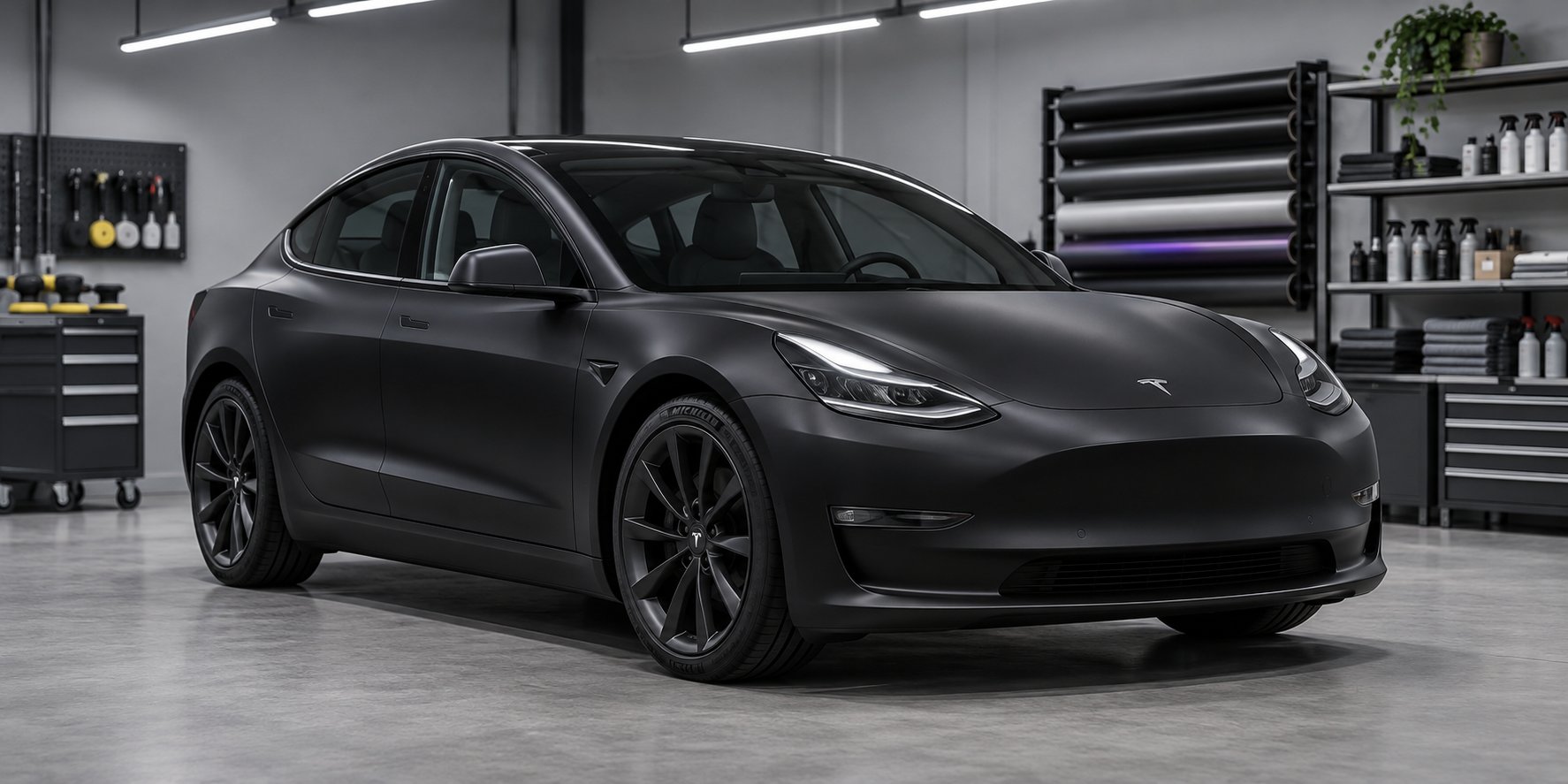
What a Tesla Custom Shop Actually Is and Why It Exists
You just picked up your new Tesla, and the first thought hits you: how do I make this thing truly mine? Maybe it's a matte wrap, a set of forged wheels, or just a center console organizer so your sunglasses stop sliding around every time you corner. Whatever the itch, you'll quickly discover that not every auto shop knows what to do with a Tesla sitting in their bay. That's exactly where a dedicated Tesla custom shop enters the picture.
Defining the Tesla Custom Shop
A Tesla custom shop is a retailer or service provider — online, brick-and-mortar, or hybrid — that sells aftermarket parts, accessories, and modification services designed specifically for Tesla vehicles.
This distinction matters more than it sounds. A Tesla custom shop is not a Tesla dealership, which focuses on selling new vehicles and performing warranty-covered service. It's also not the general auto accessory store down the street that stocks universal phone mounts and pine tree air fresheners. These specialized businesses exist because Teslas are fundamentally different machines, and the people who modify them need to understand those differences inside and out.
Think of it this way: a traditional auto shop knows engines, transmissions, and exhaust systems. A Tesla has none of those. What it does have is a high-voltage battery pack, an integrated software ecosystem controlling nearly every vehicle function, and a suite of cameras and sensors powering Autopilot and Full Self-Driving features. Tuning Tesla vehicles or installing even seemingly simple tesla mods requires awareness of these systems in ways that simply don't apply to a conventional car.
Why Tesla-Specific Expertise Matters
Here's where most owners underestimate the complexity. Tesla vehicles use proprietary connectors, aluminum-intensive body construction, and over-the-air software updates that can change how components interact with the car overnight. A vinyl wrap that covers a camera lens? That disables part of Autopilot. A suspension swap performed without proper torque specs on an aluminum subframe? That's a safety risk. Aftermarket lighting that confuses the vehicle's vision system? You've just introduced a software conflict that no generic scan tool can diagnose.
Research into the EV repair landscape highlights that electric vehicles demand entirely new areas of expertise, from battery diagnostics and software troubleshooting to high-voltage safety protocols. Repair and customization shops that fail to develop these specialized skills risk damaging the very vehicles they're trying to improve. Sensor calibration after bodywork, compatibility checks before and after OTA updates, and an understanding of how modifications interact with regenerative braking are all part of the baseline knowledge a credible Tesla-focused operation needs.
General auto shops may occasionally work on a Tesla, but there's a meaningful gap between "occasionally" and "exclusively." That gap is where costly mistakes live — bubbled wraps from improper prep on Tesla's water-based paint, voided warranties from poorly executed electrical taps, or misaligned body kits that block ultrasonic sensors.
Who Uses Tesla Custom Shops
The audience for these specialized businesses is broader than you might expect. It's not just enthusiasts chasing a modded Tesla look for weekend car meets. Three distinct groups drive this market:
- New owners seeking personalization — They want their Tesla to feel unique from day one, often starting with simple interior accessories, screen protectors, and chrome deletes.
- Performance enthusiasts — These owners pursue suspension upgrades, forged wheels, big brake kits, and track-oriented builds, pushing what a battery-electric platform can do.
- Everyday practical owners — Families and daily drivers looking for all-weather floor mats, cargo organizers, paint protection film, and accessories that preserve resale value and simplify daily life.
Each group has different priorities, different budgets, and different tolerance for complexity. What unites them is a shared need for products and services that actually fit their vehicle without creating new problems.
The Tesla aftermarket ecosystem has grown rapidly to serve all three, but navigating it without a clear understanding of how these businesses operate, what modifications are available, and which ones carry real risk is where most owners stumble. That's precisely what the rest of this guide unpacks — starting with the different types of shops you'll encounter and what each one actually does.
The Three Types of Tesla Custom Shops Explained
Knowing that Tesla-specific expertise matters is one thing. Figuring out where to actually spend your money is another. The Tesla aftermarket ecosystem isn't a single category — it's three distinct business models, each built to serve different needs. Understanding the difference saves you from ordering parts you can't install yourself, or driving to a local shop only to discover they don't stock the product you need.
The Tesla aftermarket is also not a niche curiosity anymore. Industry data cited by Tesstudio projects the global Tesla aftermarket parts market to surpass $850 million, with the U.S. opportunity alone estimated between $2.8 billion and $4.2 billion. Roughly 72% of Tesla owners buy at least one accessory within the first six months of delivery. That kind of demand has created a sprawling marketplace — and three very different ways to shop within it.
Online Aftermarket Retailers
The most accessible entry point is the e-commerce model. Companies like Unplugged Performance, T Sportline, RPM Tesla, Tesery, Abstract Ocean, Taptes, and EveryAmp primarily sell aftermarket Tesla accessories through their websites, shipping parts directly to owners for self-installation. You browse a catalog, select your model year, and receive a product designed to be bolt-on or plug-and-play.
These retailers typically offer broad catalogs spanning multiple Tesla models — from Model 3 floor mats to Model Y cargo organizers to Cybertruck bed accessories. Their strength lies in convenience, price transparency, and selection. About 78% of Tesla accessory transactions happen online, which tells you how dominant this channel has become. The trade-off? You're on your own for installation. If a product requires professional fitting — say, a body kit or suspension component — you'll still need to find a separate shop to do the work.
Local Tesla-Specialized Service Shops
Imagine you want a full-body vinyl wrap, a complete paint protection film application, or a coilover suspension installed. These aren't projects you tackle in your garage on a Saturday afternoon. That's where brick-and-mortar Tesla-specialized shops come in — operations like Apex Customs and regional specialists you'll find through Tesla owner communities in cities from Tesla Tempe AZ locations to shops across Houston and Los Angeles.
These businesses provide hands-on services requiring professional skill: vinyl wraps, PPF, ceramic coatings, suspension installation, body kit fitting, window tinting, and custom fabrication. You get in-person consultation, a technician who can evaluate your specific vehicle, and installation labor backed by a workmanship guarantee. The limitation is product scope — most local shops carry a curated selection of brands they trust rather than an exhaustive catalog. Their pricing reflects the labor intensity and expertise involved, so expect higher per-visit costs than an online parts order.
When searching for these specialists — whether you're scouting a Tesla Tempe shop or one in your own metro — owner forums and regional Tesla Facebook or Reddit groups remain the most reliable sources. Real owners sharing real results beats any ad spend.
Hybrid Operations and Performance Tuners
The third category blends both worlds. Hybrid operations design and manufacture proprietary parts while also offering installation and tuning services under one roof. Unplugged Performance is the most prominent example — a Los Angeles-based company that not only sells premium suspension, aero, and performance components but also became directly authorized by Tesla for vehicle service and body repair. Their technicians completed Tesla's official training and gained access to diagnostic equipment, proprietary repair tools, and direct replacement parts.
That kind of integration is rare. Most hybrid operations sit somewhere between the online catalog and the full-service local shop, offering their own branded products plus professional installation. Dedicated performance tuners within this category focus specifically on suspension, braking, and track-oriented upgrades — the high-skill modifications where engineering precision is non-negotiable.
| Business Model | Typical Services | Price Range Tier | Best For | Examples |
|---|---|---|---|---|
| Online Aftermarket Retailer | Bolt-on accessories, interior organizers, trim kits, screen protectors, wheels, lighting | Low to Moderate | Self-installers seeking convenience, broad selection, and competitive pricing | T Sportline, RPM Tesla, Abstract Ocean, Taptes, Tesery, EveryAmp |
| Local Tesla-Specialized Shop | Vinyl wraps, PPF, ceramic coating, window tint, suspension install, body kit fitting, custom fabrication | Moderate to High | Owners needing professional labor, consultation, and hands-on craftsmanship | Apex Customs, regional Tesla-focused wrap and tint studios |
| Hybrid Operation / Performance Tuner | Proprietary parts design, installation, suspension tuning, brake upgrades, track preparation, authorized service | High to Premium | Enthusiasts pursuing performance builds, owners wanting one-stop design-to-install service | Unplugged Performance, select regional performance shops |
Most Tesla owners will interact with more than one of these shop types over time. You might start with an online order for floor mats and a console organizer, graduate to a local specialist for a ceramic coating, and eventually land at a hybrid tuner for a full suspension overhaul. The key is recognizing which model fits each stage of your build — and understanding that the products and services themselves vary just as widely as the shops that sell them.
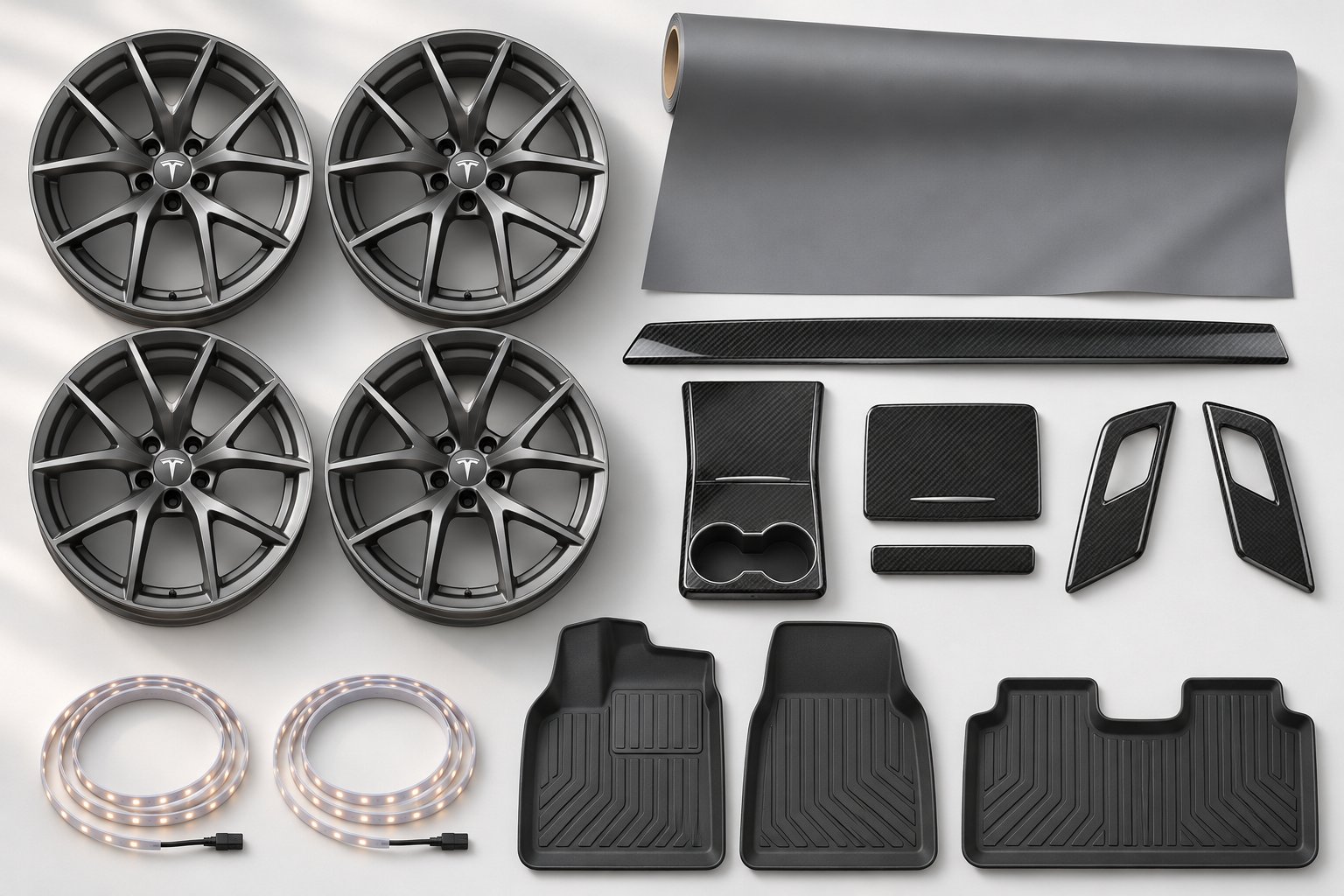
Every Tesla Modification Category Broken Down
Products and services vary widely across those three shop types — but what exactly are the tesla modifications owners are choosing, and why? Browse any specialist's website and you'll find dozens of categories listed in a sidebar without much explanation. A chrome delete sounds cool, but what does it actually involve? Is a ceramic coating worth it if you already have PPF? Can you install ambient lighting yourself, or does it require a professional?
This section answers all of that. Think of it as an encyclopedia of everything a Tesla custom shop can do to your vehicle — organized by category, with honest context about what each modification entails, who it's for, and how much skill is involved.
Exterior Modifications and Protection
The outside of your Tesla is where most customization journeys begin, partly because it's the most visible and partly because protection-focused modifications pay for themselves over time. Here's what falls under this umbrella:
Vinyl wraps are thin adhesive films applied over the factory paint to change the vehicle's color or finish. You can go from Tesla's standard white to a deep satin black, a matte military green, or even a chrome rose gold — all without touching the original paint underneath. Wraps are also fully reversible, which makes them popular with owners who lease or plan to resell. A full-body color-change wrap requires professional installation; the process involves surface prep, heat-forming the film around curves and recesses, and careful trimming around sensors and cameras. Expect a skilled installer to spend two to five days on a complete wrap.
Chrome delete is a subset of wrapping focused specifically on replacing the shiny chrome trim pieces — window surrounds, door handles, badges — with a blacked-out or color-matched finish. On pre-refresh Model 3 and Model Y vehicles, chrome delete became one of the most popular first modifications because the bright chrome contrasted sharply with darker paint colors. Newer Highland and Juniper models ship with dark trim from the factory, reducing the need.
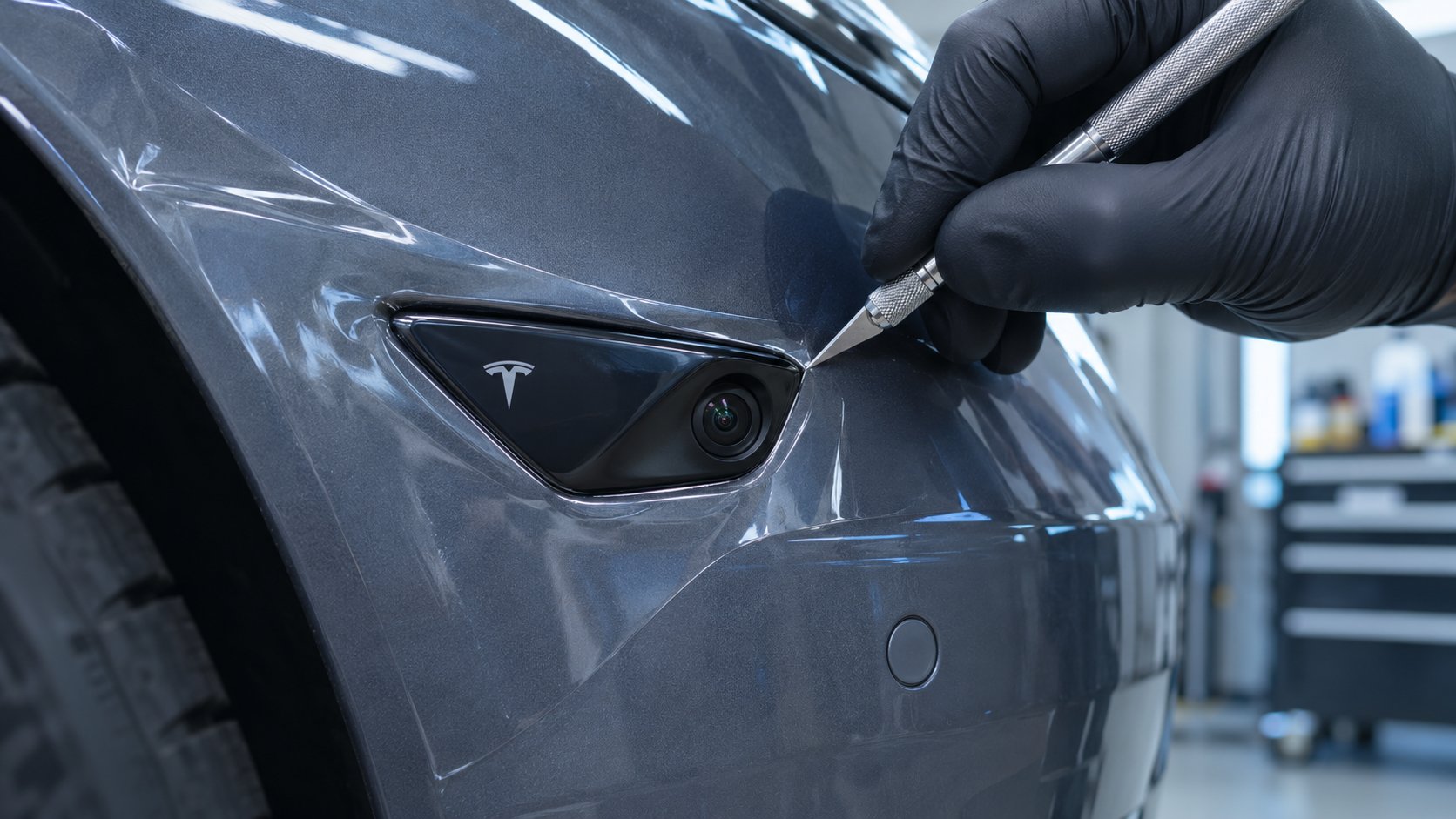
Paint protection film (PPF) is a transparent, self-healing urethane layer applied to high-impact areas like the front bumper, hood, fenders, side mirrors, and rocker panels. Its purpose is purely functional: it absorbs rock chips, bug splatter, and minor abrasions that would otherwise damage the paint. Full-body PPF coverage provides the most complete shield but requires meticulous professional installation, especially around Tesla's camera housings and sensor zones. Partial coverage — just the front end and rocker panels — offers a balanced compromise.
Ceramic coating is a liquid polymer that bonds to the paint surface and creates a hydrophobic, UV-resistant barrier. It doesn't replace PPF; it complements it. Ceramic coating makes the car dramatically easier to wash, repels water and contaminants, and enhances gloss. Many owners layer ceramic coating on top of PPF for the best of both worlds — physical impact protection plus chemical and environmental resistance.
Window tinting reduces heat, glare, and UV exposure inside the cabin while adding privacy and a sleeker exterior look. Tesla's glass roof on the Model 3 and Model Y is a common tinting target since the factory glass, while coated, still allows significant heat transmission. Professional tinting is recommended because improper application can interfere with defrosters, and certain film types may affect the visibility of embedded antenna elements in the glass.
Aero kits and body kits add visual drama and, in some cases, functional aerodynamic benefits. These include front lip spoilers, rear diffusers, side skirts, and rear wing spoilers. The functional versions are designed to reduce drag or increase downforce at higher speeds, while cosmetic versions focus purely on appearance. Installation typically requires professional fitting to ensure alignment with Tesla's body lines, sensor positions, and camera fields of view.
Interior Upgrades and Organization
Tesla's minimalist cabin design is polarizing — some owners love the clean aesthetic, while others feel it leaves too much empty space begging to be filled. Interior modifications bridge that gap, and the good news is that many of them are completely owner-installable without any tools.
Carbon fiber trim replaces or overlays the factory dash, center console, and door panel surfaces with real or carbon-fiber-style pieces, adding a sporty, premium texture. Real carbon fiber is lighter and more visually striking; carbon-fiber-style overlays achieve a similar look at a lower price. Both options typically attach with adhesive or clip-on mounting, making them accessible to DIY owners.
Ambient lighting kits add LED strips beneath the dash, along door panels, or inside footwells, creating a customizable glow that transforms the cabin atmosphere. Most aftermarket kits for Tesla models are plug-and-play, tapping into existing power connections without cutting wires or modifying the electrical system.
Custom upholstery and seat covers range from protective neoprene seat covers to full leather or Alcantara reupholstery. Protective covers are straightforward slip-ons. Full reupholstery, on the other hand, is a professional-grade modification involving removal of the factory seat skins and replacement with custom-fitted material.
Center console organizers, screen protectors, and storage solutions are among the highest-volume accessories in the Tesla aftermarket. Console trays, glove box dividers, sunglass holders, and under-seat storage bins address the practical shortcomings of Tesla's interior design — specifically, the lack of small-item storage that many owners notice within the first week of ownership. Screen protectors shield the touchscreen from fingerprints and glare, available in matte or glossy finishes. All-weather floor mats from dedicated Tesla suppliers offer precise fitment that generic mats simply can't match, covering the frunk, trunk, and cabin floors.
Wheels, Suspension, and Performance
Here's where Tesla modifications diverge most dramatically from traditional car customization. There's no engine to tune, no exhaust to upgrade, and no intake to swap. Performance gains on an EV come from how the car handles, stops, and connects to the road — which means wheels, suspension, and brakes carry outsized importance.
Aftermarket wheels are one of the most visually impactful upgrades, but on an EV, they're also one of the most functionally significant. The choice between forged and cast wheels matters more here than on a gas car. Forged wheels are lighter — often significantly so — which directly affects range, acceleration feel, and ride quality. Cast wheels are more affordable but heavier, meaning you'll sacrifice some efficiency for the aesthetic upgrade. Weight-conscious Tesla owners gravitate toward forged options from aftermarket brands for exactly this reason.
Suspension upgrades include coilovers, lowering springs, and air suspension kits. Coilovers offer adjustable ride height and damping, letting owners fine-tune the car's handling characteristics for daily driving or track use. Lowering springs drop the ride height for a more aggressive stance and lower center of gravity without the adjustability of coilovers. Air suspension kits — available on models that don't come with factory air suspension — offer the flexibility to raise or lower the car on demand.
Real-world performance results from these modifications are significant. Testing by Jalopnik and Speed Academy showed that upgrading a Model 3 with coilovers, improved brake pads and fluid, rear suspension arms, and performance tires dropped lap times from 1:29.0 to 1:21.7 — over seven seconds faster on the same track. Even just a wheel and tire change alone cut nearly five seconds off the stock lap time.
Brake upgrades include performance pads, stainless steel brake lines, upgraded fluid, and big brake kits with larger rotors and multi-piston calipers. Teslas rely heavily on regenerative braking for everyday deceleration, but the friction brakes become critical during spirited driving and track sessions. Upgrading the braking system improves stopping power, reduces fade under repeated hard braking, and gives the driver more confidence at the limit.
Here's a scannable overview of every major modification category and what each one delivers:
- Vinyl Wraps — Full or partial color-change films; reversible; professional installation required
- Chrome Delete — Blackout trim replacement for a cleaner, modern look; semi-DIY friendly
- Paint Protection Film (PPF) — Transparent self-healing film that absorbs rock chips and scratches
- Ceramic Coating — Hydrophobic chemical barrier for UV protection and easy cleaning
- Window Tinting — Heat and glare reduction; privacy; professional application recommended
- Aero and Body Kits — Front lips, diffusers, spoilers, and side skirts for aesthetics or aerodynamics
- Carbon Fiber Trim — Interior dash and console overlays in real or styled carbon fiber
- Ambient Lighting — LED accent strips for cabin customization; plug-and-play kits available
- Custom Upholstery — Seat covers or full reupholstery in leather, Alcantara, or neoprene
- Console Organizers and Storage — Trays, dividers, and bins to address Tesla's minimal storage design
- Screen Protectors — Matte or glossy films for fingerprint and glare resistance on the touchscreen
- All-Weather Floor Mats — Precision-fit mats for cabin, frunk, and trunk coverage
- Aftermarket Wheels — Forged or cast options; weight affects EV range directly
- Suspension (Coilovers / Lowering Springs / Air Kits) — Adjustable handling, stance, and ride quality
- Brake Upgrades — Performance pads, fluid, lines, and big brake kits for improved stopping power
- Puddle Lights — Custom LED projector lights beneath door mirrors or door sills
- LED Interior and Exterior Lighting — Brighter, customizable replacements for factory bulbs
- Dash Cameras — Upgraded or supplemental cameras beyond Tesla's built-in dashcam
- Digital Accessories — USB hubs, rear-seat displays, head-up displays, and smart button controllers
Digital and Lighting Accessories
This final category is often overlooked, but it's one of the fastest-growing segments in the Tesla aftermarket. Digital and lighting accessories tap into the vehicle's tech-forward identity and let owners push the cabin experience even further.
Puddle lights replace the stock under-door lights with custom LED projectors that cast a logo, pattern, or Tesla emblem onto the ground when you open the door. They're a subtle touch that makes a disproportionately big impression, especially at night. Installation is straightforward — most kits are direct plug-and-play replacements.
LED upgrades swap out the factory interior and trunk lights for brighter, whiter LEDs. Tesla's stock interior lighting is functional but underwhelming in some areas, and aftermarket LED kits address this with noticeably improved illumination. These are simple bulb swaps that take minutes.
Dash cameras and supplemental recording systems expand beyond Tesla's built-in dashcam, which relies on the vehicle's Autopilot cameras. Owners who want higher resolution, wider angles, or rear-facing coverage independent of Tesla's system often add standalone dash cameras that record to their own storage.
Digital accessories represent the broadest subcategory. This includes USB hubs that expand connectivity, rear-seat entertainment screens, head-up displays that project speed and navigation onto the windshield, and programmable smart buttons that trigger specific vehicle functions. These accessories integrate with Tesla's existing tech ecosystem rather than replacing it, adding layers of convenience without conflicting with the car's software.
With so many modification categories available, a natural question emerges: which ones make sense for your specific Tesla model? A chrome delete that transformed a pre-refresh Model 3 may be irrelevant on a Highland. A cargo organizer designed for the Model Y's hatch doesn't exist for the Model S sedan. The answer depends entirely on which vehicle is sitting in your driveway — and that's where model-specific guidance becomes essential.
Model-Specific Customization Guides for Every Tesla
Every Tesla modification category from the previous section sounds appealing in the abstract. But which ones actually make sense for the vehicle you own? A carbon fiber spoiler that looks stunning on a Model S Plaid might seem oddly out of place on a Model Y hauling kids to soccer practice. A cargo organizer purpose-built for the Model Y's deep trunk well simply doesn't exist for the Model 3 sedan. And wrapping a Cybertruck? That's a completely different challenge than wrapping anything else in Tesla's lineup.
Most online retailers organize their catalogs by model — click "Model 3," see Model 3 products. That's helpful for filtering, but it never explains why certain modifications dominate certain models. Understanding those patterns helps you prioritize smarter, spend less on mods that don't match your vehicle's strengths, and build a custom Tesla that actually makes sense for how you drive it.
Model 3 and Model Y Customization Priorities
These two vehicles account for the vast majority of Tesla deliveries, which means they also enjoy the largest and most competitive aftermarket ecosystem. More owners means more demand, more products, better fitment options, and lower prices. If you're looking to customize Tesla 3 or Model Y, you'll have no shortage of choices — but the priorities between the two models diverge in interesting ways.
Model 3 owners tend to lean heavily into aesthetic personalization. This is the car people want to make look different. Chrome deletes were practically a rite of passage for pre-refresh Model 3 buyers — that bright silver window trim clashed with darker paint colors, and blacking it out instantly modernized the car's appearance. Vinyl wraps, aftermarket wheels, and window tinting round out the top modification categories. Interior comfort upgrades like carbon fiber trim overlays, ambient lighting, and center console wraps (to hide that fingerprint-magnet piano black finish on older models) are equally popular. As Find My Electric notes, even practical mods like PPF and mud flaps rank among the most recommended Model 3 modifications because the vehicle's rocker panels are notoriously vulnerable to road debris damage.
Performance-oriented owners gravitate toward the Model 3 Performance variant, where suspension mods, upgraded brake pads, and wheel-and-tire swaps unlock genuine track capability. Swapping between wheel sets lets owners toggle between an efficient daily commute setup and a firmer, grippier performance configuration — and keeping the stock wheels means the mod stays fully reversible for resale.
Model Y owners skew practical. The vehicle's crossover SUV profile attracts families, outdoor enthusiasts, and owners who use it as a daily hauler — and the modification priorities reflect that. All-weather floor mats, cargo organizers, trunk storage bins, roof rack solutions, and pet seat covers consistently rank as the highest-volume Model Y accessories. Protection-focused mods like PPF, ceramic coating, and mud flaps are also popular because the Model Y shares the Model 3's susceptibility to rocker panel paint damage from road debris.
That's not to say Model Y owners ignore aesthetics. Window tinting, wheel upgrades, and subtle chrome deletes are common. But the center of gravity for Model Y tesla customization sits squarely in the "make daily life easier" category rather than the "turn heads at a car meet" category.
One critical detail many shops skip: generational compatibility matters. The pre-refresh Model 3 (2017-2023) and the Highland refresh (2024+) have different interior layouts, trim attachment points, and accessory compatibility. The same applies to the original Model Y versus the Juniper refresh. A center console organizer designed for the pre-refresh interior simply won't fit the redesigned cabin. Always verify your model year and generation before ordering, especially from online retailers that may list products under a generic "Model 3" or "Model Y" label without specifying which generation they fit.
Model S, Model X, and Cybertruck Considerations
Step outside the high-volume Model 3/Y world, and the aftermarket landscape shifts considerably. Fewer units on the road mean fewer aftermarket products, higher prices per item, and a customization culture with different priorities.
Model S owners often pursue performance-oriented builds that match the vehicle's grand touring character. Tesla's own refinements to the refreshed Model S — including revised and retuned air suspension, improved active noise cancellation, and Plaid-specific upgrades like a carbon fiber spoiler and front splitter — underscore that this is a performance-first platform. Aftermarket modifications follow that lead: suspension tuning, forged wheels sized in 19" or 21" configurations, big brake kits, and high-performance tire setups dominate. Aesthetic mods like wraps and PPF are popular too, but they tend to complement a performance build rather than define one. The Model S Plaid, in particular, attracts the kind of enthusiast who wants track preparation — coilovers, upgraded brake fluid, and performance pads that can handle repeated high-speed stops.
Model X customization introduces a challenge no other Tesla has: falcon-wing doors. Any roof-mounted accessory — rack systems, cargo carriers, rooftop tents — must account for the upward-swinging rear doors and their clearance requirements. This single constraint eliminates many universal roof solutions and narrows the aftermarket to Model X-specific designs. Beyond that, Model X owners prioritize interior comfort and family-friendly upgrades: premium floor mats covering all three rows, third-row storage solutions, and window tinting for the massive glass area. The refreshed Model X now offers 20" and 22" wheel options from the factory along with dynamic ambient lighting, which means aftermarket wheel and lighting mods need to compete against an already-strong stock configuration.
Cybertruck represents the most unique customization frontier in Tesla's lineup. Its stainless steel body creates challenges that simply don't exist on any other vehicle. Traditional vinyl wraps require different adhesion techniques on bare stainless steel compared to painted surfaces — and real-world experience has shown that the stainless exterior reveals imperfections, scratches, and even surface corrosion more readily than many owners initially expected. Both color wraps and color PPF have emerged as popular solutions, each with distinct trade-offs: wraps offer more design variety and lower cost, while color PPF provides superior long-term protection and self-healing properties. Bed accessories, off-road lighting, storage organizers, and wheel-and-tire packages round out the Cybertruck aftermarket — a space that's expanding rapidly as more units hit the road.
| Model | Most Popular Mod Categories | Unique Considerations | Aftermarket Availability |
|---|---|---|---|
| Model 3 | Chrome deletes, vinyl wraps, wheels, window tint, PPF, console wraps, ambient lighting, suspension (Performance variant) | Pre-refresh vs. Highland generation compatibility; rocker panel paint vulnerability; no rear screen on older models | Extensive — largest Tesla aftermarket catalog |
| Model Y | All-weather mats, cargo organizers, roof racks, PPF, ceramic coating, window tint, mud flaps, pet accessories | Original vs. Juniper generation fitment; family-use focus; shared Model 3 platform means some parts cross over | Extensive — second-largest aftermarket selection |
| Model S | Suspension tuning, forged wheels, brake upgrades, wraps, PPF, performance tires, carbon fiber accents | Factory air suspension interaction with aftermarket kits; 19"/21" wheel sizing; Plaid-specific aero components | Moderate — focused on performance and premium aesthetics |
| Model X | Floor mats (all rows), window tinting, wheels, interior comfort, charging accessories | Falcon-wing door clearance eliminates many roof accessories; 20"/22" wheel fitment; three-row interior coverage | Limited — fewer aftermarket options due to lower volume |
| Cybertruck | Wraps, color PPF, bed accessories, off-road lighting, wheels and tires, storage organizers | Stainless steel body requires specialized wrap adhesion; surface imperfections and corrosion risk; emerging product market | Growing rapidly — still maturing compared to Model 3/Y ecosystem |
The pattern is clear: your Tesla model doesn't just determine which products fit — it shapes which modifications are worth pursuing in the first place. A Model 3 owner chasing a clean aesthetic build has completely different priorities than a Cybertruck owner protecting bare stainless steel from the elements. Recognizing this alignment between vehicle character and modification strategy is what separates a thoughtful build from a random collection of parts.
Of course, knowing what to modify and which model you're working with still leaves one of the biggest practical questions unanswered: should you install these modifications yourself, or hand them over to a professional? The answer depends on the modification — and getting it wrong in either direction costs you time, money, or both.
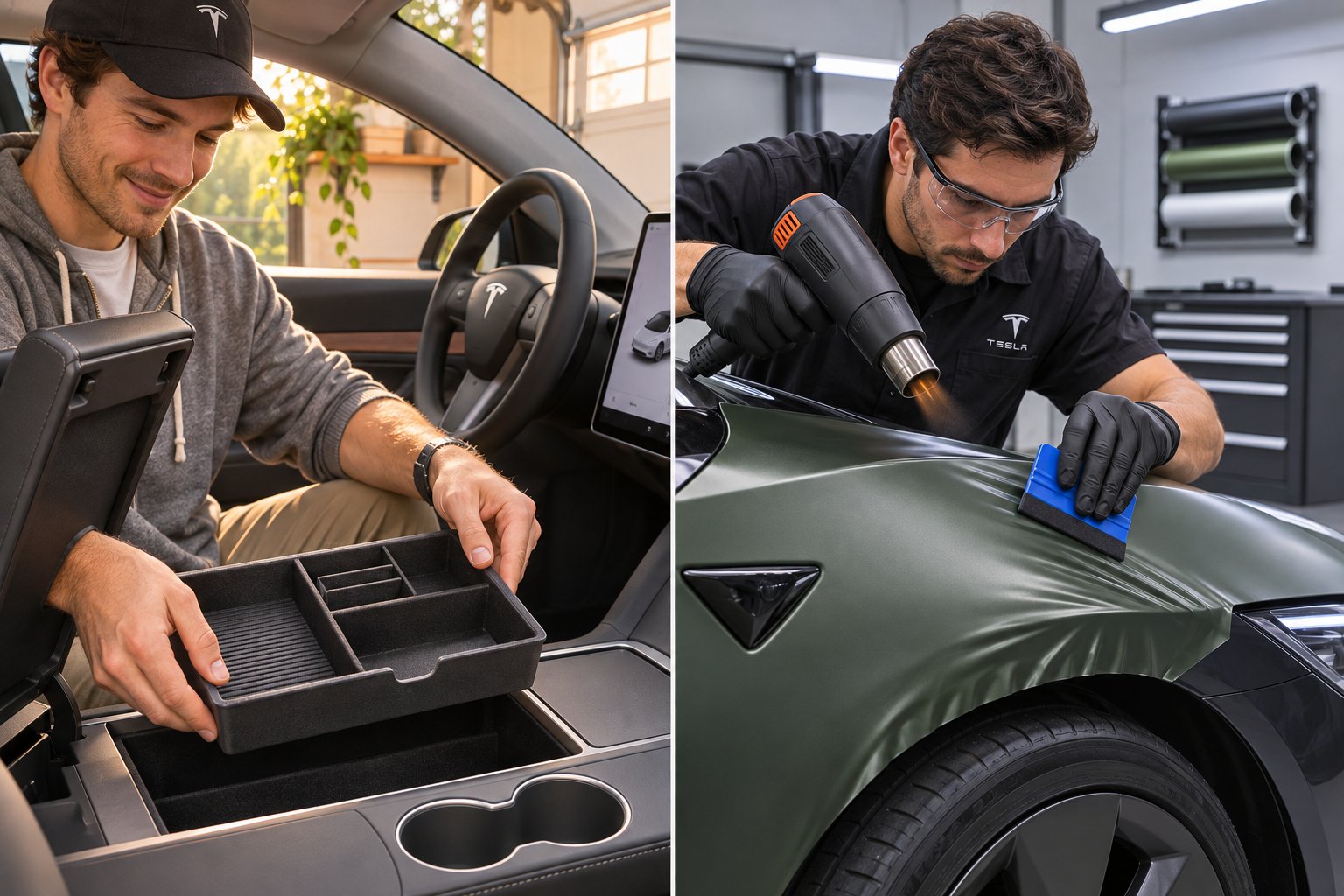
DIY Tesla Accessories vs Professional Installation
Getting it wrong in either direction is more common than you'd think. Some owners pay a shop hundreds of dollars to install accessories they could have snapped into place in five minutes. Others watch a YouTube tutorial, attempt a full-body vinyl wrap in their garage, and end up with bubbles, creases, and a film that starts peeling within weeks. The difference between a satisfying weekend project and an expensive mistake comes down to understanding which modifications are genuinely DIY-friendly and which ones demand professional hands.
No Tesla custom shop lays this out clearly — and for understandable reasons. Online retailers want you to feel confident buying everything yourself. Local service shops want you to book appointments for everything. The truth sits somewhere in the middle, and most successful Tesla builds actually combine both approaches over time.
DIY Bolt-On and Plug-and-Play Accessories
Here's the good news: a surprisingly large portion of the Tesla aftermarket is designed for owner installation with zero tools, zero technical knowledge, and zero risk to your vehicle. These products are engineered to drop in, snap on, or peel-and-stick — and they're the reason tesla modding has become accessible to everyday owners who've never turned a wrench.
Think about the accessories you interact with every time you sit in your car. A center console organizer slides into the existing tray. A screen protector peels and applies like a giant phone screen film. All-weather floor mats drop into the footwells with precise laser-cut fitment. A phone mount clips to the vent or adheres to the dash. LED puddle light replacements pop out of the door housing and click back in with the upgraded unit. None of these require disassembly, wiring, or calibration.
The advantages of this approach are compelling:
- Lower cost — No labor charges. You're paying only for the product itself.
- Instant gratification — Most bolt-on accessories install in under ten minutes. Order on Monday, install on Wednesday.
- Easy reversibility — Don't like how it looks? Pull it off. Selling the car? Return it to stock in an afternoon.
- Zero warranty concern — Floor mats, organizers, and screen protectors carry absolutely no risk of triggering a warranty dispute.
The key to a smooth DIY experience is shopping from a source that organizes products by category and confirms Tesla-specific fitment. E-commerce platforms like CUTIM's aftermarket Tesla accessories collection sort options into interior, exterior, wheel, and digital categories — letting you browse bolt-on products by type rather than guessing whether a generic listing actually fits your model year. That kind of category-level organization matters when you're building out a tesla model 3 custom interior or outfitting a Model Y for daily family use, because it eliminates the fitment guesswork that plagues generic auto parts sites.
Other popular DIY items include exterior trim pieces (carbon fiber mirror caps, door handle covers), trunk and frunk lighting upgrades, wireless charging pad inserts, and simple exterior badges or emblems. If the product description says "no tools required" or "plug-and-play," you can generally take that at face value — these manufacturers know their customers are installing in driveways, not garages with lifts.
Professional-Installation Modifications
Some modifications, however, are emphatically not weekend projects. Attempting them without proper training, tools, and environment almost always costs more in corrections than you saved by skipping the shop.
Full-body vinyl wraps sit at the top of this list. A quality color-change wrap requires a temperature-controlled workspace, professional heat guns, specialized squeegees, and an installer who understands how to stretch film around compound curves without distortion. On a Tesla specifically, the installer must carefully work around Autopilot cameras, side repeater lenses, and any ultrasonic sensor housings without covering or misaligning them. As DIY Wrap Club notes, high-end seamless wraps often require removing lights, mirrors, and trim — and if the shop breaks a clip, strips a bolt, or causes an electrical short during disassembly, that damage falls squarely on you, not Tesla's warranty.
Paint protection film presents a similar challenge. While pre-cut DIY PPF kits exist and have improved significantly, a full-body PPF application with seamless edges and wrapped corners remains a professional-grade skill. The margin for error on a Tesla's curved body panels is razor-thin: misalignment creates visible edges, trapped air creates bubbles that won't self-heal, and improper trimming around sensor zones can interfere with Autopilot functionality. Professional installers who work on Teslas daily know exactly where the tight spots are — and more importantly, where the cameras and sensors sit on each specific model generation.
Suspension swaps require a lift, proper torque specifications for Tesla's aluminum subframe and suspension components, and in many cases an alignment afterward. Incorrect torque on an aluminum component can strip threads or cause a catastrophic failure. Coilover installation on a Model 3, for example, demands precise spec adherence and careful handling of the high-voltage battery pack's proximity to the rear subframe mounting points.
Body kit installation involves test-fitting, drilling, bonding, and sometimes modifying panels to ensure alignment with Tesla's factory body lines. Performance SpeedShop emphasizes that professional installation is recommended because the precision required for fitting body kit components seamlessly onto a Model 3 demands expertise — proper alignment, fit, and adherence to recommended procedures preserve the vehicle's structural integrity.
Ceramic coating application requires thorough paint correction and surface preparation before the coating can bond properly. Applying ceramic coating over swirl marks or contaminants locks those imperfections under the coating permanently. Professional detailers use machine polishers, paint depth gauges, and controlled lighting to ensure the surface is pristine before applying the coating in a dust-free environment.
Window tinting rounds out the professional-installation category. While window tint kits exist for DIY application, Tesla's curved glass — particularly the expansive glass roof on the Model 3 and Model Y — makes clean, bubble-free installation extremely difficult without experience. Improper tint application on the rear glass can also damage defrost lines.
Deciding Which Path Fits Your Build
So how do you decide? The honest answer is that you probably won't pick just one path. Most Tesla owners who create your own tesla build over time naturally start with accessible bolt-on accessories and graduate to professional services as their ambitions grow. The console organizer comes first. The ceramic coating comes later. The full wrap comes after you've lived with the car long enough to know exactly what color you want.
Here's a side-by-side comparison to help frame your decision for each modification:
| Factor | DIY Bolt-On Accessories | Professional Installation |
|---|---|---|
| Cost Range | Low — product cost only, no labor | Moderate to High — product plus skilled labor |
| Skill Required | None to minimal; most products are plug-and-play | Professional-grade; requires training, tools, and controlled environment |
| Time Investment | Minutes to an hour per accessory | Hours to days depending on the service |
| Reversibility | Easily reversed; return to stock in minutes | Varies — wraps are reversible, PPF is removable, suspension can be swapped back |
| Risk Level | Very low; no impact on vehicle systems or warranty | Low with a skilled specialist; significant if attempted by an inexperienced shop |
| Best For | Organization, protection basics, interior comfort, lighting, digital accessories | Full wraps, PPF, ceramic coating, suspension, body kits, window tinting |
The critical takeaway here isn't that one path is better than the other — it's that choosing the wrong path for a specific modification is where problems happen. Floor mats belong in your hands at home. A full-body PPF application belongs in a professional bay with controlled lighting and a trained technician. Matching the modification to the right installation approach is what separates a build that grows smoothly over time from one that starts with a costly correction.
That raises a related concern many owners carry in the back of their mind through every purchase decision: will any of this void my Tesla warranty? It's the single most common question in every Tesla forum thread about modifications — and the answer is more nuanced than a simple yes or no.
How Aftermarket Modifications Affect Your Tesla Warranty
The fear is real — and it's everywhere. Scroll through any Tesla forum thread about modifications and you'll find some version of the same worried question: "Will this void my warranty?" It stops owners from installing aftermarket wheels they've been eyeing for months. It makes people hesitate before booking a suspension upgrade. It even creates anxiety around something as harmless as swapping in brighter LED interior lights.
Here's the thing: the warranty concern is legitimate, but most of what owners believe about it is either exaggerated or flat-out wrong. The relationship between tesla aftermarket modifications and warranty coverage is governed by federal law — not by Tesla's preferences, not by a service advisor's opinion, and not by vague forum speculation. Understanding that law gives you a framework for making confident decisions about every modification on your build, from a console organizer to a complete suspension overhaul.
The Magnuson-Moss Warranty Act and Your Tesla
Imagine you install a set of aftermarket wheels on your Model Y. Six months later, the air conditioning compressor fails. Can Tesla deny the warranty claim because you changed the wheels? Under U.S. federal law, the answer is no — not unless Tesla can prove those wheels directly caused the compressor failure.
That protection comes from the Magnuson-Moss Warranty Act, a federal consumer protection law enacted in 1975. Its core principle is straightforward: a manufacturer cannot void your warranty or deny a warranty claim simply because you installed an aftermarket part. The burden of proof falls on the manufacturer — in this case, Tesla — to demonstrate that the specific aftermarket modification directly caused the failure being claimed.
The key protections worth understanding include:
- Burden of proof rests on the manufacturer — Tesla must show that your aftermarket part caused the damage. Merely having a modified Tesla is not grounds for denial.
- Tie-in sales prohibition — Tesla cannot require you to use only Tesla-branded parts or accessories as a condition of warranty coverage.
- Clear disclosure requirements — Warranty limitations must be explicitly stated, not implied retroactively after a modification is discovered.
This doesn't mean every modification is risk-free. It means Tesla must demonstrate causation, not merely correlation. As T Sportline explains, if an air suspension unit or electric drive motor fails and you have aftermarket wheels installed, the dealership or manufacturer would have to prove the aftermarket wheel caused the suspension or motor failure in order to deny the claim. In scenarios like that, there's typically no legitimate reason for denial.
Where the law does allow warranty denial is when the aftermarket part itself was defective or improperly installed — and that defect directly caused damage to a warranted component. A poorly installed suspension arm that causes premature ball joint failure? That's a legitimate denial. A screen protector on the touchscreen when the drive motor develops a fault? Tesla has no legal basis to connect the two.
Which Modifications Carry Higher Warranty Risk
Not all modifications carry equal risk. Think of warranty exposure as a spectrum — and your position on that spectrum depends on how close the modification sits to a critical vehicle system. A floor mat lives miles from your battery pack. A rewired electrical accessory tapped into the high-voltage system sits right next to it.
Here's how common modifications break down across three risk tiers:
- Low Risk — All-weather floor mats, center console organizers, screen protectors, phone mounts, exterior trim pieces (badges, emblems), puddle lights, LED interior bulb swaps, cargo organizers, seat covers, and storage accessories. These items don't interact with any vehicle system and carry virtually zero chance of triggering a warranty dispute. As one reference scenario illustrates: battery degradation with aftermarket floor mats installed means coverage is fully maintained — there's simply no possible connection.
- Moderate Risk — Aftermarket wheels, lowering springs, window tinting, vinyl wraps, aftermarket lighting (exterior), carbon fiber body accessories, and roof rack installations. These modifications are physically attached to the vehicle and interact with visible systems, but they don't alter core electrical or drivetrain components. The risk isn't that they'll void your warranty outright — it's that if a related system fails (say, a tire pressure sensor after a wheel swap, or paint damage after a wrap removal), Tesla could plausibly argue a connection. Proper installation and quality parts minimize this risk substantially.
- High Risk — Suspension overhauls (coilovers, aftermarket air suspension), big brake kit installations, electrical system modifications (hardwired accessories, aftermarket controllers), performance tuning software, and any modification that taps into the high-voltage system or alters safety-critical components. These carry the highest warranty exposure because a direct causal chain between the modification and a potential failure is easiest for Tesla to establish. If aftermarket coilovers are installed incorrectly and a control arm fails, the link is obvious.
Notice the pattern: the closer a modification sits to the drivetrain, high-voltage battery, Autopilot hardware, or safety systems, the higher the warranty risk. Cosmetic and organizational accessories sit at one end of the spectrum. Electrical and structural modifications sit at the other. Most owners who want to customize Tesla Model X, Model 3, or any other variant will find that the majority of popular modifications — wraps, wheels, interior accessories, PPF, ceramic coating — land in the low-to-moderate range where Magnuson-Moss protections are strongest.
Protecting Yourself When Modifying
Even with federal law on your side, smart documentation habits make warranty interactions smoother if a claim ever arises. You don't need a lawyer — you need a folder.
Here's a practical checklist for protecting yourself throughout any modified Tesla build:
- Keep all receipts and invoices — Every part purchased, every installation service booked. Digital copies are fine. This establishes what was installed, when, and by whom.
- Photograph your vehicle before and after each modification — Timestamped photos create an objective record of the vehicle's condition at every stage. If Tesla claims a modification caused damage, your photos provide baseline evidence.
- Choose reputable Tesla-specialized shops — A shop that understands sensor calibration, aluminum torque specs, and camera positioning is far less likely to create an installation-related failure. The shop's expertise is your first line of warranty defense.
- Request documentation from your installer — Any professional shop should provide a work order detailing what was done, the torque specifications used, and whether any recalibration was performed. This paper trail demonstrates that the modification was installed correctly.
- Know which modifications are easily reversible — If you're heading to a Tesla Service Center for warranty work and you'd rather avoid a conversation about your lowering springs, certain bolt-on modifications can be returned to stock before the appointment. This isn't deceptive — it's pragmatic risk management.
- Understand your specific warranty terms — Tesla's New Vehicle Limited Warranty covers the Basic Vehicle for 4 years or 50,000 miles, the Battery and Drive Unit for 8 years or 100,000 to 150,000 miles depending on model, and body rust for 12 years with unlimited mileage. Knowing these timelines helps you assess which modifications matter more during active warranty periods.
- If a claim is denied, reference the law — Politely cite the Magnuson-Moss Warranty Act and ask Tesla to provide documented proof that your specific aftermarket part caused the specific failure. This shifts the conversation from assumption to evidence.
The bottom line? Cosmetic accessories and organizational add-ons carry virtually zero warranty concern — you can install floor mats, organizers, and screen protectors without a second thought. Performance and structural modifications require more careful consideration, better documentation, and ideally a Tesla-specialized installer who knows how to do the job without creating downstream problems.
Warranty protection is one side of the decision equation. The other side — and the one that actually determines what you can build — is budget. Every modification tier comes with its own price reality, and understanding those ranges before you start shopping prevents the most common financial mistake in the Tesla aftermarket: spending enthusiast money on entry-level goals, or expecting premium results from a budget approach.
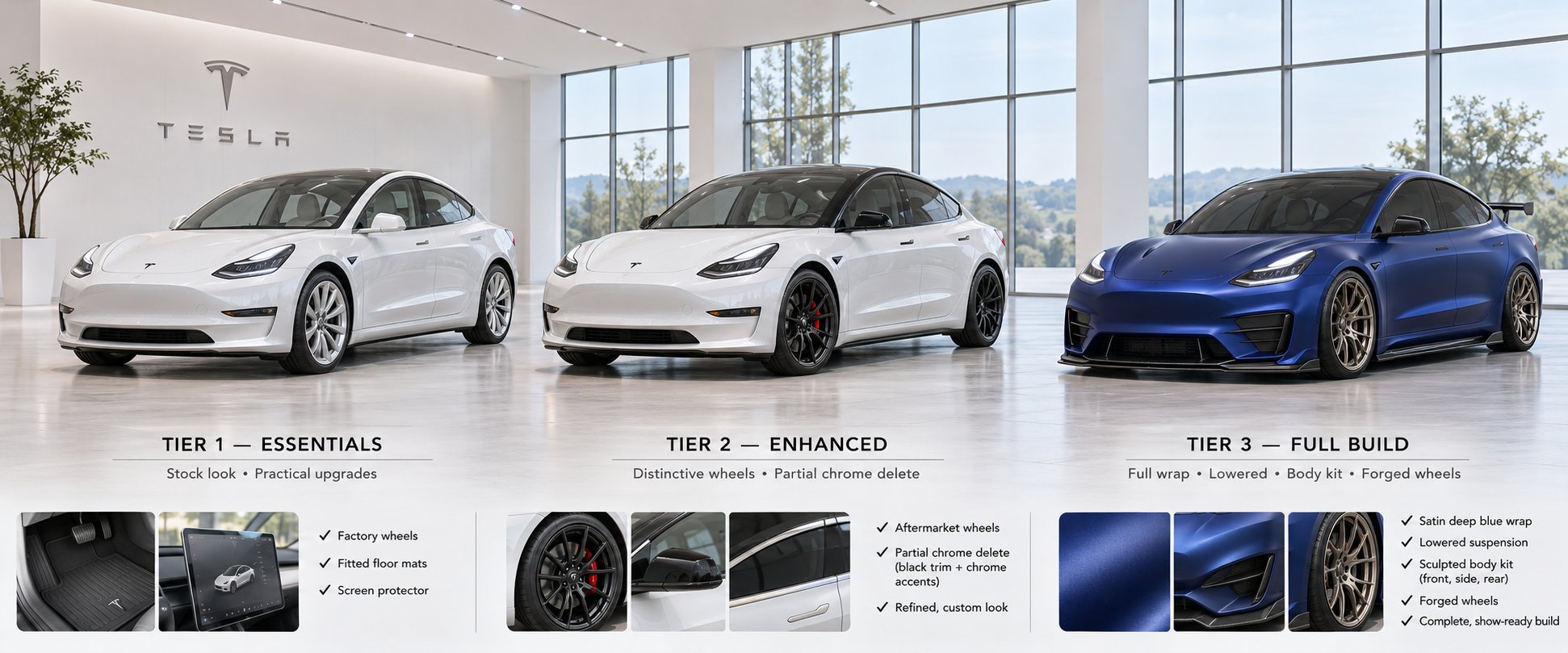
What Tesla Customization Actually Costs by Tier
Budget is the word nobody in the Tesla aftermarket wants to say out loud. Browse any specialist's website and you'll find beautifully photographed products, detailed fitment guides, and enthusiastic descriptions — but almost zero context about what a realistic tesla customization budget looks like from start to finish. Individual product prices are listed, sure. A set of floor mats costs one amount. A ceramic coating costs another. But what does an entire build cost when you add it all up? And where should you start if you're working with a limited budget?
The silence around total build cost isn't accidental. Every Tesla custom shop benefits from the ambiguity — if you don't know the full picture, you're more likely to impulse-buy individual items without a plan. This section breaks that pattern by organizing modifications into three clear spending tiers, giving you a framework to budget your build before the first credit card charge hits.
Entry-Level Personalization Tier
This is where most Tesla owners begin, and honestly, it's where some of the highest-satisfaction modifications live. The entry-level tier focuses on practical comfort, basic protection, and subtle personalization — the kind of upgrades you'll appreciate every single time you get in the car, not just when someone compliments the exterior at a parking lot.
Think about what you interact with daily: the touchscreen, the center console, the floor beneath your feet, the phone you set down every time you drive. Entry-level accessories address all of these touchpoints. A tempered glass screen protector — typically under $50 — shields the most important interface in the entire vehicle. Center console organizers and trays, usually in the $20 to $50 range, solve the storage problem Tesla's minimalist interior creates. All-weather floor mats from Tesla-specific manufacturers run between $80 and $250 depending on coverage, but they protect the carpet from years of mud, snow, and coffee spills. Tesla's own accessories shop lists center console trays at $35, carpet interior mats at $80, and all-weather interior liners between $225 and $325 depending on the model — and aftermarket alternatives from third-party retailers frequently undercut those prices while offering comparable or better fitment.
Other entry-level staples include phone mounts ($15 to $40), LED accent light kits for the footwells or trunk ($20 to $60), puddle light replacements ($20 to $65), and simple exterior trim pieces like license plate frames or badge overlays. A set of Tesla projection lights runs about $65 through the official shop. These are all plug-and-play, owner-installable products with no labor cost attached.
The total investment for a well-rounded entry-level setup? Most owners spend somewhere between $150 and $500 to cover the basics — screen protection, floor coverage, console organization, and a few lighting touches. It's the lowest entry point in the customization world, but the daily quality-of-life improvement is disproportionately high. You'll use these accessories every single drive, which is more than you can say for a body kit you admire twice a week in your driveway.
Mid-Range Aesthetic and Protection Tier
Once the practical basics are handled, most owners start looking outward. The mid-range tier is where your customized tesla model 3 or Model Y starts to visually separate itself from every other identical one in the grocery store parking lot — and where serious paint protection enters the equation.
This tier blends DIY products with professional services, so it's the first point where labor costs become a meaningful part of the budget. Here's what typically falls into this range:
Aftermarket wheels are often the single biggest visual upgrade. A quality set of Tesla-specific wheels ranges widely — cast options start around $800 to $1,500 for a set of four, while forged wheels from performance-oriented brands can run $2,000 to $4,000+. The weight savings of forged wheels directly benefit EV range, which is why serious Tesla owners often view the premium as a functional investment rather than a purely cosmetic one.
Partial vinyl wraps and chrome deletes fall squarely in the mid-range. A full chrome delete on a pre-refresh Model 3 — covering all the window trim, door handles, and badges — typically costs $300 to $800 when professionally installed, depending on the shop and film quality. Partial wraps covering specific panels like the roof, hood, or mirrors offer a taste of the color-change experience without the commitment or cost of a full-body wrap.
Ceramic coating is one of the smartest mid-range investments for long-term paint care. Professional ceramic coating application — including the necessary paint correction prep work — generally runs $500 to $2,000 depending on the coating brand, number of layers, and whether you're coating just the paint or adding the wheels, glass, and trim as well. The result is years of easier maintenance and better protection against environmental contaminants.
Window tinting is nearly universal at this tier. Professional ceramic window tint for a Model 3 or Model Y, including the glass roof, typically costs $300 to $800 depending on the film brand and regional pricing. This is one modification where the comfort improvement — reduced cabin heat and glare — justifies the expense almost immediately during summer months.
Upgraded interior trim like carbon fiber dash and console overlays, plus ambient lighting kits, round out the mid-range aesthetic package. Carbon fiber accent pieces run $100 to $400 for a set, while quality ambient lighting kits range from $50 to $200. These are usually DIY-installable, keeping labor costs out of the equation.
All told, the mid-range tier typically involves a cumulative investment of $1,500 to $5,000, depending on which combination of upgrades you pursue. Most owners don't do everything at once — wheels might come first, then ceramic coating a few months later, then tint before summer arrives. That phased approach makes the spending manageable and lets you evaluate each modification before committing to the next.
Full Build and Performance Tier
This is where tesla aftermarket performance modifications enter the picture, and where budgets climb significantly. The full build tier isn't about a single upgrade — it's about a comprehensive vision for the vehicle that often spans exterior transformation, interior overhaul, and performance enhancement simultaneously.
Full-body color-change vinyl wraps represent one of the signature investments at this level. A professional-quality full wrap on a Tesla runs anywhere from $3,000 to $7,000+ depending on the film brand, finish complexity (satin, matte, color-shift), and the installer's expertise. Premium films from brands like 3M, Avery Dennison, and XPEL command higher prices but offer better conformability, longevity, and warranty coverage.
Complete PPF coverage — protecting the entire vehicle rather than just the front end — is another major line item. Full-body paint protection film installation typically falls between $4,000 and $8,000, reflecting both the material cost and the intensive labor required to wrap every panel seamlessly. Some owners opt for color PPF on vehicles like the Cybertruck, which serves double duty as both protection and aesthetic transformation.
Suspension upgrades define the performance side of full builds. A quality coilover kit for a Model 3 Performance ranges from $1,500 to $3,500 for parts alone, with professional installation adding several hundred more. Pair that with a big brake kit — typically $2,000 to $5,000 depending on rotor size and caliper configuration — and you've fundamentally changed how the car handles and stops.
Forged wheel packages at this tier often involve premium lightweight options sized specifically for performance driving. A full set of high-end forged wheels with performance tires can easily reach $3,000 to $6,000 or more. Body kits from manufacturers like Unplugged Performance add front splitters, side skirts, rear diffusers, and spoilers — a complete aero package can run $2,000 to $8,000+ before installation.
Comprehensive interior overhauls — full reupholstery in premium leather or Alcantara, custom headliner wraps, complete carbon fiber interior trim replacement, and upgraded audio systems — push interior costs into the $2,000 to $10,000 range depending on scope and materials.
Full builds are rarely completed in a single weekend or even a single month. Most owners phase these projects over six months to two years, spreading the investment across multiple stages. The total cumulative spend for a comprehensive build easily reaches $10,000 to $30,000 or more — a significant investment that often represents 20% to 50% of the vehicle's original purchase price. That reality check is exactly why no shop tells you upfront: it's easier to sell one modification at a time than to reveal the total cost of the dream build.
How to Budget Your Tesla Build
So how do you approach this without either overspending or stalling out after the first purchase? The most effective strategy follows a logical sequence: protect first, personalize second, perform last.
That priority order isn't arbitrary. Protection-focused modifications — PPF, ceramic coating, floor mats, screen protectors — preserve your vehicle's resale value from day one. Every week you drive without them is a week of rock chips, carpet stains, and touchscreen micro-scratches accumulating. Personalization comes next because it builds on that protected foundation — a ceramic-coated vehicle wraps better, looks sharper with new wheels, and maintains its appearance longer with tinted windows keeping UV exposure at bay. Performance modifications come last because they're the most expensive, the most specialized, and the most likely to evolve as your driving preferences mature.
Here's the full framework in a single reference table:
| Tier | Typical Modifications Included | General Investment Level |
|---|---|---|
| Entry-Level Personalization | Screen protectors, all-weather floor mats, center console organizers, phone mounts, LED accent lights, puddle lights, exterior trim pieces, trunk organizers | Lowest entry point — roughly $150 to $500 total for a well-rounded practical setup |
| Mid-Range Aesthetic & Protection | Aftermarket wheels (cast or forged), chrome deletes, partial vinyl wraps, ceramic coating, window tinting, carbon fiber interior trim, ambient lighting kits | Moderate investment — typically $1,500 to $5,000 cumulative, often phased over several months |
| Full Build & Performance | Full-body color-change wraps, complete PPF coverage, coilover suspension, big brake kits, forged wheel packages, body kits, comprehensive interior reupholstery, audio upgrades | Significant investment — $10,000 to $30,000+ cumulative, usually phased over six months to two years |
A few practical budgeting principles worth keeping in mind as you plan:
- Start with what you'll use daily. Floor mats and a screen protector deliver value every single drive. A rear spoiler delivers value when you remember to look at it in a parking lot reflection.
- Don't skip protection to fund aesthetics. A $3,000 vinyl wrap looks incredible for about six months — until a rock chip cracks through to the bare paint underneath because you skipped the PPF underneath it. Sequencing matters.
- Factor in labor costs for professional services. A $1,200 set of wheels is just the beginning if you also need mounting, balancing, TPMS sensor transfer, and an alignment. Budget the total installed cost, not just the parts cost.
- Phase your build intentionally. Living with each modification for a few weeks before adding the next one lets you evaluate whether the direction still feels right. Rushing to complete a full build in one month often leads to regret about choices made too quickly.
The owners who end up happiest with their builds aren't necessarily the ones who spent the most — they're the ones who spent deliberately, in the right order, with a clear sense of what they wanted at each stage. Tesla customization is a marathon, not a sprint. Budget it like one.
Spending deliberately, though, requires more than a budget framework. It also requires confidence that the shop receiving your money — whether an online retailer or a local installer — actually delivers quality work and stands behind it. That confidence doesn't come from flashy websites or Instagram feeds. It comes from knowing exactly what to look for, and what should send you running in the other direction.
How to Evaluate and Choose a Reputable Tesla Custom Shop
Flashy Instagram reels and a polished website tell you exactly one thing about a shop: they know how to market. What they don't tell you is whether the installer understands Tesla's sensor calibration requirements, whether the online retailer actually confirms fitment for your specific model generation, or whether anyone will answer the phone when a product arrives damaged. Choosing where to spend your money is arguably more important than choosing what to spend it on — because a great product installed by the wrong shop becomes a liability, and a mediocre product from a trustworthy retailer at least comes with support when things go sideways.
Most owners skip this evaluation step entirely. They Google "tesla modified near me," click the first result with decent photos, and hope for the best. That works sometimes. It also leads to bubbled wraps, misaligned body kits, and customer service emails that vanish into the void. A more deliberate approach takes ten extra minutes of research and saves hundreds — sometimes thousands — in corrections.
Credentials and Tesla-Specific Experience
The single most important question you can ask any shop, online or local, is simple: how much of your work involves Teslas specifically? A general auto shop that wraps BMWs, tints Jeep windows, and occasionally touches a Model 3 is fundamentally different from a shop that works on Teslas daily. The gap between those two businesses isn't just preference — it's technical competency.
Tesla vehicles carry unique quirks that general shops routinely miss. The aluminum-intensive body panels require different prep and adhesion techniques for wraps and PPF than steel-bodied vehicles. Camera and sensor placements shift between model generations — the side repeater cameras on a pre-refresh Model 3 sit in a different position than on a Highland, which means a wrap installer cutting film around those lenses needs generation-specific knowledge. Suspension work on Tesla's aluminum subframe demands precise torque values that differ from what a technician accustomed to steel components would use. And any bodywork or panel removal near Autopilot cameras may require sensor recalibration afterward — a step that shops unfamiliar with Tesla's software ecosystem often skip entirely.
When vetting a local service shop, look for these concrete indicators of Tesla-specific expertise:
- Portfolio of completed Tesla builds — Ask for photos or browse their social media for real vehicles they've worked on. Multiple Tesla models across different services (wraps, PPF, suspension) signal genuine experience, not a one-off project.
- Model-generation awareness — Can they distinguish between a 2022 Model Y and a 2025 Juniper without you explaining the differences? A shop that knows the generational nuances instinctively is one that works on these cars regularly.
- Familiarity with Tesla's sensor and software ecosystem — Do they know which cameras need to remain uncovered during a wrap? Do they recalibrate sensors after removing and reinstalling body panels? These aren't optional details — they're safety-critical steps.
- Years of dedicated EV or Tesla experience — A shop that pivoted to Tesla work five years ago has seen more edge cases, encountered more model-specific challenges, and developed more refined processes than one that started last quarter.
For online retailers, the equivalent of "experience" is product catalog depth. A retailer that stocks accessories for every Tesla model and generation — including Highland, Juniper, and Cybertruck-specific products — demonstrates an ongoing investment in staying current with the platform. One that still lists generic "Model 3/Y" products without specifying generation compatibility hasn't kept pace with how quickly Tesla updates its vehicles.
Reviews, Warranties, and Red Flags
Reputation isn't built by the shop — it's built by the people who've already handed over their money. Verified customer reviews with photos are the single most reliable indicator of what your experience will look like. Not testimonials on the shop's own website (those are curated). Not a five-star average with three total reviews (that's statistically meaningless). You want volume, detail, and visual proof.
Look for reviewers who mention the specific Tesla model they own, describe the installation experience, and post before-and-after photos. A Tesla owner in Tempe, Arizona, sharing detailed images of a completed ceramic coating on their Model Y provides more useful information than a hundred anonymous five-star ratings saying "great job." The same scrutiny applies to online product reviews — look for fitment-specific detail, installed photos, and mentions of the exact model year rather than generic praise.
Beyond reviews, two factors separate trustworthy operations from risky ones: warranties and responsiveness.
Product and workmanship warranties signal confidence. A local shop that guarantees its wrap installation for a year is telling you they trust their work enough to fix it free if it fails. An online retailer offering a fitment guarantee — "if it doesn't fit your model, we'll replace or refund it" — is absorbing the risk that should be theirs, not yours. Shops and retailers that offer no warranty or guarantee on their work are asking you to absorb 100% of the risk for their potential mistakes.
Responsiveness to questions reveals operational maturity. Send a pre-purchase email or message asking a specific technical question — something like "Does this console organizer fit the 2025 Model Y Juniper, or only the pre-refresh?" The speed, accuracy, and helpfulness of the response tells you everything about what post-purchase support will look like. A shop that takes three days to answer a simple fitment question won't suddenly become responsive when you have a warranty claim.
Here's a quick-reference checklist you can use when evaluating any Tesla shop or online retailer:
- Does the shop show a portfolio of previous Tesla work across multiple models?
- Can they name model-generation differences without prompting?
- Do customer reviews include photos and specific vehicle details?
- Is there a written warranty or guarantee on products and installation work?
- Does the retailer offer installation guides, fitment confirmation, or video walkthroughs?
- Are customer service inquiries answered within 24 to 48 hours with specific, helpful information?
- Does the shop understand sensor recalibration requirements after bodywork or panel removal?
- Are return and exchange policies clearly stated before purchase?
- Does the shop or retailer pressure you toward unnecessary add-ons or upsells?
- Can you find independent references — forum posts, Reddit threads, community recommendations — beyond the shop's own marketing?
If a shop fails more than two or three of these checks, keep looking. The Tesla aftermarket is large enough that you don't need to settle for a provider that can't demonstrate basic competency and transparency.
Red flags deserve special attention because they're easy to rationalize away in the excitement of planning a build. Be cautious of any shop that cannot show previous Tesla work when asked, seems unfamiliar with the difference between pre-refresh and current-generation models, dismisses sensor recalibration as unnecessary, or pressures you into modifications you didn't request. For online retailers, watch for missing fitment specifications, stock photos instead of real product images, no listed return policy, and customer service channels that lead nowhere.
Local Shop Finder Strategies
Here's a reality most owners discover too late: the best Tesla-specialized shops in your area probably aren't the ones spending the most on Google Ads. They're the ones other Tesla owners already know about and recommend to each other through community channels.
Tesla owner forums — both dedicated platforms and model-specific subreddits like r/TeslaModel3 and r/TeslaModelY — are the most reliable discovery tool for local specialists. Owners in these communities share detailed accounts of their experiences, post photos of completed work, and aren't shy about naming shops that delivered (or didn't). Regional Facebook groups organized around Tesla ownership in specific metro areas are equally valuable. A search for Tesla groups in your city will typically surface at least one active community where members regularly discuss local wrap shops, tint studios, and detailers who specialize in EVs.
When you search for a shop in a specific region — whether it's Tesla Tempe Arizona, Houston, Los Angeles, or anywhere else — the results often surface established operations with strong local reputations built entirely through word-of-mouth and community referrals. These shops earn repeat business by doing excellent work on a vehicle their neighbors also own, which creates a natural accountability loop that advertising alone can't replicate.
A few practical tips to accelerate your search:
- Post in your regional Tesla group first. A simple "Who does the best ceramic coating on Teslas in [your city]?" will generate more trustworthy recommendations in an hour than a week of Google searching.
- Look for shops that appear in multiple independent recommendations. When three different owners in the same thread name the same shop without any affiliation, that's a strong signal.
- Visit in person before committing to major work. Walk through the shop, look at vehicles currently in progress, ask about their process, and evaluate cleanliness and organization. A chaotic shop floor often predicts chaotic results.
- Ask the shop for references you can contact directly. A confident shop will happily connect you with previous Tesla customers. A shop that deflects that request might not have satisfied customers to share.
The effort you invest in finding the right shop pays compound dividends. A great local specialist becomes your go-to resource for every stage of your build — from the first ceramic coating to the eventual suspension upgrade. And a reliable online retailer becomes your default source for every bolt-on accessory and replacement part you'll need over years of ownership. Both relationships are worth building carefully.
Finding the right shop, though, is only half the equation. Even the most reputable specialist can't protect you from modification choices that ignore the unique physics and technology of an electric vehicle. Tesla customization carries a set of EV-specific considerations that traditional car enthusiasts never had to think about — and overlooking them can cost you real-world range, safety system functionality, or both.
EV-Specific Modification Considerations Every Tesla Owner Must Know
Traditional car customization follows a familiar playbook: bolt on a cold air intake, swap the exhaust, maybe add a turbo kit, and tune the ECU. The engine is the center of gravity for every modification decision — literally and figuratively. Tesla ownership throws that entire playbook out the window. There's no engine to tune, no exhaust to reroute, and no intake to upgrade. What you do have is a battery pack that stores a finite amount of energy, a body shaped to slip through air as efficiently as possible, and a suite of cameras and sensors that your car depends on to drive itself. Every modification you make interacts with at least one of those systems — and ignoring that interaction is where Tesla builds go wrong in ways that ICE builds never could.
This is the knowledge gap that separates a thoughtful Tesla build from an expensive collection of regrets. Whether you're searching for a tesla mod shop near me or evaluating products from an online retailer, the considerations below should inform every decision you make.
Weight, Aerodynamics, and Range Impact
Here's a reality that gas car enthusiasts rarely stress about: fuel stations are everywhere, and filling a tank takes five minutes. Range anxiety isn't a concept when you can refuel in under 300 seconds at any of 150,000 gas stations across the country. But in a Tesla, every modification that adds weight or disrupts airflow translates directly into fewer miles between charges. That trade-off follows you on every drive — not just road trips.
Wheels are the most consequential example. A heavier set of aftermarket wheels increases rotational mass, which means the motor works harder to accelerate them from a stop and maintain highway speed. According to TNA Wheels' engineering analysis, four variables drive wheel-related range impact on a Model Y: aerodynamics, mass, tire behavior, and overall diameter. Of these, aerodynamic drag at highway speed is often the dominant factor — an open-spoke design that looks aggressive may churn air through the spokes and around the tire shoulder, increasing turbulence and energy consumption. This is why Tesla's own factory aero covers exist: they're not just aesthetic choices, they're range-preserving engineering.
The practical advice? Choose forged wheels over cast whenever budget allows. Forged construction is significantly lighter, which benefits both stop-and-go efficiency and highway range. But don't stop at weight — evaluate the spoke design for aerodynamic neutrality. A wheel with carefully managed surface shape, spoke depth, and edge treatment can reduce drag without sacrificing visual appeal. As TNA's analysis notes, a well-designed wheel paired with an efficient tire can narrow the gap between a larger-diameter package and a smaller factory setup, while a poorly chosen wheel-and-tire combination can widen it dramatically.
Body kits introduce a similar calculation. A front lip spoiler, rear diffuser, or side skirt set can look stunning — but if the design disrupts the vehicle's factory aerodynamic profile, you're paying for that aesthetic in kilowatt-hours on every highway mile. Functional aero kits designed with computational fluid dynamics in mind can actually improve efficiency at speed by reducing lift and managing underbody airflow. Cosmetic-only kits that prioritize looks over airflow management may do the opposite. Before installing any body kit, ask whether the manufacturer has tested its aerodynamic impact — and if they can't answer that question, you're buying decoration, not engineering.
Roof racks and cargo carriers are another common culprit. They're enormously practical for road trips, ski gear, and bikes — but the drag penalty is real. A loaded roof rack at highway speed can reduce range by 10% to 20% depending on the cargo profile. The smartest approach for owners who need roof carrying capacity occasionally is a removable system: install it when you need it, pull it off when you don't. Driving year-round with an empty roof rack because it looks rugged costs you range every single day for no functional benefit.
The core principle is simple: on an EV, every pound you add and every square inch of aerodynamic disruption you create has a measurable energy cost. ICE owners could absorb these penalties with a slightly heavier right foot and five minutes at a gas pump. Tesla owners absorb them with longer charging stops and reduced daily range margins — especially in cold weather, when battery efficiency is already compromised.
Sensors, Cameras, and Software Compatibility
Imagine spending $5,000 on a flawless full-body vinyl wrap, only to discover that the installer covered a side repeater camera lens and now your Autopilot throws a "Camera Blocked" warning every time you drive. Or picture a beautiful body kit that looks incredible from twenty feet away — but positions the front lip directly in the field of view of a forward-facing camera, creating a persistent visual artifact that confuses the Full Self-Driving neural network. These aren't hypothetical scenarios. They happen when modifications are made without accounting for Tesla's sensor architecture.
Tesla vehicles rely on a sophisticated matrix of cameras, and on some models, ultrasonic sensors and radar to power driver-assist features. PPF Pros' technical guide details exactly how aftermarket films and wraps can interfere with these systems when installed improperly:
- Autopilot cameras process visual input similarly to human eyes. Placing protective film directly over camera lens glass introduces light refraction, adhesive distortion (the subtle "orange peel" texture that blurs a camera's focal plane), and potential moisture trapping — all of which trigger repeated "Camera Blocked or Blinded" dashboard alerts.
- Ultrasonic sensors on pre-2023 models measure distance by emitting high-frequency sound waves. If a wrap or PPF sheet covers the sensor bezels with a continuous layer of film, the material acts as a sound muffler, creating air pockets that produce false proximity alerts or complete "Park Assist Unavailable" errors.
- Radar units on applicable models are sensitive to film composition. Standard non-metallic TPU film passes radar waves through unimpeded, but metallic-infused films — chrome wraps, metalized vinyl — reflect the radar signal inward, potentially causing phantom braking events or total radar disengagement.
The installation strategy also varies by model year. Pre-2023 Teslas with ultrasonic sensors require precision-cut circular relief holes for every bumper sensor so sound waves transmit freely. Newer Tesla Vision camera-only models eliminate that complexity on the bumpers but demand even more careful work around camera housings. After any PPF or wrap installation near camera areas, a manual camera recalibration through the touchscreen — Controls, then Service, then Camera Calibration — is standard practice. The system typically needs 10 to 25 miles of highway driving to relearn its visual environment.
Aftermarket lighting adds another dimension to consider. LED upgrades for the interior and puddle lights are generally safe because they don't sit in any camera's field of view. Exterior lighting modifications, however, require more caution. Excessively bright or oddly positioned aftermarket lights can confuse Tesla's vision system, which relies on interpreting the light patterns it sees around the vehicle. Any exterior lighting change should be evaluated for potential interference with forward-facing and side cameras.
Then there's the software layer. Tesla's over-the-air updates occasionally change how the vehicle interacts with accessories and peripherals. An aftermarket USB hub that worked perfectly before an update might lose functionality afterward. A dash camera that tapped into a specific power circuit could behave differently after a firmware change. Staying informed about OTA update release notes — and checking Tesla owner forums for reports of accessory compatibility issues after major updates — is a maintenance habit every modified Tesla owner should build. The car you parked last night might not behave identically to the car you start this morning if an update downloaded overnight.
This is why a reputable tesla tuning company or specialized shop matters so much. Professionals who work on Teslas daily already know where every camera sits on every generation, which bumper sensors need relief cuts, and how to verify full system functionality before returning the car. A general auto shop that wraps one Tesla a quarter simply doesn't encounter these edge cases often enough to develop reliable instincts around them.
Charging Access and Electrical System Integrity
This last category sounds obvious — until you see how often it's violated. Modifications must never obstruct the charging port. A body kit side panel that sits too close to the charge port door, a wrap edge that interferes with the port flap's opening mechanism, or an aftermarket accessory mounted near the port that prevents the charging connector from seating fully — all of these create problems that range from frustrating to genuinely dangerous.
Electrical system integrity is where the stakes rise even higher. Tesla's high-voltage battery system operates at voltages that can be lethal. FirstEnergy's EV safety guidance is direct: never try to modify or tamper with the charging equipment or electrical components in your EV. That principle extends to aftermarket accessories. Any electrical add-on — ambient lighting, powered storage compartments, aftermarket amplifiers, auxiliary power outlets — should draw power from the vehicle's 12-volt low-voltage system through approved access points, not from the high-voltage architecture.
Tapping into Tesla's high-voltage system without proper training and equipment isn't just a warranty risk — it's a safety hazard. Even the 12-volt system requires care: improperly spliced wiring can create parasitic drains that deplete the auxiliary battery, cause intermittent electrical gremlins, or interfere with the vehicle's CAN bus communication network. Reputable installers use dedicated fuse taps, proper gauge wiring, and non-invasive connections that can be fully reversed without leaving any trace on the vehicle's electrical system.
If you want to customize Model X with powered accessories, or add an aftermarket sound system to a Model 3, or install a powered tonneau cover on a Cybertruck, the guiding principle is the same: route power safely from the low-voltage system using proper connectors, fuse every circuit appropriately, and never cut into or splice the high-voltage wiring under any circumstances. A qualified Tesla-specialized shop understands these boundaries instinctively — and that instinct is the single strongest argument for choosing a dedicated specialist over a general shop that "can probably figure it out."
These EV-specific constraints don't exist to discourage modification. They exist to ensure that your build enhances the vehicle without undermining the engineering that makes it work. Weight-conscious wheel choices preserve range. Sensor-aware installations preserve safety features. Electrically sound accessory work preserves reliability. Every smart modification decision accounts for these realities — and armed with that awareness, you're ready to translate everything in this guide into a concrete, phased plan for your own build.
Planning Your Tesla Build Step by Step
You've absorbed the modification categories, the model-specific priorities, the warranty realities, the cost tiers, and the EV-specific constraints that make modifying Tesla vehicles fundamentally different from anything in the ICE world. That's a lot of information — and without a clear action plan, it stays exactly that: information. The owners who end up with modded teslas they genuinely love didn't just learn what was possible. They mapped out a sequence, defined their priorities, and built one deliberate step at a time.
This final section turns everything above into a decision framework you can act on this week.
Define Your Customization Goals First
Before you spend a single dollar, answer one honest question: what do you actually want from this build? Not what looks cool on Instagram. Not what a forum thread convinced you was essential. What matters to you, for the car you drive, in the way you use it daily?
Most Tesla owners fall into one of four goal categories — and recognizing yours upfront prevents the most expensive mistake in the aftermarket: spending money that doesn't serve your actual priorities.
- Protection — Your primary concern is preserving the vehicle's paint, interior surfaces, and resale value. PPF, ceramic coating, all-weather floor mats, and screen protectors anchor this approach.
- Aesthetics — You want your car to turn heads. Vinyl wraps, aftermarket wheels, window tinting, ambient lighting, and chrome deletes define this path.
- Performance — You want the car to handle, stop, and grip better than stock. Coilovers, brake upgrades, forged wheels, and performance tires are your priorities.
- Everyday Practicality — You want your Tesla to work better as a daily tool. Console organizers, cargo storage, phone mounts, roof racks, and pet accessories dominate here.
Most owners lean toward one primary category with a secondary interest in another. A family-focused Model Y owner might prioritize practicality first and protection second. An enthusiast looking to customize Tesla Model 3 Performance might lead with performance and follow with aesthetics. Clarity here focuses your budget, narrows your product research, and ensures that each purchase actually advances the build you want — not just a build that looked compelling in someone else's photo gallery.
Build a Phased Modification Roadmap
Resist the impulse to do everything at once. The smartest Tesla builds — the ones that look cohesive, function well, and don't drain a bank account overnight — follow a phased approach that respects a logical progression:
- Phase 1: Protection and Practical Accessories — Start with modifications that preserve your vehicle's condition and improve daily usability from day one. Screen protectors, all-weather floor mats, PPF on high-impact areas, ceramic coating, console organizers, and trunk storage solutions all fall here. These products pay dividends immediately and protect the foundation you'll build on. Nearly everything in this phase is owner-installable, keeping costs low and involvement high.
- Phase 2: Aesthetic Personalization — Once the vehicle is protected, introduce the visual changes that make your custom model 3, Model Y, or any Tesla uniquely yours. Window tinting, aftermarket wheels, chrome deletes, partial or full vinyl wraps, carbon fiber interior trim, and ambient lighting kits transform the car's appearance. This phase often mixes DIY accessories with professional services, so budget accordingly for labor on wraps and tint.
- Phase 3: Performance Modifications — For enthusiasts who want more than looks, this phase adds functional upgrades: coilover suspension, big brake kits, performance tires, upgraded brake fluid and pads, and body kits with engineered aerodynamic benefits. These modifications require professional installation, carry the highest costs, and benefit from the owner experience you've built during Phases 1 and 2 — by this point, you know your car, your preferences, and your local specialist well enough to make confident decisions.
Starting with accessible bolt-on accessories lets you explore your taste, learn how modifications feel on your specific vehicle, and build a relationship with the aftermarket community before committing thousands to professional services. For owners beginning Phase 1 with interior and exterior accessories, browsing a categorized collection like CUTIM's Tesla accessories catalog can help compare options across categories — from organization and protection products to wheel and digital accessories — before committing to larger modifications. Having products sorted by type rather than dumped into a single listing page makes it significantly easier to build a Phase 1 shopping list that's focused and intentional.
The phased approach also lets your budget recover between stages. Instead of a $10,000 lump-sum commitment, you're spending $200 to $500 in Phase 1, evaluating the results, then moving to Phase 2 a few months later with a clear sense of what the next tier should include. That rhythm keeps the build sustainable and the enthusiasm intact.
Take Your First Step With Confidence
Every impressive Tesla build you've seen at a car meet, in a forum gallery, or on a YouTube channel started with a single modification. Usually something small. A set of floor mats. A screen protector. A console tray that finally stopped the sunglasses from rattling. The owner who eventually showed up with a fully wrapped, lowered, ceramic-coated custom Model 3 on forged wheels didn't start there. They started exactly where you are right now — weighing options, reading guides, and wondering whether the first purchase would be the right one.
Here's what this entire guide has been building toward: a well-informed Tesla owner makes better customization decisions at every stage. You now understand the different shop types and what each one actually offers. You know which modifications suit your specific model. You can distinguish between a safe DIY install and a job that demands professional hands. You understand your warranty rights under federal law. You have a realistic cost framework. You know how to vet a shop before handing over your keys. And you understand the EV-specific constraints — weight, aerodynamics, sensor integrity, electrical safety — that make modifying Tesla vehicles a discipline unto itself.
Whether your next move is ordering a set of all-weather mats from an online retailer, booking a ceramic coating consultation at a local Tesla-specialized shop, or simply saving this guide as a reference for when the budget is ready — you're equipped to build the Tesla you envision. One thoughtful modification at a time.
Tesla Custom Shop FAQs
1. What is a Tesla custom shop and how is it different from a regular auto shop?
A Tesla custom shop is a specialized retailer or service provider — online, brick-and-mortar, or hybrid — that sells aftermarket parts, accessories, and modification services designed specifically for Tesla vehicles. Unlike general auto shops, these businesses understand Tesla's high-voltage EV architecture, proprietary connectors, Autopilot camera and sensor placement, aluminum body construction, and over-the-air software updates. This specialized knowledge prevents costly mistakes like covering sensor lenses during wraps, using incorrect torque specs on aluminum subframes, or creating electrical conflicts that general mechanics may not anticipate.
2. Will aftermarket modifications void my Tesla warranty?
Under the federal Magnuson-Moss Warranty Act, Tesla cannot void your warranty simply because you installed an aftermarket part. The legal burden falls on Tesla to prove that a specific modification directly caused the component failure being claimed. Low-risk accessories like floor mats, console organizers, and screen protectors carry virtually zero warranty concern. Moderate-risk items include aftermarket wheels and window tinting. Higher-risk modifications involve suspension overhauls and electrical system changes. Keeping receipts, photographing before-and-after states, and choosing reputable Tesla-specialized installers are the best ways to protect yourself during any warranty interaction.
3. How much does it cost to fully customize a Tesla?
Tesla customization costs vary across three general tiers. Entry-level personalization — screen protectors, floor mats, organizers, and LED lights — typically totals $150 to $500. Mid-range builds that add aftermarket wheels, ceramic coating, window tinting, and chrome deletes usually run $1,500 to $5,000 cumulatively. Full performance and aesthetic builds with color-change wraps, complete PPF, coilover suspension, big brake kits, and body kits can reach $10,000 to $30,000 or more over time. Most owners phase spending across months rather than committing everything at once. Online accessory collections like CUTIM's Tesla accessories catalog help owners compare bolt-on options by category before investing in larger professional services.
4. What are the most popular modifications for a Tesla Model 3 or Model Y?
Model 3 owners most frequently pursue chrome deletes, vinyl wraps, aftermarket wheels, window tinting, PPF, and interior upgrades like carbon fiber trim and ambient lighting. Performance Model 3 builds often add coilovers, brake pads, and wheel-tire swaps for track use. Model Y owners tend to prioritize practical accessories — all-weather floor mats, cargo organizers, roof racks, mud flaps, and pet seat covers — reflecting the crossover's family-oriented use. Both models benefit from ceramic coating and PPF due to their shared vulnerability to rocker panel paint damage from road debris. Always verify generation compatibility, as Highland and Juniper refreshes use different trim attachment points and interior layouts.
5. Can I install Tesla accessories myself or do I need a professional?
Many Tesla accessories are specifically designed for owner installation with zero tools — console organizers, screen protectors, floor mats, phone mounts, LED puddle lights, and exterior trim pieces all qualify as DIY-friendly bolt-on products. However, modifications like full-body vinyl wraps, paint protection film, ceramic coatings, suspension swaps, body kit fitting, and window tinting require professional-grade skill, controlled environments, and specialized tools. Attempting professional-level work without experience often costs more in corrections than the labor you tried to save. Most successful builds combine both paths: starting with accessible DIY accessories and graduating to professional services as the build evolves.