
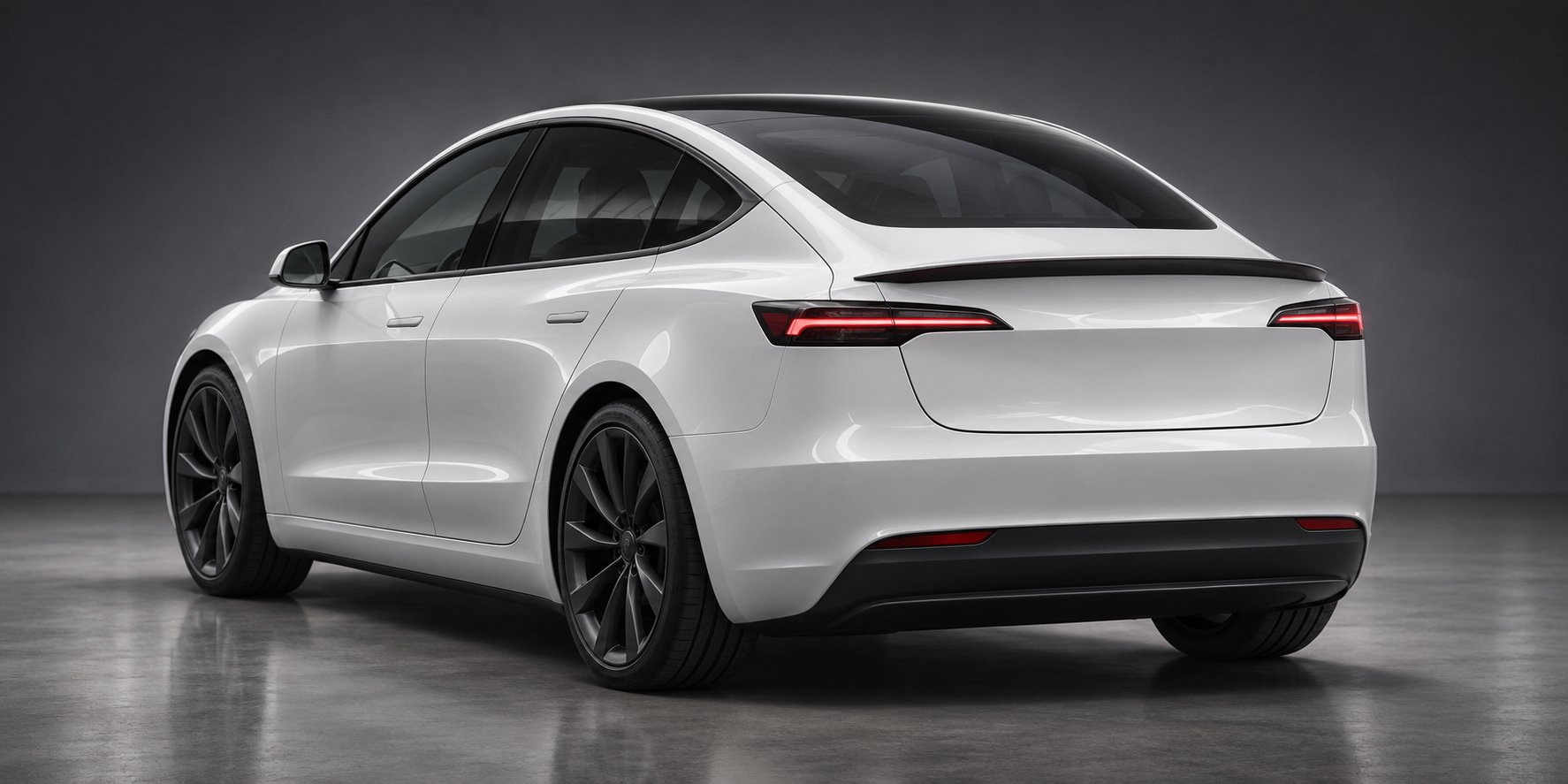
What a Model 3 Highland Spoiler Is
Model 3 Highland spoiler: A Model 3 Highland spoiler is a low lip spoiler that attaches to the trunk lid of the refreshed Tesla Model 3, which owners and sellers call Highland or Gen 2. It mounts with automotive tape or bolts. It is shaped for the refreshed car's redesigned rear, so you can't swap it with spoilers made for the pre-refresh Model 3.
Have you ever opened a spoiler listing and found ten photos, a model-year range and almost no explanation? Most shoppers start there. This guide begins with the basics.
What a Tesla Model 3 Spoiler Is on the Highland
"Highland" was the code name for the refreshed Model 3, as Car and Driver noted when the car was revealed. Enthusiasts kept using the name after launch, but Tesla sells the car as the Model 3 on its official model page. The refresh changed the back of the car as well as the front. MotorTrend reports that Tesla called every rear panel different from the legacy model. The changes include new taillights built into the trunk lid and an updated rear spoiler. That is why you shouldn't assume a Tesla Model 3 spoiler made for the earlier car will sit correctly on a Highland.
Lip Spoiler Versus Rear Wing on a Tesla Spoiler Model 3
A lip spoiler is a thin strip that follows the trailing edge of the trunk lid and sits close to the paint. A rear wing, which people often search for as a "Tesla wing," stands on uprights above the trunk with open space underneath so air can flow below it. Think of the lip as a raised rim on a tray and the wing as a shelf on brackets. The Highland spoilers in the top search results are all lip-style parts.
Those top results are the MPP, EVBase and Xprite pages, plus BASENOR on Amazon. Each one is a product or collection page. None of them explains what the part is or how to choose one. The sections below cover:
- The factory spoiler on the Highland Performance
- What "aerodynamic" claims mean at everyday speeds
- Real carbon fiber versus carbon-look ABS
- Fitment wording, questions to ask the seller, installation and removal
One group of owners has a different starting point, because the Highland Performance already has a spoiler when it leaves the factory.
The Factory Spoiler on the Highland Performance
Do you drive a Highland Performance? If so, your trunk lid already has a spoiler on it, so your choice is different from most buyers'. You're deciding whether to replace a part Tesla installed, which is a different job from adding one to a bare trunk lid.
The Factory Tesla Model 3 Performance Spoiler
On its Model 3 page, Tesla presents the rear spoiler as part of the Performance trim's exterior styling. For the exact material on your car, check Tesla's current Performance specs or your order documents. Don't rely on forum threads, because descriptions can vary by market and model year.
For this decision, it matters most how the part is attached. Tesla's service manual for the 2017-2023 Model 3 treats the rear spoiler as a tape-bonded part. Technicians cut it free with fishing line from a badge removal kit and then clear off the leftover adhesive. That manual covers the pre-refresh car, so Highland owners should find the procedure for their own generation. It still shows how Tesla handles a factory spoiler.
Do Teslas Have Automatic Spoilers
The Model 3 doesn't. Its spoiler is fixed, with no motor and no deploy setting. It doesn't rise at speed or retract when you park. In Tesla's service procedure, removing and installing it takes tape, alignment marks and hand pressure, and no wiring has to be disconnected. To confirm the equipment on your car, use the Model 3 2024+ owner's manual. If you drive a different Tesla model, check that model's own manual.
Should Performance Owners Change the Model 3 Performance Rear Spoiler
Some aftermarket listings call their parts "OEM Performance style," and the BASENOR listing uses this wording. The phrase means the part copies the shape of the factory spoiler. It doesn't mean Tesla made or approved the part. Other owners want a look the factory part doesn't offer, such as the custom forged carbon version sold by MPP. In both cases, the factory spoiler has to come off first. The removal section later in this guide explains how.
Reasons to keep the factory spoiler
- Tesla fitted it at the factory, so you don't have to worry about fit.
- Removing a bonded part puts the paint at risk.
- An "OEM Performance style" copy looks the same as the part you already have.
Reasons to change it
- You want a different material or finish, such as forged carbon.
- The factory spoiler is damaged.
- You want the spoiler to match other aftermarket trim on the car.
Many shoppers search for a "Tesla Model 3 Performance wing," even though the factory part is a low lip. Both factory and aftermarket parts get called aerodynamic. How much that word means at the speeds you actually drive depends on some basic physics.

What Aerodynamic Claims Mean at Everyday Speeds
Many Highland spoiler listings, including Xprite's, describe their parts as aerodynamic. Does that word change anything on your daily commute? The answer depends mostly on how fast you drive.
How a Sports Car Spoiler Manages Airflow
As air flows over a moving car, the body can act a little like a wing and create lift, which takes some load off the rear tires. A sports car spoiler sits at the back edge of the trunk lid. It disrupts or redirects the air leaving the car so the rear makes less lift.
Speed is what limits the effect. NASA's lift equation shows aerodynamic force rising with the square of velocity. When you double your speed, the force grows four times. So a spoiler at 30 mph feels one-sixteenth of the force it feels at 120 mph. On city streets and at legal highway speeds, the effect is a small share of what it is on a track.
Some Model 3 data exists, with limits. Unplugged Performance, a company that sells aero parts, published a CFD simulation study of a 2018 Model 3. In that simulation, the factory Performance spoiler cut total drag by 2.3% and raised rear downforce by 34.7% compared with the same car without it. The study also says that below about 30 mph, drag matters less to efficiency than mechanical losses. Keep three limits in mind. These are computer results from a parts seller. They come from the pre-refresh car. They tell you nothing about any aftermarket Highland part.
Why Car Spoilers Differ From Spoilers on a Plane
If you got here by searching "what does spoilers do on a plane," the basic idea is the same, but the goal is different. Pilot Institute describes aircraft spoilers as wing panels that rise into the airflow to cut lift and add drag. Pilots use them to come down more steeply without gaining speed. After touchdown, ground spoilers push the plane's weight onto its wheels so the brakes work better. A car spoiler also reduces lift, but it doesn't move, and its job is to keep the rear of the car settled.
Reading Aerodynamic Claims on a Tesla Rear Wing Listing
None of the top-ranking listings shows wind-tunnel data, test results or engineering specs. That doesn't make the parts bad. It does mean their claims about downforce, stability or range are unverified. If a Tesla rear wing or lip spoiler listing promises any of these, ask the seller for the test data behind the claim. If the seller has none, judge the part on what you can check for yourself.
On a road car, a lip spoiler is mainly a styling choice, so judge it on fit, finish and material, and material is the detail listings explain least clearly.
Spoiler Materials and Finishes Explained
Picture two listings that both say "carbon fiber." One part is woven carbon cured under pressure. The other is plastic with a printed pattern on it. Could you tell which is which? None of the ranking pages defines these terms, so this section explains each one in plain language.
Prepreg and Forged Tesla Carbon Fiber Spoiler Construction
Real carbon fiber is a composite. Thin carbon filaments carry the load, and cured epoxy resin holds them in place. The way the two are combined decides how the part looks and how consistent it is from one piece to the next. Italian parts maker RSI c6 describes the main methods.
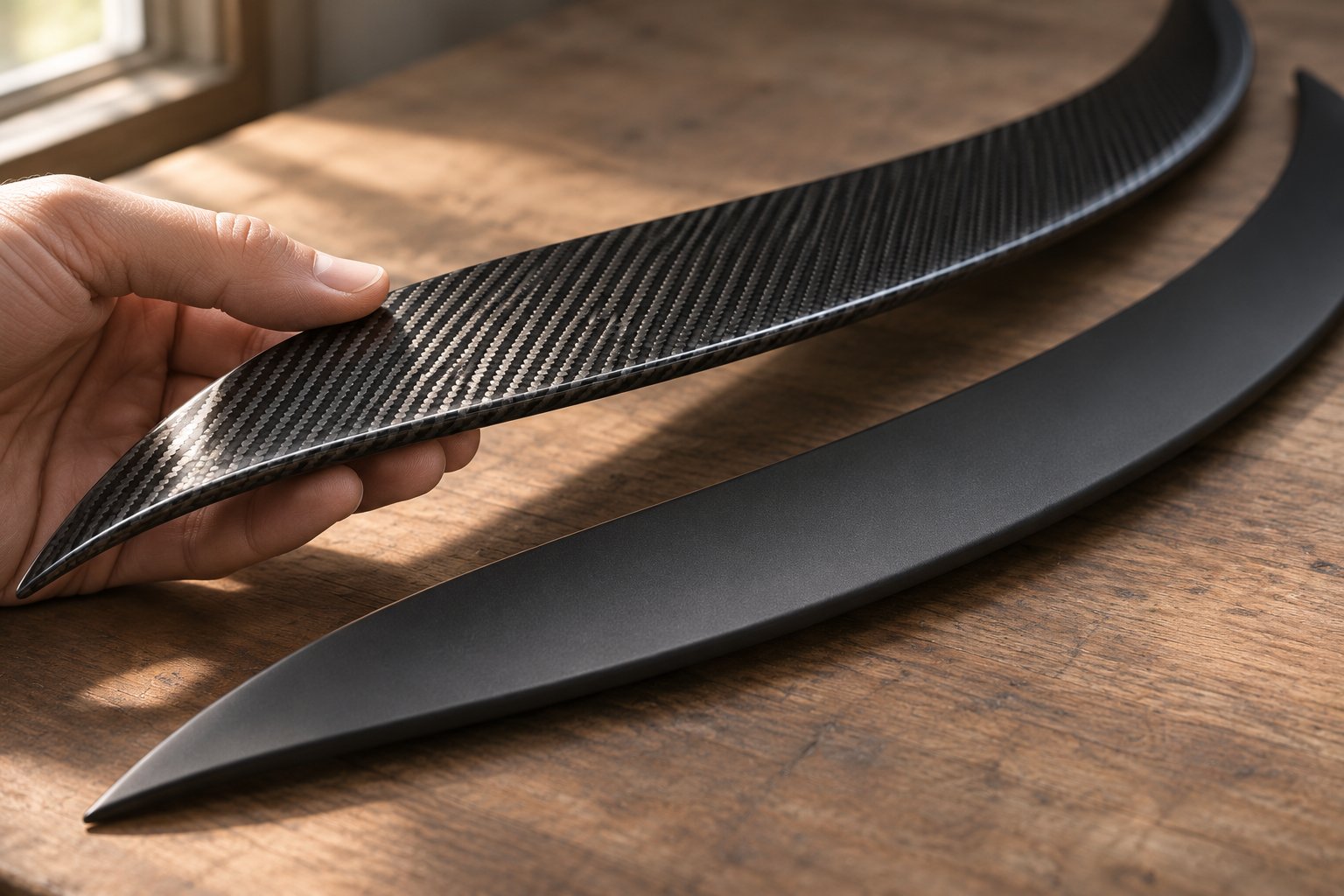
- Prepreg is short for pre-impregnated. The woven carbon sheets arrive already soaked with a measured amount of resin. Workers lay them into a mold, and the part cures under heat and pressure, usually in an autoclave. The result is a crisp, even weave under the clear coat. MPP sells a prepreg Tesla carbon fiber spoiler for the Highland.
- Forged carbon starts as short, chopped carbon bundles mixed with resin. That mix is pressed into a heated mold. Because the fibers point in random directions, the surface looks marbled, and no two pieces match exactly. MPP offers a custom forged version.
The same source describes a cheaper third method called wet lay-up. A worker brushes liquid resin onto dry fabric by hand, and the part cures without pressure. It is still real carbon, but quality varies more from part to part. A visible weave won't tell you which method a seller used.
ABS Plastic and Carbon-Pattern Finishes
ABS (acrylonitrile butadiene styrene) is a thermoplastic that is melted and molded into shape. Many lip spoilers are made of ABS and sold either painted a solid color or with a carbon-pattern finish. The carbon pattern goes on in one of two ways:
- Hydro-dip, also called water transfer printing. A printed carbon film floats on water, a chemical activator softens the ink, and the part is dipped through it so the pattern wraps around the surface. A clear coat goes on top.
- Film wrap. A vinyl film printed with a carbon pattern is stretched over the part.
Both methods put a print on plastic. That is a perfectly legitimate product when the listing says so plainly.
| Material or finish | How it is made | Appearance | Relative cost | What to verify with the seller |
|---|---|---|---|---|
| Prepreg carbon fiber | Resin-soaked woven sheets cured under heat and pressure | Uniform, crisp weave | Higher | That it is prepreg and not wet lay-up, and whether the back face is carbon too |
| Forged carbon | Chopped fibers and resin compressed in a heated mold | Marbled, unique to each piece | Higher | That it is real forged carbon and not a forged-look print |
| Painted ABS | Molded thermoplastic, then painted | Solid color | Lower | Paint match to your car, and clear coat and UV protection |
| Hydro-dip carbon pattern | ABS dipped through a printed film, then clear coated | Printed weave that may repeat | Lower | That the base material is named as ABS, and how durable the clear coat is |
| Carbon-pattern film | Printed vinyl stretched over ABS | Printed weave, with visible film edges | Lower | How the film edges are finished, and how well the film holds up in sun and car washes |
Real carbon costs more because the materials, molds, curing time and skilled labor all cost more. RSI c6 points to frozen resin storage and autoclave cycles that run for hours. ABS costs less because it is molded in high volume.
Matte Versus Gloss on a Model 3 Carbon Fiber Spoiler
Matte and gloss describe the top layer, which is usually the clear coat. They tell you nothing about the material underneath. A gloss clear coat reflects light and makes a weave look deep. A matte clear coat scatters light and gives a flat, satin look. Either one can go over real carbon, a hydro-dip print or paint. So when a listing calls a Model 3 carbon fiber spoiler "matte," it is describing the sheen and not confirming what the part is made of. Ask whether the clear coat includes UV protection, because that layer is what shields the finish from sun damage.
These definitions only help if a listing actually uses them. Some product pages describe the same part in two different ways, depending on where you look.
Telling Real Carbon Fiber From Carbon-Look ABS
Scroll through spoiler search results and you'll see the words "carbon fiber" on parts made of very different materials. The title alone rarely tells you which one you're looking at. The construction terms further down the listing usually do.
Listing Words That Signal Real Tesla Carbon Fiber
A buyer's guide from Yeslak, a Tesla accessory seller, warns shoppers not to rely on "carbon fiber" in a title and to look for specific construction wording. Use this list to decode what you find.
- "Prepreg" or "forged." These words name methods for making real carbon. Be careful with "forged look" or "forged pattern," because those phrases describe a print.
- A named weave, such as "2x2 twill" or "1x1 plain weave." Real woven carbon is often described this way. A print can copy a weave too, so look for a construction term alongside it.
- "ABS," "carbon pattern," "carbon look," "hydro-dip" or "carbon texture." These usually mean a printed finish on plastic.
- "Carbon fiber" listed as a color. In a spec table, this describes the finish, not the material.
- Just "carbon fiber," with no construction detail. You need a written answer from the seller before you buy.
The same rule applies to titles that promise a Tesla Model 3 Performance carbon fiber look. In those titles, "Performance" describes the shape and says nothing about the material. Yeslak suggests asking the seller whether the part itself is carbon fiber or ABS plastic with a carbon pattern. That question is harder to dodge than "Is this carbon fiber?"
The Xprite Title and URL Conflict
The Xprite listing makes a useful example. Its title starts with "Matte Carbon Fiber Rear Spoiler," and ABS shows up only later in the title and in the URL. Someone skimming search results sees the carbon wording first. Further down, the page clears it up. The description says the spoiler is built from ABS and calls the look a "matte carbon fiber style finish." The spec table lists Material: ABS and Color: Matte Carbon Fiber. The page discloses ABS, but nothing on it explains that "carbon fiber" in the title refers to the color. So read the spec table before you trust the headline.
Checking a Carbon Fiber Rear Spoiler for Tesla Model 3 After Delivery
Once the box arrives, check these points before you peel any tape backing:
- Edges: Check whether the weave carries on around the edges or stops at a seam or film line.
- Underside: Yeslak notes that the back of an ABS part usually shows plain molded plastic.
- Pattern: Tilt the part under a light. A real weave changes as the angle changes. A print tends to look flat, and its pattern may repeat.
Get the seller to confirm the material in writing before you buy. If the part doesn't match what they told you, that message gives you a clear basis for a return. The same Xprite title also carries a model-year range and the words "OEM Fit." Those claims need the same close reading, because they decide whether the part fits your trunk lid at all.
Fitment, Generations and Model-Year Ranges
Say you've found a spoiler you like, and the listing says it fits your car's model year. Is that enough? Not quite. Fitment wording varies a lot from seller to seller. Which generation your car belongs to matters more than any year printed on the page.
Why Highland and Pre-Refresh Tesla Model 3 Rear Spoiler Parts Differ
Tesla reworked the back of the car in the refresh. You can see the current design on Tesla's Model 3 page. Before launch, InsideEVs reported spy photos showing new taillights with a vertical amber indicator and a rear diffuser styled after the Model S. Tesla also publishes a separate service manual for the pre-refresh Model 3, so Tesla itself handles the two generations as different cars.
A lip spoiler has to follow the curve of the trunk lid it sits on. Tesla's manual notes that each rear spoiler "might have a slight different contour," and that applies to factory parts. Don't assume a Tesla Model 3 rear spoiler shaped for the earlier trunk lid will sit flat on a Highland. The same goes the other way around.
Decoding Model-Year Ranges on Seller Listings
The ranking listings all start their ranges at the same year, but they end in different places. MPP gives an open-ended "plus" range. Xprite and BASENOR give closed ranges, and their end years don't match. All three mean the same Highland generation.
An end year is the seller's claim. It may only show when the listing was written, and the seller may never have tested the part on newer cars. A closed range doesn't prove the part won't fit a later Highland. An open range doesn't prove it will, especially if Tesla changes the Model 3 rear in a future update.
Some listings cover two vehicles. A "Tesla Model 3 Highland / Model Y rear LED spoiler" listing may sell a separate SKU for each car under one title. The Model 3 has a trunk lid and the Model Y has a liftgate, so a part made for one won't fit the other. Check which vehicle the SKU you select is for, and make sure your order confirmation names your car.
What OEM Fit and OEM Performance Style Promise
| What the phrase says | What it likely means | What it does not guarantee |
|---|---|---|
| Open-ended range ("plus") | The seller expects the part to fit current and future Highland cars | That it has been tested on the newest cars or on any later rear redesign |
| Closed range | The years the seller has confirmed or chose to list | That it fits every car in the range, or that it won't fit a newer one |
| Highland or Gen 2 | Made for the refreshed generation, not the pre-refresh car | Which trim it suits, since the Performance already has a factory spoiler, or what the part is made of |
| "OEM fit" | Shaped to follow the factory trunk-lid contour | Tesla manufacture or approval, or gap-free fit on every car |
| "OEM Performance style" | Copies the shape of the factory Performance spoiler | Tesla manufacture or approval, or the same material as the factory part |
Neither "OEM" phrase means Tesla made or approved the part. Both describe the seller's design goal. They don't certify anything. A fitment phrase only tells you what the seller intended. You can usually get the measurements and part numbers behind it by asking the seller directly.
Questions to Ask a Seller Before You Buy
How long is the spoiler you're about to order, and how much does it weigh? Many listings don't say. MPP's visible product content gives no dimensions, weight or part number. None of the other ranking pages shows those details in its preview either. You can turn each missing spec into a question for the seller.
Specs to Request Before Buying a Spoiler Tesla Owners Will Install
- Exact dimensions. The length and depth let you check the part against your trunk lid's back edge. They also let you compare it with photos of cars you like.
- Weight. The tape carries the full weight of the part. Knowing the weight also gives you a number to check when the box arrives.
- Part number or SKU. A part number ties your order to one version. This matters when a single listing sells several finishes or covers more than one vehicle.
- Trim fitment. Ask whether the part is made for the standard Highland or the Performance. The Performance already has a factory spoiler, and it has to come off first.
- Installation instructions. Ask to see them before you pay. If the seller has written steps, they should come before any general advice.
- Photos of the underside. The back face shows the base material and where the tape sits. Most product photos don't show either one.
- Return terms if the part doesn't fit. Ask whether a test-fitted part can be returned and who pays return shipping. Peeling the tape backing may count as installing the part. For example, Fitment Industries' FAQ says it won't accept accessory returns that show signs of installation or attempted installation. It also requires return requests within 30 days. Policies differ from seller to seller, so get the terms for the part you're buying.
Material and Attachment Questions for a Carbon Fiber Spoiler for Tesla Model 3
- Full material composition. Ask whether the part is real carbon all the way through, a carbon layer over another base, or ABS. A title that says "carbon fiber" can mean any of the three.
- Finish method. Ask whether it is prepreg, forged, hydro-dip, film or paint. Each method looks different and holds up differently over time.
- Clear coat and UV protection. The clear coat on top takes the sun and the car washes. UV protection in that layer helps keep the finish from sun damage.
- Attachment method. Ask for the tape brand, whether the tape comes pre-applied, and whether a technical data sheet is available. The data sheet lists the surface prep, application temperature and cure time the tape maker requires.
- Whether drilling is required. Holes drilled in the trunk lid are permanent. A part held on only by tape can usually be removed later.
Ask your questions by email or through the store's messaging system, and save every reply. Screenshots of a chat work as well. Suppose a part sold as carbon arrives as ABS, or it doesn't fit the trim the seller confirmed. A written answer then backs up your return or dispute. Ask the same questions of every seller, whatever the price.
You'll use the attachment answers again on installation day. If the tape has a published data sheet, you can follow the tape maker's actual conditions for prep, temperature and cure time.
Installing a Tape-Mounted Tesla Rear Spoiler Correctly
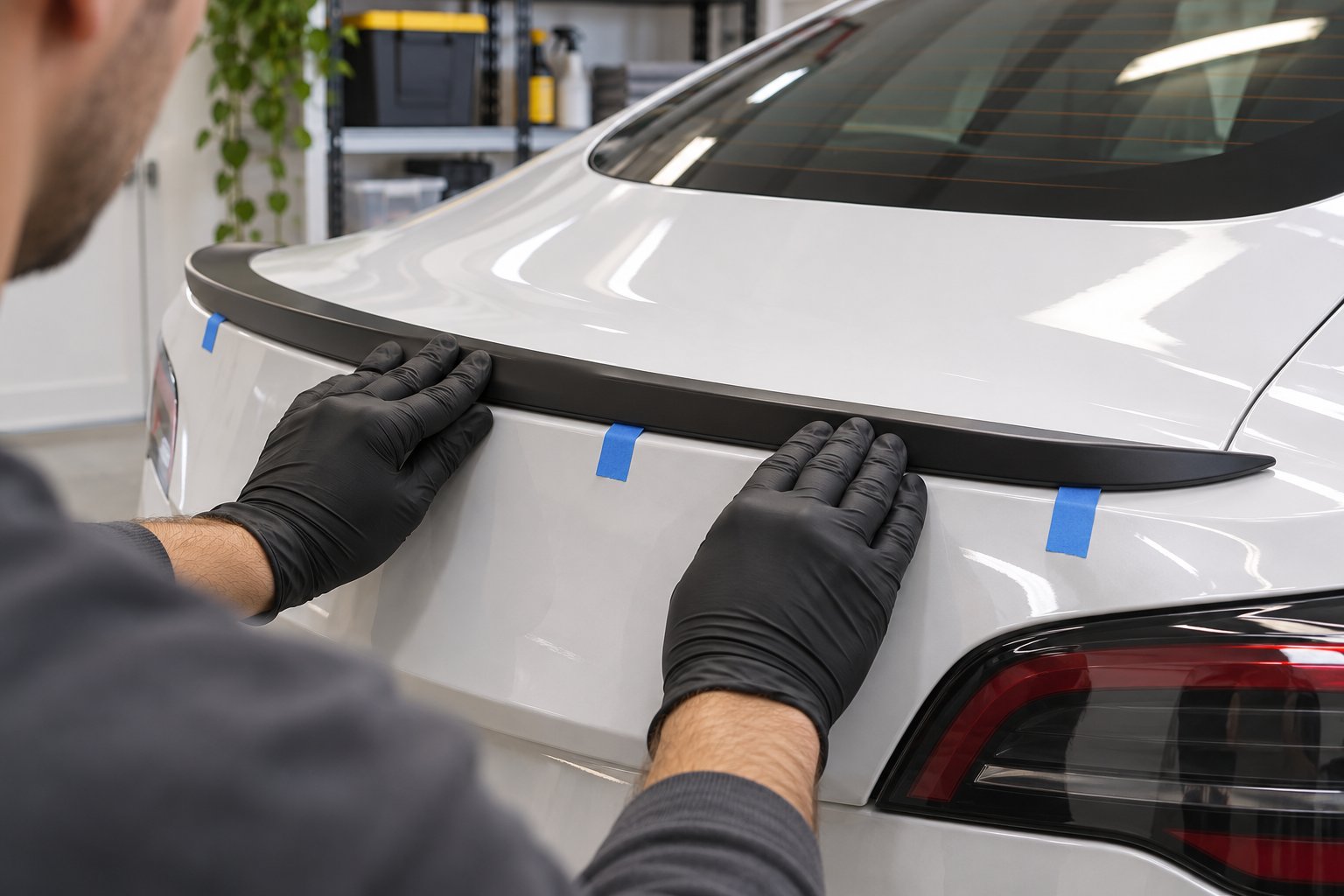
Whether a tape-mounted spoiler stays on for years depends mostly on the prep you do before the tape touches the paint. The steps below work the same for an ABS part and a carbon fiber Tesla spoiler. If your seller sends its own instructions, follow those first, because they were written for that part and that tape.
Dry-Fitting a Tesla Rear Spoiler on the Trunk Lid
- Dry-fit the spoiler and mark its position with painter's tape. Set the spoiler on the trunk lid with the tape backing still on. Make sure it is centered and follows the edge of the lid, then mark the corners. RW Carbon's install guide adds a mark at the center too. That extra mark makes the final placement easier to line up.
Surface Prep and Adhesive Conditions
- Clean the surface the way the tape maker recommends. For VHB tape, 3M's surface preparation guide calls for a 50:50 mix of isopropyl alcohol and water on most surfaces. If there is heavy oil, use a degreaser first. Ceramic coatings also block the bond. RW Carbon says you have to buff the coating off where the spoiler will sit.
- Use adhesion promoter if the tape maker calls for it. 3M notes that a primer can improve adhesion to paints and plastics. RW Carbon puts promoter on both the trunk and the spoiler's taped edges, then lets both dry for a few minutes.
- Apply the spoiler within the temperature range on the tape's data sheet. Each tape has its own range, so look it up for the exact tape on your part. A cold garage in winter can be below it.
- Press firmly and evenly. 3M says bond strength depends on how much adhesive makes contact with the surface. It recommends at least 15 psi of pressure, which usually means going over the tape with a hand roller. Press the center down first, peel the backing out toward each side, and then go back over the edges.
Curing Time Before Washing a Tesla Model 3 Spoiler
- Let the bond cure before you go through a car wash or drive at high speed. The tape keeps getting stronger after you press it on. For VHB at room temperature, 3M gives about 50% of full strength after 20 minutes, 90% after 24 hours and 100% after 72 hours. Other tapes cure at different rates, so check the data sheet or the seller's instructions.
Some kits use screws as well as tape. Drilled holes in the trunk lid are permanent, while a tape-only spoiler can usually come off later. A body shop or detailer makes sense if your trunk has PPF or a wrap. If you tape the spoiler on top of the film, the bond can only be as strong as the film's grip on the paint. A professional can decide whether to trim the film under the tape line. Paying for professional fitting also makes sense if you'd rather not buff off a ceramic coating yourself, or if your Tesla Model 3 carbon fiber spoiler would be expensive to replace after a crooked install.
All this prep is meant to make the bond hold for years. Because the bond is that strong, taking the spoiler off later takes just as much care as putting it on.
Removing a Tesla Spoiler
What if you sell the car, end a lease or just get tired of the look? None of the ranking listings explains how to take a spoiler off. A tape-mounted Tesla spoiler can usually come off cleanly. The job takes patience, though, and some cars carry more risk than others.
How a Tape-Mounted Tesla Spoiler Comes Off
Tesla's own service procedure for the 2017-2023 Model 3 shows the basic method. Technicians first clean around the spoiler so grit can't scratch the paint. They mark its position with masking tape, then cut it free with fishing line from a badge removal kit, starting at one end.
- Soften the adhesive with gentle, controlled heat. Use a hair dryer or a heat gun on a low setting, and keep it moving. Warm foam tape cuts more easily. Don't hold the heat on one spot, because too much heat can damage the paint or soften an ABS spoiler.
- Cut through the foam tape with fishing line or a plastic trim tool. Work the line back and forth behind the spoiler, close to the trunk lid. Never use a metal blade or a screwdriver. One slip can cut through the clear coat.
Paint Damage Risks When Removing a Spoiler
Tesla's manual tells technicians to take care to avoid damage to the paintwork and exterior trim. Some cars need extra caution:
- Repainted or thin clear coat. The tape may hold on harder than the paint holds to the panel, so the clear coat can lift with it.
- PPF or a wrap. If the spoiler is stuck to film, removing it can lift or tear the film. Budget for a film repair, or let the installer remove the spoiler.
- Drilled installs. The screw holes stay after the spoiler comes off. Filling them takes body work, so a drilled install isn't reversible.
- Lease or warranty terms. Your agreement may say something about aftermarket parts or the condition the car must be in when you return it. Check your own agreement first.
If you drive a Highland Performance and plan to replace the factory Model 3 Performance rear spoiler, look for Tesla's service guidance for your generation, or ask Tesla Service. The procedure above was written for the pre-refresh car. The method you'd use on an aftermarket part may not suit the factory bond.
Cleaning Leftover Adhesive From a Tesla With Spoiler Removed
After a Tesla with spoiler removed loses the part, a strip of foam and glue usually stays on the trunk lid. Tesla technicians take it off with a rubber wheel, a shop tool that requires eye and ear protection. At home, a solvent is the more practical choice.
- Remove the residue with an adhesive remover rated safe for automotive paint, and use it as the label directs. Roll off as much foam as you can with your thumb first. 3M describes its Adhesive Remover as safe for nearly all cured automotive paint, with a wipe-on, wipe-off formula that needs no scrapers or abrasives. If the trunk was repainted recently, ask the body shop whether the paint has cured before you use any solvent.
- Finish with a light polish or wax. 3M notes that its remover takes off wax along with the adhesive, so the cleaned area is left bare. A light polish can blend in any faint outline left by the old tape, and a coat of wax protects the paint again.
Because the spoiler can come off later, your first choice doesn't have to be permanent. It's still cheaper to get it right the first time, so the next step is to compare what each seller actually offers and how its finish will look with the rest of the car.
Choosing the Right Spoiler and Finish for Your Highland
By now you know how to read material terms, fitment ranges and the specs a listing leaves out. How do the main options look side by side? The table below uses only what each listing states. Treat the last column as your list of questions for each seller, and ask every seller the same ones.
Comparing Highland Spoiler Options Across Sellers
| Seller | Stated material | Finish options | Fitment wording | What to confirm |
|---|---|---|---|---|
| CUTIM | ABS for every version | Several finishes to coordinate with the car's exterior. The carbon-look finishes are printed on ABS and are not genuine carbon fiber. | Model 3 Highland option selected at checkout | That you selected the Highland option and your order confirmation names it. Also ask how the carbon-look finish is applied, the tape brand and whether a data sheet is available, the dimensions, and the return terms. |
| MPP | Prepreg carbon fiber, plus a custom forged option | Prepreg weave or forged | Open-ended "plus" range | Dimensions, weight and part number, since the visible content gives none of them. Also ask whether the back face is carbon too. |
| Xprite | The title leads with "Matte Carbon Fiber," while the URL and spec table say ABS | Matte carbon fiber, listed as a color | Closed Highland range, "OEM Fit" | The finish method (hydro-dip or film), clear coat and UV protection, and tape details. The listing does give dimensions and a SKU. |
| BASENOR | Matte carbon fiber | Matte | "OEM Performance" style, closed range | Whether the part is real carbon or ABS with a carbon pattern, and which trim it is made for |
| EVBase | Varies, because this is a collection page | Varies by product | Varies by product | Material, finish method and fitment for each product you open |
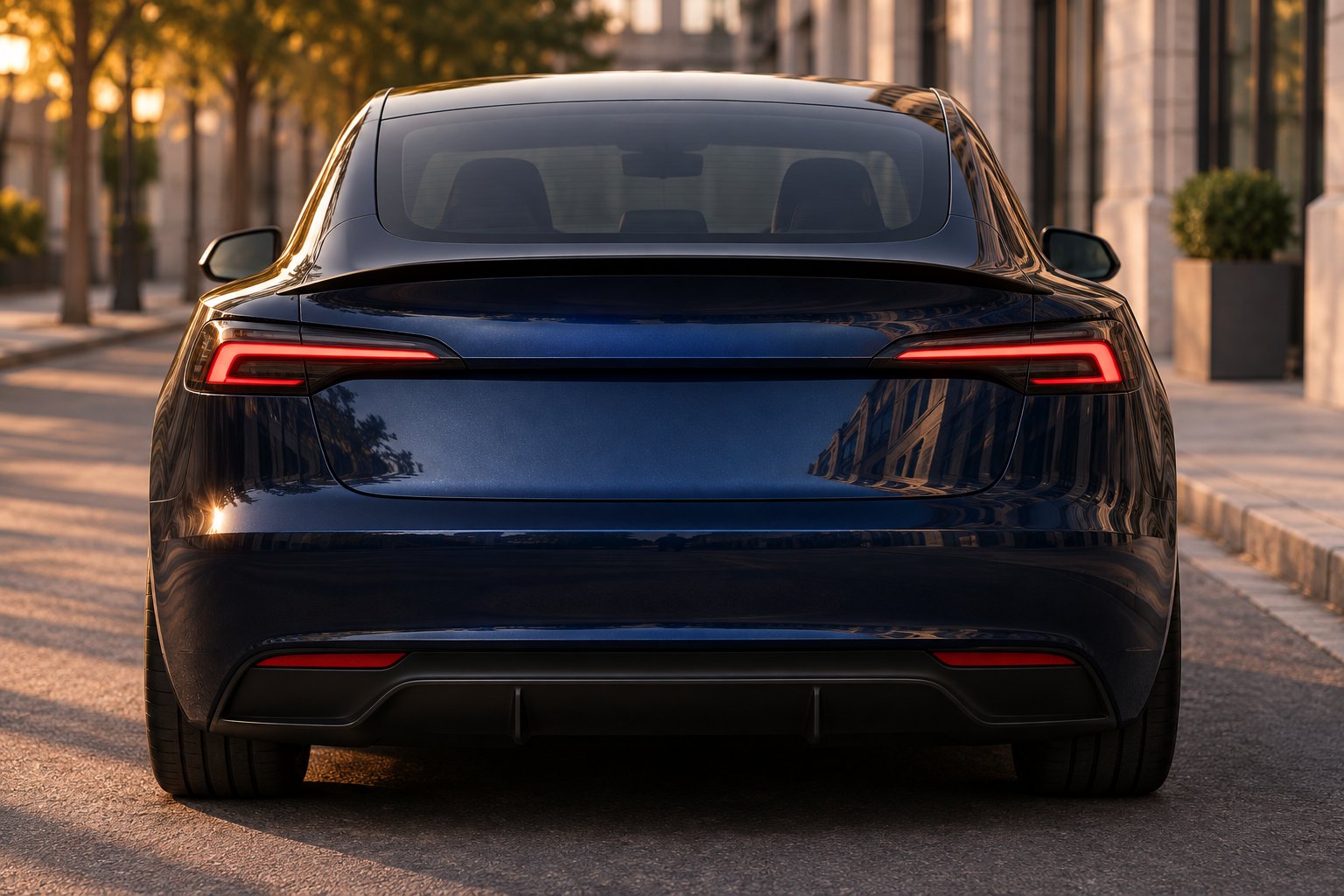
Coordinating the Spoiler With the Tesla Model 3 Rear Diffuser and Paint
When you stand behind the car, you see the spoiler at the top of the rear and the diffuser at the bottom. If you've added an aftermarket Tesla Model 3 rear diffuser, the spoiler should share its sheen. Picture a matte carbon-look spoiler above a gloss diffuser. Even good parts can look as if they came from two different orders.
- Keep the sheen consistent. Pair gloss with gloss and matte with matte. That applies to the spoiler, the diffuser, mirror caps and any other trim you've changed.
- Match the pattern type. A real weave and a printed pattern rarely look the same side by side, even with the same sheen. Forged carbon's marbled look is even harder to pair with a woven print.
- Plan for your paint color. A body-color spoiler blends into the trunk lid. A carbon-look or black spoiler adds contrast that you'll notice more on light paint than on dark paint.
- Compare finishes in daylight. Ask the seller for photos of the finish on a car, and hold them up against your Tesla Model 3 diffuser and trim outdoors.
Matching Your Choice to Your Priorities
Decide which of these matters most to you:
- Genuine carbon. Look for prepreg or forged construction, get the material confirmed in writing, and expect a higher cost.
- Finish choice and matching trim. An ABS part with several finishes gives you more options, as long as you accept that any carbon look on it is printed.
- Correct generation fit. Choose the Highland option or SKU and check that the order confirmation names your car.
- A raised wing. Every ranking listing sells a lip spoiler. A Tesla Model 3 wing on uprights is a different product, so ask whether it requires drilling.
If you want genuine carbon, look at prepreg or forged parts. If you care most about finish choice and correct Highland fitment, an ABS part may suit you better, as long as the seller answers the same questions in writing.
Model 3 Highland Spoiler FAQs
1. Will a spoiler made for the older Model 3 fit a Model 3 Highland?
Don't count on it. The refresh gave the Model 3 a new trunk lid with the taillights built into it. A lip spoiler only sits flush when it follows the exact curve of the panel under it. A part shaped for the pre-refresh car can leave gaps or sit unevenly on a Highland, and a Highland part can do the same on the older car. Look for listings that say Highland or Gen 2. Pick the matching SKU and check that your car appears on the order confirmation. A model-year end date is the seller's claim and doesn't prove the part was tested. Take extra care with listings that cover both the Model 3 and the Model Y, because a part made for a trunk lid won't fit a liftgate.
2. How can I tell if a Model 3 spoiler is real carbon fiber or carbon-look ABS?
Start with the construction words, not the title. Prepreg or forged points to real carbon. ABS, carbon pattern, carbon look, hydro-dip or carbon texture usually means a printed finish on plastic. Check the spec table too. If carbon fiber appears under color and ABS appears under material, the part is plastic. If a listing only says carbon fiber, ask the seller in writing whether the part is carbon or ABS with a pattern. When it arrives, look at the underside and the edges, and watch how the pattern changes as you tilt it under a light. ABS is a fair choice when the seller says so plainly. CUTIM, for example, sells an ABS rear spoiler with a Model 3 Highland option and several finishes. Every version is ABS, and its carbon-look finishes are not genuine carbon fiber.
3. Does the Tesla Model 3 have an automatic or active spoiler?
No. The Model 3 spoiler is fixed. It has no motor, no wiring and no deploy setting, so it stays in the same place whether you're parked or on the highway. The Highland Performance comes with a factory lip spoiler bonded to the trunk lid, and aftermarket lip spoilers for the standard car are fixed too. To confirm the equipment on your car, use Tesla's Model 3 owner's manual. If you drive a different Tesla model, check that model's own manual.
4. Does a lip spoiler improve range or handling on a Model 3 Highland?
At everyday speeds, you probably won't feel much difference. Aerodynamic force grows with the square of speed, so at city or legal highway speeds a spoiler gets only a small share of the force it would get on a track. The one published Model 3 study comes from a parts seller. It used computer simulation and looked at the factory Performance spoiler on the pre-refresh car, so it tells you nothing about any aftermarket Highland part. None of the top Highland listings shares wind-tunnel or test data. If a listing promises better range, stability or downforce, ask the seller for evidence. If there is none, choose the spoiler on fit, finish and material.
5. Can I remove a tape-mounted Tesla spoiler without damaging the paint?
Usually, if you work slowly. Warm the tape with low heat and keep the heat moving. Then cut through the foam with fishing line or a plastic trim tool held close to the panel. Never use a metal blade. Remove the leftover foam and glue with an adhesive remover rated safe for cured automotive paint, then polish lightly and wax the bare area. The risk is higher on repainted panels or thin clear coat, on trunks covered with PPF or a wrap, and on drilled installs, which leave holes that need body work. Check your lease or warranty terms before you start. Highland Performance owners removing the factory spoiler should look for Tesla's service guidance for their generation.