
Forged Carbon vs Carbon Fiber
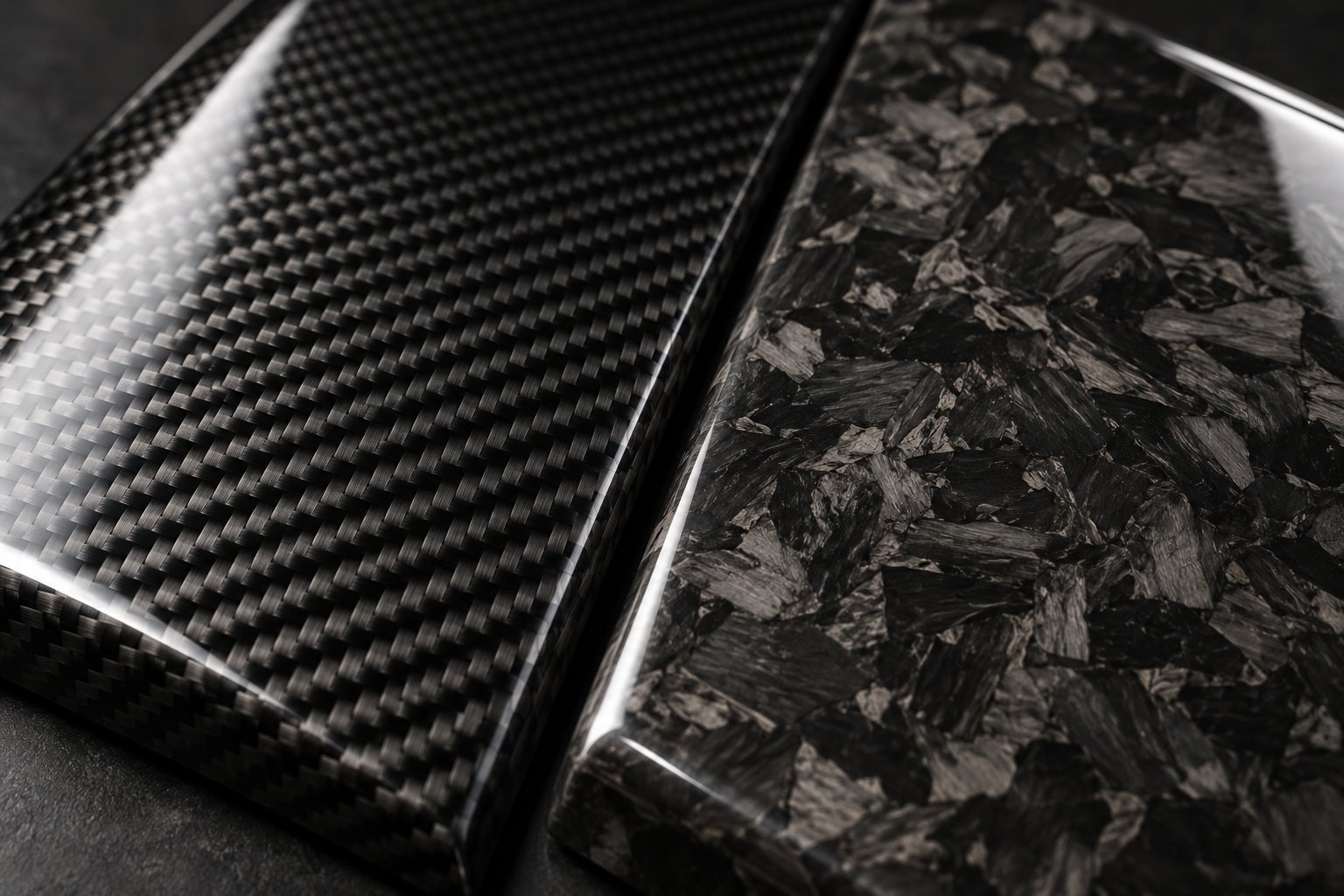
Imagine two supercars parked side by side. One sports a hood with that instantly recognizable woven checkerboard pattern — tight, geometric, unmistakably high-tech. The other flaunts a swirling, marbled finish that looks almost like polished stone. Both materials carry the "carbon fiber" name. Both are lightweight, strong, and undeniably premium. Yet they're manufactured in completely different ways, perform differently under stress, and sit at different price points. So which one actually deserves your money?
That's the question at the heart of the forged carbon vs carbon fiber debate, and it's one that confuses engineers, car enthusiasts, and everyday buyers alike. This guide breaks down the real differences — no sales pitch, just materials science and practical buying advice.
Why This Comparison Matters More Than Ever
Carbon fiber composites have moved far beyond the aerospace lab. You'll find them on military hardware, commercial aircraft, and performance vehicles, but also on phone cases, wallets, and watch bezels. As prices drop and manufacturing scales up, more buyers face a choice they didn't have a decade ago: traditional woven carbon fiber or its younger sibling, forged carbon. Making the wrong call can mean overpaying for aesthetics you don't need — or under-specifying a part that has to carry real structural loads.
Two Materials, One Name — Understanding the Basics
Traditional carbon fiber starts as long, continuous strands woven into fabric-like sheets — typically in twill, plain, or satin weave patterns. Technicians lay those sheets into a mold one ply at a time, carefully orienting each layer to maximize strength along specific directions. The result is a stiff, lightweight panel with that signature geometric look.
Forged carbon fiber takes a fundamentally different path. Short chopped strands of carbon fiber — sometimes only a few centimeters long — are mixed with resin, placed into a compression mold, and cured under high pressure. The fibers settle in random orientations, producing that distinctive marbled, almost organic appearance where no two pieces look exactly the same.
Forged carbon and traditional carbon fiber share the same raw material but differ in nearly every other way — from how they're made to how they perform under load.
This article ranks the 7 most important differences between these materials, scored against criteria that matter to three distinct audiences: engineers evaluating directional strength and stiffness-to-weight ratios, automotive enthusiasts searching for the best-looking and best-value upgrade parts, and lifestyle buyers comparing phone cases or accessories. Each difference is ranked by how much it actually influences a real purchasing or engineering decision — not by how flashy it sounds on a spec sheet.
The ranking starts with the single factor that shapes every other difference between these two composites: how they're manufactured.
How We Ranked These 7 Key Differences
Ranking seven differences between two materials that share the same base ingredient — carbon — sounds straightforward. But what is carbon fiber made of, really? At its core, it's thin filaments of carbon atoms bonded together in a crystalline structure, and both traditional and forged carbon fibre start from that identical foundation. The divergence happens in manufacturing, performance, and price. To rank those divergences fairly, you need a framework that accounts for more than just raw strength numbers.
Here's the lens we used — and why it matters whether you're specifying parts for a race car or picking out a phone case.
Our Four-Criteria Scoring Framework
Every difference in this guide was scored against four weighted criteria, listed here from highest priority to lowest:
- Broad audience relevance — Does this difference matter equally to engineers, enthusiasts, and casual buyers? Factors that affect all three groups ranked higher than niche engineering metrics.
- Measurable real-world impact — Can this difference be quantified in performance data, cost savings, or tangible product quality? Theoretical distinctions without practical consequences scored lower.
- Misconception frequency — How often is this factor misunderstood or misrepresented online? The more confusion surrounds a topic — like what a forged carbon fiber layup is actually called versus traditional prepreg layup — the more urgently it needs clear explanation.
- Decision-making influence — When a buyer is choosing between these two composites for a specific project, how heavily does this factor tip the scales? A difference that rarely changes the final purchase decision ranked lower, even if it's technically interesting.
This scoring system prevents the rankings from skewing toward any single audience. A difference that only matters to aerospace engineers won't outrank one that shapes decisions for all three buyer types.
Three Buyer Profiles That Shaped Our Rankings
Understanding what carbon fiber is made from is only half the equation — you also need to know what you're making with it. That's why we built these rankings around three distinct buyer profiles:
- The Performance Engineer — Prioritizes directional stiffness, tensile strength, and stiffness-to-weight ratios for structural applications.
- The Automotive Enthusiast — Wants the best combination of visual appeal, authentic material quality, and value for upgrade parts like spoilers, mirror caps, and interior trim.
- The Consumer Product Buyer — Evaluates forged carbon fibre or traditional weave accessories based on aesthetics, durability, and price point for items like cases and watch components.
Each of these personas weighs the same seven differences very differently. An engineer might place structural performance at the top, while an enthusiast cares most about the visual pattern and cost. By scoring every difference against all three perspectives simultaneously, the final ranking reflects genuine cross-audience importance rather than a single viewpoint.
With that framework in place, the first — and most consequential — difference on the list comes down to how each material is actually formed inside a mold.
#1 Manufacturing Process and Production Method
Every other difference on this list — strength, appearance, cost, sustainability — flows directly from one upstream decision: how the part is built inside the mold. Change the manufacturing method and you change everything downstream. That's why the production process earns the top spot in our ranking, and why understanding what is forged carbon fiber at the process level is essential before evaluating any performance claim.
Two approaches. Same raw carbon filaments. Radically different outcomes.
Traditional Carbon Fiber Layup — Precision Engineering by Hand
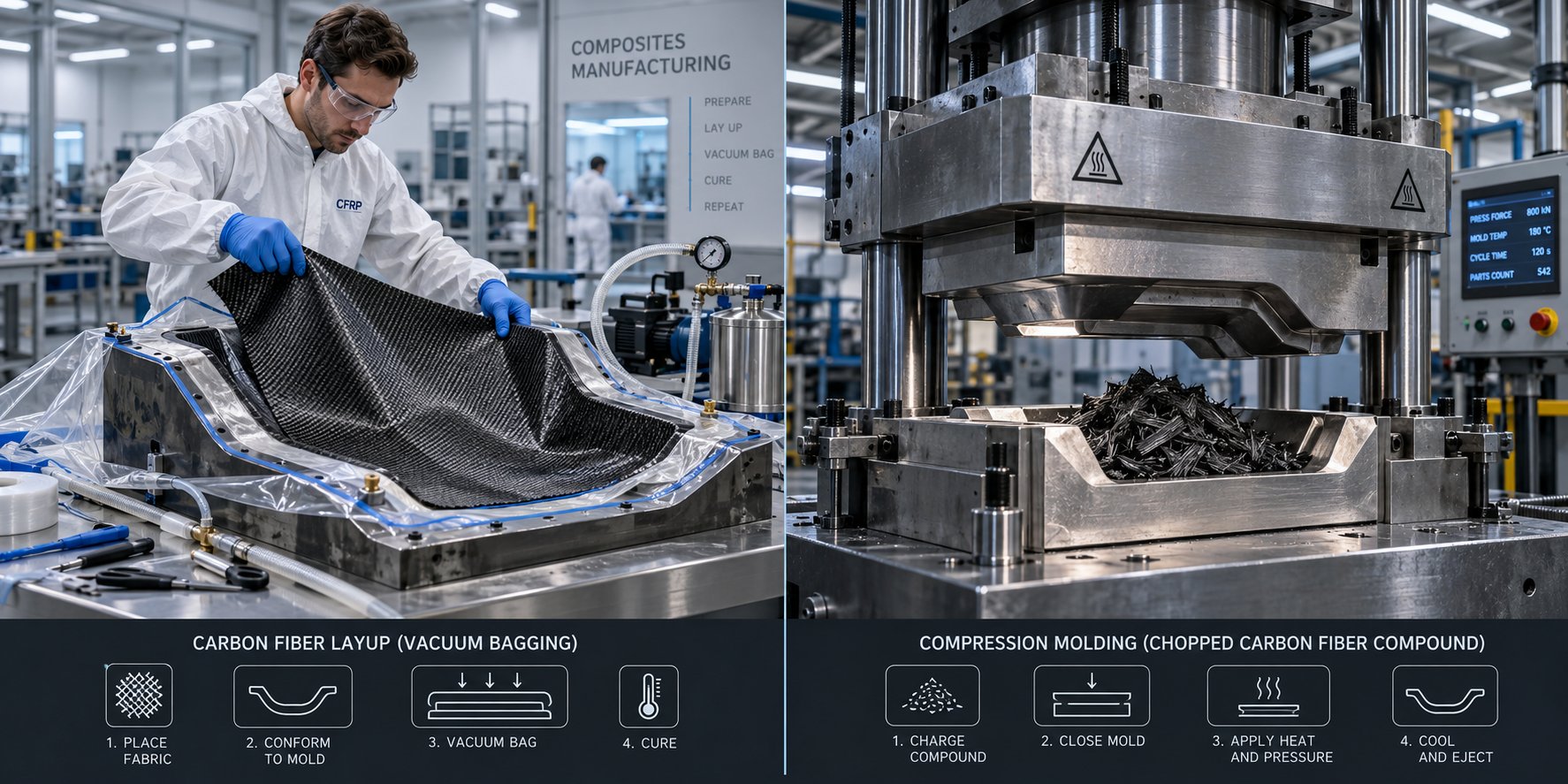
Traditional carbon fiber manufacturing relies on prepreg — pre-impregnated woven carbon fabric that arrives from the supplier already saturated with a factory-controlled amount of epoxy resin. Because the resin begins curing at room temperature, prepreg sheets must be shipped and stored frozen, typically at around -20 degrees Celsius.
Here's how the process unfolds. Skilled laminators cut the frozen prepreg into precise shapes, then lay each ply into a one-sided open mold by hand. Every layer is carefully oriented so that the continuous fibers align with the expected load paths — one ply at 0 degrees, the next at 45 degrees, and so on. This directional stacking is what gives traditional carbon fiber its extraordinary strength along specific axes.
Once layup is complete, the mold is sealed inside a vacuum bag and loaded into an autoclave — a pressurized oven that cures the laminate under both heat (typically 120-180 degrees Celsius) and pressure (around 6 bar, or roughly 85 psi). That pressure is the critical ingredient. It squeezes out excess resin, collapses trapped air voids, and produces an exceptionally high fiber-to-resin ratio. The result? Parts that are light, stiff, and virtually identical from one production run to the next.
The trade-off is time and cost. Autoclave equipment demands significant capital investment. Hand layup requires trained technicians who can orient plies precisely without introducing wrinkles or bridging defects. And each cure cycle takes hours, not minutes. For large structural panels — think aerospace wing skins or F1 monocoque chassis — this painstaking process is justified because the directional performance simply cannot be achieved any other way.
Forged Carbon Compression Molding — Speed Meets Complexity
Carbon forged composites take a completely different manufacturing path. Instead of continuous woven sheets, the process starts with short chopped bundles of carbon fiber — often just a few centimeters long — mixed with a controlled amount of epoxy resin. This mixture, sometimes called chopped tow molding compound, is packed into a heated steel compression mold and pressed under high pressure until the resin cures.
Because the fibers are short and unoriented, something interesting happens: the material flows. It fills sharp radii, deep undercuts, and complex three-dimensional cavities that a flat woven sheet simply cannot conform to without cutting, darting, or wrinkling. You'll notice this advantage immediately in parts like mirror caps, shift knobs, and small structural brackets — geometries that would require extensive hand work and material waste with traditional prepreg layup.
The compression molding cycle is also significantly faster. There's no meticulous ply-by-ply orientation, no vacuum bagging choreography, and no hours-long autoclave run. A heated steel mold can produce a carbon fiber forged part in a fraction of the time, with less skilled labor and better material utilization.
Here's another detail that often gets overlooked: forged carbon can be manufactured from recycled offcuts and scrap fiber generated during traditional carbon fiber production. When laminators cut prepreg sheets to fit curved molds, the trimmed edges are typically discarded. Chopping those offcuts into short fibers and feeding them into a compression mold creates a secondary use for material that would otherwise be waste — a sustainability advantage we'll explore later in this article.
Why Manufacturing Method Is the #1 Difference
The table below puts both processes side by side across the six attributes that matter most at the factory level:
| Attribute | Traditional Carbon Fiber (Prepreg) | Forged Carbon (Compression Molded) |
|---|---|---|
| Fiber Form | Continuous woven sheets (twill, plain, satin weave) | Short chopped tows (typically 2-5 cm) |
| Mold Type | One-sided open mold with vacuum bag | Matched heated steel compression mold |
| Curing Method | Autoclave (heat + pressure, ~120-180 degrees C, ~6 bar) | Heated compression mold (high pressure, shorter cycle) |
| Production Speed | Slow — hours per cure cycle, sequential hand layup | Fast — shorter cycle times, minimal hand labor |
| Labor Intensity | High — requires skilled laminators for ply orientation | Low — compound is placed in mold without precise orientation |
| Geometric Complexity | Limited — flat sheets resist sharp radii and deep 3D shapes | Excellent — material flows into complex cavities and undercuts |
Every entry in that table cascades into downstream consequences. Slower production speed means higher per-part cost. Greater geometric complexity means forged carbon can produce shapes that traditional layup simply cannot. Higher labor intensity means traditional carbon fiber is more vulnerable to human error — a point the CKN Knowledge in Practice Centre highlights as a key disadvantage of hand layup processing.
In short, the manufacturing method doesn't just influence the final product — it defines it. The fiber form determines the visual pattern. The curing method dictates structural consistency. The mold type sets the geometric boundaries. And those boundaries, in turn, shape the engineering trade-off that earns our #2 ranking: how each material handles directional versus multi-axis loads.
#2 Strength and Structural Performance Trade-Offs
The manufacturing method shapes the material. But the question every buyer eventually asks is simpler: which one is actually stronger? The answer depends entirely on how you define "stronger" — and this is where the forged carbon vs carbon fiber conversation gets genuinely interesting, because the two materials don't just differ in degree. They differ in kind.
Traditional carbon fiber is engineered for directional dominance. Forged carbon is built for uniform resilience. That distinction sounds subtle on paper, but it changes which material wins depending on the loads your part needs to handle. Let's break down exactly what that means — and why so many people get it wrong.
Directional Strength — Traditional Carbon Fiber's Engineering Edge
Imagine holding a bundle of dry spaghetti. If you try to pull it apart lengthwise — fiber to fiber — it's almost impossible to break. But snap it sideways across the bundle and it fractures instantly. That's the principle behind traditional carbon carbon fibre composites: continuous fibers are incredibly strong along their length and comparatively weak across it.
Engineers exploit this property through a technique called anisotropic layup. When building a wing spar for a commercial aircraft or a monocoque tub for a Formula 1 car, they orient each ply of woven prepreg so the continuous fibers align precisely with the expected load paths. The first layer might run at 0 degrees to handle primary tensile loads, the next at plus-or-minus 45 degrees for shear resistance, and a subsequent layer at 90 degrees for lateral stiffness. Stack enough plies in these calculated orientations and the finished laminate delivers extraordinary stiffness and tensile strength exactly where the structure needs it most — while keeping weight to an absolute minimum.
This directional optimization is why traditional carbon fiber dominates in applications where loads are predictable and travel along known paths: aerospace control surfaces, bicycle down tubes, racing chassis, and high-performance sail masts. The material can be "tuned" to the load case, almost the way a guitar string is tuned to a specific note. Remove the ability to control fiber direction and you lose that precision entirely.
Isotropic Performance — Where Forged Carbon Holds Its Own
So what is forged carbon doing differently inside the laminate? Instead of long, continuous fibers aligned along calculated axes, forged carbon components contain short chopped strands — typically a few centimeters long — scattered in random orientations throughout the resin matrix. No ply stacking. No directional optimization. Just a dense, chaotic web of short fibers pointing in every direction at once.
The result is isotropic mechanical behavior: roughly equal strength and stiffness in all directions. You can load a forged carbon part from the top, the side, or at an oblique angle and it will respond with similar resistance. That sounds like a limitation compared to the directional power of traditional layup — and for applications like aerospace wing skins, it absolutely is. But here's where the misconception begins.
Forged carbon is not structurally weak. Mechanical testing by Easy Composites demonstrated that compression-molded forged carbon components — reinforced with randomly oriented short-strand chopped tow — delivered a flexural yield of 220 kg compared to cast aluminium's 120 kg in the same brake lever geometry. In the lever pull test, the forged carbon sample yielded at 153 kg versus aluminium's 98 kg, while weighing roughly half as much (24.7 g vs 46.7 g). The tensile yield told a different story — 192 MPa for forged carbon against aluminium's 304 MPa — illustrating exactly where the random fiber orientation gives up ground. But the overall picture is clear: forged carbon comfortably matches or exceeds cast aluminium in multiple load scenarios, at nearly half the density.
Those numbers shift dramatically when you hybridize the approach. The same Easy Composites study tested an "optimised" forged carbon sample that incorporated continuous carbon fiber tow alongside the chopped strands — continuous fibers laid lengthwise in high-load areas, with chopped tow filling the remaining geometry. The result? Tensile yield jumped from 192 MPa to 875 MPa, nearly tripling the performance of aluminium. Flexural modulus climbed from 35.5 GPa to 61.1 GPa, surpassing aluminium's 51.9 GPa. This hybrid technique proves that the forged carbon process is remarkably adaptable — you can inject directional reinforcement where it matters while still leveraging the flow and moldability of chopped fiber everywhere else.
When Random Fiber Orientation Is Actually an Advantage
Here's where the real nuance lives. Many structural components don't experience loads along a single, predictable axis. Think about a mounting bracket on a motorcycle engine — vibration, thermal cycling, and impact forces hit it from multiple angles simultaneously. Or consider a housing for sensitive electronics that needs to resist drops, twists, and crush loads from any direction. In these multi-axis scenarios, traditional carbon fiber's directional strength can actually become a liability. Optimize for one load path and you create weakness in others. Engineers compensate by adding more plies at more angles, which adds weight, cost, and complexity.
Forged carbon sidesteps this problem entirely. Its isotropic nature means no single direction is weaker than any other, which makes it a natural fit for parts subjected to complex, multi-directional, or unpredictable loading. Small structural connectors, interior trim brackets, shift knobs, and complex housings all benefit from this even-strength profile. The material flows into tight cavities during molding, fills sharp radii without bridging defects, and delivers consistent performance throughout the part — including in areas that would be resin-rich weak spots in a traditional layup.
There's a practical observation from the Easy Composites testing that reinforces this point. When they attempted to use continuous woven reinforcement in the same matched-tool compression mold geometry, the result was significant voiding and resin-rich zones, because continuous fibers can't migrate and redistribute themselves in a closed cavity the way short strands can. The very feature that limits forged carbon's directional performance — its short, mobile fibers — is also what allows it to fill complex shapes reliably and without defects.
Even aesthetic variants like white forged carbon fiber — where colored resin is mixed with the chopped tow before molding — retain these same isotropic mechanical properties. The visual effect changes, but the structural logic remains identical: random fiber orientation, uniform load distribution, and excellent moldability.
Understanding the directional vs isotropic trade-off is the single most important engineering consideration when choosing between forged carbon and traditional carbon fiber — it determines whether you're optimizing for peak performance in one axis or reliable strength across all of them.
This performance trade-off sets the stage for a difference that hits buyers on a more visceral level. Before most people ever read a data sheet, they've already formed an opinion based on what the material looks like — and that's where these two composites couldn't be more different.
#3 Visual Pattern and Aesthetic Appeal of Forge Carbon Fiber vs Traditional Weave
Strength numbers live on data sheets. Visual patterns live on Instagram feeds, showroom floors, and the first glance across a parking lot. For lifestyle buyers and automotive enthusiasts, the look of a material often carries more purchase-decision weight than its tensile modulus ever will. And when it comes to appearance, forge carbon fiber and traditional woven carbon fiber couldn't look more different if they tried.
One is precision geometry. The other is controlled chaos. Both signal premium quality — but to very different audiences and for very different reasons.
The Classic Weave — Carbon Fiber's Signature Look
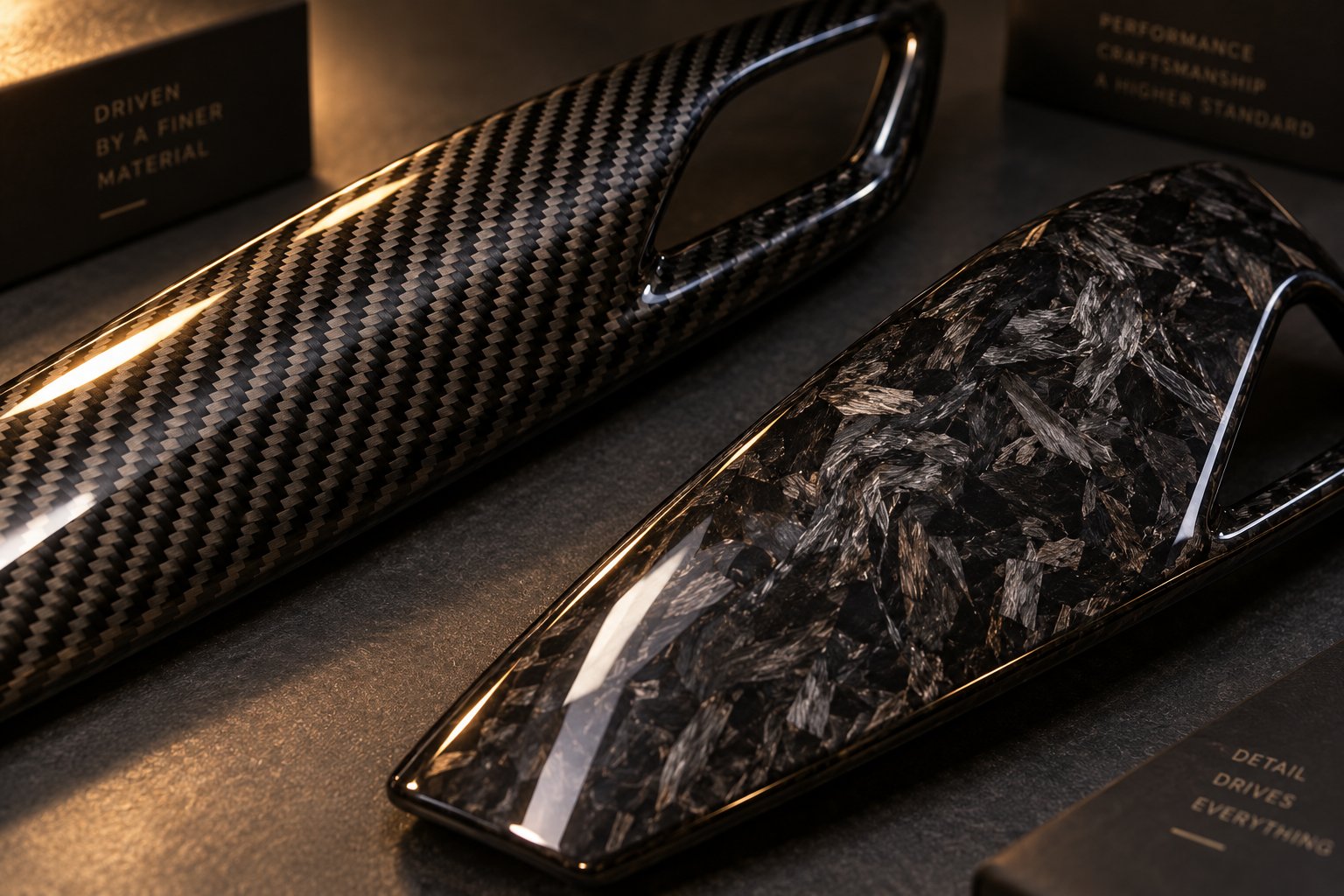
You've seen it a thousand times: that tight, repeating checkerboard of interlocking fiber bundles catching light at alternating angles. This is traditional carbon fiber's visual identity, and it's been the universal shorthand for "high performance" for decades.
The pattern itself comes from how the fiber tows are physically woven together before being impregnated with resin. The three most common configurations each produce a distinct visual texture:
1K weave uses bundles of roughly 1,000 filaments per tow. The result is a fine, tight pattern with small repeating squares — subtle, elegant, and often found on luxury accessories and watch components where visual refinement matters more than raw performance.
3K weave — with 3,000 filaments per tow — strikes the balance most buyers recognize instantly. It's the pattern you'll see on aftermarket spoilers, mirror caps, and interior trim panels across the automotive world. The squares are large enough to be dramatic at arm's length but still refined up close.
12K weave uses much thicker tow bundles, producing a bold, industrial-scale pattern with wide, flat bands. You'll find it more commonly in structural and industrial applications where aesthetics take a back seat to fiber volume and layup efficiency.
Within those tow sizes, the weave style adds another layer of visual variation. A 2x2 twill weave creates a diagonal, almost herringbone-like appearance — this is the pattern most people picture when they think "carbon fiber." A plain weave produces a simpler, symmetrical grid. Both carry the same unmistakable visual DNA: order, precision, engineering discipline made visible.
That's the power of the traditional weave pattern. It doesn't just look technical — it is technical. Every line you see on the surface traces an actual structural fiber running through the laminate. The aesthetic and the engineering are inseparable, and that authenticity is exactly why the classic weave has dominated motorsport, aerospace, and performance automotive culture for over three decades.
The Marbled Swirl — Forged Carbon's Unique Fingerprint
Forge carbon fibre produces something entirely different. Instead of geometric repetition, you get flowing, marbled swirls — dark fibers twisting through lighter resin channels in patterns that look almost geological. Think polished stone or abstract ink art. No two pieces are identical, because the randomly oriented chopped fibers settle into unique configurations every time the compression mold closes.
This aesthetic didn't emerge from a design studio. It's a direct byproduct of the manufacturing process described earlier — short chopped tows compressed under heat and pressure, with fibers migrating freely through the resin matrix. The visual result just happens to be striking.
The look gained mainstream recognition through Lamborghini's collaboration with Callaway Golf, which co-developed a material they branded "Forged Composite." Announced at the Paris Motor Show, the partnership produced components featuring over 500,000 intertwined fibers per square inch, at one-third the density of titanium. Lamborghini integrated the material into its supercar interiors and exteriors, while Callaway introduced it across premium golf equipment. That dual launch — supercars and luxury sporting goods — cemented forged carbon's identity as an avant-garde, exclusive material distinct from the traditional weave.
The cultural positioning matters. Traditional woven carbon fiber carries decades of Formula 1, Le Mans, and fighter jet heritage. It says: "this part was engineered for speed." The forged marble pattern carries a different message — one of modern luxury, material innovation, and individuality. Each piece's one-of-a-kind swirl pattern appeals to buyers who want something that can't be mass-replicated in appearance, even if the manufacturing process itself is faster and more scalable than traditional layup.
Colored resin variants push that exclusivity even further. White forged carbon fiber, for example, mixes light-toned or pigmented resin with the chopped carbon tow before molding. The result is a dramatic contrast of bright resin channels against dark fiber clusters — an eye-catching look that has gained traction in luxury phone cases, high-end watch bezels, and custom automotive trim. The structural properties remain functionally identical to standard dark-resin forged carbon; only the visual impact changes.
How to Spot Fake Forged Carbon Patterns
Here's the catch with any material that becomes a style trend: fakes follow fast. The forged carbon look is relatively easy to imitate visually — a hydro-dipped plastic shell or a printed vinyl wrap can reproduce the marbled swirl pattern convincingly enough to fool casual buyers. These imitations carry zero structural carbon content and none of the weight, strength, or thermal properties of genuine forge carbon fiber.
Before spending money on any product marketed as "real forged carbon," check for these telltale signs:
- Weight — Genuine forged carbon is noticeably lighter than plastic or resin-only alternatives. Pick it up. If it feels heavy or dense for its size, it's likely a fake.
- Edge finish — Real forged carbon parts reveal visible fiber cross-sections along cut or machined edges. You'll see tiny dark filament ends embedded in the resin matrix. Hydro-dipped plastic shows a uniform, fiber-free edge.
- Surface depth — Authentic forged carbon has a three-dimensional quality under clear coat. The fiber swirls sit at slightly different depths within the resin, creating parallax as you tilt the piece. Vinyl wraps and printed patterns appear flat regardless of viewing angle.
- Tap test — Knock gently on the surface with a fingernail. Genuine carbon composites produce a sharp, high-pitched "tick." Plastic shells sound duller and lower in pitch.
- Price sanity check — If a product claims forged carbon construction but costs less than a comparable ABS plastic accessory, question the claim. Real carbon fiber — even in chopped form — carries a raw material cost floor that rules out bargain-bin pricing.
Both the traditional weave and the forged marble pattern have earned their places in the premium materials landscape. One speaks to engineering heritage, the other to modern exclusivity. Neither is inherently "better" looking — the right choice depends on the visual language you want your part, car, or accessory to speak.
Aesthetics draw buyers in. But eventually, every purchase comes down to what it costs — and the production economics behind these two materials reveal one of the most misunderstood gaps in the entire comparison.
#4 Cost Breakdown and Production Economics
"Forged carbon is cheaper." You'll hear that claim constantly — and it's not entirely wrong. But it's not entirely right either. The real cost picture when comparing carbon fiber vs forged carbon fiber depends on four interlocking variables: raw materials, tooling, labor, and production volume. Shift any one of those and the price advantage can flip entirely.
Let's pull the curtain back on where the money actually goes.
Raw Material and Tooling Cost Breakdown
Traditional carbon fiber parts start with prepreg — woven carbon fabric pre-impregnated with precisely measured epoxy resin. Prepreg is expensive. It requires climate-controlled shipping (frozen at around -20 degrees Celsius), cold storage at the manufacturing facility, and careful handling to prevent premature cure. The material itself commands a premium because producing continuous, defect-free woven fabric from thousands of aligned filaments is inherently labor-intensive at the supplier level.
Tooling compounds the cost. Autoclave-cured parts need not only the part mold itself but also vacuum bagging consumables, breather fabrics, release films, and — most significantly — access to an autoclave. These pressurized ovens represent major capital investments, often running into six figures for industrial-grade units. Every cure cycle ties up that equipment for hours.
Forged carbon's material equation looks different from the start. The chopped tow compound can be produced from virgin short-fiber stock, but it can also incorporate recycled offcuts from traditional carbon fiber production — edge trimmings and scrap that would otherwise be discarded. That recycled feedstock comes at a fraction of virgin prepreg pricing. The compression molds themselves are typically simpler matched-tool steel dies — no vacuum bagging consumables, no autoclave required. Upfront tooling costs for a compression mold can still be substantial, especially for tight-tolerance steel tooling, but the ongoing per-cycle consumable costs drop significantly.
Labor and Production Volume Economics
Here's where the gap really widens. Traditional prepreg layup demands skilled technicians who can orient each ply precisely, manage vacuum bag integrity, and monitor autoclave cycles. That expertise doesn't come cheap. A single complex aerospace panel might require hours of hands-on lamination before it ever enters the oven.
Forged carbon compression molding, by contrast, requires loading a pre-measured charge of chopped fiber compound into a mold cavity and pressing a button. The operator skill threshold is considerably lower, the cycle time is shorter, and the process lends itself to higher production volumes with better part-to-part consistency. For moderate runs — think hundreds to low thousands of complex-geometry parts — the labor savings alone can make forged carbon fiber vs carbon fiber a straightforward economic decision.
A critical nuance, though: at very low volumes, forged carbon may actually cost more. The steel compression tooling requires upfront investment that only pays off when amortized across a meaningful production run. If you only need a handful of prototype parts, traditional hand layup with simpler open molds can be the more economical path — a point industry manufacturers consistently emphasize when advising OEM buyers.
And don't confuse production cost with retail price. Consumer-facing fordged carbon products — watch cases, phone accessories, luxury automotive trim — often carry premium price tags that have less to do with manufacturing expense and more to do with brand positioning. The marbled aesthetic signals exclusivity, and brands price accordingly. A real forged carbon fiber phone case may cost only marginally more to produce than its traditional-weave equivalent, yet retail for a significant premium because of perceived rarity.
Price-Per-Performance — The True Value Metric
Raw cost per part only tells half the story. The metric that actually matters for engineering decisions is price-per-performance — what you get structurally for every dollar spent.
For any application demanding optimized directional strength — an aerospace spar, a racing monocoque, a high-performance bicycle frame — traditional carbon fiber delivers more structural capability per unit cost despite its higher absolute price. You simply cannot replicate that directional stiffness-to-weight ratio with randomly oriented chopped fibers, regardless of how cheaply they're molded. Spending less on forged carbon for a primary load-bearing panel would mean adding material thickness to compensate for lower directional performance, potentially erasing the cost advantage while adding weight.
For geometry-driven parts where multi-axis strength matters more than peak directional performance — brackets, housings, interior trim, cosmetic-structural covers — forged carbon's lower production cost aligns perfectly with the application's actual performance requirements. You're not paying for directional optimization you don't need.
The table below lays out the economic comparison across the categories that matter most:
| Cost Category | Traditional Carbon Fiber | Forged Carbon |
|---|---|---|
| Raw Material Cost | High — prepreg requires frozen storage and premium-priced woven fabric | Moderate to Low — can use recycled offcuts and virgin chopped tow |
| Tooling Investment | Moderate mold cost + high autoclave capital | Moderate to High matched-tool steel mold, but no autoclave needed |
| Per-Cycle Consumables | High — vacuum bags, breather, release film replaced each cycle | Low — minimal consumables in compression molding |
| Labor Intensity | High — skilled hand layup, hours per part | Low — compound loading, shorter cycle times |
| Material Waste | Significant — flat sheet trimming generates offcuts | Minimal — compound fills mold cavity with little excess |
| Scalability | Limited — each part requires individual hand layup | Strong — compression molding supports higher volumes efficiently |
| Low-Volume Economics | More flexible — simpler open molds for prototypes | Less flexible — steel tooling costs need volume to amortize |
| Retail Price Behavior | Premium, driven by production cost and heritage branding | Premium, often driven by luxury positioning beyond production cost |
The bottom line? Forged carbon genuinely costs less to produce in many scenarios — particularly for complex shapes at moderate-to-high volumes. But "costs less" doesn't automatically mean "better value." Value depends on whether the material's performance profile matches your application's actual demands. Overspend on traditional carbon fiber for a decorative trim piece and you're wasting money on structural capability you'll never use. Underspend on forged carbon for a primary load-bearing structure and you're trading safety margin for savings that aren't worth the risk.
Cost and performance define what each material can do. But there's a growing question about what each material should do — especially as the composites industry faces increasing pressure to address its environmental footprint.
#5 Environmental Impact and Sustainability
Manufacturing cost tells you what a material takes from your budget. Environmental impact tells you what it takes from everything else. As industries from aerospace to automotive face mounting pressure to reduce waste and lower carbon footprints, the sustainability profile of each carbon form has become a genuine differentiator — not just a marketing talking point. And on this front, forge carbon holds a meaningful edge that most comparisons between these two materials overlook entirely.
Waste Reduction Through Offcut Reuse
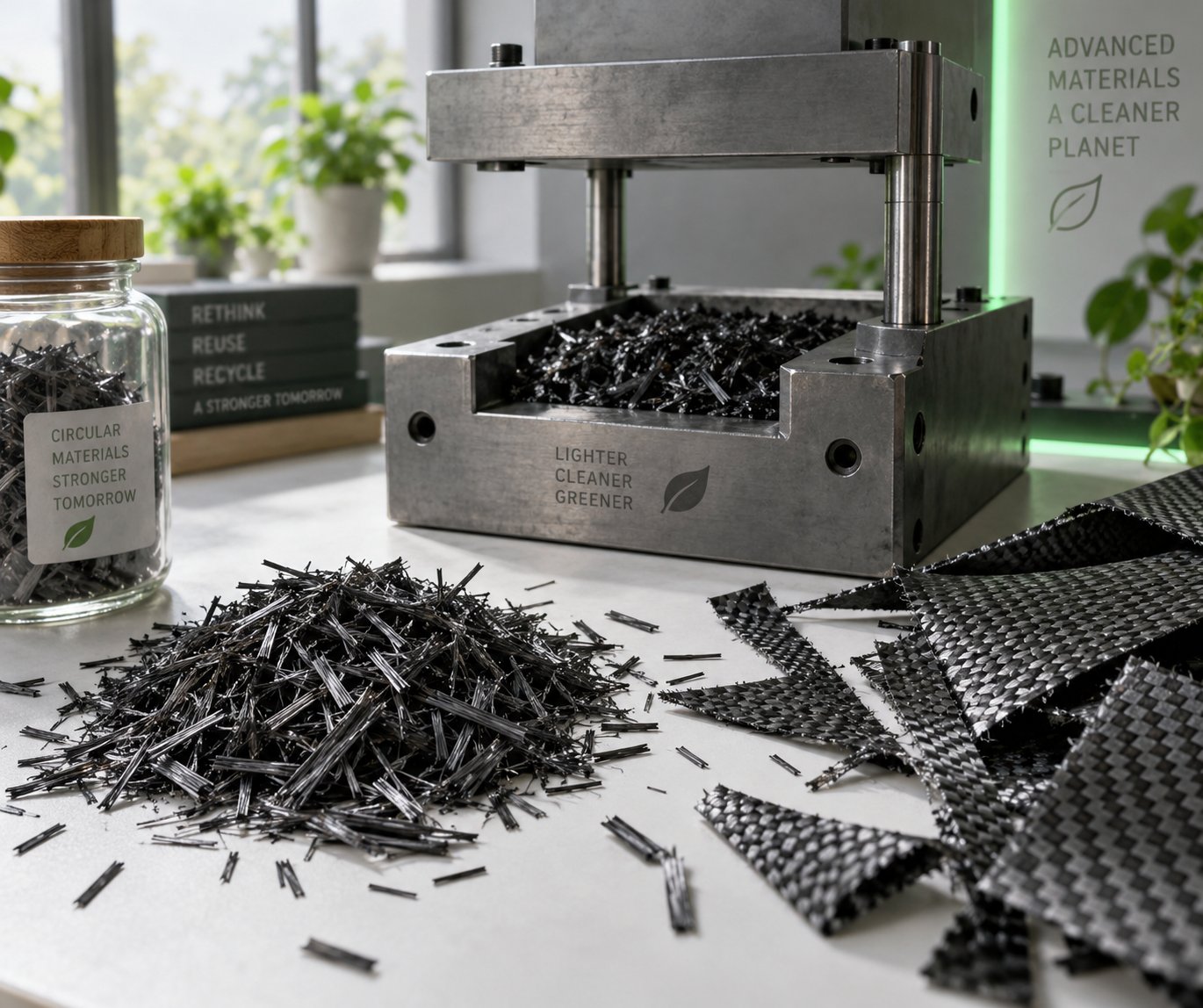
Picture the traditional carbon fiber layup process from a waste perspective. Flat prepreg sheets arrive in rectangular rolls. Technicians cut them into curved, irregular shapes to fit contoured molds. Every cut produces edge trimmings, corner scraps, and leftover strips that can't be reused in another layup — the continuous fibers are now the wrong shape, the wrong size, and already partially exposed to ambient cure conditions. Research into CFRP sustainability confirms that this waste generation is a systemic challenge across high-tech industries utilizing carbon fiber reinforced polymer components, with increasing use leading to substantial waste volumes.
Forged carbon turns that waste stream into a feedstock stream. Those same offcuts — trimmed edges, miscut plies, expired prepreg that aged out of its shelf life — can be chopped into short fiber segments and fed directly into a compression mold. The carbon fiber forging process doesn't care whether its fibers started life as pristine rolls or factory-floor scraps. Short, randomly oriented strands are the entire point. What traditional manufacturing discards, forged carbon manufacturing consumes.
This isn't a theoretical advantage. Multiple manufacturers already source chopped tow compound from reclaimed offcuts, creating a direct link between traditional carbon fiber production lines and forge carbon supply chains. The material that was heading for a landfill instead becomes the raw input for mirror caps, brackets, phone cases, and interior trim pieces.
Energy Footprint and Curing Efficiency
The environmental cost doesn't stop at material waste. Traditional carbon fiber's autoclave curing process is energy-hungry by design. Heating a large pressurized vessel to 120-180 degrees Celsius, maintaining that temperature and roughly 6 bar of pressure for several hours, then cooling the entire system back down — that cycle demands significant electricity or gas input for every single part. Scale that across thousands of components in an aerospace production run and the cumulative energy footprint becomes substantial.
Compression molding for forged carbon typically operates at lower temperatures, with shorter cycle times and no need for the massive thermal mass of an autoclave. The heated steel mold applies pressure directly to the material charge without heating an entire pressurized chamber full of air around it. Energy goes where it's needed — into the part — rather than into maintaining a large environmental envelope. The result is a measurably smaller energy expenditure per cured component, particularly for small-to-medium parts where the autoclave's overhead is disproportionate to the actual part volume inside it.
The Circular Economy Potential for Forged Carbon
Here's where the sustainability argument gets genuinely compelling. The carbon composite vs carbon fiber recycling challenge has long been one of the composites industry's biggest weak spots. Unlike aluminum or steel — which can be melted down and recast with minimal property loss — carbon fiber composites are notoriously difficult to recycle. The thermoset resin matrix that gives them their rigidity also makes them resistant to simple reprocessing. Research from the American Composites Manufacturers Association highlights that the intricate and anisotropic structure of CFRP components poses challenges that lead to increased waste generation, though innovative recycling processes offer a solution by reintegrating carbon components into a closed material cycle.
Forged carbon's tolerance for short, imperfect fibers makes it uniquely positioned in that recycling conversation. End-of-life carbon fiber parts — retired aircraft panels, worn-out sporting goods, obsolete automotive components — can be shredded, the fibers recovered through thermal or chemical processes, and those reclaimed fibers chopped and compounded into new forge carbon products. The fibers lose length during recycling, which would disqualify them from traditional woven layup. But length loss is irrelevant in a compression-molded process that already uses short strands by design.
This creates the framework for a genuine circular economy loop within the composites industry:
- Primary waste diversion — Production offcuts from traditional carbon fiber layup are chopped and reused as forged carbon feedstock instead of being landfilled.
- Lower energy processing — Compression molding consumes less energy per part than autoclave curing, reducing the carbon footprint of each recycled-content component.
- End-of-life recovery compatibility — Reclaimed fibers from thermal recycling methods like pyrolysis or fluidized bed processing can re-enter the supply chain as chopped tow compound.
- Reduced virgin material demand — Every kilogram of recycled fiber used in forged carbon is a kilogram of energy-intensive virgin carbon fiber that didn't need to be produced from scratch.
- Cascading reuse potential — Forged carbon parts themselves can theoretically be shredded and re-molded at end of life, extending the fiber's useful lifespan across multiple product generations.
A necessary dose of realism, though: this circular vision isn't fully operational yet. Carbon fiber recycling infrastructure remains nascent compared to metals recycling. Not all forged carbon products on the market actually use recycled feedstock — many are manufactured from virgin chopped fibers that carry the same upstream environmental cost as traditional prepreg. And both materials share a fundamental end-of-life challenge: thermoset resin systems don't melt, which means recovering clean fibers always requires energy-intensive chemical or thermal processing. Low-temperature solvolysis methods — operating under mild to subcritical conditions below 250 degrees Celsius — show promising results in recovering up to 99.9% of fibers while preserving original strength, but these processes haven't yet reached industrial scale for most applications.
The honest assessment? Forged carbon has a clear sustainability advantage in waste utilization and energy efficiency, and it's better positioned for a circular economy future than traditional woven carbon fiber. But neither material is truly "green" in the way recycled aluminum or steel can claim to be. The gap is narrowing as recycling technologies mature — and forged carbon's inherent compatibility with shorter, recycled fibers means it will likely benefit from those advances first.
Sustainability shapes how these materials are perceived by industry and regulators. But perception is also shaped by something less technical and far more persistent: the myths, half-truths, and outright misconceptions that surround both materials online — and those deserve their own reckoning.
#6 Myths vs Reality for Both Forged Carbon Fiber Material and Traditional Carbon Fiber
Half-truths travel faster than test data. Search "forges carbon" or "forged carbon fiber" online and you'll find forum threads, social media posts, and even product listings repeating the same handful of claims — some wildly oversimplified, others flatly wrong. The problem isn't that people are uninformed. It's that the misconceptions sound plausible enough to pass unchallenged, especially when they confirm a bias someone already holds.
What makes this particularly tricky is that the myths cut both ways. Forged carbon gets unfairly dismissed by engineering purists, while traditional carbon fiber gets placed on a pedestal it doesn't always deserve. Let's dismantle the five most persistent myths — three targeting forged carbon and two aimed at traditional woven composites — with the mechanical evidence and manufacturing reality we've already established.
Myths About Forged Carbon — Separating Hype from Science
Forged composite carbon fiber attracts more skepticism than almost any other advanced material on the market. Some of that skepticism is healthy. But much of it stems from misunderstanding how the material actually works and what it's designed to do.
-
Myth: "Forged carbon is just chopped-up carbon fiber and therefore inferior."
Reality: Calling forged carbon "just chopped-up carbon fiber" is like calling concrete "just crushed rocks." Technically, yes, the process starts with short chopped strands of carbon fiber. But the way those strands interact under compression molding — flowing into complex cavities, interlocking in random orientations, consolidating under high pressure — produces a distinct forged carbon fiber material with its own legitimate mechanical profile. As we covered in the strength comparison, forged carbon comfortably outperforms cast aluminum in flexural and compressive loading at roughly half the weight. It's a different engineering tool, not a damaged version of the original. -
Myth: "Forged carbon can replace traditional carbon fiber in all applications."
Reality: This is the opposite extreme — and it's equally wrong. Forged carbon's randomly oriented short fibers cannot replicate the directional stiffness and tensile strength that continuous woven plies deliver when aligned along known load paths. An aerospace wing spar, a Formula 1 monocoque tub, or a competitive cycling frame requires fiber orientation optimized to specific stress vectors. Forged carbon simply cannot provide that level of directional performance, no matter how well the compression molding process is executed. Claiming universal substitution ignores the fundamental physics of how is carbon fiber produced in continuous versus chopped form — and the downstream structural consequences of each approach. -
Myth: "Forged carbon is purely aesthetic with no real structural value."
Reality: This one likely persists because many consumer-facing forged carbon products are primarily aesthetic — phone cases, watch bezels, decorative automotive trim. But the material's origin story tells a different tale. Lamborghini and Callaway developed forged composite carbon fiber specifically for structural applications: suspension components, engine covers, and golf club heads that needed to withstand repeated high-impact forces. The marbled appearance was a byproduct, not the objective. Functional forged carbon parts carry genuine mechanical loads in motorsport, aerospace hardware, and industrial equipment. Dismissing the entire material category as cosmetic ignores its engineering DNA.
Myths About Traditional Carbon Fiber — It's Not Always Superior
Traditional woven carbon fiber benefits from decades of motorsport and aerospace prestige. That heritage is well-earned — but it sometimes inflates expectations beyond what the material can actually deliver in every scenario.
-
Myth: "Traditional carbon fiber is always stronger."
Reality: Stronger in which direction? That qualifier changes everything. Traditional carbon fiber's advantage is directional — it excels when loads are predictable and fibers can be oriented to match those load paths precisely. But in applications with complex, multi-axis, or unpredictable loading — mounting brackets subjected to vibration, housings exposed to drop impacts from random angles, connectors under combined torsion and compression — traditional layup's directional optimization can actually become a vulnerability. Optimize for one axis and you inherently create relative weakness in others. Forged carbon's isotropic nature provides more uniform resistance across all directions, which can be the smarter structural choice for parts that don't experience loads along a single clean vector. -
Myth: "All carbon fiber weave patterns are equal."
Reality: Walk into any aftermarket parts shop and you'll see "carbon fiber" marketed as a single, monolithic material. In practice, the weave pattern significantly affects both structural behavior and visual appearance. A plain weave — with each tow crossing over and under alternately — offers the tightest interlocking pattern and good stability but can be harder to drape over complex curves. A 2x2 twill weave — each tow crossing over two and under two — provides better conformability to curved surfaces and that distinctive diagonal visual. Unidirectional (UD) fabric isn't woven at all: fibers run in a single direction, delivering maximum stiffness along that axis but essentially zero strength perpendicular to it. Choosing the wrong weave style for an application can mean sacrificing drapability, impact resistance, or directional stiffness without realizing the trade-off was even on the table.
The Biggest Misconception of All
Every myth on this list shares a common root: the assumption that one of these materials is universally "better" than the other. It's a satisfying narrative — clean, simple, easy to act on. And it's completely wrong.
Forged carbon isn't a budget knockoff. Traditional carbon fiber isn't an all-purpose champion. Each material was engineered to solve a specific set of manufacturing and performance problems, and each excels within its intended domain. The engineer specifying a load-bearing aircraft component and the enthusiast choosing a decorative mirror cap are making fundamentally different decisions — and the "right" material changes accordingly.
Neither forged carbon nor traditional carbon fiber is universally superior — the right choice depends entirely on the application, the loading scenario, and the buyer's priorities.
Stripping away these myths leaves a clearer picture of what each material genuinely does well. The remaining question is the most practical one of all: for your specific use case — whether that's a structural bracket, an automotive upgrade, or a consumer accessory — which material actually earns the recommendation?
#7 Best Applications for Every Buyer Type
Myths cleared. Data reviewed. Manufacturing processes, strength profiles, cost curves, and sustainability footprints — all laid out. The question that remains is the one you probably started this article with: which material should I actually choose?
The answer depends less on the material itself and more on what you're building, bolting on, or carrying in your pocket. Here's the application-by-application breakdown, organized by the three buyer profiles that shaped our entire ranking framework.
Best Choice for Aerospace and Motorsport
If you're specifying primary structural components — wing spars, monocoque chassis tubs, control surfaces, load-bearing suspension arms — traditional carbon fiber wins without qualification. These applications share a defining characteristic: loads travel along predictable, well-mapped paths that engineers can model with precision. Aligning continuous fiber plies along those paths delivers stiffness-to-weight ratios that no randomly oriented chopped-fiber process can match.
Think of it this way. An F1 monocoque needs to survive a 200 mph impact while protecting the driver inside a structure that weighs less than 40 kilograms. That demands fiber architecture tuned ply by ply to specific crash load vectors — exactly the kind of directional optimization that only continuous woven or unidirectional prepreg layup can provide. Carbon forging processes, for all their moldability and cost advantages, simply cannot replicate that level of structural precision.
Where does forged carbon fit in aerospace and motorsport? Secondary and tertiary structures. Brackets, housings, fairings, interior fittings, and complex connectors that experience multi-directional loads without extreme peak forces — these are ideal candidates. The compression molding process fills intricate geometries faster and with less labor, and the isotropic strength profile handles the unpredictable vibration and thermal cycling these parts face during real-world service.
Best Choice for Automotive Enthusiasts and Tesla Owners
Step outside the world of primary race car structures and the calculus shifts dramatically. For aftermarket automotive accessories — spoiler lips, mirror caps, dashboard trim, door handle covers, diffuser accents — both materials deliver genuine lightweight performance alongside premium aesthetics. The choice comes down to two factors: which visual pattern you prefer and what geometry the part demands.
Traditional woven carbon fiber remains the dominant choice for flat or gently curved exterior panels where the classic 3K twill weave communicates motorsport heritage at a glance. Spoilers, hood scoops, and trunk lip accents with relatively simple geometries play to traditional layup's strengths — clean weave alignment, consistent visual pattern, and well-understood structural performance.
Fordged carbon fiber earns its place on parts with tight radii, deep recesses, and complex three-dimensional shapes — shift knobs, small interior trim accents, mirror housings with compound curves — where the compression molding process can produce a finished part in a single cycle that would require extensive hand work with flat woven sheets. The forged carbon fiber pattern also appeals to buyers who want something visually distinct from the ubiquitous twill weave: that marbled swirl signals a different kind of premium.
For Tesla owners specifically, carbon fiber accessories have become one of the most popular upgrade categories. Real carbon fiber upgrades can reduce overall vehicle weight by 20-40 kg depending on the number of components replaced, translating to measurable range improvements and sharper handling dynamics. The key is material authenticity. The aftermarket is flooded with vinyl-wrapped plastic masquerading as real carbon fiber — parts that add weight instead of saving it and offer zero structural benefit.
When evaluating carbon fiber accessories for a Tesla Model 3, Model Y, or any other variant, prioritize three things: verified material composition (genuine dry or prepreg carbon fiber, not hydro-dipped ABS), weave quality and consistency across the visible surface, and precise fitment engineered to OEM panel gaps. Collections like CUTIM's Tesla Carbon Fiber Accessories demonstrate what to look for — real carbon fiber construction across both interior and exterior components, with the kind of finish quality and fit precision that separates authentic upgrades from cosmetic imitations. Whether you're drawn to the classic woven pattern or a distinctive forged look, verifying material authenticity before purchase protects both your investment and your vehicle's performance profile.
Best Choice for Consumer Products and Accessories
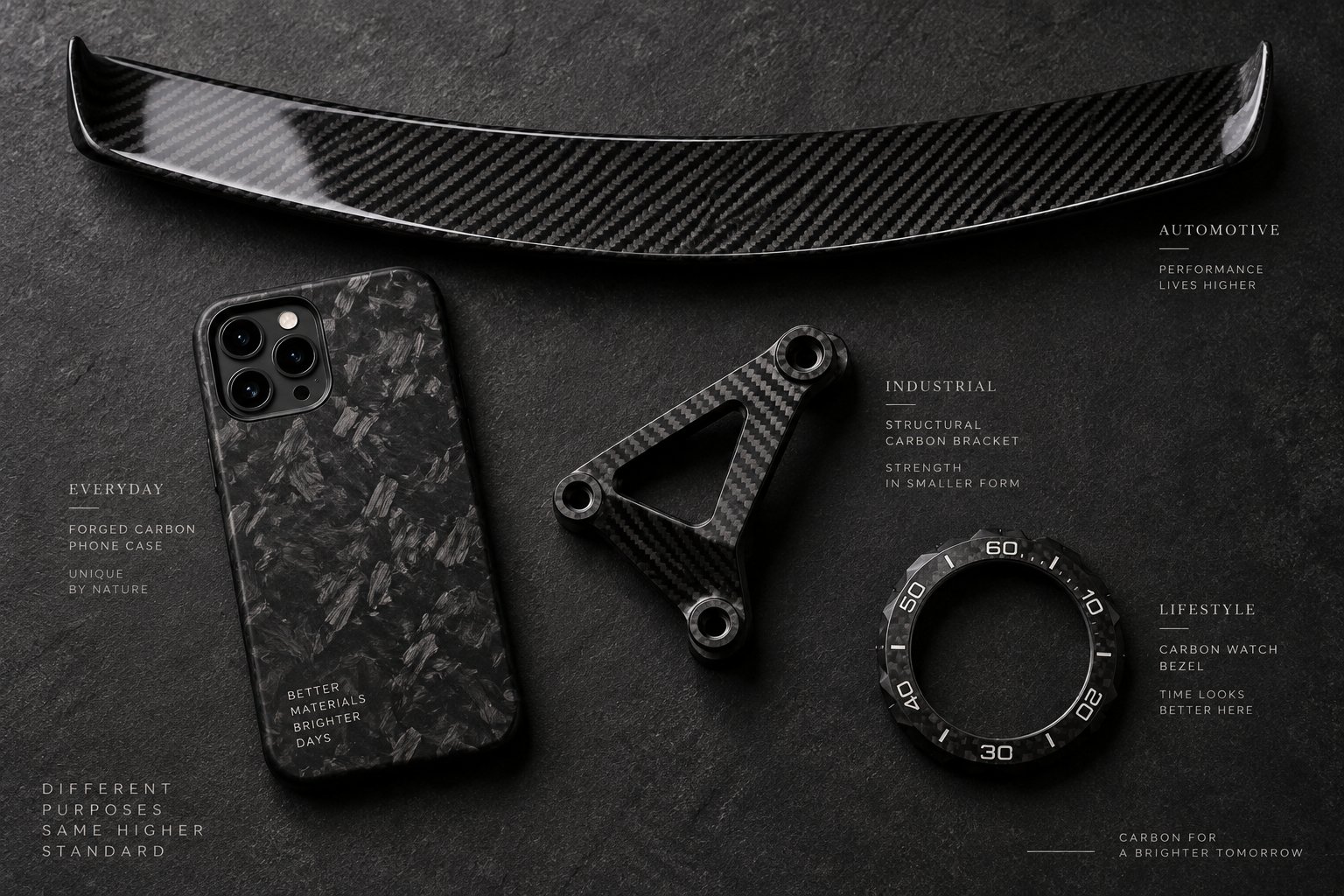
Phone cases. Watch bezels. Wallet inserts. Laptop shells. Eyewear frames. These products share a common set of requirements: complex 3D geometry, small size, high visual impact, and moderate structural demands. This is forged carbon's natural habitat.
Compression molding excels at producing small, intricately shaped parts with tight tolerances and Class A cosmetic surfaces in a single cycle. The forged carbon fiber pattern — that unique marbled swirl — gives each piece a one-of-a-kind appearance that resonates with luxury and tech-forward consumers. No two phone cases look identical, which brands actively market as an exclusivity feature.
Traditional woven carbon fiber can certainly be used for consumer accessories, and many premium phone cases and watch bands feature the classic twill weave. But the manufacturing economics favor forged carbon at the volumes these products typically require. Compression molding's shorter cycle times, lower labor costs, and better material utilization translate to more competitive per-unit pricing — savings that either improve margins or reduce retail prices for end consumers.
For structural brackets, connectors, and industrial hardware, the verdict aligns with consumer products but for different reasons. Here, it's the isotropic mechanical performance — not the aesthetics — that earns forged carbon the recommendation. Multi-axis loading, vibration resistance, and the ability to mold complex geometries with integrated bosses and ribs make compression-molded forged carbon a practical alternative to machined aluminum in weight-sensitive applications.
The table below maps each major application category to its recommended material, the primary reason for that recommendation, and the buyer type most likely to encounter the decision:
| Application Type | Recommended Material | Primary Reason | Buyer Type |
|---|---|---|---|
| Aerospace primary structures (wing spars, fuselage panels) | Traditional Carbon Fiber | Directional strength optimization along known load paths | Performance Engineer |
| Motorsport chassis and monocoques | Traditional Carbon Fiber | Tunable ply orientation for crash and stiffness requirements | Performance Engineer |
| Automotive spoilers, hoods, and flat exterior panels | Traditional Carbon Fiber | Clean weave aesthetics and proven structural performance on simple curves | Automotive Enthusiast |
| Automotive mirror caps, interior trim, and complex-geometry accents | Both (application-dependent) | Forged carbon for tight radii and unique look; traditional for classic weave appeal | Automotive Enthusiast |
| Tesla interior and exterior carbon fiber accessories | Traditional Carbon Fiber | Authentic weave finish, lightweight performance, and broad fitment availability | Automotive Enthusiast |
| Phone cases and small electronics accessories | Forged Carbon | Complex 3D shapes, unique marbled pattern, and favorable production economics | Consumer Product Buyer |
| Watch cases and eyewear frames | Forged Carbon | Intricate geometry, lightweight comfort, and one-of-a-kind aesthetics | Consumer Product Buyer |
| Structural brackets and connectors | Forged Carbon | Isotropic strength, integrated features, and compression molding efficiency | Performance Engineer |
| Drone and UAV housings | Forged Carbon | Complex enclosure shapes with multi-axis impact resistance at low weight | Performance Engineer |
Notice a pattern? Neither material sweeps the board. Traditional carbon fiber dominates where loads are directional and geometries are relatively simple. Forged carbon dominates where shapes are complex and loads are multi-directional. The automotive space sits right in the middle — a contested zone where the right answer depends on the specific part, the specific aesthetic, and the specific buyer.
With application-specific recommendations established, only one task remains: putting every key attribute into a single head-to-head comparison and delivering a final, definitive verdict for each buyer type.
The Complete Comparison Table and Final Verdict on Forged Carbon vs Carbon Fiber
Nine differences explored. Mechanical data compared. Manufacturing processes dissected. Myths dismantled. Everything you've read so far distills into the table below — a single, side-by-side snapshot that puts every major attribute on the same page so you can make a confident decision without scrolling back through thousands of words.
Complete Head-to-Head Comparison Table
| Attribute | Traditional Carbon Fiber | Forged Carbon |
|---|---|---|
| Strength (Directional) | Excellent — continuous fibers tuned ply by ply to specific load paths | Limited — randomly oriented short fibers cannot be directionally optimized |
| Strength (Multi-Axis) | Moderate — requires additional plies at multiple angles, adding weight and cost | Excellent — isotropic properties provide roughly equal resistance in all directions |
| Stiffness | Very High — fiber alignment maximizes stiffness along designed axes | Moderate — forged carbon fiber strength is distributed uniformly rather than concentrated directionally |
| Weight | Very Low — optimized layup achieves maximum performance at minimum mass | Very Low — comparable density, though more material may be needed to match directional stiffness |
| Cost Per Part (Complex Geometry) | High — hand layup, vacuum bagging, and autoclave time drive per-unit costs up | Moderate — compression molding fills complex shapes in shorter cycles with less labor |
| Tooling Cost | Moderate mold + high autoclave capital investment | Moderate to high matched-tool steel mold, but no autoclave required |
| Production Speed | Slow — hours per cure cycle with sequential ply placement | Fast — shorter compression cycles, minimal hand work |
| Geometric Complexity | Limited — flat woven sheets resist sharp radii, deep undercuts, and compound curves | Excellent — chopped tow flows freely into intricate 3D cavities |
| Visual Pattern | Iconic woven weave (1K, 3K, 12K twill or plain) — geometric, repeating, universally recognized | Marbled swirl — organic, unique per piece, modern and exclusive |
| Recyclability | Difficult — offcuts are often landfilled; thermoset resin resists reprocessing | Better positioned — tolerates recycled and reclaimed short fibers; compatible with emerging circular economy loops |
| Best-Fit Application | Primary structural panels, aerospace spars, racing monocoques, bicycle frames | Complex-geometry brackets, consumer accessories, decorative trim, multi-axis-loaded housings |
Scan the table vertically and a clear pattern emerges. Traditional carbon fiber dominates every row related to directional engineering performance. Forged carbon dominates every row related to manufacturing flexibility, geometric freedom, and sustainability. Neither column is uniformly green. That's the entire point.
Final Verdict by Buyer Type
For the Performance Engineer: Choose traditional carbon fiber whenever your application involves predictable, directional loading — wing spars, chassis tubs, load-bearing suspension components, or any structure where fiber orientation can be mapped to known stress vectors. The ability to tune each ply's angle gives you a performance ceiling that randomly oriented chopped fibers simply cannot reach. Reserve forged carbon for secondary structures, brackets, and complex connectors where isotropic strength and moldability matter more than peak directional stiffness.
For the Automotive Enthusiast: Both materials deliver genuine lightweight benefits, and why is carbon fiber used in cars comes down to the same reason it's used in aircraft — exceptional strength at a fraction of the weight of metal. Your decision here hinges on two things: visual preference and part geometry. Want the classic motorsport weave on a spoiler or trunk lip? Traditional carbon fiber. Want a modern, one-of-a-kind marbled finish on a mirror cap or shift knob with compound curves? Forged carbon. Either way, prioritize material authenticity above all else — a genuine carbon fiber part saves weight and adds structural value, while a vinyl-wrapped plastic imitation does neither.
Tesla owners upgrading with real carbon fiber components should evaluate fitment precision, weave consistency, and verified material composition before purchasing. CUTIM's Tesla Carbon Fiber Accessories collection offers a practical reference point — real carbon fiber interior and exterior parts with authenticated finish quality across Model 3, Model Y, and other variants. If you've determined that traditional carbon fiber is the right material for your upgrade, starting with a trusted source that verifies its materials saves the guesswork of sorting genuine products from cosmetic knockoffs.
For the Budget-Conscious Buyer: Forged carbon parts can deliver striking visual impact and genuine carbon fiber construction at lower production costs — particularly for small accessories like phone cases, watch components, and wallet inserts where compression molding economics work in your favor. But "lower production cost" doesn't always mean "lower retail price." Brands leverage the forged carbon fiver aesthetic's exclusivity to command luxury pricing. Compare carefully, read material specifications rather than marketing copy, and use the authentication tips from earlier in this guide to verify that what you're buying contains actual carbon fiber — not hydro-dipped plastic riding on the material's reputation.
The Bottom Line on Forged Carbon vs Carbon Fiber
Every comparison naturally tempts you toward a clean winner. One material crowned, one dismissed. But the engineering reality — and the honest buying advice — doesn't work that way. These two composites start from the same carbon filaments, diverge at the mold, and end up serving fundamentally different purposes. Picking the "wrong" one isn't a matter of choosing an inferior material. It's a matter of mismatching a material's strengths to your application's demands.
The best composite is never the strongest, the cheapest, or the most visually striking in isolation — it's the one whose manufacturing process, mechanical profile, and cost structure align precisely with what the application actually requires.
Match the material to the mission. That's the catch — and it's the only rule that never changes.
Frequently Asked Questions About Forged Carbon vs Carbon Fiber
1. Is forged carbon fiber stronger than traditional carbon fiber?
It depends on how you define strength. Traditional carbon fiber excels in directional (anisotropic) strength, where continuous fibers are aligned along specific load paths — making it ideal for aerospace spars and racing chassis. Forged carbon offers isotropic strength, meaning roughly equal resistance in all directions. Mechanical testing shows forged carbon outperforms cast aluminum in flexural and compressive scenarios at about half the weight. For multi-directional or unpredictable loads, forged carbon can actually be the smarter structural choice, while traditional carbon fiber remains superior for single-axis, high-performance applications.
2. Why does forged carbon fiber look different from regular carbon fiber?
The visual difference is a direct result of each material's manufacturing process. Traditional carbon fiber uses continuous woven tows — typically in twill or plain weave patterns — producing the iconic geometric checkerboard look. Forged carbon uses short chopped strands compressed in random orientations, which creates a unique marbled, swirling pattern where no two pieces are identical. This aesthetic was popularized by Lamborghini's collaboration with Callaway Golf and has since become a hallmark of modern luxury products, from supercar interiors to premium phone cases and watch bezels.
3. Is forged carbon fiber cheaper than traditional carbon fiber?
At the production level, forged carbon often costs less per part — especially for complex geometries at moderate-to-high volumes. Compression molding requires less skilled labor, shorter cycle times, and no expensive autoclave equipment. It can also use recycled carbon fiber offcuts as feedstock, lowering raw material costs. However, retail prices for forged carbon products can still be premium due to luxury brand positioning. At very low production volumes, traditional carbon fiber with simpler open molds may actually be more economical because steel compression tooling requires volume to amortize.
4. Can forged carbon fiber be used for structural applications?
Yes — forged carbon carries genuine structural value and is not purely cosmetic. It was originally developed by Lamborghini and Callaway for functional components like suspension parts and golf club heads designed to withstand repeated high-impact forces. Testing has shown that hybrid forged carbon — combining chopped tow with selective continuous fiber reinforcement — can achieve tensile yields approaching 875 MPa, nearly tripling the performance of cast aluminum. Forged carbon is well-suited for brackets, connectors, housings, and any part experiencing multi-directional loads, though it cannot replace traditional carbon fiber for primary load-bearing structures requiring directional optimization.
5. What are the best carbon fiber accessories for Tesla vehicles?
The most popular Tesla carbon fiber upgrades include spoiler lips, mirror caps, dashboard trim, door handle covers, and diffuser accents. Real carbon fiber parts can reduce vehicle weight by 20-40 kg depending on the number of components replaced, potentially improving range and handling. When shopping, prioritize verified material composition (genuine carbon fiber, not hydro-dipped plastic), consistent weave quality, and precise OEM-level fitment. Collections like CUTIM's Tesla Carbon Fiber Accessories at cutimauto.com offer authenticated real carbon fiber parts for Model 3, Model Y, and other variants — a reliable starting point for owners who want both lightweight performance and premium styling.