
Floor Mats vs Floor Liners
When you start shopping for car floor protection, you'll notice two terms everywhere: floor mats and floor liners. Most people use them interchangeably. Retailers blur the lines even further. And that confusion leads to one of two outcomes — you overspend on features you don't need, or you buy something that barely protects your cabin at all.
The truth? These are fundamentally different products solving different problems. Understanding the distinction before you shop is the single best way to avoid wasting money, whether you're browsing car floor mats, WeatherTech floor mats, or lesser-known alternatives.
What Separates a Floor Mat from a Floor Liner
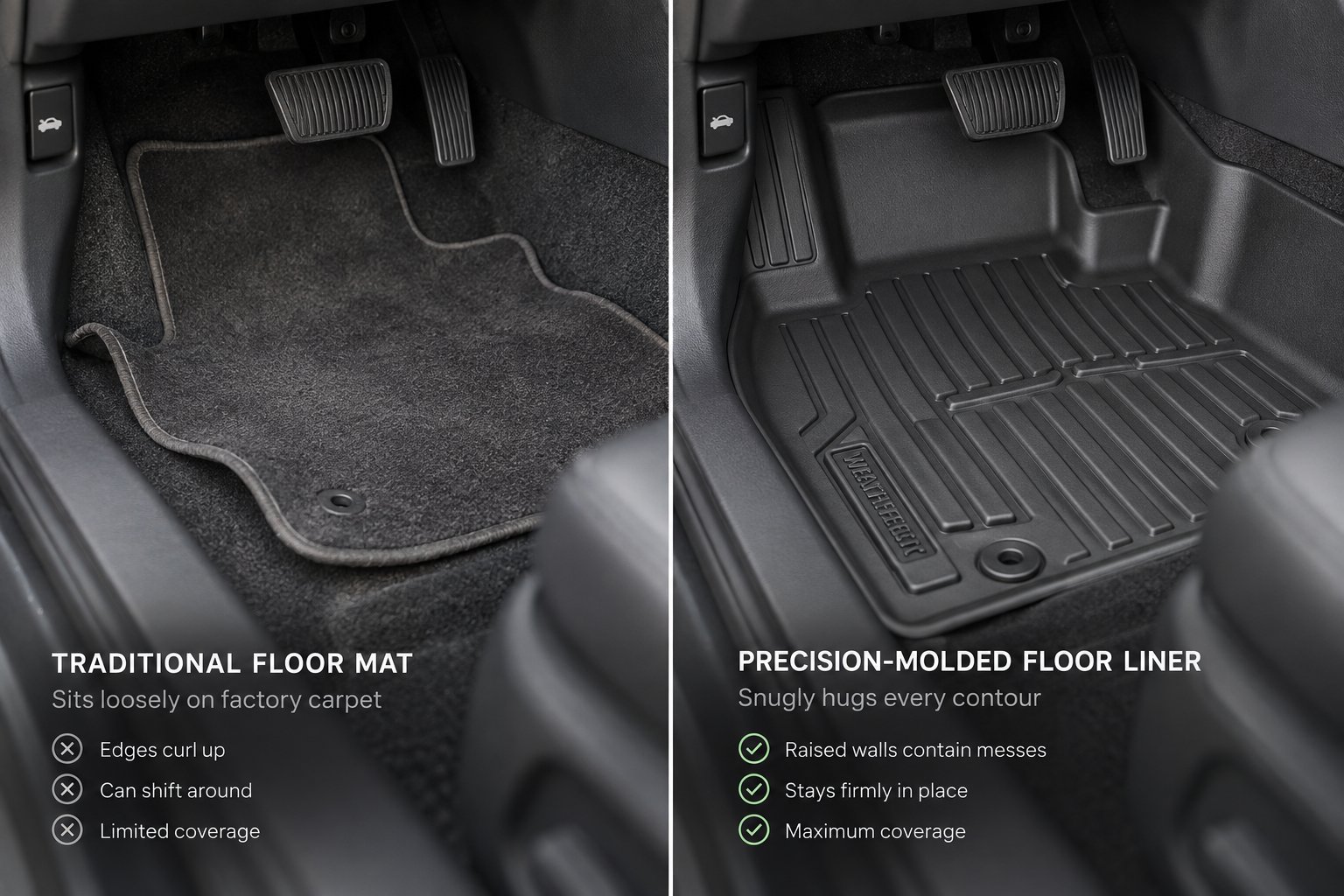
A floor mat is a flat protective layer — carpet, rubber, or a blend — that sits loosely on top of your vehicle's factory carpeting. Think of it like a doormat for your car. It catches some dirt and absorbs minor spills, but the edges are flat, coverage is limited, and the fit is approximate at best. Universal mats are the most common type, and they leave gaps around the pedals, console, and footwell walls where moisture and debris sneak underneath.
A floor liner, on the other hand, is a rigid or semi-rigid tray that's laser-measured to your vehicle's exact footwell dimensions. It wraps up the sides, locks into factory retention clips, and channels liquids away from the carpet entirely. Imagine a custom-molded shell that hugs every contour of your floor — that's the difference.
Coverage, fit precision, edge height, and material all separate the two categories. Luxury car mats might look polished, and cool car mats might turn heads, but neither label tells you whether you're getting real protection or just decoration.
Why This Ranking Exists
Here's the problem with most car floor mats and WeatherTech floor mats comparison articles online: they're published by manufacturers. Every recommendation funnels you toward that brand's product line. Recent company news from brands like Auto Floor Guard, WeatherTech, and others consistently promotes their own solutions without acknowledging trade-offs.
This ranking is editorially independent. We evaluated six standout products across both categories — from Tesla-specific liners to budget-friendly picks — using consistent criteria that apply to commuters, pet owners, off-roaders, and families alike.
Most buyers overpay or under-protect their vehicle's cabin because they confuse marketing terms with actual product categories — and manufacturers have zero incentive to clarify the difference.
The criteria behind these rankings matter just as much as the picks themselves, and the evaluation framework reveals why material science and fit precision outweigh brand recognition every time.
How We Evaluated and Ranked These Products
Picking the best car floor mats or floor liners isn't just about reading spec sheets. It requires a repeatable framework — one that treats a $60 budget liner and a $250 premium option with the same scrutiny. Every product in this ranking was measured against five criteria designed to cut through brand hype and surface what actually matters when rubber meets carpet.
Five Criteria We Used to Rank
- Coverage and fit precision — How closely does the product map to factory floor contours? Custom-molded car floor mats that hug pedal areas, transmission tunnels, and footwell walls score higher than those leaving exposed carpet gaps.
- Material quality and durability — Is the construction TPE, TPO, natural rubber, or carpet? Material choice directly determines lifespan, flexibility in freezing temperatures, odor resistance, and UV stability over years of use.
- Weather and spill protection — Raised lip height, liquid channeling grooves, and waterproof barriers separate all weather floor mats that truly contain messes from flat mats that let coffee and snowmelt seep right through to the carpet.
- Installation and retention — Does the product use factory clip compatibility, anti-slip backing, or Stay-Put cleats? Driver-side retention is especially critical. Real-world testing by Car and Driver confirmed that even premium mats can be difficult to anchor when vehicle-specific hook angles don't cooperate with rigid materials.
- Value for money — Protection delivered relative to price. A liner half the cost of WeatherTech floor liners that covers 90 percent of the same footwell area represents stronger value than a premium product riding its brand name alone.
Why Material Science Matters More Than Brand
Most shoppers compare brands. Fewer compare materials — and that's where the real performance gap hides. Here's a quick primer on the four materials you'll encounter when shopping for floor liners or mats:
- TPE (Thermoplastic Elastomer) — Flexible even in sub-zero temperatures, odorless, recyclable. This is the material behind many of today's best car floor mats, including several in this ranking. It stays pliable when cheaper alternatives stiffen and crack.
- TPO (Thermoplastic Olefin) — Rigid and extremely durable, but can feel stiff in extreme cold. WeatherTech's standard FloorLiner uses a proprietary high-density tri-extruded material in this family. The weathertech hp vs regular debate essentially boils down to TPO rigidity versus the HP's softer TPE feel.
- Natural rubber — Traditional, affordable, decent grip. However, rubber is heavier, prone to odor when heated, and less UV-resistant than modern thermoplastics.
- Carpet — Best for appearance and comfort in dry, mild climates. It absorbs rather than repels moisture, making it a poor choice for all weather floor mats but perfectly adequate for garage-kept vehicles in temperate regions.
Material drives cold-weather flexibility, long-term odor, eco-friendliness, and UV resistance more than any logo stamped on the surface. Each product review that follows will reference these material categories so you can connect the construction to real-world performance — starting with a Tesla-specific liner that bets entirely on TPE.
CUTIM Tesla Floor Liners
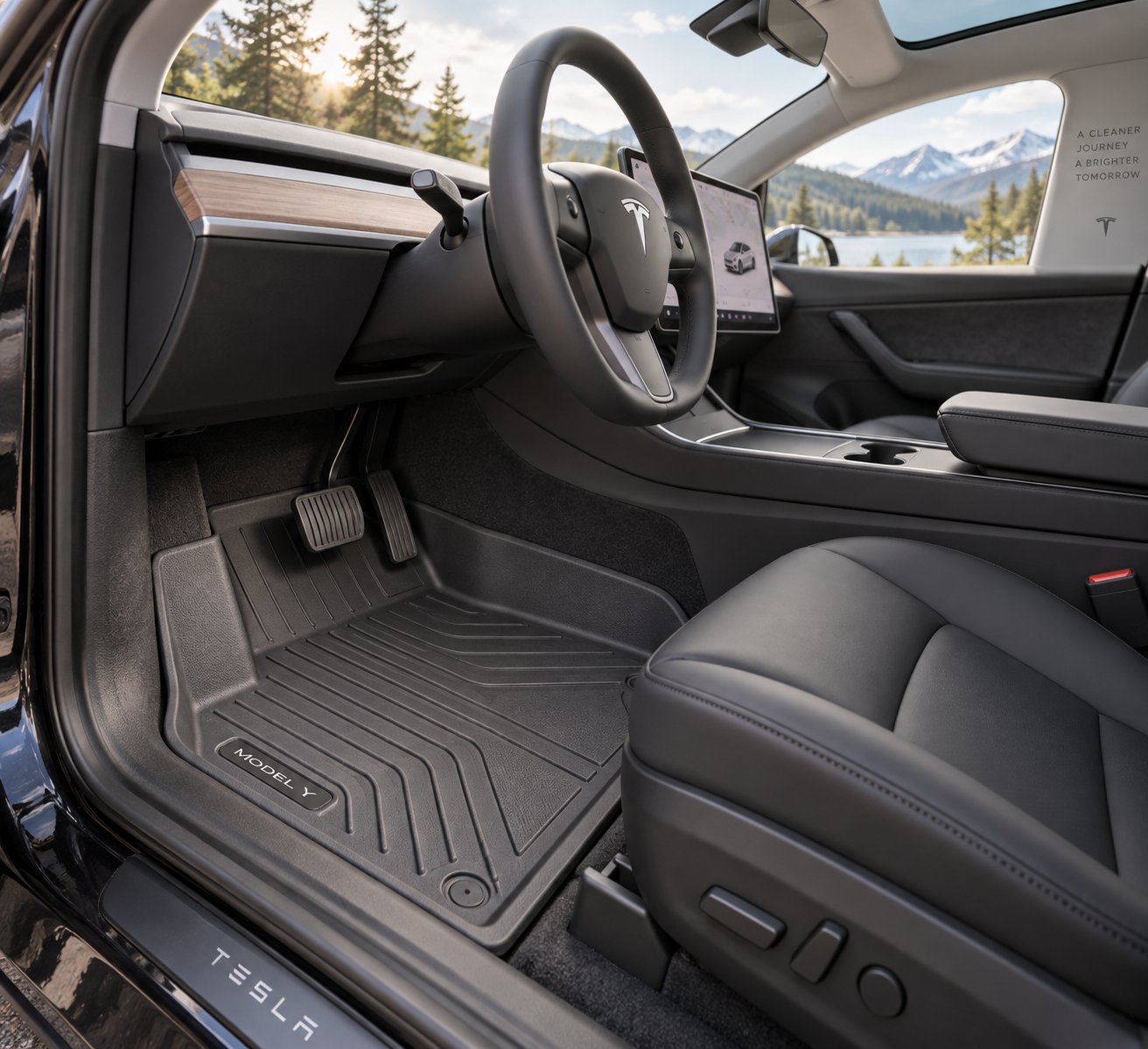
Tesla interiors are different from virtually every other vehicle on the road. The flat, minimalist cabin layout, the absence of a traditional center console stack, and the unique under-seat vent placements all mean that generic auto floor mats — even good ones — rarely sit right. Gaps appear near the pedal area, edges curl away from the transmission tunnel, and universal weather mats leave carpet exposed in exactly the spots where road grime collects fastest.
That's the problem CUTIM set out to solve, and they took an unusual approach: instead of trying to cover hundreds of makes and models, they built their entire product line around Tesla. The result is a set of floor liners that feel less like aftermarket accessories and more like something that should have shipped with the vehicle.
Custom-Fit Design for Every Tesla Model
What separates CUTIM from the crowded field of Tesla floor protection is model-specific engineering. Each liner is designed around the exact footwell contours of a particular Tesla — Model 3, Model Y, and other variants each get their own dedicated mold. You won't find a "one-size-fits-most" approach here. The liners map to factory retention points, which means they click into the same anchor locations that Tesla's OEM mats use. No sliding, no bunching under the brake pedal, no guessing which corner to trim.
For Tesla owners comparing weather guard floor mats for cars from generalist brands, the difference in fitment is immediately noticeable. Generalist manufacturers typically work from broad scan data covering dozens of vehicle platforms. CUTIM's narrower focus allows tighter tolerances — the kind of precision that eliminates the annoying carpet gaps near the driver's heel rest and along the door sill transitions.
The liners themselves are constructed from all-weather TPE, the same thermoplastic elastomer material that outperformed traditional rubber and TPO in our evaluation criteria. TPE stays flexible in freezing temperatures, produces no chemical odor when the cabin heats up, and resists UV degradation over years of sun exposure through Tesla's panoramic glass roof — a detail that matters more than most buyers realize.
Raised lip edges run along the full perimeter of each liner, creating a containment channel that traps snowmelt, coffee spills, muddy boot runoff, and pet accidents before they reach the factory carpet. Edge height is competitive with more established weathertech car mats and weather tech floor mats options, which is notable given CUTIM's significantly lower price point. The textured anti-slip backing grips the carpet beneath without adhesive, preventing the kind of forward creep that makes some liners a driver-side safety hazard.
One standout feature is the integrated cargo liner bundle. Tesla's trunk areas — especially in the Model Y — are notoriously vulnerable to scratching and staining from groceries, luggage, and gear. CUTIM offers a matched cargo liner set designed to the same tolerances as their cabin liners, covering the main trunk floor, sub-trunk storage compartment, and side walls. Buying the cabin and cargo set together means consistent material and color matching throughout the vehicle, which preserves the clean, cohesive interior look that drew many Tesla owners to the brand in the first place.
Tesla owners who want to explore the full model-specific lineup can browse CUTIM's Tesla floor mats and cargo liners collection, where each product page maps directly to a specific Tesla model and year range — no guesswork about compatibility.
Pros and Cons
Pros
- Precise Tesla-specific fit — Dedicated molds for Model 3, Model Y, and other Tesla variants mean zero trimming, no exposed carpet gaps, and factory-clip retention compatibility
- All-weather TPE material — Odorless, flexible in cold weather, UV-resistant, and recyclable, matching the material standard found in weathertech auto floor mats and other premium options
- Cargo liner bundle option — Matched trunk, sub-trunk, and cabin liners available as a set for full-vehicle coverage
- Competitive pricing — Significantly undercuts legacy brands like WeatherTech and TuxMat while delivering comparable edge height and coverage
- Anti-slip textured backing — Prevents forward creep on the driver side without requiring adhesive or aftermarket clips
Cons
- Tesla-only lineup — If you drive a Ford F-150 or need weathertech truck mats for a Silverado, CUTIM simply doesn't make a product for you. The specialization that sharpens their Tesla fit also limits their audience.
- Newer brand with less long-term track record — While the TPE material itself has proven durability across the industry, CUTIM hasn't accumulated the decade-plus real-world data that legacy competitors can point to. Early owner feedback is strong, but multi-year wear data is still building.
For Tesla owners specifically, CUTIM represents the floor mats vs floor liners distinction at its sharpest. These aren't flat weathertech all weather floor mats trimmed to roughly fit a Tesla footwell — they're purpose-built trays engineered for a single vehicle ecosystem. That specialization is either the product's greatest strength or its most obvious limitation, depending entirely on what you drive. Truck and SUV owners need a different kind of heavy-duty protection, and the next product on this list was built for exactly that audience.
WeatherTech FloorLiner
Search for any vehicle floor liner online and one name dominates every result page: WeatherTech. The brand has built something rare in the car mats automotive space — genuine household-level recognition. Your neighbor knows the name. Your mechanic recommends it. Super Bowl ads cemented it. But brand awareness and product superiority aren't the same thing, and the premium price tag attached to every WeatherTech product makes honest evaluation more important than ever.
WeatherTech's flagship FloorLiner is laser-measured to specific vehicle footwells using digital scanning technology. The result is a rigid tray that follows the contours of the floor pan, transmission tunnel, and door sill transitions with impressive accuracy. High sidewalls — among the tallest in the category — wrap up the edges of the footwell to create a basin effect, while a patented channel design routes liquids toward the center of the liner rather than letting them pool near carpet-exposed edges. For snow belt commuters and anyone hauling muddy boots into the cabin, this channeling system genuinely earns its reputation.
The standard FloorLiner uses what WeatherTech calls a High-Density Tri-Extruded (HDTE) material — essentially a proprietary TPO compound that prioritizes rigidity and impact resistance. It's tough. It's durable. And it's made entirely in the United States, which matters to a specific buyer segment. The vehicle coverage database is also the widest in the industry, spanning sedans, trucks, and SUVs from virtually every manufacturer — whether you need all weather floor liners for a Camry or truck floor liners for a Ram 2500, WeatherTech almost certainly has a fitment.
FloorLiner vs FloorLiner HP — Which Version to Choose
This is where things get interesting for anyone comparing weathertec products. The standard FloorLiner and the FloorLiner HP look similar in photos but feel dramatically different underfoot. The standard version's TPO construction creates a hard, tray-like surface — excellent for containment, but noticeably stiff, especially in cold weather. Some owners describe it as standing on a plastic cutting board.
The FloorLiner HP swaps that rigid TPO for a softer TPE compound with a more carpet-like texture on top. It's easier to install, more flexible when maneuvering into tight floorboards, and — based on Car and Driver's long-term testing — it cleans up noticeably better than the standard version. Scuffs and embedded dirt marks that stubbornly clung to the standard FloorLiner wiped away more easily from the HP's surface.
If you prioritize maximum rigidity and the deepest possible containment walls, the standard FloorLiner remains the safer pick. If daily comfort, easier maintenance, and cold-weather flexibility matter more, the HP justifies its comparable price. The tuxmat vs weathertech debate often hinges on this same texture question — buyers wanting a refined feel underfoot tend to gravitate toward the HP or away from WeatherTech entirely.
Pros and Cons
Pros
- Widest vehicle coverage database — More make, model, and year fitments than any competitor, spanning everything from compact sedans to heavy-duty trucks. Ford truck mats classification, Chevy, Toyota, and nearly every other manufacturer is covered.
- Proven durability track record — Decades of real-world use data confirm that these liners hold up under heavy abuse, and the brand's reputation for longevity is well-earned.
- Strong resale value — Used WeatherTech mats regularly sell on secondary markets, a testament to how well the brand holds perceived and functional value over time.
- Made in the USA — Designed, engineered, and manufactured domestically, which supports faster quality control and a transparent supply chain.
Cons
- Highest price point in the category — A full front and rear set frequently exceeds $200, making it the most expensive option on this list by a significant margin.
- TPO stiffness in extreme cold — The standard FloorLiner can feel rigid and difficult to install in freezing temperatures, and the hard surface underfoot isn't for everyone.
- Limited color options — Black, tan, and gray cover most offerings. Buyers looking for unique interior coordination have fewer choices than with some competitors.
- Brand premium over comparable competitors — Independent testing consistently shows that several alternatives deliver 90 percent or more of WeatherTech's protection at a meaningfully lower price. You're paying partly for the name.
It's worth noting that WeatherTech's own comparison content — articles, videos, and landing pages — naturally steers every reader toward a WeatherTech purchase. That's expected from any manufacturer, but it's exactly why independent evaluation matters in the floor mats vs floor liners conversation. WeatherTech earns its place as an industry benchmark, yet being the most recognized name doesn't automatically make it the best value. Truck and SUV owners especially might find that a competitor built specifically for heavy-duty abuse delivers equal protection with a few advantages WeatherTech can't match — which brings us to Husky Liners.
Husky Liners X-act Contour
WeatherTech may own the brand recognition race, but if you spend any time in truck forums, off-road communities, or fleet maintenance circles, a different name keeps surfacing: Husky Liners. This is the brand that truck and SUV owners recommend to each other — not because of Super Bowl ads, but because the product takes a beating and holds up. For buyers whose vehicles regularly encounter mud, gravel, snow, construction debris, and the kind of filth that makes a sedan owner cringe, Husky Liners built two distinct product lines that deserve serious attention as a floor liner for cars, trucks, and full-size SUVs alike.
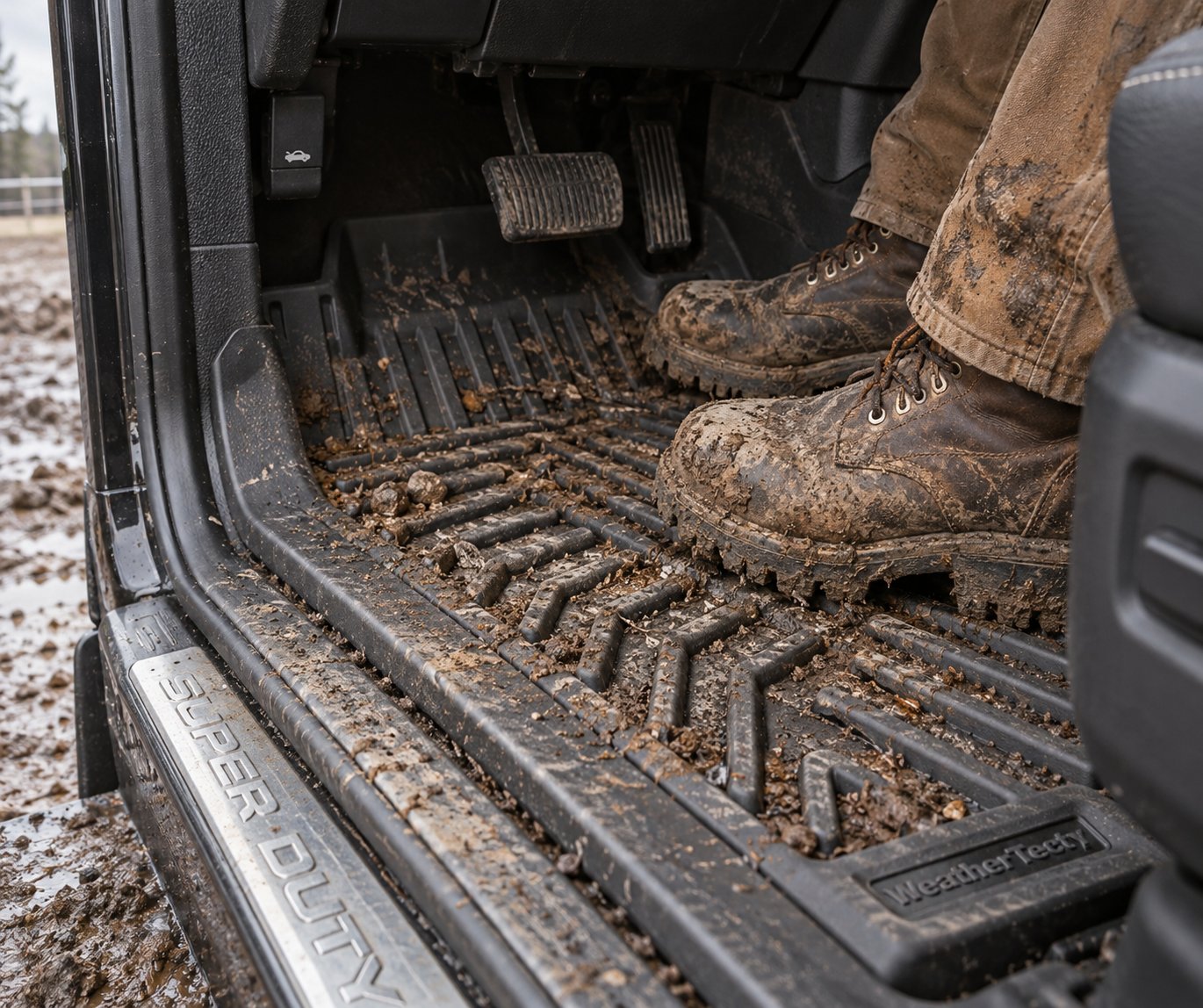
What makes Husky stand out is a combination of rubberized thermoplastic construction and form-fit edge design that wraps up and around the footwell perimeter. The material itself has a tactile quality that sits somewhere between WeatherTech's rigid TPO tray and the softer TPE compounds used by brands like 3D MAXpider. Hands-on testing by The Drive described Husky's mats as "robustly heavy" with raised sections resembling all-terrain tire lugs — a design choice that channels mud and liquid into deep grooves rather than letting it slosh across a flat surface. The grippy nubs on the underside, combined with Husky's patented Stay-Put cleats, anchor the liners to factory carpet without screws, adhesive, or aftermarket brackets. On the driver side, that retention matters more than aesthetics — a liner that shifts under braking is a safety hazard, not just an annoyance.
X-act Contour vs WeatherBeater — Two Tiers Explained
Husky doesn't force every buyer into a single product. Instead, they split their lineup into two tiers that address different priorities and budgets — a strategy that makes the weathertech vs tuxmat comparison feel unnecessarily narrow by only focusing on premium options.
The X-act Contour is the premium line. It uses a softer rubberized material that flexes easily during installation, conforms more naturally to floor contours, and feels noticeably more comfortable underfoot during long drives. The surface texture is smoother and less industrial than the WeatherBeater, making it a better match for buyers who want heavy-duty containment without the cabin feeling like the bed of a work truck. Edge height is generous, channeling is aggressive, and the overall fit precision rivals anything in the weather tech car mats category.
The WeatherBeater sits at a lower price point and uses a more rigid thermoplastic compound. It shares the same form-fit approach and vehicle-specific molding as the X-act Contour, but the material is stiffer, the surface texture is more pronounced, and the overall feel skews more utilitarian. For the buyer persona this targets — think fleet operators replacing truck floor mats across a dozen vehicles, or families who treat their SUV like a mobile mudroom — the WeatherBeater delivers roughly 90 percent of the X-act Contour's protection at a meaningfully lower cost. A real-world price comparison by The Drive found that a full set of Husky WeatherBeater mats for a 2020 F-150 SuperCrew came in at about $140, while a comparable WeatherTech set for the same vehicle rang up near $270 after shipping and taxes. That's nearly double the cost for car floor mats WeatherTech labels as equivalent protection.
The difference between the two lines essentially mirrors the broader floor mats all weather debate: how much are you willing to pay for refinement on top of function? If maximum containment at minimum cost is the goal, the WeatherBeater wins. If you want a premium underfoot feel with slightly better cold-weather flexibility, the X-act Contour justifies the step up — and still costs less than WeatherTech's standard FloorLiner in most fitments.
Husky's vehicle coverage skews heavily toward trucks and SUVs, which is both a strength and a limitation. Their fitment catalog for pickups — Ford F-150, Chevy Silverado, Ram 1500, Toyota Tacoma, and their full-size counterparts — is exceptionally deep. SUV coverage across the Suburban, Tahoe, 4Runner, and similar platforms is equally strong. Where Husky falls shorter is in the sedan and compact crossover space, where competitors like 3D MAXpider and SmartLiner offer broader automotive rubber matting options for smaller vehicles.
Pros and Cons
Pros
- Excellent truck and SUV coverage — The fitment database for pickups and large SUVs is among the deepest in the industry, making Husky the go-to choice for truck floor mats across Ford, Chevy, Ram, and Toyota platforms
- Lifetime warranty — The "Guaranteed for Life" promise backs every product, providing long-term peace of mind that budget alternatives can't match
- Competitive pricing below WeatherTech — Consistently undercuts the industry's most recognized name by 30 to 50 percent on comparable fitments, making premium-quality floor mats all weather protection accessible without the brand tax
- Strong mud and debris channeling — Deep grooves and raised lug-style ridges trap dirt, water, and gravel far more effectively than flat-surface liners, keeping mess contained until you're ready to hose them off
- American-made construction — Designed and manufactured in the United States, matching WeatherTech's domestic production advantage
Cons
- Fewer sedan fitments than some competitors — If you drive a compact car or midsize sedan, Husky's catalog thins out compared to brands that prioritize broader vehicle coverage across every segment
- X-act Contour availability — The premium line can be harder to find in stock for certain vehicles, especially newer model years, forcing some buyers to wait or default to the WeatherBeater
- Brand awareness lower than WeatherTech — Despite comparable (and in some cases superior) quality, Husky doesn't carry the same instant recognition, which can make resale value slightly lower and gifting less straightforward
- Industrial aesthetic — The prominent logo badging and rugged surface texture won't appeal to drivers who prioritize cabin elegance over raw function
It's worth acknowledging that Husky Liners produces genuinely useful educational content — their own articles and comparison guides explain the differences between mat types clearly and accurately. But like every manufacturer-published resource, that content ultimately funnels readers toward Husky products. Independent evaluation reveals that Husky earns its reputation on merit, particularly for the truck and SUV crowd who need maximum containment without maximum spending. Still, not every buyer prioritizes rugged utility over interior refinement. For drivers who want floor liner protection without sacrificing the polished look of a well-appointed cabin, a completely different design philosophy exists — one built around layers rather than lugs.
3D MAXpider KAGU
Rubber car mats and heavy-duty liners solve the protection problem — but some drivers take one look at the rugged tread patterns and logo-stamped surfaces and think, "that's not going in my car." If your vehicle has a leather interior, ambient lighting, or any kind of premium cabin treatment, the industrial aesthetic of most floor liners can feel like putting work boots on a tailored suit. The 3D MAXpider KAGU exists for exactly this buyer: someone who refuses to choose between real protection and a polished interior appearance.
Three-Layer Construction and Why It Matters
Most floor mats car owners encounter are single-layer products — one slab of rubber, TPE, or carpet doing all the work. The KAGU takes a fundamentally different approach by stacking three distinct layers into a single custom car floor mats solution, each serving a specific purpose.
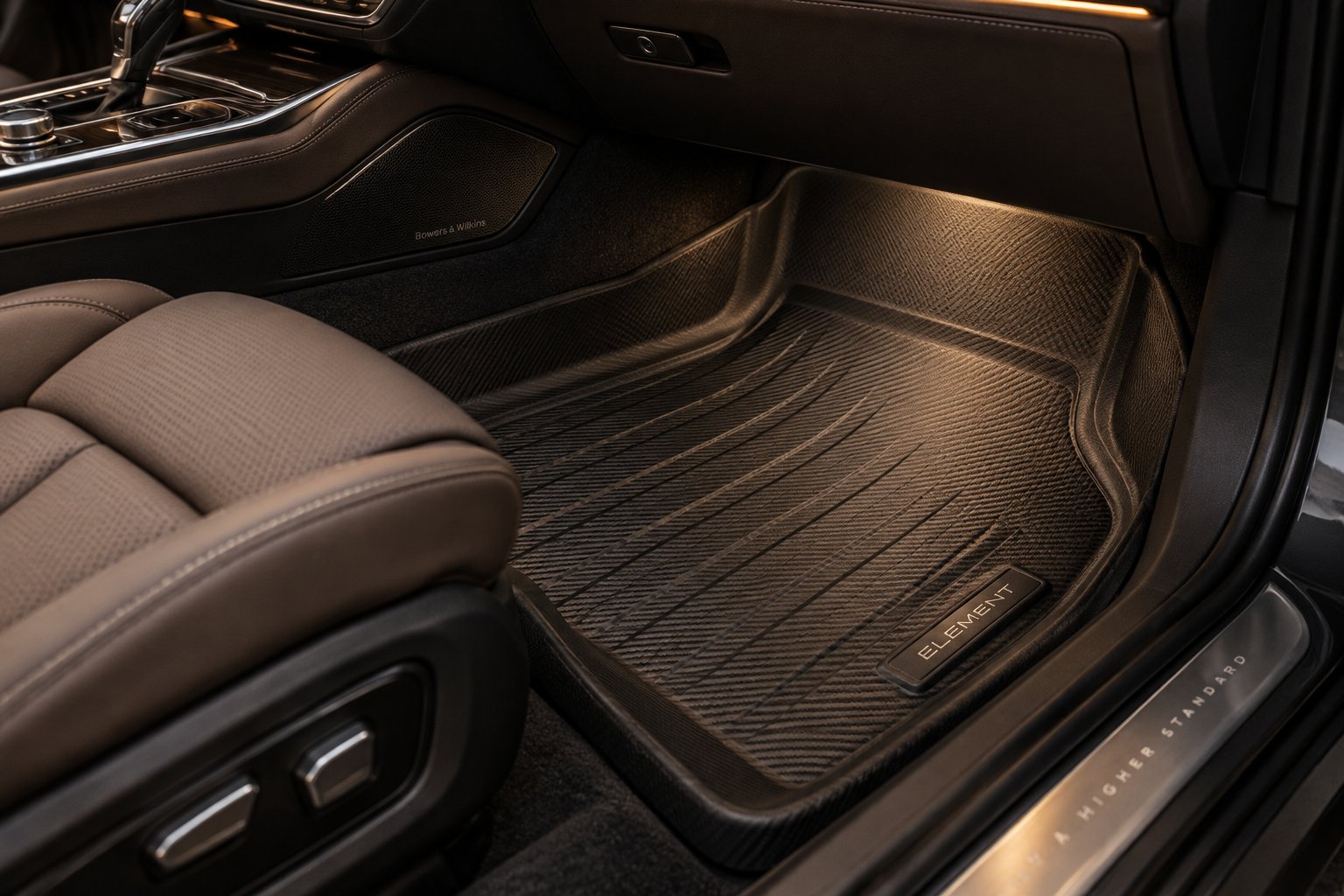
The bottom layer is a custom-molded thermoplastic shell that maps to your vehicle's exact footwell shape. It functions like any precision-fit liner, hugging factory contours and locking into OEM retention points. Above that sits an XPE foam core — a closed-cell cushioning layer that adds genuine comfort underfoot. You'll notice the difference immediately if you've ever stood on a rigid TPO tray during a long commute. It softens the step-in feel without sacrificing structural integrity.
The top layer is where the KAGU earns its "best looking" label. A carbon fiber-textured surface covers the entire mat, replacing the typical lug-pattern or diamond-plate look with something that actually complements a well-appointed cabin. The texture is subtle enough to read as intentional design rather than aftermarket add-on, which matters for luxury vehicle owners and anyone whose all weather car mats need to look as good as they perform.
Raised edges run along the perimeter to contain spills and moisture, though the lip height sits slightly lower than what you'll find on WeatherTech or Husky products. For snow belt drivers dealing with deep slush pooling, that difference is worth noting. For daily commuters in moderate climates, the edge height handles coffee spills, rain-soaked shoes, and pet hair without issue. The anti-skid backing uses a patented system that grips factory carpet firmly — no clips required on most fitments — and the material itself is odorless, free of cadmium, latex, and BPA.
The KAGU's coverage database is broader than you might expect from a brand that leads with aesthetics. Fitments span dozens of manufacturers from Honda and Toyota to BMW and Mercedes, making it one of the best all weather floor mats options for buyers whose vehicle isn't a truck or Tesla. TuxMat occupies a similar luxury-focused niche and generates heavy search traffic around tuxmat vs weathertech comparisons, but the KAGU's three-layer construction and lower price point give it an edge for buyers who want refinement without a premium-tier invoice.
Pros and Cons
Pros
- Premium appearance with carbon fiber texture — Looks purposeful inside luxury and mainstream interiors alike, eliminating the "car mats rubber afterthought" aesthetic that turns off style-conscious owners
- Odorless and eco-friendly materials — No chemical off-gassing, no latex, and no heavy metals, making the KAGU a strong choice for families and anyone sensitive to new-product smells
- Strong coverage database across brands — Custom fitments span a wide range of sedans, crossovers, and SUVs from both domestic and import manufacturers
- Comfortable underfoot — The XPE foam core adds a cushioned feel that rigid TPO and standard TPE liners simply can't replicate, especially during long highway commutes
Cons
- Raised edges slightly lower than WeatherTech or Husky — Buyers in heavy-snow or flood-prone regions may find the containment walls insufficient for extreme water volume
- Higher price than budget alternatives — The three-layer construction and premium surface finish push pricing above entry-level liners like SmartLiner, though still below WeatherTech's top tier
- Textured surface can trap fine debris in grooves — Sand, crumbs, and fine dirt settle into the carbon fiber pattern and require more deliberate cleaning than a smooth-surface liner you can simply hose off
The KAGU proves that "floor liners always look ugly" is a myth worth retiring. Protection and aesthetics aren't mutually exclusive — but neither is protection and affordability. For buyers whose priority isn't luxury appearance but rather stretching every dollar as far as possible, the budget end of the custom-fit liner market has matured faster than most shoppers realize.
SmartLiner Floor Mats
Spending $200 or more on floor mats for car protection makes sense when you're driving a brand-new truck off the lot. But what about the buyer protecting a five-year-old Camry? Or the rideshare driver outfitting three vehicles at once? Or the college student whose first car needs cabin protection more than any luxury SUV — but whose budget says otherwise? For all of these buyers, SmartLiner has quietly become one of the best car mats in the custom-fit liner space, delivering genuine tray-style protection at a price that undercuts every premium name on this list.
SmartLiner uses the same TPE (Thermoplastic Elastomer) material found in products costing twice as much. The liners are custom-molded to specific vehicle footwells rather than trimmed from universal blanks, and the raised lip edges create a basin that contains water, mud, and spills before they reach factory carpet. In Car and Driver's hands-on testing, the SmartLiner stood out as the most "tub-like" of every product evaluated — meaning the containment walls felt genuinely structural, not decorative. The rubber-plastic and polyethylene blend produced a sturdier, more rigid feel than several pricier competitors, and the standout lip extending over the door sill significantly improved edge protection during Michigan's slush-heavy winter months.
Where SmartLiner Matches Premium Brands
The smartliner vs weathertech debate usually starts and ends with price. A full front-and-rear set of SmartLiner floor liner car protection typically runs around $100 to $130, depending on the vehicle. A comparable WeatherTech FloorLiner set for the same model routinely hits $220 or more. That's nearly half the cost — but does cutting the price mean cutting corners?
In several measurable areas, no. SmartLiner's TPE compound matches the chemical composition of materials used across the premium tier. It stays flexible in sub-zero temperatures, resists UV degradation, and produces no chemical odor when the cabin heats up — the same material advantages that justify higher price tags elsewhere. Edge height is surprisingly competitive too. The raised walls won't match WeatherTech's tallest containment channels millimeter for millimeter, but they're more than adequate for daily driving scenarios: snowmelt pooling, coffee spills, rain-soaked boots, and the general mess that accumulates in any commuter vehicle.
Fitment is where the gap between budget and premium shows most clearly. SmartLiner's vehicle coverage database is growing but remains smaller than WeatherTech's or Husky's exhaustive catalogs. For popular models — think Toyota floor mats fitments for the RAV4, Camry, and Highlander, or common Honda and Ford platforms — the custom fit lands accurately and installs cleanly. Car and Driver's testers found that fitment in their long-term Rivian R1T was "on point," and cleaning was effortless. For less common or brand-new model years, however, precision can vary. Some owners report minor gaps near pedal areas or transmission tunnel curves that a WeatherTech or Husky liner would cover more tightly.
That trade-off defines the budget liner category honestly: you're getting roughly 85 to 90 percent of premium protection for roughly 50 percent of the price. For many drivers, that math makes the decision obvious.
The price gap between budget and premium custom-fit liners has narrowed dramatically — the same TPE materials, the same waterproof floor mats construction, the same raised-edge containment philosophy. Overspending on brand name alone is harder to justify than ever.
Pros and Cons
Pros
- Most affordable custom-fit liner on the market — Full car floor mats custom sets consistently priced 40 to 50 percent below WeatherTech and Husky Liners for comparable vehicle fitments, making it the clear value leader
- TPE material matches premium brands — Same thermoplastic elastomer compound used in products twice the price, delivering equivalent cold-weather flexibility, odor resistance, and UV stability
- Growing fitment database — Coverage spans popular sedan, crossover, truck, and SUV platforms from Toyota, Honda, Ford, Chevy, and Hyundai, with new models added regularly
- Surprisingly good edge height for the price — The door sill lip and raised perimeter walls provide waterproof floor mats containment that punches above its price class, especially effective against seasonal slush and liquid spills
- Family-owned business — A smaller, more responsive company that has earned a loyal customer base through product quality rather than advertising spend
Cons
- Fit precision can vary by vehicle model — Popular platforms fit cleanly, but less common or very recent model years may show minor gaps near pedal areas or curved transitions that premium competitors handle more precisely
- Thinner material than premium competitors — While the TPE compound itself performs well, the overall liner thickness is noticeably less than WeatherTech's HDTE construction or Husky's rubberized thermoplastic, which may affect long-term wear under extreme use
- Limited color options — Black dominates the lineup, with fewer tan or gray alternatives for buyers matching lighter interior color schemes
- Customer service infrastructure smaller than established brands — Warranty claims and fitment questions may take longer to resolve compared to WeatherTech's or Husky's larger support teams
SmartLiner won't win a head-to-head precision test against WeatherTech's best fitments, and it doesn't try to. What it does is make custom-fit floor liner car protection accessible to buyers who previously had to choose between cheap universal mats and expensive premium liners — with nothing credible in between. For first-time car owners, rideshare drivers protecting multiple vehicles, and anyone who values function-per-dollar over brand prestige, SmartLiner belongs on the short list. With all six products now evaluated individually, the real question becomes how they stack up when placed directly side by side — across material, coverage, price, and the specific climate conditions that determine which liner actually earns its keep.
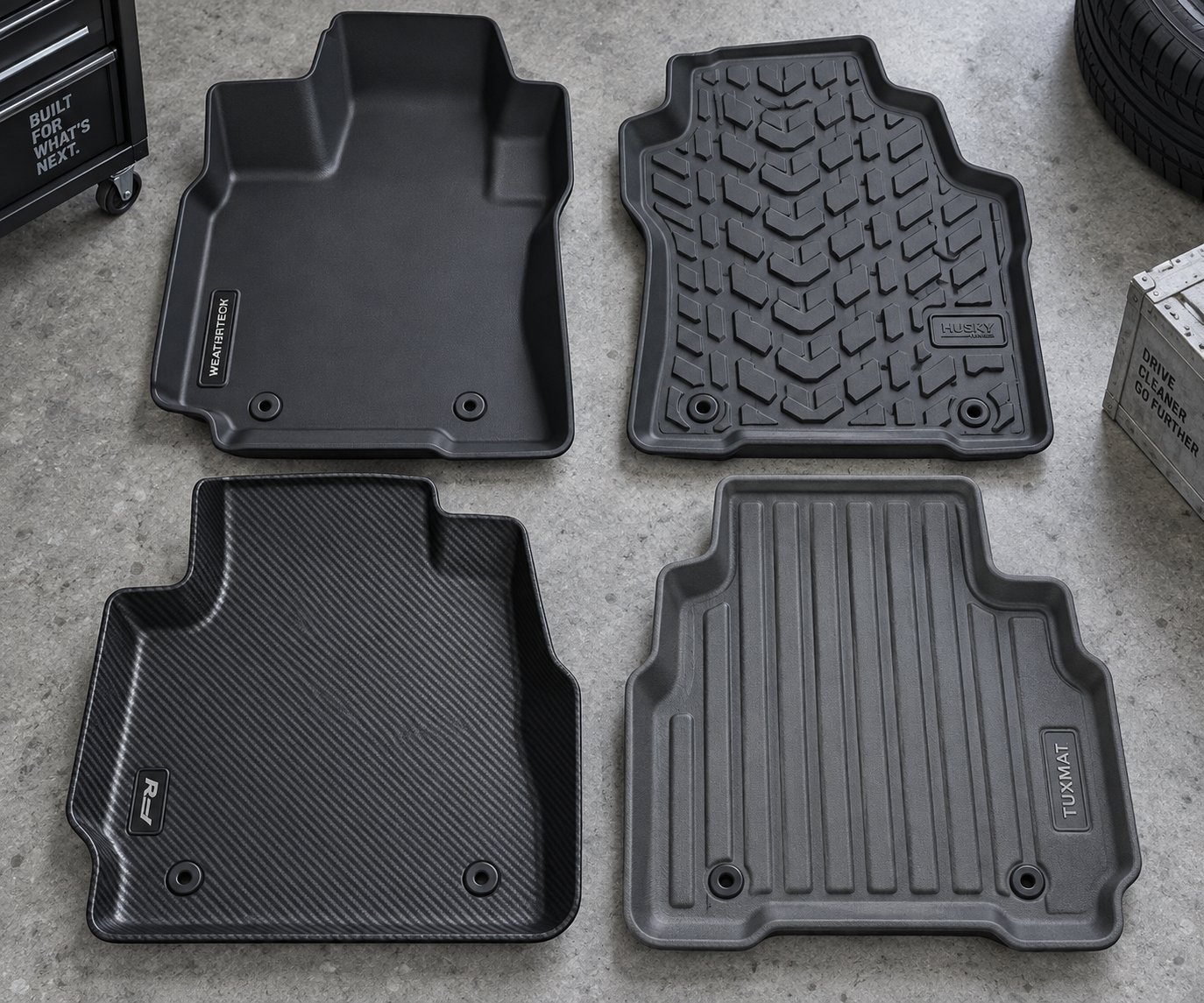
All Six Products Compared Side by Side
Individual reviews tell you what each product does well in isolation. But when you're deciding between six custom floor mats car options that all claim custom fit, all-weather protection, and durable construction, isolation doesn't help. You need them lined up against the same criteria, under the same lens — especially for the practical questions no manufacturer wants to answer: how long will this actually last, how do I clean it, and will it protect my trade-in value?
Head-to-Head Feature Comparison
This table condenses the key specifications across every product reviewed. Whether you're weighing the lasfit vs weathertech debate, comparing smartliner floor mats to Husky, or just trying to figure out which liner fits your vehicle and budget, start here.
| Product | Material Type | Edge Height | Price Range (Full Set) | Vehicle Coverage | Warranty | Best Use Case |
|---|---|---|---|---|---|---|
| CUTIM Tesla Floor Liners | TPE | High | $100–$170 | Tesla only (Model 3, Model Y, others) | Manufacturer warranty | Tesla owners wanting model-perfect fit and cargo coverage |
| WeatherTech FloorLiner / HP | TPO (standard) / TPE (HP) | Highest | $200–$300 | Widest database — nearly every make and model | Limited lifetime | Brand-conscious buyers and extreme-weather commuters |
| Husky Liners X-act Contour | Rubberized thermoplastic | High | $130–$200 | Deep truck/SUV coverage; limited sedans | Lifetime (Guaranteed for Life) | Truck owners, off-roaders, fleet operators |
| Husky Liners WeatherBeater | Rigid thermoplastic | High | $100–$150 | Deep truck/SUV coverage; limited sedans | Lifetime (Guaranteed for Life) | Budget-conscious truck and SUV drivers |
| 3D MAXpider KAGU | TPE + XPE foam (3-layer) | Moderate | $150–$230 | Broad — sedans, crossovers, SUVs across domestic and import brands | Limited 3-year | Style-focused owners and luxury vehicle drivers |
| SmartLiner Floor Mats | TPE | Moderate-High | $80–$140 | Growing — popular sedans, crossovers, trucks | Limited lifetime | Budget buyers, rideshare drivers, first-time car owners |
A few patterns jump out immediately. Every top rated auto floor mats option on this list uses some form of thermoplastic — TPE, TPO, or a rubberized blend. Traditional rubber car floor mats and basic carpet mats are absent from the top tier entirely. That's not coincidence. As MotorTrend's hands-on testing confirmed, TPE has effectively become the industry standard, outperforming conventional rubber mats for floor protection in cleanability, odor resistance, and cold-weather flexibility. The era of basic rubber mats for floor coverage being "good enough" is fading fast.
Price spread is equally revealing. The gap between SmartLiner's $80 entry point and WeatherTech's $300 ceiling is significant, yet every product in the table uses fundamentally similar containment architecture: raised edges, vehicle-specific molding, and anti-slip retention. What you're paying for at the premium end is tighter tolerance, deeper containment walls, broader vehicle coverage, and brand confidence. Whether those extras justify doubling or tripling the cost depends on your vehicle, your climate, and how long you plan to keep the car.
Climate and Seasonal Buying Guide
Your zip code matters as much as your vehicle when choosing between these products. A liner that's perfect for Phoenix performs very differently in Minneapolis. Here's how to match your climate zone to the right product type:
- Snow belt and harsh winters (Midwest, Northeast, Mountain states) — Prioritize the highest sidewalls and deepest channeling available. WeatherTech's standard FloorLiner and Husky X-act Contour lead here. Snowmelt, road salt slurry, and ice-melt chemicals pool fast, and only tall containment walls keep that corrosive mix off factory carpet. TPE materials maintain flexibility even when you're installing them in a sub-zero garage — TPO liners stiffen noticeably and fight you during cold-weather installation.
- Rainy and humid regions (Pacific Northwest, Southeast) — Effective water channeling matters more than extreme edge height. Look for deep grooves that route liquid toward a central collection point rather than letting it pool flat. Husky's lug-pattern grooves and WeatherTech's patented channel system both handle sustained rain exposure well. Avoid carpet mats entirely — they'll absorb moisture, develop mildew, and smell within weeks of sustained wet-season use.
- Hot and arid climates (Southwest, desert states) — UV resistance becomes the deciding factor. Intense sun exposure through windshields and side glass degrades cheap materials within two to three seasons, causing cracking, warping, and color fade. TPE compounds used by CUTIM, SmartLiner, and the WeatherTech HP resist UV breakdown far better than standard rubber. The 3D MAXpider KAGU's XPE foam core also holds up well in sustained heat. If your car sits in direct sunlight regularly, skip any product made from traditional rubber — it'll crack.
- Moderate and temperate climates (coastal California, mid-Atlantic) — You have the widest range of viable options. Even carpet custom fitted floor mats perform adequately when snowmelt and extreme rain aren't daily threats. This is where value leaders like SmartLiner shine — you simply don't need the fortress-level containment of a $250 WeatherTech set if your biggest spill risk is a latte from the drive-through.
- Mixed-use and four-season regions — All-weather TPE liners with moderate-to-high edge heights offer the best year-round versatility. CUTIM (for Tesla owners), Husky WeatherBeater, and SmartLiner all balance containment, flexibility, and price for drivers who face different conditions every few months.
Durability and Maintenance Breakdown
How long a product lasts and how easily it cleans are the two questions that manufacturer marketing almost never answers honestly. Here's what real-world use and independent testing reveal about each product category.
Expected lifespan under normal use — Custom-fit TPE and TPO liners from any brand on this list should last three to five years under typical commuter conditions. Heavy-duty use — think ford f150 floor mats handling daily construction site boots, or SUV liners absorbing weekly dog park mud — shortens that window to two to four years before the surface texture wears smooth and containment edges begin to soften. MotorTrend's testing team noted that TPE's nonporous structure means the material won't absorb dirt, liquids, or odors over time — a durability advantage that traditional rubber can't match, since rubber gradually becomes sticky and porous as curing agents break down.
Cleaning requirements by material type:
- TPE liners (CUTIM, SmartLiner, WeatherTech HP, 3D MAXpider) — Wipe clean with a damp cloth for light messes. For heavier buildup, pull them out and hit them with a garden hose or pressure washer. MotorTrend's cleanability tests gave TPE mats top marks — mud slurry power-washed off almost completely with water alone. No soap necessary for routine maintenance.
- TPO liners (WeatherTech standard FloorLiner) — Similar hosing procedure, but the rigid surface and deeper channel grooves can trap fine debris in corners. A stiff brush helps clear out the last bits of packed-in dirt. The harder material resists staining better than TPE over time but takes slightly more effort to scrub clean.
- Rubberized thermoplastic (Husky Liners) — Hose off and scrub. The pronounced lug pattern channels heavy mud effectively but also creates more crevices for fine sand and grit to settle into. Regular cleaning prevents long-term buildup that can grind down the textured surface.
- Three-layer construction (3D MAXpider KAGU) — The carbon fiber-textured top surface looks fantastic but traps fine particles in its pattern grooves. A vacuum pass before wiping or hosing prevents scratching. The XPE foam core shouldn't be submerged for extended periods — quick rinse and air dry is the safest approach.
- Carpet custom fitted floor mats — Not represented in this ranking for a reason. Carpet requires vacuuming, spot treatment, and periodic shampooing. Moisture absorption means they need thorough drying to prevent mildew. Functional in dry climates, but far more maintenance-intensive than any thermoplastic alternative.
The resale value angle — Here's a detail most comparison articles skip entirely. Custom-fit liners don't just protect your daily driving experience — they protect the factory carpet underneath, which directly affects your vehicle's trade-in or private-sale value. Dealerships and appraisers inspect interior condition closely, and stained, matted, or worn carpet is one of the fastest ways to knock hundreds off a valuation. A $120 set of liners that preserves pristine carpet for four years can easily return two to three times its cost when you sell or trade. Think of it less as a car accessory purchase and more as a low-cost insurance policy against depreciation — one that pays out whether you drive a Tesla, a Ford F-150, or anything in between.
Numbers and specs only tell part of the story, though. Matching the right product to the right driver — and avoiding the costly mistakes that trip up first-time buyers — requires a different kind of guidance.
Our Final Verdict and Recommendations for Every Driver
Six products, five evaluation criteria, and hundreds of vehicle fitments later, the floor mats vs floor liners decision comes down to something surprisingly simple: who you are as a driver matters more than which brand spends the most on advertising. A rideshare operator protecting three sedans on a tight budget has fundamentally different needs than a truck owner hauling muddy kayaks every weekend or a Tesla owner preserving a minimalist cabin. The right pick for one driver is a waste of money for another.
Before jumping to recommendations, a few myths deserve a proper burial. "Floor liners always look ugly" is flatly wrong — the 3D MAXpider KAGU's carbon fiber texture proves that automotive floor liners can complement a luxury cabin rather than ruin it. "Car carpet mats are always inferior" is equally misleading — in dry, temperate climates where a vehicle stays garaged, carpet mats handle light duty just fine and feel better underfoot than any thermoplastic. And "you need to spend $200 or more for good protection" ignores the reality that SmartLiner delivers custom fit floor liners with the same TPE material used by brands charging nearly double.
Our Pick for Every Type of Driver
Rather than naming a single "best" product — which would ignore the fact that every buyer brings a different vehicle, climate, and budget to the table — here's how each product maps to a specific driver profile:
- Tesla owners → CUTIM Tesla Floor Liners — No other brand engineers exclusively for Tesla's unique footwell geometry. The model-specific molds for Model 3, Model Y, and other variants eliminate the fitment guesswork that plagues generalist brands trying to cover hundreds of platforms. The all-weather TPE construction, cargo liner bundles, and competitive pricing make this the obvious first stop for any Tesla driver. You can explore CUTIM's full model-specific lineup to find the exact match for your vehicle and year.
- Truck and SUV owners → Husky Liners X-act Contour — The deepest truck and SUV fitment catalog, aggressive debris channeling, a lifetime warranty, and pricing that consistently undercuts WeatherTech by 30 to 50 percent. For anyone whose auto floor liner needs involve mud, gravel, construction dust, or weekly trips to the trailhead, Husky delivers heavy-duty containment without the heavy-duty invoice.
- Brand-conscious buyers → WeatherTech FloorLiner — The widest vehicle coverage database in the industry, proven multi-year durability, strong resale value, and domestic manufacturing. If you want the weathertech floorliner vs hp decision to be your biggest dilemma — rather than worrying about whether the brand behind your liners will exist in five years — WeatherTech's track record is unmatched.
- Style-focused owners → 3D MAXpider KAGU — Three-layer construction, XPE foam comfort, and a carbon fiber-textured surface that looks intentional rather than aftermarket. The best all weather mats for cars when cabin aesthetics rank as high as spill protection on your priority list.
- Budget buyers → SmartLiner Floor Mats — The smartliner vs weathertech conversation always starts with price, and SmartLiner wins that comparison decisively. Same TPE material, custom-fit molding, and raised containment walls at roughly half the cost. For first-time car owners, rideshare drivers, and anyone protecting an older vehicle, the value math is hard to argue with.
Three Mistakes That Cost Buyers Money
Even informed buyers make expensive errors in the floor mats vs floor liners space. These three show up more than any others — and each one is entirely avoidable.
1. Buying universal mats when custom-fit options exist for your vehicle. Universal mats leave gaps at the edges, bunch near the pedals, and expose the exact carpet zones that collect the most grime. A fit-check guide from SmartLiner details the safety risks of unsecured mats, including forward sliding that can interfere with brake and accelerator pedals. Custom-fit automotive floor liners cost more upfront but eliminate these risks while protecting carpet that directly affects resale value. Whether you drive a Chevy, a Ford, or a Tesla, a vehicle-specific liner exists at nearly every price point.
2. Ignoring retention clip compatibility. A liner that doesn't anchor to your vehicle's factory clip system is a liability, not an accessory. Loose mats shift under braking. They ride up against pedals. They create the exact hazard that custom-fit products are designed to prevent. Before ordering, confirm that the product uses your vehicle's OEM anchor points — or includes its own retention hardware. This single check matters more than material type, edge height, or brand name.
3. Choosing carpet mats for wet climates — or assuming "all-weather" and "floor liner" mean the same thing. Carpet absorbs moisture and holds it against factory flooring, promoting mildew, staining, and odor that's nearly impossible to reverse. All-weather mats are a material designation — they resist water. Floor liners are a coverage and fit designation — they map to your footwell and contain liquid within raised walls. You want both qualities. A flat, all-weather rubber mat with no sidewalls still lets coffee run under the edges and soak the carpet. A properly molded auto floor liner with raised containment channels keeps every spill trapped until you're ready to dump it out.
The bottom line? Match the product to your life, not to the loudest advertisement. Truck owners hauling gear through four seasons need Husky's containment depth. Commuters in mild climates can save confidently with SmartLiner. Style-first buyers get genuine protection from 3D MAXpider without compromising their cabin's look. And Tesla owners have a purpose-built option in CUTIM's Tesla floor mats and cargo liners — designed for one vehicle ecosystem and engineered to fit it perfectly. Whichever direction you go, prioritize custom fit, confirm clip compatibility, and let your climate guide the material choice. Everything else is just marketing noise.
Floor Mats vs Floor Liners: Frequently Asked Questions
1. What is the main difference between floor mats and floor liners?
Floor mats are flat protective layers — made from carpet, rubber, or a blend — that sit loosely on top of factory carpeting with minimal edge height and approximate fit. Floor liners are rigid or semi-rigid trays laser-measured to a specific vehicle's footwell dimensions. They lock into factory retention clips, feature raised sidewalls that channel liquids away from the carpet, and wrap up around pedal areas and door sills. The key distinctions are coverage area, fit precision, edge containment height, and material construction. A floor mat catches surface-level dirt, while a floor liner acts like a custom-molded basin that traps everything from snowmelt to coffee spills before it ever reaches the carpet underneath.
2. Are floor liners worth the extra cost over regular floor mats?
For most drivers, yes. Custom-fit floor liners made from TPE or TPO materials typically cost between $80 and $300 for a full set, depending on the brand. That investment protects factory carpet from stains, moisture damage, and wear — which directly preserves your vehicle's trade-in or resale value. Dealerships and appraisers inspect interior condition closely, and pristine carpet can add hundreds of dollars to a valuation. Budget-friendly options like SmartLiner deliver genuine liner-style protection starting around $80 to $140, making the cost barrier much lower than many buyers assume. The exception is drivers in dry, temperate climates who garage their vehicles — basic carpet mats may suffice in those conditions.
3. What is the best floor liner material: TPE, TPO, or rubber?
TPE (Thermoplastic Elastomer) is currently the strongest all-around performer. It stays flexible in sub-zero temperatures, produces no chemical odor when heated, resists UV degradation, and is recyclable. TPO (Thermoplastic Olefin), used in WeatherTech's standard FloorLiner, is extremely rigid and durable but can feel stiff in cold weather and is harder to install in freezing conditions. Traditional rubber is affordable and grippy but heavier, prone to odor when heated, and less UV-resistant than modern thermoplastics. Brands like CUTIM, SmartLiner, and 3D MAXpider use TPE, while Husky Liners employs a rubberized thermoplastic blend. Your climate should guide the choice — TPE excels in extreme cold and hot sun, while TPO prioritizes maximum rigidity.
4. Do I need different floor liners for different climates or seasons?
Climate significantly affects which floor liner performs best. Snow belt and harsh-winter drivers should prioritize the highest sidewalls and deepest channeling — WeatherTech FloorLiner and Husky X-act Contour lead in this area. Rainy and humid regions benefit from deep groove patterns that route standing water efficiently. Hot, arid climates demand UV-resistant materials like TPE to prevent cracking and warping from sustained sun exposure. Moderate climates offer the widest range of viable options, including budget picks like SmartLiner. Rather than swapping liners seasonally, choosing a TPE-based all-weather liner with moderate-to-high edge height provides the best year-round versatility for four-season regions.
5. Which floor liner is best for Tesla vehicles?
CUTIM Tesla Floor Liners are purpose-built exclusively for Tesla's unique cabin layout. Unlike generalist brands that adapt broad scan data across hundreds of platforms, CUTIM engineers dedicated molds for Model 3, Model Y, and other Tesla variants. This narrower focus produces tighter tolerances — eliminating common fitment gaps near the driver's heel rest, pedal area, and door sill transitions that plague universal or multi-platform options. The liners use all-weather TPE, feature raised containment edges, and include cargo liner bundle options for trunk coverage. Tesla owners can browse the full model-specific lineup at CUTIM's collection page to find exact year-and-model matches without compatibility guesswork.