
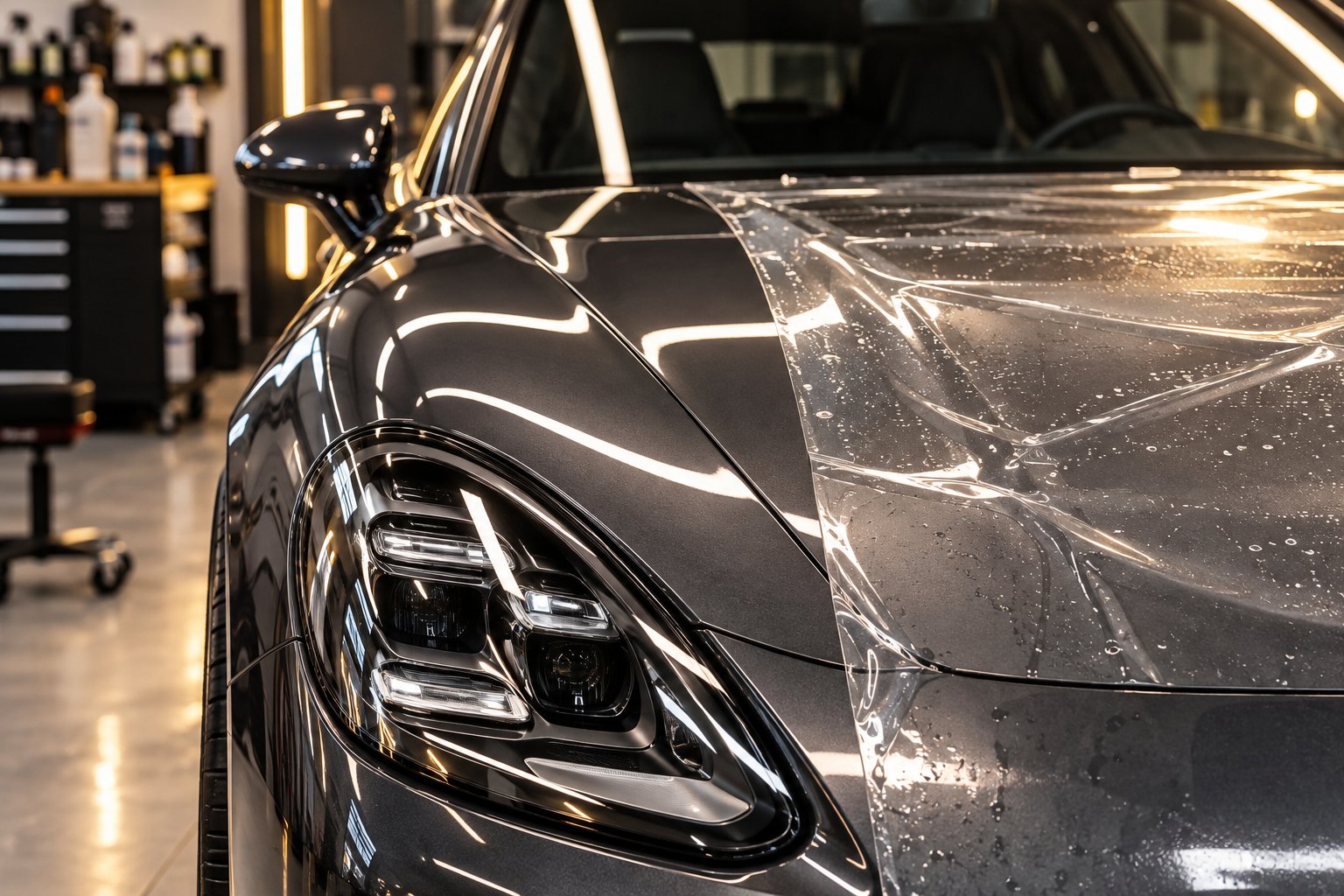
Paint Protection Film Explained for Every Car Owner
Paint protection film is a transparent, flexible layer of thermoplastic urethane applied directly to a vehicle's painted surfaces to guard against rock chips, scratches, bug acids, bird droppings, and UV damage. Often abbreviated as PPF, this nearly invisible film acts as a sacrificial barrier between your car's factory paint and the hazards of everyday driving.
PPF Defined in Plain Language
Imagine the screen protector on your phone. It absorbs scuffs and minor impacts so the glass underneath stays pristine. PPF film works the same way for your car's exterior — it takes the punishment so the paint does not have to. You will hear it called paint protection film, PPF, or occasionally "clear bra," but they all describe the same product: a durable, optically clear sheet engineered to stick to painted panels without altering color, gloss, or texture.
So what is the PPF actually made of? At its core sits a layer of thermoplastic polyurethane, a material prized for its elasticity, impact absorption, and optical clarity. A specialized adhesive bonds it to paint, and a protective top coat gives the surface its gloss and self-healing ability. The result is a multi-layer shield you can barely see once installed.
Paint protection film (PPF) is a transparent thermoplastic urethane film applied to a vehicle's exterior surfaces that absorbs physical impacts, resists chemical contaminants, blocks UV rays, and self-heals minor scratches — preserving factory paint quality for years.
From Military Innovation to Everyday Automotive Use
PPF's origin story starts far from a car dealership. During the Vietnam War era, U.S. military engineers needed a tough, flexible material to protect helicopter rotor blades from sand, debris, and high-speed impacts. 3M developed what became known as "helicopter tape" — a polyurethane film durable enough to survive battlefield conditions.
By the early 1990s, manufacturers recognized that the same protective principle could shield automotive paint. Early PPF film products were thick, hard to install, and prone to yellowing, but they proved the concept worked. Throughout the 2000s, breakthroughs in adhesive chemistry, optical clarity, and material science transformed those crude military sheets into the virtually invisible, self-healing films available today. Modern PPF bears little resemblance to its predecessor — it is thinner, clearer, more flexible, and capable of repairing its own surface scratches when exposed to heat.
That self-healing capability, along with the sophisticated layer structure that makes it possible, is exactly what separates today's films from every previous generation of vehicle paint protection.
How PPF Works Layer by Layer
A single sheet of PPF car film may look simple when you hold it up to the light, but what appears to be one transparent layer is actually a precisely engineered stack of four distinct materials. Each layer serves a specific purpose, and together they create a shield far more capable than any wax, sealant, or spray-on ppf coating could achieve on its own. Understanding what is PPF at the structural level helps you evaluate film quality and make smarter purchasing decisions.
The Four Layers That Protect Your Paint
Picture a sandwich built from the outside in. The outermost surface faces the road, absorbing everything the world throws at it. The innermost layer bonds directly to your vehicle's clear coat. Here is what sits between those two extremes:
1. Clear coat / top coat. This is the first line of defense — the surface you actually touch when you run a finger across a protected panel. Made from a nano-scale hydrophobic and oleophobic coating (often fluoride- or silicon-based), it delivers gloss, stain resistance, and the self-healing behavior that makes modern film so impressive. When a light scratch deforms this layer, heat causes its polymer chains to rearrange and restore surface flatness — almost like the material has a memory.
2. TPU elastomeric layer. Beneath the top coat sits the core of the film: a thermoplastic polyurethane body that absorbs impact energy. This is the layer that actually stops a rock chip from reaching your paint. High-end films use aliphatic TPU, which offers elongation at break exceeding 300 percent, stays flexible even at -30 degrees Celsius, and resists yellowing three to five times better than aromatic alternatives.
3. Acrylic pressure-sensitive adhesive. This bonding layer is what keeps the film anchored to your vehicle's painted surface. It is engineered for a careful balance — strong enough to prevent lifting and shifting, yet gentle enough that the film peels away cleanly without damaging factory paint when it is time for removal. Some brands incorporate air-release channels into the adhesive to speed up installation and reduce trapped bubbles.
4. Release liner. The backing layer you never see on the finished car. This matte PET film protects the adhesive during shipping, storage, and handling. Installers peel it away just before applying the film to a panel. On premium products, the liner may feature vehicle-model markings to improve cutting accuracy.
| Layer Name | Material | Function |
|---|---|---|
| Clear Coat / Top Coat | Nano-scale fluoride or silicon-based coating | Provides gloss, stain resistance, hydrophobicity, and self-healing capability |
| TPU Elastomeric Layer | Aliphatic thermoplastic polyurethane | Absorbs impact energy from rock chips and debris; resists UV damage and yellowing |
| Pressure-Sensitive Adhesive | Acrylic-based adhesive | Bonds film to paint securely while allowing clean, residue-free removal |
| Release Liner | Matte PET film | Protects the adhesive layer during transport and handling; removed at installation |
Why TPU Is the Industry Standard
If you have shopped for PPF, you have probably noticed that nearly every reputable brand markets its film as TPU-based. That was not always the case. Older-generation films relied on PVC (polyvinyl chloride), a stiffer plastic that was cheaper to produce but carried serious drawbacks — limited stretch, poor conformability around complex body curves, weak UV resistance, and a frustrating tendency to yellow and crack within a few years.
TPU changed the equation entirely. Its molecular structure combines the toughness of hard plastic with the flexibility of soft rubber, which is why a PPF car wrap can stretch over compound curves, tuck around sharp edges, and still spring back to its original shape. That elastic memory is also the foundation of self-healing: when heat activates the thermoplastic polymers in the top coat, they "remember" their pre-scratch arrangement and flow back into place.
Materials science leaders like Avery Dennison have pushed these advances further with premium polyurethane formulations that achieve optical clarity above 95 percent light transmittance and haze levels below one percent. The practical result? A ppf coating layer so transparent that even under direct sunlight, most people cannot tell it is there.
Compared to PVC alternatives that typically last only three to five years before degrading, quality TPU films hold their clarity and protective performance for seven to ten years. They resist bird droppings, road salt, and chemical contaminants far more effectively, and they remove cleanly when the time comes — no adhesive residue, no lifted clear coat.
Each of these four layers plays its part quietly. But the real magic happens at the very top of the stack, where heat-activated polymers perform a trick that still surprises first-time PPF owners — erasing scratches right before your eyes.
Self-Healing Technology and How It Repairs Scratches
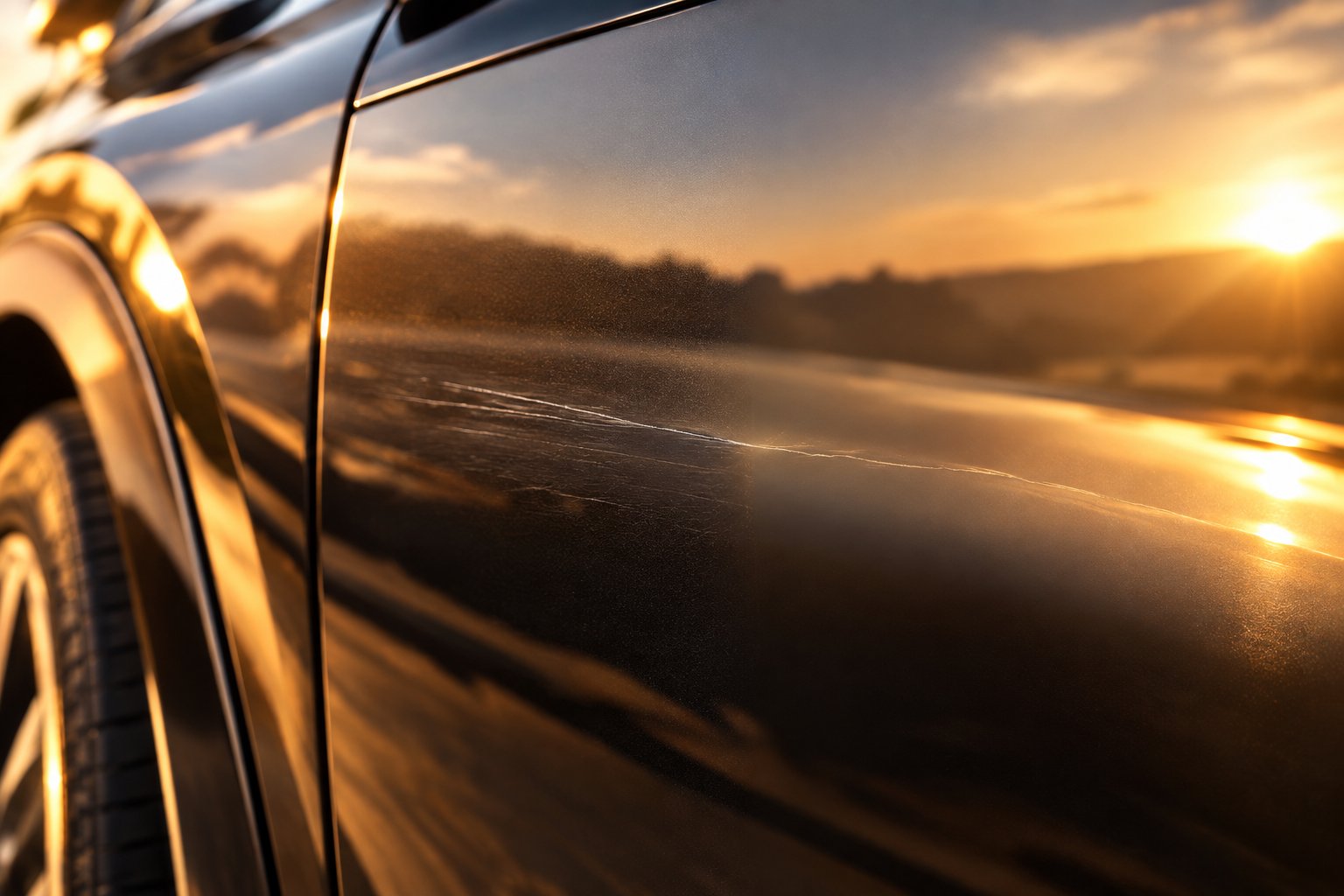
Pour warm water over a fresh scratch on your car's paint protection film and watch the mark fade in seconds. It looks like a camera trick, but it is real — and the polymer science behind it is far more practical than it seems. Self-healing is the feature that gets the most attention in paint protection film news, yet most explanations stop at "it fixes scratches." The actual mechanism deserves a closer look because understanding it helps you know exactly what to expect and, just as importantly, what falls outside the technology's reach.
How Heat-Activated Self-Healing Actually Works
The self-healing property lives in the film's top coat — the outermost layer discussed in the previous section. This top coat is made from an elastomeric polymer engineered with what materials scientists call shape memory. The molecular chains inside it are arranged in a specific cross-linked network that "remembers" its original smooth configuration.
When something scratches the surface — a fingernail, a stiff branch, a gritty wash mitt — it physically displaces those polymer chains. The scratch is essentially a tiny valley where molecular bonds have been shoved out of position. Light reflects unevenly off this disrupted surface, making the damage visible to the naked eye.
Here is where heat enters the equation. Thermal energy increases molecular movement within the top coat. As the polymer chains vibrate and gain mobility, surface tension pulls them back toward their lowest-energy state — the original, undamaged arrangement. The chains flow and slide into the valley left by the scratch, filling it in and restoring a flat, uniform surface. The scratch effectively erases itself.
The heat source does not need to be exotic. Direct sunlight works. Warm water poured over the affected area works. A heat gun on a low setting, held six to eight inches from the surface and kept moving, also works. Most self-healing top coats begin responding at film surface temperatures around 40 to 50 degrees Celsius (104 to 122 degrees Fahrenheit), a range easily reached on a car panel parked in afternoon sun.
Think of it this way: the polymer chains behave like a bowl of cooked pasta. Push a fork through and you leave a visible trail. Remove the fork, warm the bowl gently, and the noodles slowly slide back together, closing the gap. That analogy is surprisingly close to what happens at the molecular level inside the film's top coat.
Real-World Self-Healing Performance
Technical explanations are useful, but you probably want to know how this plays out in daily life with your car PPF. Several common scenarios showcase the technology's practical value:
Parking-lot door contact. Someone swings a car door into your fender and leaves a light surface scuff. On unprotected paint, that scuff stays until you pay for a polish. On a paint protection film for car panels, the mark begins healing the next time the vehicle sits in sunlight — often within 20 to 30 minutes on a warm day.
Car-wash swirl marks. Even touchless washes can leave faint swirls on film surfaces from mineral-laden water or drying towels. These surface-level marks represent the ideal healing scenario. A single heat cycle — parking outdoors on a sunny afternoon — typically resolves them completely.
Branch and hedge scratches. Tight parking spots near landscaping create fine scratches that would accumulate on bare paint over time. On self-healing film, these minor abrasions disappear passively with environmental warmth.
Climate plays a meaningful role in how often you need to intervene. In warmer regions, environmental heat triggers healing passively — you may never even notice the damage because it repairs itself between drives. In cooler climates, healing slows down because the polymer chains lack sufficient thermal energy to reorganize. Running lukewarm water over the scratch or parking the vehicle in a heated garage kick-starts the process when ambient temperatures are not enough.
The healing process is also repeatable. The polymer chains do not degrade or lose their memory through repeated activation cycles. The same area of film can heal over and over throughout its lifespan, which is why self-healing PPF maintains a cleaner appearance far longer than traditional non-healing films.
That said, the technology has clear boundaries. Knowing what falls outside its capability prevents disappointment:
- Light swirl marks and fine scratches — heals effectively; this is the primary use case the technology was designed for.
- Surface scuffs from soft contact (rubber bumpers, jacket zippers, fingernails) — heals well with a single heat cycle.
- Minor car-wash marring and haze — heals quickly, especially in warm climates.
- Deep cuts or slices (key scratches, sharp metal edges) — cannot heal; the damage penetrates through the top coat into the TPU base, and displaced material cannot regenerate.
- Rock chip impact craters — cannot heal; the film absorbs the impact and protects the paint underneath, but the film itself retains a visible mark where energy was dispersed through the full stack.
- Edge lifting or adhesive failure — cannot heal; this is an installation or bonding issue, not a surface-damage issue.
- Long-term UV yellowing — cannot heal; yellowing results from gradual polymer chain breakdown, which is a degradation process rather than a surface deformation.
The critical takeaway? Self-healing handles the everyday wear that gradually makes a car's exterior look tired — the kind of damage you accumulate week after week without any single dramatic event. It does not make the film invincible, but it keeps it looking fresh far longer than any non-healing alternative. And when a rock chip does hit hard enough to mark the film itself, your factory paint stays untouched beneath it. The film took the hit so the paint did not have to — and that damaged section of film can be replaced without a respray.
Self-healing addresses what happens after damage occurs. But a well-chosen PPF delivers a much broader range of protection that prevents problems in the first place — from UV degradation and chemical etching to the financial hit of diminished resale value.
Top Benefits of Paint Protection Film for Your Vehicle
A self-healing top coat is impressive, but it represents just one line item on a much longer list of advantages. The real ppf meaning — in practical, daily-driving terms — extends well beyond erasing the occasional scratch. Clear paint protection film delivers a layered defense against threats that range from highway gravel to invisible ultraviolet radiation, and each benefit carries consequences you can measure in both appearance and dollars.
Protection Against Physical and Environmental Damage
Every mile on the road exposes your paint to a barrage of micro-hazards. Some hit hard and leave an immediate mark. Others work slowly, breaking down the finish over months of accumulated exposure. Paint protection film addresses both ends of that spectrum simultaneously.
Rock chips and road debris. This is the headline benefit — and for good reason. When a stone strikes unprotected paint, all of that kinetic energy concentrates on a tiny point, cracking through the clear coat and into the color layer. PPF's TPU core absorbs and distributes impact energy across a wider area, so the paint underneath does not feel a thing. Installers who remove film after several years of service routinely find the outer surface peppered with impact evidence while the factory paint beneath remains flawless.
Scratch resistance. Shopping-cart brushes, jacket zippers dragged across a door panel, even a wayward set of keys — everyday contact leaves marks on bare paint that compound over time. PPF intercepts these abrasions at the film's surface, and as the previous section explained, the self-healing top coat erases most of them without any intervention.
Bug splatter and bird droppings. These are not just unsightly — they are chemically aggressive. Bug acids and the uric acid in bird droppings can etch unprotected clear coat within hours on a warm day. The film's stain-resistant top coat creates a barrier that prevents these contaminants from reaching the paint, giving you time to wash without worrying about permanent damage.
Road salt and chemical exposure. Winter driving introduces salt, brine, and de-icing chemicals that accelerate corrosion, especially on lower panels and wheel arches. PPF blocks these substances from contacting the paint surface. The adhesive layer remains chemically inert, so even prolonged salt exposure does not compromise the bond between film and panel.
UV ray protection. One of the most frequently asked questions is whether PPF shields against ultraviolet radiation — and the answer is a definitive yes. Quality films incorporate UV-stabilizing additives that block harmful wavelengths responsible for paint oxidation, fading, and chalking. Over years of sun exposure, a protected panel retains its original color depth and gloss while an unprotected panel gradually loses both. This is especially relevant for owners of red, black, or dark-colored vehicles, where UV-induced fading is most visible.
Preserving Resale Value and Aesthetic Quality
Beyond day-to-day protection, paint protection film makes a surprisingly strong financial argument. Every chip, scratch, and stain on bare paint subtracts from your vehicle's resale value — and those deductions add up faster than most owners expect. A buyer comparing two identical vehicles will almost always choose the one with unmarked factory paint over one that has been touched up repeatedly.
Data from the resale market supports this directly. According to Veteran Detail's analysis of protected versus unprotected vehicles, cars with well-maintained PPF can command 10 to 15 percent higher resale prices compared to similar models showing ppf damage — or more accurately, the kind of paint damage that PPF would have prevented. On a vehicle valued at $50,000, that premium translates to $5,000 to $7,500 in preserved equity, far exceeding the typical installation cost.
The financial upside is not limited to luxury cars. Any vehicle driven daily on highways, gravel roads, or in harsh climates accumulates cosmetic wear that depresses trade-in offers. PPF freezes your paint's condition at the moment of installation, and that preserved condition pays dividends the day you sell or trade in.
Ranked by practical impact on both your driving experience and your wallet, the top benefits stack up like this:
- Rock chip and impact prevention — eliminates the single most common and costly form of paint damage on front-facing panels.
- Resale value preservation — maintains factory-finish condition that directly increases what buyers are willing to pay.
- UV and oxidation resistance — prevents the slow, irreversible fading that ages a car's appearance long before mechanical components wear out.
- Chemical and contaminant defense — blocks bug acids, bird droppings, road salt, and tree sap from etching or staining the clear coat.
- Scratch absorption and self-healing — handles the everyday abrasion that makes garage-kept paint look worn after a few years of real-world use.
- Reduced maintenance costs — eliminates the need for frequent paint correction sessions, touch-up paint, and polishing compounds that would otherwise be necessary to keep unprotected paint looking presentable.
Invisible Protection That Maintains Your Car's Appearance
Perhaps the most common concern among first-time buyers is whether the film will change how the car looks. It is a fair question — nobody wants to cover a beautiful paint job with something that looks like cling wrap. The good news is that modern clear paint protection film has moved far beyond the thick, slightly hazy sheets of earlier generations.
Today's premium TPU films achieve optical clarity ratings above 95 percent light transmittance with haze levels below one percent. In practical terms, that means the film is virtually invisible once a professional lays it down. Edges are tucked behind panels and trim pieces, seams are placed along natural body lines, and the surface gloss matches — or in some cases slightly enhances — the factory clear coat beneath it. A survey of PPF users found that roughly 90 percent report high-quality film is nearly undetectable after installation, reinforcing that the "invisible" claim is not marketing exaggeration.
You will not see awkward orange-peel textures, visible seam lines, or a milky haze that cheapens the finish. What you will see is the same color, the same gloss, and the same depth of reflection you had before — just with an invisible layer quietly absorbing everything the road throws at it. Even potential ppf damage to the film itself (a deep chip or gouge that exceeds the self-healing threshold) can be repaired by replacing a single section of film rather than repainting an entire panel, keeping both cost and downtime minimal.
These benefits apply broadly, but they do not apply equally to every film on the market. The protective performance, clarity, and longevity you actually experience depend heavily on the type of film material and the finish you choose — and that is a decision with more options than most buyers realize.
PPF Types, Grades, and Film Finishes Compared
Walk into a detailing shop and ask for paint protection film, and you might expect a simple yes-or-no decision. In reality, the market offers three fundamentally different base materials and a growing menu of finish options — each carrying distinct trade-offs in durability, appearance, and cost. Knowing what is PPF on a car at the material level helps you avoid overpaying for features you do not need or, worse, underpaying for a film that yellows within a year.
TPU vs TPH vs PVC Films
Every roll of PPF for cars falls into one of three material families. They share a basic purpose — shielding paint from the outside world — but the chemistry under the surface creates dramatically different ownership experiences.
TPU (thermoplastic polyurethane) is the premium standard discussed throughout this article, and for good reason. Its molecular structure blends hard crystalline segments with soft elastomeric segments, giving the film both toughness and flexibility. That dual nature is what allows TPU to absorb rock impacts without cracking, stretch over compound curves without creasing, and self-heal surface scratches when exposed to heat. Premium formulations use aliphatic TPU, which resists UV-driven yellowing far better than aromatic alternatives. Expect a lifespan of seven to ten years — or longer on garaged vehicles — with optical clarity that remains virtually unchanged throughout.
TPH (thermoplastic polyolefin hybrid) occupies the middle shelf. Manufacturers create TPH by blending polyolefin plastics with select polymers, producing a film that is more flexible than PVC but noticeably stiffer than TPU. Protection against everyday scratches and road debris is decent, and some TPH products include a basic self-healing top coat. The limitations show up over time: TPH films are less elastic, less optically clear, and more prone to wear in harsh weather compared to true thermoplastic polyurethane. If you plan to keep your vehicle three to five years and want moderate protection at a lower price point, TPH can make sense — but it is not the film you choose for long-term, set-it-and-forget-it coverage.
PVC (polyvinyl chloride) is the budget entry point. It is the same rigid plastic family used in plumbing pipes, which tells you something about its flexibility — or lack thereof. PVC film is stiff, difficult to conform around modern vehicle body lines, and almost universally prone to yellowing under UV exposure. It offers no self-healing capability and typically begins degrading visually within one to two years. The one advantage? Cost. For owners who need temporary protection — say, shielding a rental fleet vehicle for a single season — PVC keeps the price low. For anyone planning to own their car beyond a couple of years, it is a false economy.
The differences become easier to evaluate side by side:
| Feature | TPU | TPH | PVC |
|---|---|---|---|
| Durability | Very high — 7 to 10+ years | Moderate — 3 to 5 years | Low — 1 to 2 years |
| Self-Healing | Advanced heat-activated repair | Limited or none | None |
| Clarity | Excellent — above 95% light transmittance | Moderate — slight haze possible over time | Low — yellows and hazes quickly |
| Flexibility | High — conforms to complex curves without creasing | Moderate — workable on gentle curves | Low — stiff and difficult on compound shapes |
| Price Tier | Premium | Mid-range | Budget |
The takeaway is straightforward. If you are investing in paint protection film benefits that last, TPU is the material worth specifying by name. Ask your installer which base material their film uses — reputable shops will tell you without hesitation. Any reluctance to answer that question is a red flag worth noting.
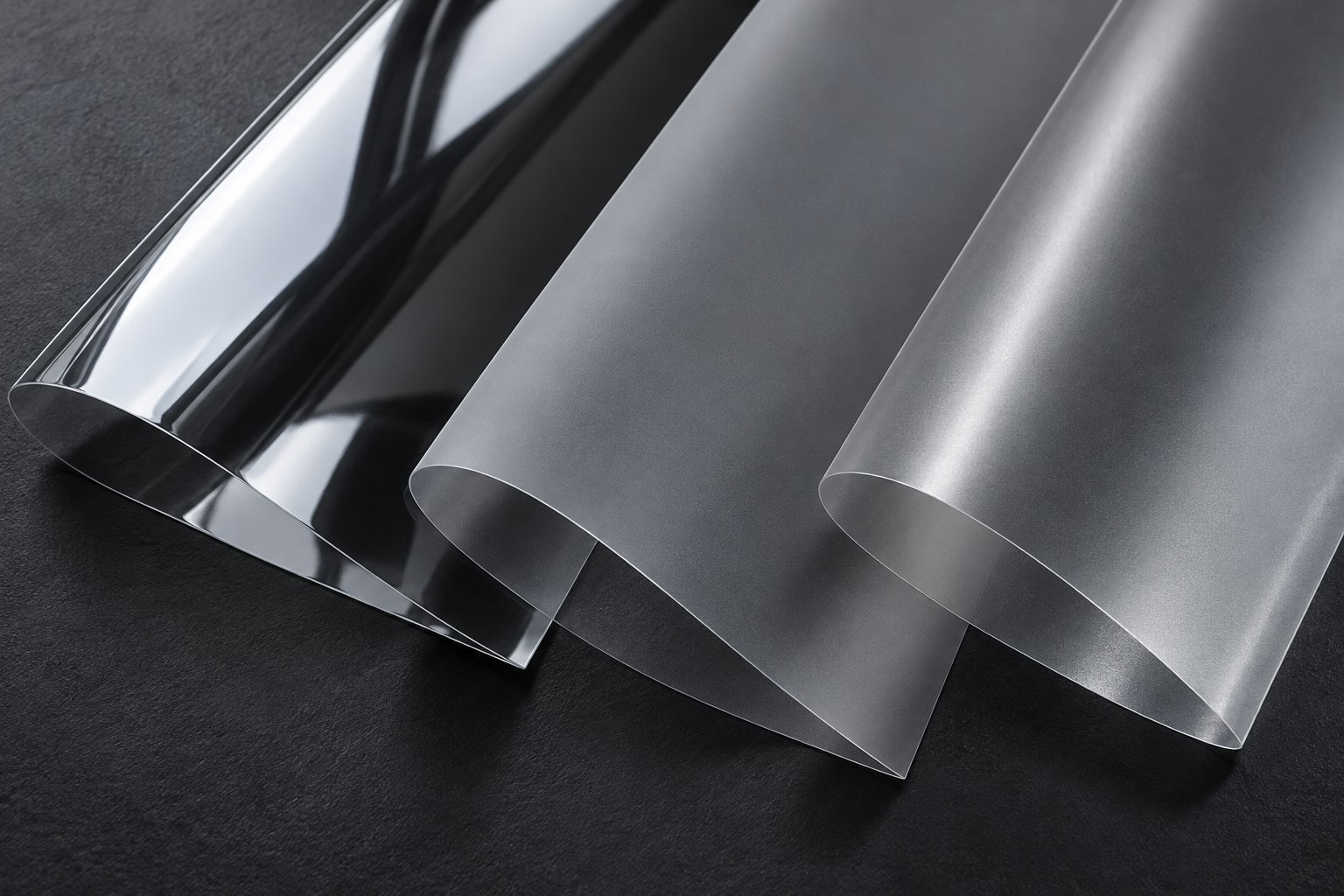
Gloss, Matte, Satin, and Color-Shift Finishes
Here is where the conversation gets interesting for owners who care about aesthetics as much as protection. PPF is no longer a one-finish product. The same TPU technology that delivers self-healing and impact resistance now ships in multiple visual profiles, each designed for a specific look and use case.
Imagine you have just taken delivery of a matte-finish vehicle. Traditional gloss PPF would add unwanted shine and ruin the factory aesthetic. A matte-finish film solves that problem — it preserves the flat look while still delivering the full protective stack underneath. The same logic applies in reverse: satin and color-shift films let you transform a standard gloss car into something visually distinct without committing to a permanent respray.
Each finish carries its own practical considerations, so here is a quick breakdown of what to expect:
- Gloss — the most common finish; enhances depth and shine, closely mimics factory clear coat, and is the easiest to maintain because it tolerates light polishing if needed.
- Matte — delivers a flat, non-reflective surface ideal for stealth aesthetics or preserving OEM matte paint; cannot be polished (abrasive correction permanently adds unwanted shine) and requires matte-specific wash products.
- Satin — sits between gloss and matte with a soft, understated sheen; flatters body lines without the mirror-like intensity of gloss; like matte, it cannot be machine-polished without damaging the finish.
- Color-shift / pearlescent — contains pigments or interference layers that change hue depending on the viewing angle; best suited for show vehicles or owners seeking maximum visual impact; availability varies by brand, and pricing runs higher than standard clear options.
- Tinted / colored — carries actual pigment within the TPU layer, allowing a full color change and paint protection in a single installation; some manufacturers now offer hundreds of shades across gloss, matte, metallic, and liquid-metal families.
One detail that catches many buyers off guard: maintenance requirements shift with the finish you choose. Gloss film forgives a lot — minor swirls disappear through self-healing or gentle correction. Matte and satin finishes are far less forgiving. A single pass with an abrasive polish can burn permanent shiny patches into the surface, and conventional waxes or sealants may leave uneven gloss spots. If you choose a flat or semi-flat finish, commit to using products specifically formulated for that texture.
Knowing the material grade and finish you want puts you in a much stronger position when you walk into a shop. But there is still one more decision that shapes both your protection and your budget more than almost anything else — how much of the vehicle you actually choose to cover.
Partial vs Full-Body PPF Coverage and Where to Start
You know the material grade you want and the finish that suits your style. The next question hits your wallet directly: how many panels should you actually wrap? Full-body paint protection film for cars delivers the ultimate peace of mind, but it is not the only path to meaningful coverage. Strategic partial protection can shield the areas that matter most while keeping costs realistic — and for many drivers, that balance is exactly where the answer to "is PPF worth it" becomes a clear yes.
Full-Body Wrap vs High-Impact Zone Coverage
Think of PPF coverage as a spectrum, not a binary choice. On one end sits the full-body wrap — every painted surface enclosed in film from bumper to bumper. On the other sits a single-panel application, maybe just the hood. Between those extremes lies a range of packages that match protection levels to budgets and driving habits.
Full-body coverage wraps the entire exterior, including doors, roof pillars, rear bumper, rocker panels, and door sills. You get uniform protection against chips, scratches, UV damage, and chemical contaminants across every square inch. The trade-off? Cost typically lands between $4,000 and $7,000 or more, and installation requires two to five days of shop time. For owners of high-value vehicles who plan to keep them long-term, that investment often pays for itself in preserved resale equity and eliminated repaint costs.
High-impact zone coverage (often called a "full front" package) targets the hood, front bumper, front fenders, and side mirrors — the panels that face oncoming road debris head-on. According to EuroLuxe Detailing's priority analysis, these forward-facing surfaces account for roughly 80 percent of all rock chip damage. Wrapping just these panels typically runs $1,500 to $2,500, delivering outsized protection relative to cost.
Targeted single-panel or small-kit coverage lets you protect individual vulnerable spots — door edges, door cups, mirror caps, or rocker panels — for as little as a few hundred dollars. This approach works well as a starting point or as an add-on to a full-front package.
Here is how the three tiers compare at a glance:
| Coverage Level | Typical Panels Covered | Protection Scope | Relative Cost Tier |
|---|---|---|---|
| Full Body | Entire painted exterior — hood, bumpers, fenders, doors, roof, pillars, rocker panels, door sills | Complete protection from chips, scratches, UV, and chemical damage across all surfaces | $4,000 – $7,000+ |
| Full Front / High-Impact Zones | Hood, front bumper, front fenders, side mirrors; optional door edges and door cups | Covers forward-facing panels absorbing ~80% of road-debris damage | $1,500 – $2,500 |
| Targeted / Small-Kit Coverage | Individual panels or zones — door corners, side skirts, rocker panels, mirror caps, door cups | Localized defense for specific high-wear or overlooked areas | $100 – $800 |
Protecting Vulnerable Areas on a Budget
Most conversations about what is paint protection film focus on hoods and bumpers — and rightfully so, since those panels face the highest debris exposure. But some of the most frustrating cosmetic damage happens in spots that standard packages overlook entirely.
Door corners are a prime example. Every time you or a passenger swings a door open in a tight parking garage, the leading corner risks contact with walls, pillars, or neighboring vehicles. The paint on these edges is thin by design — it wraps around a sharp body-panel radius — which means even light contact can chip through to bare metal.
Side skirts and rocker panels sit in the direct firing line of tire-flung gravel, road salt, and debris kicked up by your own front wheels. Industry data suggests rocker panels are among the most battered body sections on any daily-driven vehicle, yet many owners skip them when budgeting for PPF because they are less visible than the hood.
Targeted pre-cut kits address exactly this gap. One option worth considering is CUTIM's Door Corner & Side Skirt TPU Paint Protection Film, which includes four door-corner pieces and two side-skirt pieces cut specifically for Tesla Model 3 and Model Y. The kit uses transparent TPU film — the same premium material grade discussed earlier — and provides localized coverage for those high-wear zones without the commitment or cost of a full wrap. For Tesla owners comparing partial-coverage options, it offers a focused entry point into film-based protection. Just be sure to confirm your exact model year matches the kit's fitment specifications before ordering, as dimensional differences between production years can affect how precisely pre-cut pieces align.
Beyond model-specific kits, other targeted options include universal door-edge strips, mirror-cap templates, and rocker-panel rolls that installers trim to fit. The common thread? You do not need to protect every panel to get real results. Even a modest investment in high-risk zones prevents the kind of cumulative cosmetic damage that quietly erodes resale value year after year.
A practical way to think about budgeting for coverage:
- Under $1,200 — start with the hood alone; it is the single most damage-prone and expensive-to-repaint panel on the vehicle.
- $1,500 to $2,500 — move to a full-front package (hood, bumper, fenders) for the broadest impact-per-dollar ratio.
- $2,500 to $3,500 — add door edges, door cups, mirror caps, and rocker panels or side skirts for comprehensive high-risk coverage.
- $4,000 and above — expand toward full-body coverage for maximum long-term preservation.
Whether you invest in a full wrap or a single targeted kit, the protection equation ultimately depends on more than just which panels you cover. How that film gets applied — by a trained professional or by your own hands in the garage — shapes the durability, appearance, and longevity of every square inch of coverage you choose.
PPF vs Ceramic Coating and Why You Might Want Both
Every new car film discussion eventually lands on the same fork in the road: should you choose paint protection film, ceramic coating, or both? The question sounds like it demands a winner, but the reality is more nuanced. These two products solve fundamentally different problems, and understanding where each one excels — and where it falls short — makes the decision surprisingly straightforward.
How PPF and Ceramic Coating Differ
Imagine holding a rubber shield in one hand and a rain-repellent spray in the other. The shield physically blocks objects from hitting you. The spray keeps you dry and clean but cannot stop a thrown rock. That contrast captures the core difference between protection film and ceramic coating.
PPF is a physical barrier. Its TPU body absorbs kinetic energy from rock chips, gravel strikes, and incidental scratches so the paint underneath never takes the hit. Ceramic coating, by contrast, is a liquid polymer that chemically bonds to a surface — paint, clear coat, or even the film itself — creating a nanoscopic layer roughly 1 to 3 microns thick. That layer delivers outstanding hydrophobicity (water beading and sheeting), chemical resistance against bird droppings and tree sap, UV filtering, and a deep, candy-like gloss. What it cannot do is absorb a physical impact. A stone chip will pass right through a ceramic coating as if it were not there.
The practical differences become clearer when you compare them across the attributes most owners care about:
| Attribute | Paint Protection Film (PPF) | Ceramic Coating |
|---|---|---|
| Impact Protection | Excellent — absorbs rock chips and road debris | None — cannot prevent physical damage |
| Scratch Resistance | High — self-healing top coat repairs light scratches | Moderate — adds surface hardness but cannot heal damage |
| UV Protection | Strong — UV stabilizers built into the TPU layer | Strong — blocks UV to prevent oxidation and fading |
| Hydrophobicity | Moderate — improves with ceramic-infused top coats | Excellent — water beads and sheets off effortlessly |
| Lifespan | 5 to 10 years depending on film quality and climate | 2 to 9 years depending on product grade and maintenance |
| Cost | Higher — $1,500 to $7,000+ depending on coverage | Lower — $500 to $2,500 for full-vehicle application |
Neither product is universally "better." A daily commuter who parks in a garage and rarely sees highway gravel may benefit more from ceramic coating's easy-clean properties and UV defense. A driver logging thousands of highway miles each month through construction zones and gravel shoulders needs the physical barrier that only PPF provides. Your driving conditions, budget, and protection priorities dictate which investment delivers the most value.
Can You Combine PPF and Ceramic Coating
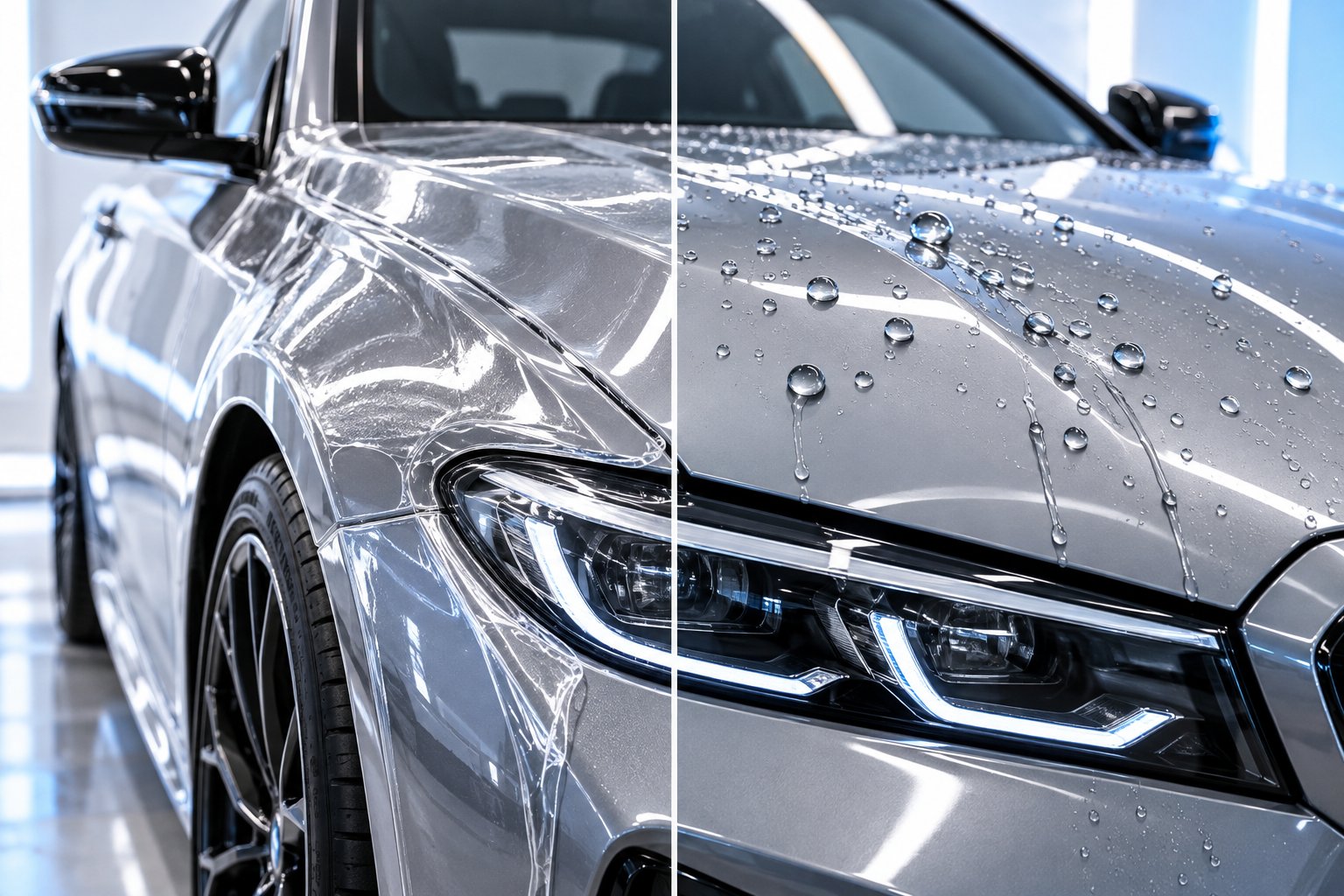
Here is the option gaining the most traction among enthusiasts and detailers alike: layer both. The approach is simple in concept — install protection film on high-impact panels first, then apply ceramic coating over the entire vehicle, including the filmed surfaces. The film handles stone chips and scratches. The coating adds hydrophobicity, chemical resistance, and easier cleaning across every panel, whether it carries film underneath or not.
This combination solves a real weakness. PPF surfaces, while durable, can become slightly porous over time, trapping contaminants that are difficult to wash away. A ceramic coating over the film seals that surface and prevents contaminants from bonding, extending the film's visual clarity and functional lifespan. You also get consistent gloss and water behavior across the entire car — no visible difference between coated bare paint and coated filmed panels.
The industry has noticed this trend. Many PPF manufacturers now ship films with ceramic nanoparticles integrated directly into the top coat layer, delivering hydrophobic and UV-resistant properties straight off the roll. These ceramic-infused films eliminate the need for a separate coating appointment on the filmed areas, though owners still benefit from coating the unfilmed panels independently. It is worth noting that hybrid films are still a maturing product category — standalone ceramic coatings applied over traditional PPF generally deliver stronger and more refreshable hydrophobic performance than what an integrated top coat offers today.
The bottom line? PPF and ceramic coating are complementary technologies, not competing ones. Choosing between them is less about which is superior and more about which combination fits your car paint protection film installation budget and the threats your vehicle actually faces. A full-front PPF package topped with ceramic coating across the entire vehicle represents the sweet spot for most owners who want both impact defense and effortless maintenance.
Whichever route you lean toward, the quality of the result depends heavily on one more variable that no product specification can overcome — how the film actually gets applied to the vehicle.
Professional Installation vs DIY PPF Application
A premium TPU film only performs as well as the hands that apply it. Two identical sheets of material can produce completely different results depending on surface preparation, cutting precision, and technique during application. Whether you hire a certified installer or tackle the project yourself, understanding each step of the process helps you set realistic expectations — and avoid costly mistakes.
What Professional PPF Installation Looks Like
Walking into a professional shop for ppf paint protection is not like dropping your car off for an oil change. The process is meticulous, multi-stage, and time-intensive. Here is what happens behind the bay doors, step by step.
Stage 1: Surface decontamination. The vehicle receives a detailing-grade wash that goes far beyond soap and water. XPEL's installation protocol specifies clay bar treatment to remove embedded contaminants — tar spots, iron deposits, industrial fallout, and mineral buildup — that a standard wash leaves behind. Every micro-particle trapped between film and paint becomes a permanent blemish once the adhesive bonds, so this step is non-negotiable.
Stage 2: Paint inspection and correction. After decontamination, the installer examines the paint under high-intensity lighting. Existing scratches, swirl marks, chips, and any previous repaint work are identified and documented. If the surface is not smooth enough, a paint correction session — machine polishing to remove defects — is performed before any film touches the car. You are essentially locking in whatever condition the paint is in at the moment of installation, so starting with a flawless surface matters.
Stage 3: Precision cutting. This is where professional shops pull ahead of DIY efforts most dramatically. Leading installers use computer-aided cutting systems like XPEL's DAP (Design Access Program), which stores pattern data for tens of thousands of vehicle models worldwide. A digital plotter cuts each panel's film to millimeter accuracy — no blade ever touches the car's paint. Hand cutting with a knife on the vehicle surface still happens at some shops, but it introduces the risk of blade marks in the clear coat. If you are paying for professional paint protection film for vehicles, ask whether your shop uses plotted patterns or hand-cuts on the panel.
Stage 4: Wet application. The installer sprays a slip solution — a mixture of distilled water and a small amount of soap — onto the clean paint surface. This thin liquid layer allows the film to float and be repositioned freely before commitment. The pre-cut piece is peeled from its release liner, misted on the adhesive side to prevent static contamination, and laid onto the panel. At this point, nothing is locked down. The film slides across the wet surface until alignment is perfect.
Stage 5: Squeegee work. Starting from the center and working outward, the installer uses a squeegee to push slip solution and trapped air out from under the film. Overlapping, controlled strokes ensure consistent pressure across the entire panel. Complex curves — bumper contours, fender arches, mirror housings — get heat-gun treatment to soften the film, making it pliable enough to conform without creasing or stretching unevenly.
Stage 6: Edge tucking and sealing. Film edges are wrapped behind panel gaps, under trim pieces, and along body lines so no raw film edge is visible or exposed to peeling forces. The installer finishes by running a heat gun along every sealed edge to lock the film's shape permanently. This edge work is what separates a professional result from an obvious DIY job — and it is the single hardest skill to replicate without training.
Stage 7: Curing. Immediately after installation, a small amount of moisture remains between the film and paint. This is completely normal. The curing period typically runs 24 to 48 hours, during which the vehicle should remain parked and unwashed. Small bubbles or hazy moisture marks visible right after installation will naturally disappear as the slip solution evaporates through the film. After curing, the installer performs a final quality check — verifying adhesion, inspecting for trapped debris, and correcting any edge issues before releasing the vehicle.
Total shop time varies. Partial coverage — hood, fenders, and mirrors — typically takes four to six hours. A full-body wrap can stretch across two to five days, depending on vehicle size and body complexity. Rushing the timeline to save a day almost always compromises the result.
DIY PPF Application — Is It Realistic
Honest answer? It depends entirely on what you are trying to cover. Small, targeted pieces — door edges, mirror caps, side skirts — are absolutely achievable for a patient beginner with the right tools and a clean workspace. Full-panel or full-body installation is a different story. Wrapping an entire hood or bumper demands precise handling of large, unwieldy sheets of film, tolerance for a steep learning curve, and the willingness to potentially waste expensive material on your first few attempts.
Consider the practical reality. A professional installer works in a temperature-controlled, dust-free bay with years of muscle memory guiding every squeegee stroke. A first-timer working in a garage contends with ambient dust, imperfect lighting, and unfamiliar material behavior. On a small piece — say, a six-inch door-corner patch — those disadvantages are manageable. On a four-foot hood panel, they compound into wrinkles, contamination, and trapped bubbles that are extremely difficult to correct once the film begins tacking down.
The sweet spot for DIY falls squarely in the pre-cut kit category. Kits designed for specific vehicle models eliminate the cutting step entirely, which removes one of the biggest sources of DIY error. You receive pieces that already match your panel dimensions, so alignment becomes a matter of careful positioning rather than freehand trimming.
CUTIM's Door Corner & Side Skirt TPU Paint Protection Film illustrates this approach well. The kit ships with four door-corner pieces and two side-skirt pieces pre-cut for Tesla Model 3 and Model Y — small, manageable sections that cover high-wear zones discussed in the previous chapter. Because each piece is compact and designed for a specific panel contour, the margin for misalignment shrinks significantly compared to wrestling with a full-bumper sheet. The transparent TPU material is the same premium grade used in professional installations, so you are not sacrificing protection quality by going the DIY route on these targeted areas. Just verify that your specific model year matches the kit's fitment before purchasing, since Tesla has revised body panel dimensions across production runs.
Pre-cut kits like this also make practical sense for owners in harsh climates. If you have ever wondered why your car needs PPF in South Florida, for example — where UV intensity, salt air, and summer heat assault every exterior surface year-round — a targeted kit lets you protect the most vulnerable spots immediately while budgeting for broader coverage later.
Whether you are applying a small pre-cut kit or attempting a larger panel, you will need the same core set of tools:
- Spray bottle with slip solution — distilled water mixed with a few drops of baby shampoo (roughly 2 ml per liter) to allow repositioning during application.
- Spray bottle with tack solution — distilled water mixed with isopropyl alcohol (about 15 percent IPA by volume) to lock edges and corners into place.
- Squeegee (soft rubber or felt-edged) — for pressing out fluid and air bubbles without scratching the film's top coat.
- Heat gun or hair dryer — to soften the film around curves and seal edges; keep it moving and maintain six to eight inches of distance to avoid overheating.
- Isopropyl alcohol (IPA) wipes — for a final surface decontamination pass after washing and claying.
- Clay bar and lubricant — to remove embedded contaminants that washing alone cannot reach.
- Microfiber towels (lint-free) — for drying panels and wiping excess solution during application.
- Precision knife or blade — only needed if trimming non-pre-cut film; use extreme caution to avoid scoring the paint beneath.
A few ground rules keep the process manageable. Work indoors or in a shaded area — direct sunlight accelerates slip solution evaporation and causes the adhesive to grab before you have finished positioning. Keep the workspace as dust-free as possible; even closing garage doors and wetting the floor helps reduce airborne particles. And do not rush. Professional installers spend 30 to 60 minutes on small panels like mirrors and door edges — give yourself at least that much time, plus extra for learning the material's behavior on your first piece.
Regardless of who applies the film — you or a certified professional — what happens in the weeks and months after installation determines whether that ppf paint protection lasts five years or ten. Proper care is simpler than most owners expect, but a few critical mistakes can shorten the film's life dramatically.
PPF Maintenance, Lifespan, and When to Replace
You have invested in film selection, chosen your coverage level, and survived the installation process — either professionally or in your own garage. The temptation now is to assume the hard part is over. In many ways it is. But how you treat your automotive paint protection film in the months and years that follow determines whether it delivers five strong years of service or quietly degrades in half that time. The good news? Caring for PPF is actually simpler than caring for bare paint. You just need to avoid a handful of mistakes that accelerate wear.
How to Wash and Care for PPF-Protected Paint
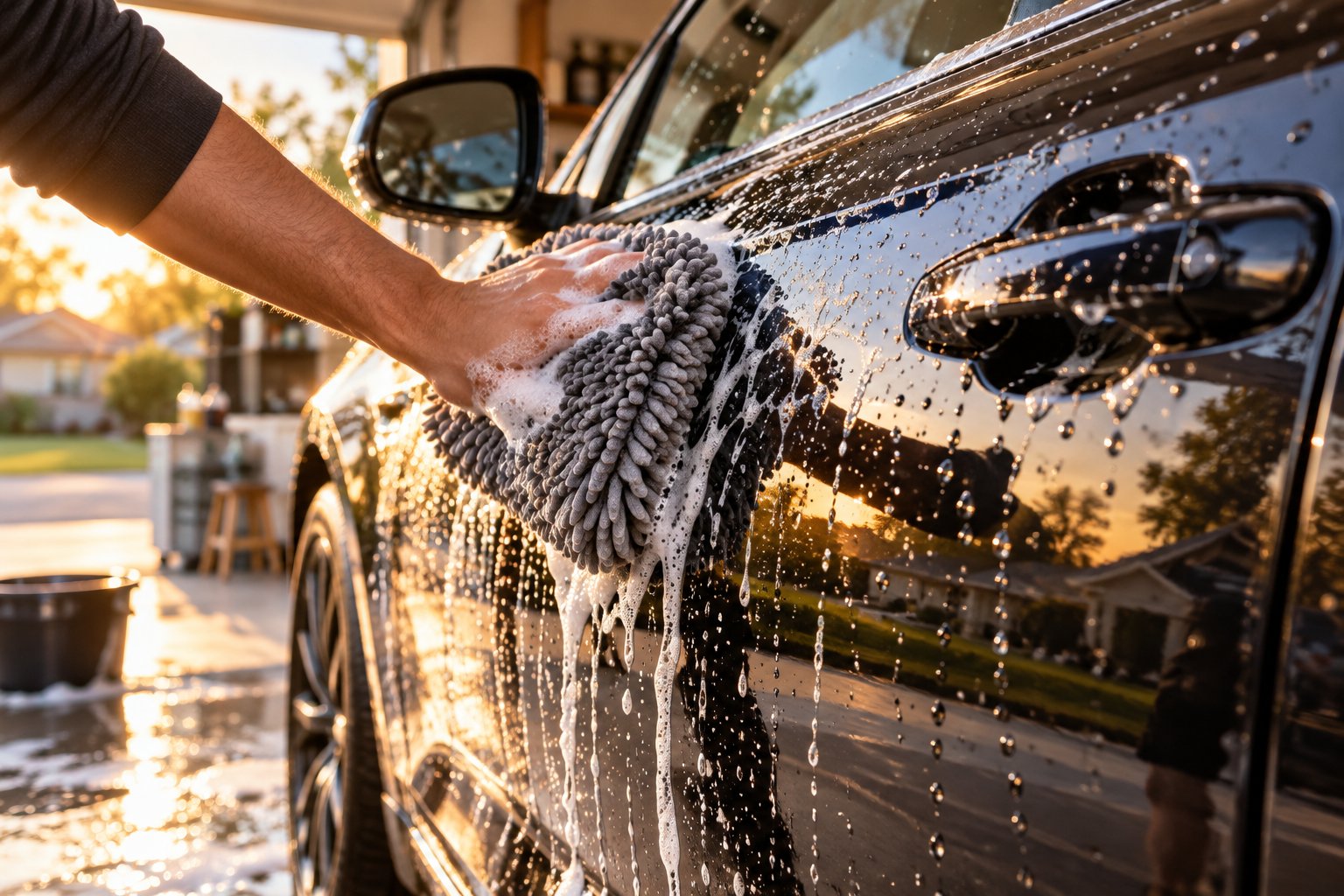
The single most important rule is also the easiest to remember: wash gently and wash often. Road grime, bird droppings, tree sap, and bug residue are not just cosmetic problems on film — they are chemical ones. Left sitting on the surface, these contaminants can stain the top coat within hours, especially in warm weather when heat intensifies the reaction. Frequent rinsing prevents buildup from ever reaching that threshold.
Beyond frequency, the products and tools you use matter more than you might expect. A ppf for car surfaces responds differently than bare clear coat, and using the wrong chemical or the wrong wash method can create problems that no amount of self-healing will fix.
Here is a quick-reference list of care dos and don'ts that covers the essentials:
- Do use a pH-neutral car shampoo — it cleans effectively without attacking the film's top coat chemistry or weakening the adhesive at exposed edges.
- Do hand wash with a soft microfiber wash mitt — gentle contact lifts dirt without grinding particles into the film surface.
- Do use touchless automatic car washes if hand washing is not practical — pressurized water and soap without physical contact keep the film safe.
- Do rinse the vehicle thoroughly before making contact — a pre-wash rinse removes loose dirt and sand that would otherwise act as abrasive particles under your mitt.
- Do dry with a clean, lint-free microfiber towel — pat or blot rather than dragging aggressively across the surface.
- Do remove bird droppings, tree sap, and bug splatter as soon as possible — a quick wipe with a damp microfiber towel prevents chemical etching before it starts.
- Don't use automatic brush-style car washes — spinning bristles can catch film edges and initiate lifting or peeling, particularly on seams and panel borders.
- Don't apply abrasive rubbing compounds or cutting polishes to the film — these are designed to remove microns of clear coat, and they will strip the self-healing top coat instead.
- Don't use petroleum-based tire dressings or silicone sprays near film edges — these products can creep under the film boundary and weaken adhesive bonds over time.
- Don't use harsh solvents like acetone, lacquer thinner, or aggressive degreasers on the film surface — they dissolve the polymers that give the top coat its gloss and healing ability.
- Don't pressure-wash directly at film edges from close range — high-pressure water forced under a seam accelerates edge failure faster than almost anything else.
If your front bumper PPF or hood film picks up stubborn contamination that a normal wash cannot remove — tar spots, heavy mineral deposits, dried sap — use isopropyl alcohol diluted to roughly 20 percent with water. Apply it to a microfiber towel, not directly to the film, and wipe gently. This approach dissolves most organic and mineral contaminants without damaging the top coat. For anything more stubborn, consult a professional detailer rather than escalating to harsher chemicals on your own.
How Long PPF Lasts and When to Replace It
So what does PPF mean in terms of real-world longevity? The honest answer depends on three variables that interact differently for every owner: film quality, environmental exposure, and maintenance consistency.
Quality TPU films from reputable manufacturers typically deliver five to ten years of effective service, with premium formulations reaching up to twelve years under ideal conditions — meaning garage storage, minimal UV exposure, and consistent hand washing. Lower-tier PVC films, by contrast, often begin yellowing and cracking within two to three years, which is one more reason the material grade you choose at the outset matters so much.
Climate plays a decisive role. A vehicle parked outdoors in a high-UV environment ages its film measurably faster than one kept in a climate-controlled garage. Repeated heat-and-cold cycling stresses the adhesive layer, and prolonged sun exposure gradually depletes the UV stabilizers built into the TPU. Owners in moderate climates with covered parking routinely report film lasting well beyond the manufacturer's warranty window, while identical film on an outdoor-parked vehicle in an intense desert climate may show signs of fatigue by year five or six.
Knowing what those signs of fatigue look like helps you decide when replacement is genuinely necessary versus when the film still has life left:
Yellowing or discoloration. This is the most visible indicator that a film has reached the end of its functional life. Yellowing signals that the film's UV inhibitors are exhausted, and once discoloration becomes noticeable — particularly on white, silver, or light-colored paint — no amount of cleaning will reverse it.
Edge lifting and peeling. When adhesive bonds begin failing at borders and seams, dirt and moisture infiltrate beneath the film. This trapped contamination accelerates paint damage in exactly the area the film was supposed to protect. If you notice edges pulling away, replacement of the affected section should happen soon rather than later.
Reduced self-healing response. A film that once erased parking-lot scuffs in a few minutes of sunlight but now holds onto every mark has likely lost its top coat integrity. The self-healing polymers degrade over time, and when they stop responding to heat, the film's most valuable feature is gone.
Micro-cracking and brittleness. Flexible film that turns rigid and develops fine surface cracks — especially on high-exposure areas like the hood and front bumper — has undergone irreversible polymer degradation. Cracking compromises the protective barrier and exposes paint to the very hazards the film was designed to block.
Heavy pitting from absorbed impacts. A film surface peppered with visible rock chip craters has done its job admirably — every one of those marks represents a hit that your paint never felt. But heavily pitted film has reduced structural integrity and diminished optical clarity. At this point, removal and replacement restores both protection and appearance.
One concern surfaces more than any other when owners consider removing aged film: will it damage the paint underneath? The short answer, for quality film on healthy factory paint, is no. Properly installed TPU automotive paint protection film uses an acrylic pressure-sensitive adhesive engineered specifically for clean removal. When you peel the film at a controlled angle — or have a professional do it with low heat to soften the adhesive — the bond releases without pulling clear coat, leaving residue, or transferring adhesive stains. Reputable manufacturers warranty against exactly this kind of removal damage.
The one caveat applies to film left on far too long. PPF left in place for fifteen or more years significantly increases the risk of adhesive baking — where prolonged heat exposure essentially fuses the adhesive to the paint surface. At that point, removal becomes riskier and may require professional intervention with steam or specialized solvents. Replacing film before it reaches severe degradation is both cheaper and safer than waiting for complete failure.
Quality TPU paint protection film typically lasts five to ten years under normal driving and maintenance conditions, with premium formulations reaching up to twelve years on garage-kept vehicles — making timely replacement before severe degradation the simplest way to protect both the film investment and the paint underneath.
Maintenance and lifespan are practical concerns, but they are not the only factors that shape a smart purchasing decision. Your driving habits, parking situation, local climate, and long-term ownership plans all feed into a broader question that deserves its own honest evaluation — whether PPF is the right investment for your specific circumstances.
Is PPF Worth It
You understand the technology, the materials, the installation process, and the care routine. The only question left is personal: does auto paint protection film make sense for your car, your driving life, and your budget? There is no universal answer — but there is a clear way to think through it.
Factors That Determine Whether PPF Makes Sense for You
Rather than guessing, walk through these five considerations in order. Each one narrows the decision until the right choice becomes obvious for your situation.
- Vehicle value and ownership timeline. The higher the vehicle's purchase price and the longer you plan to keep it, the stronger the case for PPF. A driver who spends $50,000 on a new car and plans to own it for seven years stands to preserve thousands in resale equity — often more than the cost of a full-front installation. Conversely, if you are leasing a $25,000 sedan for 24 months, the math tilts toward minimal or no coverage. Ask yourself: will I still own this car in five years? If yes, protection pays dividends the entire time.
- Daily driving conditions. Highway commuters face a constant barrage of gravel, construction debris, and kicked-up road grit. Edmunds notes that use case is one of the single biggest factors in whether film justifies its cost. If your daily route includes stretches of highway, unpaved shoulders, or active construction zones, front-facing panels are absorbing micro-impacts every trip. Short, low-speed urban drives generate far less debris exposure — though parking-lot door dings and shopping-cart scratches still add up.
- Parking environment. A vehicle garaged overnight and parked in a covered structure during the day faces dramatically less UV exposure, weather cycling, and accidental contact than one sitting in an open lot under full sun. Garage-kept vehicles benefit from PPF but may not need full-body coverage since their environmental stress is lower. Open-lot parking shifts the calculus toward broader protection.
- Local climate. UV intensity, road salt, sandstorms, and extreme temperature swings all accelerate paint degradation. Owners in sun-heavy states, coastal salt-air environments, or regions with harsh winters face a compounding damage curve that ppf auto protection interrupts early. Shine Design's cost-benefit analysis found that for Arizona highway commuters, PPF typically pays for itself within three to four years through avoided repairs and preserved resale value alone. Similar math applies anywhere the climate actively punishes exterior paint.
- Available budget. You do not need to commit to a full-body wrap on day one. A bumper-only kit for $600 to $900 is better than no coverage at all, and you can expand to a full front or targeted side-panel kits as your budget allows. Think of PPF coverage as modular — start where the damage risk is highest and build outward over time.
Common PPF Myths That Mislead Buyers
If you have been researching what is a PPF installation and reading forums or comment sections, you have almost certainly encountered claims that sound authoritative but crumble under scrutiny. Most of these myths trace back to experiences with first-generation PVC films from the early 2000s — products that bear almost no resemblance to today's TPU technology. Here are the most persistent misconceptions, paired with the reality behind each one.
-
Myth: PPF always turns yellow.
Reality: Early PVC-based films absolutely yellowed, sometimes within a year or two. Modern TPU films use UV-stabilized top coats with fundamentally different chemistry. Premium TPU products resist yellowing for seven to ten years or longer. If someone shows you a yellowed film as proof that "PPF yellows," ask what material it was — chances are it was a budget PVC or TPH product, not a quality thermoplastic polyurethane. -
Myth: PPF ruins your paint when removed.
Reality: Quality film uses pressure-sensitive adhesive that bonds through contact pressure, not chemical fusion. When removed properly — with controlled heat and slow peeling at the correct angle — the film comes off cleanly, and the paint underneath is typically in better condition than the surrounding unprotected panels because it has been shielded from UV, chemicals, and impacts for years. The only real risk arises when film is left on far beyond its rated lifespan (fifteen-plus years), at which point adhesive can bake onto the surface. -
Myth: PPF eliminates all maintenance.
Reality: Film significantly reduces maintenance needs — you will not need waxing, sealant reapplication, or frequent paint correction. But it still benefits from regular washing with pH-neutral soap, prompt removal of bird droppings and bug residue, and an annual visual inspection of edges and seams. Low maintenance is not the same as zero maintenance. -
Myth: Only brand-new cars benefit from PPF.
Reality: Used vehicles benefit equally — sometimes more. If you plan to keep a used car for several more years, PPF prevents additional damage from accumulating during your remaining ownership. The one difference is that used vehicles typically need paint correction before installation to remove existing swirl marks and defects, since the film locks in whatever condition the surface is in at the time of application. -
Myth: PPF is only for luxury cars.
Reality: Body shop repaint costs are driven by panel size and labor hours, not by the badge on your hood. A professional respray on a mid-range sedan's hood runs $800 to $1,500 — comparable to the cost of a full-front PPF kit that prevents all front-end damage for years. The ppf auto protection math works for any vehicle driven regularly on highways, regardless of price tier.
Strip away the outdated anecdotes and internet speculation, and the decision framework is refreshingly simple. Evaluate your vehicle's value, your exposure to road hazards, your parking and climate conditions, and your budget. If two or more of those factors point toward meaningful risk, PPF delivers measurable returns — in preserved paint, avoided repair bills, and stronger resale value. If your car lives in a garage, sees only short neighborhood drives, and you plan to trade it in within a couple of years, the investment may not move the needle enough to justify the cost.
Either way, you are now making that call from a position of genuine understanding rather than guesswork. You know what the film is made of, how it heals itself, which material grades and finishes exist, where to prioritize coverage, and how to maintain the result for years. That knowledge — more than any single product choice — is what separates a confident buyer from one who overpays for the wrong solution or skips protection they genuinely needed.
Frequently Asked Questions About Paint Protection Film
1. How long does paint protection film last on a car?
Premium TPU paint protection film generally lasts between five and ten years, with top-tier formulations reaching up to twelve years on garage-kept vehicles. Longevity depends on three main factors: the film's material grade (TPU outlasts TPH and PVC significantly), local climate conditions such as UV intensity and temperature extremes, and how consistently the owner follows proper care practices like pH-neutral washing and prompt contaminant removal. Films left outdoors in high-UV environments may show signs of aging closer to the five-year mark, while identical film on a garaged car in a moderate climate can exceed the manufacturer's warranty window.
2. Does paint protection film damage your paint when removed?
Quality TPU film installed on healthy factory paint does not damage the surface when removed correctly. The acrylic pressure-sensitive adhesive is specifically engineered to release cleanly under controlled heat and slow, angled peeling. In most cases, the paint underneath looks better than surrounding unprotected panels because it has been shielded from UV rays, chemical contaminants, and physical impacts for years. The only notable risk arises if film is left in place for fifteen or more years, at which point prolonged heat exposure can cause the adhesive to partially fuse to the surface, making removal more difficult and potentially requiring professional steam or solvent treatment.
3. What is the difference between PPF and ceramic coating?
PPF is a physical thermoplastic urethane film that absorbs rock chips, gravel impacts, and scratches before they reach the paint. Ceramic coating is a liquid-applied chemical layer (roughly 1 to 3 microns thick) that bonds to the surface to deliver hydrophobicity, UV resistance, chemical protection, and enhanced gloss — but it cannot stop a physical impact. Many owners now combine both: PPF on high-impact zones like the hood and bumper, with ceramic coating applied over the entire vehicle for uniform water beading and easier cleaning. The two technologies are complementary rather than competing.
4. Can you apply paint protection film yourself as a DIY project?
DIY PPF application is realistic for small, pre-cut pieces such as door edges, mirror caps, and side skirts — especially when using model-specific kits that eliminate freehand cutting. For example, targeted kits designed for Tesla Model 3 and Model Y include pre-cut door-corner and side-skirt pieces that simplify alignment for beginners. Full-panel or full-body installation, however, demands professional-grade tools, a dust-free workspace, and significant experience handling large film sheets. Most first-timers find that starting with a small targeted kit builds confidence before attempting larger panels.
5. Is paint protection film worth it for non-luxury cars?
PPF delivers measurable value on any vehicle driven regularly on highways or in harsh climates, regardless of its price tier. A professional hood respray on a mid-range sedan typically costs $800 to $1,500 — comparable to a full-front PPF kit that prevents all front-end chip damage for years. The financial case strengthens further when you factor in preserved resale value: protected vehicles can command 10 to 15 percent higher prices than similar models with visible paint wear. Even budget-friendly partial-coverage options, like door-corner or rocker-panel kits, prevent cumulative cosmetic damage that quietly erodes trade-in offers over time.