
Why the Tesla Model Y Doubles as a Capable Camper
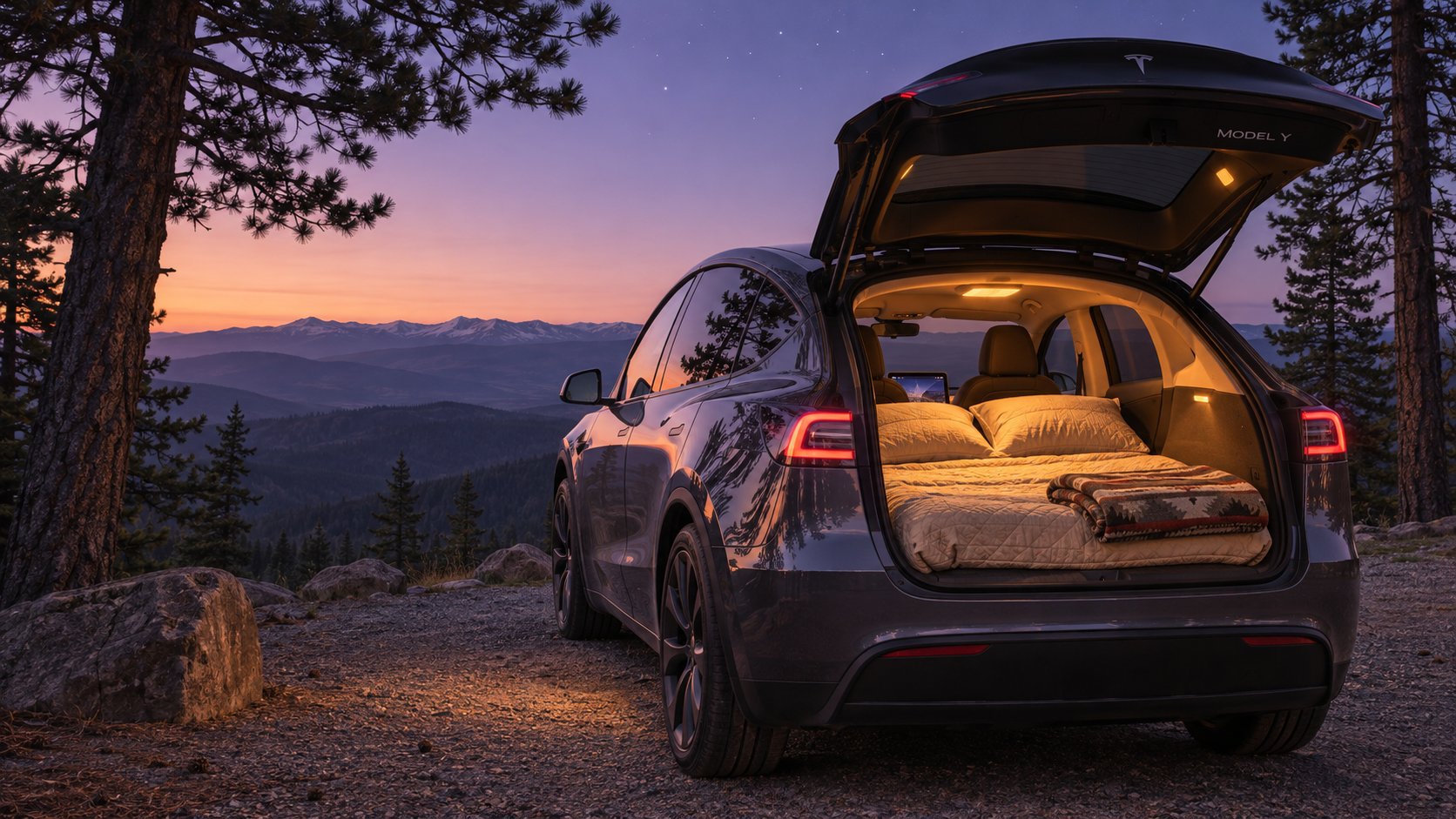
Imagine pulling into a trailhead at dusk, folding your rear seats flat, rolling out a mattress, and drifting off in a perfectly climate-controlled cabin while stars fill the glass roof above you. No tent poles. No generator noise. No campground fees. That scenario isn't a fantasy — it's a Tuesday night for a growing number of Model Y owners who have discovered their crossover doubles as a surprisingly capable sleep-ready vehicle.
Why the Model Y Has Become a Go-To Car Camping Platform
The Tesla Model Y camper concept isn't about bolting on a pop-top roof or gutting the interior for a permanent conversion. It's simpler than that. Fold the rear seats, lay down a sleeping surface, activate Camp Mode, and the vehicle's own battery maintains heating, cooling, lighting, and USB power all night long. With the second row folded, the cargo area opens up to roughly 70.8 cubic feet of usable space — enough for a nearly flat sleeping platform that stretches close to six feet ten inches in length. That makes it viable for solo travelers, couples, and anyone who'd rather skip the hotel and wake up where the adventure starts.
The Model Y combines a flat cargo floor, software-controlled climate, and access to a nationwide Supercharger network — three pillars that make EV camping practical rather than a novelty.
What This Guide Covers and Who It Is For
Whether you're eyeing a Snuuzu camping mattress for the Tesla Model Y, curious about an Adreama Tesla Model Y camping tent, or simply wondering whether a rolled-up sleeping bag on folded seats actually works — this guide is built for you. It's vendor-neutral, first-timer-friendly, and covers every angle: Camp Mode mechanics, real sleeping dimensions, mattress comparisons, budget tiers from zero-cost to full tesla model y camper kit setups, must-have accessories, overnight battery drain, charging logistics, and seasonal strategies. By the end, you'll know exactly how to turn your crossover into a comfortable overnight base camp — and whether the lifestyle suits you before spending a dollar on gear.
How Camp Mode Works and How to Enable It
The entire Tesla Model Y camping experience hinges on a single software feature most owners have never tapped. Camp Mode is the reason you can sleep in a climate-controlled cabin at 68°F while a snowstorm rages outside — or keep cool in a desert parking lot in August — without the car shutting itself off, locking you out, or blasting alarm notifications at passing hikers.
Camp Mode is a built-in Tesla software feature that keeps the HVAC system, interior lights, USB power, music, and touchscreen active while the vehicle is in Park — all without triggering the security alarm or automatic shutoffs.
In practical terms, the vehicle behaves as though it's a parked, battery-powered studio apartment. The cabin holds your target temperature, the low-voltage outlet and USB ports remain live for charging devices, and the touchscreen stays on so you can stream music, browse the web, or queue up a movie in Tesla Theater. Walk-Away Door Lock is disabled, which means you can step outside for a breath of fresh air without the car locking behind you. It's available on every current Model Y variant — Standard Range, Long Range, and Performance — and requires no additional purchase or subscription to activate.
Step-by-Step Camp Mode Activation
Getting Camp Mode running takes less than a minute. Here's exactly how to do it:
- Park the vehicle. Camp Mode only appears when the Model Y is in Park. Find a level spot, engage Park, and keep the car powered on.
- Set your desired cabin temperature. Adjust heating or cooling to whatever feels comfortable before activating Camp Mode. A setting around 68°F (20°C) strikes a good balance between comfort and energy efficiency on most nights.
- Open the climate controls screen. Tap the fan icon at the bottom of the touchscreen to pull up the full climate menu.
- Tap "Camp." You'll see the Camp Mode icon alongside Keep Climate On and Pet Mode. Tap it, and a confirmation indicator appears on the display. The HVAC, lights, USB power, and touchscreen will remain active indefinitely — or until the battery drops critically low.
- Lock the doors from the Tesla app (optional). Since Walk-Away Door Lock is disabled in Camp Mode, use your phone to lock up once you're settled inside.
If the Camp option doesn't appear, confirm that your software is up to date. Tesla introduced Camp Mode in a late-2019 update, and all vehicles running current firmware should have it available. You can also enable or adjust Camp Mode remotely through the Tesla mobile app by swiping up on the Climate screen — handy if you want to pre-cool the cabin while you're still organizing gear outside.
Camp Mode vs Dog Mode vs Sentry Mode
Three climate-related Park modes live in the same menu, and confusing them can ruin a night's sleep. Here's how they differ:
- Camp Mode maintains cabin temperature, keeps USB ports powered, leaves the touchscreen on for entertainment, and disables the vehicle alarm plus Walk-Away Door Lock. It's designed for people staying inside the vehicle.
- Pet Mode (Dog Mode) also maintains cabin temperature, but its primary purpose is protecting pets left alone briefly. The touchscreen displays a large message showing the current cabin temperature so passersby know your animal is safe. It's not designed for overnight use, and Tesla recommends only short durations with active monitoring via the mobile app.
- Sentry Mode uses the exterior cameras to detect potential threats and can trigger loud alerts and flashing lights. Running Sentry Mode overnight while you're sleeping inside the car wastes battery on continuous camera processing and risks jarring false alarms — a dog walking past, a leaf blowing across the hood, or a neighboring camper returning to their site. Turn Sentry Mode off before settling in for the night.
A quick rule of thumb: Camp Mode for sleeping in the car, Pet Mode for short pet-only waits, and Sentry Mode for when the car is unattended and you want security footage. Overlapping Camp and Sentry modes simultaneously drains the battery faster with little practical benefit while you're lying right there.
Screen Brightness and Interior Lighting Tips
One question comes up constantly among first-time Tesla Model Y camper users: "How do I deal with that giant glowing screen two feet from my face?" Camp Mode dims the touchscreen automatically after a period of inactivity, but it doesn't turn it off completely. For some sleepers, even the dimmed glow is enough to disrupt rest.
A few practical fixes help. First, lower the screen brightness manually to its minimum setting before you lie down — you'll find the brightness slider in the Display menu. Second, a simple microfiber cloth draped over the screen blocks residual light without causing any harm to the display. Third, if you're using window shades or privacy covers (which you should be, for insulation and light-blocking reasons), the reflected glow from the screen is already reduced significantly. For the overhead interior lights, switch them off entirely from the touchscreen lighting controls so they don't flick on when you shift position. Some owners also tilt the rearview mirror upward to eliminate any screen reflection bouncing off the glass.
With the screen dimmed, interior lights off, and window covers in place, the cabin becomes genuinely dark — dark enough to sleep soundly until your morning alarm. And that comfort leads directly to the next question every prospective car camper asks: is there actually enough room back there to stretch out?
Sleeping Space Dimensions and Real-World Comfort Limits
Knowing you can keep the cabin at a perfect 68°F all night is great — but none of that matters if you can't actually lie flat without your knees bent or your shoulders jammed against the interior trim. The Model Y's cargo area looks spacious when you glance at it in a parking lot, yet published spec-sheet numbers like 71.4 cubic feet behind the front row don't tell you whether your six-foot-two frame actually fits back there. What you need are the tape-measure rectangles — the real-world length, width, and height you'll be sleeping within.
Cargo Area Length, Width, and Height When Seats Are Folded
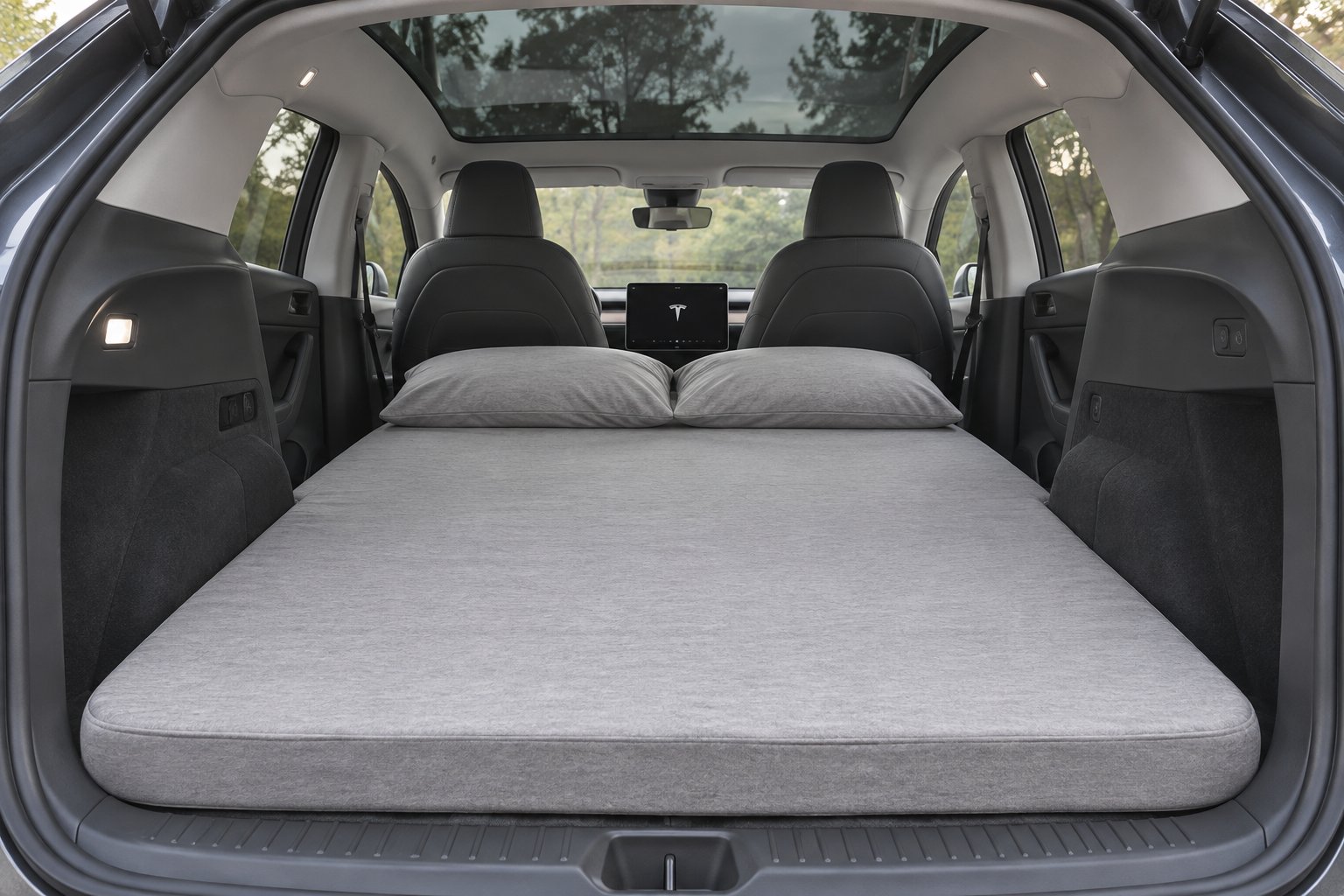
Drop the rear seats and the Model Y opens into a single continuous surface that stretches from the inside of the tailgate to the back of the front seatbacks. How far that surface actually extends depends on where you position the front seats. Most owners find that sliding the front seats forward to a moderate position — about where a five-foot-eight passenger would sit comfortably — creates a sleeping surface roughly 74 to 76 inches long, which is just over six feet. Push the front seats all the way forward against the dashboard and you can gain another inch or two, though nobody will want to drive that way the next morning.
Width is where things get interesting. The cargo floor measures approximately 48 inches across at its widest point between the interior side panels. However, the wheel-well intrusions — those raised humps along both sides of the cargo area — narrow the usable flat width to about 41 to 42 inches at shoulder height. That narrower dimension is the one that matters for sleeping. Vertical clearance from the cargo floor to the headliner runs roughly 28 to 30 inches, which is plenty of room to sit up partially and change clothes, though you won't be standing up inside.
Here's an approximate breakdown of the sleeping-surface dimensions owners should verify against their specific vehicle:
| Dimension | Approximate Measurement | Notes |
|---|---|---|
| Sleeping length (seats folded, front seats at moderate position) | 74 – 76 inches (~188 – 193 cm) | Gains 1 – 2 inches with front seats pushed fully forward |
| Maximum floor width (between interior panels) | ~48 inches (~122 cm) | Widest point near the center of the cargo area |
| Usable flat width (between wheel wells) | ~41 – 42 inches (~104 – 107 cm) | This is the shoulder-room bottleneck for two sleepers |
| Height clearance (floor to headliner) | ~28 – 30 inches (~71 – 76 cm) | Enough to sit up partially; varies with mattress thickness |
| Rear seat fold angle (pre-Juniper 5-seat) | ~8 degrees | Mild slope toward the tailgate |
| Rear seat fold angle (Juniper 5-seat) | ~13 degrees | Noticeably steeper; requires leveling strategy |
These are approximate owner-reported values. Exact measurements can vary by trim, seat position, mattress thickness, and model year. Always verify with a tape measure in your own vehicle before purchasing fitted camping accessories.
Can Two Adults Sleep Comfortably Side by Side?
The honest answer: it depends on body size and your tolerance for cozy quarters. That 41-to-42-inch span between the wheel wells is roughly the width of a standard double bed — workable for two average-build adults, but tight for two broad-shouldered sleepers. You'll notice that each person gets about 20 to 21 inches of shoulder space at the narrowest point, which is comparable to an airline economy seat in width. Couples who sleep close together tend to report it as perfectly fine. Two friends who prefer personal space may find it a squeeze.
A few practical tricks help. Sleeping head-to-tailgate with one person slightly offset from the other takes advantage of the wider section near the center of the cargo area. Using a single, vehicle-width mattress rather than two individual pads eliminates the annoying gap that forms between separate sleeping surfaces. And if one sleeper runs hot while the other runs cold, Tesla Model Y camp mode lets you set a cabin temperature that splits the difference while each person adjusts their own blanket layers.
Solo travelers, on the other hand, have it easy. One person can sleep diagonally across the full 48-inch width, gaining extra shoulder room and stretching out more comfortably than on many traditional camping cots.
Dealing with the Seat-Fold Angle and Wheel-Well Intrusions
Here's the detail the showroom won't mention: the rear seats don't fold perfectly flat. On pre-Juniper five-seat Model Y vehicles, the folded seatbacks settle at roughly an eight-degree incline — a gentle downhill slope toward the tailgate. You might not notice it while loading groceries, but spend a few hours sleeping on it and gravity slowly slides you toward the rear. The 2025–2026 Juniper refresh actually made this steeper, not flatter. Its redesigned interior places the folded seatback at about 13 degrees — more than half again as much tilt as the older version.
Why did it get worse? The Juniper's upgraded seats feature thicker bolstering, improved reclining mechanisms, and premium materials that add bulk to the seatback. Those are genuine comfort upgrades for daily driving, but they create a steeper fold angle that camping owners need to compensate for.
There's one notable exception. The seven-seat Juniper variant uses a different sliding rail system. Pull those second-row seats fully forward into access mode before folding them, and they can settle to a virtually flat zero-degree position. The trade-off is a slight vertical step-down where the floor level changes into the trunk area, but it's far easier to pad over a step than to fight a continuous 13-degree slope all night.
For five-seat owners — which is the vast majority of the Model Y camping community — the leveling strategy boils down to three approaches:
- Thick contoured mattress: Purpose-built foam mattresses designed for the Model Y use varying thickness to counteract the exact slope angle, creating a level sleeping surface on top of an uneven floor.
- DIY gap filling: Rolled towels, stuffed duffel bags, or foam blocks placed in the footwell behind the front seats raise the lower end of the sleeping area, reducing the effective incline.
- Raised sleeping platform: Rigid platform kits sit above the fold point entirely, spanning from the trunk floor to the front seatbacks at a uniform height. These also create storage space underneath but add weight and cost.
The wheel-well intrusions along each side of the cargo area present a secondary comfort challenge. They protrude roughly three to four inches inward from the side panels, creating raised humps right where your hips or shoulders rest if you sleep near the edge. Tesla Model Y car camping accessories like custom-cut mattresses are typically shaped to fit around these intrusions, filling the gaps so you don't roll into a hard plastic ledge at 3 a.m. If you're using a generic camping pad, position it between the wheel wells and accept the narrower width, or add foam wedges along the sides to create a flush surface.
Getting these physical dimensions and quirks dialed in is half the battle. The other half? Choosing a sleeping surface that actually matches your vehicle's contours, your budget, and how often you plan to camp — which is exactly where the mattress decision comes in.
Choosing the Right Camping Mattress for Your Model Y
You've measured the cargo area, eyed the wheel-well humps, and felt that seat-fold slope with your own hands. The next question is obvious: what do you actually put down there to sleep on? The Tesla Model Y camping mattress market has matured rapidly, and the options now split into three distinct categories — each with clear strengths and trade-offs that map directly to how you travel, how much storage space you're willing to sacrifice, and how seriously you take your sleep quality while camping in Tesla Model Y.
Foam vs Self-Inflating vs Air Mattress Trade-Offs
Custom-fit foam mattresses deliver the most consistent comfort. Because they're cut to the exact contours of the Model Y cargo area — including wheel-well cutouts and tapered thicknesses that counteract the seat-fold angle — they create a genuinely level, gap-free sleeping surface the moment you unfold them. The downside? Bulk. A tri-fold foam pad thick enough to smooth out the slope typically consumes a significant portion of your trunk space when you're not sleeping on it, which can be a dealbreaker for road-trippers carrying coolers, hiking gear, and luggage.
Inflatable air mattresses sit at the opposite end of the spectrum. They deflate down to roughly the size of a rolled towel, tuck into the sub-trunk well or frunk, and leave your full cargo floor open during the day. Setup means two to four minutes with an electric pump. The compromise? A rectangular air chamber can't perfectly match irregular vehicle contours. Gaps form around the wheel wells, the mattress may shift on the smooth cargo liner overnight, and cold-weather air contraction can reduce firmness by morning. Heavier sleepers sometimes bottom out against the folded seat hinges on thinner models.
Self-inflating pads split the difference. They combine an open-cell foam core with air chambers, letting you fine-tune firmness through a bleed valve after the pad self-inflates. Storage footprint lands between the other two — not as compact as a pure airbed, but far smaller than a rigid foam slab. Thermal insulation is notably better than a pure air mattress because the foam core traps body heat instead of circulating cold air through hollow chambers. The trade-off is pack-down effort: squeezing air out of foam takes more muscle than simply deflating a standard air mattress.
Notable Brands and Where to Compare Options
The market for a dedicated camper Tesla Model Y sleep setup has expanded quickly. Here are the names you'll encounter most often as you research:
- TESMAT — Known for tri-fold memory foam pads precision-cut for the Model Y. Popular among frequent campers who prioritize instant setup and maximum comfort over storage efficiency.
- SNUUZU — A premium foam-air hybrid with an integrated rechargeable pump, removable washable cover, and adjustable firmness. Real-world reviews praise hotel-grade comfort, though pricing starts around $899 USD for the mattress alone.
- TESCAMP — Offers Tesla-specific folding mattresses and accessory bundles with storage bags designed to fit the sub-trunk area.
- EVANNEX — A broad Tesla accessory retailer carrying camping gear alongside interior and exterior upgrades.
- Lost Horizon — Specializes in a self-inflating air-foam hybrid with micro-bleed valve firmness adjustment, sized at roughly 75 by 52 inches with a 4.5-inch profile.
- Hikenture — Budget-friendly inflatable options that appeal to occasional campers who want compact storage above all else.
If you'd rather compare foam and inflatable formats side by side without hopping between six different websites, CUTIM's Tesla mattress and camping collection organizes both types by vehicle generation and available cargo space. It's a useful research starting point — especially if you're unsure whether foam or inflatable is the right call for your camper Tesla Model Y setup — and you can cross-reference against the individual brand sites listed above before committing.
The table below compares the three mattress categories across the factors that matter most for Tesla Model Y camping mode overnights:
| Mattress Category | Comfort Level | Storage Size (Packed) | Setup Time | Gap-Filling Ability | Approximate Price Range |
|---|---|---|---|---|---|
| CUTIM Collection (foam & inflatable options) | Varies by format — foam is plush, inflatable is adjustable | Varies — compact for inflatables, moderate for foam | 1 – 4 minutes | High for contoured foam; moderate for inflatable | $80 – $300+ |
| Custom-Fit Foam (TESMAT, SNUUZU, TESCAMP) | Excellent — conforms to body and vehicle contours | Bulky — fills 40 – 60% of cargo area when folded | Under 1 minute (unfold) | Excellent — tapered profiles level the seat-fold slope | $150 – $900+ |
| Self-Inflating Foam-Air Hybrid (Lost Horizon, similar) | Very good — foam core with adjustable air firmness | Moderate — fits in sub-trunk or frunk | 3 – 5 minutes (self-inflates, then top off) | Good — foam core fills minor gaps; edges may not match wheel wells precisely | $150 – $400 |
| Inflatable Air Mattress (Hikenture, Tesla OEM, generic) | Good — adjustable firmness, but can feel bouncy | Compact — rolls to towel size, fits sub-trunk easily | 2 – 4 minutes (electric pump) | Low to moderate — rectangular shape leaves gaps at wheel wells | $60 – $225 |
Choosing by Storage Space and Sleep Style
Your daily driving habits should steer the decision as much as your sleep preferences. If the Model Y doubles as your only vehicle and you need full cargo capacity on weekdays, an inflatable or self-inflating pad that disappears into the sub-trunk is the practical choice. If you're building a dedicated weekend camping rig and don't mind dedicating trunk space to a foam slab, the comfort payoff is significant — especially for couples sharing that 41-inch-wide sleeping surface where every fraction of an inch of cushion matters.
Side sleepers generally need more pressure relief at the hips and shoulders, which favors foam or foam-air hybrids with at least three to four inches of thickness. Back sleepers can get away with firmer, thinner inflatable pads. And if you're the type who wants to test the lifestyle before investing hundreds of dollars, a basic air mattress in the $60 to $100 range gives you a perfectly functional trial run — you can always upgrade later once you know how often you'll actually camp.
Whichever format you choose, the mattress is only one piece of the puzzle. How much you spend — and what you pair it with — depends on how deep you want to go, which is where a clear budget framework becomes essential.
Budget Tiers from Free to Premium Camping Setups
Not everyone needs a $900 memory foam mattress and a slide-out kitchen drawer system to camp in Tesla Model Y comfortably. Some of the best overnight experiences start with gear you already own, and scaling up from there only makes sense once you know the lifestyle fits. Here's a straightforward breakdown of three spending levels — each one a legitimate way to sleep overnight in your crossover.
Zero-Cost Setups Using What You Already Own
Fold the rear seats, grab a sleeping bag or a couple of household blankets, and toss a pillow from your couch into the cargo area. That's it — you're camping. To deal with the seat-fold slope, stuff a duffel bag or rolled-up jackets into the footwell gap behind the front seats. It won't be perfectly level, but it's more than enough for a one-night test run at a nearby campground or a rest-stop nap during a road trip. This zero-cost approach is genuinely the smartest first move for anyone curious about the concept. You'll quickly learn whether sleeping in a crossover feels liberating or claustrophobic — and that answer should guide every dollar you spend afterward.
Mid-Range Mattress and Shade Packages
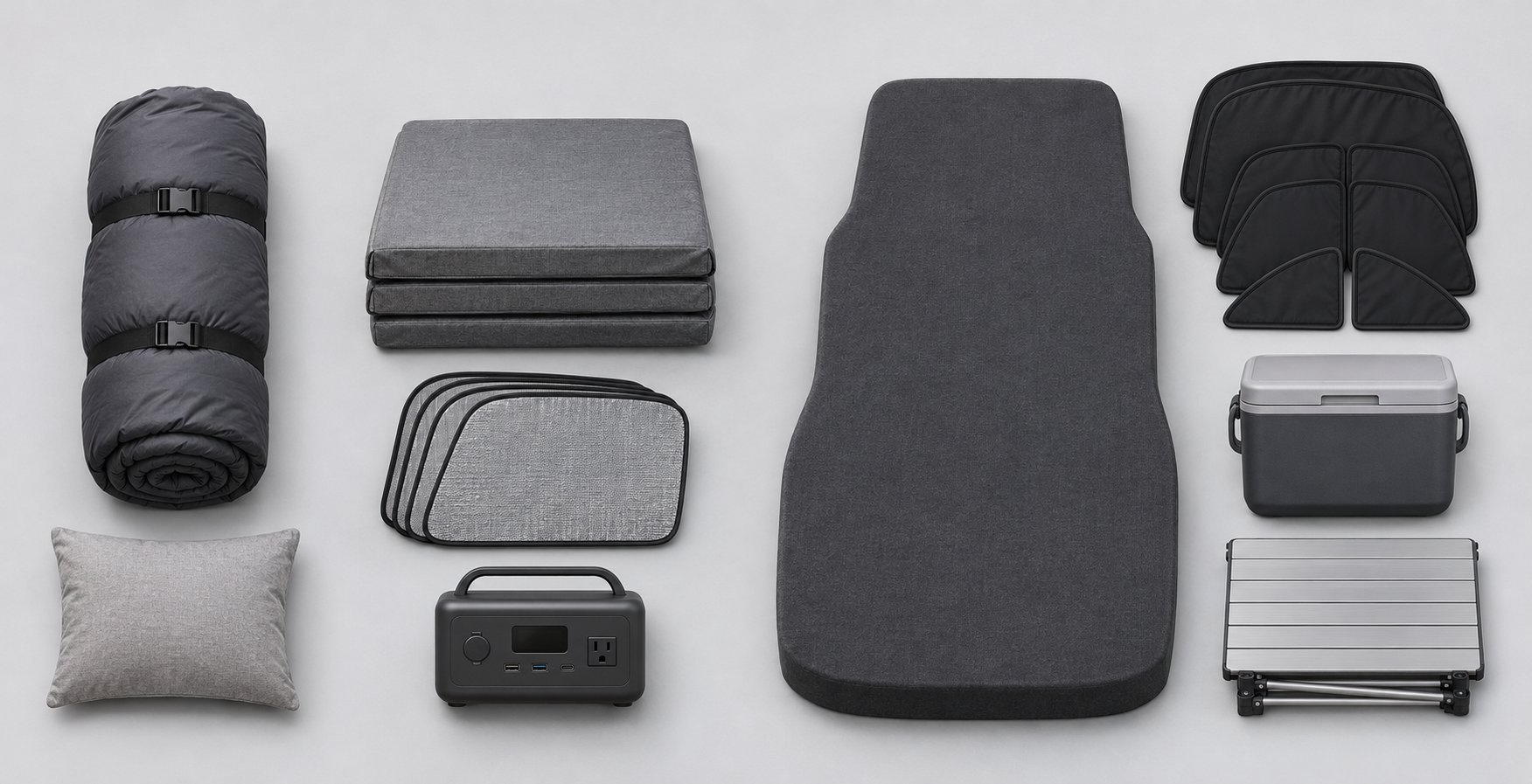
Once you've confirmed that car camping suits your travel style, a modest investment transforms comfort dramatically. A dedicated Tesla Model Y camp mattress — whether inflatable or self-inflating — eliminates the uneven surface and provides real cushioning over the cargo floor. Pair it with a set of basic window shades for privacy and light-blocking, and add a portable USB power bank for charging phones or running a small fan. This mid-range tier typically costs between $150 and $350, and it covers 90% of what most weekend campers actually need.
Premium Kits with Platforms and Integrated Storage
For frequent adventurers and digital nomads who spend multiple weekends per month off the grid, premium setups justify their price tag. Think custom-contoured foam mattresses, rigid sleeping platforms with pull-out storage drawers underneath, a purpose-built Tesla Model Y camping tent that seals around the open liftgate, professional-grade blackout window covers, and a compact 12V compressor fridge tucked into the sub-trunk. Camper-kit platforms — sometimes marketed as camper conversion kits — raise the sleeping surface to create organized gear storage below, but they add permanent weight and reduce daily-use cargo flexibility. Always verify exact fitment with your specific Model Y generation and variant before purchasing, since interior dimensions differ between pre-Juniper and Juniper models.
| Budget Tier | Typical Components | Approximate Investment Range |
|---|---|---|
| Zero-Cost | Folded rear seats, household blankets or sleeping bag, rolled clothes for gap-filling, pillow from home | $0 |
| Mid-Range | Tesla-fit inflatable or self-inflating mattress, basic window shades, portable USB power bank | $150 – $350 |
| Premium | Custom foam mattress or platform kit with storage drawers, liftgate tent attachment, blackout window covers, 12V compressor fridge | $500 – $2,500+ |
The beauty of this tiered approach is that each level builds on the one before it. Start free, upgrade to a mattress and shades after your second or third trip, and only go premium once you're certain you'll use the gear regularly. Whichever tier you land on, though, the sleeping surface is just the core — a whole ecosystem of accessories exists to extend comfort, privacy, and livable space well beyond the cargo floor.
Tents, Window Covers, and Must-Have Tesla Camping Model Y Accessories
A mattress handles the sleeping surface. Shades and budget tiers handle the financial planning. But the moment you actually set up camp — doors open, gear scattered across the tailgate, the evening air rolling in — you realize the cargo area is only the starting point. The accessories you bring around the vehicle often matter just as much as what's inside it. From liftgate tents that double your livable footprint to a two-dollar headlamp that saves you from stumbling in the dark, the broader gear ecosystem is what separates a cramped overnight nap from a genuinely comfortable campsite.
Liftgate Tents That Extend Your Living Space
Imagine unzipping a tent flap and stepping directly from your sleeping mattress into a standing-height, bug-free living area — no shoes required. That's the idea behind liftgate tents designed specifically for the Model Y. These structures attach around the open rear hatch, creating a sealed passage between the vehicle's interior and a freestanding tent extension outside. You get roughly 50 square feet of covered floor space and headroom tall enough to stand upright, all while maintaining direct access to camp mode Tesla Model Y climate control, your touchscreen entertainment, and USB charging inside the cabin.
Two purpose-built options show up most often in owner forums and accessory roundups:
- Tesloid Model Y Camping Tent — Built from 190T polyester taffeta with an Oxford fabric floor and a steel wire frame, this tent is designed to spring open and take shape quickly. Full assembly runs about 20 to 30 minutes, and it folds into a compact carrying bag when you're done. The interior offers roughly seven-foot ceilings, 50 square feet of enclosed space, and a 25-square-foot shaded porch — enough room for camp chairs, a small table, and gear storage. The waterproof, windproof construction handles rain and moderate gusts without issue.
- Adreama Tesla Model Y Camping Tent — Another popular option tailored to the Model Y's liftgate dimensions. Like the Tesloid tent, it seals around the open hatch and provides a weatherproof extension of the vehicle's living area, though design details, materials, and pricing vary by generation.
One critical consideration: fitment. The Model Y's rear liftgate shape and hinge geometry changed with the 2025 Juniper refresh. A tent cut for the pre-Juniper body may leave gaps or apply uneven tension on a Juniper hatch, and vice versa. Before ordering, confirm that the tent you're eyeing explicitly supports your specific model year. Most manufacturers now list generation compatibility on their product pages — if they don't, reach out to customer support rather than guessing.
Window Covers for Privacy and Insulation
Your Model Y's glass roof and large side windows are gorgeous during a sunset drive. At midnight in a campground, they're a liability. Every interior light turns the cabin into a glowing fishbowl, passing headlights sweep across your face, and early morning sun can wake you hours before your alarm. Window covers solve all three problems at once.
Purpose-built Tesla Model Y privacy shades typically use a multi-layer construction: a reflective outer surface that bounces sunlight and reduces solar heat gain, an insulating foam or fabric core, and a dark interior face that blocks light transmission from both directions. High-quality sets designed for the Juniper use magnetic or embedded-edge installation so they snap into place in seconds and hold firm without adhesive or suction cups that degrade over time.
The functional benefits extend beyond privacy:
- Thermal insulation — Glass is the weakest link in any vehicle's climate control envelope. Window shades add a barrier that traps warmth on cold nights and reflects heat on hot days, reducing the HVAC load and saving battery.
- True blackout — Even in remote locations, moonlight, neighboring RV lights, and parking lot floods can disrupt sleep. A properly fitted set eliminates all of it.
- Condensation control — By insulating the glass surface, shades reduce the temperature differential that causes interior moisture to condense on windows overnight.
Just like tents, window cover fitment varies between pre-Juniper and Juniper models because the Juniper's updated window dimensions don't match universal covers precisely. Loose corners or gaps defeat the purpose entirely. Spend the extra few dollars on generation-specific covers and you'll notice the difference the first time you wake up in total darkness at 7 a.m.
Essential Small Accessories Most Campers Forget
The big-ticket items — mattress, tent, window covers — get all the attention. But it's the small, inexpensive accessories that make the difference between a smooth overnight experience and a series of minor frustrations. Here's what experienced Tesla camping mattress model y owners consistently recommend packing:
- USB-powered fan — Even with Camp Mode running, air circulation inside a sealed cabin can feel stale. A compact clip-on fan powered by the Model Y's USB port moves air across your face and improves perceived comfort without increasing HVAC demand.
- Headlamp or magnetic LED light — The cabin dome lights are either too bright or too dim for tasks like finding your water bottle at 2 a.m. A red-mode headlamp preserves night vision, while a magnetic LED strip attaches to the liftgate or interior metal surfaces for hands-free ambient light outside the vehicle.
- Portable 12V-compatible cooler — A small thermoelectric cooler plugged into the vehicle's 12V outlet keeps drinks and snacks cold without the mess of melting ice. For longer trips, a compressor-style mini fridge holds temperature more efficiently but costs significantly more.
- Small folding table — A collapsible camp table positioned at the open tailgate creates a functional kitchen counter, coffee station, or gear staging area. It takes up almost no space when stored flat alongside your mattress.
- Microfiber towels — Useful for everything from wiping condensation off windows in the morning to drying off after a lake swim. They pack to almost nothing and dry faster than cotton.
- Cargo area liner or fitted sheet — A waterproof liner protects the carpet from muddy boots, spilled coffee, and pet hair. A fitted jersey sheet laid over your mattress adds a home-bed feel without bulk.
- Collapsible water container — A two-to-three-gallon collapsible jug stored in the sub-trunk gives you a campsite water supply for cooking, drinking, and hand-washing without repeated trips to a spigot.
None of these items costs more than $10 to $50 individually, and together they weigh under five pounds. Toss them into a small organizer bag that lives permanently in your frunk, and you'll always be trip-ready on short notice.
With your sleeping surface chosen, your living space extended, and your accessory kit packed, the remaining variable is the one that makes EV camping fundamentally different from gas-powered car camping: the battery. Every comfort feature you've just read about draws from the same energy reserve that needs to get you to a charger the next morning — and understanding that balance is what separates confident overnighters from anxious ones.
Camp Mode Battery Drain and Model Y Variant Differences
Every accessory, mattress, and window cover you've assembled draws its value from a single shared resource: the high-voltage battery pack beneath the floor. Camp Mode's climate system, USB ports, touchscreen, and interior lights all pull energy from the same lithium-ion cells that need to drive you to a charger the next morning. Understanding how quickly that energy depletes — and what accelerates or slows the drain — is the difference between waking up relaxed with plenty of range and waking up to a low-battery warning at 4 a.m.
The core principle is straightforward. HVAC is the dominant power consumer. When the gap between outside temperature and your target cabin temperature is small, the climate system barely works, and the draw is minimal. When that gap widens — sweltering desert heat or sub-freezing mountain cold — the compressor or heat pump ramps up dramatically, and battery consumption climbs with it. Everything else Camp Mode runs (the screen, USB charging, interior fans on low) accounts for a relatively small slice of the total.
Typical Overnight Battery Consumption by Season
Real-world overnight drain varies enough across seasons that a single "Camp Mode uses X percent" answer is misleading. The table below consolidates data from Tentsla's field testing and EV-MATS' multi-vehicle experience data to give you a practical picture of what to expect during an eight-hour sleep cycle:
| Scenario | Outside Temperature Range | Hourly Drain (Approx.) | 8-Hour Overnight Drain (Approx.) | Impact Level |
|---|---|---|---|---|
| Mild night — windows of ideal weather | 60°F – 75°F (15°C – 24°C) | ~1% | 8% – 15% | Low |
| Hot summer night — AC cooling required | 80°F – 95°F+ (27°C – 35°C+) | 1.5% – 2% | 12% – 20% | Moderate |
| Cool autumn/spring night — light heating | 40°F – 59°F (5°C – 15°C) | 2% – 4% | 15% – 30% | Moderate to High |
| Cold winter night — heat pump active | 20°F – 32°F (-6°C – 0°C) | 2% – 3% | 16% – 24% | High |
| Extreme cold — prolonged heating demand | Below 10°F (-12°C) | ~3%+ | 24%+ (can reach 30% – 50%) | Very High |
Values are approximate and reflect combined owner reports across Model Y and Model 3 vehicles. Actual results vary based on cabin target temperature, insulation (window covers vs. bare glass), number of occupants, and battery age.
A few patterns jump out. On a mild night where you set the cabin to 68°F and the outside air is already in the low 60s, the HVAC system essentially idles — circulating fresh air through the HEPA filter while the compressor and heater sit dormant. You might lose only 8% to 10% over a full night, leaving you with nearly the same range you parked with. That's barely more than the vehicle's normal vampire drain while asleep.
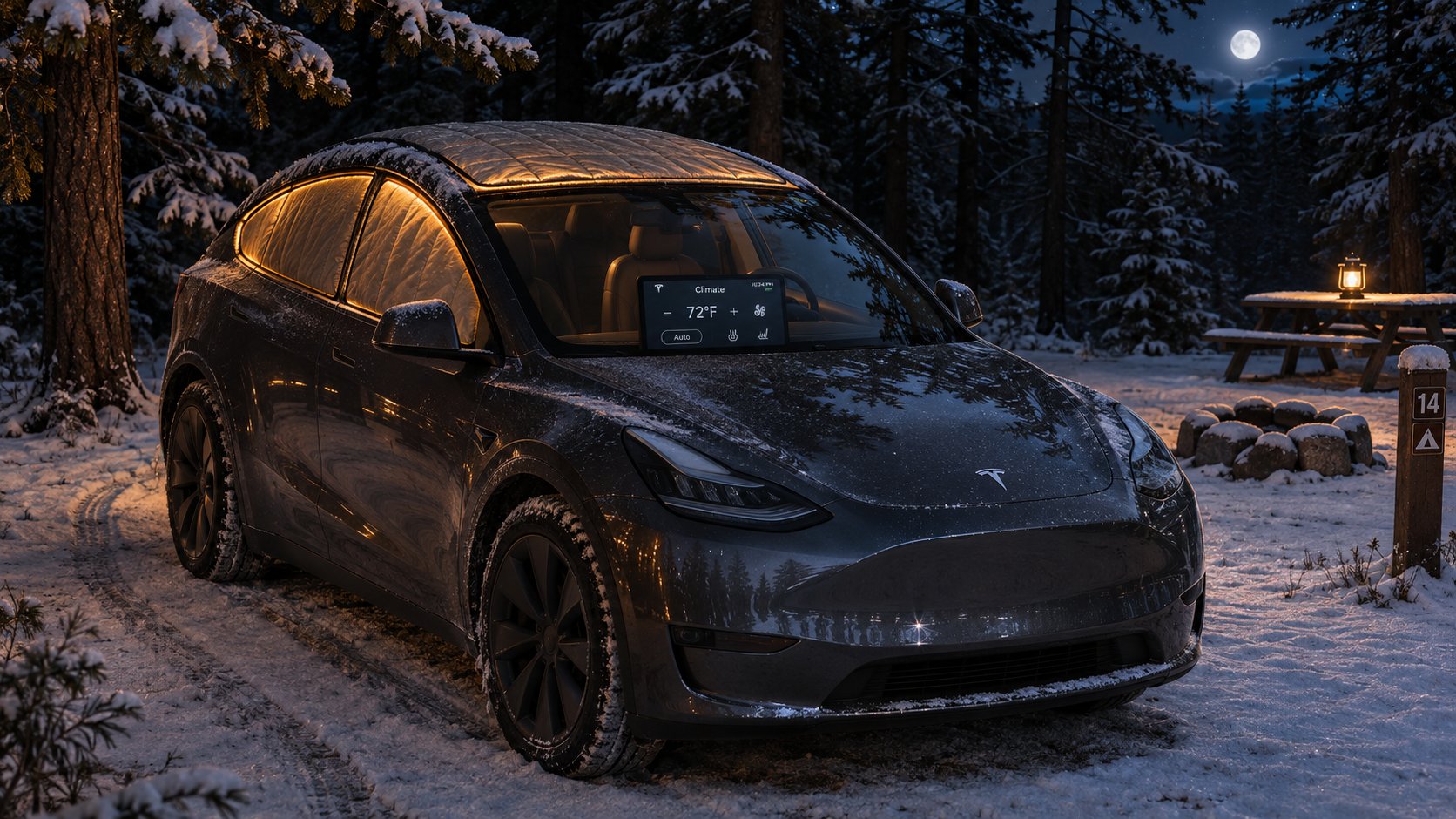
Swing to the opposite extreme — a January night in Colorado with the thermometer at 15°F and your cabin set to a cozy 70°F — and the heat pump battles a 55-degree temperature differential for eight straight hours. Consumption can climb past 24% and, according to EV-MATS' cold-weather testing, approach 30% to 50% in truly brutal freezing conditions. The panoramic glass roof, while stunning, provides almost zero thermal insulation and accelerates heat loss in winter. This is exactly why the window covers and insulating shades discussed in the previous chapter matter so much — they're not just about privacy; they directly reduce the HVAC workload and slow the battery drain.
How Model Y Variants Affect Your Overnight Buffer
The same Camp Mode feature runs identically across every Model Y variant, but the battery pack underneath determines how much margin for error you have. Here's where variant selection quietly becomes a Tesla Model Y car camping advantage — or a constraint.
The Long Range Model Y carries the largest usable battery capacity in the lineup. That extra capacity doesn't make Camp Mode consume fewer kilowatt-hours per hour — the HVAC system draws what it draws regardless of pack size — but it means the same overnight drain represents a smaller percentage of total charge. Losing 15% of a Long Range pack leaves you with significantly more morning miles than losing 15% of a Standard Range pack. For most owners planning regular Tesla Model Y tent camping trips, the Long Range variant offers the most comfortable overnight buffer: enough energy to run climate control all night, skip the 3 a.m. battery-level anxiety, and still reach a Supercharger after breakfast without white-knuckling the range estimate.
The Performance variant shares the Long Range battery but carries slightly more vehicle weight from its upgraded drivetrain and braking components. In practice, this weight penalty is negligible for overnight camping energy use — Camp Mode drains the stationary HVAC, not the motors — though it does slightly reduce your driving efficiency per mile the following morning. Think of the Performance pack as functionally identical to the Long Range for camping purposes, with marginally less range per percentage point when you start driving again.
The Standard Range (rear-wheel-drive) variant works perfectly fine for Tesla Model Y camp overnights in mild to moderate weather. The smaller pack simply leaves less room for error. A mild-weather night that consumes 10% is barely noticeable on any variant. A freezing night that burns through 25% to 30% on a Standard Range pack, however, could leave you uncomfortably close to the 20% floor where Camp Mode automatically shuts itself off — a hardcoded safety cutoff designed to preserve enough charge for you to drive to a charger. If you own a Standard Range Model Y and plan to camp in cold conditions, arriving at the campsite with 70% or more charge — rather than the 50% that suffices in mild weather — gives you a much more comfortable margin.
Practical Tips to Minimize Camp Mode Drain
You can't change the weather, but you can control how much energy the weather costs you. These rules of thumb come from owner-tested strategies that consistently reduce overnight consumption:
- Set the lowest comfortable cabin temperature. Every degree lower in winter (or higher in summer) reduces the gap the HVAC system has to bridge. Pair a 64°F cabin setting with a warm sleeping bag instead of cranking heat to 72°F and sleeping under a thin sheet. Sleep science suggests most adults sleep best between 60°F and 67°F anyway — your body and your battery agree on this one.
- Turn off Sentry Mode. Sentry Mode keeps the exterior cameras, FSD computer, and motion-detection algorithms running continuously. Disabling it while you sleep inside the vehicle can reduce total overnight drain by up to 30% in mild conditions. Camp Mode already disables the vehicle alarm and interior motion sensors — there's no security benefit to running both systems simultaneously while you're physically present.
- Install window covers before settling in. Insulating shades create a thermal buffer between the glass and the cabin air. In summer, they block residual radiant heat from sun-baked surfaces outside. In winter, they slow convective heat loss through the roof and side windows. Either way, the HVAC system cycles less frequently.
- Dim or sleep the touchscreen. Streaming Netflix or playing games on the center display pulls meaningful wattage on top of the climate system. If you're going to sleep, reduce the screen brightness to its minimum or use the "Screen Clean Mode" to turn it off entirely. Let it rest when you do.
- Limit device charging. Plugging in two phones, a laptop, and a portable speaker simultaneously draws power through the DC-DC converter. Charge your essentials before activating Camp Mode, then unplug what you can overnight.
- Park strategically. In summer, choose shade to reduce cooling demand. In winter, park with the nose facing away from prevailing wind to minimize heat loss through the front glass. Level ground isn't just about sleep comfort — it prevents the car from running extra systems to compensate for grade-related sensor alerts.
- Monitor from the Tesla app. You can check real-time battery level, cabin temperature, and Camp Mode status directly from your phone without touching the car's touchscreen. Set a mental check-in — glance at the app if you wake briefly during the night — and you'll catch unexpected drain before it becomes a problem.
Camp Mode's battery cost is predictable once you match it to the season: mild nights are nearly free, hot nights are moderate, and freezing nights demand serious charge planning — but insulation, lower temperature settings, and disabling Sentry Mode keep the draw manageable in every scenario.
Knowing your overnight energy budget changes how you plan the rest of the trip. The charge level you arrive with, the proximity of your campsite to a Supercharger, and whether the campground itself offers electrical hookups all feed into the same equation — and that's where EV-specific route planning earns its place alongside the sleeping gear and climate strategies you've already assembled.
Charging Logistics and Campground Planning for EV Road Trips
Your overnight energy budget is only half the equation. The other half is making sure you can replenish what you spent — ideally before you even leave the campsite. Gas-powered car campers rarely think about fuel when choosing a campground. For a camper for Tesla Model Y trips, charging infrastructure is just as important as flat ground and a fire ring. The good news? The tools to plan around it are already built into the car, your phone, and a handful of free apps.
Finding Campgrounds Near Charging Infrastructure
Three resources do most of the heavy lifting when you're scouting sites:
- Tesla's in-car navigation and route planner — Enter your destination and the car automatically plots Supercharger stops along the way, factoring in your current state of charge, elevation changes, and weather. It won't show campground-level detail, but it instantly reveals which Supercharger stations are within a short morning drive of your planned site.
- The Tesla mobile app — Use the app's map to browse Superchargers and Tesla Destination chargers (Level 2 stations installed at hotels, resorts, and some campgrounds). Destination chargers are especially valuable for overnight stays because they charge slowly and steadily — exactly what you want while you're sleeping.
- PlugShare — This crowd-sourced database covers every public charging network, not just Tesla's. Filter by connector type (NACS, J1772, CCS), power level, and real-time availability. Campground owners who have installed EV charging often list their stations here, complete with photos and user reviews describing the actual outlet types available at each pedestal.
A practical workflow: search PlugShare for campgrounds within your destination area that have Level 2 or higher charging on-site. Cross-reference against Tesla's in-car map to identify the closest Supercharger as a backup. Then book the campground with the best combination of on-site power and proximity to fast charging. That layered approach means you're never relying on a single charging source.
Using Campground Electrical Hookups to Charge Overnight
Here's something many first-time EV campers don't realize: traditional RV campgrounds already have electrical hookups at most sites — and those same outlets can charge your Tesla. The power pedestal at a typical RV site offers two or three outlet types, and understanding them unlocks a genuinely effortless overnight charge.
A 50-amp NEMA 14-50 outlet delivers true 240-volt Level 2 power. Plug in your Tesla Mobile Connector with the NEMA 14-50 adapter and you'll add roughly 25 to 30 miles of range per hour — enough to fully recover a day's driving while you sleep. This is the same outlet many Tesla owners install in their home garages, and it's the best option on any campground pedestal.
A 30-amp TT-30 outlet is the standard RV plug, but it runs at only 120 volts despite the higher amp rating. You'll need a TT-30-to-14-50 adapter (around $40) so your Mobile Connector fits, and you should dial your charging amps down to 24A or lower in the car's settings to avoid tripping the pedestal breaker. Charge speed drops to about 10 to 12 miles of range per hour — slower, but across eight or nine hours of sleep that's still 80 to 100 miles added by morning. For camping mode Tesla Model Y overnights where you only burned 10% to 20% running Camp Mode, that top-up more than covers the deficit.
A 20-amp standard household outlet (NEMA 5-20 or 5-15) is the last resort — trickle charging at 3 to 5 miles per hour. It's better than nothing for a multi-day stay, but don't count on it for meaningful recovery after a long driving day.
One important etiquette note from experienced campground EV owners: ask the campground at check-in whether EV charging from the pedestal is permitted. Most parks are fine with it, but a few prohibit it or charge an additional fee. A quick question at the front desk avoids an awkward confrontation later.
Route Planning for Remote and National Park Destinations
Campgrounds near interstate highways and popular tourist corridors tend to have Superchargers or Level 2 stations within easy reach. Remote destinations — think backcountry national forest sites, BLM dispersed camping areas, and some national parks — are a different story. Charging infrastructure thins out dramatically once you leave major corridors, and that's where arrival charge level discipline becomes critical.
The concept is simple: calculate backward from your next available charger. If the nearest Supercharger is 60 miles from your campsite and you expect Camp Mode to consume 15% overnight, you need to arrive with enough charge to cover both the overnight drain and the 60-mile morning drive — plus a comfortable 10% to 15% safety buffer for unexpected detours, elevation gain, or headwinds. For a Long Range Model Y, that math is usually forgiving. For a Standard Range variant in cold weather, it demands more deliberate planning.
National parks present a unique mix of opportunity and challenge for Tesla Model Y camping enthusiasts. Many gateway towns — Springdale near Zion, Moab near Arches and Canyonlands, Tusayan outside the Grand Canyon, Jackson Hole near Grand Teton — now have charging stations, and hotels and lodges within park boundaries are increasingly adding EV-ready amenities. But once you're deep inside a park on a scenic byway, you're on battery alone. High desert heat can also reduce range, as the battery management system throttles output to protect cells at extreme temperatures.
A practical framework: treat remote camping as a two-stage plan. Stage one is the drive in — arrive with a healthy state of charge, ideally 70% or above for cold-weather trips and 50% or above for mild conditions. Stage two is the drive out — know exactly where your first charging stop will be, how many miles it takes to reach it, and what connector types are available there. Apps like PlugShare and the ChargeHub trip planner let you verify station status before you leave cell coverage.
Speaking of cell coverage — it matters more than you'd expect. The Tesla app is your real-time window into battery level, cabin temperature, and Camp Mode status while you're away from the car. Campgrounds with poor signal make remote monitoring impossible, which means you'll need to physically check the touchscreen if you want to confirm overnight drain. When comparing sites, a campground with reliable LTE signal isn't just convenient — it's a functional safety net for your energy planning.
Here's a consolidated checklist of campground selection criteria that EV owners should weigh alongside the usual campsite priorities:
- Proximity to charging — Is there a Supercharger, Destination charger, or on-site electrical hookup within comfortable driving range of the campsite?
- Outlet type at the pedestal — Does the site offer 50A (NEMA 14-50), 30A (TT-30), or only standard 20A household outlets? Bring the appropriate adapters.
- Cell signal strength — Can you reach the Tesla app from the campsite for remote monitoring of battery level and Camp Mode status?
- Level terrain — A flat site isn't just more comfortable for sleeping; it prevents the vehicle from triggering grade-related sensor alerts and keeps the mattress from shifting overnight.
- Shade availability — In summer, a shaded site reduces cabin heat buildup during the day and lowers the cooling demand on Camp Mode overnight, preserving battery.
- Campground EV policy — Confirm that the campground allows EV charging from its pedestals, and ask about any additional fees or restrictions before plugging in.
- Distance to next-morning charger — Even if the campground has no power, knowing you can reach a fast charger within 30 to 50 miles gives you a reliable exit strategy.
Dialing in your charging logistics removes the single biggest anxiety point of EV camping. But energy planning doesn't happen in a vacuum — it shifts with the season. A summer trip to Joshua Tree and a winter weekend in the Rockies demand fundamentally different strategies for temperature management, battery budgeting, and gear selection, which is exactly where seasonal planning ties everything together.
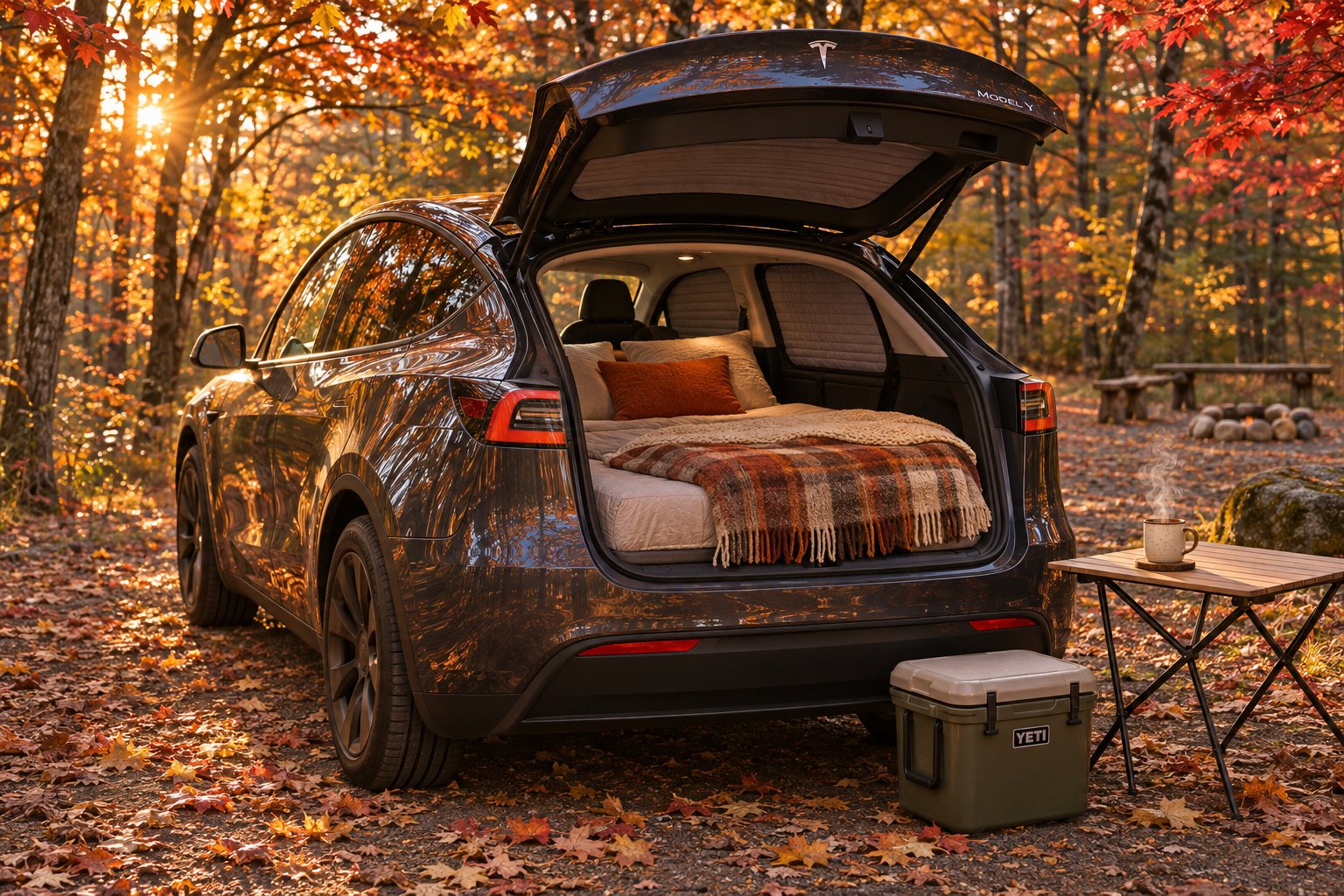
Seasonal Strategies and Your Pre-Trip Camping Checklist
A July overnighter at Joshua Tree and a February weekend in the Colorado Rockies both start with the same vehicle, the same Camp Mode toggle, and the same cargo floor. Yet they demand completely different approaches to temperature management, battery budgeting, and gear selection. Season is the variable that ties every other decision in this guide together — your mattress choice, your window cover investment, your arrival charge level, and even your campground selection all shift depending on whether you're fighting heat, cold, or something in between.
Summer Heat Management Strategies
High temperatures force the air-conditioning compressor to run harder and longer, which drives up overnight battery consumption. The goal in summer isn't just comfort — it's reducing the thermal load the vehicle has to fight so Camp Mode can do its job efficiently.
Start with site selection. A shaded campsite under tree cover can lower exterior surface temperatures by 20°F or more compared to a fully exposed parking spot. That smaller gap between outside heat and your target cabin temperature translates directly into lower compressor demand and less battery drain. If shade isn't available, park so the rear glass and panoramic roof face away from the afternoon sun's final angle — residual heat stored in the glass and body panels radiates inward for hours after sunset.
Reflective window covers are your best passive defense. Installed before the sun goes down, they bounce radiant heat away from the cabin instead of letting it soak through the glass. Multi-layer covers with a reflective outer face are especially effective because they reject solar energy before it ever enters the interior. Even after dark, those covers help — they insulate against warm ambient air pressing against the glass and reduce the cooling system's cycling frequency.
Inside the cabin, set Camp Mode to a moderate temperature — 72°F to 74°F rather than an aggressive 65°F. The compressor works exponentially harder to maintain large differentials, and most sleepers won't notice a two-degree difference once they're horizontal under a light sheet. A small USB-powered fan clipped to the front headrest moves air across your body, creating a wind-chill effect that makes a warmer set point feel cooler on the skin without any additional HVAC cost.
One summer-specific tip that experienced campers swear by: crack a window roughly one-quarter inch on each side of the vehicle before activating Camp Mode. This allows the HVAC system to exhaust stale warm air rather than recirculating it, and it prevents the slight positive cabin pressure that can make the interior feel stuffy even at comfortable temperatures. The energy cost of conditioning the tiny volume of fresh air entering through a quarter-inch gap is negligible compared to the perceived comfort improvement.
Winter Camping and Cold-Weather Battery Tips
Cold nights flip the equation. The Model Y's heat pump is remarkably efficient down to about 30°F, but below that threshold it works progressively harder to extract thermal energy from frigid outside air. Real-world winter camping data shows that owners who rely solely on Camp Mode heat in sub-20°F conditions can burn through 30% to 50% of their battery in a single night — an unsustainable draw for anyone who needs to drive to a charger the following morning.
The solution is a layered warmth strategy that shifts the burden from the battery to your bedding. Set the cabin temperature lower than you think you need — 60°F to 64°F is a realistic target — and make up the difference with a cold-rated sleeping bag, an insulated sleeping pad with a high R-value, and thermal base layers. A properly insulated sleep system rated to 20°F or below keeps you comfortable even if the cabin sits at 60°F, and that lower set point can cut your overnight drain nearly in half compared to heating to 72°F.
Insulating window covers become non-negotiable in winter. Glass is the weakest thermal barrier in the vehicle, and the panoramic roof — while gorgeous for stargazing — is essentially a massive cold radiator pulling heat out of the cabin all night. Quality insulated window covers can reduce overnight heat loss by 30% to 40%, which translates directly into fewer heat pump cycles and a gentler battery draw. Dedicated thermal liners for the glass roof are available from multiple accessory brands and are well worth the investment for anyone who camps in temperatures below freezing.
A few additional cold-weather considerations:
- Arrive with 70% charge or higher. Cold reduces both battery efficiency and Camp Mode's automatic shutoff threshold sits at 20%. A larger buffer protects you from waking up in a cold, powered-down cabin.
- Pre-heat the cabin before settling in. Run the heater at full blast for 10 to 15 minutes while you're still organizing gear outside. Warming the interior mass — seats, dashboard, headliner — means the heat pump has less catch-up work once Camp Mode takes over at a lower set point.
- Avoid portable fuel-based heaters. Propane and butane heaters introduce carbon monoxide risk, moisture buildup, and fire hazard inside an enclosed vehicle. They are not recommended for Tesla winter camping.
- Pack a backup plan. If temperatures drop well below your forecast, an extra blanket or a low-wattage USB-powered heated pad gives you a safety net that doesn't rely on the HVAC system at all.
Shoulder Seasons and Rain-Night Condensation
Spring and fall are the sweet spot for the best camper for Tesla Model Y adventures. Daytime highs hover in the 50s to 70s, overnight lows settle into the 40s to 60s, and Camp Mode barely breaks a sweat maintaining a comfortable cabin temperature. Battery consumption on a mild shoulder-season night often lands in the single digits — 5% to 10% over eight hours — leaving you with plenty of range for the next morning's drive.
The catch? Nighttime temperature swings can be dramatic, especially at elevation. An evening that starts at a pleasant 65°F can drop into the low 40s by 3 a.m. A layered sleep system handles this gracefully: start under a light blanket, keep a warmer sleeping bag unzipped at your feet, and pull it up if you feel the chill creep in. Camp Mode will adjust the HVAC automatically, but giving your bedding the first line of defense reduces the number of heating cycles the system runs during those pre-dawn hours.
Rain brings a separate challenge: condensation. Two adults breathing inside a sealed cabin for eight hours produce a surprising amount of moisture, and when that warm humid air meets cold glass surfaces, water condenses on every window. Window covers help by keeping the glass slightly warmer, which slows condensation formation — but they don't eliminate it. Cracking a window on each side of the vehicle by a quarter inch provides enough cross-ventilation to carry moisture out without letting rain in, especially if you park with the wind hitting the front bumper rather than a cracked side window directly. A compact USB-powered dehumidifier placed in the footwell can also absorb excess moisture overnight, and reusable silica-gel moisture absorbers tucked into the corner pockets work passively without drawing any power at all.
Successful Model Y camping depends on matching your sleep setup, charge planning, and climate strategy to the season — mild nights are nearly free, extreme temperatures demand layered insulation and deliberate charge targets, and shoulder seasons reward you with the easiest overnights of the year.
Your Pre-Trip Model Y Camping Checklist
Every chapter in this guide — Camp Mode activation, sleeping dimensions, mattress selection, budget tiers, accessories, battery management, charging logistics, and seasonal strategies — feeds into a single moment: the hour before you settle in for the night. This checklist ties it all together so nothing falls through the cracks, whether you're heading out for your first-ever camp Tesla Model Y experience or your fiftieth.
- Set your arrival charge target. Mild weather: arrive with at least 50% state of charge. Cold weather: aim for 70% or higher. If the campground has electrical hookups, confirm outlet type (NEMA 14-50, TT-30, or standard 120V) and bring the correct adapter so you can charge overnight.
- Verify your sleep gear is packed. Mattress, pillow, sleeping bag or blankets, fitted sheet or liner. Match insulation to the forecast — a warm-rated bag for winter, a light blanket for summer. When assembling seasonal gear, CUTIM's camping collection offers a convenient way to compare foam and inflatable mattress options by vehicle generation alongside brands like TESMAT, SNUUZU, and TESCAMP.
- Install window covers before sunset. Every window, including the front windshield and panoramic roof. In summer they reflect heat; in winter they insulate against cold; year-round they block light and provide privacy. Fit them early so you're not fumbling with panels in the dark.
- Fold rear seats and set up the sleeping surface. Level the seat-fold slope with your mattress, gap-filling materials, or a sleeping platform. Test that the surface is stable and comfortable before you commit to lying down for the night.
- Activate Camp Mode. Open climate controls, tap Camp, and set your target temperature. Summer: 72°F – 74°F with a USB fan for airflow. Winter: 60°F – 64°F supplemented by insulated bedding. Shoulder seasons: 66°F – 68°F is usually perfect.
- Turn off Sentry Mode. Disable it from the touchscreen or the Tesla app. Running Sentry alongside Camp Mode wastes battery on continuous camera processing and risks jarring false alarms from passing wildlife or neighboring campers.
- Lock the doors from the Tesla app. Camp Mode disables Walk-Away Door Lock, so tap the lock icon in your app once you're settled inside. This keeps the car secured without triggering the alarm system.
- Dim the touchscreen and switch off interior lights. Lower brightness to minimum, turn off dome lights, and drape a cloth over the screen if residual glow bothers you.
- Crack windows slightly if needed. A quarter-inch gap on two opposite windows manages condensation and improves air circulation without meaningful energy loss.
- Set a morning alarm in the Tesla app or on your phone. Check your battery level when you wake up. Confirm you have enough range to reach your next charging stop — including a 10% to 15% safety buffer for elevation, headwinds, or detours.
That's the complete picture — from the first time you tap Camp on the touchscreen to the morning you roll up your mattress, check your range, and pull out of the campsite with a full night of climate-controlled sleep behind you. The best Tesla Model Y camping tent, the best Tesla Model Y camping mattress, and the smartest charging strategy all matter — but none of them work in isolation. Match your gear to the season, your charge level to the terrain, and your expectations to the trip, and the Model Y stops being a commuter crossover and starts being the most comfortable, quietest, and most capable base camp you've ever slept in.
Tesla Model Y Camper: Frequently Asked Questions
1. How much battery does Camp Mode use overnight in a Tesla Model Y?
Overnight battery consumption depends heavily on outside temperature and your cabin set point. On mild nights between 60°F and 75°F, expect roughly 8% to 15% drain over eight hours — barely more than normal vampire drain. Hot summer nights with AC running push consumption to 12% to 20%, while freezing winter nights can draw 24% to 50% depending on severity. Turning off Sentry Mode, installing insulating window covers, and setting the lowest comfortable cabin temperature are the most effective ways to reduce drain. Standard Range owners should arrive at camp with at least 70% charge in cold weather to maintain a safe buffer above the 20% automatic shutoff threshold.
2. Can two adults sleep comfortably in a Tesla Model Y?
Yes, though comfort depends on body size and personal space preferences. The usable flat width between the wheel wells measures approximately 41 to 42 inches — roughly the width of a standard double bed. Each person gets about 20 to 21 inches of shoulder room at the narrowest point, which works well for couples who sleep close together but feels tight for two broad-shouldered adults. Using a single vehicle-width mattress rather than two separate pads eliminates the annoying center gap. Solo travelers benefit from the full 48-inch floor width and can even sleep diagonally for extra room.
3. What is the best camping mattress for a Tesla Model Y?
The best mattress depends on how you travel and how often you camp. Custom-fit foam mattresses from brands like TESMAT and SNUUZU offer the highest comfort and level the seat-fold slope perfectly, but they consume significant cargo space when stored. Self-inflating foam-air hybrids from brands like Lost Horizon balance comfort and portability. Inflatable air mattresses from Hikenture and others pack down smallest and cost the least but leave gaps around wheel wells. CUTIM's Tesla mattress collection at cutimauto.com organizes foam and inflatable options by vehicle generation, making it easy to compare formats before committing.
4. Can you charge a Tesla Model Y at a campground overnight?
Many RV campgrounds have electrical hookups that can charge your Tesla. A 50-amp NEMA 14-50 outlet delivers Level 2 power at roughly 25 to 30 miles of range per hour — enough for a full recovery overnight. A 30-amp TT-30 RV outlet adds about 10 to 12 miles per hour with the right adapter, still sufficient to offset Camp Mode drain and add meaningful range. Standard 20-amp household outlets provide only 3 to 5 miles per hour, suitable mainly for multi-day stays. Always ask the campground at check-in whether EV charging from their pedestals is permitted, as policies vary by location.
5. Does Camp Mode work on all Tesla Model Y variants?
Camp Mode is available on every current Model Y variant — Standard Range, Long Range, and Performance — at no additional cost. The feature runs identically across all trims, keeping HVAC, USB power, interior lights, and the touchscreen active while the vehicle is in Park. The key difference between variants is battery capacity: Long Range and Performance models share a larger pack, so the same overnight drain represents a smaller percentage of total charge and leaves more driving range the next morning. Standard Range owners simply need to plan arrival charge levels more carefully, especially in cold weather.