
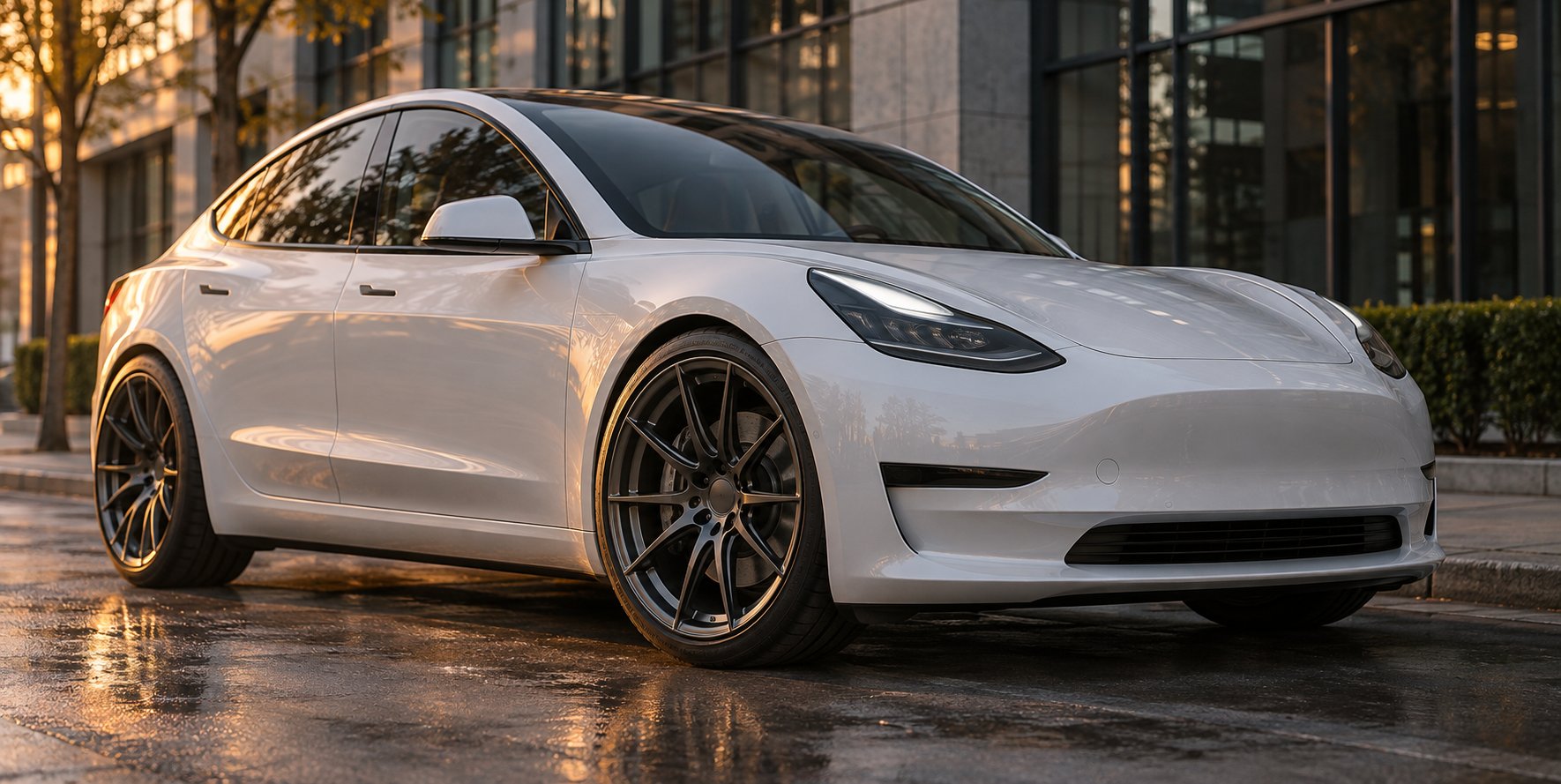
Why Custom Tesla Model 3 Wheels Are a Smart Upgrade
Park your Model 3 at a busy Supercharger and you'll probably see several more that look almost the same, with the same paint choices and the same factory rims. New wheels are one of the quickest ways to make the car look like yours. So many Model 3s are on the road that the aftermarket for tesla wheels is huge. It also comes with Tesla-specific rules that someone shopping for a gas car never has to think about. This guide takes you through each decision before you spend money, and it doesn't push any one brand.
Common Reasons Model 3 Owners Explore Custom Wheels
Looks usually come first. A darker finish, a new spoke design, or a bigger diameter can change the whole profile of the car. Curb rash comes next. The low-profile tires on stock tesla model 3 wheels leave little sidewall to protect the rim lip. After a few scrapes, many owners would rather buy new tesla rims model 3 owners actually want than refinish the old ones. Other owners want a lighter or more unusual design, or they like the look of tesla model 3 performance wheels and want something similar on a Standard or Long Range car.
What Makes Wheel Shopping Different on an EV
Weight matters in a specific way. Wheels, tires, and brakes make up a car's unsprung mass, which is the weight the suspension doesn't carry. Engineers at Protean Electric explain that the dampers can push a lighter wheel back onto the road more easily, which helps grip. Their study with Lotus Engineering also found that road roughness affected ride much more than unsprung mass did. A lighter wheel is a small improvement and won't change how the car drives overall.
Integration with the car's systems matters too. The motor has to spin up any extra rotating weight, and regenerative braking has to slow it back down. The tire pressure sensors report directly to the car's software, and newer cars use Bluetooth-based sensors, which limits which sensors you can reuse. This guide covers each of these decision factors:
- Fitment specs: bolt pattern, hub bore, offset, and brake clearance
- Construction type: cast, flow-formed, or forged
- Diameter trade-offs at 18, 19, and 20 inches
- Tire pairing and overall rolling diameter
- Finish options and how to care for them
- TPMS sensor transfer and pairing
- Warranty and service center considerations
- How to compare aftermarket options
Even the best-looking wheel is useless if it won't mount safely on your car, so the fitment numbers need to come before any style choice.
Tesla Model 3 Wheel Fitment Specs Every Buyer Needs
Have you ever found a wheel design you love and then wondered whether it will actually bolt on? A handful of numbers answers that question. Some of them allow no tolerance at all. Others give you a little room to adjust the look you want.
Bolt Pattern, Hub Bore, and Why They Are Non-Negotiable
Every Model 3, pre-Highland or Highland, uses a 5x114.3 mm bolt pattern and a 64.1 mm center bore. The bolt pattern means five lug studs spaced around a circle 114.3 mm across. The lug nuts are M14x1.5 with a 21 mm hex, torqued to 175 Nm (129 lb-ft), as listed in The New Aero's fitment chart. A 5x112 or 5x115 wheel can look close enough, but it won't fit correctly. Forcing the lugs on pulls the wheel off center and loads the studs unevenly.
The center bore decides whether a wheel is hub-centric or lug-centric. On a hub-centric wheel, the center hole fits snugly over the hub, so the hub carries the load and keeps the wheel centered. A lug-centric wheel depends on the tapered lug nuts alone to center it. Many aftermarket wheels have an oversized bore so they fit several car models. The fitment team at ThreePiece.us notes that most of these wheels hub-center on the Model 3 when fitted with the correct hub rings. This is especially important on an EV. The motor delivers full torque from a stop, and the quiet cabin makes small vibrations easy to notice. If a wheel sits slightly off center, you may feel a shimmy in the steering wheel that engine noise would hide in a gas car.
OEM Wheel Sizes and Offset Ranges by Variant
Offset is the distance from the wheel's mounting face to its centerline. A higher positive offset tucks the wheel deeper into the wheel arch. Factory tesla 3 wheels vary by generation and trim:
| Variant | OEM Wheel | Width | Offset | Factory Tire Size |
|---|---|---|---|---|
| Pre-Highland Standard Range / Long Range | 18-inch Aero | 8.5 in | +40 mm | 235/45R18 |
| Pre-Highland (optional) | 19-inch Stiletto | 8.5 in | +40 mm | 235/40R19 |
| Highland RWD / Long Range | 18-inch Photon | 8.5 in | +38 mm (some sources list +40 mm) | 235/45R18 |
| Highland Long Range (optional) | 19-inch Nova | 8.5 in | +38 mm | 235/40R19 |
| Highland Performance (staggered) | 20-inch Warp | 9.0 in front / 10.0 in rear | +34 mm front / +45 mm rear | 235/35R20 front / 275/30R20 rear |
Pre-Highland Performance cars came on 20-inch wheels. Check the width and offset for those cars in your owner documentation. Published specs also disagree by 2 mm on some 18-inch offsets, so confirm exact specs for your model year through Tesla's owner documentation or a qualified wheel specialist. Check the wheel's stated load rating as well. It should meet or exceed what your variant requires, and a reputable vendor can show you that number. Listings for tesla model 3/y turbine wheels need extra scrutiny, because Model 3 wheels are generally not interchangeable with Model Y wheels without modifications.
Brake Caliper Clearance Across Variants
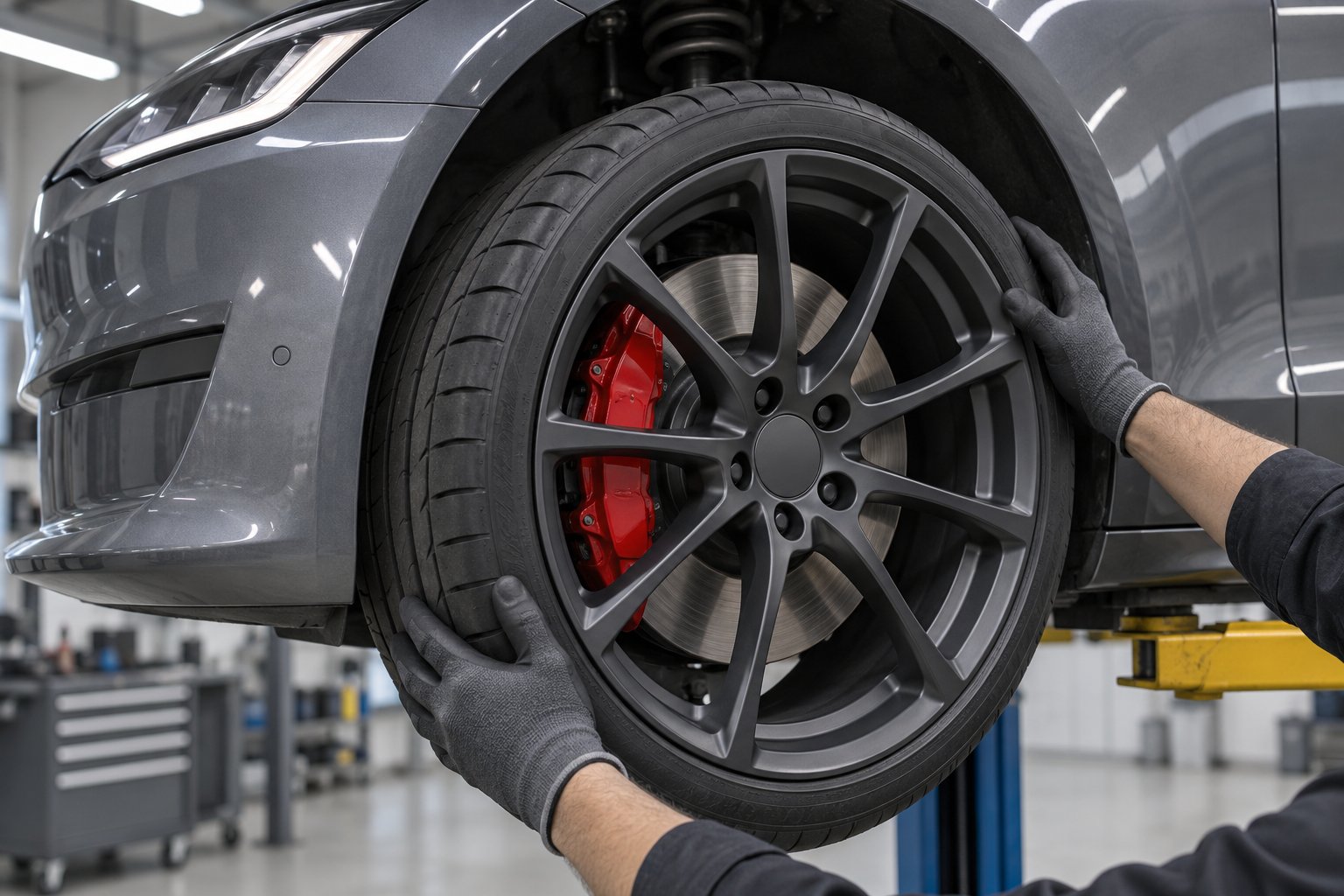
Performance models have the tightest fitment. CyberMetals describes the Performance car's 4-piston Brembo calipers as wider and more protruding than the calipers on other Model 3 trims. It adds that many aftermarket brands never test their wheels against Tesla's brake profile. On 2023 and newer cars, ThreePiece.us reports that the most common contact point is between the rear caliper and the inside of the wheel barrel, and the spokes are less often the problem. Base-brake cars clear 18s easily. On a Performance car, 18s are hit-or-miss.
Say you want a set of 18 inch tesla wheels with taller tires for winter on a Performance car. That set may only clear the calipers if the wheel has thin barrel walls, which flow-formed and forged wheels usually do. Square 19- and 20-inch setups rarely raise the same concern.
Before ordering any tesla wheel, verify brake clearance with the wheel vendor or a fitment specialist, especially for 18-inch wheels on a Performance Model 3.
The barrel-wall detail shows that the way a wheel is made can decide whether it clears the brakes, in addition to setting its weight and price.
Forged, Flow-Formed, and Cast Tesla Model 3 Rims Explained
Have you seen product titles with words like "rotary forged" or "spin-formed" and wondered what they mean? Each of these labels tells you how the wheel was made. The method sets the wheel's weight, strength, and price. On a Performance car it can also decide whether the wheel clears the calipers.
Cast Wheels and Where They Fit
Casting is the simplest and cheapest method. Molten aluminum, usually A356 alloy, is poured into a mold shaped like the finished wheel. In gravity casting, the metal fills the mold under its own weight. In low-pressure casting, pressure pushes the metal up into the mold, which leaves fewer air pockets and makes a denser wheel. A cast wheel needs thicker sections to be strong enough, so it ends up heavier. Discounted Wheel Warehouse also notes that cast wheels bend or crack more easily under heavy loads, though they hold up fine in normal driving. Cast wheels also come in the widest range of designs and finishes. If you mainly want a new look on a daily driver, cast tesla 3 rims are a sensible low-cost place to start.
Flow-Formed and Spin-Formed Construction
A flow-formed wheel starts as a cast blank. The face and spokes stay as they were cast. The barrel is heated and spun while high-pressure rollers stretch and squeeze it out to its final width. The team at Unleashed Wheels describes this as a hybrid between casting and forging. Rolling the metal lines up the aluminum's grain structure, so the barrel can be thinner and still be stronger than a cast barrel.
"Rotary forged" and "spun forged" are marketing names for this same basic process. "Flow forged" is a vaguer term, and Blaque Diamond recommends asking the manufacturer exactly what process it means.
Flow forming is a common choice among aftermarket wheels for tesla model 3 owners because it cuts unsprung weight for much less than forged pricing. Keep your expectations modest, though, since unsprung weight has only a small effect on ride. The thinner barrel has a second advantage: it can help with the Performance caliper clearance problem described in the fitment section.
Fully Forged Wheels and the Premium Trade-Off
A forged wheel starts as a solid billet of aluminum, typically 6061 alloy. The billet is heated, pressed into shape under very high pressure, and then machined into its final design. This gives the densest, most uniform structure and the best strength-to-weight ratio of the three methods. Many forged wheels can be ordered with a custom offset, which helps when caliper clearance is tight. The specialized equipment and labor make forged wheels by far the most expensive option. Forged model 3 performance wheels make the most sense for track use or for owners who want the lightest setup and will pay for it.
| Construction | Process Summary | Relative Weight | Relative Strength | Price Tier | EV-Specific Notes |
|---|---|---|---|---|---|
| Cast | Molten aluminum poured into a mold | Heavy | Fine for daily driving, but can bend or crack under heavy loads | $ | Suits looks-focused builds. Adds unsprung weight. Thick barrels can limit Performance caliper clearance. |
| Flow-formed (spin-formed, rotary forged) | Cast face, with the barrel heated, spun, and rolled under pressure | Medium | Stronger than cast | $$ | Popular middle ground for Tesla owners. The thinner barrel can help with caliper clearance. |
| Forged | Solid billet heated, pressed, and machined | Light | Highest | $$$$ | Lowest unsprung weight, and custom offsets are often available. Best suited to track use or precise fitment needs. |
Construction decides how much a wheel weighs at a given size. Diameter decides how much tire sidewall sits between the rim and the road. Two tesla model 3 rims built the same way can ride very differently once you go from 18 to 20 inches.
How Wheel Diameter Shapes Ride Quality and Aesthetics on the Model 3
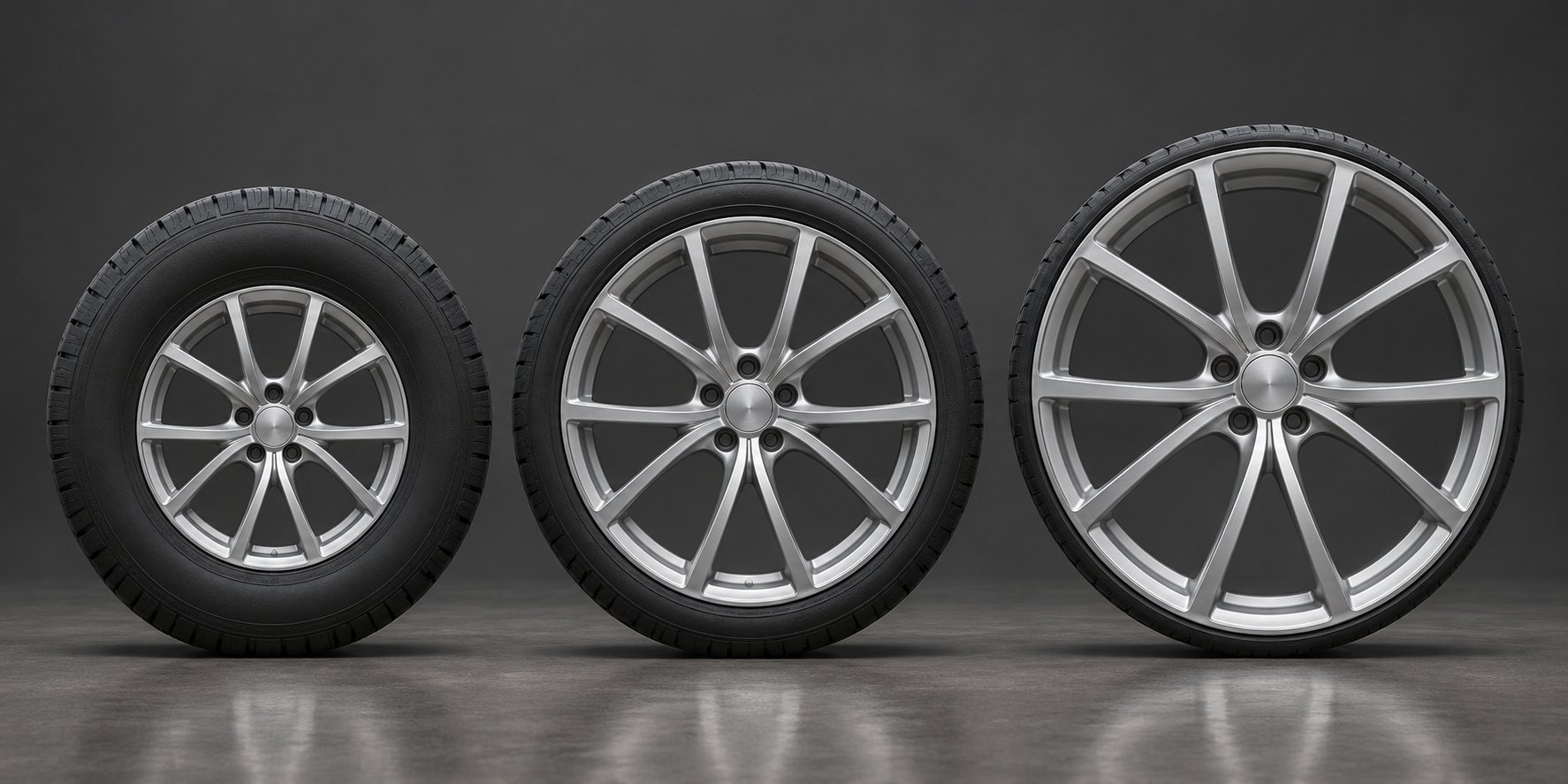
Picture two Model 3s parked side by side, one on 18s and one on 20s. The car on 20s looks lower and more planted. The car on 18s is the one you'd rather ride in over a cracked highway. The tire explains the difference. A bigger wheel usually gets a shorter sidewall, so the overall tire height stays about the same. Tesla's own factory sizes show this. The 235/45R18 tire has a sidewall about 106 mm tall. The 235/40R19 has about 94 mm. The 235/35R20 front tire on the Highland Performance has only about 82 mm.
18-Inch Wheels for Comfort and Everyday Driving
18 inches is the factory base size on most Model 3 variants, including the pre-Highland Aero and the Highland Photon. It's also the most common size for tesla model 3 aftermarket wheels on daily-driver builds. The taller sidewall flexes over potholes, broken pavement, and expansion joints, so less of each hit reaches the cabin. Tires in this size also tend to be quieter and cheaper to replace. Unplugged Performance sells wheels in all three sizes, and it still calls 18s the sweet spot for most owners. Its reason is that the extra rubber soaks up rough roads and also shields the rim from potholes.
19-Inch Wheels as a Balanced Middle Ground
Tesla has offered 19s on both generations of the car. Pre-Highland cars could get the Stiletto, often called the Sport wheel, and Highland cars can get the Nova. Since so many factory designs come in 18 or 19 inches, this range will look familiar to most owners. A 19 gives an OEM-plus look. It fills the wheel arch a little more without making the car look heavily modified. You lose about 12 mm of sidewall compared with an 18. You'll feel sharp impacts a bit more, but most drivers find the ride easy to live with.
20-Inch Wheels and the Aggressive-Stance Trade-Off
20s make the biggest visual change, especially on the "black Tesla, black rims" look, where a thin band of rubber makes the wheel seem to fill the arch. You pay for that look on bad roads. Consumer Reports explains that low-profile tires have short, stiff sidewalls that can't flex around a pothole edge as well as taller tires, so they are more prone to damage. AAA estimates that about 1 in 10 drivers each year has pothole damage that needs repair, at an average cost of about $600. Larger tires also usually cost more per tire. If your area has a lot of potholes, CR's tire experts suggest buying a road hazard warranty for expensive short-sidewall tires. The same advice applies to owners shopping for aftermarket wheels for tesla model y, although the Model Y has different fitment specs.
| Diameter | Sidewall Profile | Ride Comfort | Road Noise | Curb and Pothole Damage Risk | Tire Replacement Cost | Visual Profile |
|---|---|---|---|---|---|---|
| 18-inch | Tallest | Most comfortable | Lowest | Lowest | $ | Clean, factory-like |
| 19-inch | Moderate | Slightly firmer | Moderate | Moderate | $$ | OEM-plus, fuller arch |
| 20-inch | Shortest | Firmest | Highest | Highest | $$$ | Aggressive, low stance |
Work out the overall diameter of the factory 18-, 19-, and 20-inch tires, and you get about 669, 671, and 673 mm. They land within a few millimeters of each other. Tesla chose each tire size to keep rolling diameter nearly the same across wheel sizes. When you buy tesla aftermarket wheels, the tires you pair with them have to keep that diameter too.
Matching Tires to Aftermarket Model 3 Wheels
Say you've found a set of tesla black wheels you love, and the installer asks which tires you want. Most people choose by brand or price. Aftermarket tesla rims only ride as well as the tires mounted on them, though, and on a Model 3 three numbers matter more than the brand: overall diameter, load index, and speed rating.
Why Overall Tire Diameter Matters on the Model 3
The car uses wheel-speed readings to run the speedometer, odometer, traction control, and stability control. At the same road speed, a taller or shorter tire turns at a different rate, so those readings drift. A large change can set off dashboard warnings or make these systems less accurate.
A tire-size calculator does the math for you. Enter the factory size and the new size, and it shows the percentage difference. The rule of thumb at Emotive Engineering is to stay within plus or minus 3% of the OEM overall diameter, and closer to zero is better. For example, a 245/40R19 is 1.2% taller than the factory 235/40R19, which is well inside that range. For scale, a tire loses about 0.6 cm of diameter through normal wear over its life. After installation, set the car's Wheel Configuration to the closest match and reset the tire configuration. This keeps range estimates, tire pressure warnings, and the on-screen car image accurate.
Load Index and Speed Rating Requirements
The load index is a number on the sidewall that tells you the maximum weight each tire can carry. A Model 3 weighs roughly 3,600 to just over 4,000 lbs, depending on variant and battery. Divided by four, that is about 1,000 lbs per corner before you add passengers or cargo, and the weight isn't spread evenly between corners. Tesla's owner's manual says the load and speed ratings on any replacement tire must equal or exceed the original specification.
The Tire and Loading Information label on the driver's door pillar shows the original tire size and pressures. Read the factory load index and speed rating off the sidewall of your original tires or from the manual's Wheels and Tires specifications. If your new tire size differs from the label, Tesla says the driver is responsible for finding the correct pressure, so ask your installer to confirm it.
Square vs Staggered Setups
A square setup uses the same tire size at all four corners. A staggered setup puts wider tires on the rear. Most Model 3s ship with square setups. The Highland Performance is the exception, with 235/35R20 tires in front and 275/30R20 tires in back. Tesla recommends a tire rotation every 6,250 miles. On a staggered car with non-directional tires, you can only swap tires left to right, never front to back, so the rear pair usually wears out first. Square sets of model 3 wheels can be rotated in any pattern and usually get more miles out of each set of tires.
Run through these checks before you buy tires for any tesla model 3 rim:
- Overall diameter: Within plus or minus 3% of the OEM size, as close to 0% as you can get.
- Load index: Equal to or higher than the factory tire's rating.
- Speed rating: Equal to or higher than the factory tire's rating.
- Square or staggered: Decide whether you care more about rotation and tire life or about a wider rear stance.
- Seasonal use: Fit winter tires as a full set of four with the same diameter, brand, construction, and tread pattern. Summer performance tires lose grip below about 40 degrees F. Regenerative braking may be weaker for a short time after you fit aggressive winter tires.
Winter tires cope with the cold, but the wheel finish still has to survive road salt and months of brake dust.
Wheel Finishes and Ongoing Care for Tesla Model 3 Owners
Do you take your Model 3 through an automatic car wash on the way home from work? If you do, the finish you choose matters as much as the spoke design. The finish sets how the wheel looks in sunlight. It also sets how often you need to clean it and how well it hides a scratch.
Common Wheel Finish Options
Most aftermarket finishes belong to a few families. The finish guide from Variant Alloy Wheels lays out the trade-offs for each one.
Gloss finishes are shiny and reflective and sit under a hard clear coat. Brake dust and swirl marks show up easily on them. Gloss is still the easiest finish to repair, because a scratched wheel can be buffed and given a new clear coat.
Satin and matte finishes range from a soft low sheen to completely flat. Day to day, they hide dust and small marks better than gloss. They are harder to fix later. You can't buff a scuff out of a true matte finish, and wax or the wrong cleaner can leave shiny spots that never come out.
Brushed and machined faces show the metal's grain and depend on a protective clear coat over the bare aluminum. If that coat chips, the repair is a job for a refinishing specialist.
Powder coating is different. Powder coat is a dry powder that is sprayed on and then baked. It cures into a thick, hard layer that resists corrosion, so the color layer is also the protection.
The main difference between these finishes is what covers the metal. If a finish depends on clear coat, your goal is to keep that layer intact. Once the clear coat breaks, water and road salt can reach the alloy underneath.
Finish Maintenance and Tesla-Specific Cleaning Considerations
Regenerative braking does most of the slowing on a Model 3, so the friction brakes see little use. An analysis by EIT Urban Mobility and Transport for London, reported by Electrek, found that battery-electric cars produce 83% less brake dust. That still leaves some dust. The front wheels do most of the friction braking, so they collect the most, mainly in spoke corners and around the five lug nuts of the tesla model 3 lug pattern.
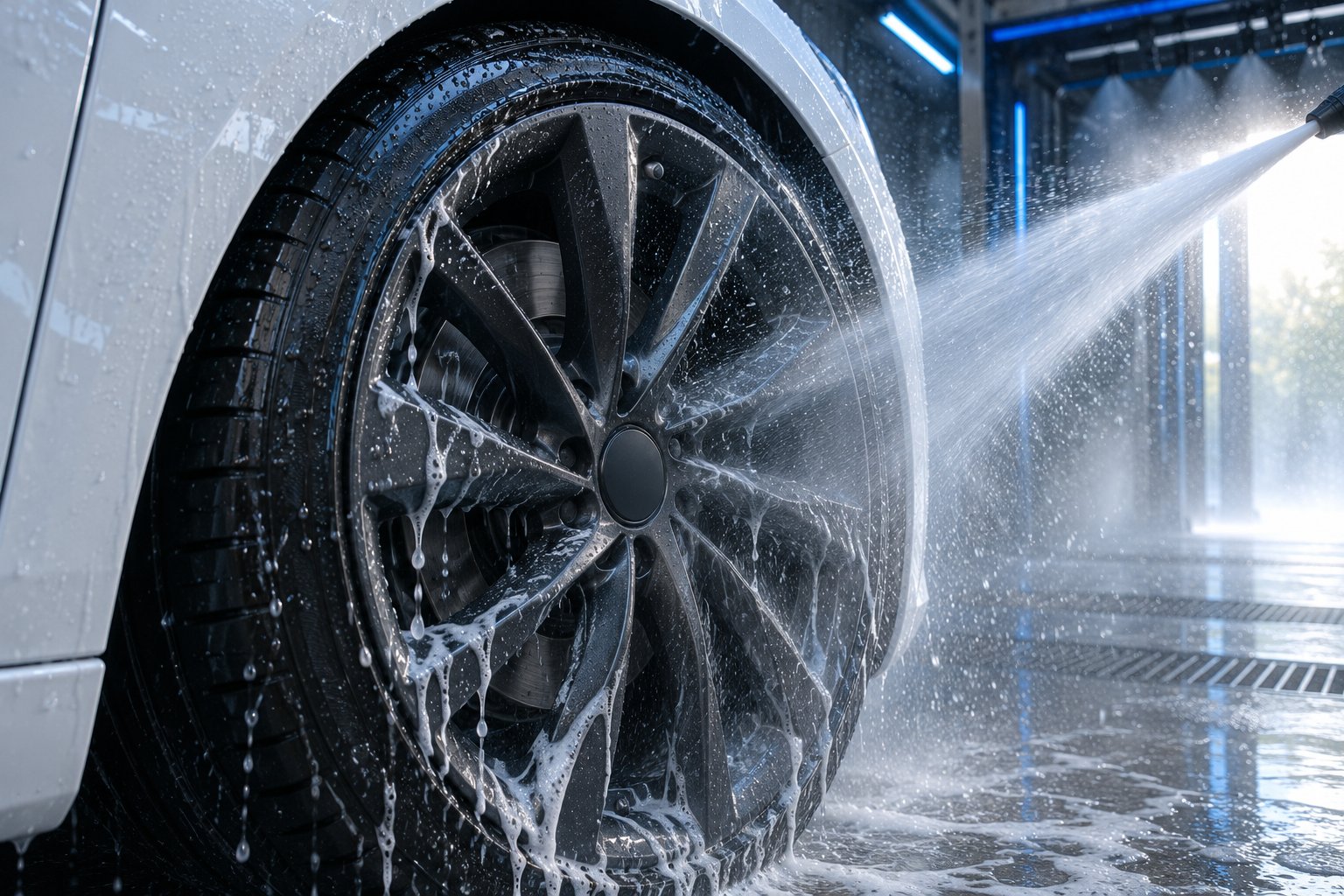
Automatic washes are where finishes get damaged most often. A touchless wash uses detergent and high-pressure water, so nothing rubs against the wheel. Black Dog Car Wash notes that brushes can hold grit left behind by earlier cars. That makes touchless the safer choice for satin, matte, and machined finishes. Brush-style washes can leave micro-scratches on gloss and piano-black surfaces. Touchless washes have a downside, though, because they don't scrub. Baked-on dust can stay behind the spokes and on the inner barrel, especially on designs with many thin spokes. An occasional careful hand wash takes care of what the touchless wash misses.
These care habits apply to new tesla highland rims and to a spare set of 18 prismata wheels that you keep for winter:
- Gloss and piano black: Use a pH-neutral wheel cleaner with a soft mitt or brush. Wash often, because dust and swirl marks show quickly. Skip brush-style washes and abrasive pads. You can polish out light swirls and then apply a sealant or ceramic coating.
- Satin and matte: Use only pH-neutral, non-abrasive cleaners labeled safe for matte finishes. Never wax or machine-polish these wheels. Touchless washes are a good fit for routine cleaning.
- Brushed and machined: Wash gently, and check the clear coat for chips after any contact with a curb. Take damaged spots to a refinisher before moisture gets under the coat.
- Powder-coated: These finishes handle routine washes well. Still avoid harsh household cleaners and stiff brushes, which can stain or dull protective coatings.
- All finishes: Wash soon after driving on salty or wet roads, before the residue dries on. Reapply wax, sealant, or ceramic coating on the schedule the product maker recommends, or sooner if water stops beading on the surface.
You can take care of the finish yourself at the wash bay. The tire pressure sensor behind each valve stem needs its own plan before the new wheels go on, because it reports to the car's software.
TPMS, Warranty, and Service Rules for Tesla Model 3 Wheels
When your new wheels arrive, the tire shop will ask what to do about the pressure sensors. Most advice about tesla wheels model 3 owners find online stops at style and fitment. The sensors, your warranty, and the driver-assist systems each need a plan too.
TPMS Sensor Compatibility and Pairing
Start by finding out which system your car has. Tesla's owner's manual explains that some Model 3s use direct TPMS, with a sensor in each wheel. Others use indirect TPMS, which estimates pressure loss without any sensors. If the car's on-screen image shows a PSI value at each tire, you have direct TPMS.
On direct-TPMS cars, the factory sensors can usually move to the new wheels. Each sensor clamps through the valve hole with a nut. The service manual for the closely related Model Y torques that nut to 8 Nm (5.9 lb-ft). The new wheel's valve hole has to fit that stem, and the sensor body needs room inside the barrel. If it doesn't fit, you'll need new sensors. Cars built from around late 2021 use Bluetooth Low Energy sensors, while earlier cars use radio-frequency sensors. A sensor made for one type won't pair with the other, so confirm which type your build uses before you buy.
After a wheel swap, the manual says direct-TPMS sensors relearn on their own within 10 minutes of driving above 15 mph. If a non-Tesla shop replaces a sensor, it may not work until Tesla performs its setup procedure, so plan for a possible service visit. Cars with indirect TPMS need a manual calibration from the touchscreen. Tesla warns that this calibration may be inaccurate with non-standard tire sizes. On either system, a warning light that flashes for about a minute and then stays on means the TPMS has a fault.
Warranty and Service Center Considerations
Under the federal Magnuson-Moss Warranty Act, installing aftermarket wheels doesn't void your warranty by itself. Unplugged Performance explains that Tesla would have to show the wheels caused a specific failure to deny a related claim. A wheel that rubs a caliper or comes loose because it was under-torqued is a different case. Tesla's manual also states that Tesla isn't liable for damage caused by wheels it hasn't approved.
Keep a folder with the wheel's spec sheet showing size, offset, and load rating. Add the installer's receipt and a record of the 175 Nm (129 lb-ft) lug torque. Keep your factory set as well. It might be 18 Photon wheels on a Highland, or the 20-inch Uberturbines that answer the common search for the 2020 Tesla Model 3 Perf stock wheel name. Either way, having the stock set makes it easy to go back to factory for a warranty visit or at resale.
Autopilot and Sensor Calibration
New wheels don't move the cameras, which are mounted in the car's body and glass. They also don't move the bumper-mounted ultrasonic sensors on cars that have them. Driver-assist features do use the same wheel-based speed signal as the speedometer, though. A tire with a very different rolling diameter can throw that signal off, and staying within the 3% tolerance from the tire section prevents this. After installation, update Wheel Configuration in the car's settings. Then watch for warnings or unusual Autopilot behavior during the first few drives on your new tesla model 3 wheel setup.
Have a qualified wheel specialist confirm the fitment, keep every spec sheet and torque record, and make sure all four tire pressures appear with no TPMS warning before you drive.
Brands vary a lot in how much of this data they publish, such as valve-hole design, load ratings, and Tesla-specific fitment notes. That makes it a useful way to sort the options when you start comparing them.
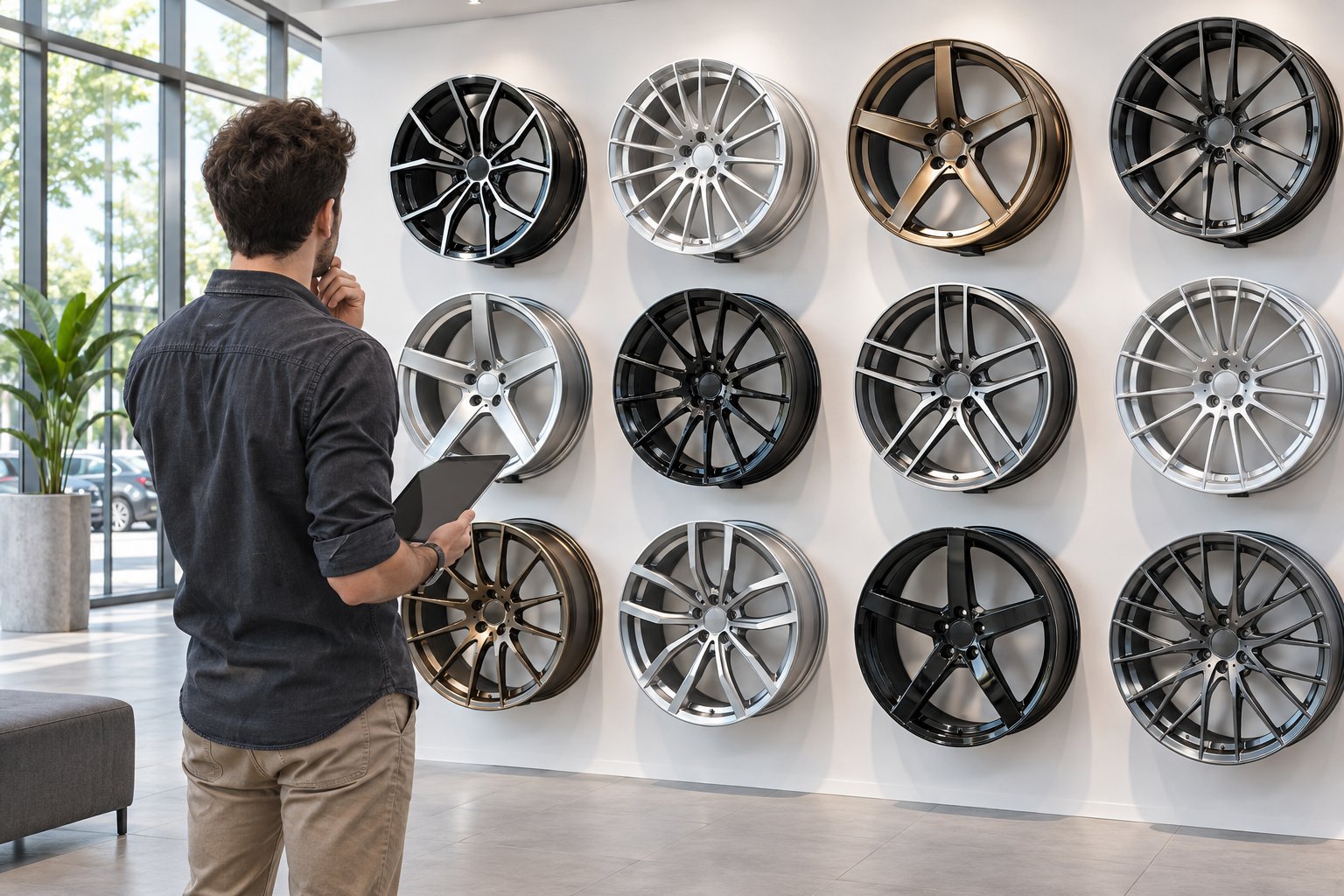
Comparing Aftermarket Model 3 Wheels by Size and Build
Have you ever opened three wheel shops in three browser tabs and found three completely different ways of describing a product? One lists the offset and load rating for every size. Another shows a photo, a price, and the words "fits Tesla." You can tell a lot from that difference before you look at a single spoke design. The specs covered in earlier sections give you a way to score each listing.
What to Look for When Comparing Aftermarket Wheel Brands
Search for tesla model 3 wheels aftermarket and you'll get hundreds of listings. Check each one for these details:
- Construction method: The listing should state plainly whether the wheel is cast, flow-formed (spin-formed), or forged. If it says "flow forged," ask the seller what process that means.
- Available diameters: Look for the sizes offered for your specific variant. A generic "Tesla" label isn't enough.
- Offset options: The listing should give a published offset for each size and width, including front and rear offsets on staggered sets.
- Stated load rating: Look for a per-wheel figure in kg or lbs. A vague "meets OEM" claim doesn't tell you anything.
- Finish selection: Check which finishes are offered and whether each one is clear-coated or powder-coated.
- Hub-centric design: The wheel should have a 64.1 mm bore. If the bore is larger, hub rings should be included.
- Tesla-specific fitment data: Good listings cover caliper clearance by variant, TPMS sensor compatibility, and whether the factory lug nuts and center caps fit.
Pay attention to how many sizes a brand offers for the same car. Some brands sell one design in 18, 19, and 20 inches, with a different width and offset for each size. That brand has usually put more engineering work into the platform than one selling a single universal 5x114.3 wheel. T Sportline's wheel guide is an example of that kind of depth. It lists load ratings by diameter for its flow-formed designs on pre-Highland cars: 750 kg (1,653 lbs) per wheel at 18 inches, 900 kg (1,980 lbs) at 19 inches, and 650 kg (1,433 lbs) at 20 inches. The 20-inch wheels have the lowest rating of the three, so check the figure for each size you're considering. A rating published for one size doesn't apply to the others. The brand also says its wheels work with the factory center caps, lug nuts, tires, and TPMS sensors.
Aftermarket Options Worth Evaluating
The brands below appear often in Model 3 wheel searches. They are listed in no particular order of quality, as a starting point for your own research. Where our research couldn't confirm a detail, the table says so.
| Brand | Construction Type | Diameters Listed for Model 3 | Tesla-Specific Fitment Noted | Source |
|---|---|---|---|---|
| CUTIM | Spin-formed alloy | 17, 18, and 19 inch (one listing covers Model 3/Y/S/X) | Yes. Confirm offset, load rating, and brake clearance for your variant. | CUTIM spin-formed wheels |
| T Sportline | Flow-formed, fully forged, and forged carbon fiber (earlier cast designs discontinued) | 18, 19, and 20 inch (pre-Highland guide) | Yes, with size, offset, bore, and load rating listed for each wheel | T Sportline guide |
| Ohm | Not verified | Not verified | Not verified | Confirm with the vendor |
| RVRN | Not verified | Not verified | Not verified | Confirm with the vendor |
CUTIM's page lists spin-formed wheels in 17-, 18-, and 19-inch sizes across four Tesla models, so a single listing covers several different fitments. Ask the vendor for the exact width, offset, and load rating of the Model 3 version, and whether it clears your brakes. Of all the sizes on that page, a 17-inch wheel leaves the least room for the calipers. If you're shopping for model 3 performance rims, the larger Performance calipers make this the first thing to confirm. For Ohm and RVRN, ask for the same spec sheet you would expect from any other brand.
Many shoppers also search by factory design name, such as Turbine, Crossflow, or Photon. Aftermarket brands often sell designs styled after those wheels, but a similar look doesn't guarantee the same spec. T Sportline describes its 18-inch TST as having a similar appearance to the Model S Turbine wheel. Like most of the brand's tesla model 3 18 wheels, it uses a +35 offset. The factory pre-Highland 18-inch Aero uses +40, so the TST sits 5 mm further out. The same caution applies if you need a single replacement for a 2020 tesla model 3 sport wheel. Tesla released a redesigned 19-inch Sport wheel in October 2020, so a 2020 car could have either version. Both versions are listed at 19x8.5 with a +40 offset. With any lookalike design, ask whether the product is a confirmed OEM-design match or only styled after one.
A comparison table can narrow the field. It can't tell you your caliper size, sensor type, or model year. You'll get those answers from your own car, and it helps to check them in a set order before you pay.
Your Pre-Purchase Checklist for Model 3 Custom Wheels
Ready to click "buy" on a new set of wheels? Buying online can save you money, and most orders arrive without trouble. The installers at OTS Long Beach say that the orders that do go wrong usually fail on one of five things: bolt pattern, offset, center bore, lug nuts, or TPMS sensors. If you check each item below in order, you'll catch those problems before you pay.
Your Pre-Purchase Verification Checklist
- Confirm your exact variant and generation. Know whether your car is pre-Highland or Highland, and whether it is SR+ (or RWD), Long Range, or Performance. Fitment, brake size, and sensor type all depend on this.
- Document your OEM specs. Write down the tire size and pressures from the door jamb placard. Then add the load index and speed rating printed on your original tires.
- Pick a diameter and construction type. Decide what matters most to you: comfort, looks, weight, or budget.
- Verify bolt pattern, hub bore, and offset. The wheel needs a 5x114.3 bolt pattern and a 64.1 mm bore. If the bore is larger, it needs matching hub rings. Its offset should be close to your factory spec.
- Check brake caliper clearance with the vendor. This matters most on Performance cars. On those cars, the rear caliper can hit the barrel of an 18-inch wheel.
- Choose tires that keep the rolling diameter. Stay within 3% of the stock diameter. Match or exceed the factory load index and speed rating.
- Plan for TPMS. Decide whether you'll move your current sensors or buy new ones. Confirm whether your car uses Bluetooth or RF sensors and how they will be paired.
- Keep your records. File the spec sheets, receipts, and torque values in case you ever need them for a warranty claim.
- Book a qualified installer. Before any tires are mounted, inspect every wheel for shipping damage. Make sure the size and offset stamped on each wheel match your order. The shop should check lug nut seat type and clearance on the car itself. It should torque the lugs to 175 Nm (129 lb-ft), the value in Tesla's service manual.
Where to Start Your Search
When you browse tesla rims for sale, start with vendors that publish Tesla-specific fitment data and sell several diameters for the same car. Both are signs that the brand knows the platform well. If you're comparing 17-, 18-, and 19-inch tesla aftermarket rims, CUTIM's spin-formed alloy wheels are one place to start. Before you order, ask the vendor for the exact offset, load rating, and caliper clearance for your variant. Compare those answers with at least two other brands from the previous section. No single brand makes wheels for tesla owners that suit every driver.
Whichever wheels you choose, have a qualified specialist confirm the fit on your own car before you pay.
Tesla Model 3 Custom Wheels FAQs
1. What bolt pattern and hub bore do Tesla Model 3 wheels use?
Every Model 3, from early pre-Highland cars to the Highland refresh, uses a 5x114.3 mm bolt pattern and a 64.1 mm center bore. The factory lug nuts are M14x1.5 with a 21 mm hex, and Tesla specifies 175 Nm (129 lb-ft) of torque. A wheel drilled 5x112 or 5x115 can look close enough. On the car, it would sit off center and put uneven stress on the studs, so treat the bolt pattern as fixed. Some aftermarket wheels have a larger bore so they fit several cars. For those, ask for hub rings sized to 64.1 mm, so the hub keeps the wheel centered instead of the lug nuts alone. Offset leaves a little more room to play with, but stay close to your factory spec and confirm it for your model year. Also, don't assume Model Y wheels will bolt on, because the two cars generally need different fitments.
2. Which wheel size is best for a Tesla Model 3: 18, 19, or 20 inches?
It depends on whether you care more about comfort or looks. 18-inch wheels have the tallest tire sidewall. They ride the softest, stay the quietest, protect the rim best on potholes, and usually take the cheapest tires. 19-inch wheels fill the wheel arches a bit more for an OEM-plus look, and the ride gets only slightly firmer. 20-inch wheels look the most aggressive. Their short sidewall sends more road impacts into the cabin, raises the risk of pothole and curb damage, and costs more per tire. At any size, choose tires that keep the overall rolling diameter within about 3% of stock and that match or exceed the factory load index and speed rating. Performance owners should know that 18s can be hard to fit over the larger brake calipers, so confirm clearance before ordering.
3. Are flow-formed (spin-formed) wheels better than cast or forged wheels for a Model 3?
Each type suits a different buyer. Cast wheels are poured into a mold. They cost the least and come in the most designs, but they are the heaviest. Forged wheels are pressed from a solid aluminum billet and give the best strength for their weight at the highest price. Flow-formed wheels, also sold as spin-formed or rotary forged, sit between the two. They pair a cast face with a barrel that is heated, spun, and rolled thinner and stronger. Many Model 3 owners choose them as a balance of cost and weight, and the thinner barrel can help with Performance caliper clearance. Keep your expectations realistic, since lower unsprung weight has only a small effect on ride. CUTIM is one option to evaluate. It lists spin-formed wheels in 17-, 18-, and 19-inch sizes for Model 3/Y/S/X. Before you order, ask the vendor or a wheel specialist for the exact offset, load rating, and brake clearance for your variant. Smaller diameters leave the least room around the calipers.
4. Can I move my factory TPMS sensors to aftermarket Model 3 wheels?
Usually yes, if your car has direct TPMS. Look at the car image on the touchscreen. If it shows a PSI reading at each tire, there is a sensor inside each wheel. The new wheel needs a valve hole that fits the sensor stem and enough space in the barrel for the sensor body. Also check which sensor type your car uses. Cars built from around late 2021 use Bluetooth Low Energy sensors, earlier cars use RF sensors, and one type won't pair with the other. Reused Tesla sensors normally relearn on their own after about 10 minutes of driving above 15 mph. If a shop fits new non-Tesla sensors, they may not work until Tesla runs its setup procedure. Cars with indirect TPMS have no sensors to move. They need a manual calibration from the touchscreen instead, which may be less accurate with non-standard tire sizes.
5. Do aftermarket wheels void the Tesla Model 3 warranty?
Not by themselves. Under the federal Magnuson-Moss Warranty Act, Tesla would have to show that the aftermarket wheels caused a specific failure before it could deny a related claim. Tesla can still refuse to cover damage the wheels actually cause, such as a wheel rubbing a brake caliper or coming loose because it was under-torqued. Tesla's manual also says it isn't liable for damage from wheels it hasn't approved. Keep a simple paper trail to protect yourself: the wheel spec sheet showing size, offset, and load rating, the installer's receipt, and a record of the lug torque used. If you keep your factory wheels, you can also put the car back to stock for a service visit or when you sell it.