
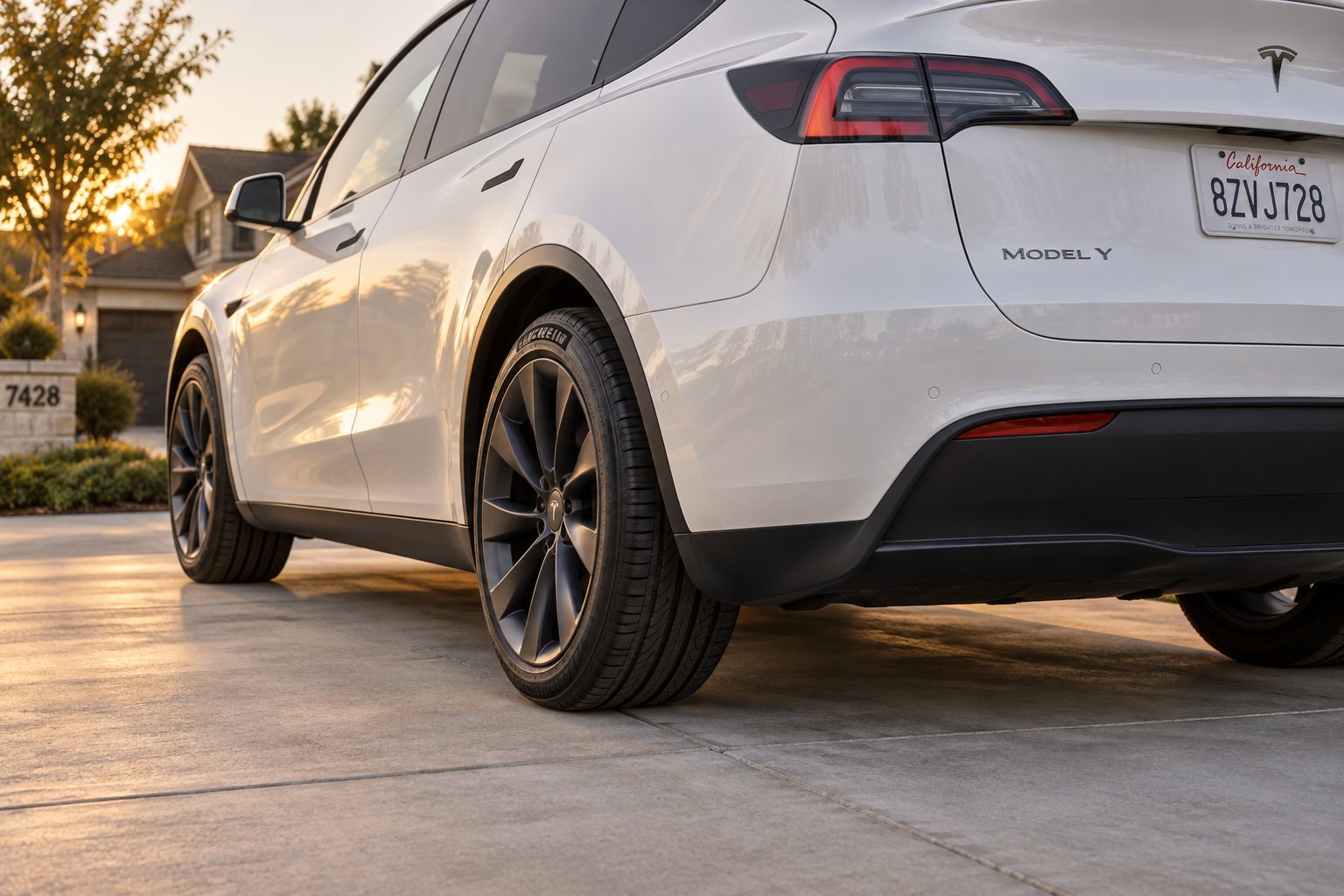
Does the Tesla Model Y Actually Come With Mud Flaps?
If you just picked up a new Model Y — or you're still in the research phase — this is one of the first questions worth settling before road debris settles the matter for you.
No, the Tesla Model Y does not come with mud flaps. No trim level, no factory, and no model year has ever included factory-installed mud flaps as standard or optional equipment.
That applies whether your Model Y rolled off the line in Fremont, Austin, Berlin, or Shanghai. Long Range, Performance, Standard Range — none of them ship with mud flaps or splash guards of any kind. Tesla simply does not include them.
The Short Answer Every Model Y Owner Needs
Tesla model y mud flaps are not part of the production build — period. You won't find them listed on the configurator, tucked into a delivery checklist, or hiding behind the wheel well liners. Unlike many traditional automakers that bolt on basic splash guards before a vehicle leaves the factory, Tesla treats mud flaps as an aftermarket decision left entirely to the owner.
This catches a surprising number of buyers off guard. When you're spending tens of thousands of dollars on a vehicle packed with cutting-edge technology, it's natural to assume basic exterior protection comes included. Yet Tesla's minimalist design philosophy extends well beyond the cabin. The same approach that eliminated a physical instrument cluster, ditched the traditional key fob, and removed a front grille also strips away accessories like model y mud flaps. If it isn't essential to the vehicle's core driving function, Tesla tends to leave it out.
Why This Question Matters More Than You Think
Here's the frustrating reality: most owners don't search for "does tesla model y come with mud flaps" out of casual curiosity. They search it after noticing the first cluster of rock chips along their rocker panels or a fine mist of road grime coating the rear quarter panels after a rainy commute. By then, the damage has already started.
Tesla's paint — while improved over earlier production years — remains a frequent topic of concern in owner communities. Many drivers report that the clear coat and base layers feel thinner than what they've experienced on vehicles from legacy manufacturers. Without tesla mud flaps model y owners rely on, every mile driven on loose gravel, wet pavement, or salted winter roads sends a steady stream of tiny projectiles directly into exposed body panels.
That makes this more than an accessories question. It's a paint protection and long-term ownership awareness issue that can quietly cost hundreds — or even thousands — in cosmetic repairs over the life of the vehicle. Understanding the gap early gives you the chance to address it on your own terms, before the road does it for you.
The bigger question, of course, is why Tesla made this choice in the first place — and what the real trade-offs are behind that decision.
Why Tesla Leaves Mud Flaps Off the Model Y
Tesla's decision to skip mud flaps isn't an oversight — it's a pattern. Strip away anything that doesn't serve the core driving experience, and you're left with a vehicle that's sleek, efficient, and deliberately spartan. That philosophy explains a lot about what you find (and don't find) on a Model Y when it shows up on delivery day.
Tesla's Minimalist Design Philosophy
Think about everything Tesla has already removed from the traditional car ownership equation. There's no physical instrument cluster behind the steering wheel. No traditional key fob ships in the box (you can buy one separately if you prefer). The front end has no grille, no chrome trim on newer builds, and the interior is stripped down to a single touchscreen controlling nearly every function in the vehicle.
Tesla mud flaps fall into the same category as all those absent components — things the company views as optional rather than essential. Where legacy automakers often include basic splash guards as a standard protective measure, Tesla treats exterior protection accessories as choices the owner can make after purchase. The reasoning aligns with a broader corporate approach: deliver a clean, uncluttered product and let the aftermarket handle personal preferences.
That said, Tesla does operate its own accessories store. You'll find floor mats, cargo liners, roof racks, and even an All-Weather Protection Kit for the Model Y listed on the official shop. Yet branded tesla mudflaps designed specifically for the Model Y have not historically appeared among those offerings. The gap is notable, especially when you consider how frequently owners report paint damage caused by road debris — a problem mud flaps directly address.
Aerodynamics and Range Optimization
There's a more technical reason behind the omission, too. Every Tesla is engineered around one non-negotiable priority: maximizing electric range per charge. That means Tesla's engineers obsess over drag coefficients — the measurement of how much air resistance a vehicle's shape creates as it moves. Even small additions to the exterior profile can nudge that number upward.
Traditional mud flaps, especially bulkier rubber designs, extend below the body line and disrupt airflow around the wheels. That disruption creates additional drag, which forces the electric motors to work harder and reduces the distance you can travel on a single charge. For an automaker that markets range as a key competitive advantage, even marginal efficiency losses get scrutinized.
How significant is the impact in practice? Real-world testing by Tesla owners suggests the drag penalty from well-designed mud flaps lands in the range of roughly 1-3% during sustained highway driving. At lower city speeds, the effect is essentially negligible. That's a minor trade-off for most drivers, but it's enough for Tesla to leave the decision in the buyer's hands rather than bake it into every build.
Aftermarket manufacturers have caught on to this concern. Many mud flaps tesla owners install today feature low-profile, aerodynamically contoured designs specifically engineered to minimize drag impact while still providing meaningful debris protection. It's a direct response to the efficiency-first mindset that Tesla baked into the Model Y's design DNA.
The Aftermarket Ecosystem Tesla Created
Here's the irony: by leaving mud flaps off the Model Y, Tesla inadvertently fueled one of the most active aftermarket accessory categories in the entire EV space. Mud flaps consistently rank among the most recommended accessories for new Model Y owners, right alongside floor mats, screen protectors, and center console organizers.
Dozens of companies now produce Tesla-specific mud flaps in a range of styles — from discreet OEM-look designs to aggressive rally-style options. The variety speaks to the demand. Tesla owners aren't ignoring the protection gap; they're filling it themselves, often within the first few weeks of ownership.
That thriving ecosystem does benefit buyers in one important way: competition drives innovation. You'll find options with screwless clip-on mounting, custom-molded fitments for specific factory origins, and materials engineered to withstand extreme temperatures without cracking or warping. None of that variety would exist if Tesla had simply bolted on a generic set at the factory.
Still, understanding the why behind Tesla's choice only gets you halfway. The more pressing concern for most owners is what actually happens to exposed body panels mile after mile without any mud flaps installed — and how quickly that cumulative damage adds up.
What Happens When You Drive Without Mud Flaps
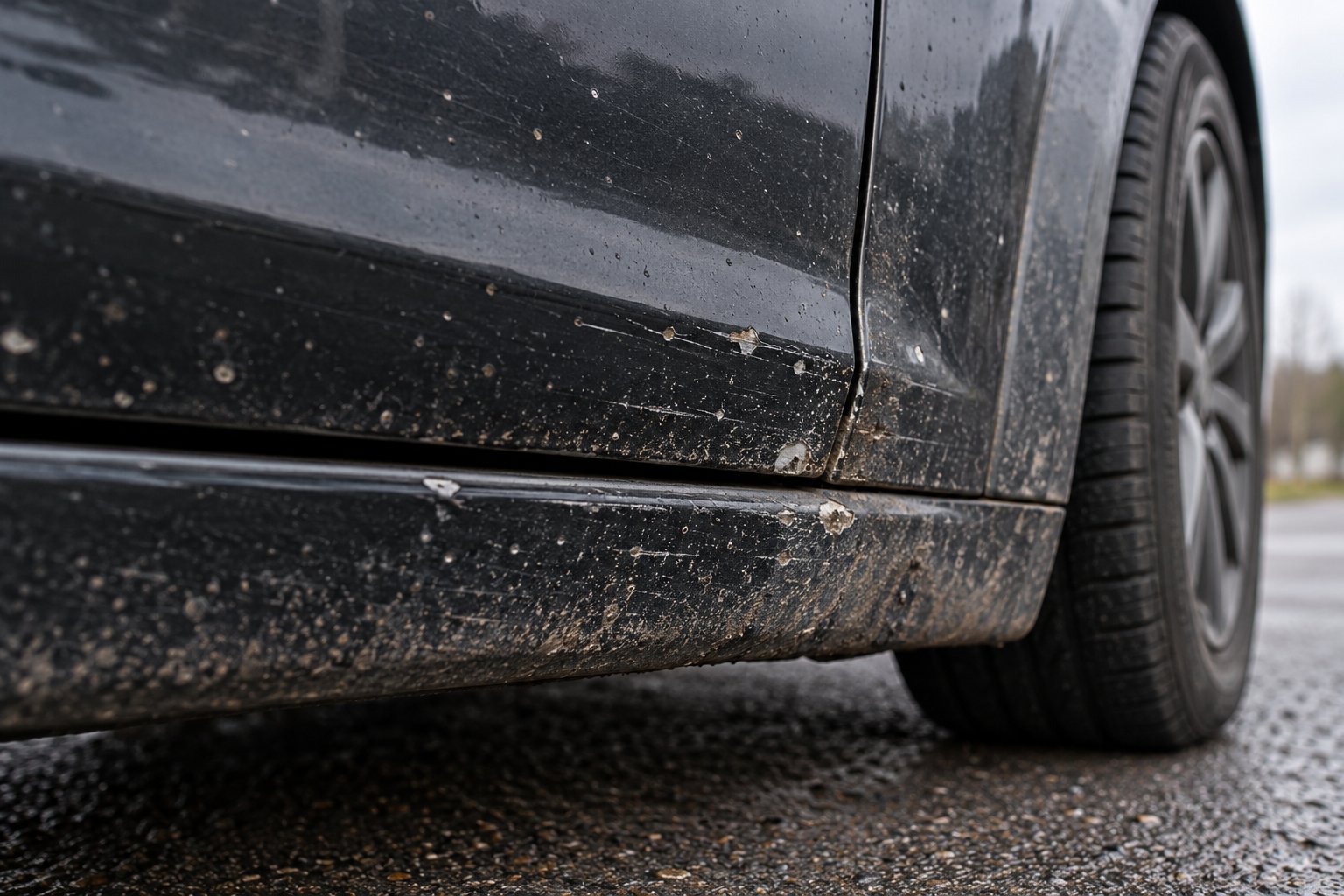
Imagine pulling into your garage after a few weeks of highway commuting and crouching down to inspect the lower body panels. You notice a faint spray pattern of tiny white specks running along the rocker panels behind the front wheels. It's not dirt. It's bare metal showing through where the clear coat and paint have been blasted away, one grain of sand at a time.
That's the reality for a surprising number of Model Y owners who discover the cost of skipping Tesla splash guards only after the damage is already underway. The absence of mud flaps doesn't announce itself with a single dramatic event — it's a slow, cumulative erosion that compounds with every mile driven.
Paint Damage and Rock Chips on Rocker Panels
Your tires are constantly picking up debris from the road surface — tiny stones, sand particles, loose asphalt fragments, and grit. As the wheels spin, centrifugal force flings that material outward at high velocity. Without tesla model y splash guards or mud flaps blocking the path, all of that debris fires directly into the lower body panels.
The Model Y's body shape actually makes this worse. Tesla's aerodynamic "Coke bottle" silhouette — where the body narrows through the middle and widens at the rear wheel arches — positions the rear door panels and rocker panels squarely in the firing line of the front tires. Owners in the Tesla community frequently refer to this as the "sandblasting effect," and the name fits perfectly. It's not one big rock causing a single chip — it's thousands of micro-impacts acting like sandpaper, gradually stripping through the clear coat, then the color layer, and eventually exposing primer or bare metal.
Here's what makes Model Y paint particularly vulnerable: Tesla uses water-based paint systems to meet strict environmental regulations, especially at the Fremont facility. While that's a positive step for reducing volatile organic compound (VOC) emissions, the resulting finish is generally softer and thinner than the solvent-based paints many legacy automakers still use. Owners routinely report that the clear coat chips more easily than what they've experienced on previous vehicles. When you combine thin paint with zero debris deflection, the math isn't kind.
The most commonly reported damage zones include:
- Rocker panels — the trim running beneath the doors, directly behind the front wheels
- Rear quarter panels — the body surfaces near the rear wheel arches
- Lower rear doors — especially the area where the door skin curves toward the rear fender
- Rear bumper lower section — where rear tire spray deposits grime, grit, and debris
Once the paint breaks through to bare metal, the damage shifts from cosmetic to structural. Exposed steel is an invitation for oxidation, and even small rust spots can spread beneath surrounding paint if left untreated. What starts as a minor annoyance can escalate into a repair bill measured in hundreds of dollars — or worse, a blemish that's impossible to fully reverse without professional repainting.
Winter Climate and Road Salt Corrosion Risks
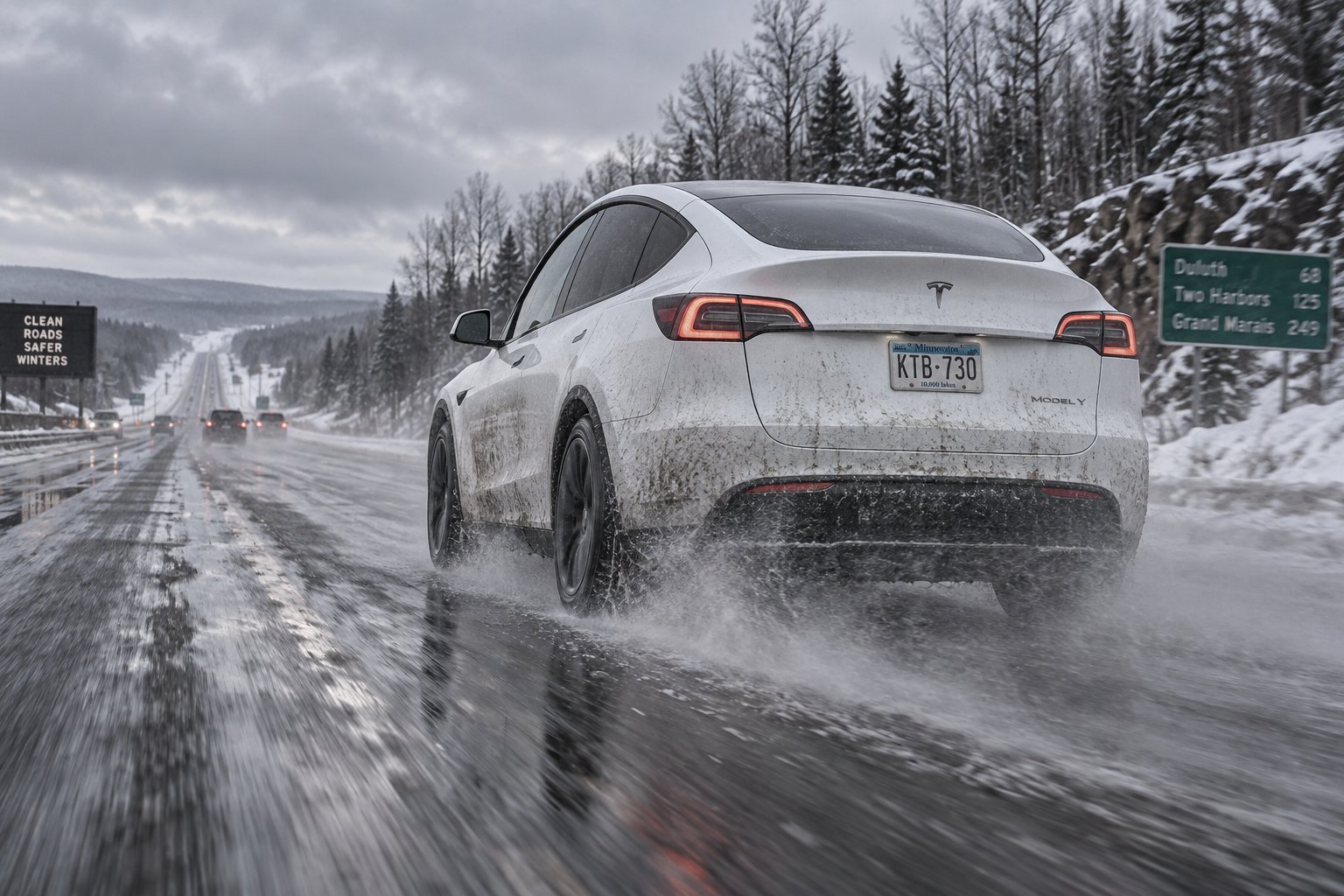
If you live in the northern United States, Canada, or anywhere road crews treat ice with salt and brine, the stakes climb even higher. Road salt isn't just abrasive on contact — it's chemically corrosive. When your tires launch a mixture of salt crystals, brine solution, and sand into unprotected body panels at highway speed, the impact is twofold.
First, the physical force of the particles chips and erodes the paint surface, just like standard rock debris. Second, the salt residue that clings to the damaged area actively accelerates corrosion on any exposed metal. A tiny chip that might take months to develop visible rust in a dry climate can show oxidation within weeks during a cold, wet winter season.
Sand and gravel spread for traction on icy roads compound the problem further. These particles are often larger and more angular than typical highway debris, meaning they strike with more force and cause deeper gouges. Without tesla splash guards intercepting this barrage, every winter commute quietly degrades the lower body panels. And because road spray also coats the wheel well liners, fender seams, and undercarriage mounting points, the corrosion risk extends well beyond what's visible at a casual glance.
For Model Y owners in states like Minnesota, Michigan, Massachusetts, or provinces like Ontario and Quebec — where road salt application is heavy and sustained for months — mud flaps shift from a "nice to have" accessory to a genuine paint protection necessity.
Courtesy to Other Drivers on the Road
There's another dimension to this issue that goes beyond your own vehicle. Without mud flaps, your Model Y sprays road debris, water, and grime onto the vehicles traveling behind you. On wet roads, the rooster tail of mist flung by unshielded tires reduces visibility for following drivers. On loose gravel, you're essentially peppering their windshield and hood with projectiles.
This isn't just a matter of etiquette — in many jurisdictions, it's a matter of law. Are mud flaps required? The answer depends on where you drive. The NTEA's U.S./Canada Mud Flap Requirements Guide confirms that no federal-level mud flap mandate exists in either country. Instead, regulations are set at the state, provincial, or territorial level — and they vary widely. While most of the 42 U.S. states with mud flap laws target commercial vehicles specifically, some states include broader language that can apply to passenger vehicles depending on interpretation. Eight states — including Indiana, Kentucky, and North Carolina — have no specific requirements at all.
In Canada, provinces and territories each maintain their own rules, and the specifics differ from one region to another. The practical takeaway is straightforward: even if your personal Model Y isn't legally required to have mud flaps in your state, installing them is a simple act of road courtesy — and it eliminates any ambiguity if you regularly drive across state or provincial lines with stricter splash suppression standards.
The combination of paint vulnerability, accelerated winter damage, and road spray reduction makes a compelling case for treating mud flaps as a paint protection investment rather than a cosmetic afterthought. The real question for most owners at this point isn't whether to install them — it's figuring out which ones actually fit their specific Model Y, since not all versions of the vehicle are built the same way.
How Factory Origin and VIN Affect Mud Flap Compatibility
Here's a detail that trips up a lot of first-time buyers: not every set of mud flaps for Tesla Model Y will fit every Model Y on the road. Your vehicle's factory of origin and production generation directly influence the body panel geometry around the wheel arches — and that geometry is exactly what determines whether a given mud flap set clips on cleanly or leaves you with gaps, misaligned edges, or fasteners that don't reach their mounting points.
Before you spend a dollar on aftermarket protection, you need to know where your Model Y was built and when. Fortunately, that information is encoded right into your Vehicle Identification Number.
How to Identify Your Model Y's Factory Origin by VIN
Every Tesla carries a 17-character VIN stamped on a small plate visible through the base of the windshield on the driver's side. You'll also find it on your registration documents and inside the Tesla app under vehicle details. The character you're looking for is the 11th position — that single letter tells you exactly which Gigafactory assembled your car.
Here's the breakdown for every Model Y production facility:
| VIN Position | Character | Factory Location | Common Market Designation |
|---|---|---|---|
| 11th | F | Fremont, California | Made in USA (Fremont) |
| 11th | A | Austin, Texas | Made in USA (Austin) |
| 11th | B | Giga Berlin-Brandenburg, Germany | Made in Germany (MIG) |
| 11th | C | Giga Shanghai, China | Made in China (MIC) |
Grab your VIN, count to the 11th character, and you'll know your factory in seconds. This is the same identification method the aftermarket community uses to sort compatibility, and you'll notice many mud flap product listings now ask for this information — or list specific factory codes in their fitment notes. It's a quick step that prevents the frustration of ordering a set that looks right in photos but doesn't align with your specific build.
Why Factory Origin Changes Mud Flap Fitment
You might wonder why a Model Y built in Berlin would have different wheel arch dimensions than one built in Fremont. They're the same vehicle, right? In broad strokes, yes — but the manufacturing details diverge in ways that matter at the millimeter level.
Each Gigafactory uses its own tooling, stamping equipment, and in some cases, distinct structural approaches. Giga Berlin was the first European plant to use single-piece front and rear giga castings on the Model Y, which simplify and stiffen the body structure. Shanghai refined its production processes over a longer timeline, building Model Ys since early 2021 with highly mature assembly techniques. Fremont — the original production line — and Austin each bring their own tooling generations and supplier networks into the equation.
What does this mean in practical terms? The fender liner shape, wheel arch lip profile, and mounting hole locations can vary subtly between factories. A mud flap designed around the precise contour of a Fremont-built wheel well might sit too far inward on a Berlin car — or the clip positions might not align with the liner cutouts on a Shanghai build. These aren't dramatic differences you'd notice walking past the vehicle, but they're enough to make a clip-on mud flap either snap into place perfectly or refuse to seat properly.
Mud flaps tesla Model Y owners rely on need to match these factory-specific dimensions. Reputable aftermarket manufacturers test fitment across multiple factory origins and either produce universal designs with adjustable mounting hardware or offer factory-specific variants. Always check the product's compatibility notes for your VIN's factory letter before purchasing.
Model Year Generations and Body Design Differences
Factory origin isn't the only variable. The Model Y's body has evolved through distinct production generations, and those changes create hard compatibility lines that no amount of creative installation can bridge.
The key generations break down like this:
- 2020–2024 (original production run): The initial Model Y design shared across all factories, with incremental refinements over the years. Mud flaps designed for this generation generally offer broad cross-compatibility, though factory-specific variations still apply as described above.
- 2025+ Juniper redesign: Tesla introduced the facelifted "Juniper" Model Y with significant exterior body panel changes — reshaped front and rear fascia, revised fender arches, and updated bumper geometry. These aren't minor cosmetic tweaks. The wheel arch contours and fender liner structures changed enough that pre-Juniper mud flaps simply do not fit the new body.
This is where tesla Model Y 2026 mud flaps become a distinct product category. If you own a Juniper-generation vehicle, you need mud flaps explicitly engineered for that body style. Installing a set designed for the 2020–2024 generation on a Juniper Model Y will leave you with mounting points that don't line up, edges that gap away from the body, and protection coverage that misses the mark entirely.
The reverse is true as well — Juniper-specific products won't retrofit onto earlier builds. Think of it like trying to use a phone case designed for last year's model. The screen size might be similar, but the camera cutout is in the wrong spot and the buttons don't line up.
So before you add any mud flap set to your cart, run through this quick compatibility checklist:
- Identify your factory origin using the 11th VIN character
- Confirm your model year and whether your vehicle is a pre-Juniper or Juniper build
- Cross-reference both data points against the product's listed fitment specifications
- When in doubt, contact the manufacturer directly with your full VIN for confirmation
Taking sixty seconds to verify fitment saves you the hassle of returns, refunds, and the window of unprotected driving while you wait for the correct set to arrive. Your Model Y's specific combination of factory origin and production generation is the key to finding mud flaps that mount cleanly, sit flush, and actually deliver the debris protection your paint needs.
Of course, knowing which mud flaps fit is only one piece of the puzzle. The driving conditions you face every day — your wheel size, your climate, the roads you travel — determine just how urgently your particular setup needs that protection in the first place.
Which Model Y Setups Benefit Most From Mud Flaps
Every Model Y owner faces some degree of debris exposure — that much is clear. But the urgency of adding tesla y mud flaps varies significantly depending on how your vehicle is configured and where you actually drive it. A Model Y rolling on 19-inch Gemini wheels through suburban Phoenix faces a very different risk profile than one fitted with 21-inch Uberturbines grinding through a Michigan winter. Understanding where your specific setup falls on that spectrum helps you decide whether mud flaps belong on your weekend to-do list or your "order today" list.
Wheel Size and Tire Sidewall Height Matter
Here's a quick physics lesson that makes the connection intuitive. When your tire rolls over a loose pebble or grain of sand, the tread picks it up and flings it outward as the wheel spins. The trajectory of that debris depends largely on where it leaves the tire — and how much sidewall exists between the tread surface and the wheel rim.
A taller sidewall acts like a partial shield. It absorbs some energy, contains more of the spray within the wheel well, and deflects particles downward rather than outward toward the body panels. A shorter sidewall does the opposite — it offers less surface area to intercept debris, which means more material escapes the wheel arch at sharper angles and higher velocities.
The aspect ratio printed on your tire's sidewall tells you exactly how tall that protective buffer is. It's expressed as a percentage of the tire's width. A tire with an aspect ratio of 55 has a sidewall height equal to 55% of its total width — a meaningfully taller profile than a tire with an aspect ratio of 35, which is only 35% as tall relative to its width.
Apply that to the Model Y's available wheel options:
- 19-inch wheels — paired with tires that typically carry aspect ratios around 45 to 50, producing a relatively tall sidewall that helps contain road spray
- 20-inch wheels — fitted with tires closer to a 40-45 aspect ratio, reducing sidewall height and increasing debris exposure to lower body panels
- 21-inch wheels — matched with low-profile tires around a 35 aspect ratio, creating the shortest sidewall and the most direct path for flung debris to reach rocker panels and quarter panels
Imagine two identical Model Ys driving the same stretch of gravel-dusted highway. The one on 19-inch wheels with a taller sidewall naturally deflects a larger portion of kicked-up material back into the wheel well. The one on 21-inch wheels with a thin sidewall sends that same debris straight into the paint. Over months of driving, that difference translates into noticeably more rock chips and paint erosion on the larger-wheel setup.
Does that mean owners on 19-inch wheels are in the clear? Not exactly. Even the tallest factory sidewall doesn't fully replace the coverage a mud flap provides. But if you're running a rally armor mud flaps model y setup or any aftermarket splash guard, the benefit compounds — you're layering two forms of debris deflection instead of relying on one.
Driving Environment and Road Conditions
Wheel size sets the baseline, but your daily driving environment determines how aggressively debris actually attacks your paint. A Model Y that rarely leaves freshly paved suburban streets faces a fraction of the exposure compared to one that regularly navigates construction zones, rural gravel roads, or winter-treated highways.
Think about your typical commute and weekend driving patterns. Do you pass through active construction areas where loose aggregate spills onto the road surface? Do you live on or near unpaved roads where every departure kicks up a cloud of dust and gravel? Do road crews in your region blanket the highways with salt, sand, and brine for five months of the year?
Each of those scenarios dramatically increases the volume and velocity of debris your tires encounter — and without mud flaps, every particle has a clear shot at exposed body panels. Auto body professionals note that winter conditions make the problem especially severe because cold temperatures cause vehicle materials to become more brittle, increasing the likelihood of paint cracking on impact.
Here's a practical comparison to help you gauge your own risk level:
| Driving Scenario | Debris Exposure Level | Mud Flap Urgency |
|---|---|---|
| Paved suburban roads, mild climate, minimal highway driving | Low | Recommended but not urgent |
| Mixed highway and city driving in a temperate climate | Moderate | Strongly recommended |
| Regular highway commuting in a region with seasonal road construction | Moderate to High | High priority |
| Rural or semi-rural driving with gravel or unpaved road segments | High | High priority |
| Cold-climate region with sustained road salt, brine, and sand treatment | Very High | Essential — install before winter |
| Combination of large wheels (20"+), winter climate, and highway commuting | Maximum | Essential — install immediately |
If you see yourself in the bottom half of that table, mud flaps aren't a matter of preference — they're a practical necessity for preventing the kind of cumulative damage discussed earlier. And even owners in the "low" category benefit over the long run, especially those who plan to keep their Model Y for several years or eventually sell it.
Protecting Your Model Y's Resale Value
Speaking of selling — here's where mud flaps quietly pay for themselves. A tesla model y 2020-2024 rally mud flap set typically costs somewhere between $25 and $80 depending on the brand, material, and coverage level. That's a modest investment by any measure. Compare it to what happens to your resale or trade-in value when a buyer or appraiser spots a constellation of rock chips, paint erosion, and early-stage rust along the lower body panels.
Cosmetic condition is one of the most visible factors in used vehicle valuation. Dealers and private buyers both scrutinize the rocker panels, lower doors, and bumper edges during inspection — exactly the zones that take the worst beating without mud flaps. Even if the vehicle runs flawlessly, noticeable paint damage signals deferred maintenance and reduces the perceived care given to the vehicle. That perception directly translates into lower offers.
A set of mud flaps installed early in ownership acts like an insurance policy for your exterior finish. You're not just blocking debris today — you're preserving the paint quality that a future buyer will evaluate three, five, or seven years from now. Over that timeframe, the cumulative difference between a protected lower body and an unprotected one can easily amount to hundreds of dollars in preserved value. When the upfront cost of protection is a fraction of a single paint correction session, the math speaks for itself.
The takeaway is straightforward: the larger your wheels, the harsher your climate, and the rougher your roads, the faster you'll benefit from installing mud flaps. But even owners in the gentlest driving conditions gain long-term value from the added protection. The question that naturally follows — especially if you own one of Tesla's newest builds — is whether the mud flaps available today will actually fit the redesigned body that rolled out with the Juniper generation.
The Juniper Model Y Redesign and Mud Flap Fitment
If you took delivery of a redesigned Juniper Model Y and assumed the mud flap set your friend installed on their 2023 would work just the same — pause before ordering. The Juniper generation introduced sweeping exterior changes that redrew the lines around every wheel arch, bumper edge, and fender surface on the vehicle. For mud flap compatibility, those changes aren't cosmetic footnotes. They're deal-breakers.
What Changed in the Juniper Redesign
Tesla didn't simply refresh the headlights and call it a day. The Juniper Model Y arrived with a substantially reworked exterior that touches nearly every body panel relevant to mud flap mounting. You'll notice reshaped wheel arches with revised lip profiles, a completely new front fascia that alters the geometry around the front wheels, and a redesigned rear bumper that changes the contour line where rear splash guards typically seat.
The fender liner structures — the plastic panels lining the inside of each wheel well — also shifted in shape and fastener placement. Since most aftermarket mud flaps anchor to these liners using clips or existing factory holes, even small changes in hole spacing or liner curvature can make a previously perfect-fitting product completely unusable on the new body.
Beyond the wheel wells, the Juniper's updated side profile and revised lower body trim alter how close the rocker panels sit relative to the tire's spray path. These dimensional shifts mean that model y juniper mud flaps need to account for mounting geometry that simply didn't exist on earlier production runs.
Why Pre-Juniper Mud Flaps Do Not Fit
This isn't a matter of "close enough." Aftermarket manufacturers who produce mud flaps for the 2020–2024 Model Y have explicitly stated that their legacy products are not compatible with the Juniper variant. The incompatibility shows up in multiple ways:
- Misaligned clip positions — mounting tabs designed for pre-Juniper liner holes land between or entirely past the new fastener locations
- Incorrect contour profiles — the curved edge that should sit flush against the fender pulls away or buckles against the reshaped body panels
- Coverage gaps — because the wheel arch opening changed dimensions, a legacy mud flap may leave exposed sections that defeat the purpose of installation
- Interference with new trim pieces — the Juniper's updated lower body cladding and trim elements can physically conflict with mud flaps designed around the older body's clearances
Think of it this way: a mud flap is essentially a custom-molded part shaped to the exact geometry of a specific body design. When that body design changes at the level the Juniper refresh introduced, the mold no longer matches. Forcing a pre-Juniper set onto a Juniper body risks poor adhesion, rattling at speed, premature detachment, and — most critically — incomplete protection that gives you a false sense of security while debris still reaches your paint.
Finding Juniper-Specific Mud Flap Options
The good news is that the aftermarket has responded quickly to the Juniper's arrival. Manufacturers who specialize in Tesla accessories are actively releasing tesla model y juniper mud flaps engineered from scratch around the new body's precise dimensions. These purpose-built products account for the updated fender liner fastener points, revised arch contours, and new bumper geometry — ensuring a clean, flush fit without modification.
Before purchasing any set, here's what to verify:
- Look for explicit "Juniper compatible" or "2025+ Model Y" labeling in the product description — vague "fits all Model Y" claims are a red flag
- Confirm whether the product covers both front and rear positions, since some listings sell individual axle sets
- Check for customer-submitted fitment photos on Juniper-generation vehicles specifically, not just legacy builds
- When in doubt, provide your full VIN to the manufacturer and ask for written confirmation of compatibility
The mud flaps model y juniper owners need are a distinct product category — not a variation of the older design. Treating them as interchangeable with pre-Juniper options is the fastest path to wasted money and unprotected paint. As long as you verify the Juniper designation before checkout, you'll end up with a set that mounts cleanly and delivers the debris coverage the redesigned body demands.
With compatibility sorted — whether you're driving a Juniper or an earlier build — the next step is understanding what types of aftermarket mud flaps are actually available, how they differ in design and material, and which features matter most when comparing your options side by side.
Comparing Aftermarket Mud Flap Options for the Model Y
You've confirmed your Model Y didn't ship with mud flaps, identified your factory origin, verified whether you're driving a Juniper or pre-Juniper build, and assessed how urgently your driving conditions demand protection. The natural next question: what are you actually choosing between? The aftermarket for tesla model y mud flap splash guards has grown into a surprisingly diverse category, and not every option serves the same purpose or delivers the same level of coverage.
Understanding the key differences in design type, material composition, and installation method will keep you from buying the wrong product — or overpaying for features you don't need. Here's a straightforward breakdown of what's available and what to look for.
Types of Aftermarket Mud Flaps for the Model Y
Walk through any Tesla accessories store or marketplace listing, and you'll encounter three primary categories of mud flap designs. Each one balances coverage, aesthetics, and installation complexity differently, so the right choice depends on what matters most to you.
Low-Profile OEM-Style Mud Flaps
These are designed to blend in. Low-profile mud flaps follow the contour of the wheel arch closely, extending just enough below the fender line to deflect debris without drawing visual attention. They're the most popular choice among owners who want effective protection without altering the Model Y's clean factory appearance.
- Pros: Sleek, factory-integrated look; minimal aerodynamic impact; less likely to scrape on speed bumps or steep driveways; generally the easiest to install
- Cons: Smaller coverage area means less protection against heavy spray and larger debris; may not fully shield rocker panels in severe conditions like gravel roads or heavy winter slush
Rally-Style Mud Flaps
If you've ever seen a WRC rally car with oversized, flexible flaps hanging well below the body line, you know the look. Rally-style options for the Model Y aren't quite that aggressive, but they extend significantly farther than OEM-style designs, providing broader coverage across the rocker panels and lower doors. They tend to use thicker, more flexible materials that absorb impacts rather than deflecting them.
- Pros: Maximum debris coverage area; excellent for gravel roads, construction zones, and winter driving; thicker material resists cracking in cold temperatures; highly visible protection that clearly works
- Cons: More noticeable appearance that some owners find too utilitarian; greater chance of scraping on speed bumps and parking ramp transitions — the single most common complaint in owner communities; slightly higher aerodynamic drag than low-profile designs
Full Splash Guards
Full tesla splash guard sets combine the mud flap function with extended coverage that wraps partially around the wheel well opening. They aim to block not just forward-flung debris but also the lateral spray pattern that coats door panels and side skirts during wet driving. Some designs integrate with the existing fender liner, creating a semi-enclosed barrier.
- Pros: Broadest coverage of all three types; reduces side spray in addition to rear-facing debris; keeps more road grime off the vehicle's flanks, meaning fewer car washes
- Cons: Most complex installation, often requiring partial fender liner removal or adjustment; bulkier visual footprint; higher price point; some designs trap moisture and debris behind the guard if not cleaned periodically
For the majority of Model Y owners — daily commuters in mixed urban and highway conditions — low-profile OEM-style mud flaps hit the sweet spot between protection and aesthetics. Owners who regularly face harsh conditions or gravel exposure tend to gravitate toward rally-style options for the added coverage margin. Full splash guards suit drivers who prioritize maximum protection above all else and don't mind a more involved installation process.
Key Features to Compare Before You Buy
Regardless of which style appeals to you, a handful of decision criteria separate a solid purchase from a regrettable one. Walk through each of these before committing:
Material Durability — The three most common materials in this space are TPE (thermoplastic elastomer), PP (polypropylene), and traditional rubber. TPE is the current industry favorite for Tesla mud flaps because it stays flexible across a wide temperature range, resists UV degradation, and holds its molded shape without becoming brittle in sub-zero conditions. PP is lighter and less expensive but can crack in extreme cold. Rubber offers excellent impact absorption but tends to be heavier and less precisely moldable. For cold-climate owners especially, thicker TPE — like the heavier-gauge options that hold shape better at highway speeds and below-freezing temperatures — is worth the modest price premium.
Installation Method — You'll encounter two primary approaches: screwless clip-on systems and screw-mount systems. Clip-on designs use plastic or metal retention clips that snap into existing factory holes in the wheel well liner, requiring no drilling and leaving no permanent marks if removed. Screw-mount systems use self-tapping screws or bolts secured through the liner material for a more rigid attachment. Most Tesla owners prefer the screwless approach because it's fully reversible and tool-free, but screw-mount options offer superior hold in extreme driving conditions.
Compatibility Verification — As covered in earlier sections, your factory origin (VIN 11th character) and production generation (pre-Juniper vs. Juniper) both dictate fitment. The best manufacturers clearly label compatibility for each variant. Avoid any product that simply says "fits all Tesla Model Y" without specifying model years or factory codes.
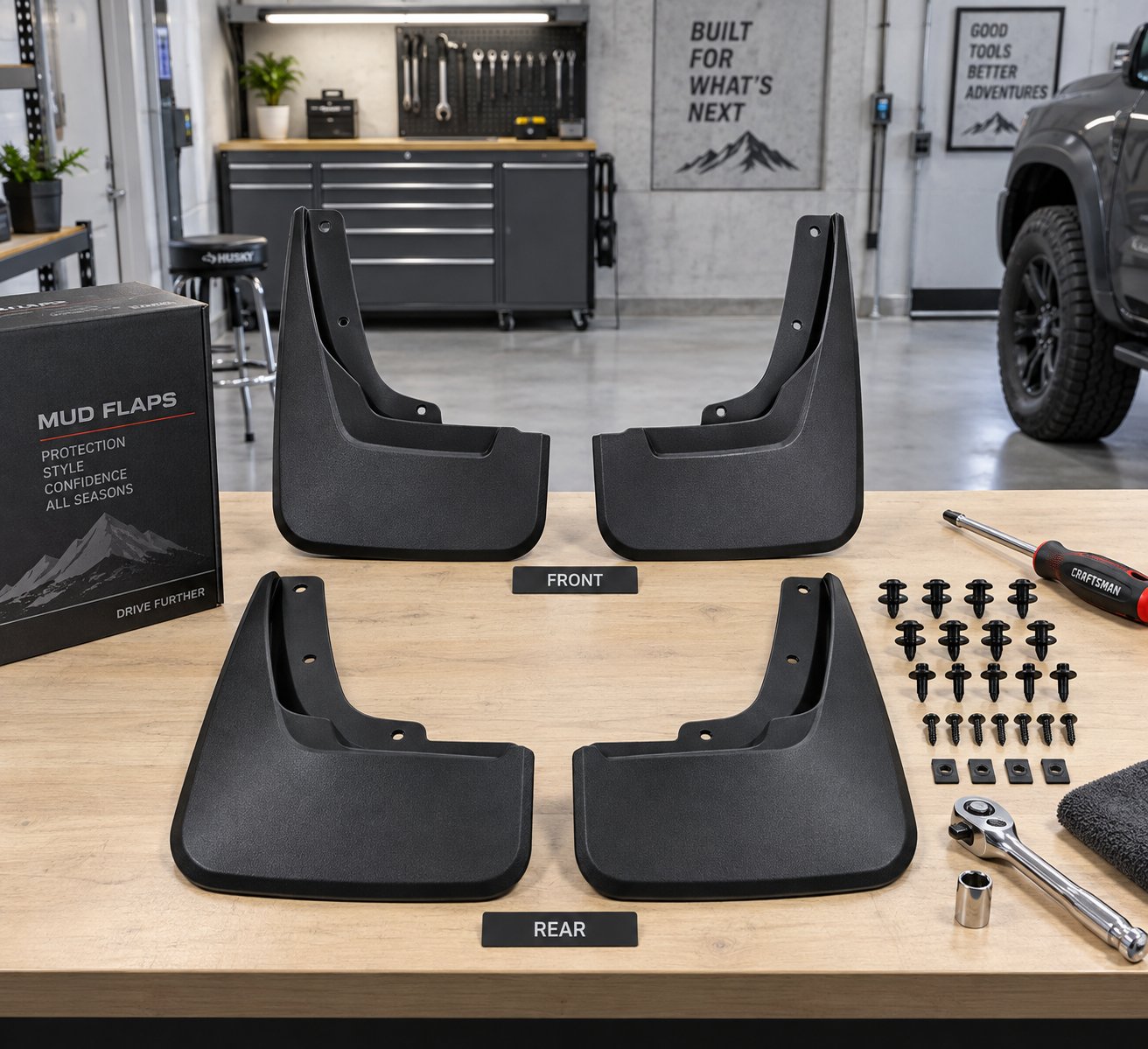
Coverage Area — Front and rear mud flaps serve different purposes. Front flaps primarily protect the rear door panels and rocker panels from debris flung by the front tires. Rear flaps shield the bumper and reduce spray for vehicles following behind you. A complete set covering all four positions delivers the fullest protection, but some owners start with fronts only since that's where the most damaging sandblasting effect originates.
Visual Integration — Does the mud flap follow the Model Y's body lines, or does it protrude noticeably? Color match, edge profile, and how far the flap extends below the fender all affect the visual outcome. If maintaining the vehicle's clean silhouette matters to you, prioritize products with photos installed on your specific generation and color.
The following table summarizes how these attributes compare across the main product categories available to Model Y owners:
| Brand / Type | Coverage Area | Material | Installation Method | Aesthetic Impact | Approximate Price Range |
|---|---|---|---|---|---|
| CUTIM Tesla Mud Flaps Collection | Front and rear sets available | Durable polymer | Designed for straightforward fitment | Clean, low-profile integration | Varies by set |
| Low-Profile OEM-Style (various brands) | Moderate — covers primary spray zones | TPE or PP | Screwless clip-on (most common) | Minimal — follows body contour closely | $20–$45 |
| Rally-Style (various brands) | High — extended rocker and door coverage | Thicker TPE or rubber | Screw-mount or heavy-duty clips | Noticeable — extends below fender line | $35–$80 |
| Full Splash Guards (various brands) | Maximum — includes lateral spray coverage | TPE, PP, or rigid composite | Screw-mount with liner integration | Most visible — wraps around wheel well | $40–$90+ |
Price ranges reflect general market availability rather than specific manufacturer pricing, which fluctuates with sales and bundling. Note that some brands — including those producing tesla model 3 mud flaps — also offer Model Y-specific products, but cross-model compatibility should never be assumed. Always confirm the listing specifies your exact vehicle.
Where to Find Reliable Options
The sheer number of listings across Amazon, eBay, and Tesla-specific accessory sites can make comparison shopping feel overwhelming. A few guidelines help you cut through the noise and land on a product worth installing.
First, prioritize vendors that specialize in Tesla-specific accessories. Generalist automotive parts sellers sometimes list universal-fit mud flaps repackaged with Tesla keywords — products that technically attach but don't follow the Model Y's unique body geometry. Dedicated Tesla accessory retailers invest in model-specific tooling and fitment testing because their entire business depends on getting compatibility right.
CUTIM's Tesla mud flaps and splash guards collection is one resource worth bookmarking during your research. Their catalog organizes front and rear options built specifically for Tesla models, which simplifies the compatibility decisions covered earlier in this article — you're browsing products already filtered for Tesla fitment rather than hunting through mixed-vehicle listings. For owners comparing factory protection gaps against aftermarket solutions, having a single collection that addresses road spray, paint wear, and debris damage in an organized layout saves time and reduces the risk of ordering the wrong part.
Beyond dedicated collections, established aftermarket brands like Basenor, REEVAA, and Wigoo have built strong reputations within the Tesla community through consistent fitment quality and responsive customer support. Owner forums on Reddit, the Tesla Motors Club, and dedicated review sites regularly surface real-world install photos and long-term durability reports that give you more actionable insight than any product listing alone.
Regardless of which vendor or brand you choose, three habits consistently lead to a better purchase:
- Read owner-submitted reviews that include photos of the installed product on a vehicle matching your generation and factory origin
- Verify the listing explicitly supports your model year — especially the Juniper distinction for 2025+ builds
- Confirm whether the listing includes a complete front-and-rear set or individual axle pairs, since pricing can be misleading when coverage is split across separate purchases
Picking the right mud flap comes down to matching your priorities — coverage level, material quality, visual preference, and budget — against the specific demands of your Model Y and driving environment. Once you've made that decision, the final step is the one that actually gets the protection on the car: installation. And the good news is that most Tesla-specific options are designed to make that process far simpler than you might expect.
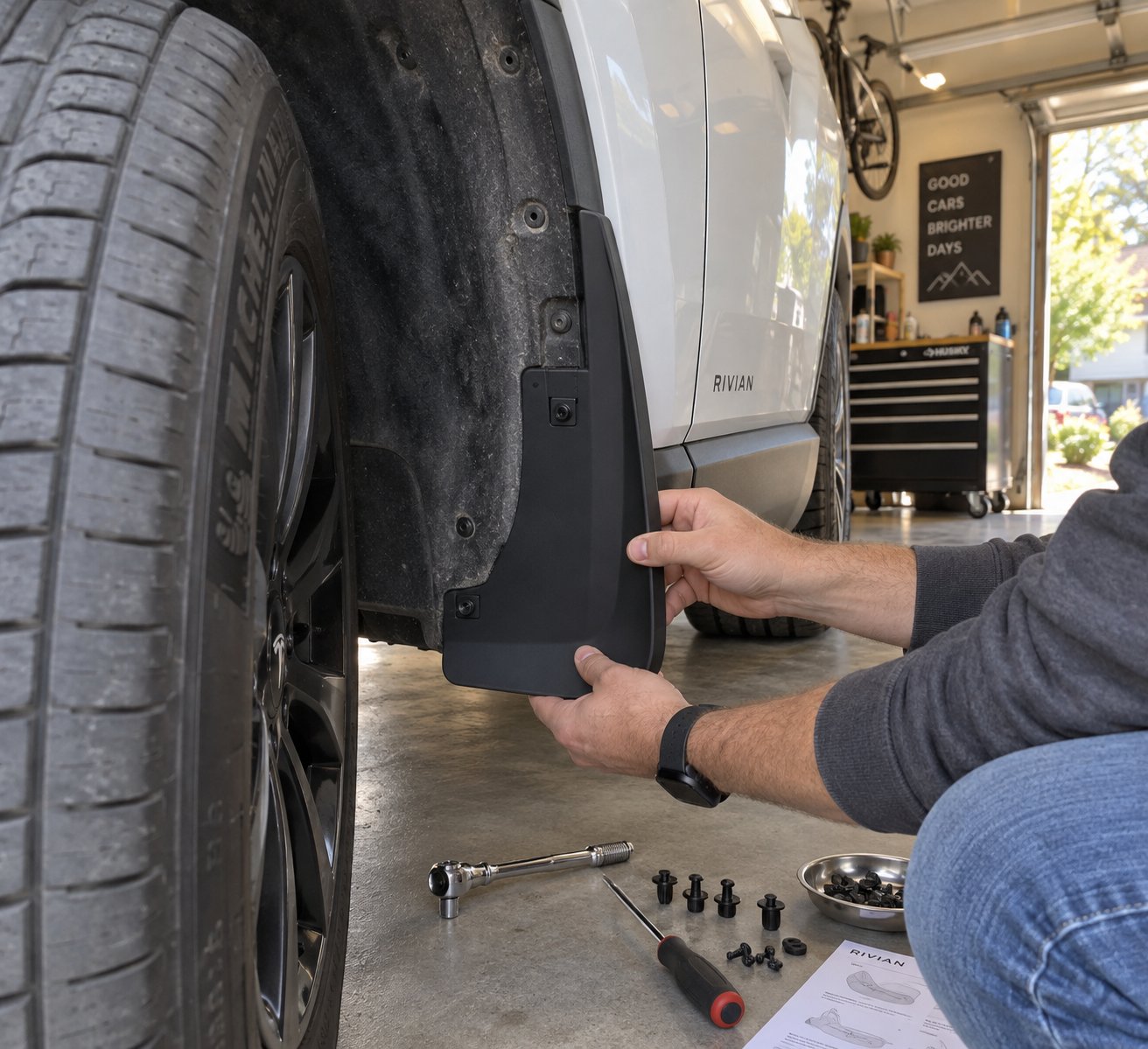
How to Choose and Install the Right Model Y Mudflaps
You've narrowed down the style, confirmed compatibility, and selected a set that matches your Model Y's factory origin and generation. The box is sitting on your garage floor. What comes next is the part most owners overthink — and then realize takes less than thirty minutes once they actually start. Installing tesla model y mudflaps is one of the most straightforward DIY tasks you'll encounter as an EV owner, but a few details make the difference between a secure, rattle-free fit and a mud flap that loosens up or shifts out of position after a few hundred miles.
Screwless vs. Screw-Mount Installation Methods
Before you reach for any tools, take a look at how your specific mud flap set attaches. Nearly every aftermarket option for the Model Y uses one of two mounting approaches, and each has distinct trade-offs worth understanding.
Screwless Clip-On Systems
This is the dominant method in the Tesla accessories space — and for good reason. Screwless designs use push clips or retention tabs that snap into existing factory holes in the wheel well liner. You're not drilling into the vehicle's body. You're not threading screws through plastic. You're leveraging mounting points Tesla's engineers already placed in the liner during production.
Tesla's own Model Y mud flap installation guide details a push clip process: you remove the existing lower push clips from the front wheel arch liner, discard them, and then install new push clips provided with the kit to secure the mud flap in position. The inboard clip goes in first, followed by the outboard clip. Each push clip has a two-stage design — insert the body of the clip with the plastic rivet pulled out, then push the rivet in to lock it closed.
- Tools typically needed: Push clip removal tool or flathead screwdriver (to remove factory clips), clean microfiber cloth, isopropyl alcohol for surface prep
- Installation time: Roughly 10–15 minutes per side for a confident DIYer
- Reversibility: Fully reversible — removal leaves no visible marks, scratches, or permanent holes
The appeal here is obvious. Tesla owners who lease their vehicles, plan to sell in a few years, or simply want the option to remove mud flaps for aesthetic reasons can do so without leaving any trace. It's also completely tool-friendly for people who have never done automotive modifications — no power tools, no alignment jigs, no permanent commitment.
Screw-Mount Systems
Some mud flap sets — especially rally-style and full splash guard designs — use self-tapping screws or bolts that thread through the wheel well liner into the mud flap's mounting bracket. This creates a more rigid attachment that resists vibration and movement at sustained highway speeds, making it the preferred method for owners who drive aggressively, frequently navigate rough roads, or live in regions where extreme temperature swings cause clip-on systems to contract and loosen.
- Tools typically needed: Phillips or Torx screwdriver (depends on included hardware), electric drill or driver (optional but speeds things up), push clip removal tool, measuring tape for alignment verification
- Installation time: Roughly 15–25 minutes per side, depending on the number of fastening points
- Reversibility: Partially reversible — small screw holes remain in the liner material upon removal, though these are hidden within the wheel well and not visible from outside the vehicle
Which method wins? For most daily drivers in typical road conditions, screwless clip-on systems deliver more than enough holding strength while preserving full reversibility. If you regularly face gravel, washboard roads, or heavy winter slush at highway speed, the added security of a screw-mount setup provides peace of mind that the flaps won't shift or detach under sustained bombardment.
Step-by-Step Installation Tips for a Clean Fit
Regardless of which mounting method your mud flap set uses, a handful of best practices separate a tight, professional-looking install from one that gaps, rattles, or gradually works itself loose over time.
1. Clean the mounting area thoroughly. This sounds basic, but it matters more than you'd expect. Road grime, brake dust, and oily residue coating the fender liner and inner wheel arch prevent clips from seating fully and reduce adhesion for any foam tape backing strips. Wipe down every surface the mud flap will contact using isopropyl alcohol and a clean cloth. Tesla's own installation documentation specifically instructs owners to clean the installation area with alcohol and allow it to fully dry before beginning — skip this step and you're building on a compromised foundation.
2. Turn the steering wheel fully to access the front wheel wells. When installing front model y mudflaps, turn the steering wheel all the way to the left to expose the right front wheel well's mounting points, and all the way to the right for the left side. This simple step opens up the working area dramatically and saves you from blindly reaching behind the tire to find clip locations by feel.
3. Test-fit before final attachment. Hold the mud flap in position and visually confirm that every mounting tab, clip hole, and contour edge lines up with the corresponding point on the vehicle. Look for interference — does any part of the flap contact the tire at full steering lock? Does the lower edge sit flush with the fender garnish without buckling? Catching a fitment issue during the dry run is infinitely easier than discovering it after you've already driven push clips home or threaded screws into place.
4. Install in moderate temperatures. TPE and PP — the materials most Tesla mud flaps are made from — become stiffer and less pliable in cold conditions. If you're working in a garage during winter, let the mud flaps sit at room temperature for at least 30 minutes before installation. Warm material flexes into position more easily, clips seat with less force, and any adhesive backing strips bond more effectively. Trying to flex a cold, rigid mud flap into a contoured wheel arch is a recipe for cracked clips and frustration.
5. Discard the factory push clips and use only the new hardware. Tesla's installation guide makes this point explicitly: discard the existing push clips and use the new ones provided with the mud flap kit. The original factory clips may look functional, but they're often weakened during removal and aren't designed to handle the additional load of securing a mud flap to the liner. Fresh hardware ensures a secure grip from day one.
6. Confirm clearance at full steering lock. After installation, turn the steering wheel lock-to-lock while crouching down to watch the front mud flaps. You're checking that the flap doesn't rub against the tire at any point during the full range of steering travel. Even slight tire-to-flap contact will generate noise, accelerate wear on both surfaces, and eventually deform the flap's edge. If contact occurs, reposition the flap slightly or verify you have the correct product for your specific wheel and tire combination.
Protecting Your Investment for the Long Run
Getting the mud flaps on the car is the big win — but keeping them performing well requires a small amount of ongoing attention. Fortunately, the maintenance involved is minimal and takes only a few minutes during your normal car care routine.
Clean behind the mud flaps periodically. Mud flaps trap debris by design — that's their job. But over time, grit, sand, and moisture can accumulate in the narrow gap between the flap and the body panel or liner surface. Left unchecked, this trapped material holds moisture against the paint and can cause the same kind of surface degradation the mud flaps are meant to prevent. Every few weeks — or after driving through heavy mud, slush, or standing water — pull the flap back gently and rinse out any accumulated buildup with a garden hose or pressure washer on a low setting.
Inspect clip and fastener security seasonally. Temperature cycling — the repeated expansion and contraction that comes with seasonal changes — can gradually loosen push clips and even back out screws over the course of several months. Make it a habit to check fitment at least once per season. Press firmly on each clip to confirm it's fully seated, and tighten any screws that show signs of loosening. A 60-second inspection every few months prevents the annoying discovery of a dangling mud flap on the highway.
Watch for wear and material fatigue. Even high-quality TPE degrades over years of UV exposure, road chemical contact, and repeated impact. Look for cracking, thinning at the edges, or loss of flexibility during your seasonal checks. Most well-made 2026 tesla model y mud flaps and earlier-generation options last several years under normal driving conditions, but extreme environments — constant gravel exposure, sustained sub-zero winters, or heavy road salt use — can accelerate wear. Replacing a worn mud flap before it fails completely is a small cost that maintains continuous protection.
For owners who want to simplify the entire process — from product selection through installation — collections like CUTIM's Tesla mud flaps and splash guards offer front and rear sets designed for straightforward installation on Tesla models. Having matched sets built specifically for Tesla fitment reduces the guesswork involved in compatibility verification and ensures you're working with hardware engineered for the exact liner geometry and mounting points on your vehicle. It's a practical shortcut for owners who want complete coverage against road spray and debris damage without spending hours cross-referencing part numbers across multiple vendors.
At the end of the day, mud flaps are one of the highest-value, lowest-effort modifications you can make to a Model Y. The vehicle didn't ship with them. Tesla isn't likely to start including them. And every mile you drive without protection is another round of invisible damage accumulating on your lower body panels. A thirty-minute installation and a few minutes of seasonal upkeep stand between your paint and years of road debris — and that's a trade-off that pays for itself many times over.
Frequently Asked Questions About Tesla Model Y Mud Flaps
1. Does any Tesla Model Y trim come with mud flaps from the factory?
No trim level of the Tesla Model Y — Standard Range, Long Range, or Performance — has ever included mud flaps as standard or optional equipment. This applies to every factory origin, including Fremont, Austin, Berlin, and Shanghai. Tesla's minimalist design philosophy treats mud flaps as an aftermarket accessory, leaving the decision entirely to the owner. Many new buyers only realize this gap after noticing rock chips and paint wear on rocker panels and lower body surfaces.
2. Do mud flaps affect Tesla Model Y range or aerodynamics?
Real-world testing by Tesla owners suggests that well-designed aftermarket mud flaps create a drag penalty of roughly 1-3% during sustained highway driving, while the impact at lower city speeds is essentially negligible. Modern aftermarket manufacturers have responded to this concern by engineering low-profile, aerodynamically contoured designs that minimize drag while still providing meaningful debris protection. For most daily drivers, the minor efficiency trade-off is far outweighed by the paint damage prevention mud flaps deliver.
3. Will mud flaps from an older Model Y fit the 2025 Juniper redesign?
No. The Juniper Model Y introduced substantial exterior changes — reshaped wheel arches, new front and rear fascia, revised fender liner structures, and updated bumper geometry — that make pre-Juniper mud flaps incompatible. Aftermarket manufacturers have explicitly confirmed that legacy products do not fit the Juniper variant. Owners of the redesigned Model Y should look for products labeled 'Juniper compatible' or '2025+ Model Y' and verify fitment with their full VIN before purchasing. Collections like CUTIM's Tesla mud flaps (https://www.cutimauto.com/collections/tesla-mud-flaps) offer organized options that help owners navigate these compatibility distinctions.
4. How do I know which mud flaps fit my specific Tesla Model Y?
Check the 11th character of your Vehicle Identification Number (VIN) to determine your factory origin: F for Fremont, A for Austin, B for Berlin, and C for Shanghai. Then confirm whether your vehicle is a pre-Juniper (2020-2024) or Juniper (2025+) build. Body panel geometry, wheel arch shapes, and fender liner designs can vary between factories and generations, so cross-referencing both data points against the product's fitment specifications is essential. When in doubt, contact the manufacturer directly with your full VIN for written confirmation.
5. Are mud flaps legally required on a Tesla Model Y?
No federal-level mud flap mandate exists in the United States or Canada for passenger vehicles. Regulations are set at the state, provincial, or territorial level and vary widely. Most of the 42 U.S. states with mud flap laws target commercial vehicles specifically, though some include broader language that could apply to passenger cars. Eight states have no specific requirements at all. Even where not legally required, mud flaps reduce road spray and debris kicked onto vehicles behind you, serving as both a paint protection measure and a courtesy to fellow drivers.