
What a Carbon Fiber Rear Spoiler Actually Does
Have you ever noticed how a thin strip on a trunk lid can change the whole look of a car? You might also wonder whether that strip does anything once the car is moving. The honest answer depends on the design, and even more on how fast you're driving.
Defining the Carbon Fiber Rear Spoiler
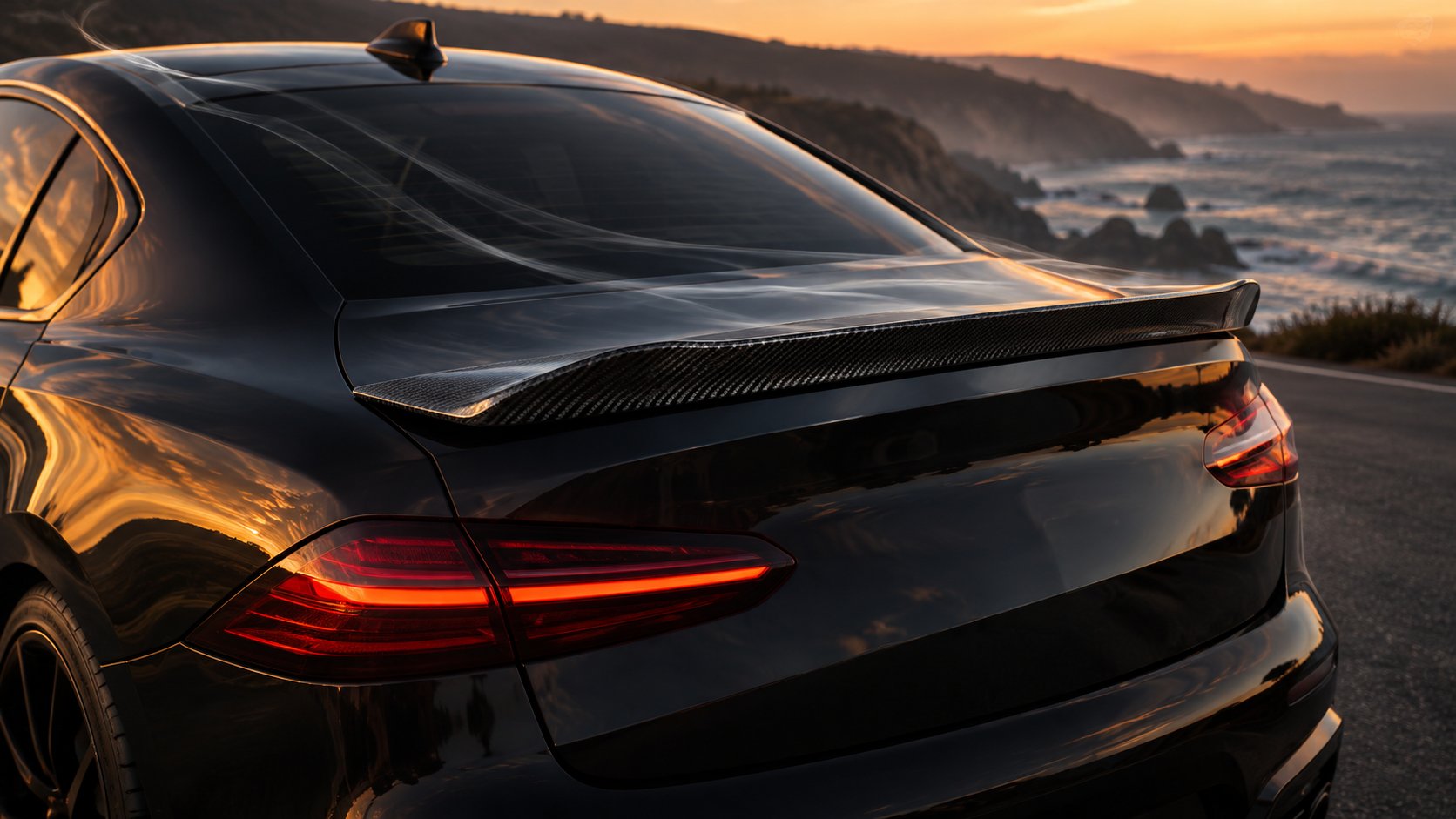
A carbon fiber rear spoiler is an aerodynamic add-on made from resin-bonded carbon fiber that mounts on a car's trunk lid or rear deck to disrupt airflow and reduce rear-end lift at speed.
Most spoilers sit at the trailing edge of the trunk, where air coming off the roof meets the rear deck. Hatchbacks and SUVs often carry theirs at the top of the rear glass instead. The name describes the job: a spoiler is designed to spoil unfavorable airflow, such as lift, turbulence, or drag. A carbon fiber rear wing works differently. It is a raised airfoil built to generate downforce, and the gap between the two is wider than most product listings suggest.
Basic Aerodynamic Principles Behind Rear Spoilers
When air flows over the roof, it follows the rear window down toward the trunk and tries to curl under the car. That creates lift, which takes load off the rear tires and weakens their grip. Carfax compares a spoiler to holding your hand up in the windstream. The lip blocks that downward path and keeps the tail from getting light.
Body shape matters too. Many cars drop steeply from the roof to the trunk, so the airflow separates and turns turbulent. A spoiler lets the air "see" a longer, gentler slope. That delays separation and builds a little pressure just ahead of the lip. The result is less rear lift and a more settled car at higher speeds. Reducing lift is a different job from generating large amounts of downforce, and most small spoilers are much better at the first one.
Aesthetic Appeal vs Functional Downforce at Street Speeds
Many buyers assume every spoiler presses the car into the road, but the physics doesn't support that at everyday speeds. Aerodynamic forces grow with the square of speed, so doubling your speed roughly quadruples both downforce and drag. At 35 mph on a city street, a trunk-mounted lip barely registers. Testing bears this out: when Car Life magazine evaluated the 1969 AMC Javelin's roof spoiler, it found no reduction in lift below 115 mph. Some automakers openly state that their spoilers are for looks only.
The material has its own story. Racing teams use carbon fiber because it is light, stiff, and durable. The BMW M8 GTE endurance racer, for example, runs a carbon rear wing. Carbon fiber also costs more than plastic or fiberglass, partly because its production involves a lot of manual labor. The motorsport association carried over to street cars. A carbon fiber spoiler on a BMW M3 signals performance even when the car is parked. The same goes for a subtle BMW IS spoiler on an older 3 Series, or any aftermarket BMW spoiler with an exposed weave. For most daily drivers, the part is a styling upgrade first, and that's a perfectly good reason to buy one if you know what you're paying for.
The labels are where shoppers get confused. Many retailers call almost anything on a trunk lid a "spoiler," including raised designs that work on a completely different aerodynamic principle.
Rear Spoiler vs Rear Wing and Why the Difference Matters
Open a listing titled "carbon spoiler" and you may find a part perched on tall aluminum stands. Is that really a spoiler? Aerodynamically, no. The quickest way to tell the two apart is to ask where the air goes.
How a Spoiler Works Differently Than a Wing
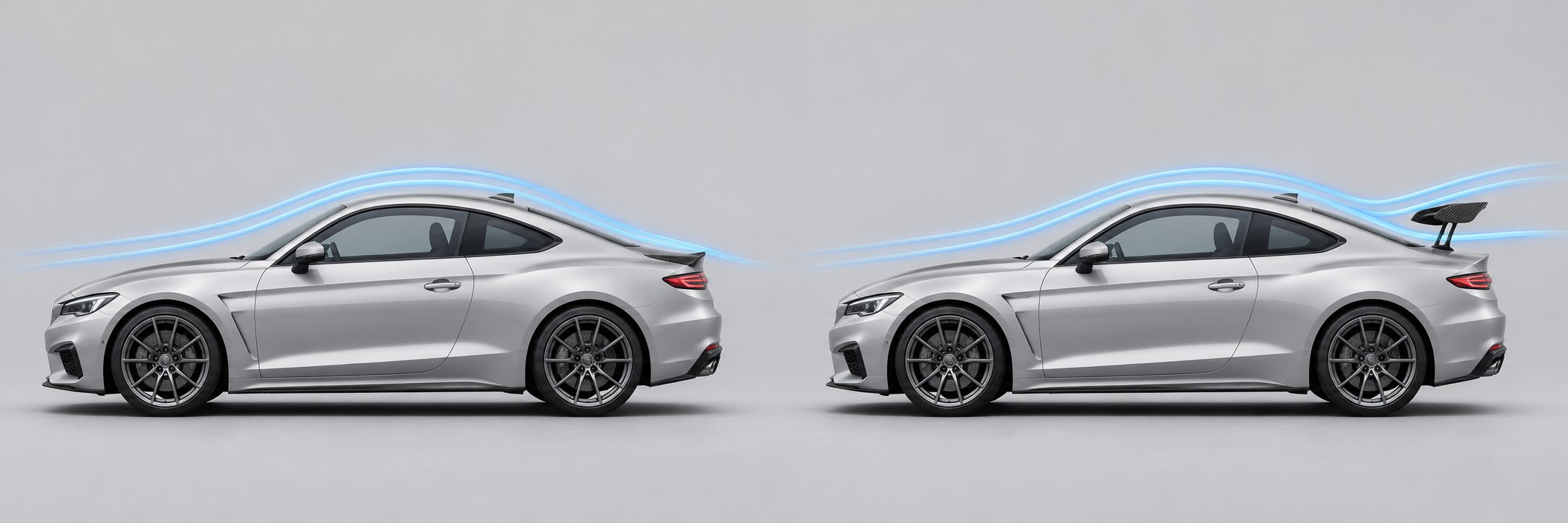
Air passes only over the top of a spoiler. With a wing, air flows over the top and underneath, as Occam's Racer explains. A spoiler attaches to the trunk and blocks the air coming down the back of the car. That builds pressure ahead of the lip and cuts rear lift. A wing is an upside-down airfoil held up in clean air. Its underside does most of the work by creating a low-pressure zone that pulls the rear of the car down.
You can see the difference in efficiency numbers. A typical spoiler makes about 3 pounds of downforce for every pound of drag, while around 8:1 is normal for a wing. Mounting height matters too. A wing mounted closer to the trunk than its own chord (its front-to-back depth) loses performance and starts behaving like a spoiler.
Spoiler Sub-Styles From Ducktail to Lip
- Lip: a thin, low blade along the trunk edge. It's the most understated rear spoiler BMW sedan owners tend to choose.
- Duckbill: a taller, flatter kick that extends rearward past the trunk edge.
- Ducktail: an upswept edge molded into or attached to the trunk that keeps a clean, factory-like look.
- Gurney flap: a small vertical tab at the trailing edge, used on spoilers or wings to fine-tune pressure.
| Attribute | Rear Spoiler | Rear Wing |
|---|---|---|
| Mounting style | Flush on the trunk lid, often with tape or factory holes | Raised on stands, usually needs drilling and a backing plate |
| Aerodynamic function | Disrupts airflow to reduce lift | Generates downforce from the pressure difference between its top and bottom surfaces |
| Visual profile | Subtle and integrated | Aggressive and race-inspired |
| Typical use case | Street cars and daily drivers | Track and motorsport builds |
| General cost range | Lower | Higher |
When to Choose a Spoiler Over a Wing
For a street car, a spoiler usually makes more sense. Small spoilers under about an inch tall can trim both drag and lift. They also don't block rear visibility, which is one reason automakers favor them. Search for a BMW with spoiler upgrades and most of what you'll find are lips and ducktails that keep the factory lines intact.
Wings belong on track-focused builds. A BMW rear wing on a dedicated track car can add real grip in fast corners. It also adds drag and weight, and you have to tune its height and angle. Weight placement can cancel the gains. On one tight, twisty circuit, a spoiler lapped half a second faster than a wing because the wing put 14 pounds high up at the very back of the car. For a car that sees occasional track days, a taller, adjustable spoiler is a sensible middle ground.
Choosing a style narrows the search. Two lips with an identical shape can still differ widely in weight, stiffness, and price, and much of that gap comes down to how the carbon was made.
How Carbon Fiber Car Spoilers Are Manufactured
Imagine two listings for the same carbon fiber BMW spoiler. They have the same shape and the same glossy weave, yet one costs far more than the other. The production method usually explains the gap. Every carbon part is carbon fabric held together by resin. How the resin gets into the fabric and how it cures set the part's weight, consistency, and finish.
Autoclave Pre-Preg and Why It Commands a Premium
Pre-preg is short for "pre-impregnated." The material supplier coats the fabric with a measured amount of partially cured resin. The sheets ship on refrigerated rolls and can only be used for a limited time. Technicians lay the sheets into a mold and seal it in a vacuum bag. The part then cures in an autoclave, which is a pressurized oven that applies heat and pressure at the same time.
The pressure squeezes out trapped air and extra resin. Autoclave parts typically reach 58 to 65 percent fiber by volume, with voids (air pockets that weaken a part) under 1 percent. The surface comes out of the mold clean and glossy and needs little finishing. The costs show up elsewhere. Molds have to survive heat and pressure, so they are usually machined aluminum or steel. The material needs cold storage, and an autoclave is expensive to run.
Wet Layup and Vacuum Infusion Methods
Wet layup is the older and simpler method. A worker places dry fabric in a mold and applies resin by brush or roller. The part cures at room temperature or in a low-heat oven, and the mold can be cheap fiberglass or even 3D-printed. Because the worker controls the resin ratio by hand, results vary from part to part. Fiber volume usually falls between 40 and 55 percent, and voids can reach 2 to 8 percent or more. You'll also see more pinholes, resin pooling, and weave print-through on the surface.
Vacuum infusion falls between those two methods. Dry fabric goes into the mold, and a vacuum pulls resin through it. Compared with hand layup, infusion raises fiber content and reduces voids, and its tooling costs less than pre-preg tooling. Its quality still falls short of a good autoclave part.
Dry Carbon vs Wet Carbon Explained for Buyers
Product listings use these two labels all the time. "Dry carbon" means pre-preg cured in an autoclave. "Wet carbon" means fabric laid by hand with resin applied manually. Dry carbon is lighter because it holds less resin. One BMW aero shop says a dry carbon hood can be 30 to 40 percent lighter than the same hood in wet carbon, and dry parts can cost two to three times as much. On a small carbon fiber spoiler lip, the same percentage saves far less actual weight than it does on a hood.
Wet carbon is still a real carbon fiber spoiler material. Most aftermarket carbon parts are wet carbon because it costs less to produce. A well-made wet part holds up fine on a street car. A poorly made one can bubble, yellow, or delaminate. How well a part was made matters more than which label it carries.
Forged carbon is a third option. The manufacturer cuts carbon fiber into pieces typically under an inch long, mixes them with resin, and compresses the mix in a mold under high heat and pressure. Because the fibers point in random directions, every part gets its own marbled pattern. Forged carbon is about as strong and stiff as woven carbon, and its strength is roughly equal in every direction.
| Process | Weight Outcome | Surface Consistency | Relative Cost Tier | Typical Application |
|---|---|---|---|---|
| Autoclave pre-preg (dry carbon) | Lightest | Excellent, very few voids | Highest | Track builds and weight-focused cars |
| Vacuum infusion | Light to moderate | Good | Medium | Mid-range parts in moderate production runs |
| Wet layup (wet carbon) | Heaviest of the carbon methods | Varies by maker | Lowest | Most street and daily-driver parts |
| Forged compression molding | Light, with stiffness similar to woven carbon | Marbled pattern that differs on every part | Medium to high | Parts chosen mainly for their look |
This table accounts for most of the price differences between carbon fiber car spoilers. Pre-preg parts carry the cost of metal molds, cold-stored material, and autoclave time. Wet layup uses cheap molds and hand labor. If a listing doesn't name its production method, ask the seller. Production method is only part of the picture, though. The pattern you see on the surface comes from how the fabric is woven, and the weave also affects how the part flexes under load.
Carbon Fiber Weave Types and What They Mean for Your Spoiler
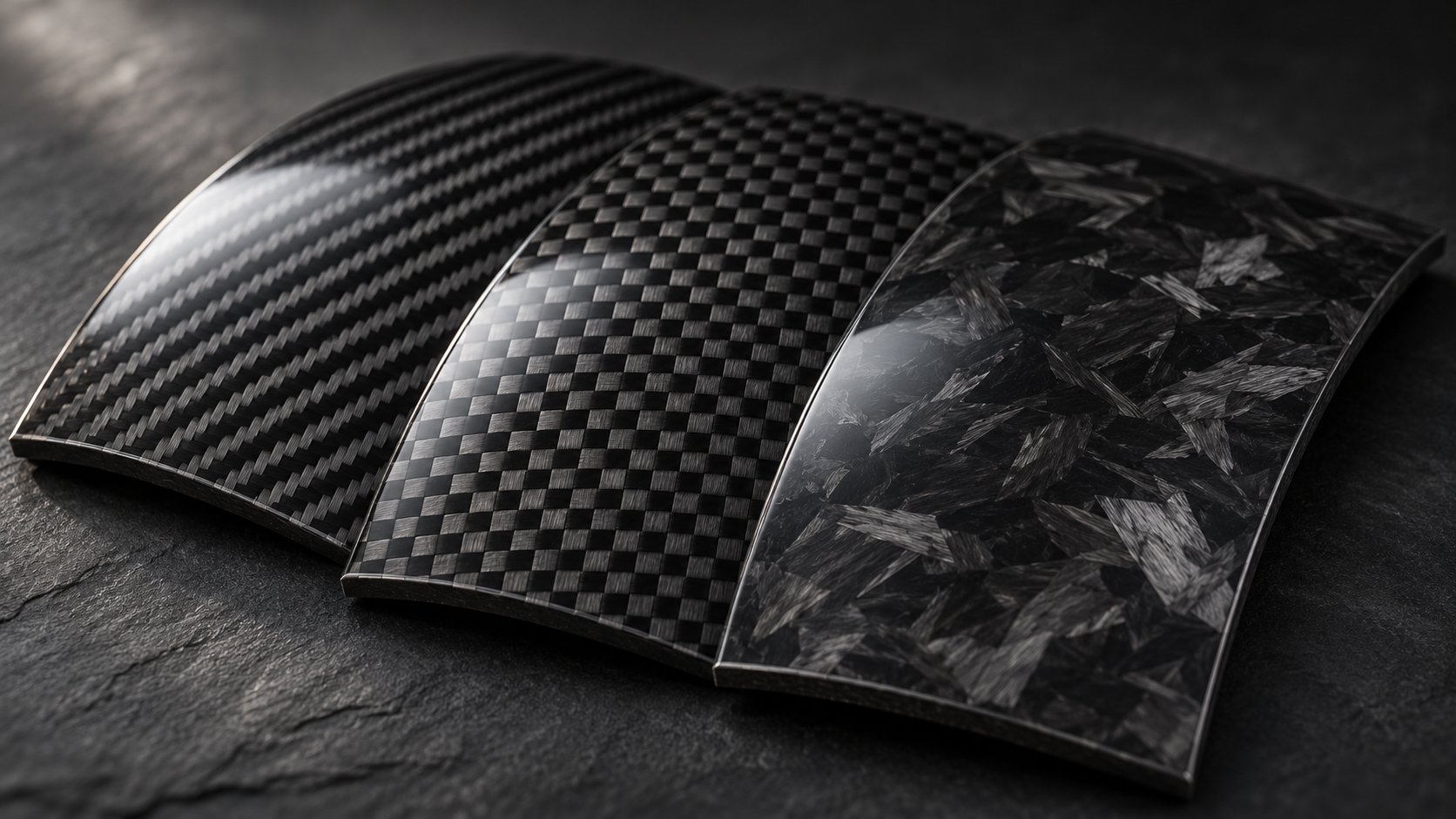
Line up a few carbon parts side by side and you'll notice the patterns differ. One shows a fine checkerboard, another shows diagonal stripes, and a third looks like polished marble. Is that just a style choice? Partly. The pattern also tells you how the part was built and how it handles curves.
Woven carbon fabric starts as tows, which are bundles of filaments. A 3k tow holds 3,000 filaments, and each one is only 5 to 10 microns thick. A loom weaves the tows into fabric, and that weave is the pattern you see under the clear coat.
2x2 Twill and Plain Weave Patterns Compared
Plain weave, also called 1x1, passes each tow over one tow and under the next. The result is a tight checkerboard. It holds its fiber angle well, but it doesn't bend easily over complex contours, so it works best on flat panels and simple curves. The tight interlacing also gives each tow a sharp bend, called crimp, which can create stress points over time.
In a 2x2 twill, each tow passes over two tows and under two, which creates diagonal lines. Fewer crimps mean fewer stress points. The fabric also drapes over compound curves while keeping reasonable stability. That makes twill a natural fit for a carbon fiber ducktail spoiler, whose upswept edge curves in more than one direction. The blade of a carbon fiber rear wing spoiler often has a simpler profile that plain weave can handle.
Weave orientation affects stiffness. Fabric comes off the roll with its fibers at 0 and 90 degrees, and a part is stiffest along those lines. When the fabric is pressed into a curved mold, the fibers shift away from perpendicular, so the stiff directions shift with them. Curing locks the fibers in place. If a maker needs extra stiffness in one direction, they can add unidirectional layers, usually with woven layers on the outside.
Most buyers still choose by appearance. Twill fills most aftermarket catalogs because it's the pattern people picture when they hear "carbon fiber."
Forged Carbon and Its Distinctive Aesthetic
Forged carbon isn't woven at all. Chopped fibers and resin are pressed together in a mold, so the pattern is random and no two parts match. Because the fibers point in every direction, the part's strength is roughly the same in every direction.
- Plain weave: small, even checkerboard squares. You'll see it most often on flatter surfaces.
- 2x2 twill: diagonal stripes with an arrowhead look, called the twill line. You'll find it on most aftermarket parts.
- Forged carbon: marbled flecks with no repeating pattern, so every piece looks a little different.
How to Tell Real Carbon Fiber From Carbon-Look Imitations
Some carbon-look parts contain no carbon. Hydro dipping applies a water-transfer film printed with a carbon pattern and then seals it with clear coat. Even a shop that sells dipped parts calls it a surface finish rather than a structural material. A dipped part weighs and flexes like whatever it's made of underneath. That's fine if you know what you're buying, but it shouldn't cost what real carbon costs.
- Weight: a real carbon fiber rear spoiler should feel light for its size. Weight alone doesn't prove anything, because a thin plastic lip can also be light.
- Backside: real carbon usually shows fabric texture or bare resin on the underside. A dipped part often shows plain plastic, primer, or the printed pattern.
- Edges: on real carbon, the weave continues around edges and corners. A printed film tends to stretch or blur on tight curves.
- Depth: a real weave has visible depth under the clear coat. A print usually looks flat.
Flip a carbon-look spoiler over and you'll often find fiberglass or ABS plastic underneath. Those materials aren't automatically bad choices. They come with their own trade-offs in weight, impact resistance, and cost.
Carbon Fiber Compared to Fiberglass, ABS, and Polyurethane Spoilers
Why would anyone choose plastic over carbon? Price is one reason, but there are others. Most aftermarket spoilers are made from one of four materials: carbon fiber, fiberglass, ABS plastic, or polyurethane. They differ in weight, how they handle bumps and sunlight, and how well they take paint. Once you know those differences, you can pick the material that suits the way you actually use your car.
Carbon Fiber Strengths and Honest Limitations
Carbon fiber is the lightest and stiffest of the four. A carbon fiber duckbill spoiler keeps its sharp trailing edge without sagging or flexing at speed. It also has real downsides. It costs the most, and it is the hardest to fix. A crack in a clear-coated carbon part needs a specialist, and one supplier admits that a repaired weave is very difficult to make invisible.
Sunlight is the other weak point. UV radiation breaks down the epoxy resin, so the part relies on a clear coat with UV inhibitors mixed in. If that layer is missing or wears through, the resin can turn brittle and chalky. The weight savings is also smaller than many buyers expect. A trunk-lid spoiler weighs a few kilograms at most, so switching from plastic to carbon saves less weight than a passenger or a full tank of fuel adds.
Fiberglass, ABS Plastic, and Polyurethane as Alternatives
Fiberglass is glass fiber bonded in resin. It costs less than carbon, falls in the middle on weight, and takes paint well. It is stiff but brittle, so a hard knock can crack it. Fiberglass is easy to repair, though. A shop can grind out a crack, lay new fiberglass over it, and finish the spot so it doesn't show. Most fiberglass parts arrive raw or in primer, so plan to pay for sanding and paint.
ABS plastic is the thermoplastic used for most factory-style spoilers. It is both rigid and impact-resistant, and it keeps those properties from about -4°F to 176°F. ABS is cheap, easy to find, and often ships already finished in gloss black. It is heavier and less rigid than carbon, and long sun exposure can dull or warp an unpainted part.
Polyurethane is the most flexible of the four. It shrugs off scrapes and small impacts that would crack a rigid composite. It is also the heaviest, and heat softens it. One body kit maker tells customers they can reshape a bent PU lip by leaving it in 86°F sun for 30 minutes to an hour. That same softness means long exposure to heat can warp it. Polyurethane also needs flexible primer and paint, or paint mixed with a flex additive.
| Material | Weight | Rigidity | Impact Resistance | UV Durability | Repairability | Aesthetic Finish Quality | Cost Tier |
|---|---|---|---|---|---|---|---|
| Carbon fiber | Lightest | Highest | Moderate, can crack on hard hits | Good only with a quality UV clear coat | Hardest, specialist repair | Visible weave under clear coat | High |
| Fiberglass | Moderate | High but brittle | Low, prone to cracking | Good once painted | Easy, cracks can be ground out and patched | Excellent after proper prep and paint | Low to medium |
| ABS plastic | Moderate | Moderate | Good, flexes with minor knocks | Fair, unpainted parts can dull | Moderate, scuffs can be sanded and refinished | Clean gloss black or painted finish | Low |
| Polyurethane | Heaviest | Lowest | Highest | Fair, heat can warp it | Good, minor bends can be heat-reshaped | Good with flexible paint | Low |
Matching the Right Material to Your Priorities
Start with what matters most to you. If you want the lowest weight or a real weave, carbon fiber is the clear choice. Picture a BMW rear spoiler on a daily-driven 3 Series, though. On that car, the weight difference won't change how it drives, so you're paying mainly for the look. If budget comes first, ABS gets you a finished part for the least money. A carbon-look ABS part gives you the pattern at a fraction of the cost of real carbon. Fiberglass suits builders who plan to paint anyway, but add the cost of paint prep to the sticker price. Polyurethane makes sense for a car that sees more bumps than sun.
Choosing the material is only half the decision. Even a light, stiff carbon part causes problems if it doesn't match the trunk it sits on. A universal carbon fiber rear wing made to fit many different trunks can't follow the exact shape of any one of them.
Why Vehicle-Specific Fitment Changes Everything
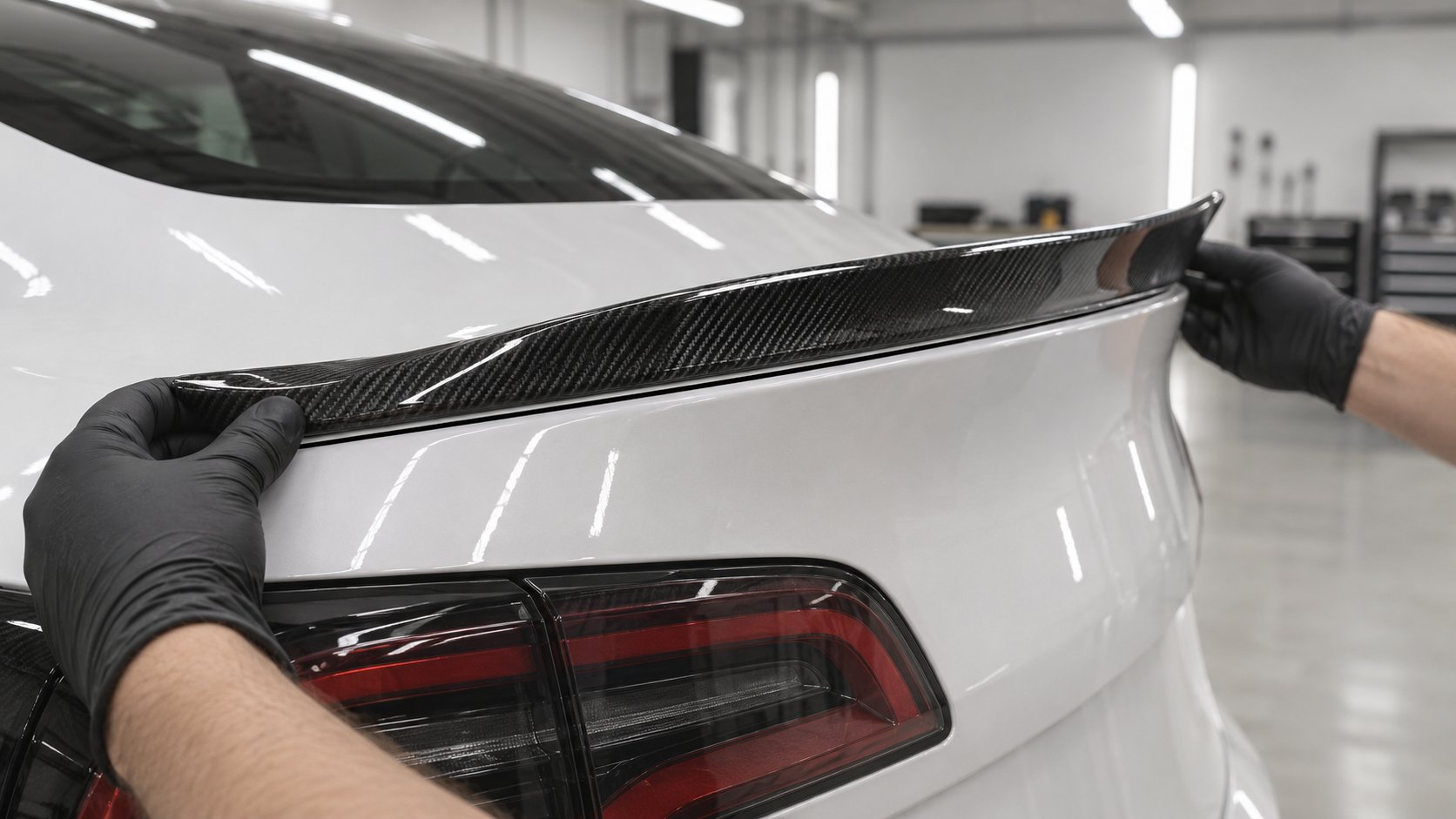
Picture a carbon part that looks perfect in the product photo. You set it on your trunk, and one end floats a few millimeters above the paint. What went wrong? The part was shaped for a different trunk. Buyers spend more time thinking about weave and material than about fit, yet fit is what decides whether a spoiler looks like a factory part or an afterthought.
Why Chassis-Specific Design Matters
Every trunk lid has its own curvature, its own mounting point spacing, and its own body lines where the deck meets the fenders and taillights. The trunk seal is shaped differently from car to car too, and that changes how much clearance the spoiler edge needs when the lid closes. A spoiler has to follow all of these surfaces at once. One supplier calls the model name the weakest piece of information in the fitment puzzle, because two cars that look alike can have different trunk lids and mounting points.
BMW is a good example. The M3 sedan and the M4 coupe share much of their engineering, but their trunk lids are different, so a BMW M4 rear spoiler won't sit correctly on an M3. An M3 rear wing has the same problem where its stands meet the deck. A carbon duckbill spoiler is even harder to fit, because its front edge has to match the trunk's curve across the full width. If it doesn't, you'll see the gap from every angle.
Universal Fit vs Vehicle-Matched Spoilers
A vehicle-matched spoiler is designed around one body style and one generation. Makers usually develop these parts from 3D scans of the panel or from factory reference data, so the width, curve, and mounting points are settled before you open the box. A carbon fiber universal spoiler is built to a generic size and adapts to your car with adhesive tape or adjustable brackets. The same fitment guide recommends treating a universal part as a fabrication project, with measuring, drilling, and bracket positioning.
Poor fit causes the same problems again and again. Panel gaps come out uneven. Air gets under a lifted edge and causes wind noise and vibration at highway speed. Tape that only partly touches the paint can let go after months of heating and cooling. Paint can get damaged if the spoiler shifts or has to be pried off. Drilled holes are the hardest mistake to undo. Even small dimensional differences can lead to rattles and adhesive failure.
Generation-Specific Fitment Traps to Watch For
Facelifts cause the hardest problems to spot. The Tesla Model 3 Highland refresh kept the basic chassis but changed the trunk curvature, the edge profiles, and the panel tolerances. A spoiler built for a pre-refresh car may not sit flush on a Highland, and a Highland spoiler may not fit an older car. Some catalogs sort parts by generation to avoid this problem. CUTIM's carbon fiber spoiler collection is organized around the Model 3 and Model Y, so Tesla owners can check which generation a part is made for before buying. Wherever you shop, confirm your exact model year and generation, and check whether the listing says genuine carbon fiber or a carbon-look finish.
Check these details before you buy:
- Model, year, and body style: sedan, coupe, and hatchback versions of the same nameplate often have different trunk lids.
- Generation or facelift: for example, pre-refresh Model 3 vs Highland.
- Listing wording: "Direct fit" means the part was made for your car. "OEM style" only describes the shape.
- Mounting method: tape, factory holes, or new drilling.
- Clearances: the third brake light, the rear camera, and the trunk seal when the lid closes.
- Dimensions: compare the seller's published measurements with your own measurements of the trunk lid.
- Real photos: look for installation photos on your generation of the car, not just renders.
- Material: confirm whether the part is genuine carbon fiber or carbon-look.
- Dry fit: test the fit before you apply any adhesive or drill.
A spoiler can fit perfectly and still be the wrong size for how you drive. A low lip and a tall, adjustable profile do different jobs. Which one makes sense depends on whether the car spends its time on public roads or at the track.
Street vs Track Use
Where does your car spend most of its miles? A commuter car and a weekend track car need different things from the rear deck. Plenty of owners use their car both ways, so the right part depends on how you actually drive.
Spoilers as a Street Style Upgrade
On public roads, a spoiler's main job is visual. A well-fitted lip or ducktail sharpens the rear profile and gives the car a performance look. At commuting and highway speeds, the aero effect of a trunk-mounted spoiler is too small for most drivers to feel. A subtle lip spoiler BMW owners add to a daily-driven 3 Series is a styling choice first, and that's fine. On a street car, fit, finish, and how well the part ages matter more than downforce figures.
Functional Aerodynamics for Track and Motorsport Builds
At the track, the choice becomes an engineering decision. Profile height and angle of attack set how much downforce a carbon fiber wing makes and how much drag comes with it. End plates limit the air that spills around the wing tips from the high-pressure top surface to the low-pressure underside, which helps the wing hold its pressure difference.
You also can't tune the rear by itself. One aero tuning guide warns that adding a rear wing without balancing the car often makes it slower. Too much rear downforce causes understeer at high speed, and too little causes oversteer. A front splitter and rear diffuser help spread the load between the front and rear axles. The same guide suggests starting with a moderate wing angle, changing it 1 to 2 degrees at a time, and checking stability, braking confidence, and lap times after each change. Extra aero load also compresses the suspension at speed, so you may need stiffer springs or more damping.
If you split time between commuting and occasional track days, a moderate-profile spoiler is usually the most practical choice. It reduces some lift without the drag, weight, and blocked rear view that come with a tall wing.
- Street: appearance, exact fit for your generation, clear coat quality, unobstructed rear view, and simple tape or factory-hole mounting.
- Track: adjustable angle of attack, rigid stands with backing plates, effective end plates, and front aero that matches the rear.
- Dual-purpose: a moderate profile that adds some stability at speed, keeps the rear view clear, and doesn't add much drag on the highway.
Legal and Insurance Considerations Worth Checking
Large carbon wings can cause trouble away from the track too. Rules vary by state and country. Missouri's safety inspection, for example, doesn't care whether a part is factory. It checks whether required items are present, working, and within legal dimensions. A tall wing that hides the third brake light or the license plate is the kind of problem an inspector may flag. Other jurisdictions have their own rules on body additions, so check your local code before you order an aggressive wing.
Insurance is the other thing to check. Many insurers treat exterior modifications as material changes to the vehicle. Tell your insurer about the part, and ask whether your policy covers aftermarket equipment or whether you need custom-equipment coverage. An undisclosed modification can complicate a claim.
Most street spoilers will never come close to the speeds where aero matters. They will spend hundreds of hours parked in the sun, though, and that exposure decides how good the carbon still looks years later.
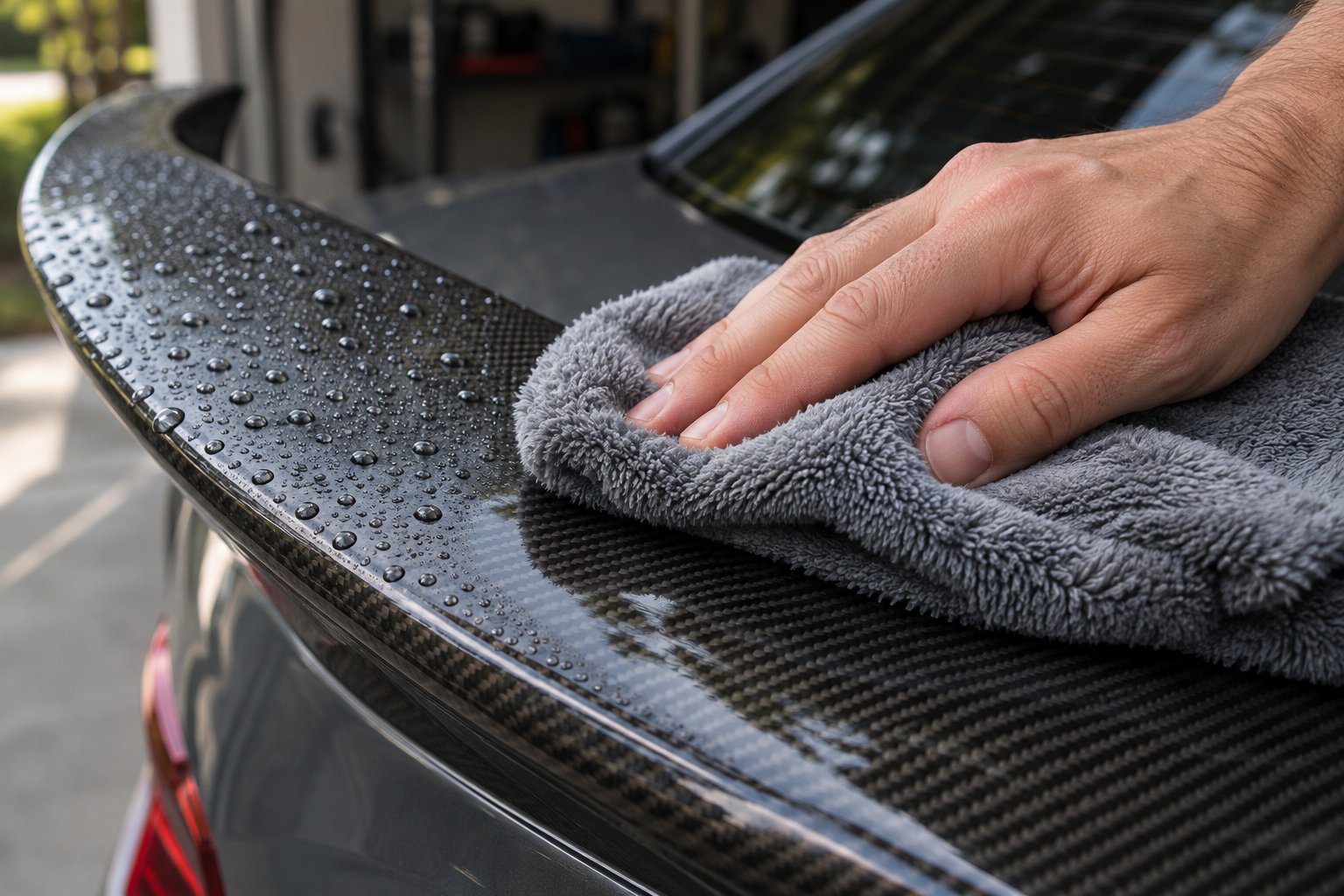
Caring for Your Carbon Fiber Spoiler Over the Long Term
Your spoiler looked deep black when it went on, and a few summers later it looks a little dull, maybe even slightly yellow. Is the carbon wearing out? Usually it isn't. The weave underneath is essentially permanent. What fails is the clear resin coating on top, which breaks down slowly from sun, heat, and age.
Protecting Against UV Damage and Clear Coat Breakdown
UV damage tends to show up in stages. The finish loses its gloss first. Next the surface yellows or turns chalky. Then fine cracks form in the clear coat. Once those cracks go all the way through the coating, moisture can reach the laminate and eventually cause its layers to separate, which is called delamination. The damage builds over time, so yellowing keeps getting worse unless you cut the UV exposure or refinish the part.
The quality of the resin sets the starting point. One carbon parts maker says lower-grade clear coats can start yellowing within 12 to 18 months, while premium UV-stable formulas can last 7 to 10 years or more. Parking makes a big difference too. Picture two identical BMW M3 rear spoilers, one on a car parked outside in Southern California and the other on a car garaged in Seattle. The one in California will yellow first.
A good routine slows that wear. Wash the car with a pH-neutral automotive soap. Avoid harsh degreasers, abrasive polishes, and waxes that contain petroleum solvents, because all of them strip or oxidize the clear coat. Add a UV-protective sealant or ceramic coating. A ceramic coating acts as a sacrificial layer that absorbs the UV damage before it reaches the factory clear coat. Most coatings need reapplying every 2 to 5 years, depending on the product.
Spotting Early Signs of Degradation
Check the spoiler under light from several angles. Hairline cracks often show up only when the light hits them from the side. You may also notice the weave losing its sense of depth, so it looks flatter and grayer than it used to. Raised bubbles, dull patches, and soft or spongy spots are more serious because they can mean moisture has gotten into the layup. White halos around mounting holes point to stress in the resin, often from overtightened hardware.
If you're not sure whether the part is yellowed or just dirty, wash it thoroughly and look at it in direct sunlight. A tint that's still there after washing is yellowing.
Repair Realities When Damage Goes Beyond the Surface
A skilled detailer can usually fix light clear coat scratches with wet sanding and machine polishing, as long as enough healthy coating is left. Every correction removes some material, though. If the sanding cuts through the clear coat, the bare resin is exposed and degrades faster in sunlight. Matte carbon needs extra care because polishing it can leave permanent shiny spots.
Cracks in the laminate itself need professional composite repair or replacement. Bonding a decorative carbon patch over the crack won't restore the part's strength. For a small trunk lip, replacing it often costs less than repairing it properly. A raised wing for a BMW track car needs extra caution, because damage near the wing stands affects whether the wing stays secure at speed. Even perfect care can't guarantee that a part will never delaminate. Regular care lowers the risk and helps you catch problems early.
A seasonal checklist covers these steps:
- Spring: Deep clean with pH-neutral soap, then inspect the spoiler under angled light for hairline cracks, yellowing, and lifted edges.
- Early summer: Apply or top up your sealant or ceramic coating, and park in shade whenever you can.
- Late summer: After a run of hot weeks, check the adhesive edges and mounting points, and look for white halos around the bolts.
- Fall: Do the wash-and-sunlight test, and book a detailer for any light scratches before winter.
- Winter: Rinse off road salt and grime promptly, and look for raised or soft spots without flexing the part.
Care can slow the aging, but it can't make up for a poorly made part. The clear coat formula is fixed the day the part leaves the factory. A BMW M3 with spoiler parts made from low-grade resin can yellow in 18 months however carefully the owner washes the car. That means the clear coat and build quality are worth judging before you buy.
How to Spot Quality When Shopping for a Carbon Fiber Spoiler
Search for "spoiler carbon fiber" on any marketplace and you'll get thousands of results with very different prices. Two listings can show the same glossy weave, the same shape, and the same "real carbon" claim, and one can still cost three times as much as the other. Photos alone won't tell you which one is worth buying. The construction details, the finish, and the hardware will. These checks apply whether you're buying a low trunk lip, a raised wing spoiler, or a custom rear wing spoiler built to order.
Key Quality Indicators to Examine Up Close
Start with the clear coat. A well-made part has several layers of UV-resistant clear, which gives the weave its glassy depth and protects the resin as it ages. A single thin coat can look fine at delivery and start yellowing within a couple of summers. Ask the seller how many coats they apply and whether the clear contains UV inhibitors.
Next, look at the weave. The twill lines should run straight from one end of the spoiler to the other, with no wavy sections, gaps, or kinks at the corners. Crooked weave usually means the layup was rushed. Then turn the part over. A clean, sealed backside shows the maker finished the whole part. A rough underside or exposed raw resin points to cost-cutting and leaves the laminate open to moisture.
Hardware gets overlooked. Look for stainless steel or zinc-plated bolts and brackets, because bare steel fasteners can rust and stain the trunk paint. Last, confirm the fitment. A listing that names your model, generation, and body style is worth more than one that claims to fit "most sedans."
Red Flags That Signal a Low-Quality Part
The cheapest carbon spoiler you can find often contains no carbon. Budget listings frequently put a hydrographic carbon print over a fiberglass or ABS base. You get the pattern without the weight savings or the stiffness. One manufacturer's price breakdown puts $80 to $150 listings in ABS or fiberglass territory and starts real wet carbon at around $500. Those figures come from a seller, so treat them as a rough guide. Still, a price far below the rest of the market deserves a closer look.
Read the wording carefully. Phrases like "carbon style," "carbon pattern," and "carbon look" usually describe the finish, not the material. A carbon overlay is also a different product. It puts one real carbon layer over a plastic or fiberglass base. Be wary of listings that don't name a construction method, that reuse the same stock photo for unrelated vehicles, or that say nothing about clear coat protection.
Run through this checklist before you buy:
- Construction: the listing names the method, such as wet layup, pre-preg, forged, or overlay.
- Material: the listing says genuine carbon fiber, not carbon-look.
- Clear coat: multiple UV-resistant layers are specified.
- Weave: the pattern runs straight and continues around the edges.
- Backside: the underside is clean and sealed, with no rough raw resin.
- Hardware: stainless steel or zinc-plated fasteners are included.
- Fitment: your model, year, generation, and body style are listed by name.
- Photos: the seller provides real front, underside, and edge shots, plus the part installed on your generation of car.
Where to Browse Reliable Carbon Fiber Spoiler Options
Shopping by vehicle saves time and prevents fitment mistakes.
- CUTIM: the carbon fiber spoiler collection sorts designs by model, so Model 3 and Model Y owners can compare styles in one place and check which generation each part fits.
- Owner forums and clubs: groups for your chassis are useful because members post real install photos and report how parts have held up over time.
Wherever you shop, confirm that the listing says genuine carbon fiber, not a carbon-look finish, and that it matches your exact generation. Ask for the part's actual weight. Most owners buy a spoiler for how it looks, not for downforce they'll rarely use at street speeds. A part that passes these checks will fit your trunk properly, hold its gloss, and still look good years later.
Carbon Fiber Rear Spoiler FAQs
1. Does a carbon fiber rear spoiler actually improve handling?
It depends mostly on speed. Aerodynamic force grows with the square of velocity. A trunk lip that has a measurable effect at track speeds does very little at 35 or even 70 mph. A spoiler's main job is to cut rear lift. It does not press the car down the way a raised wing does. One classic magazine test found that a factory roof spoiler made no measurable lift difference below 115 mph. On a daily driver, treat a carbon spoiler as a styling upgrade that may add a little stability at high speed. Choose it for fit, finish, and build quality, and don't expect extra grip on public roads.
2. What is the difference between a rear spoiler and a rear wing?
The difference is where the air goes. A spoiler sits on the trunk, and air passes only over its top. It works like a small dam that raises pressure ahead of the lip and reduces lift. A wing is raised on stands into clean air, so air flows both over and under it. Its underside creates low pressure that pulls the rear of the car down. Wings are more efficient, at roughly 8 pounds of downforce per pound of drag versus about 3 for a typical spoiler. They also add drag and weight and need tuning. A wing mounted closer to the trunk than its own front-to-back depth starts acting like a spoiler. Lips, ducktails, and duckbills usually suit street cars, and wings suit track builds.
3. How can I tell if a carbon fiber spoiler is real or just carbon-look?
Start with the underside. Genuine carbon usually shows fabric texture or sealed resin on the back. A hydro-dipped part often shows plain ABS, fiberglass, or primer. Next, follow the weave around the edges and tight curves. Real fabric stays continuous there, while printed film tends to stretch or blur. Under the clear coat, a real weave has visible depth and a print looks flat. Read the listing wording closely, because 'carbon style' or 'carbon pattern' usually describes a finish and not the material. Ask the seller whether the part is wet layup, dry pre-preg carbon, forged carbon, or an overlay with one carbon layer over a plastic base. A price far below the rest of the market is another warning sign.
4. Will a carbon fiber spoiler made for one model year fit my car?
Not always. Trunk lid curvature, mounting points, and seal clearances can change with a facelift even when the model name stays the same. The Tesla Model 3 Highland refresh is a common example. Its trunk contours changed, so pre-refresh and Highland spoilers may not swap between cars. Sedan and coupe versions of related cars, such as the BMW M3 and M4, also use different trunk lids. Look for listings that name your exact generation, body style, and model years, and dry fit the part before you apply tape or drill. Model 3 and Model Y owners can browse CUTIM's carbon fiber spoiler collection, which groups designs by model so it is easier to confirm which generation each part fits. Wherever you buy, also check whether the part is genuine carbon fiber or a carbon-look finish.
5. How do I keep a carbon fiber spoiler from yellowing?
Yellowing happens when UV light breaks down the clear coat and the epoxy resin under it. The goal is to limit sun exposure and keep a protective layer on top. Wash with pH-neutral car soap. Avoid abrasive polishes, harsh degreasers, and waxes that contain petroleum solvents. Add a UV-protective sealant or ceramic coating, and reapply it every 2 to 5 years depending on the product. Parking in a garage or in shade also helps. Clear coat quality matters as much as care. Budget clear coats can start to tint within 12 to 18 months, while premium UV-stable formulas may last 7 to 10 years or more. No routine can guarantee that a part will never yellow or delaminate, but regular inspection catches problems early.